

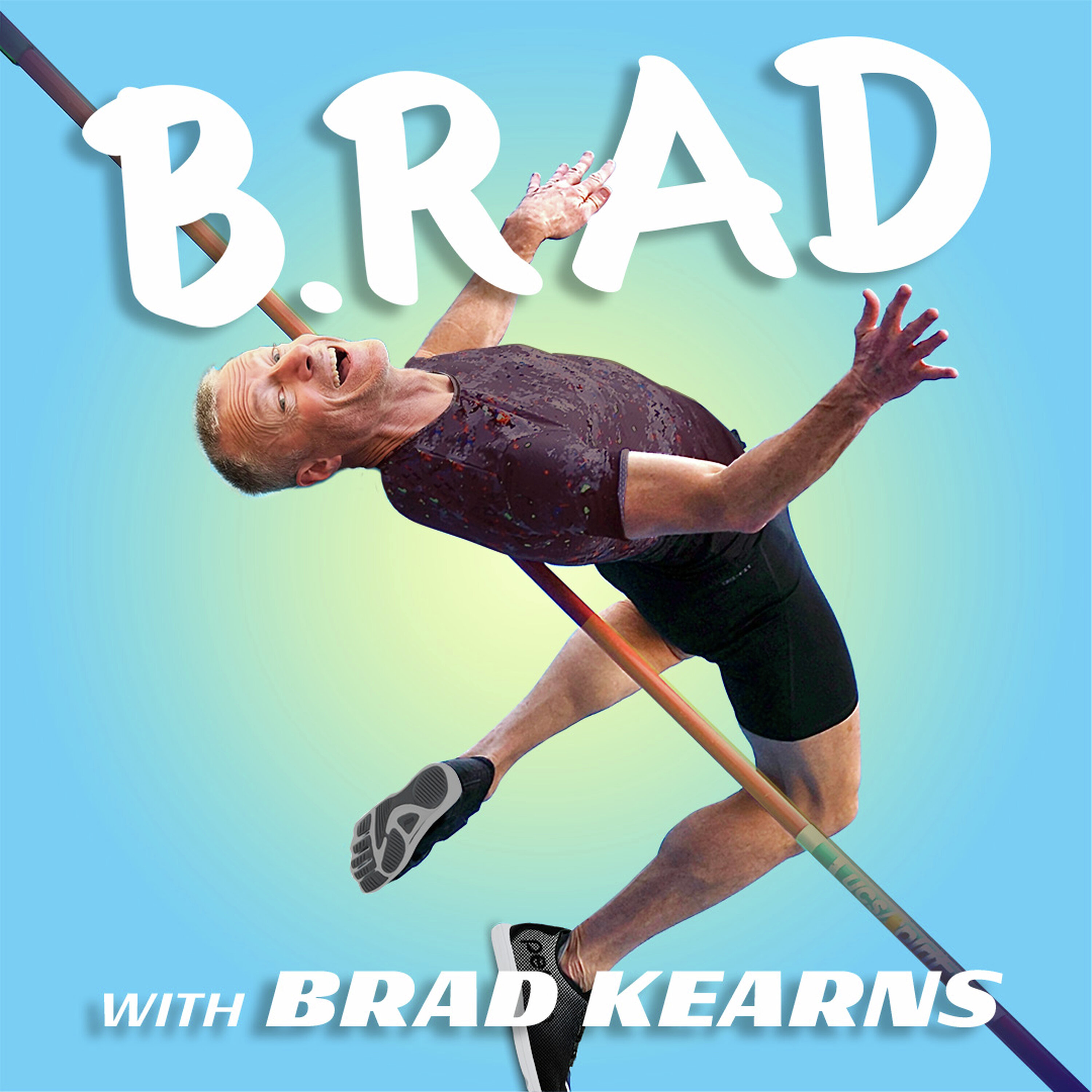
The B.rad Podcast
Brad Kearns
Join Brad Kearns, New York Times bestselling author, world #1 ranked masters 60+ high jumper, Speedgolf world record holder, and former world #3 ranked pro triathlete, in pursuing peak performance with passion throughout life. Brad delivers an engaging mix of step-by-step education on important health topics like staying fit, strong and powerful as you age; transforming diet to lose body fat and increase energy; sort through hype and misinformation to make simple, sustainable lifestyle changes; and broaden your perspective beyond a fit body to experience happy relationships, nonstop personal growth, and ultimately sail to 100 with a happy, healthy, long life. Let’s explore beyond shortcuts, hacks, and crushing competition to laugh, have fun, appreciate the journey, and not take ourselves too seriously. It’s time to B.rad!
Episodes
Mentioned books

Sep 10, 2019 • 1h 29min
Luke Shanahan on Understanding the Function of Everything That You Do
Luke busts out of the gate with a hilarious freestyle rap of the rich arrogant entrepreneur buying and sellin’ companies, houses, and private jets. After five minutes we catch our breath and get into an incredibly deep conversation that will get you thinking and reflecting on the importance of pursuing the highest expression of your talents and contributing to the community at large. The funny stuff at the start does set up some moral questions, because things are out of hand these days with the glorification of wealth, celebrity, entrepreneurism, and of course social media. Nothing against sharing the exciting moments of your lives on social media, but it’s critical to remember that, as Luke says, “We don’t post things that are uninspiring.” Luke is a Renaissance man who has had a long career as a writer in the realms of health and diet, Hollywood, and even fiction. He worked together with his wife, Dr. Cate Shanahan, on the mega-bestselling tome for healthy eating called Deep Nutrition. He has also done some masterful work that no one knows about due to the nature of the ghostwriting profession. Luke offers some reflection on the commonly-cited mission statement to “be in service.” This is easy for people at the top of the mountain to say, and also believe sincerely. For the rest of us, we have to strike a constant balance between serving the community and looking out for our own needs and best interests. Luke strongly believes that being in a perpetual state of service can actually put you at a disadvantage, because you’re not out collecting “the flowers of experience” - which you need to do in order to have balance in your life. As Luke so beautifully puts it: “It is your obligation, on occasion, to be selfish....It is absolutely necessary to the respiration of your own relationship with yourself.” Yes, Luke’s got mad wisdom to drop and this episode showcases how this supremely deep thinker can effortlessly weave in facts from history and philosophy into a discussion on serious, personal subjects such as relationships, parenting, and values. Listeners of all ages will be able to get something out of this enlightening talk with a truly engaging conversationalist and storyteller, and thanks to Luke’s intelligence and depth, endless curiosity, and unique perspective, it’s a particularly special one. Enjoy! TIMESTAMPS: Luke Shanahan is husband and co-author of Dr. Cate Shanahan. He and Brad, looking at some podcasts, satirize an interview with a bullshitter. [05:17] More seriously, they analyze the difference between high-minded ideas and reality [13:32] The people who are happiest have a network of fulfilling relationships where they feel significant and they can give back. [17:27] If you are always in service to others, you don’t get to collect your own experience. [20:10] Language is powerful. What is its function? [26:24] Parents who do everything for their kid, are not necessarily giving the kid a gift. [29:39] Values are not something you carry around in a satchel since childhood. [31:44] To improve yourself in an area, competing with someone just slightly better leads to growth-full change. [37:32] We often test our values because we haven’t exercised them. [38:21] Throughout this show, they are asking you to ask “what is the function?” [41:43] Why do we take such big risks? [45:17} We create icons so we can tear them apart. [46:30] When Brad was a triathlete, he started out unsophisticated, but then began to take himself seriously. [48:13] You are not your business. [50:28] What is the function of ownership? [56:16] No matter how much you are serving, you do have to remember to serve yourself. [01:02:11] Luke describes a good example of a subtle power play. [01:07:53] What do your values do to you? [01:11:08] When you take it when someone puts you down, or you do something you don’t particularly want to do, you are memorizing that you are not important. [01:14:19] Live your values. [01:24:53] Support this podcast at — https://redcircle.com/the-get-over-yourself-podcast/donationsAdvertising Inquiries: https://redcircle.com/brandsSee omnystudio.com/listener for privacy information.See omnystudio.com/listener for privacy information.

Sep 6, 2019 • 31min
Managing Digital Distraction and Hyper-connectivity While Staying Focused, Productive, and Stress-Balanced, Part 1 (Breather Episode with Brad)
(Breather) This is a pretty important topic, and it’s something we all deal with daily. I talk through some great articles on the subject and offer a bunch of personal insights about stuff I do well, as well as the stuff I really suck at! In part 1, I focus on the positive things I have going in my daily routine, and in part 2, I get into the stuff I struggle with, and ideas we can all use to make things better. This all started when I read a great article written by Nir Eyal for Medium.com. In this article, Eyal details how researchers say our ability to pay attention is equal parts focusing and ignoring. Irrelevant information bogs down our ability to suppress distraction, especially as we age. Ouch! So, in order to increase our ability to focus, researchers suggest both boosting our ability to concentrate as well as reducing distraction. How do you reduce your chances of being distracted? Use one screen, one browser window, and one computer program at a time. Keep your physical and virtual desktop tidy. This one is key. The average American spends 2.5 days a year looking for lost documents. You don’t want to waste your time like that, especially when you can keep your space clean by putting in a little bit of time every week to ensure everything is organized. What about increasing your ability to concentrate? Try: Exercise, meditation, and spending time in nature may help boost cognitive control. Some cognitive exercises and immersive action video games also seem to improve our ability to focus. Julie Morgenstern, author of the book Never Check Your Email In The Morning, told the Huffington Post that when you check your email (or notifications) first thing in the morning, “you will never recover.” In other words, much like Harris explained in his post for Thrive Global, your focus is pretty much shot when you begin your day with your eyes glued to your phone — or, at least, your focus won’t be what it could have been, if you’d only started your day off differently. Morgenstern explained, “It’s hard to go from your transactional, shallow part of your brain, the frontal cortex, to the other parts of your brain where strategy happens and relationships happen. It’s easier to start in the deep recesses of your brain and go to the shallow parts.” Basically, Morgenstern is saying that your mind sort of goes all over the place when you scan your email or notifications as soon as you wake up, and it can leave you feeling directionless and overwhelmed as you move forward with your day. But if you start off with something important and focused in the morning, Morgenstern explained, you’ll be well on your way to feeling, as well as actually being more productive. This show is filled with helpful tips and useful strategies you can employ in order to ensure your days are as productive and distraction free as possible. Unfortunately, it is all too easy to get sidetracked, so you must be deliberate about how you spend your time and prioritize tasks. For example, when you’ve got something you have to do, you should first consider how long that task will take. Is it five minutes? Three minutes? If it’s longer than 60 seconds, then just put it on your to-do list. Otherwise, that’s how you lose time. Five minutes here and there really adds up! Speaking of to-do lists, have you tried Evernote? I have been using this organizational App for some time now and I’ve found it extremely helpful for keeping my notes organized and easily accessible. Then there are the other things you can do to help yourself, like spending time in nature. As I explain in the show, spending time in nature improves our cognitive control. Even gazing at a large body of water prompts a powerful, calming parasympathetic response, because it allows you to finally relax. You don’t have to go to a lake or the beach during the work day – who has time for that? – but you can simply incorporate photos of natural scenery into your work environment. You can also use pictures of the mountains, a beautiful forest, or the ocean as your screensaver – either way, your body (and your brain) will still respond to the image as if it were really in nature. As I explain in the show, you need to be proactive about doing things for yourself throughout the course of your day that actually help you stay focused, and steer clear of the habits that steal your attention and mess with your ability to stay on task. Taking breaks, meditating, keeping on top of clutter, and being mindful about your email and social media usage – these are all essential to dealing with the distraction we all struggle with daily. Enjoy part one of this show, and we will dive even deeper into this topic of how to manage digital distraction and hyper-connectivity in part two next time. TIMESTAMPS: Get motivated to get focused and take action on the digital distraction problem. [05:17] As we get older, we have less ability to filter out distraction. [07:40] Brad highly recommends to stay on top of your digital world. [09:55] The cloud is the safest way to organize your stuff. [10:49] Looking at stuff cluttering around your house or desk provokes flight or fight reaction. [14:25] Exercise, meditation and spending time in nature may help boost cognitive control. [16:02] Looking at artificial scenery such as your screensaver of the beautiful oceans and mountains and deserts, natural scenery or putting up a print in your office of nature has a similar response in the brain to being in real nature. [18:47] Never check your email in the morning. [20:17] You need to find ways to advocate for yourself and do something proactive even in your busy day. [26:37] Support this podcast at — https://redcircle.com/the-get-over-yourself-podcast/donationsAdvertising Inquiries: https://redcircle.com/brandsSee omnystudio.com/listener for privacy information.See omnystudio.com/listener for privacy information.

Sep 3, 2019 • 1h 10min
Setting Things Straight With Dr. Cate Shanahan
Switch the B.S. meter to the “on” position, and listen to the wise and powerful Dr. Cate (DrCate.com) address many myths and misconceptions about keto and other ancestral health practices on this hard-hitting show. Brad has avoided caffeine his whole life so he wouldn’t “fry his adrenals.” Dr. Cate calls BS. How about eating in the evening – that makes you store fat, right? Probably doesn't matter that much, says Cate. We know lots of conventional wisdom that has been shattered in recent years by thought leaders in alternative health like Dr. Cate, Mark Sisson, Robb Wolf, and the rest. Now it’s time to get further nuanced with Cate’s examination of some of the stuff even super cool progressive health folks might be stretching reality on. One example is trying to go keto when you aren’t starting out as a healthy fat burner. Everyone talks about the “keto flu” as something to endure and tolerate on their journey to the promised land. This is simply not true. Of course, we get deep into Cate’s pet crusade against refined high polyunsaturated vegetable oils, called out as the single worst thing you can ingest. These toxic, highly reactive vegetable oils inflict damage at the DNA level immediately upon ingestion to the extent that Dr. Cate says they are, “literally no different than eating radiation.” Speaking of vegetable oil, you can even generate ketones eating a crap load of toxic vegetable oils. You’ll get a keto gold star, and you’ll also feel fatigued and be inactive, and develop insulin resistance, fatty liver, and increase your risk of stroke. This may counter the recent popularity of “dirty keto” where you are “allowed” to eat a bunch of junk food as long as you hit the requisite macros. Oh yeah, you know those headaches that happen during a busy, sugar crash burnout day? This pattern can become a serious matter whereby you suffer from frequent mini-strokes when your brain is deprived of oxygen due to overconsumption of carbs and the brains over-reliance on sugar. Prominent author Dr. David Perlmutter calls Alzheimer’s “Type III diabetes” due to the close association between insulin resistance and cognitive decline. Good news shared by Dr. Cate is that you can reverse early brain problems and stroke risk by transitioning to a more nutrient-dense, lower sugar, and especially keto friendly diet. This is no funny business, as Dr. Cate offers the stat the typical western diet derives 66 percent of total calories from the big three main most offensive modern foods: sugars, grains, and refined vegetable oils. Dr. Cate is not afraid to call out entities like Harvard University for aggressively promoting nutrient-deficient diets for decades, spurred by corporate influences and the almighty dollar. This is highly disturbing, and greatly inspiring to take matters of health into your own hands. Listeners, you can’t get any better than Dr. Cate when it comes to learning about breaking science and the practical application of simple, do-able, sustainable health practices free of hype and gimmicks and promoting of longevity. Enjoy the show and get things straight. TIMESTAMPS: When you’re insulin resistant, pre-diabetic or diabetic, it's very difficult for your body to produce ketones even while following a ketogenic diet. [05:16] Snacking on fat foods will help keep you away from craving sugar. [07:57] There’s no such thing as a healthy snack. [09:34] If people feel bad when they are fasting, it’s called hypoglycemia. [13:04] Our body makes ketones for the brain. [14:02] Most people are not healthy enough to fast for very long because they have this toxic fat and their body is going to resist burning fat and insist on burning sugar. [16:43] Some studies show that a ketogenic diet made out of vegetable oil instead of good fats, you really get fatter. [18:18] If you are working towards a keto diet but you are hungry for a snack, you have to honor that hunger signal. [19:34] Having frequent headaches when you are carb dependency eating pattern, could be a bad sign. [20:33} 99 percent of people who are overweight have a metabolic problem as a core issue that needs to be resolved before they can really regain control. [29:33] Cate talks about the deceit that came out of Harvard studies on nutrition. [31:13] Basically, if the American Heart Association says it’s “heart healthy,” it’s probably a red flag! [33:48] Calories do matter. {38:57] Alcohol is a precursor to acetate and ketones are also a precursor to acetate. [41:58] What is the benefit of caffeine? [44:27] How do supplements play a role? [49:54] We are in a human experiment, eating junk food and seeing how fast we die! [58:31] Many doctors hand out nutrition information that is incorrect. [01:01:01] What helps longevity? [01:03:44] Support this podcast at — https://redcircle.com/the-get-over-yourself-podcast/donationsAdvertising Inquiries: https://redcircle.com/brandsSee omnystudio.com/listener for privacy information.See omnystudio.com/listener for privacy information.

Aug 30, 2019 • 25min
How to get started with micro-workouts. Now is the time! (Breather Episode with Brad)
I introduce the fantastic breakthrough fitness concept that I’ve been doing more and more of in recent years: micro workouts. Micro workouts are explosive fits of strength, efficient and easy to do, and hits the #1 goal of being more active in daily life while also serving to elevate your baseline fitness level to do better workouts. They also take away so much of the stress that can come with working out. Let’s be real, even if you’re one of those people who loves to hit the gym, part of what puts most people off working out is just carving out the time – not just for the actual work out, but allowing for time to drive there, and find parking, etc. Micro workouts are the easiest way to slip in a little activity that really makes a big difference as your efforts will add up over time. I initially began incorporating this practice into my daily life because of my desire to take work breaks and also because my own competitive intensity in gym – I admit to having the tendency to overdo it, something I am sure many can relate to. What’s nice about micro workouts is that they are so brief, it’s easy to set yourself up for success, since they’re way less strenuous and time consuming than a regular gym session or workout class. You can sneak them in at nearly any time or any place – I try to get one in while I’m already doing something else, like taking out the trash, and I’ve also set myself up for success in my home environment - I have a pull-up bar in one doorway, with stretch Cordz hanging from it. Obviously having equipment staring at you right in the face is a good motivator, but truthfully, you don’t even need this stuff around to perform micro workouts – you just need to get up off your butt and go! Do 20 squats, a single set of pullups, or run outside for a quick 1-minute sprint – and then bam! Back to work in no time, with the added bonus of elevated energy levels and improved cognitive function. It’s the ideal way to break up your work day, adds a little boost to your energy and concentration, and as you’ll see over time, your efforts really add up. Five to ten minutes really feels like two minutes throughout the course of a busy day, but those minutes will add up, week after week, as you continue to incorporate this revolutionary fitness concept into your life. TIMESTAMPS: Brad describes how to get a good workout without hassle. [02:07] This system of mini workouts throughout the day is appealing because it prevents you from overworking at the gym for example. [06:17] Maybe you don’t want to skip the gym all together but you can make it a pleasant routine part of your week for the camaraderie. [08:59] Many leading fitness experts are now stating that general everyday movement is of higher priority than adhering to an ambitious workout regimen. [12:09] Slow weights are an option. It includes lifting three or four days and each lift is modest. [15:21] You want to make sure that you got a little bit of blood flowing and some lubrication in the joints before you step over a weighted bar. [18:46] Support this podcast at — https://redcircle.com/the-get-over-yourself-podcast/donationsAdvertising Inquiries: https://redcircle.com/brandsSee omnystudio.com/listener for privacy information.See omnystudio.com/listener for privacy information.

Aug 27, 2019 • 1h 15min
Dr. Cate Shanahan – Learning the Four Healthiest Food Categories You Need to Eat From!
Dr. Cate is second to none as a health resource, period. Does anyone else blend her disparate interests of hands-on patient care during her long career as a family physician, a deep interest in scientific research, and an ability to communicate practical tips to a broad audience through her books, videos and podcast appearances? Clearly, Dr. Cate is exceptional. In this show, we learn about her background and wild journey across the continent to pursue an assortment of career roles. In particular, her nine years serving a rural native population on the island of Kauai served as inspiration for her groundbreaking book, Deep Nutrition. This book was initially self-published in 2009 and became a runaway bestseller. It was expanded and updated in 2017 to become an absolute must-have resource on your bookshelf. While on the island, Dr. Cate and Luke were exposed by longtime native Hawaiians to forgotten cooking traditions featuring nose-to-tail consumption of naturally raised animals and a devotion to fermented foods in honor of their ancestry. Dr. Cate noticed in her medical clinic that the elderly natives who had preserved these ancestral traditions were healthier than the more westernized younger generations. This led to the research and development of Dr. Cate’s trademarked “Four Pillars of the Human Diet”: Fresh foods (e.g. fruit and vegetables), fermented foods (e.g., sauerkraut, yogurt), organ meats (hey if you can’t stand liver, try the legit supplements from AncestralSupplements.com that package the purest sourced organ meats and bone broth into convenient capsules), and meat on the bone (bone broth is one of the most nutritious foods on the planet, yet often completely overlooked even by devoted primal/paleo eaters). The diet Dr. Cate follows now completely contradicts what she learned in medical school, which can be summarized as: “Fat makes you fat, cholesterol clogs your arteries, and salt gives you hypertension.” Unfortunately, Dr. Cate admits that: “As a doctor, I paid a lot for my medical education, and I did not learn anything true or worthwhile about nutrition or what people are supposed to eat.” And she’s hardly the only doctor to experience this – everyone who went to medical school during her time was fed the same incorrect information. Fortunately, she is a passionate advocate and spokesperson for living a natural, healthy, ancestral lifestyle, and her wealth of knowledge is truly boundless. Enjoy this show with the supremely well-informed, intelligent, and humorous Dr. Cate, as she shares so much of the invaluable knowledge she has accumulated over years of dedicated research and study – and before you start listening, you might want to take out a pen and paper – you will want to keep track of everything you learn from this radical conversation with one of the leading experts on nutrition and the history of human health. TIMESTAMPS: Cate talks about how she has lived in many different places and what it teaches her. [09:11] Dr. Cate describes how her work with traditional Hawaiian diet brought her to the ancestral diet. [14:52] In medical school, Cate didn’t learn true information about nutrition. [16:02] Cookbooks that came out before the 1950s were the real nutrition science. [19:12] The four pillars of traditional diet are (1) fresh (umbrella for variety, local, and seasonal), (2) fermented & sprouted, (3) meat on the bone, and (4) organs. [25:47] Dogs are prehumen. What else came before us humans? [28:62] How did our ancestors manage their food? How do we know what tastes good? [30:34] It is almost impossible to not become addicted to sugar. [33:34] Learn how to use the bones in your diet to strengthen your joints and skin. [37:02] In order to take advantage of what the bones provide, it’s better to use chicken on bone rather than boneless breast for example. [40:21] It’s hard to buy natural fats any more. [43:06] The fourth pillar is organ meats. Liver is especially good for anemia. [45:06] Try to train yourself when you are hungry to try these new healthy meats. [51:52] Energy emergency crisis is a result from craving sugar. [55:29] We have radically altered the composition of our bodies by consuming vegetable oils. [56:05] Dr. Cate acknowledges that sugar is important in this discussion, but she believes that the problem of the vegetables oils is way more important. {59:28] When we decide to give up vegetable oils to clean up our diet, what happens then? [01:22:20] Many people get headaches when their brain is needing energy. [01:07:00] People trying to lose weight get into this vicious cycle when they have to work so hard. It’s because their cells are dependent on sugar. [01:10:56] Support this podcast at — https://redcircle.com/the-get-over-yourself-podcast/donationsAdvertising Inquiries: https://redcircle.com/brandsSee omnystudio.com/listener for privacy information.See omnystudio.com/listener for privacy information.

Aug 23, 2019 • 22min
The Importance of a Pitch Dark Sleeping Experience and Sunlight in The Morning (Breather Episode with Brad)
(Breather) As you can tell by the title, this breather show is all about sleep – and the specifics of sleep. That means: how you sleep, what your habits are pre-bedtime, what your bedroom environment is like – anything particular to the way you go about getting some Zzzz’s. This show will help you identify what you’re doing right, and what you’re doing wrong when it comes to sleep – which will in turn, ensure that you get the best sleep of your life. These are a few bedroom rules I won’t budge from. One of them is Establish a sleep sanctuary. This means that you need to commit to maintaining an incredibly tidy and minimalist bedroom, reserved for sleep, intimacy, and other restful activities like pleasure reading and meditation. Absolutely no screens, piles of mail, stacks of magazines, partially completed home improvement projects, or any such clutter allowed. Absolutely no mini-work areas! Google “minimalist bedroom design” imagery to get some inspiration to achieve a sanctuary feel. It’s essential to create both a physical and psychological separation between your bedroom and other areas of your house where you do work or consume entertainment. Maintain a temperature of between 60-68F (16-20C) to facilitate the slowing of assorted metabolic functions that help your body get and stay into sleep mode. For this same reason, you don’t want to do a workout or sauna in the evening hours. The second important practice is achieving total darkness for maximum sleep efficiency. This one makes a huge difference. Use blackout blinds or drapery, and eliminate even tiny LCD screens and power indicator lights. Even minor light influences can significantly disrupt your attempt to cycle gracefully throughout all phases of sleep. Biohacker extraordinaire Dave Asprey, author of The Bulletproof Diet and host of the Bulletproof podcast, describes how he travels with a roll of electrical tape so he can cover up every random light emission in a hotel room, including fire sprinklers and other offenders. As Lights Out: Sleep, Sugar, and Survival details, it’s not only your eyes that are sensitive to light; skin cells all over your body have very sensitive light receptors. One study revealed that flashing a single beam of light on the back of the knee was enough to disrupt melatonin production. Taking a quick glance at your smartphone screen to see what time you stirred in the middle of the night can be surprisingly harmful beyond suppressing melatonin. Dr. Nerina Ramlakhan, sleep therapist and author of Tired But Wired: How To Overcome Your Sleep Problems, asserts that checking the time can “send you into a whirl of calculations and worry about how much sleep you will or won’t be getting.” Strongly consider charging your devices in the hallway, or at least out of arm's length. Kelly Starrett calls this setting yourself up for success by eliminating even the possibility of temptation. Don’t be one of the 80 percent of Americans who check their phones upon awakening (per a 2013 Adweek report), or worse yet when you stir at some point during the night. Should you refuse, Julie Morgenstern, author of Never Check Email In The Morning explains that, “you’ll never recover.” Numerous studies reveal that once you activate the shallow, reactionary brain function in the frontal cortex with a smartphone engagement—especially first thing in the morning when you are locking habit patterns into place—it’s difficult to transition into high-level strategic problem-solving mode. Who wants to start their morning off like that? I definitely don’t, and I bet you don’t either. So many people are locked into bad habits and their sleep suffers as a result, thereby affecting their performance during the day. This show provides a remedy for this problem, teaching you how to align your circadian rhythm to natural light and helping you identify the habits that are actually a hindrance to your body and your mind, so you can finally experience the deep, restorative sleep you deserve. TIMESTAMPS: Most people don’t realize that it's not only the eyes bring light into our bodies. [02:22] Think of creative ways to make your bedroom pitch dark. [05:39] You really shouldn’t have to get up in the night to pee. [06:30] Train your circadian rhythm by popping up early in the morning and exposing yourself to sun. [08:32] Brad talks about his morning routine. [09:45] Try the orange tinted glass in the evening to block the harmful spectrum of blue light. [11:29] Jack Kruse’s article suggests the best time to have sex….and other activities! [12:43] Even minor light influences can significantly disrupt your attempt to gracefully cycle through all phases of sleep. Get your phone out of the room! [13:33] We sleep less deeply away from home. [16:11] Support this podcast at — https://redcircle.com/the-get-over-yourself-podcast/donationsAdvertising Inquiries: https://redcircle.com/brandsSee omnystudio.com/listener for privacy information.See omnystudio.com/listener for privacy information.

Aug 20, 2019 • 1h 19min
Dr. Mark Cucuzella on “The Biggest Mistake in Human History”
The biggest mistake in human history!? What is he talking about? We will get to that, and more in this very thoughtful show with Dr. Mark, pioneering physician and legendary endurance runner. Dr. Markhas been quietly changing the world with his devoted efforts to get people healthy, both inside the medical system as a physician and also a fitness enthusiast who conducts running clinics and opened the first ever barefoot-focused running store in the USA. He is a highly accomplished runner, with an absolutely astonishing and perhaps unrivaled streak of running a sub-3-hour marathon 30 years in a row. Mark recently wrote a book to convey his unique and broad-based health and fitness message, titled Run For Your Life. As a cutting edge thought leader in ancestral health, you could say that Mark hails from an unlikely home state of West Virginia. This state just earned the dubious distinction of being the fattest state in America according to the CDC. Alas, they are also the most honest citizens, as they also admitted to their high obesity rates in the “self-reported obesity rates” graph that accompanies the official CDC graph. This show gets into all kinds of juicy topics, and Dr. Mark pulls no punches. He observes that the creation and promotion of the USDA Food Pyramid has been “the biggest mistake in human history,” one that has led to millions of deaths, not only in America, but in all the other western nations that we export our culture to. Dr. Mark believes that the hyperinsulinemia (chronically excessive insulin production) that results from eating by the food pyramid is now the “biggest crisis in humanity” and everyone should stay away from foods that he refers to as “white death.” Indeed, as Dr. Doug McGuff observed in his book, Primal Prescription, if type 2 diabetes continues at today’s accelerated rate, the ensuing expensive long-term care for this condition is on track to bankrupt the US Treasury by the year 2060. This is serious stuff that we seem to overlook, buried under the billions of dollars of marketing efforts by processed food manufacturers. American dietary guidelines are changing (at a snail’s pace it seems, but at least it’s still happening) but Dr. Mark rightfully believes that ridding the patient of the guilt they carry over their weight is key. They need to know it’s not their fault if they are obese or have a metabolic disorder, as the truth is, there are so many factors that contribute to this. Dr. Mark mentions a great Huffington Post article, “Everything You Know About Obesity Is Wrong” and uses the analogy of a classroom of kids to illustrate society’s view of obesity and fat shaming: “If one kid out of a class of 30 is failing, then it’s maybe about that kid, but when 2/3 are failing, it’s not about the kid – it’s about something else.” As he points out, “it’s inhumane” for people to pay for diet programs where they’re severely restricting calories to starvation level, because they spend all this money only to gain it all back, and find themselves again in the same place – shouldering the blame for something that they don’t even know isn’t their fault. Dr. Mark’s counter solution to this problem is empowering people by giving them the knowledge they need to truly understand that their health is in their hands. His patients have experienced enormous success because they have been given the tools they need to make lifestyle changes that have lasting, long-term effects. Enjoy this show as Dr. Mark fuses sharp intellect and curiosity with deep empathy for his patients, and illuminates many integral, underlying issues central to our food system that could be holding you back from thriving and functioning at peak performance. TIMESTAMPS: Brad introduces his guest who is actively changing the backwards medical community where he lives in West Virginia, the most obese state. [03:44] The idea that eating fat causes you to get fat and causes heart disease has been refuted. It is widely accepted that sugar is the problem. [07:06] Medical schools are finally paying attention to diet. [09:40] Some believe that you should have a plant-based diet. [12:44] People don’t understand about fruits. If you want to build up body fat, eat fruit. [16:27] What used to be viewed as the good diet for triathletes has to be refuted. [21:47] Dr. Mark runs sub three-hour marathon. [31:18] The US Dept. of Agriculture’s food pyramid could be the biggest mistake in human history. [33:05] If your HDL is high it is a predictor of cardiovascular disease. [38:38] Fat in the midsection is a warning. [44:36] Fatty livers have now been seen in kids. [48:47] Anything that involves calorie restriction to starvation levels, is unhealthy. [55:41] US dietary guidelines are slowly changing. [59:50] If the healthcare provider can assure the patient it is not their fault, it is a big step forward. [01:01:24] “There is more money spent in the USA on medical care and consumer products relating to weight loss than on national defense.” [01:04:56] Why isn’t there more talk about the blood test for insulin? [01:05:58] Other societies do not have sugar sweetened drinks and garbage and junk food. [01:10:39] Whether the change is slow or cold turkey, it is up to the patient how they want to improve the health. [01:13:49] Support this podcast at — https://redcircle.com/the-get-over-yourself-podcast/donationsAdvertising Inquiries: https://redcircle.com/brandsSee omnystudio.com/listener for privacy information.See omnystudio.com/listener for privacy information.

Aug 16, 2019 • 27min
The Incredible Micro-Workout And Other Time-Efficient Fitness Tips (Breather Episode with Brad)
(Breather) For the past 10 years, I have modified my fitness regimen away from narrow endurance focus (including the extremely health-destructive chronic cardio training regimen that I followed as an elite competitor for 15 years) to a more balanced regimen featuring comfortable aerobic workouts (i.e., jogging daily with dogs), regular brief, intense strength training sessions, and occasional all-out sprints. It takes time, research, and a lot of trial and error to find out what works for you. A decade into this process of modifying my ever-evolving routine and here’s what I’ve come up with: Establish a Flexibility/Mobility/Wakeup Call Routine. This is fairly new to me, something I started doing around 2 years ago. Check out my YouTube video here and note that I’ve found moving my practice from the bed to the floor has yielded even better results! Increase General Everyday Movement. This one’s easy – just move! The goal is to break up the prolonged periods of stillness that most of us experience during the work day. Just freaking walk! Walk where you can, whenever you can, take the stairs instead of the elevator, and aim for frequent, very comfortable jogging (HR 130 bpm max) for 20 – 30 minute duration – something you can do with your friends, your partner, your dogs ….and then there’s also one of my favorite ways to move: the Unfrozen Caveman Runner! And don’t forget that foam rolling actually counts as movement too! Incorporate Micro-Workouts. These are brief efforts of explosive strength over the course of the day, one of my favorite fitness breakthroughs in recent memory. For example, hauling off a set up chin-ups when you enter that doorway, or doing a set of deep squats in your cubicle during the workday. Bring Brief Strength Training into the mix. It only needs to last anywhere from 5-20 minutes, 2-3 days a week. Save the extremely high intensity full-body work exercises (Schlepmo type-stuff—go hard or go home!) for the gym or outdoors. Full Strength Sessions should consist of 5 sets of 6-8 deadlift/ 5 x 12 pullups. Or Cordz. This should take approximately 30-45 minutes. All Out Sprints. Do this weekly. After 12 years of draining workouts (soreness, fatigue, etc.) I transformed my approach with Dr. Craig - HIIT v HIRT. 8 x 60m on field. Luxury rest intervals. 4-10. 10 minutes of quite challenging technique drills. TIMESTAMPS: Do your fitness goals fit into the reality of your real life? [04:35] Brad suggests you custom design a routine for yourself that will fit into your flexibility needs. [07:20] Move more every day. Take breaks. Walk. [09:18] Adding other micro workouts during the day is easier than you think. [11:31] At the gym, even once a week, high intensity explosive workouts works. [15:22] Don’t forget to sprint. [16:47] So many factors go in to the concept of anti-aging. [19:41] Do not reach for your phone first thing in the day. [20:09] Support this podcast at — https://redcircle.com/the-get-over-yourself-podcast/donationsAdvertising Inquiries: https://redcircle.com/brandsSee omnystudio.com/listener for privacy information.See omnystudio.com/listener for privacy information.

Aug 13, 2019 • 1h 22min
Tippy Wyatt: A Long Journey to YouTube Sensation
I first encountered the remarkable Tippy Wyatt after she contacted me to pitch an idea for a keto cookbook. Well, turns out that not only were we living in the same area at the time, but Tippy has an awesome YouTube channel and has a couple viral videos for how keto works for her daily routine, Costco shopping, and “What I Eat in A Day.” The show evolves from a breezy discussion for how to get a viral YouTube video, into an interesting account of a young couple’s journey to health. After Tippy’s husband gained 70 pounds in college, he found MarksDailyApple.com, and came to her for support. Seeking support from your partner during a massive lifestyle makeover is not uncommon, and after being asked the question of “how do I get my partner to be as enthusiastic and committed to the Primal lifestyle as I am?”, Mark decided to post the answer on his blog, and the answer is surprising: “You don’t.” You have to wait for people to be ready to receive the message – the inspiration and motivation needs to come from yourself. But this was interesting twist on a common problem in the ancestral health community, which is not obtaining “buy in” from your partner. The couple detail their whimsical journey to Austin, Texas and how that immersed them into paleo lifestyle. We need to give Austin a shout-out, because at this point, the city could very well be renamed PaleoLand (as if that would go over well!). But all joking aside, Austin is such an exciting place for those on the Paleo diet – the conference PaleoFX takes place there, as well as KetoCon. As the epicenter of the ancestral health scene, Tippy and her husband could not have landed in a better place for the journey they were about to embark on. This doesn’t mean it was a happy-go-lucky, super easy time of success flowing effortlessly to this couple – in fact, it was the opposite. They experienced some really tough and trying times, but as Tippy goes further into sharing her powerful story, you will start to understand how she got to be such a resilient person. This becomes clear towards the end of the show, as things start to get pretty heavy and intense as Tippy shares the details of her amazing journey to present day. She came to America from a refugee camp in Thailand, her father literally carrying her and her sister into the land of opportunity in a backpack. They settled into an impoverished existence on a farm near Fresno, CA. Tippy explains that she didn’t have summers like a normal American kid – she wasn’t at camp, doing arts and crafts, or running down a SlipNSlide and pelting water balloons at neighbors. Nope, instead she spent those hot, long, summer days doing hard labor, farming assorted Asian vegetables. But her experiences served her well, and with her immigrant work ethic is full bloom, Tippy excelled in school and graduated Fresno State with a business degree. She relates that her father’s American dream was much simpler than a house and white picket fence or any other material achievements; he simply dreamed for his daughters to obtain an education. Some important themes arise for reflection: one is: how do you balance the immigrant work ethic and constant drive with the ability to enjoy life? This concept applies to career pursuits and well as staying aligned with eating goals, something we all strive to do. When Tippy shares her story and mentions the importance of expressing gratitude in everyday life, it will have a profound and lasting impact on you. Compare and contrast to the cultural stereotype of the entitled millennial and those of us at any age suffering from the modern afflictions of affluenza, FOMO (Fear Of Missing Out) and FOKU (Fear of Keeping Up). Yes, it’s easy to complain and tell stories when you can’t reach your weight loss goals, or when you don’t get all the stuff you wish for in daily life. But this is one millennial who’s not wasting her time with complaints and unrealistic expectations – her grit, perseverance, and sunny outlook on life will inspire you to look at your life in the same tough, critical, no-mercy way Tippy did when she examined her life, which prompted her to make a total lifestyle change. This show will inspire you no matter what stage or season you are at in your life, as Tippy’s journey truly showcases the strength of the human spirit and its capacity for change and evolution in the face of immeasurable challenges. TIMESTAMPS: How do I get my partner on board for this primal lifestyle thing? The answer is you have to wait until people are ready. [03:33] Tippy tells how to publish YouTube videos. [07:56] Her videos are about her eating tips, especially for the Keto diet. [16:04] You need to identify your why? [17:58] Tippy’s first attempt at dieting worked but she didn’t enjoy the food. [24:59] Low fat diets work, but you have to realize what is happening in your body. [27:37] When you go Keto, you must be careful not to mess up electrolytes. You need salt. [32:23] Fat does not make you fat! [35:32] Tippy gained weight and found herself in denial that she wasn’t happy and had to deal with the reality of her situation. [36:36] She tried many things until she discovered that eating what she liked (Keto) helped her come back to where she wanted to be. [41:47] It’s a lifestyle, not a diet. [45:59] Excess sugar is killing Americans. [49:24] Now after many months of being on Keto, Tippy feels good, enjoys her food, and feels in control. [52:31] How do you strike that balance between being okay with departures but adhering to something that takes commitment and takes mindfulness all the time? [54:06] She and her friends have a contest for the best physique by January. [55:31] Tippy’s family were refugees from Thailand and were dirt poor. [01:00:38] Work ethic: You show up and work harder. [01:09:00] Tippy talks about why she is so driven. [01:12:00] Support this podcast at — https://redcircle.com/the-get-over-yourself-podcast/donationsAdvertising Inquiries: https://redcircle.com/brandsSee omnystudio.com/listener for privacy information.See omnystudio.com/listener for privacy information.

Aug 9, 2019 • 12min
Dr. Ron Sinha On Aging Gracefully (Breather Episode with Brad)
I keep the tape running as Dr. Ron and continue to talk, going into a discussion about longevity, some concerns related to menopause, when heart disease risk increases, and related concerns for aging males. Longevity promoting behaviors include keeping that visceral fat off the body, because it hampers hormonal function and can accelerate aging. Some great checkpoints to mitigate the effects of aging include keeping competency with squats, running the mile, and maintaining muscle reserves with regular resistance training. Also, monitor your blood values for triglycerides, glucose, HbA1c and inflammatory markers like C-reactive protein. Surprisingly, women’s cardiovascular risk is lower before menopause – after menopause, their heart risk stats more closely resemble their male counterparts. Dr. Ron also warns us to watch out for the “skinny male” syndrome, when a thin man is actually at higher risk than his heavier wife, because more of the carbohydrates in the diet are going towards lipid production. As Dr. Ron explains, menopause can act as a sort of trigger – because pre menopause, women are fertile; a lot of the time, this means there’s more fat. This is not usually a problem especially during child-rearing years. Obviously, losing weight is a hot topic, and many women in the paleo community have asked for years why they can’t get rid of that last 10 pounds (something I expanded on in my article, How to Lose That Last 10 Pounds) but a lot of the time, it’s just because the female body needs that extra weight for hormonal reasons. But after menopause, Dr. Ron says the female body asks, “Why are we still eating this garbage?” because it’s aware that it doesn’t need to support a baby, and the excess fat is just that...excess. As all of us get older, carrying a little extra weight has more serious ramifications – as Dr. Ron says, “With aging, you have to stay ahead of the insulin resistant race as far as possible.” This is why he advises patients to keep carbohydrates restrained, and stay on top of weight/resistance training for muscle preservation. “Muscle wasting with aging” is something Dr. Ron sees all the time with sedentary office workers, and adequate protein intake, along with weight training, are great ways to counteract this. Muscle mass preservation is particularly integral as you age because it helps you metabolize fuel, and the muscle cells themselves contain chemicals, that when released, can help with the aging process. One of Dr. Ron’s most illuminating tests when checking his patients’ vital signs is, how are your squats going? Of course, he’ll check out the triglycerides, their stats, etc., but if his patients can’t do a few squats without getting out of breath, then he knows there’s an area that needs improving. We also discuss The Cooper Institute’s data about the mile run, and how one’s 1 mile run time at the age of 50 is strongly predictive of your changes of living to 80. Clearly, there’s so much you can do to increase your longevity and quality of life as you get older. And, sure, some of those things aren’t always fun or pleasurable – who out there actually likes doing squats? Not many people. Most people would prefer to be noshing on some French fries on the couch then to be sweating and squatting – but think about Longcuts, something I’ve discussed before (twice!). Nothing good in life ever comes easy, but thankfully, a healthy lifestyle is actually pretty easy once you commit to it. It’s just the mental part of it all that trips us up....so, get over yourself, and focus on enjoying the steps you take to increase your longevity and support your health. TIMESTAMPS: Brad and Ron talk about aging gracefully. [03:39] Why is menopause such a trigger for physiological changes? [05:22] With aging, you have to stay ahead of the insulin resistant race. [07:15] Squats and mile run abilities are a good indicator of longevity. [08:42] Support this podcast at — https://redcircle.com/the-get-over-yourself-podcast/donationsAdvertising Inquiries: https://redcircle.com/brandsSee omnystudio.com/listener for privacy information.See omnystudio.com/listener for privacy information.

