

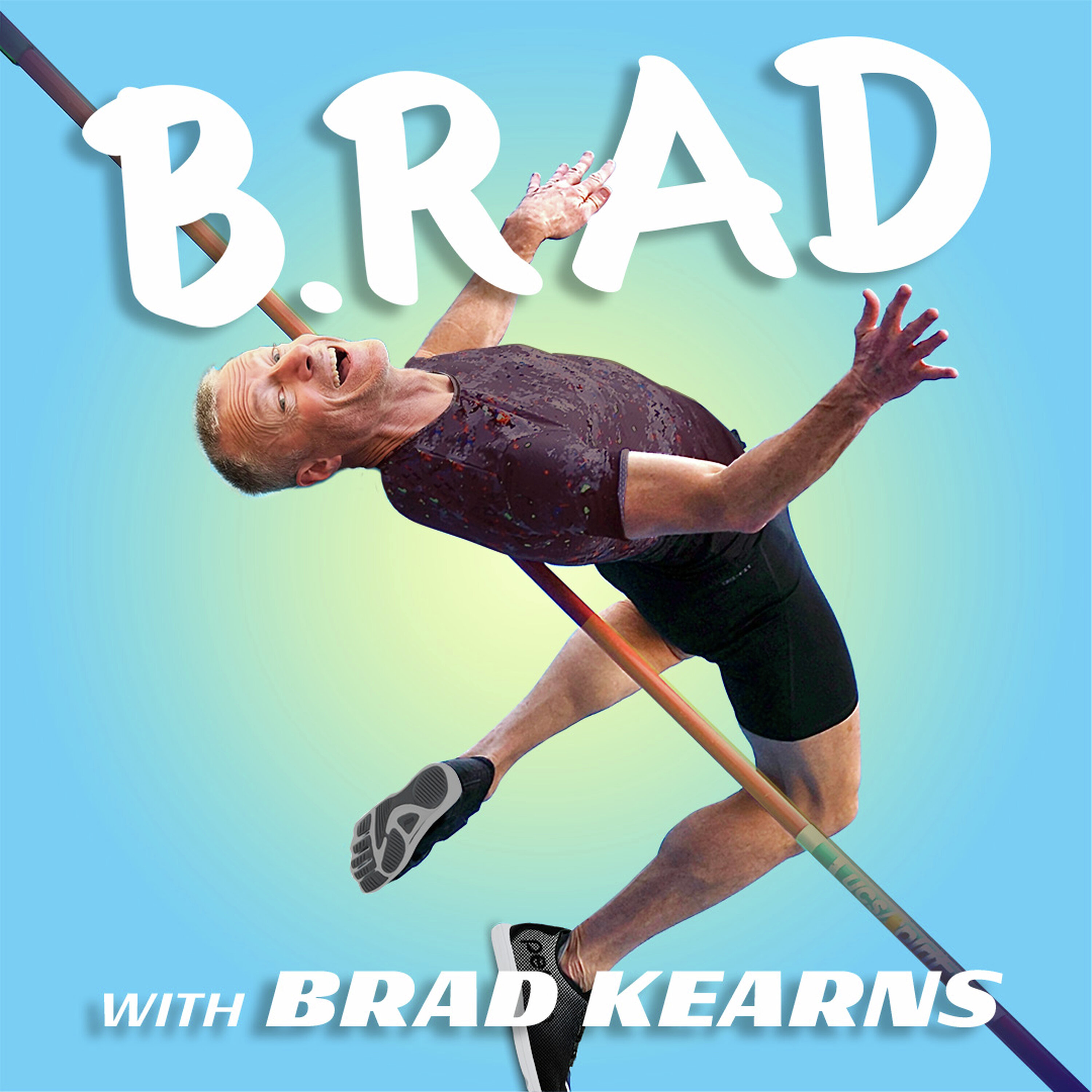
The B.rad Podcast
Brad Kearns
Join Brad Kearns, New York Times bestselling author, world #1 ranked masters 60+ high jumper, Speedgolf world record holder, and former world #3 ranked pro triathlete, in pursuing peak performance with passion throughout life. Brad delivers an engaging mix of step-by-step education on important health topics like staying fit, strong and powerful as you age; transforming diet to lose body fat and increase energy; sort through hype and misinformation to make simple, sustainable lifestyle changes; and broaden your perspective beyond a fit body to experience happy relationships, nonstop personal growth, and ultimately sail to 100 with a happy, healthy, long life. Let’s explore beyond shortcuts, hacks, and crushing competition to laugh, have fun, appreciate the journey, and not take ourselves too seriously. It’s time to B.rad!
Episodes
Mentioned books

Oct 15, 2019 • 1h 8min
Triathlon Legends Mark Allen and Dave Scott Discuss The Epic 1989 Ironwar
What a great honor to connect with two legends of triathlon on the occasion of the 30th anniversary of the greatest triathlon race of all time and what many observers call the greatest endurance competition of all time. That’s the 1989 “Ironwar,” where Mark Allen and Dave Scott battled for the Hawaii Ironman world championship title, side-by-side for eight hours, before Mark pulled away to achieve his long-awaited first victory in Hawaii. The race was special for so many reasons: First, it was a transcendent performance that has stood for 30 years. The times of 8:09 and 8:10 shattered the previous world record by 20 minutes. Third place Greg Welch and the rest of the world’s elite were 23 minutes+ behind the duo in front—two athletes at the very top of their game pushing each other to the best performances of their lives. Even today, no pro has bested the six-minute per mile pace these two held across the steamy hot lava fields of Kona on the heels of swimming 2.4 miles and cycling 112 miles. Second, the confluence of career arc’s made for high drama. Allen was the undisputed #1 triathlete in the world, virtually unbeatable at all distances from the Olympic distance circuit, to his 10 for 10 domination of the world long course championships in Nice, France. However, he was definitely cursed in Hawaii, with a string of mistakes and misfortunes keeping him from the victory that was the single void in his career accomplishments. Dave on the other hand was the King of Kona—six victories, many busting his own previous world record time and setting a superhuman standard for peaking on demand and performing in the extreme heat of Kona. By 1989 however, Dave seemed to be at the tail end of his career, was not racing much on the world circuit, and missed the 1988 Ironman due to injury. The pressure on both athletes to come through on the big day was enormous. Thanks to an ambitious project by the Scott Zagarino Agency, the story of 1989 is being told in more detail than ever before. Check out the website 1989TheStory.com for a serial publication of articles from Mark and Dave about all things relating to the big race and their career and personal challenges at the time. Thirty years is sufficient time for reflection and perspective, and Mark and Dave each offer vulnerable and revealing insights about the psyche of a champion athlete and the challenges and pressures relating to performing on the world stage and pushing the limits of human endurance. If you are a triathlon enthusiast, this will be a huge treat. But even if you’ve never heard of these two senior citizens, the insights they share have a powerful application to all manner of peak performance goals, and striking the delicate balance between competing hard and achieving goals, and trying to remain healthy and balanced along the way. TIMESTAMPS: Legends Mark Allen and Dave Scott connect on the eve of the Hawaii Ironman to talk about their Iron war in 1989. [03:36] Are they still enjoying their incredible story of thirty years ago? [13:20] They have many stories to tell of the experience. [15:32] 1989 was about a race but it was also about life. [30:57] You may as well be yourself; everybody else is taken. [39:41] In the old days, there were fewer “tools” with which to measure how you were doing. [41:43] Slow down to go faster. [47:10] How are they handling the memories of the big “Iron war?” [58:11] Support this podcast at — https://redcircle.com/the-get-over-yourself-podcast/donationsAdvertising Inquiries: https://redcircle.com/brandsSee omnystudio.com/listener for privacy information.See omnystudio.com/listener for privacy information.

Oct 11, 2019 • 25min
Inspiration From Warren Buffet and Setting Healthy Financial Responsibility Goals (Breather Episode with Brad)
(Breather) Pursue your passions, be of service, make a contribution to the planet aligned with the highest expression of your talents! Don’t you love all the high minded talk that’s come out these days about having your cake and eating it too? I’ve always been good about pursuing my passions and not settling for a miserable existence in the name of economic security or consumerism ideals. However, there is a fine balance to strike between irresponsible surf bum and becoming consumed by unhealthy wealth ideals, isn’t there? In this Breather show, I share some of my personal journey as a writer/content creator as well as some insights from investor legend Warren Buffett, as detailed in a great article on the Medium.com. Buffett has long been the poster boy for minimalism (in life and in investment strategy), focus, discipline and long-term vision. You’ll get some memorable insights that might help frame not only your investment strategy, but how you conduct yourself in other areas of life, such as relationships and your diet/fitness regimen. One of the most inspiring things you can take away from today’s show is the idea that competition is good, even helpful. Don’t feel let down by those moments of extreme struggle and difficulty strewn along your path, because those hindrances are exactly what help you grow and achieve your goals. Take Mark Sisson and his super popular website, MarksDailyApple. It’s not like Mark started his blog and it was an overnight sensation: BAM, one blog post, and millions of readers! Instead, Mark’s blog was his passion project, something he did for many years before it became what it did. But when you have this kind of high-minded motivation and intention when pursuing your passions, things always seem to work out. Another great idea to take from Buffet is the importance of saying “No.” Don’t waste time doing unnecessary things; instead be committed to staying focused, and prioritize things on your to-do list. Discipline and minimalism will take you far, and creating strict boundaries for yourself in all areas of your life is something you should view as a necessity, not an option, because it’s in your best interest to be strict with how you spend your time. Try implementing just a few of Warren’s tips into your daily life/habits to see for yourself just how much your life changes, and stay tuned for a piggyback show where we’ll cover 13 practical tips to be like Buffett! TIMESTAMPS: Find the balance between pursuing your passions and the work you do to contribute to society [5:53]. Why so many similar stores are within such close proximity to one another (theory of abundance) [7:00]. The truth about our current economy. 50% of Americans have zero net worth and don’t own anything [11:30]. How MarksDailyApple went from being a side passion project to a super successful blog [13:00]. How to find a happy medium between minimalism and consumerism [15:55]. Why Warren Buffet famously says “No” to almost everything [18:01]. Warren has no computer, no smartphone, and doesn't even monitor the stock market [22:01].Support this podcast at — https://redcircle.com/the-get-over-yourself-podcast/donationsAdvertising Inquiries: https://redcircle.com/brandsSee omnystudio.com/listener for privacy information.See omnystudio.com/listener for privacy information.

Oct 8, 2019 • 59min
William Shewfelt: How To Get Shredded On The Carnivore Diet
William and I finally succeed in transitioning over to talk about his current area of passion and focus - becoming shredded and helping others achieve their ideal body composition goals. Now that you know where William is coming from, you can fully appreciate his recommendations for cultivating the proper mindset, exercise program, and dietary strategy to take your body composition goals to the ultimate level. William doesn’t only dream big, he has put all his lofty goals into action by sustaining a lifestyle that allows him to maintain food satiety and great body composition all while having the energy to spare. We speak passionately about “the black hole of cardio training” and how burning too many calories leads to sugar cravings and unnecessary cortisol hikes and he tells us how to get our dream bodies without calorie tracking or overtraining – methods that will undoubtedly exhaust you mentally and physically. William favors an intuitive approach when it comes to workouts and eating strategy, warning against the obsessive self-quantification and tracking that can drive you nuts and burn you out. “Tracking is like riding a tricycle,” he says. In this show, you will get past the knee-jerk criticisms about carnivore-based diets and learn from someone who’s made it work very well for 1.5 years and running. He speaks about the risks involved with eating a mostly-meaty diet and the ways he implores negating those risks altogether. William describes the rationale for leveraging fasting and ketosis and trying out the carnivore plan, whereby he increases protein intake and moderates his fat intake to make those final steps of progress to super-ripped. William lets us in on the secret of the kind of protein that took him to his ideal body mass in a brief time period. We figure out what collagen should actually be used for, the best type and right way to consume it as well as the supplements he believes in. By increasing nutrient density with the right foods and using the proper training, William promises you will get stronger, faster and leaner. He talks about the way to get better-looking and shapelier muscle by reverting back to the golden age of weight training. He also lets us in on the secret of just how many days we should really be lifting, how many reps we should be doing, and what pound of weights to use that hit the exact sweet spot. William demonstrates how old school beliefs meet new and how the future is unstoppable for anyone as long as they practice confidence and execution. TIMESTAMPS: The new trend of the carnivore diet is something to think about. [03:29] Always maintain a strong alignment between your stated goals and your diet, exercise and lifestyle habits. [05:17] William incorporated intermittent fasting along with carnivore diet. [07:45} How does William manage the fat burning? [09:56] When he tried to get as strong as he possibly could, he was stronger but looked worse. . [11:53] William’s diet philosophy is heavily influenced by Ketogenic diet and carnivore diet. He talks about how his diet has evolved. [15:03] Is eating so much protein bad for longevity? [17:36] If food is not nutrient dense, you don’t need it. [21:57] The purpose of tracking and biofeedback is to guarantee results. Does it do that? [23:11] How do we best pair the fasting, the exercise and the meals? [25:24] William’s diet is based around beef, eggs and fish. [28:34] Egg yolks should be orange indicating the hen ate grass, worms and bugs. [31:48] William does not go for a lot of fat. [34:12] You can survive without plants. [38:51] When he was on Vegan diet, he felt great for several months and then slowly over time he got worse. [42:12] If you feel like crap, it's probably not good for you. [45:31] Usually 45 minute workouts are enough for William. [50:37] One does not need to make a huge time investment to do this. [52:43]Support this podcast at — https://redcircle.com/the-get-over-yourself-podcast/donationsAdvertising Inquiries: https://redcircle.com/brandsSee omnystudio.com/listener for privacy information.See omnystudio.com/listener for privacy information.

Oct 4, 2019 • 21min
What Are The Happiest, Healthiest Countries? Hint: The USA Is Draggin’ Ass (Breather Episode with Brad)
The World Happiness Report is the ultimate authority on global happiness, ranking 156 countries by their happiness levels. It’s pretty interesting looking at the list of the Top 10 happiest countries in 2018, as determined by the latest study: Finland Norway Denmark Iceland Switzerland Netherlands Canada New Zealand Sweden Australia Similarly, The Bloomberg Health Index ranks the healthiest countries in the world based on several factors, including life expectancy, health risks, availability of clean water, malnutrition, and causes of death. Here are the Top 10 healthiest countries in the world: Italy Iceland Switzerland Singapore Australia Spain Japan Sweden Israel Luxembourg I’ll add now that the US happens to rank as the #34 healthiest country, in large part due to its high levels of overweight and obese residents. If you prefer to look at just life expectancy as the primary metric for health, here are the countries that come out on top: Hong Kong (84.3 years) Japan (83.8 years) Italy (83.5 years) Spain (83.4 years) Switzerland (83.2 years) Iceland (82.9 years) France (82.7 years) Singapore (82.6 years) Sweden (82.6 years) Australia (82.5 years) Where does the US rank? At #37 in life expectancy, with an average of 78.7 years. Now, there are currently half a million centenarians living on the planet - but the highest concentrations of them reside in places with infamously high longevity, like the Okinawa in Japan, the Ikaria off of the coast of Greece, but not in the US...unless you count the Seventh-Day Adventists in Loma Linda, California. And it’s important to note that the groups who had recorded the highest rates of longevity also seem to be the ones who have let’s say, less than impressive record keeping practices...But still, there is plenty to learn from the groups of people who have had consistently impressive longevity. And what about the world’s oldest person, Jeanne Calment? Her diet consisted of beef, chocolate, red wine, and... a lot of cigarettes (well, she was French)...and yet, she lived to be 122 years old. Of course, you can’t discount genetics - and maybe Jeanne had a little extra something going on to help her make it to 122 (there’s a whole conspiracy theory regarding her daughter about that now), but at the same time, genes don’t always factor in as much as you think. This is why it drives me nuts when I’m at the doctor’s office and get asked questions like, “What’s your family history with heart disease?” Hello! Maybe my family was eating nasty hot dogs, smoking cigarettes, and living an all around trash lifestyle - you never know - so why would that be relevant to my health, when it’s so far removed from my current lifestyle? That’s not to say you should completely ignore your genes. If you have a genetic predisposition to obesity, heart disease, etc, then you better be on top of it - otherwise those adverse genetic factors will manifest into some serious health problems later on. But regardless of genetic predispositions, you don’t need to suffer from the same fate as your family. On the opposite end of this spectrum, if your parents and family members enjoyed long lives in spite of eating crap, smoking, and drinking too much, then that’s not an excuse to follow their example and expect that you can do the same and enjoy good health. No way! Your genes should inform your decisions, but not rule them. I wrap up with a very important warning, cautioning you to be extra, super-hypervigilant when it comes to your devices, earbuds, and EMF. We haven’t even begun to tap into all the negative effects of EMF and yet the influx of new products and improved, faster, shinier, brighter technology is on a never ending loop. Never mind the fact that it might be seriously terrible for your health! Check this out: Dave Asprey got a bone scan that showed his right femur had 20% less bone density than his left - and where does he carry his cell-phone? For years, it’s been in his right hand pocket. Coincidence? I think not. I’ll admit, even I broke down and got the wireless Apple earbuds, and while I’ve been happy to be free of that pesky chord that I always found myself tripping on or getting tangled up in, I can’t help but worry: am I sending EMF waves directly from my phone to my ears? I try to use them as sparingly as possible, but you never know… What I do know is this: the US didn’t place in the top 10 on any of these lists. Clearly, we are lagging behind, stuck in the very sorry space on that list, the mid-30s, and it’s time we climb up towards the top! At #37, we certainly have a long road ahead of us to catch up, but there’s nothing wrong with starting small...Share this episode with someone you know who could use a little inspiration to improve their happiness and/or health. You never know... they could share it with someone, who could then share it with someone…. TIMESTAMPS: Brad discusses a study on happiness and how far away the US is compared to European countries in many attributes. [04:08] Another study on health index ranks the healthiest countries. [05:06] Life expectancy in the US is ranked 37th with an average of 78.7 years. [07:33] There are half a million centenarians on the planet now. [08:54] What are the dangers of the new 5G cellular service? [14:44] The cell phone and ear buds and all those new devices are maybe harming our bodies. [15:42] Brad summarizes the statistics and urges listeners to improve the stats. [16:59]Support this podcast at — https://redcircle.com/the-get-over-yourself-podcast/donationsAdvertising Inquiries: https://redcircle.com/brandsSee omnystudio.com/listener for privacy information.See omnystudio.com/listener for privacy information.

Oct 1, 2019 • 1h 24min
Deirdre Fitzpatrick: Sacramento’s News Queen
Deirdre is the Queen of Sacramento News with an impressive 20 year run as the morning anchor and particular feature reporter focusing on all things health. I met her many years ago, and have been on the morning news many times to promote books and events with her. Deirdre’s business is to create fabulously produced shows that tell a big story in quick three minutes, five minutes, or even 15 second sound bites. So, I wanted her to change gears with me, sit down, unwind and get talking about her fantastic journey that landed her in Sacramento and what’s kept her here ever since. When you hear Deirdre’s story, it will call to mind “Luck is where preparation meets opportunity.” She is a real go-getter and a very inspirational force of nature. The theme of the show? We couldn’t decide. I think we are both super-fast-moving types and hit many tangents and insights so you’ll have to listen and reflect and pick up on the themes that resonate with you. In a nutshell, we talk about modern media and how it’s changed with the influence of mobile technology and social media, the impact it has had on our careers and how we divulge information differently now. We also discuss how she continually finds herself in new and exciting opportunities by making sure to take advantage of propositions when they knock at her door. Sitting back, wishing and hoping for the good life isn’t what got Dierdre where she is. It’s been all about enthusiasm and pushing forward at any given turn. Her career-transforming role as the Special Olympics correspondent for dozens of Hearst-owned TV stations across America, and the fact that she has been to ten different Olympics over her life is just one example of the chances she honored for herself that took her life in an upward swing. We also talk about identifying which of Gretchen Rubin’s Four Tendencies you are and accepting that in your career choice and daily routine. You can absolutely work with tendencies and weaknesses that are unique to your character to create a stronger you. Of course, we also talk about her new podcast called Dying to Ask. I dig this wild, fast-moving interview with Sacramento KCRA 3 News Queen @deirdreFitzpatrick1. She indeed asked some great questions, and we covered a lot of new ground relating to Speedgolf, the ketogenic diet, and cultivating a pure motivation for peak performance. Deirdre manages to do the early morning news, train for great endurance feats, and be a super mom to two kids, and we talk about how she manages to keep up with it all. We go off on a tangent regarding parenting idealisms and strategies, and what it means to be a modern-day parent. Did she get into a peak performance lifestyle through being born with a truly gritty and resilient nature, or did she develop these attributes through hard work and habit? How does this change the way you think of your day-to-day capabilities and what small changes can you make that could potentially have a huge effect? Deirdre proves that action creates momentum and you are going to get a powerhouse conversation from a bundle of energy and enthusiasm from this one! TIMESTAMPS: Brad introduces the star of Sacramento news/sports scene. [03:26] Deirdre describes her job as a TV news personality covering the Olympics as well as local news. [08:23] What is the personal routine? [14:00] University of Missouri owns an NBC affiliate. Deirdre took broadcast journalism there. [18:37] She explains how she progressed in her career from Des Moines to Sacramento . [22:41] It’s not an accident that you can do something well if you do it a lot. [28:58] She developed a stutter when her position required five straight hours of broadcasting. [29:05] Technology as evolved in the 20 years since she has done this. How has her job changed? [34:27] We are going to learn that not having stricter control on our kids’ media use is going to create fallout. [37:24] Trying to control a child’s life is a huge task. They have to figure it out on their own. [38:59] Four tendencies (Gretchen Rubin) are obliger, upholder, the questioner, and the rebel. [48:37] Kids need boundaries. [54:54] Deirdre details her athletic experiences and how she uses it for reducing stress. She has the resiliency gene. [56:29] Ask yourself: How do I want to do life? [01:03:41] We don't always get to the destination we set out for, but the journey can be what we make of it. [01:11:12] Make an effort, then evaluate what went wrong, and see what you can do better. [01:12:13] Deirdre’s favorite part of her job of covering the Olympics is doing the interviews with the athletes in the more obscure sports. [01:14:52] The podcast Dying to Ask looks at people about the backstory of their approach to their goals. [01:19:02] Support this podcast at — https://redcircle.com/the-get-over-yourself-podcast/donationsAdvertising Inquiries: https://redcircle.com/brandsSee omnystudio.com/listener for privacy information.See omnystudio.com/listener for privacy information.

Sep 27, 2019 • 29min
The Truth About Overtraining and the Stress Response (Breather Episode with Brad)
(Breather) We all know about the importance of working out. But what is equally important is how you exercise - otherwise, you could fall into the “overtraining” category, where you can seriously hurt yourself, and/or compromise your health. As embarrassing as it is to admit, I have dealt with this in the past enough to the point where I have finally learned my lesson! I even got totally fried for a period of 3-4 weeks just this past summer, due to a pattern of excessive exercise. Ouch! I’ve definitely had to adjust my routine from what it used to be. These days, the longest I’ll run is between 20 and 30 minutes - if I really want to go for it, I’ll go until I hit the 45 minute mark. I’ve also shortened the duration of my sprints, and I’ve made it a point to take longer rests in between (at least one minute long), as this helps prevent the cellular breakdown and destruction that occurs when you push it too far by trying to sustain maximum speed for longer than 10-20 seconds. It also allows me to improve my sprinting skills as I can do sprint workouts more frequently, although it is important to keep in mind that they should occur every 7-10 days - otherwise you’ll likely feel like crap! I used to wake up with really tight calves the day after a hardcore sprinting session - this went on for years! Then, I’d crash 24-36 hours later, and have no idea why….Well, it all makes sense now, as we know that performing high intensity exercise without taking adequate rest periods leads to cellular destruction. A by-product of this process is ammonia toxicity in the bloodstream, which is especially sensitive in the brain cells - definitely not something you want happening in your body! You want to walk away from a workout feeling energized, not fatigued and utterly depleted. Elated to no longer be waking up to tight calves, and feeling great after my sprint workouts, I started sprinting more frequently. Instead of every 7-10 days, it was when I felt like going again - and often, this was every few days. But over time, I started to feel the effects, most noticeably in my digestive system - which is often the first thing to be weakened by the effects of overtraining, as it increases your gut permeability. I certainly felt this stress on my digestion, and thankfully, I’ve kept track of my workouts in journals since the 70s! This practice has allowed me to easily identify what is going on in my body based off my (recorded) behavior, and man, did it come in handy here! Turns out, I had done 7 high intensity workouts in a period of 11 days. No wonder I was feeling so lousy! I share this story in the hope of illuminating the real consequences that come with overtraining and the importance of taking appropriate rest periods. Think of it as “borrowing from the bank.” When you’re overstimulating the flight or fight response, you will inevitably crash and burn at some point - it’s undeniable. So, listen to your body, and be careful not to overdo it. Try my practice of keeping a journal that details your workouts - this will make it easier for you to balance training and recovery. Learn from my mistakes: no matter how good you’re feeling that day, if you’ve already recently performed a high intensity workout, then it’s simply not worth compromising your health to do another one just because you think your body can take it. Rest and recovery is an integral part of the working out process, and needs to be taken as seriously as the workout itself if you want to be functioning at peak performance. TIMESTAMPS: Brad over-trained and suffered and learned from it. [05:52] When you perform high intensity exercise with minimal rest periods in between efforts, you are engaging processes of cellular destruction. [08:09] After years of “great” workouts, Brad realized he was damaging his body. The first symptom was digestive tract discomfort. [10:09] Keeping a journal of workouts helped Brad analyze what was happening during his workouts. [14:10] Fight or flight response kicks in. so the stress hormones flood your bloodstream and enhance your function. [16:31] During the overreaching phase is when you often experience performance breakthroughs, however it is an artificial high because your body is filled with painkillers (stress hormones) [20:17] Using intuition is tricky because we have to distinguish between intuition and animal instincts. [23:31] An important part of planning your workouts is scheduling the rest and recovery. [25:22]Support this podcast at — https://redcircle.com/the-get-over-yourself-podcast/donationsAdvertising Inquiries: https://redcircle.com/brandsSee omnystudio.com/listener for privacy information.See omnystudio.com/listener for privacy information.

Sep 24, 2019 • 1h 18min
Dr. Phil Maffetone: The Future of Athletic Peak Performance
My eye-opening conversation with this radical thinker continues, and we focus on an interesting subject, the future of athletic peak performance. Back when Phil was working on his book, 1:59 he wrote about Eluid Kipchoge, and we start by discussing him and his Nike partnership, and why it is that Phil advises athletes to be careful when committing to sponsors. In Phil’s mind, Kipchoge has not peaked yet as he is only 34 years old, so he poses the question: “What is going to be the nudge for Kipchoge?” for him to reach 1:59. Phil imagines that running barefoot would be the key to pushing him under the 2 minute mark, based off the fact that Kipchoge grew up running barefoot. This is what led him to develop the “spring mechanism” - when your (bare) foot hits the ground, the foot absorbs that gravitational energy, which is stored mostly in the tendons of the foot and the leg, and the body is then able to take that energy and convert it into mechanical energy. “A bio-mechanical balancing act” is the term Phil has coined to describe athletes who deal with a huge amount of wear and tear on their muscles during training - even the people who train properly. The joints, bones, ligaments, and soft issue are all affected, but it is the muscles that bear the most weight (pun intended!) and therefore, need to recover. Phil uses the analogy of a race-car: if you never fine tune your engine, you simply won’t run as well. Similarly, he has always worked to help athletes balance their muscles, sometimes literally up until the moments before they started running - it’s that important. As Phil explains, a lot can be learned by simply evaluating someone’s gait and posture - if you look at someone’s gait, and you see any irregularity, then you know it’s from muscle imbalance. The next step is to identify the cause of that imbalance, after which Phil will use biofeedback to correct it. When it comes to selecting the right practitioner you, Phil suggests going with someone who’s experienced with working with athletes and understands how diet affects the muscles. At the end of the day, he says, “I don’t care how you fix muscle imbalance as long as you actually correct it” and advises asking around and doing your research to figure out who does muscle testing. When it comes to marathons, “People are slowing down, and they have been for decades,” Phil comments. This is obviously tied to a general increase in excess body fat, and Phil emphasizes that diet actually comes before training, as it greatly affects it. The bottom line is, “You cannot run away from a bad diet.” Should we rethink the premise of certain endurance goals that have endured? Is it a young person’s game that begins to become unhealthy once we hit a certain age? Not at all, says Phil. Age is not the factor - it is the health and fitness level of the individual that matters most, but of course, there are always outliers in any field. We examine the boundaries of intense workouts - how do you know when you’ve pushed it too far? - and Phil explains what muscle soreness signifies, as well as what you need to do in order to steer clear of pain, fatigue, and soreness. We then wrap up with why you need to prioritize warming up (it’s equal in importance to getting adequate protein!) and why you need to avoid synthetic vitamins. Regardless of how fit you are, your athletic goals, or age, you will surely benefit from this informative episode thanks to Phil’s amazing advice and truly extensive knowledge of the human body. TIMESTAMPS: Years ago, Dr. Maffetone predicted athletes breaking the 2 hour marathon record. [04:28] Phil asks how much are you going to let your sponsors dictate your public appearances? [07:31] Eliud Kipchoge grew up running barefoot. How does performance change with shoes? [11:00] The wear and tear on the body primarily comes for the muscles. [14:06] If you look at someone’s gait and posture and see irregularity, it is because there’s muscle imbalance. [17:11] If there is muscle imbalance, what kind of practitioner does one want? [19:08] As a whole, except for the elite athletes, people running marathons are slowing down due to excess body fat. [21:04] Do we need to rethink our goals as we advance in years? [26:22] What about the explosive sports? [30:39] If you were a jock back in the day, are there some modifications that you would make to the training approach on account of being 50 or 60? [33:53] Having a great aerobics system is a requirement. [36:31] No pain, no gain? [41:37] How do you evaluate the intensity of a workout? [43:21] When you get sore, the muscle is weaker. [47:10] What you want to do is avoid pain, fatigue, and soreness. Here’s how. [51:55] You can train the brain to contract more muscle fibers. [54:59] People who put on a lot of bulk are not necessarily stronger. [58:32] Warming up before doing these exercises is important as well is getting enough protein.. [01:05:16] Synthetic vitamins can hurt. If your vitamin D is not at a good level, there’s no way you can perform, even if you do everything else right. [01:07:10] Support this podcast at — https://redcircle.com/the-get-over-yourself-podcast/donationsAdvertising Inquiries: https://redcircle.com/brandsSee omnystudio.com/listener for privacy information.See omnystudio.com/listener for privacy information.

Sep 20, 2019 • 36min
Carnivore Experiment Insights (Breather Episode with Brad)
Expanding on my show with Dr. Paul Saladino, “The Carnivore Diet to End Human Suffering, Challenge Your Fixed Beliefs, and Live a Radical Life,” I share details from the journey I’ve had so far experimenting with the carnivore diet. It was just over two years ago that I ran into Danny Vega at Keto-Con in Austin, TX, who was raving about the benefits he was experiencing from the carnivore diet. However, at that time, I dismissed the idea because of my own fixed beliefs - doesn’t everyone know that fruits and vegetables are good for you? However, a lot has changed since then. I’ve done tons of research, and read some phenomenal success stories at Meatheals.com that show powerful health transformations occur when people cut out plants. These days, either you have had extreme inflammation or an autoimmune disease, or someone you know has dealt with one, or is still trying to manage their symptoms. Acne, psoriasis, allergies, gastritis, arthritis, colitis, the list goes on...basically if you’re suffering from any kind of disease ending with “-itis” then you’re definitely dealing with some degree of gut permeability. So, how do you deal with that? Try going carnivore! Cut out plants - seriously. Of course, this is an odd idea to accept when you’re used to hearing about the wonders of greens all the time. However, the premise for going carnivore is centered around the fact that, for people who experience severe reactivity to the antigens in plant-food, removing plants from the diet has an incredible effect. When you read the testimonials from these people who’ve totally turned their life around from this simple dietary adjustment, it’s pretty hard to not want to jump on the carnivore bandwagon as soon as you can. Not only does it heal physical symptoms of autoimmune diseases, but followers report massive behavioral and cognitive changes too: ADHD, depression, anxiety, autism, even someone suffering from bi-polar disorder was able to get off her meds, all by simply eliminating plant food. Obviously the carnivore diet is particularly enticing for anyone at their wits end, who’s just exhausted from trying to figure out what is wrong with them, and how they can help themselves. Most people who’ve come to the diet admit they tried it as a last resort, but the incredible benefits are what have kept them dedicated to it. However, even if you’re not suffering from terrible, debilitating autoimmune symptoms, this diet can still enrich your life and improve your health, because of what happens when you remove plants from your diet. The benefit of consuming plant food is the hormetic stressor it causes, right? But exercise is a hormetic stressor...and so is taking a cold plunge. My point is, why bother with the vegetables when you can rely on fasting and exercise as your source of stress on the body? The best anti-inflammatory response you can generate within your body is by fasting - no superfood or smoothie will affect your inflammation as well being in a fasted state. It’s all about efficiency - it’s not like our ancestors had access to food all the time. As weird as it sounds, starving a little does wonders for you. So, I began my carnivore experiment, which went hand in hand with not consuming any calories till noon (thanks to my Fatty Popcorn Boy saga, I was already doing this). Have you ever cooked up some ground beef AND liver, then melted cheese on top? And then thrown in a few egg yolks in there too? Well, it’s certainly not a pretty, Instagram worthy lunch, but who cares when something this nutrient dense also tastes amazing? There are other options once you cut out plants - salmon is of course a classic staple, but what about one of my favorite things to buy from the grocery store, salmon eggs? Try fish eggs, try anything and everything that you, along with most people, used to ignore in the store: liver, organ meats. Sure, that stuff seems unappetizing or just straight up challenging to cook, but all you have to do is ask. Ask your butcher, reach out to people online - all the information is there for you. All you have to do is get over yourself and the old ideas you sometimes hold onto that can hold you back. This journey has led me to retiring my super nutritious breakfast smoothie, which happened to contain raw plant powder. Interestingly enough, I would often experience bloating and gas after ingesting this “super healthy” smoothie. Sometimes when you embark on a new diet, it can feel extremely limiting. But experimenting with carnivore has had the opposite effect - it’s been an eye-opening challenge, with no deprivation in sight. In fact, it’s even given me a different perspective on things I used to eat, as well as the things I didn’t consume all that much - like fruit. After I started eliminating vegetables, I began enjoying the process of incorporating fruit back into my diet, especially eating the super-ripe fruit produced during the summer season. However, when winter comes, I won’t be eating much fruit. Why? Because our bodies are not genetically adapted to eat fruit during the winter, and since the quality of fruit is lacking then, why even bother? I’ll admit to being a dark chocolate snob, and now that I eat fruit, I’m a fruit snob as well. But in order to be healthy, you have to be a little snobby, meaning: you have to demand the best for yourself. The carnivore diet works so well because it forces you to focus on micro-nutrients, not macros. To think that I almost dismissed going carnivore because it contradicted my long-held previous beliefs! I started this experiment as an already pretty healthy person, curious to see how this diet would impact me, and while I certainly have enjoyed the numerous health benefits, I have to say the best thing I’ve gotten out of going carnivore is that it’s allowed me to expand not only my palate, but most importantly, my mind. I’ll leave you with a Frank Zappa quote: “A mind is like a parachute. It doesn’t work if it is not open.” TIMESTAMPS: Brad tried the carnivore diet even though when he first heard about it, it didn’t align with his fixed beliefs. [03:51] If you have some problems with intestinal permeability and you make a radical transformation in your diet, you can get sort of a reset affect or a healing effect. [06:10] Lectin proteins can irritate the gut lining. We don’t need these plants to get an antioxidant response. [08:27] Fasting is the foundation of healthy living, longevity and everything else. [11:23] Brad’s experiment with carnivore diet went hand in hand with not consuming any calories until 12 noon. [14:31] Learn to partake of nose to tail meats. [15:40] Brad describes his carnivore diet experience. [17:31] It is difficult to digest raw plant material, even nuts. [20:09] Our biology is more similar to the animals and dissimilar to plants. [21:13] So many people have not learned that ditching grains from your diet brings remarkable positive changes in your life. [24:13] Switching from vegetable concentration to fruits is a new idea from Brad. [26:10] So nothing is written in stone. Learn what is nutritious and healthy for you and enjoy eating it. [31:21] Support this podcast at — https://redcircle.com/the-get-over-yourself-podcast/donationsAdvertising Inquiries: https://redcircle.com/brandsSee omnystudio.com/listener for privacy information.See omnystudio.com/listener for privacy information.

Sep 17, 2019 • 1h 15min
Dr. Phil Maffetone: Avoiding The Ills Of Modern Society
Dr. Phil Maffetone is a legend in the world of endurance training, for he has been advocating for a healthy approach to peak athletic performance for decades, and finally getting his due for presenting the most sensible and effective way to train for extreme endurance goals. Dr. Phil has worked with some of the greatest endurance athletes in history, including triathlon legend Mark Allen, Mike Pigg, and Tim DeBoom. He was the first guy to call out the incessant use of sugary gels and drinks as lame and unhealthy, and advocate for the use of more nutritious fats to support fat burning during workouts. Phil’s other genius breakthrough was to tell athletes to slow down and observe their maximum aerobic heart rate during sustained cardiovascular workouts, for this would help improve fat burning efficiency and reduce the stress of the workout. Today, the “MAF heart rate” is endurance training gospel— MAF being “maximum aerobic function,” but also an ode to Dr. Phil’s last name. Dr. Phil is a free-thinking individual who strives to second guess lame conventional wisdom while advocating for personal experimentation and intuition over the prevailing cookie cutter approaches to both fitness goals and traditional medical care. In this show, we get going on an assortment of topics relating to our constant exposure to manipulative marketing forces and sensationalist mainstream media. Consequently, Phil strives to exist in a bubble where you don’t consume mainstream media, barely knows what day it is, and is happier because of it. You gotta dig this guy’s approach, and I for one try hard to emulate it. In fact, our first Skype podcast appointment came and went, not because I forgot about my long-awaited conversation with Phil, but because I forgot what day it was and played morning Speedgolf, instead of connecting with him early at his new home base of Florida. Dr. Phil explains that the reason we are exposed to manipulative marketing practices is because advertisers know it works! We make decisions with our reptilian brain based on instant gratification, or we make decisions based on analytical processing — quite often over-analyzing or allowing the primitive brain to hijack the process. We are most receptive to considering new input or transformation when we have experienced pain and suffering. Notice how many people come to primal/paleo/low-carb/keto from disease conditions that couldn’t be righted with a traditional approach. Ideally, Dr. Phil argues, we would honor our instincts and intuition, and inform our decisions with personal experimentation, instead of succumbing to the cookie cutter approach that is the norm in both fitness and traditional medical care. Dr. Phil is always good for some juicy sound bites, as he acknowledges that it’s essential to fight the daily battle against manipulative marketing and BS artists. A few tidbits: Physicians are no longer experts on diet, but they often believe that they are. Phil talks about the global “overfat” epidemic. Unlike visible obesity, being overfat is represented by an excessive waistline measurement. Strive for a waistline less than half of your height in inches. This will help you avoid the prevailing disease triad of chronic inflammation, carbohydrate intolerance, and insulin resistance. First step to health: Ditch refined carbohydrates (sugars, flour/bread products, sweetened beverages) for two weeks per the Maffetone “2-week test.” Then you can reintroduce natural carbohydrates back in (fruit, sweet potatoes, etc.) and see what you can tolerate without adverse symptoms. For many people with insulin resistance and decades of junk food consumption, keto might be warranted. And what’s with all this disparaging of red meat? FYI, chicken is the worst meat because it’s high in the inflammation-promoting arachidonic acid. And yet, people are still so fixated on the importance of eating “lean meat” like chicken. Thankfully Dr. Phil is here with the hard facts and a desire to expose the truth. Enjoy listening to this radically informative and eye-opening conversation with Dr. Phil, and check out his great articles and products at PhilMaffetone.com. TIMESTAMPS: Dr. Maffetone talks about separating fact from opinion when one listens to interviews or reads about fitness. [08:04] The experience of working with thousands of patients can bring information that might not be in a book. [12:08] One way our brains work is people are looking for instant gratification. [13:24] The analytical way the brain works brings you to a conclusion after much thinking. [17:15] One of the big problems we have in our society is people being overfed. [20:33] How do we get people to listen!! [23:17] There is a lack of consensus on things like diet and exercise and this causes people to be confused and not know who to listen to. [27:13] It’s all about money. [29:19] Much confused information about meats. [31:09] Many of the professionals we go to for advice are no longer experts and are influenced by the same articles and advertisers. [39:01] Dr. Phil is disengaged from media for a specific purpose: STRESS! [45:07] The answer to “What should I do?” is very personal. [49:36] Why are we all waiting around to go to a specialist when we could be more proactive? [50:51] What does he mean by “overfat”? [53:12] You can be normal weight and non-obese and still have excess body fat. [56:22] If we're concerned and we want to make some quick a redirection, turn things around, what would be the triad of things to do with our diet or our daily activity, physical exercise. How would you attack that? [01:02:35] When you eliminate the bad foods, our brains work better. [1:10:22]Support this podcast at — https://redcircle.com/the-get-over-yourself-podcast/donationsAdvertising Inquiries: https://redcircle.com/brandsSee omnystudio.com/listener for privacy information.See omnystudio.com/listener for privacy information.

Sep 13, 2019 • 25min
Managing Digital Distraction and Hyper-connectivity And Staying Focused, Productive, and Stress-Balanced, Part 2 (Breather Episode with Brad)
In part 2 of this breather show, I dive even deeper into the topic of how to manage digital distraction and hyper-connectivity. I get honest about the shit that I struggle with by first acknowledging some things. This is the best way to heal and grow, because you heighten your awareness and give yourself a chance to do something about it. One major thing I acknowledge we get a payoff (a dopamine hit) from receiving incoming stimulus. I acknowledge we then get another payoff from being helpful, giving advice or answers. The third hit comes from being focused and organized and getting our To Do List completed and our Inbox clean. This is good for the psyche, but obviously can be bad for productivity, as well as your overall stress level. Most of us can benefit from having a more focused and linear accomplishment of top priority goals and a more mindful approach. Today, I see how the mobile device interrupts and corrupts live interpersonal interaction. Try to be aware of the intrusion, instead of just making it a given - at the same time, I hate being bored and wasting time, and I love to use technology to help me with a long drive or long line, so ultimately, it’s really all about balance. I also try to remember the wise words of Tim Ferris, who says, “indiscriminate constant action” is a form of laziness. With his obsession with time optimization and systems’ efficiency in all areas of life, Ferriss strongly presses what a disgraceful waste of life it is when you find you’re repeatedly drawn to doing this: “If you consistently feel the counterproductive need for volume and doing lots of stuff, put these on a Post-it note: Being busy is a form of laziness – lazy thinking and indiscriminate action.
Being busy is most often used as a guise for avoiding the few critically important, but uncomfortable actions.
Remember, what you do is more important than how you do everything else, and doing something well does not make it important.” British author James Hewitt calls it the “cognitive middle gear.” You may be under the illusion that you are busy and productive, but you’re actually engaged in a string of medium-demand cognitive tasks that are a far cry from true peak performance. In an article on JamesHewitt.net titled, “The Attention Paradox,” Hewitt details the “interweaving tasks” of a hypothetical office worker’s day, with each quip validated by a footnote to actual research (we reach for our phones an average of 150 times per day, etc.) My favorite excerpt comes during a morning of conference room meetings, where the worker, “switches between checking his smartphone and replying to emails, while pretending to write notes on his laptop.” Ouch! But I can admit that I notice when I drift into this cognitive middle gear - usually when I’m tired or have been working too long. I find my attention is split, elsewhere, and I’m not really concentrating on my desired task at hand. When you feel your focus and attention is wavering, just simply identify what’s going on, and take a nap, or get moving. My main suggestion that I can stand by is to carve out deliberate winning strategies that are dummy proof - this is very important. Put alarms and reminders on your phone to ensure that you aren’t just sitting there working for 5 hours straight! We’ve learned from brain research that we can only really focus on a peak cognitive task for about 20 minutes at a time before our attention breaks and we need to take our focus off the task at hand. Obviously, this poses a challenge because the world we live in is so hyper connected and technology driven that fighting digital distraction is something we must all work at daily. Taking a break should NOT be optional - it needs to be prioritized and even pencilled into your schedule if necessary. Taking breaks satisfies your brain and your body’s needs for movement and fresh air, gives you some rare distance from all your devices and screen exposure, while allowing your mind to rest and refocus. That’s why part 2 of this show is so essential: because by learning how you can stay truly focused in the face of so much overwhelming distraction, you can learn how to be as productive and stress-free as possible. TIMESTAMPS: What are the payoffs when we hear the ding of our phone? [03:27] It’s a highly stressful occupation to be on top of everything. [07:17] Is it really a big deal when the absolute cutting edge of technology is not working perfectly? [10:01] Be aware of how the mobile device interrupts and often corrupts live interpersonal interaction, [12:15] If we learn to use technology wisely, we can make our lives easier and simpler. [14:13] Tim Ferris says, “indiscriminate constant action is a form of laziness.” [16:04] You may be under the illusion that you’re busy and productive, but you’re actually engaged in a string of medium demand cognitive tasks that are a far cry from true peak performance. [17:25] Take breaks. [19:23] Support this podcast at — https://redcircle.com/the-get-over-yourself-podcast/donationsAdvertising Inquiries: https://redcircle.com/brandsSee omnystudio.com/listener for privacy information.See omnystudio.com/listener for privacy information.

