

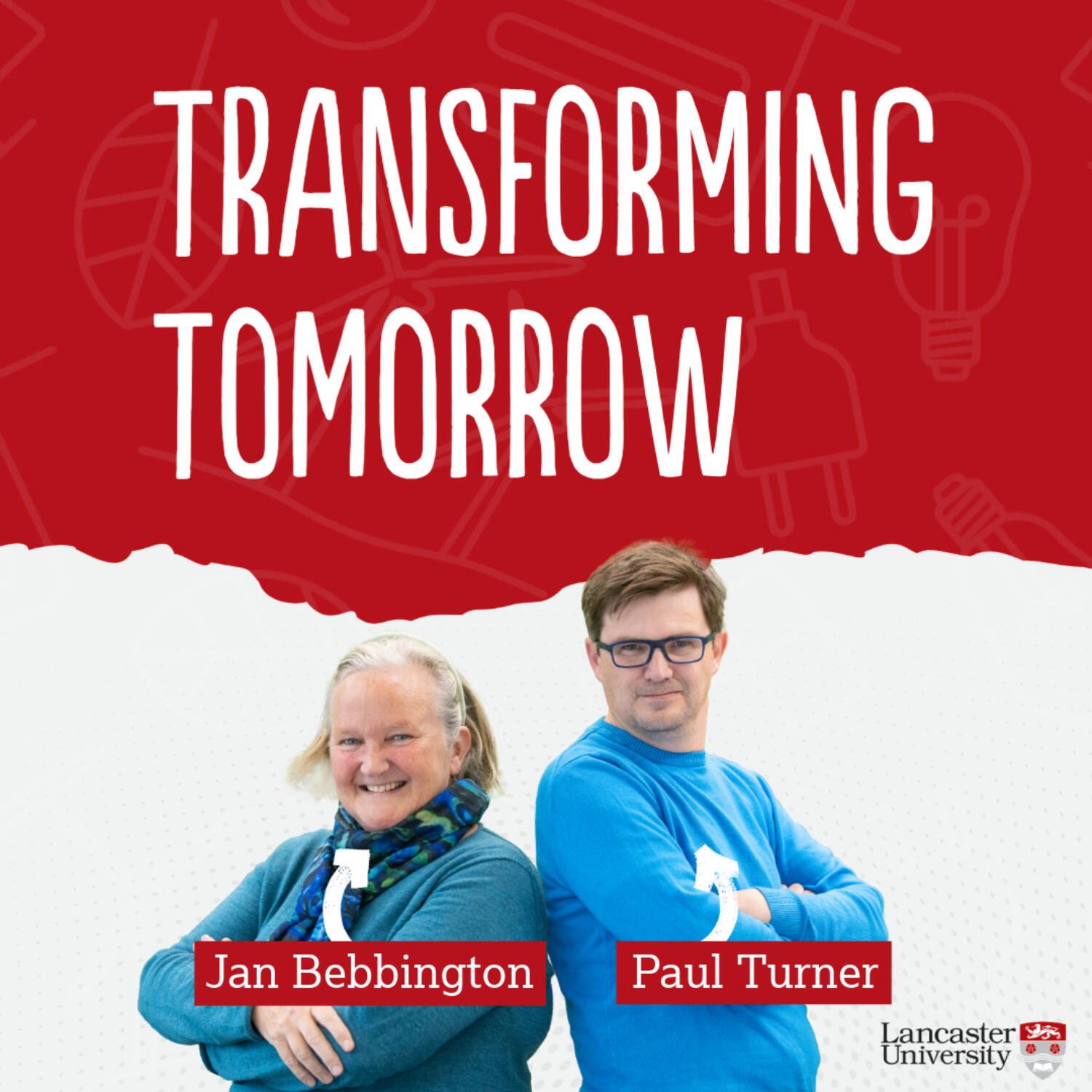
Transforming Tomorrow
The Pentland Centre for Sustainability in Business
Sustainability is a key consideration for any contemporary business, from biodiversity to modern slavery, seabeds to factory floors. Transforming Tomorrow guides you through the complex, ever-changing and often exciting (yes, really!!) world of sustainability in business.
Alongside members of the Pentland Centre, international research experts, and business leaders, we cover the theory and practice of mainstreaming sustainability into purposeful business strategy and performance.
Whether you are leading change in your business, or just want to know more about how space weather, human trafficking or architecture may influence the future of sustainability, Transforming Tomorrow is the show for you.
Taking you through it all, hosts Jan and Paul bring insight, perspective, and more than occasional disagreement to their topics.
Professor Jan Bebbington is the Director of the Pentland Centre for Sustainability in Business at Lancaster University. Jan is an expert on accounting, benchmarking (to her co-host’s annoyance), and how business and sustainability intersect. She loves nature and wants to protect it – and hopes she can change the world (ideally for the better). She is also motivated to address inequality wherever it is found and especially to eliminate forced, bonded or child labour. Transforming Tomorrow is one small step on that quest.
Paul Turner is a former sports journalist who now works promoting the research activities in Lancaster University Management School – a poacher turned gamekeeper as his former colleagues would have it. He has always been interested in nature and the natural environment – it comes from growing up in Cumbria – and has been a vocal proponent of the work of the Pentland Centre since joining Lancaster University. He does not like rankings and benchmarking, and is not afraid to say so.
Join us every Monday to uncover new insights and become a little more inspired that you can make a difference in sustainability.
Alongside members of the Pentland Centre, international research experts, and business leaders, we cover the theory and practice of mainstreaming sustainability into purposeful business strategy and performance.
Whether you are leading change in your business, or just want to know more about how space weather, human trafficking or architecture may influence the future of sustainability, Transforming Tomorrow is the show for you.
Taking you through it all, hosts Jan and Paul bring insight, perspective, and more than occasional disagreement to their topics.
Professor Jan Bebbington is the Director of the Pentland Centre for Sustainability in Business at Lancaster University. Jan is an expert on accounting, benchmarking (to her co-host’s annoyance), and how business and sustainability intersect. She loves nature and wants to protect it – and hopes she can change the world (ideally for the better). She is also motivated to address inequality wherever it is found and especially to eliminate forced, bonded or child labour. Transforming Tomorrow is one small step on that quest.
Paul Turner is a former sports journalist who now works promoting the research activities in Lancaster University Management School – a poacher turned gamekeeper as his former colleagues would have it. He has always been interested in nature and the natural environment – it comes from growing up in Cumbria – and has been a vocal proponent of the work of the Pentland Centre since joining Lancaster University. He does not like rankings and benchmarking, and is not afraid to say so.
Join us every Monday to uncover new insights and become a little more inspired that you can make a difference in sustainability.
Episodes
Mentioned books

Nov 18, 2024 • 37min
Who'd Be A Sustainability Manager?
Jan’s considering a new career – should she become a sustainability officer?
Chief Sustainability Officers are among the fastest growing jobs in the UK – but who are these people, what do they do, and does anyone actually listen to them?
Dr Katherine Ellsworth-Krebs, from the University of Strathclyde, brings gifts from her allotment to the studio as well as an avid interest in all things sustainability that started in childhood in Washington state, USA – where she was surprised to learn not all other youngsters had the same obsession. She also comes with a healthy dose of cynicism!
Through her work with a whole host of sustainability managers, we discover which businesses are leading the way by employing sustainability managers; what regulations are in place to encourage companies to have one; the importance of getting everyone on board when it comes to sustainable behaviour; and the stresses facing those pushing the sustainability agenda.
How does Jan slip up when it comes to her attitudes towards reporting? Why has Katherine stolen Jan’s ‘keystone actors’ term to apply to sustainability managers? And what will Paul do with his orchard’s worth of cooking apples?
Find out more about Katherine and her work here: https://www.strath.ac.uk/staff/ellsworth-krebskatherinedr/
And listen to the episode with Dr Carolynne Lord covering her work with Katherine on sustainability fairy tales here: https://pod.co/transforming-tomorrow/fairy-tales-and-mermaids
Episode Transcript
Nov 14, 2024 • 35min
A Taskforce for Nature
Bring back the accountants – and the taskforces! It’s time to look at how companies identify and report on nature-related impacts and opportunities.
We make an investigation of the Taskforce on Nature-related Financial Disclosures (TNFD) and its work with the Pentland Centre’s Dr Neytullah Ciftci – Neo to his friends – who works with Jan on that very topic.
Discover how companies can change nature; how these changing ecosystems could be a risk to your business; and the importance of analysing supply chain impacts as well as your own operations.
We look at how companies are adapting to the TNFD framework, and how widespread reporting is; discuss how TNFD fits in with the Taskforce on Climate-related Financial Disclosures (TCFD); gain an understanding of the different biodiversity scenarios for companies looking up to 100 years into the future; and hear Paul wonder if he knows too many accounting acronyms.
Reporting under the TNFD is moving quickly, with new reports expanding our understanding of the reporting framework. Here are the four most complete biodiversity scenarios within TNFD reports we have found to date, and the TNFD’s guide on scenario analysis.
KAO TNFD Report: https://www.kao.com/content/dam/sites/kao/www-kao-com/global/en/sustainability/pdf/biodiversity-tnfd.pdf
Kyuden Group Integrated Report 2024:
https://www.kyuden.co.jp/english_company_news_2024_h240925-1.html
Norinchuking Climate & Nature Report 2024: https://www.nochubank.or.jp/en/sustainability/backnumber/pdf/2024/climate_nature.pdf
Sekisui TCFD & TNFD Report 2024: https://www.sekisuichemical.com/sustainability_report/pdf/2024_TCFD_TNFDReport_E.pdf
TNFD (2023) Guidance: https://tnfd.global/publication/guidance-on-scenario-analysis/
Find out more about Neo and his work here: https://www.lancaster.ac.uk/lums/people/neytullah-ciftci
And catch-up on the previous episode that covered the TCFD with Duncan Pollard here: https://pod.fo/e/272bf5
Nov 11, 2024 • 32min
Nature Restoration and Business
How can businesses have a positive impact on nature? We hear a lot about the negative effects organisations have on the planet, but they can also be a force for good.
By helping to restore nature, firms big or small, local or global, can help themselves and their operations – and maybe all of us. But what are they actually doing, and why can it be so hard for them to tell us?
Dr Tim Lamont, a marine biologist in Lancaster Environment Centre, explains his work on corporate reporting around nature restoration, and how the subject fits in with his expertise on tropical coral reefs and how we look after them.
Discover how humans have damaged the planet, how the current generation is equipped with tools to repair it, and why Jan was described as ‘not a complete idiot’ and how her accounting expertise fits into the picture.
Can Paul’s inherent pessimism be overcome as we discuss the different ecosystem restoration practices from around the world; the importance of involving local people in restoration efforts and of long-term commitment over short-term attitudes; what can be done to drive change; and whether companies are more than just evil, faceless entities?
Plus, a bonus discussion on the size of Cumbria and how it could be used as a term of measurement.
Find out more about Tim and his work here: https://www.lancaster.ac.uk/lec/about-us/people/timothy-lamont
And read his paper co-written with Jan and others here: https://eprints.lancs.ac.uk/id/eprint/201803/1/CombinedPDF_Lamont_adh2610_accepted.pdf
Episode Transcript
Nov 4, 2024 • 27min
B-Corps, Brands, and Business
What do big companies do to positively contribute to sustainability efforts, and to wider society? What does your employer do? Is it enough, and could they do more?
Brands and brand values send messages and have their own sustainability identities, so it’s time to look at how this affects their actions.
Kaeisha Gibson, Head of Corporate Responsibility at Pentland Brands, discusses how brands including Speedo, Canterbury, Endura, Mitre, and more, approach their strategies towards sustainability.
The conversation focuses in on the Berghaus outdoor gear brand and its B-Corp certification, which demonstrates their determination to be a positive influence on the world and do no harm.
Learn why Berghaus pursued B-Corp status, what they do to maintain that certification, how they challenge themselves to improve, the plans for other brands under the Pentland banner to follow the Berghaus lead, and how old Jan’s Berghaus rucksack is.
Plus, after Jan uses the word ‘groovy’ once again without irony, does Kaeisha have the power to have her fired? And does Paul really only wear branded clothing?
Find out more about Berghaus’s B-Corp certification here: https://www.berghaus.com/positive-business/bcorp.list
Oct 28, 2024 • 42min
Good or Evil in Business
The battle between good and evil comes to Transforming Tomorrow. What is good? What does ‘good’ mean in the context of how you do business?
We look at how companies can balance profit with doing right in the world, why it doesn’t necessarily take as long as you think to move to a new way of thinking and working, and whether the world needs to be in crisis to force corporations to act.
Professor Steve Kempster explains his work on Good Dividends, and how he has worked with businesses to see how they work and if they can change it for the better.
Discover what a Benefit Corporation is, how purpose-led businesses perform against their competitors, and whether Steve has hope for the future.
Plus, Steve sets out to change our understanding of Adam Smith – and contemplates if he would be the kind of person to give you a High Five – and Paul becomes self-conscious about his eyebrows.
Find out more about Steve and his work here: https://www.lancaster.ac.uk/pentland/about/meet-the-team/steve-kempster
Discover the Good Growth programme featuring Good Dividends here: https://www.lancaster.ac.uk/business/good-growth-burnley/
Oct 21, 2024 • 35min
Greenpeace and Beyond
Put on your activism boots and join us on a journey from the Antarctic to Sweden and the Arctic, China, Lancaster and many places in between.
We find out the differences between being an activist and an academic, how you go from being one to the other, and how experience as an activist gives you unique and invaluable insights for research.
Frida Bengtsson describes her journey from growing up in a family where Greenpeace was an important presence, to being lead of the organisation’s Global Oceans campaign, before becoming a PhD researcher at the Stockholm Resilience Centre.
Frida’s work now looks at ocean governance and transhipment (and we will definitely find out what that means), introducing Jan and Paul to a world where understanding vessel ownership leads to murky waters, where regulations in the middle of the seas can be a maelstrom of confusion, and where we consider the ethics behind a fish finger sandwich.
What happens on fishing boats that stay at sea for months at a time? What is it like meeting with an organisation as an academic when you last met them while working for Greenpeace?
And why does Jan send Frida pictures of ships in every port she visits?
Discover more about Frida and her work at the Stockholm Resilience Centre here: https://www.stockholmresilience.org/meet-our-team/staff/2021-06-01-bengtsson.html
And read about Frida’s new paper on reefers and transshipment here: https://www.stockholmresilience.org/reefers
Episode Transcript
Oct 14, 2024 • 34min
How to Mine an Asteroid
We’re blasting off into space! Find out all you need to know to mine an asteroid – though be warned, it’s not that simple.
Discover which laws you have to follow beyond Earth’s atmosphere, how we get to asteroids in the first place, and what this might mean for life here and millions of miles away.
Dr Craig Jones joins Jan and Paul for an astronomical start to the new series. He specialises in asteroid mining and the myriad issues that arise when it comes to considering how it could be done, and what the practice could mean for sustainability.
The discussion covers potential harm to the ozone layer, how space junk could damage satellites and our oceans, and if all this is a pathway to building a back-up colony should Earth fail.
And what does William of Orange have to do with asteroid mining rights?
Read more about Craig's asteroid mining research in Fifty Four Degrees: https://doc.your-brochure-online.co.uk/Lancaster-University_FiftyFourDegrees_Issue_22/30/
And discover more about Craig’s work here: https://www.lancaster.ac.uk/lums/people/craig-jones
Episode Transcript
Aug 12, 2024 • 24min
Grilling Jan
What are externalities? How does the EU have environmental effects beyond its borders? What is justice?
We bring Season One of Transforming Tomorrow to a close with Jan answering some of the questions that have come up during previous episodes.
Jan explains externalities, and how (not when) they can be internalised; why it is important to know about the EU’s impacts; and the many elements to justice.
Plus, a sneak peek at what is coming up in Season Two.
Find details on the Frontiers of Justice book Jan mentions here: https://www.hup.harvard.edu/books/9780674024106)
And the paper on justice and earth systems is here: https://www.nature.com/articles/s41893-023-01064-1
Aug 5, 2024 • 32min
The Future of Normal
What is ‘future normal’? How will the world look years from now? How will businesses operate? How could they make your children proud? And how does sustainability fit into all this?
Professor Nick Barter, from Griffith University, takes Jan and Paul through the origins of the phrase from his time working with industry while completing his PhD with Jan at the University of St Andrews.
Covering topics from corporate direction-setting and vision to culture and language, learning from nature, and enabling others, Nick talks to us about how companies can change to be part of a world they want to live in.
Find out more about Future Normal here: https://futurenormal.net/
Jul 29, 2024 • 33min
What Is Creative Evaluation?
Like evaluations? Does anyone? It’s time to change your mind and learn about creative evaluation.
Jan and Paul welcome Dr Elisavet Christou and Violet Owen to enlighten them.
Co-authors of the Little Book of Creative Evaluation, they explain what Creative Evaluation is, and how it can be used across many disciplines.
Elisavet and Violet discuss their EViD tool, which helps people with their evaluation processes; the value of hearing from different voices; the importance of design; and why evaluation is so much more than a tick-box exercise.
Jan gets to talk benchmarking again. And is Paul right to be worried that the team are secretly being evaluated the whole time?
Check out the Little Book of Creative Evaluation here: https://creativeevaluation.uk/
And read a little more about the work here: https://doc.your-brochure-online.co.uk/Lancaster-University_FiftyFourDegrees_Issue_20/34/

