

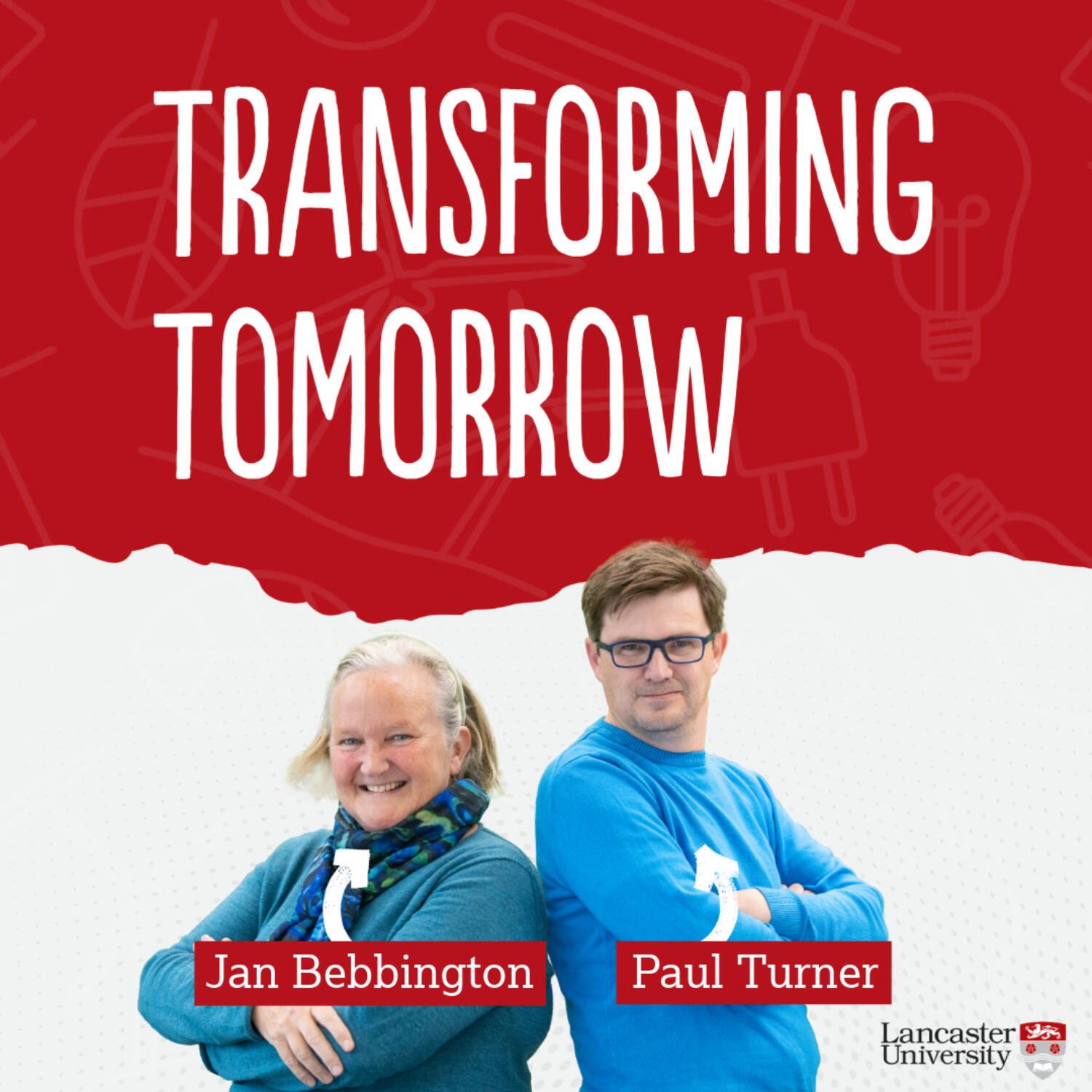
Transforming Tomorrow
The Pentland Centre for Sustainability in Business
Sustainability is a key consideration for any contemporary business, from biodiversity to modern slavery, seabeds to factory floors. Transforming Tomorrow guides you through the complex, ever-changing and often exciting (yes, really!!) world of sustainability in business.
Alongside members of the Pentland Centre, international research experts, and business leaders, we cover the theory and practice of mainstreaming sustainability into purposeful business strategy and performance.
Whether you are leading change in your business, or just want to know more about how space weather, human trafficking or architecture may influence the future of sustainability, Transforming Tomorrow is the show for you.
Taking you through it all, hosts Jan and Paul bring insight, perspective, and more than occasional disagreement to their topics.
Professor Jan Bebbington is the Director of the Pentland Centre for Sustainability in Business at Lancaster University. Jan is an expert on accounting, benchmarking (to her co-host’s annoyance), and how business and sustainability intersect. She loves nature and wants to protect it – and hopes she can change the world (ideally for the better). She is also motivated to address inequality wherever it is found and especially to eliminate forced, bonded or child labour. Transforming Tomorrow is one small step on that quest.
Paul Turner is a former sports journalist who now works promoting the research activities in Lancaster University Management School – a poacher turned gamekeeper as his former colleagues would have it. He has always been interested in nature and the natural environment – it comes from growing up in Cumbria – and has been a vocal proponent of the work of the Pentland Centre since joining Lancaster University. He does not like rankings and benchmarking, and is not afraid to say so.
Join us every Monday to uncover new insights and become a little more inspired that you can make a difference in sustainability.
Alongside members of the Pentland Centre, international research experts, and business leaders, we cover the theory and practice of mainstreaming sustainability into purposeful business strategy and performance.
Whether you are leading change in your business, or just want to know more about how space weather, human trafficking or architecture may influence the future of sustainability, Transforming Tomorrow is the show for you.
Taking you through it all, hosts Jan and Paul bring insight, perspective, and more than occasional disagreement to their topics.
Professor Jan Bebbington is the Director of the Pentland Centre for Sustainability in Business at Lancaster University. Jan is an expert on accounting, benchmarking (to her co-host’s annoyance), and how business and sustainability intersect. She loves nature and wants to protect it – and hopes she can change the world (ideally for the better). She is also motivated to address inequality wherever it is found and especially to eliminate forced, bonded or child labour. Transforming Tomorrow is one small step on that quest.
Paul Turner is a former sports journalist who now works promoting the research activities in Lancaster University Management School – a poacher turned gamekeeper as his former colleagues would have it. He has always been interested in nature and the natural environment – it comes from growing up in Cumbria – and has been a vocal proponent of the work of the Pentland Centre since joining Lancaster University. He does not like rankings and benchmarking, and is not afraid to say so.
Join us every Monday to uncover new insights and become a little more inspired that you can make a difference in sustainability.
Episodes
Mentioned books

Jul 22, 2024 • 28min
Shaping Corporate Sustainability
How can executives change their operations and attitudes – from nature restoration to modern slavery – to be more sustainable and responsible? How hard is it to get people to accept the difficulty of the task.
Linden Edgell – Inquisitor, Collaborator and Explorer extraordinaire – joins Jan and Paul from Perth, Australia, among her 150 mango trees to answer these and other questions.
Linden is ERM’s Global Sustainability Director and is a member of the Pentland Centre’s Advisory Board. She has worked in government and latterly in consulting, where she is seeking to bring about change in corporate behaviour.
What developments has she seen over the decades? How do companies balance profit, sustainability and longevity? Can you walk and chew gum?
Jul 15, 2024 • 29min
Hooked on Salmon Farming
Increase your knowledge of salmon tenfold as we look at the environmental impacts of a major industry.
Farmed salmon is the UK’s biggest food export – and Dr Josi Fernandes is obsessed!
Josi joins Jan and Paul to talk about her work looking at salmon farming practices and sustainability in the UK and how her research in the area all started over a conversation in the pub.
We discover what Josi has learned from speaking with salmon farmers, processors and retailers – though not everyone wanted to talk.
We take in the differences between farmed and wild salmon; how farmed salmon came to be such a big market; the industrial scale of production; potential futures for the industry; and whether anyone in the studio eats salmon in the first place.
Find out more about Josi’s research here: https://www.lancaster.ac.uk/lums/people/josiane-fernandes2
You can discover Paul Greenberg’s Four Fish book here: https://www.paulgreenberg.org/books/four-fish/
And see more on Mark Kurlansky’s Salmon book here: https://www.markkurlansky.com/books/salmon-a-fish-the-earth-and-the-history-of-their-common-fate/
Jul 8, 2024 • 35min
Sustainable Finance
Do investors really care about sustainability, or is it all about the money? If they do care, what powers do they have to make companies change their ways?
Jan and Paul welcome Professor Mark Shackleton to discuss the world of finance and how it intersects with sustainability.
They discover why the King can’t enter the City of London without permission; how data can be used to influence ‘green’ investing; and how shareholders can instigate change.
Among discussions of ethics and politics, they find the time to talk about physics and Paul’s strange childhood fascination with global stock exchanges.
Find out more about Mark’s research here: https://www.lancaster.ac.uk/lums/people/mark-shackleton
Jul 4, 2024 • 14min
Green Consumer Spending
Would you spend more for green products? Really? Really really?
Even if you would, is it possible consumers can change how businesses operate through such decisions?
Jan and Paul welcome back Professor Dakshina De Silva, and Drs Anita Schiller and Aurelie Slechten to discuss the factors that influence consumer spending on green goods; different cultural attitudes towards green spending; how income levels affect these attitudes; and whether the future is carrying your own ice cream spoon.
Read more about the team’s research into green consumer spending in this short article: https://doc.your-brochure-online.co.uk/Lancaster-University_FiftyFourDegrees_Issue_18/10/
Jul 1, 2024 • 33min
The Economics of Pollution
Communities with lower-income residents can be impacted more by pollution. But why? And can anything be done?
With pollution impacting health and employment opportunities, can regulations help these communities? Will they make industries pack up and leave? Or is that just a handy excuse?
A crash of economists invades the studio to talk to Jan and Paul about how industrial pollution ties in with economics and sustainability.
Professor Dakshina De Silva, and Drs Anita Schiller and Aurelie Slechten explain how economists view the world –and how we can measure the social costs of pollution.
And we discover shockingly that there may be a ‘Wrong Side’ of the river in Lancaster.
Jun 24, 2024 • 35min
Down on the Farm (Part Two)
Does planting new hedgerows help farmers, and how? Is having a connection with nature important to a farm’s success?
And, where’s Jan? Paul is left to fly solo after a car breakdown means Jan cannot make it to Orton, and the farm of Jim Beary.
Luckily, Lake District Farmers Head of Purpose and Sustainability Phil Scott can help out as the trio discuss life at Gaythorn Hall, a farm in the far east of Cumbria that falls within the boundaries of the Yorkshire Dales National Park.
From his home among the flocks of sheep and herds of cows – as well as smaller numbers of pigs and chickens – Jim tells us about his past experiences in farming – including a ‘horrifying’ time on an arable farm as a crop sprayer – and his determination to do things less intensively and more sustainably to create high-quality food.
We learn about the benefits of working with LDF, how to adapt to circumstances and the environment, how Jim has learned from his mistakes, soil resilience, and more sustainable feed types.
You can see Jim’s Instagram account at @farmer_beary
Listen to Jan and Paul’s first farm visit here: https://pod.co/transforming-tomorrow/down-on-the-farm-part-one
Jun 17, 2024 • 32min
Down on the Farm (Part One)
Paul and Jan have finally made it to the farm! But where is the sustainability? Are farmers really invested in biodiversity?
We are on Cartmel Fell, in South Cumbria, to meet Fiona Daley, who along with husband Dave owns and runs Hodge Hill Farm, where a new-born calf is among the audience.
Fiona and Dave have a small herd of Belted Galloway cows and are members of the LDF network. LDF Head of Purpose and Sustainability Phil Scott joins everyone in the barn to discuss key sustainability issues.
Why did Dave and Fiona return to farming seven years ago with a determination to do things differently/ What is the significance of regenerative farming, wildlife and nature – and of sharing best practices across farms? And what is the wince-inducing difference between a bull and a steer?
We even talk farming numbers, as it turns out Fiona is a qualified accountant.
Jun 10, 2024 • 27min
Is Net Zero Meat Possible?
Or is it a pipedream? The Pentland Centre are working with Lake District farmers to move towards net zero meat production.
Discover the unique challenges facing farmers in the Lake District; find out how farmers are cooperating with Lancaster research; and learn the differences between Net Zero, Carbon Neutral and Carbon Positive.
Dr Laura Giles, the Knowledge Transfer Partnership Associate working with Lake District Farmers, joins Jan and Paul to discuss her work – and tell us what her role means and how it operates.
Laura is working with LDF to understand how livestock farmers in the Lake District can work towards Net Zero meat production (the project is not making wild claims of Net Zero meat). This takes in soil science, farming practice, and even accounting – to Jan’s delight.
Watch a film showcasing some of the work taking place on the KTP here: https://www.youtube.com/watch?v=8ZmmOGboCbE
Find out more about the LDF work in the introductory podcast: https://pod.co/transforming-tomorrow/lake-district-farmers
Jun 3, 2024 • 23min
Farming and Sustainability
We’ve learned all about farming – and soil! – now we discover how farming and sustainability go together. Do farmers care and how do they show it?
Jan and Paul talk sustainability with Lake District Farmers’ Phil Scott about the organisation’s sustainability ambitions.
As seagulls and buzzards circle, they look at how LDF think about sustainability in their own operations and those of the farmers in their networks, and the overall impact of their work. Phil explains the efforts reflect engagement with communities, proper discussions with farmers around their practices, and a real understanding of the natural environment of the Lake District.
Plus we look at the key issue of how eating meat can fit into a sustainable lifestyle.
May 27, 2024 • 21min
Soil – It’s Alive!
There is more carbon in soil than in the Earth’s atmosphere! But how has human activity has changed soils over the centuries?
Professors Jess Davies and John Quinton, from Lancaster Environment Centre, bring their expertise to focus on the work being done with the Lake District Farmers. They tell Jan and Paul about the effects farmers have on their land – and how they have affected it over the past centuries – and what might happen in the future. Using science, they can advise on the best path forward.
Plus, a bonus mention of Pliny the Elder!
Find out more about the Sustainable Soils research group in Lancaster Environment Centre here: https://wp.lancs.ac.uk/sustainable-soils/

