

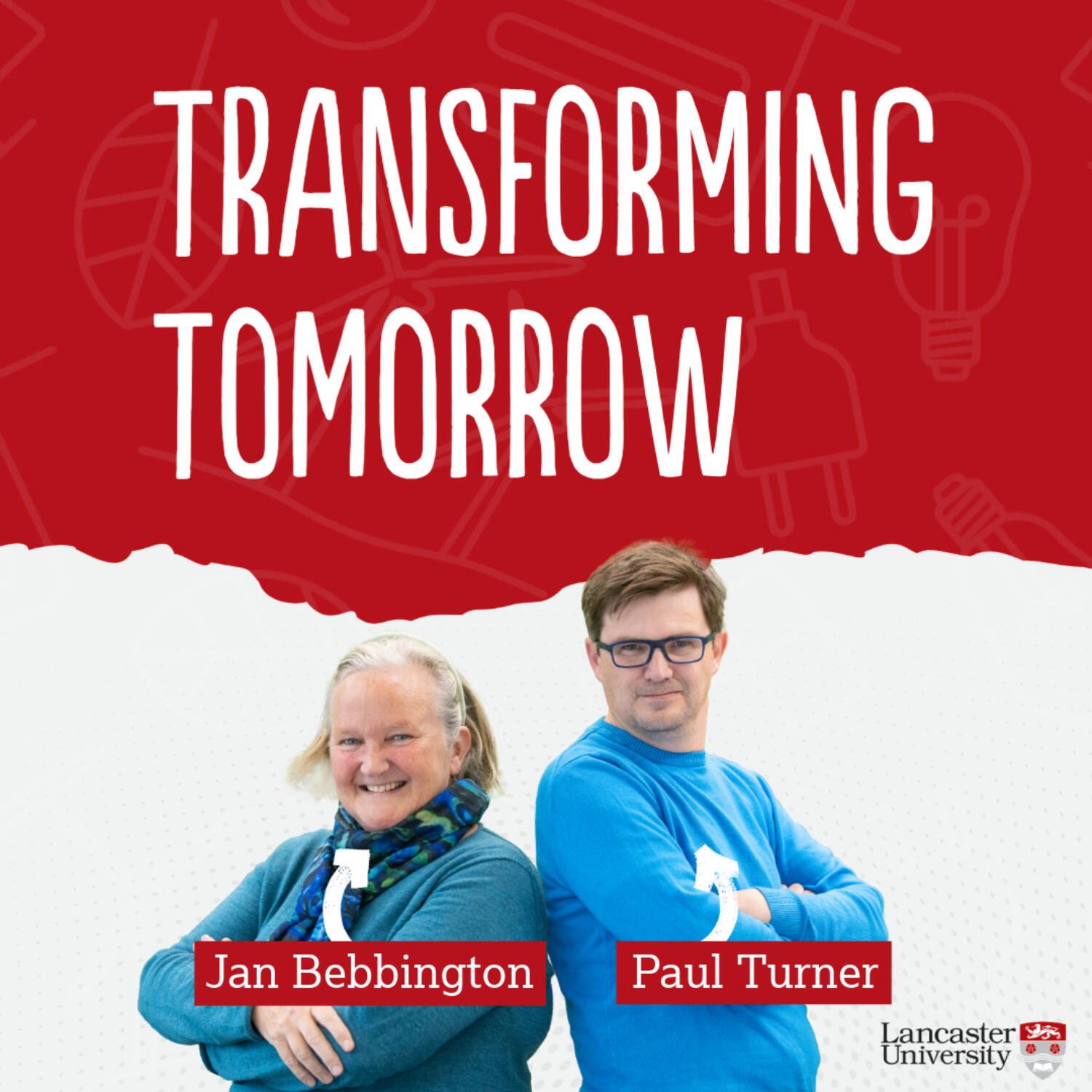
Transforming Tomorrow
The Pentland Centre for Sustainability in Business
Sustainability is a key consideration for any contemporary business, from biodiversity to modern slavery, seabeds to factory floors. Transforming Tomorrow guides you through the complex, ever-changing and often exciting (yes, really!!) world of sustainability in business.
Alongside members of the Pentland Centre, international research experts, and business leaders, we cover the theory and practice of mainstreaming sustainability into purposeful business strategy and performance.
Whether you are leading change in your business, or just want to know more about how space weather, human trafficking or architecture may influence the future of sustainability, Transforming Tomorrow is the show for you.
Taking you through it all, hosts Jan and Paul bring insight, perspective, and more than occasional disagreement to their topics.
Professor Jan Bebbington is the Director of the Pentland Centre for Sustainability in Business at Lancaster University. Jan is an expert on accounting, benchmarking (to her co-host’s annoyance), and how business and sustainability intersect. She loves nature and wants to protect it – and hopes she can change the world (ideally for the better). She is also motivated to address inequality wherever it is found and especially to eliminate forced, bonded or child labour. Transforming Tomorrow is one small step on that quest.
Paul Turner is a former sports journalist who now works promoting the research activities in Lancaster University Management School – a poacher turned gamekeeper as his former colleagues would have it. He has always been interested in nature and the natural environment – it comes from growing up in Cumbria – and has been a vocal proponent of the work of the Pentland Centre since joining Lancaster University. He does not like rankings and benchmarking, and is not afraid to say so.
Join us every Monday to uncover new insights and become a little more inspired that you can make a difference in sustainability.
Alongside members of the Pentland Centre, international research experts, and business leaders, we cover the theory and practice of mainstreaming sustainability into purposeful business strategy and performance.
Whether you are leading change in your business, or just want to know more about how space weather, human trafficking or architecture may influence the future of sustainability, Transforming Tomorrow is the show for you.
Taking you through it all, hosts Jan and Paul bring insight, perspective, and more than occasional disagreement to their topics.
Professor Jan Bebbington is the Director of the Pentland Centre for Sustainability in Business at Lancaster University. Jan is an expert on accounting, benchmarking (to her co-host’s annoyance), and how business and sustainability intersect. She loves nature and wants to protect it – and hopes she can change the world (ideally for the better). She is also motivated to address inequality wherever it is found and especially to eliminate forced, bonded or child labour. Transforming Tomorrow is one small step on that quest.
Paul Turner is a former sports journalist who now works promoting the research activities in Lancaster University Management School – a poacher turned gamekeeper as his former colleagues would have it. He has always been interested in nature and the natural environment – it comes from growing up in Cumbria – and has been a vocal proponent of the work of the Pentland Centre since joining Lancaster University. He does not like rankings and benchmarking, and is not afraid to say so.
Join us every Monday to uncover new insights and become a little more inspired that you can make a difference in sustainability.
Episodes
Mentioned books

Feb 3, 2025 • 45min
Urgh! Bin Juice!
Do you know what happens to your plastic recycling after your bins are emptied?
As we continue our journey through the plastics pipeline, we encounter bin juice and the Mafia.
Lancaster University’s Dr Clare Mumford and the Chartered Institution of Wastes Management (CIWM)’s Richard Hudson take the Plastic Packaging in People’s Lives project to the final stage of its process – how plastic waste is dealt with.
It turns out plastic is not very sociable – one type does not get along with another – and this just adds to the complications when it comes to recycling.
We talk about the importance of being able to predict how much waste people are going to produce; the post-Christmas purple polypropylene surge; the need to properly sorting your plastics before recycling, and how to avoid recycling contamination; why moving away from plastics does not automatically mean greater sustainability; and public pessimism over what happens to their recycling.
Discover the wonderfully named Association of Cleansing Superintendents of Great Britain and how it grew to have 17,000 members in its current iteration; cringe at the perils of bin juice; and feel the tension rise when Paul’s jokes about the waste management industry being a front for organised crime turn out to be closer to the truth than he imagined.
Learn more about plastic packaging and how it can be processed in the Fifty Four Degrees article here: https://doc.your-brochure-online.co.uk/Lancaster-University_FiftyFourDegrees_Issue_21/14/
And read the PPiPL white paper, Waste Matters, here: https://zenodo.org/records/10839761
Episode Transcript
Jan 27, 2025 • 36min
Shopping for Plastics
Listening to this episode can change your shopping habits!
Do supermarkets care about the planet? What actions are they taking to reduce waste? How are they changing their packaging to address the plastics problem?
The team hit the road to speak with Katie Gwynne and Jane Routh, from Plastic Packaging in People’s Lives project partners Booths, about how the supermarket chain thinks and acts around plastic packaging, and how they are looking to change their own behaviours and those of their customers.
With an ethos of ‘being the good grocers’ discover how Booths are looking to do the right thing on plastic packaging – both for their own products, and for those of their suppliers.
Discover how they have been involved with PPiPL, what they have learned from the project – and their customers, the benefits of working with the other organisations involved, how supermarkets can use their collective influence to instigate change, the shift in attitudes across the industry towards sustainability, and what comes next for them.
And do you know which is older – Booths or New Zealand? Paul makes the common mistake of thinking of post-colonial New Zealand, not when people first came to Aotearoa (the indigenous name for what became New Zealand). History is often complex. Pliny the Elder would approve of the conversation.
Read more about Booths’ involvement in the PPiPL project here: https://doc.your-brochure-online.co.uk/Lancaster-University_FiftyFourDegrees_Issue_21/26/
And see their sustainability efforts here: https://www.booths.co.uk/sustainability/
Episode Transcript
Jan 20, 2025 • 47min
Better Plastics Behaviour
How do you treat plastic waste in your home? Are you a good consumer? A good recycler or a wishcycler? And is recycling the first thing you see when you open the door to your house?
Professors Alex Skandalis and James Cronin bring their marketing and consumer culture expertise to the Plastic Packaging in People’s Lives project – and to the podcast – to analyse consumer behaviours around plastic. But are they just making up all of the language and concepts they mention?
From the Aztecs to the Dark Ages, the Victorians to the present day, we discover plastics have been around our culture for much longer than you might think and go far beyond drinks bottles and food containers.
Discover a shift from plastic as an environmental saviour to a major sustainability problem, from a luxury item to something almost invisible in its ubiquity, and how the material is intrinsic to our modern-day society.
See how the PPiPL team have looked at household behaviours – from their shopping habits to their plastic disposal routines – how actions around recycling at home and at work affect each other; and how individual choices and behaviours are shaped by many factors around you.
And we find out the answer to the key question about whether Ancient Egyptians used plastics to wrap their mummies.
Read more about consumer attitudes and behaviours towards plastics here: https://doc.your-brochure-online.co.uk/Lancaster-University_FiftyFourDegrees_Issue_21/18/
And read the PPiPL white paper on household recycling here: https://zenodo.org/records/10839795
Episode Transcript
Jan 13, 2025 • 37min
Rethinking Plastic Packaging
It’s not just consumers who need to change their attitudes and behaviours around plastics.
Packaging manufacturers and retailers need to take action too.
Professor Linda Hendry makes a return visit to the podcast, explaining how her work on supply chains unites her interests in plastics as part of the Plastic Packaging in People’s Lives (PPiPL) project and on modern slavery.
We look at how food producers, packaging manufacturers and retailers decide how to package and transport food before it reaches consumers; the role of government and regulation when it comes to packaging design and redesign – and the difficulties companies have in using packaging that meets these requirements; and how consumer attitudes affect how companies operate.
Linda outlines the strategies businesses can apply to cut the plastic packaging and waste they produce, and explains the ‘regrettable substitute’ concept as she tells us why alternatives are not always better.
We cover important issues of the day: Does Jan have a crisp addiction problem? Does Paul give his children too many crisps? Did Linda mislead her kids about how many crisps they had in the house? And how does this all fit in with packaging decisions?
Plus, does Linda – or her domestic engineer – know whether the Ancient Egyptians wrapped mummies in plastic? Is there a serial killer on the PPiPL project? And how do the Minnesota Vikings defensive line of the 1970s fit into it all?
Read more about the seven steps towards sustainable packaging innovation: https://doc.your-brochure-online.co.uk/Lancaster-University_FiftyFourDegrees_Issue_21/10/
And read the PPiPL project’s white paper on packaging here: https://zenodo.org/records/10839787
Episode Transcript
Jan 6, 2025 • 40min
Is Plastic Fantastic?
“I just want to say one word to you. Just one word… plastics.”
We don’t have Dustin Hoffman, but we do have a journey into a fascinating world as we take a deep dive into the Plastic Packaging in People’s Lives (PPiPL) project.
Dr Alison Stowell and Professor Maria Piacentini join us as we discover how consumers think and behave when it comes to plastic food packaging, and how PPiPL hopes to change the attitude-behaviour gap.
Discover how the project researchers have engaged with organisations from supermarkets to local government, SMEs to waste management firms, to gain a big picture of attitudes and actions, and make a real-world impact.
What happens in your household when it comes to plastics recycling? Do you say you’re going to do one thing, but then do another? Do you make a concerted effort to buy packaging that can be recycled – or even packaging that is not made from plastic?
There is so much to talk about, and many questions for all of us to consider when it comes to our usage of plastics – including how Nonna can swap out plastic for tea towels to bring a famous family pizza all the way from Glasgow to Lancaster.
And how many words are in the sentence ‘It’s complex’?
Find out more about the PPiPL project here: https://www.lancaster.ac.uk/ppipl/
And read more from the PPiPL team here: https://doc.your-brochure-online.co.uk/Lancaster-University_FiftyFourDegrees_Issue_21/
Episode Transcript
Dec 23, 2024 • 40min
The Bay (With Fewer Murders)
Take a moment to consider what your local area. Do you feel connected to it? Does it feel like a real home?
Morecambe Bay is a natural marvel. Stretching from Fleetwood in the south to Barrow-in-Furness in the north, it encompasses Lancaster, Morecambe, and many small towns and villages along the Lancashire and Cumbria coastlines.
And Paul feels right at home as he and Jan welcome Carys Nelkon and Dr Beth Garrett to reveal the wonders of the Morecambe Bay Curriculum to them.
The curriculum involves more than 140 educators across the Bay and is embedded in day-to-day teaching. It uses the wonders of the area and its people and ties them into the National Curriculum. It allows children to develop a love for their home and take a practical interest in its future, and schools and colleges to take a fresh look at how they deliver education to young people.
From birds to beaches, travel to the energy industry, there is a lot to cover.
Discover why Morecambe Bay is such an important place, what brings its communities – and its schools and educators – together, how the Eden Project Morecambe has provided a spark to reinvigorate the area and develop the curriculum, and how Lancaster’s role as a civic university fits in.
Find out more about the Morecambe Bay Curriculum here: https://www.lancaster.ac.uk/morecambe-bay-curriculum/
And read about the Beach Schools Network here: https://www.forestschools.com/pages/beach-schools
And as a bonus, here is a starting point for finding out more about Patrick Geddes: https://camera-obscura.co.uk/article/patrick-geddes
Episode Transcript
Dec 16, 2024 • 26min
B-School to ESG School
How can business and management schools help to shape the leaders the world needs? It’s time to examine how we operate, and how we can change to better suit the businesses of the future.
Dr Marian Iszatt-White becomes our first return guest as she talks to Jan and Paul about her work on the B-School to ESG School project. Her latest work is looking at how Environmental, Social and Governance should be at the heart of a business school’s operations.
Discover how we can help to ensure our graduates go into the world and make a positive change.
How do students think about environmental and sustainability issues? Do opinions change depending on where they are from? How do lessons learned as a student compare to the reality of going into the world of business?
Marian explains the disconnect between what students are taught and what they see happening across a University; how business schools can embed ESG at the core of their operations; and reactions among senior management and staff to the projects suggestions.
Read more about the B-School to ESG-School project here: https://doc.your-brochure-online.co.uk/Lancaster-University_FiftyFourDegrees_Issue_23/47/
Dec 9, 2024 • 40min
Turning Ideas Into Norms
What is normal now was not always so. People used to smoke in bars and offices; junk food used to be advertised during children’s TV programmes; drivers and passengers used to travel in cars without seatbelts – but not now, and for some people it feels it has always been this way.
Professor Carlos Larrinaga, from the University of Burgos, talks us through the process by which new ideas spread and become norms – both with and without regulation in place.
With a focus around Carlos’s expertise on sustainability reporting, we look at how voluntary actions start to feel compulsory; and why it is that entrepreneurial heroes and their efforts to force change can take the focus away from important mundane advances that take place in the background.
We ask why some regulations and laws do not change actions and attitudes; why companies can converge on a new behaviour and turn it into a norm without regulation; and how an understanding of accounting history helps Carlos with his work.
Carlos explains how norms can differ from companies’ core values, how behaviours can change to align with new requirements, and whether some companies only comply with reporting in a symbolic way.
And, as Jan and Carlos try to out-humble each other in an argument over who know more than the other, why does everyone want sausages for their dinner?
Find out more about Carlos and his work here: https://investigacion.ubu.es/investigadores/35281/detalle
Dec 2, 2024 • 40min
Tackling Global Inactivity
Jan is a joy rider. And that’s just great.
Not everyone is an elite athlete, but we should all be active.
The World Federation of the Sporting Goods Industry (WFSGI) is doing important work with some of the biggest names in their sector to help make this a reality.
Emma Zwiebler, a World Championship and Commonwealth Games badminton player who is now CEO of the WFSGI, explains how the trade association body operates and how they have put this mission at the core of their activities.
We investigate the issue of global physical inactivity, its wider costs to society, and the actions of WFSGI in trying to address the problem while working with the World Health Organisation.
Discover how Emma and the WFGSI can elevate issues both for business and for countries; how they can influence across industries to deepen their impact; what is already happening, and how this can inspire future change; and how each of us takes a different approach to physical activity.
And we are left pondering the questions of whether the head of the International Olympic Committee listens to Transforming Tomorrow, and if Jan and Paul will be recording future episodes while walking – or running?
Nov 25, 2024 • 39min
Ranking Business Schools
It’s Paul’s worst nightmare – a whole episode about ranking and accrediting business schools!
Learn how business schools build sustainability into their operations; why accreditation bodies – whose backing schools rely on for their prestige – take the issue so seriously; and how important the topic is when it comes to rankings.
Rose White, External Accreditation Manager at Lancaster University Management School, comes ready for Paul to rant about whether rankings should be important to anyone – and she gets just what she expects!
Rose and Jan might be unable to convince Paul of the merits of benchmarks, but is he more open to accreditations? The difference between these two approaches will become apparent in the conversation.
For accreditations, we cover everything from why business and management schools want to be accredited in the first place; who pays attention to these accreditations; the innumerable acronyms that come with the process; how sustainability is a key pillar to overall strategies; and the importance of showing people how we do engage in sustainability.
And as Paul tries to avoid starting a fight over rankings, we discuss their audience; their changing consideration of sustainability’s importance; whether they are as important – or more so – than accreditations; and throw in some breaking and Raygun for good measure!
Episode Transcript

