

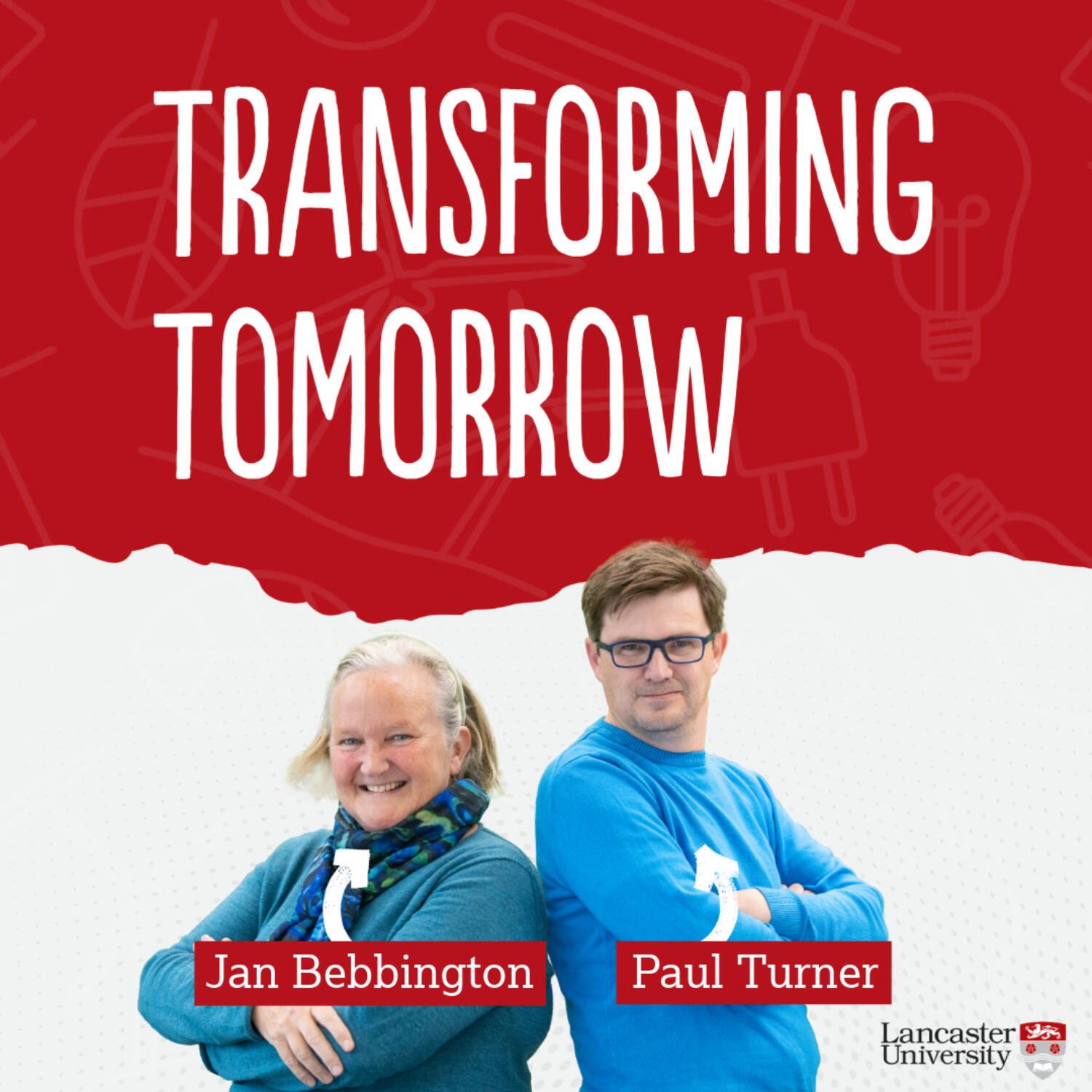
Transforming Tomorrow
The Pentland Centre for Sustainability in Business
Sustainability is a key consideration for any contemporary business, from biodiversity to modern slavery, seabeds to factory floors. Transforming Tomorrow guides you through the complex, ever-changing and often exciting (yes, really!!) world of sustainability in business.
Alongside members of the Pentland Centre, international research experts, and business leaders, we cover the theory and practice of mainstreaming sustainability into purposeful business strategy and performance.
Whether you are leading change in your business, or just want to know more about how space weather, human trafficking or architecture may influence the future of sustainability, Transforming Tomorrow is the show for you.
Taking you through it all, hosts Jan and Paul bring insight, perspective, and more than occasional disagreement to their topics.
Professor Jan Bebbington is the Director of the Pentland Centre for Sustainability in Business at Lancaster University. Jan is an expert on accounting, benchmarking (to her co-host’s annoyance), and how business and sustainability intersect. She loves nature and wants to protect it – and hopes she can change the world (ideally for the better). She is also motivated to address inequality wherever it is found and especially to eliminate forced, bonded or child labour. Transforming Tomorrow is one small step on that quest.
Paul Turner is a former sports journalist who now works promoting the research activities in Lancaster University Management School – a poacher turned gamekeeper as his former colleagues would have it. He has always been interested in nature and the natural environment – it comes from growing up in Cumbria – and has been a vocal proponent of the work of the Pentland Centre since joining Lancaster University. He does not like rankings and benchmarking, and is not afraid to say so.
Join us every Monday to uncover new insights and become a little more inspired that you can make a difference in sustainability.
Alongside members of the Pentland Centre, international research experts, and business leaders, we cover the theory and practice of mainstreaming sustainability into purposeful business strategy and performance.
Whether you are leading change in your business, or just want to know more about how space weather, human trafficking or architecture may influence the future of sustainability, Transforming Tomorrow is the show for you.
Taking you through it all, hosts Jan and Paul bring insight, perspective, and more than occasional disagreement to their topics.
Professor Jan Bebbington is the Director of the Pentland Centre for Sustainability in Business at Lancaster University. Jan is an expert on accounting, benchmarking (to her co-host’s annoyance), and how business and sustainability intersect. She loves nature and wants to protect it – and hopes she can change the world (ideally for the better). She is also motivated to address inequality wherever it is found and especially to eliminate forced, bonded or child labour. Transforming Tomorrow is one small step on that quest.
Paul Turner is a former sports journalist who now works promoting the research activities in Lancaster University Management School – a poacher turned gamekeeper as his former colleagues would have it. He has always been interested in nature and the natural environment – it comes from growing up in Cumbria – and has been a vocal proponent of the work of the Pentland Centre since joining Lancaster University. He does not like rankings and benchmarking, and is not afraid to say so.
Join us every Monday to uncover new insights and become a little more inspired that you can make a difference in sustainability.
Episodes
Mentioned books

Apr 14, 2025 • 50min
Industry 5.0 and Society 5.0
It’s time to look to the future and consider what comes next for society and industry.
Dr Rebecca Liu, from Lancaster University Management School’s Department of Marketing, and Steve Kremer, from consultancy Periphas, who specialise in connecting technology innovators, join us to discuss Society 5.0 and Industry 5.0. Both concepts envision the world’s next evolution.
This means a vision of a super-smart society, where smart tech is integrated into every aspect, serving the needs of humanity, and solving major global issues as it blends the cyber and physical worlds.
In industry, it is about achieving growth and creating jobs, but also driving prosperity and respecting planetary boundaries, prioritising societal well-being and recognising limits of resources.
It is a move away from the take, make, dispose industrial model to adopting green tech, reducing carbon emissions and minimising waste.
In both cases, tech and industry work for people, not the other way round.
We consider what came before Industry and Society 4.0; how the next iterations are different; whether 5.0 should really be 4.1; and the challenges of realising ideas and ideals.
Plus, Manga, Greek mythology, the Terminator, and Jan’s Industrial Revolution rebirth.
Discover Rebecca’s work here: https://www.lancaster.ac.uk/lums/people/rebecca-liu
And find out about Periphas here: https://periphas.com/
Find out more about work ongoing under the Industry 5.0 initiative see here: http://industrial-upcycling.cz/
Episode Transcript
Apr 7, 2025 • 32min
Learning to Sleep Hungry
Not everyone takes breakfast, lunch and dinner for granted. For millions, there is no guarantee of where their next meal will come from, or its quality.
Biraj Patnaik, Executive Director of the National Foundation for India, introduces us to the concepts and realties food poverty and food inequality, and how his organisation works with communities on the margins of Indian society towards enabling social justice.
We discuss how and why the right to food has been part of legislative discourse in India; how the caste system and gender discrimination influence who suffers malnutrition and starvation; the right to life; and the devastating prospect of teaching your child to sleep hungry.
How will climate change affect different communities – especially in the already baking heat of India? Where will extreme weather impact global crop production and food availability, especially in low-lying coastal areas?
We cover the complications of industrial agriculture; the lessons the world can take from India’s changed farming practices; the environmental pitfalls in relying on importing most of your country’s food; and the importance of learning how to live with nature from indigenous communities.
Find out more about the National Foundation for India here: https://www.nfi.org.in/
The start of the Lake District Farmers mini-series on Transforming Tomorrow can be found here: https://pod.co/transforming-tomorrow/lake-district-farmers
And discover Amartya Sen’s Capability Approach here: https://iep.utm.edu/sen-cap/
Episode Transcript
Mar 31, 2025 • 47min
The Public and The Private
Are you a public or a private person? Or maybe a bit of both? It’s not always easy to say.
The same goes for how we characterise the public and private sectors. The private sector goes beyond a simple characterisation of making a profit – and the public sector beyond providing services for people. The boundaries are blurring – where do the public and private sectors meet, and how does their symbiotic relationship work?
Dr Martin Quinn is a Reader in OWT – which in his northern brogue suggests a life of vague reading lists and relaxed afternoons in a comfy chair. But he brings with him expertise in the private and public sectors, and how they play out in terms of politics and the environment.
We discuss the concept of public value, how the public sector can help the private sector flourish, whether the private sector operates for anything other than profit, and examine anchor institutions that provide sustained employment, and sometimes even a reason for towns and cities to exist.
Plus, as Martin searches for hope, we take a journey to the world of Thomas the Tank Engine – and Paul’s childhood on Sodor – discuss GCSE geography lessons; talk about how Venice – and Morecambe – changed during Covid; and reveal the joys of working with geologists.
Discover more about Martin’s research here: https://www.lancaster.ac.uk/lums/people/martin-quinn
Here is more detail on the Ministry of the Future book mentioned in the podcast: https://en.wikipedia.org/wiki/The_Ministry_for_the_Future
Episode Transcript
Mar 24, 2025 • 35min
The Next Generation
Young people are bombarded with a huge number of issues – from cost-of-living to the challenge of finding employment, an ever-changing global political landscape to inclusion. Where does sustainability fit into the mix?
Darren Axe, Students Organising for Sustainability (SOS)’s International Membership and Engagement Manager, has an ironic name given he has planted many trees during his career – and surely no-one has ever mentioned it!
We discuss the work of SOS in the UK and across their international team in galvanising students and allowing them to realise how sustainability cuts across the challenges they face.
Darren talks us through the main environmental issues concerning young people around the world, how to get students active and involved – and how they engage with university management and try to hold them to account.
Jan gets very excited about trees – but depressed about the world we are leaving the next generation – and Paul wonders whether the trees he helped plant will one day end up as hand-carved spoons in Jan’s kitchen.
Discover more about Students Organising for Sustainability International here: https://www.sos.earth/
Episode Transcript
Mar 17, 2025 • 34min
How to Teach Sustainability
How do we educate the next generation on sustainability? How do we help them think of themselves as citizens of ‘one world’? What are their – and our – responsibilities as future responsible leaders?
Dr Jose Alcaraz-Barriga, from Lancaster University Leipzig, tell us how he teaches his students to connect business activities with the planet’s future.
Jose takes his own knowledge on planetary boundaries and the Anthropocene and applies it in his teaching to ensure young people are not overwhelmed by the situation but also understand how action at a local level can make a real impact.
We learn how filmmaking can become a valuable medium for students to learn sustainability lessons in a personal way. We discuss the importance of imagination, and of connecting with people from different walks of life to gain new perspectives. And we wonder how we ended up talking about Elon Musk.
Discover more about Jose and here work here: https://www.lancasterleipzig.de/staff/dr-jose-alcaraz-barriga/
Here is a taster of Afrofuturism: https://thecontrapuntal.com/afrofuturisms-reflection-on-waste-and-climate-crisis/
Episode Transcript
Mar 10, 2025 • 28min
Hosting Green Events
Can a big in-person event be sustainable? Or do all events need to move online? Do you spend your time at parties wondering how sustainable it is – and how it could be better?
Hilary Barraclough oversees events organisation across Lancaster University, and she and her team try to make them as sustainable as possible.
From promoting sustainable travel to and from venues, to ensuring lower levels of food waste from catering – and increasing the amount of vegan and vegetarian food being served, and cutting down on needless packaging, there are many ways to make a difference.
Discover the challenges posed by cling film, the importance of educating and training events staff, how sustainability sits in importance for agencies organising events, an innovative milk packaging solution, and a whole new accreditation system to delight Paul.
Does Jan’s sustainability obsession make as boring as she sounds at parties? And why is Paul cursing Warwick?
Discover more about the wildlife walks Hilary mentions here: https://wildlifewalk.co.uk/
Episode Transcript
Mar 3, 2025 • 41min
Who are the Ocean 100?
What do businesses get up to in the two-thirds of the world’s oceans outside national jurisdictions?
Professor John Virdin has always loved the ocean – despite growing up hundreds of miles from the sea. As Director of the Ocean and Coastal Policy Programme at Duke University Nicholas Institute for Environmental Policy Solutions in North Carolina, he has a job title too long for his business card, but a long-term dream of better protection and management of the way we use ocean to provide more food and jobs for people on the coast around the world.
John works to analyse the activities of the biggest companies operating in the ocean, engaging with them to see what they are doing and might yet do to conserve the oceans. From wind energy companies, to dredging firms, to container shipping, marine construction, seafood, and offshore oil and gas – so many companies have a presence in the oceans. While these companies are head-quartered in a small number of countries, their operations and impacts span the globe.
John explains the work being done to try to bring companies together to make progress, where the major impacts of their actions are, and what factors are influencing their behaviours.
We confirm Georgia is not in Texas, bring out the comedy drum sound effect, doubt the possibility of mining a lobster, and explain the mystery of blue carbon.
Will we keep Jan’s promise to talk about everything in the sea? And is Paul’s vision of a cruise ship with a wind turbine on top and fishing nets out the back just a crazy pipe dream?
Find out more about John and his work here: https://nicholasinstitute.duke.edu/people/john-virdin
Episode Transcript
Feb 24, 2025 • 46min
Leading Sustainable Transformation
What can you do to transform your business? What actions can you take to help it be more sustainable? How can your operations be part of the overall sustainability solution and shaping a better society – and how can this ensure your own success?
Professors Julia Binder and Knut Haanaes from IMD Business School in Lausanne, Switzerland, are here to discuss their new book Leading the Sustainable Business Transformation, and the many topics it addresses.
There are many positive examples of business practice across economic, social and environmental sustainability – and Knut even sees the sustainability ‘backlash’ as a positive sign.
We take a journey from the importance of business schools in shaping behaviour and attitudes of future leaders, and impacting the bosses of today, to examine how using your head, heart and hands are all essential to pursuing and incorporating a sustainability perspective into business.
Along the way, we take in system leaders, sustainability as a team sport, future-back thinking, the importance of entrepreneurs, Chief Sustainability Officer Barbie, and a quick dive into the career of ice hockey legend Wayne Gretzky!
Find out more about Julia and Knut’s book here: https://www.imd.org/ibyimd/leading-the-sustainable-business-transformation/
Episode Transcript
Feb 17, 2025 • 49min
A Global Plastics Treaty
The law is back in town! How can you legislate for plastic pollution all around the world? Is it possible to get close to 200 countries to agree on the way forward? What will such a treaty include?
Dr Alexandra Harrington is an environmental law specialist in Lancaster University Law School who has been part of the negotiations for a proposed international plastics treaty as a UN-accredited observer. It has not been straightforward – hence the lack of an agreement so far.
She takes us behind the scenes on negotiations that have taken place around the world – even if all she ever gets to see are the never-ending corridors of conference centres – and explains why there is the need for a treaty around plastic pollution. And while it may seem to be taking a long time to reach a conclusion, it has been quite speedy compared to similar agreements.
Discover how the plastics situation compares to mercury regulations and chemicals frameworks, how countries have banded together to wield their mass influence, and the unexpected connection between this issue and the effects of climate change for low-lying and island nations.
And is it possible to say Alex’s title of Chair of the International Union for Conservation of Nature World Commission on Environmental Law Agreement on Plastic Pollution Taskforce without taking a breath?
Plus, is there more to Busan than zombies and trains?
Discover more about Alex’s work here: https://www.lancaster.ac.uk/law/people/alexandra-harrington
Episode Transcript
Feb 10, 2025 • 40min
5,000 Giraffes of Plastic
There are around 144,000 people in the district of Lancaster – from the city itself to Morecambe, the villages and rural areas beyond. They produced 8,998 tons of household recycling in 2023.
So, why do these residents only recycle 36% of their plastics? What could you as a resident do to improve your habits? And what happens to the plastic that is recycled when the council collects it?
It’s time to bring an end to our investigation of the Plastic Packaging in People’s Lives project – and we bring it all back home.
Carly Sparks, Lancaster City Council’s Public Realm Improvement Lead, joins us to talk about their involvement in PPiPL as a waste collection authority.
We look at the reasons different councils have different rules for recycling collections, how PPiPL has helped Lancaster City Council find ways to encourage residents to recycle more and in the right way, what can be done to avoid confusion over what can and cannot be recycled, and whether Jan is a conscientious recycler. Could she even become an exemplar – or a pariah – in her community?
Plus, the importance of Sort, Wash and Squash. And why does Jan know so much about New Zealand soap operas?
Read more about Lancaster City Council’s involvement with PPiPL here: https://doc.your-brochure-online.co.uk/Lancaster-University_FiftyFourDegrees_Issue_21/22/
And find out more about the Wash and Squash it campaign from the council here: https://www.lancaster.gov.uk/bins-recycling/recycling/recycling-boxes
Episode Transcript

