


Austin Next
Jason Scharf
Austin is building the new tech, cultural, and intellectual stack. The region is a living laboratory to answer a single question: How do you build a global innovation superpower?
Host Jason Scharf dissects innovation from the individual to the ecosystem. From the soundstage to the data center to the fab, we decode the mechanics of Austin's innovation ecosystem.
As Atoms, Bits, and Intelligence converge, we explore how Hard Tech scale, digital velocity, and creative density collide. This is an audit of the future. We map the physics of the flywheel so builders and investors can navigate the chaos.
Host Jason Scharf dissects innovation from the individual to the ecosystem. From the soundstage to the data center to the fab, we decode the mechanics of Austin's innovation ecosystem.
As Atoms, Bits, and Intelligence converge, we explore how Hard Tech scale, digital velocity, and creative density collide. This is an audit of the future. We map the physics of the flywheel so builders and investors can navigate the chaos.
Episodes
Mentioned books

Oct 17, 2023 • 45min
Catalyzing Innovation in Austin: A Live Conversation at the Texas Venture Crawl with Kaitlyn DeBernardo and Aaron Perman
In this live episode from the Texas Venture Crawl, I'm joined by Kaitlyn DeBernardo of Next Coast Ventures and Aaron Perman of S3 Ventures to delve into Austin's entrepreneurial landscape. We unpack the shifts in venture capital operating models, the essential role of community in innovation, as well as the forces that both fuel and challenge Austin's ongoing growth.Episode HighlightsNext Coast Ventures is an early-stage generalist venture firm in Austin with $500 million under management focused mainly on Series A, but will invest in Seed and Series B. S3 Ventures is an Austin-based venture capital firm with $900 million under management, investing in B2B software, consumer digital experiences, and healthcare tech at Seed, Series A, and Series B.The ubiquity of AI tools like Co-Pilots and ChatGPT allow companies to build faster than before making true technical innovation and product moats even more vital.The VC platform role has grown to provide hands-on support to portfolio companies beyond just capital, especially for early-stage firms. Support spans talent, marketing, operations, and expertise like finance.Venture capitalists are catalyzing long-term ecosystem growth by offering mentorship, making key introductions, and providing strategic advice to startups and founders, irrespective of their investment relationship. This broader engagement enriches the ecosystem creating a pipeline of future opportunities.What’s next Austin?Aaron - “I think growth and scale…we're one of the few markets that hasn't seen a drop off. I really do feel like the gains Austin has made have been pretty well cemented, and it's almost given us a whole other foundation to go build on for the next decade.Kaitlyn - “I'm super excited about all things digital health right now—the addition of Dell Medical School, recent edition of new labs in town…the backdrop, the talent. I think there's going to be a real kind of step change in some digital health companies coming out of Austin.”Aaron Perman: LinkedIn, S3 Ventures: Website, LinkedIn, X/TwitterKaitlyn DeBernardo: LinkedIn, Next Coast Ventures: Website, LinkedIn, X/Twitter The Power of Platform: How VC Platform Teams Contribute to Outsized Fund Returns
-------------------Austin Next Links: Website, X/Twitter, YouTube, LinkedInEcosystem Metacognition Substack

Oct 10, 2023 • 42min
How AI and Automation are Creating a New Wave of Entrepreneurs with Sameer Gulati, Chief Product Officer at ZenBusiness
In today's rapidly evolving entrepreneurial landscape, technology is the great equalizer, opening new avenues for innovation and challenging traditional notions of business scalability. We sit down with Sameer Gulati, CPO at ZenBusiness, to explore how the company is empowering startups on their business journey. We examine the impact of recent innovations on the entrepreneurial environment and delve into the rapid shifts in competition and remote work.Episode HighlightsTechnology is having a transformative impact on the entrepreneurial landscape, enabling a new wave of business ventures through accessible tech stacks and digital tools like Generative AI.ZenBusiness positions itself as the K-12 level for early-stage businesses, offering specialized tools and services that guide startups through their formative years until they're ready for more specialized software.The rise of platforms like ZenBusiness raises questions about the changing dynamics of small business scalability and regional competition.The concept of a '1-button company' could revolutionize not just the startup phase but the entire lifecycle of running a business.In a compelling example of eating their own dog food, ZenBusiness encourages team members to launch side hustles, serving as a real-world testbed for the company’s product offerings. Despite having a majority of their workforce based in Austin, ZenBusiness's commitment to a remote work culture is so strong that even local social gatherings are rare.What’s Next Austin? “Austin has shown that as an ecosystem, as a talent pool, as a well-connected city with ambition, it certainly has the potential to be the place which creates not just the next set of unicorns but also decacorns. I'm optimistic about that. We believe that we can be one of those.” Sameer Gulati: LinkedIn, X/TwitterZenBusiness: Website, LinkedIn, X/Twitter
-------------------Austin Next Links: Website, X/Twitter, YouTube, LinkedInEcosystem Metacognition Substack

Oct 3, 2023 • 49min
The Cities that Shaped Us with Chelsea Follett of the Cato Institute & HumanProgress.org
What makes a city truly great? In this episode, we dive into the tapestry of cities that have shaped human history with Chelsea Follett, author of 'Centers of Progress: 40 Cities That Changed the World.' From the invention of writing to the digital revolutions in modern metropolises, we explore the key factors that have allowed cities to become centers of progress, innovation, and enduring impact. Episode HighlightsThe book looks at 40 cities throughout history that made major contributions to human progress, starting with ancient cities like Jericho that developed agriculture to modern cities like San Francisco that drove the digital revolution.Many of the featured centers of progress reached their peak during periods of peace and stability, often characterized by open trade, effective governance, and intellectual freedom.Paris' intellectual vibrancy in the Enlightenment and the 1920s and Cambridge's enduring scientific contributions highlight that being a center of progress can be a lasting trait for cities.The extraordinary concentration of genius in Athens and Florence led to a cross-pollination of ideas that still resonates today.Despite its smaller size, Edinburgh has made outsized contributions to various fields, thanks to its robust educational system and culture of intellectual curiosity.What’s next? In March 2024, the Cato Institute plans to release a companion volume titled "Heroes of Progress" about individuals who made significant contributions to progress and changed the world.Chelsea Follett: LinkedIn, X/TwitterCato Institute: Website, LinkedIn, X/TwitterHumanProgress.org: Website, Facebook, X/Twitter Centers of Progress: 40 Cities That Changed the World
-------------------Austin Next Links: Website, X/Twitter, YouTube, LinkedInEcosystem Metacognition Substack

Sep 26, 2023 • 1h 1min
Decentralized Science and the Future of Discovery
What is decentralized science and what will be its impact on research and innovation? Joined by experts from Arcadia Science, VitaDAO, and the Foresight Institute, we discuss the challenges posed by traditional scientific models and the rise of alternative approaches. From new funding mechanisms to the transformative potential of AI, we explore the evolving landscape of research and the promise it holds for the future. Episode HighlightsDriven by a quest for faster breakthroughs, collaboration, and democratization, decentralized science is on the rise. It's a counter to traditional models—like tenure and strict lab hierarchies—that restrict autonomy and potentially dampen innovation.Are scientific advancements speeding up or stagnating? The insights reveal that there is no simple answer as there are questions about how we measure innovation itself.Through a diversity of new funding mechanisms through prizes, fellowships, or grants, there's a strong push to support bold projects that might be overlooked by traditional institutions.Arcadia Science merges open science with for-profit models to accelerate research and ensure swift dissemination of discoveries.VitaDAO harnesses blockchain for scientific governance, creating an inclusive and permissionless platform for collaborative research funding and exploration.Foresight champions frontier technologies, such as nanotechnology, fostering collaborations and offering diverse enabling platforms suited to each field's unique needs.What’s Next?Seemay Chou emphasizes that in the future, the distinction between decentralized and centralized science may blur, as decentralized approaches become more common. Vincent Weisser highlights the increasing role of AI in scientific progress. He envisions a future where AI, particularly multimodal AI, becomes a significant driver of scientific discoveries. Allison Duettmann predicts that more countries worldwide may establish private and decentralized alternatives to traditional governmental funding for scientific research. Seemay Chou: LinkedIn, X/TwitterArcadia Science: Website, GitHub, LinkedIn, X/Twitter Vincent Weisser: Website, LinkedIn, X/TwitterVitaDAO: Website, LinkedIn, X/Twitter Allison Duettmann: LinkedIn, X/TwitterForesight Institute: Website, LinkedIn, X/Twitter Understanding science funding in tech, 2011-2021 by Nadia AsparouhovaEngines of Creation by Eric Drexler
-------------------Austin Next Links: Website, X/Twitter, YouTube, LinkedInEcosystem Metacognition Substack

Sep 19, 2023 • 1h 1min
Can A Simple Walk Revolutionize Networking with Elle Beecher, Founder of The Board Walks
Fostering connectivity within an innovation ecosystem is crucial for its ongoing vitality and growth. Often revolutionary concepts emerge from the most unforeseen origins. My guest, Elle Beecher, founded The Board Walks, where community and innovation unite through a simple yet powerful concept—a five-mile walk. In this episode, we explore this social experiment, examine how these walks serve as catalysts for creative collisions, and bring back the intellectual dynamism of Paris in the ‘20s. Episode HighlightsDrawing inspiration from the 1920s Parisian cafe culture, Elle crafted The Board Walks to ignite creative collisions in Austin, offering a fresh, organic approach to networking.Curiosity stands at the heart of Elle's vision; she champions the idea that bringing together inquisitive minds sparks deeper, more meaningful dialogues.Though spontaneous in nature, The Board Walks are intentionally designed with playbooks and guidelines to foster genuine connections and fruitful discussions.Overheard dialogues during the walks resonate with Austin's innovative aura, reminiscent of Paul Graham's "eavesdropping quality" notion from his 2008 Cities essay.The walks serve as a platform for attendees to not only build professional relationships but also to delve into personal narratives and aspirations.Given its success in Austin, Elle envisions taking The Board Walks to other cities, like San Francisco, while ensuring the preservation of its foundational values and communal essence.What’s next Austin? “More creative collisions that will bring about Paris in the 20s energy.”Elle Beecher: Website, LinkedIn, X/Twitter, InstagramThe Board Walks: Website, X/Twitter, Instagram “Cities and Ambition” by Paul Graham
-------------------Austin Next Links: Website, X/Twitter, YouTube, LinkedInEcosystem Metacognition Substack

Sep 12, 2023 • 52min
The Power of Narratives in Determining an Ecosystem's Future with Walt Maciborski, CBS Austin News Anchor
Innovation ecosystems thrive not just on groundbreaking ideas, but also on the stories that bring them to life. In this episode, I chat with Walt Maciborski, the main anchor for CBS Austin News and an Emmy and Edward R. Murrow award-winning journalist. We dive into Austin's tech transformation from its humble beginnings to today's mix of tech giants and startups. Our conversation also explores the profound influence of narratives in shaping Austin's tech identity and its promising future as a 'Technopolis.' Episode HighlightsWalt's deep-rooted connection to Austin's tech scene dates back to the 1990s. From the Dell surge to the dot-com downturn, and now to today's groundbreaking startups, his journalistic journey gives him a unique vantage point on Austin's evolution.Austin's tech landscape thrives with firms like ICON, Lazarus 3D, Focused Energy, Paradromics, Hylio, and Apptronik, showcasing a blend of innovation and real-world impact."In 'Tech This Out,' Walt highlights both vital and lesser-known tech stories of Austin, emphasizing engaging, uplifting coverage over adversarial journalism.Narratives not only captivate but also attract investors and top-tier talent, driving a region's growth.Media serves a twofold purpose in any ecosystem's narrative: capturing its evolution and simultaneously shaping its trajectory. The key is crafting stories that celebrate triumphs while critically navigating challenges.What’s next Austin? “There's going to be an explosion here in the next year. I predict there's going to be a sense that we're not Silicon Hills. We're not the also-ran. There's going to be things coming out of Austin where they're going to say, ‘Wow, Austin Tech.’ The Austin Technopolis is its own thing. It's not something that's an also-ran or were trying to be in the shadow of Silicon Hills or Silicon Valley.”Walt Maciborski: Website, LinkedIn, X/Twitter, Facebook
-------------------Austin Next Links: Website, X/Twitter, YouTube, LinkedInEcosystem Metacognition Substack
Sep 6, 2023 • 46min
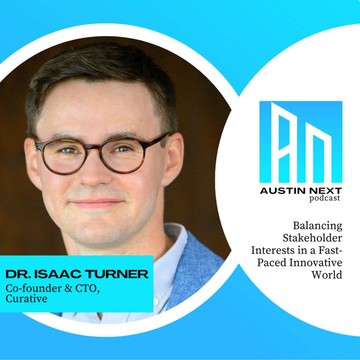
Balancing Stakeholder Interests in a Fast-Paced Innovative World with Dr. Isaac Turner, Co-founder and CTO of Curative
In this episode, we unpack the idea that innovation transcends the mere creation of new solutions. Through the lens of healthcare, and with insights from Dr. Isaac Turner, Co-founder and CTO of Curative, we delve into two key areas: how payment design can redefine user interactions, and the intricacies of diffusing groundbreaking innovations to ensure they're not only invented but also effectively adopted and utilized. While our discussions pivot around healthcare, the insights and challenges resonate across industries.Episode HighlightsCurative pivoted from COVID testing and vaccination programs to a vision to reshape the health insurance sector, emphasizing patient-centric care and efficiency.Central to Curative's approach is removing barriers to care. By eliminating copays, deductibles, and coinsurance for in-network services, and deploying non-clinical “care navigators” to assist members, they streamline the healthcare experience, encouraging patients to actively seek and manage their care.The distinct paradox for insurers lies is benefits like preventative care. Immediate financial returns are minimal and might even accrue to competitors due to customer turnover, while overall they are better for the patient and long term plan fiscal health. Obesity drugs such as Ozempic/Wegovy and advancements like cancer liquid biopsies highlight the intricacies of the diffusion of innovation in healthcare. Success hinges on aligning the interests of patients, providers, and payers, ensuring these solutions not only penetrate the market but also become accessible, adopted, and effectively utilize.Austin's dynamic growth, varied employment sectors, and a supportive healthcare regulatory backdrop made it Curative's prime choice as an innovation hub.What’s next Austin? “We want to bring better benefits to more Austinites — expanding our footprint and getting the message out so that they can have zero-dollar coverage”Dr. Isaac Turner: LinkedIn, X/TwitterCurative: Website, LinkedIn, X/Twitter, YouTube, Facebook:
-------------------Austin Next Links: Website, X/Twitter, YouTube, LinkedInEcosystem Metacognition Substack

Aug 29, 2023 • 57min
Fueling and Riding the AI Wave with Risto Miikkulainen, Professor of Computer Science at the University of Texas at Austin
In this episode, we dive deep into the AI wave and the nexus between academic research and commercial applications. Joining us is Risto Miikkulainen, an esteemed computer science professor at the University of Texas at Austin and AVP of Evolutionary Intelligence at Cognizant Technology Solutions. Together, we explore the journey to the current AI boom, delve into the era of digital natives, and assess Austin's pivotal role in shaping the future of artificial intelligence.Episode HighlightsThe recent explosion of progress in AI has been powered primarily by scaling up existing models with massive amounts of data and compute, rather than fundamental breakthroughs in new techniques.Unlike previous waves of technology adoption, these AI tools were in the hands of consumers before the enterprise, allowing for more fearless experimentation. In a real-world example, Jason's nine-year-old son created nonsensical prompts in Midjourney, yielding fascinating results that facilitated creative thinking and provided unique insights into the AI. The integration of AI into educational platforms like Khan Academy, along with decentralized research tools, raises the intriguing possibility of fostering 'citizen scientists.' However, there is still an open question about how fully this vision could be realized. Risto's current work specializes in using AI to create 'digital twins' of patients, enabling precise simulations to test and optimize various treatment strategies for conditions like stroke and dementia.UT Austin's new online master's programs extend its AI expertise globally while also potentially attracting more talent to Austin and aligning education with local industry needs.What’s next Austin? “We have lots of faculty and bright students who are learning about AI. Austin has a thriving startup community that hopefully will grow as a result. And one more factor is the medical school that was started. There are great opportunities, even for these large language models and generative AI in that domain. Try to encourage the AI folks and the medical folks to get together and identify these opportunities. That could be something that becomes a strength in Austin and we can become a world leader in it.”Risto Miikkulainen: Website, LinkedInConstant Therapy Health: WebsiteBoston University Center for Brain Recovery: Website AI Empowers Researchers to Bring Precision Medicine to Post-stroke Speech and Cognitive Rehabilitation
-------------------Austin Next Links: Website, X/Twitter, YouTube, LinkedInEcosystem Metacognition Substack
Aug 22, 2023 • 40min
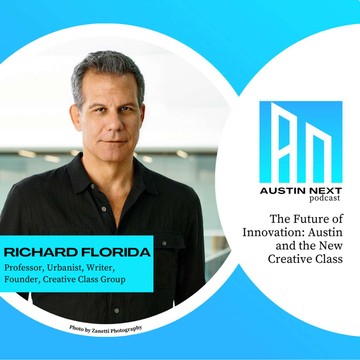
The Future of Innovation: Austin and the New Creative Class with Richard Florida
Why is Austin leading the charge as a beacon for creative minds and how are cities like it rewriting the blueprint for our economic future? Dive into this episode with Richard Florida, the trailblazer behind the "Creative Class" theory. As we explore Austin's magnetic pull and its broader implications for cities from Madison to Nashville, we'll uncover the intersection of traditional industries, tech-driven innovation, and the burgeoning global creator economy. Episode HighlightsRichard Florida developed the concept of the Creative Class to describe talented, highly skilled workers in technology, business, arts, and other innovative fields.The initial spark for the insights, theories, and eventual book “Rise of the Creative Class” stemmed from questioning why graduates from Carnegie Mellon were opting to move to Austin over Pittsburgh.Numerous heartland regions have the right foundation to adopt the Austin model, blending high-tech innovation in both the digital and physical realms. These cities stand uniquely positioned to bring together innovation, technology, and manufacturing revitalizing America's industrial foundation.Austin and Nashville represent the next phase of the Creative Class evolution, emerging as pivotal centers for the burgeoning creator economy, characterized by a seamless blend of technology, music/culture, and digital storytelling.What’s Next Austin? “I think Austin is part of this remaking of America around innovation and lifestyle, but with a real application to remaking our industrial base.” Richard Florida: Website, LinkedIn, X/TwitterRichard Florida’s Books: Rise of the Creative Class, The Breakthrough Illusion, Beyond Mass Production, The New Urban Crisis
-------------------Austin Next Links: Website, X/Twitter, YouTube, LinkedInEcosystem Metacognition Substack
Aug 15, 2023 • 58min
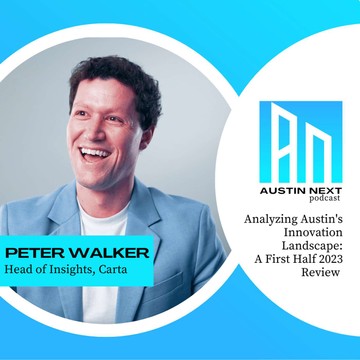
Analyzing Austin's Innovation Landscape: A First Half 2023 Review with Peter Walker, Carta’s Head of Insights
The startup ecosystem in Austin is experiencing a dynamic transformation, influenced by an influx of talent and marked changes in fundraising trends. Carta, an equity management platform that offers a distinctive lens into private market data, holds a unique vantage point to observe these shifts and more. Peter Walker, who helms Carta's Insights Team, joins us in this episode to shed light on the current landscape of US startup funding, the challenges of 2023, the intricacies of Austin's startup trajectory and its rising status as an epicenter for innovation and venture capital.Episode HighlightsCarta manages cap tables and equity for 38,000 startups, giving them unique insights into startup fundraising, valuations, employees, and compensation. This data covers about 50% of US startup funding.The fundraising environment in 2023 has been challenging for startups with activity significantly down from the 2021/2022 bubble, more down rounds and bridge rounds, though AI is an area still seeing excitement.Austin has around 380 pre-seed startups on Carta, with 175 seed and 174 series A. The numbers dramatically decrease in later rounds as the region is still is a maturing market and Silicon Valley still dominates Series C and beyond stage companies.74% of Series A rounds in Austin in Q2 2023 were bridge rounds, above the 44%-56% bridge round rate seen in other top regions, showing the high impact of the bubble on Austin startups.Diversification across sectors is an advantage for Austin versus other regions more dependent on specific verticals like biotech or SaaS. This diversity makes Austin better positioned to withstand downturns impacting individual sectors.Growth drivers like university talent, experienced angels, connector events, and an influx of talent from other regions position Austin for continued growth into a top-tier startup hub.What’s Next Austin? “I don't get the sense that it needs to prove itself anymore as a great place for venture capital and startups. Now, what it has to do is double down on some of the deepening things that happen in places like the bay and elsewhere. Is there enough density of interesting people who are excited about hard problems that want to get together and talk nerdy stuff to each other? And I think that's the place that Austin is at now, where that's like the last bit of ecosystem you turn around and you say, there's so much new stuff happening here.”Carta & Austin Next Austin's Innovation Landscape 1H 2023 Review Slides Peter Walker: LinkedIn, TwitterCarta: Website, LinkedIn, Twitter
-------------------Austin Next Links: Website, X/Twitter, YouTube, LinkedInEcosystem Metacognition Substack

