


Austin Next
Jason Scharf
Austin is building the new tech, cultural, and intellectual stack. The region is a living laboratory to answer a single question: How do you build a global innovation superpower?
Host Jason Scharf dissects innovation from the individual to the ecosystem. From the soundstage to the data center to the fab, we decode the mechanics of Austin's innovation ecosystem.
As Atoms, Bits, and Intelligence converge, we explore how Hard Tech scale, digital velocity, and creative density collide. This is an audit of the future. We map the physics of the flywheel so builders and investors can navigate the chaos.
Host Jason Scharf dissects innovation from the individual to the ecosystem. From the soundstage to the data center to the fab, we decode the mechanics of Austin's innovation ecosystem.
As Atoms, Bits, and Intelligence converge, we explore how Hard Tech scale, digital velocity, and creative density collide. This is an audit of the future. We map the physics of the flywheel so builders and investors can navigate the chaos.
Episodes
Mentioned books

Aug 8, 2023 • 49min
Embracing The Pathless Path with Paul Millerd
How do defined tracks and cultural status symbols passed on from previous generations affect a person’s life choices? When we break with those paths is that being self-employed, an entrepreneur, a creative, or something else? In this episode, we challenge the traditional notions of career paths and entrepreneurial journeys, with thought leader and author of "The Pathless Path" Paul Millerd. The conversation delves into his unconventional road to professional and creative fulfillment, how technology is creating more opportunity for people to follow the Pathless Path, and the role of storytellers & creatives in innovation ecosystems like Austin. Episode HighlightsPaul highlights the concepts from his book "The Pathless Path" that challenge traditional career paths and encourage unique, individual journeys in our evolving economy.Paul emphasizes the significant shift in work and career trajectories due to changing economic trends and advancements in technology, heralding new opportunities for autonomy and creativity.Alternative funding methods like the Thiel Fellowship and Emergent Ventures provide support for unconventional ideas and experiments, reshaping solopreneurship and entrepreneurship beyond just traditional VC-backed startups.The conversation underscores the role creatives historically have played in innovation ecosystems and how today that role is also being filled by digital storytellers, comedians, podcasters, creators, YouTubers, and Instagrammers. As Austin continues its rapid growth, rising costs pose a challenge to its creative scene, but acknowledging these obstacles allows for the formulation of strategies to maintain an inclusive and accessible hub for creativity and innovation.What’s next, Austin? “I actually do think storytellers, creators, YouTubers, Instagrammers, they're sort of underrated. They're storytellers that can link those different worlds. I think creative people are very natural at shifting between ideas and crowds and groups. Austin has been able to cultivate a scene around that, and I think it will continue to emerge and grow. What will it look like in ten years? The history of Austin is that scenes have always emerged and sort of faded away. So, what is the next scene? How do you keep cultivating that environment? Is it going to become too expensive to nurture and cultivate those scenes? I don't know. But yeah, it's going to be interesting to watch.”Paul Millerd: Website, Podcast, YouTube, X/TwitterThe Pathless Path
-------------------Austin Next Links: Website, X/Twitter, YouTube, LinkedInEcosystem Metacognition Substack
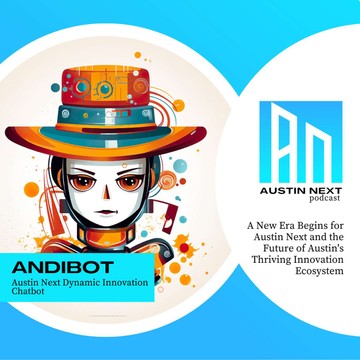
Jul 6, 2023 • 1h 12min
A New Era Begins for Austin Next and the Future of Austin's Thriving Innovation Ecosystem
In this culminating episode of Austin Next's first era, Jason engages with AndiBot, the AI-powered chatbot that amalgamates the insights of 19 innovation thinkers. Together, they explore AndiBot’s perspectives on how Austin can ascend to a superstar innovation hub. Later, Michael joins in for a reflective discussion on the AI's capabilities and the insights shared. Plus, don’t miss our special announcement that marks the beginning of a new chapter for Austin Next.Episode HighlightsThe Austin Next Dynamic Innovation ChatBot, or AndiBot, is an AI-powered chatbot anchored on ChatGPT, and is powered by a “hivemind” that brings together the intellectual prowess of innovation trailblazers such as Clayton Christensen, Everett Rogers, and Mariana Mazzucato. Tasked with unraveling insights and forging new pathways, AndiBot endeavors to illuminate the steps necessary for Austin to transition from a thriving ecosystem to a superstar innovation hub.Characterizing an innovation superstar hub, AndiBot outlines the quintessential traits: setting global trends, attracting a diverse talent pool, nurturing groundbreaking innovations, fostering a spirited entrepreneurial culture, establishing global collaborations, and achieving brand ubiquity in innovation.AndiBot evaluates Austin’s innovation ecosystem at 7.5 with Silicon Valley as the pinnacle scoring a 10. She commends Austin's startup landscape, academic strength, and appeal to tech giants, but signals the imperatives of escalating startup density, talent diversity, capital influx, and global network expansion.Jason and Michael reflect on the AndiBot interview and discuss the shift from coding to prompting in AI technology, signaling the emergence of more sophisticated and intuitive user interfaces.Exploring Austin's startup landscape, they articulate the connection between productivity and external perception, proposing that a boost in perceived value could stimulate infrastructural improvements.Jason spotlights Austin’s ability to “punch above its weight” noting the discrepancies between Austin's startup infrastructure rank (25th in the country) and its high ranking in exit values (6th in the nation, 9th globally) according to a recent Dealroom report.This episode marks a transition as Michael is taking a step back from the podcast and will return as the occasional guest.What’s next Austin? “I honestly believe only good things are going to happen next. I think we're going to have a recession nationwide within the next six months. But Austin, as we've discussed, is the last in and the first out. We need to keep Austin weird. It has worked so far for this town.”Episode LinksThe Next Generation of Tech Ecosystems Report by Dealroom
-------------------Austin Next Links: Website, X/Twitter, YouTube, LinkedInEcosystem Metacognition Substack

Jun 22, 2023 • 39min
Patient Capital, Potent Change: Ecliptic Capital’s Quest for Climate Tech Breakthroughs with David J. Neff, Operating Partner
In this episode, we dive into the world of patient capital and its potential to bring about transformative changes in climate technology. Joining us is David J. Neff, Operating Partner at Ecliptic Capital, who sheds light on Ecliptic's forward-thinking climatetech investment strategy, how they find innovations, and Austin's future as a hub for the sector.Episode HighlightsEcliptic Capital champions climatetech by prioritizing investments in adaptation, building and electrification, and then climate-friendly materials, aiming for long-term impact on climate issues and sustainable innovation.David outlines a triad for university tech transfer success: forging ties with venture capital, aligning mutual goals, and employing discerning professionals to sift groundbreaking technology from incremental improvements.The episode tackles the intricate regulatory landscape in climatetech, spotlighting the prolonged time to market and evolving environmental regulations as challenges.David emphasizes Austin's potential to transcend its software and SaaS prowess and emerge as a stronghold for climate technology and material science innovation.What’s next for Ecliptic Capital? “I think what's next for Ecliptic Capital is continuing a laser focus on really working with our founders, the people we've deployed capital to you. So I think we're continuing to do that. I think in fall of this year, we'll start talking about fund two and raising for fund two with very similar thesis.”What’s next Austin? “I hope people are thinking about climate. And the climate crisis is one of the fundamental biggest problems of this generation and the next generation. They quit that big tech job to go work on climate and I hope I see a lot more of that in Austin. It would make me very, very happy and our kids and our grandkids very happy that that's the problem you chose to work on.”Episode linksDavid J. Neff: LinkedIn, TwitterEcliptic Capital: Website, LinkedIn, TwitterEmbracing Systemic Complexity: The Ecliptic Capital Climate Thesis
-------------------Austin Next Links: Website, X/Twitter, YouTube, LinkedInEcosystem Metacognition Substack
Jun 15, 2023 • 40min
Austin vs. The World: Global Startup Ecosystem Rankings with Startup Genome’s Forrest Wright
In this episode, we take a discerning look at Startup Genome's Annual Ecosystem Report, seeking to comprehend what the data reveals about Austin's innovation landscape, while also critically examining and challenging it where discrepancies arise. Forrest Wright, Research Assessment Lead at Startup Genome, joins us to decode the metrics and shed light on Austin’s present and future trajectory in the innovation sector.Episode HighlightsStartup Genome's insightful report evaluates 290+ global startup ecosystems by scrutinizing six pivotal metrics: performance, funding, market reach, connectedness, talent, and knowledge.Despite a global 35% decline in startup funding in 2022, an unexpected trend emerged - the amount of funding per startup saw a significant surge, with AI cementing its position as a leading sector.Singapore's meteoric rise in the rankings from 18th to 8th is attributed to an influx of venture capital funding, the creation of 4 billion-dollar exits, and the emergence of 18 unicorns, including Coda Payments, which secured an impressive $690M in Series C. Demonstrating resilience and harboring potential for growth, Austin holds steady at 25th in the rankings despite a 30% fall in large-scale exits, countered by its burgeoning count of 12 unicorns.Breyer Capital, Bedrock Capital, and 8VC are among the heavyweights moving to Austin, signaling a strong belief in its ecosystem. This migration starkly contrasts Startup Genome's more retrospective rankings and the forward-looking confidence expressed by these industry leaders.What’s next Austin? “The future is really bright. I think it actually bodes really well for Austin is you have these stalwart AI companies already there like SparkCognition, Mythic, and Tethr. I think they've all raised north of a hundred million dollars and some of them much more than that. And so I think this is a lot of built-in institutional knowledge that's going to be a real advantage for Austin compared to a lot of companies that are starting now to kind of jump on the bandwagon. Austin's going to have a real advantage there.”Episode LinksForrest Wright: LinkedInStartup Genome: Website, LinkedIn, TwitterStartup Genome Global Startup Ecosystem Report 2023
-------------------Austin Next Links: Website, X/Twitter, YouTube, LinkedInEcosystem Metacognition Substack
Jun 6, 2023 • 36min
When Austin Next and Tech Connect: Exploring Q2 Software’s Digital Innovations with Lou Senko, Chief Availability Officer
In this special crossover episode of Austin Next and Austin Tech Connect, we welcome Lou Senko, the Chief Availability Officer at Q2 Software. Lou, an industry veteran with over two decades of experience in spearheading enterprise-wide solutions, enlightens us about Q2's mission-driven approach. We explore Q2's dynamic role in innovation, its extensive engagement with the vibrant Austin community, and its strategic focus on fostering a sustainable future for digital banking.Episode HighlightsQ2 Software democratizes digital banking, giving local and regional banks and credit unions a competitive edge against their larger counterparts.Lou Senko, in his role as Chief Availability Officer, guarantees secure and seamless banking experiences, accessible anytime, anywhere, across various devices and networks.Q2's innovation studio serves as a bustling marketplace and accelerator, offering pre-packaged, customizable solutions from a range of startups, allowing swift system integration.Q2 is deeply embedded in the Austin community. It holds the naming rights to the Austin FC stadium, runs the Dream Starter competition that provides a $100,000 grant to local start-ups, and contributes both financially and through volunteers to local charities.Community, Collaboration, or Conversation? “I think the collaboration though, if I think about my day and how we work through where we want to go, where we want to be, what good looks like on our journey to get there. It's through collaboration. Our staff can choose to work wherever they want to work. They choose to work at Q2 because, again, for 11 years in a row we've been, the best place to work.”What’s Next? “It's all about the customer. We're seeing people see value in digital platforms. I think the ecosphere, the ecosystems will continue to grow. I think you're going to see much, much tighter integration with the way banks and credit unions bring services to market, that there's going to be a bunch of FinTech names attached to all this.”Episode linksLou Senko: LinkedInQ2 Software: Website, LinkedIn, TwitterThom Singer: Website, LinkedIn, TwitterAustin Tech Connect Podcast
-------------------Austin Next Links: Website, X/Twitter, YouTube, LinkedInEcosystem Metacognition Substack
May 30, 2023 • 35min
Austin's Autonomous Vehicle Revolution with Michael Staples, General Manager - AUS Market at Cruise
The transportation landscape in Austin is rapidly transforming with the advent of electric and autonomous vehicles. Taking a pioneering stance, Cruise, a subsidiary of General Motors, is already offering the public the chance to experience their self-driving vehicles. Leading this revolution in Austin is Michael Staples, Cruise's General Manager for the region. In this episode, we explore the exciting advancements in autonomous vehicle technology happening here.Episode HighlightsAustin was chosen for its dynamic tech ecosystem, welcoming attitude towards innovation, and regulatory environment conducive to the development of self-driving technologies.Staples underlines Cruise's use of thorough safety studies, such as the 'Million Mile' report, to boost public trust and showcase their dedication to regulators.By focusing on downtown nightlife, Cruise aims to better understand the needs of service workers, students, and young professionals, using less congested conditions to optimize their autonomous technology.The upcoming Origin, a rider-centric vehicle with luxury amenities, a cargo unit, and wheelchair accessibility, represents a significant evolution from Cruise's current Chevy Bolt.Increasing fleet size is a central strategy for Cruise in Austin, with goals to shorten wait times and broaden service coverage across the Austin Metro area.Cruise's long-term vision includes giving back to communities by minimizing the need for parking spaces and saving users' time through efficient, autonomous transportation.What’s next? “We expect to launch the Origin experience to the public later this year. We're excited to service some customers and you're going to see a lot of our Bolts running around. We're going to be expanding the market as well. We'll be able to slowly service more Austinites. So eventually we can get rides from our homes across town.”Episode LinksMichael Staples: LinkedIn Cruise Self-Driving Cars: Website, LinkedIn, Twitter, Cruise 1 Million Mile Report
-------------------Austin Next Links: Website, X/Twitter, YouTube, LinkedInEcosystem Metacognition Substack
May 23, 2023 • 1h 7min
The Tech Tipping Point: A Thoughtful Exchange with Brett Hurt and William "whurley" Hurley
We welcome back tech pioneers Brett Hurt and William “whurley” Hurley for a deep dive into the transformative influence of technological convergence. Drawing from their vast experiences, Brett and Whurley shed light on the intersection of advanced techs, such as generative AI and quantum computing, that are rapidly redefining our world. In our engaging discussion, we uncover the profound implications these emergent technologies have on industries, their role in supercharging productivity, and how they could catalyze an unprecedented surge in startup creation.Episode HighlightsThe conversation highlights a pivotal tech convergence, where AI intersects with quantum computing, Big Data, data privacy, and every other fundamental platform that has come before. Generative AI's rapid rise has been met with excitement and unease, calls for political regulation, all amidst highly divergent dystopian and utopian views.Echoing similar themes, Brett envisions AI as potentially the "biggest startup and job creation engine we've ever seen," while whurley posits it leading to a "rise of the non-creative creative class," amplifying the transformative potential of the technology.Brett highlights the importance of creativity for engineers in the AI era, suggesting that those who can combine their technical skills with imagination will thrive, while those who can't may face commoditization.Whurley’s recent dialogues with DC leaders underscores Austin's growing influence in shaping national technology policy and wider industry trends.What’s next Austin?Brett Hurt: “I think that we're going to have an absolute explosion in the number of startups created. And as an effect of that, a derivative explosion in the number of jobs...I really want Austin to be the leader of that.” William “whurley” Hurley: “Everybody's talented, everybody plays an instrument, everybody paints or does art or they sculpt or whatever. It is a very creative city. So when you take those kinds of people and you give them this kind of power...like absolutely, Austin is next. If we're lucky.”Episode linksWilliam “whurley” Hurley: Website, LinkedIn, Twitter, StrangeworksBrett Hurt: Website, LinkedIn, Twitter, data.world
-------------------Austin Next Links: Website, X/Twitter, YouTube, LinkedInEcosystem Metacognition Substack
May 16, 2023 • 13min
Austin Next Spotlight: Getting to the Next Funding Round with ClearCam
Doug Stoakley, co-founder and president of ClearCam, joins us for an Austin Next Spotlight. He shares the story of how ClearCam was founded and its most recent funding round.Episode Highlights:ClearCam is a revolutionary medical device that aims to solve the problem of dirty cameras in laparoscopic surgeriesThey just closed their Seed Series 3, raising over $4 million with a post-money valuation of $18.5 millionThe University of Texas at Austin continues to drive innovation as ClearCam was the second investment of UT’s new seed fund With the new funding, the team is now leaning into commercialization and expanding its product lineEpisode linksDoug Stoakley: LinkedInClearCam: Website, Facebook, LinkedIn
-------------------Austin Next Links: Website, X/Twitter, YouTube, LinkedInEcosystem Metacognition Substack
May 9, 2023 • 42min
Austin's Next Innovation Hub: The Vision Behind the University of Austin with Pano Kanelos
The University of Austin is a new and promising institution set to open its doors to full time students in just over a year. The university is the brainchild of a few individuals who believe that an institution based on a new model is necessary. The school is committed to freedom of inquiry, a core tenet of any great university, that allows for the pursuit of truth. Today’s guest is the founding president, Pano Kanelos, a distinguished academic that had a successful tenure at St. John's College. We discuss the university's mission, building new institutions, and how they fit within Austin’s education and innovation ecosystems.Episode HighlightsThe University of Austin aims to become a new center for innovation and academic freedom in the city.UATX aspires to become the "Stanford to Berkeley" for Austin, complementing the University of Texas.By working closely with industry leaders, the university seeks to co-develop programs, offer internships, and provide support for student-led projects.The Polaris Project emphasizes real-world application and impact on pressing global problems, while fostering interdisciplinary collaboration among students.They want to inspire new institutions around the world by proving that it’s possible to build a new university todayWhat’s next Austin? “A dozen years from now, there is a thriving campus in the Austin area that is attracting scholars, practitioners, and young people from across the country and across the world who are building things that we haven't yet dreamed of.”Episode linksUniversity of Austin: Website, Twitter, LinkedIn
-------------------Austin Next Links: Website, X/Twitter, YouTube, LinkedInEcosystem Metacognition Substack
May 2, 2023 • 38min
Breaking the Boundaries between Deeptech and Traditional Tech in Austin with Andrew Busey Co-Founder & Co-CEO of Form Bio
The world of technology is expanding, and we're seeing a convergence of deep tech with traditional software and computation. Today, we're speaking with Andrew Busey, co-founder of Form Bio and Colossal Biosciences, two companies that sit at this intersection. With over 25 years of experience in the industry, Andrew has been a driving force behind some of the internet's most significant technologies. Andrew’s career has taken him through several pivotal moments in tech history, including the early days of the internet, gaming, AI, and now bio.Episode HighlightsAndrew’s career spanned key tech products such as Mosaic (the first web browser), iChat (the first web-based chat system), and Zynga (one the most popular gaming companies of the social media era)Software entrepreneurs are increasingly applying techniques, business models, and more to the bio, quantum, and AI fieldsHis approach is to make Reese’s Peanut Butter Cups “…software is either the chocolate or the peanut butter and then I'm finding some other thing to combine with it to make something that tastes great and is novel”Form Bio, the first spinout from Colossal Biosciences, aims to solve the badly managed data issue in the biotech industryAI's impact on business and society is shifting toward distributed vertical intelligenceThe availability of remote work technology may lead to a more distributed talent pool and impact the future of Austin as a tech hubWhat’s next Austin? “I think the big thing we're gonna see is fabs and Musk-related companies evolving here and how that affects the mix of things will be very interesting.”Episode linksAndrew Busey: Twitter, LinkedInForm Bio: Website, Twitter, LinkedInColossal Biosciences: Website, Twitter, LinkedIn
-------------------Austin Next Links: Website, X/Twitter, YouTube, LinkedInEcosystem Metacognition Substack

