


Austin Next
Jason Scharf
Austin is building the new tech, cultural, and intellectual stack. The region is a living laboratory to answer a single question: How do you build a global innovation superpower?
Host Jason Scharf dissects innovation from the individual to the ecosystem. From the soundstage to the data center to the fab, we decode the mechanics of Austin's innovation ecosystem.
As Atoms, Bits, and Intelligence converge, we explore how Hard Tech scale, digital velocity, and creative density collide. This is an audit of the future. We map the physics of the flywheel so builders and investors can navigate the chaos.
Host Jason Scharf dissects innovation from the individual to the ecosystem. From the soundstage to the data center to the fab, we decode the mechanics of Austin's innovation ecosystem.
As Atoms, Bits, and Intelligence converge, we explore how Hard Tech scale, digital velocity, and creative density collide. This is an audit of the future. We map the physics of the flywheel so builders and investors can navigate the chaos.
Episodes
Mentioned books
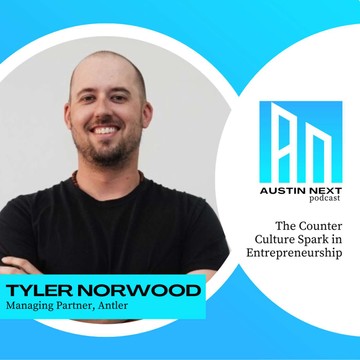
Jan 30, 2024 • 58min
The Counter Culture Spark in Entrepreneurship with Tyler Norwood, Managing Partner at Antler
Is an entrepreneur a high-status position or are true innovators actually counter-cultural icons? This intriguing question forms the heart of my conversation with Tyler Norwood, Managing Partner at Antler. We discuss the role and impact of accelerators, the shift towards physical verticals and its implications for regional ecosystems, and the defining moments that shape generations of builders.Episode HighlightsAntler's accelerator model is an eight-week, intensive evaluation program for founders, focusing on practical assessments over traditional business planning, culminating in a potential investment.True disruptive innovation is inherently countercultural as it challenges established norms and appeals to those intrinsically motivated rather than by external status.The Texas corridor's continued rise as global economic powerhouse is driven by the innovation surge in physical domains like energy, semiconductors, and space exploration.The stagnation in productivity over the last 50 years may be attributed to the absence of 'frontier moments' that ignite public imagination, emphasizing the crucial role of inspiration in driving progress.Ambitious projects like space exploration not only achieve technological feats but also inspire future generations, while conversely, those who don't witness such achievements may doubt the possibility of innovation.What's Next Austin?In the next five to 10 years, Austin is going to have a surprising amount of really large, very successful, very innovative companies sprout up here.Tyler Norwood: LinkedIn, X/Twitter, Podcasts - Early Days, The DealAntler: Website, LinkedIn, X/Twitter (Global), X/Twitter (US),
-------------------Austin Next Links: Website, X/Twitter, YouTube, LinkedInEcosystem Metacognition Substack
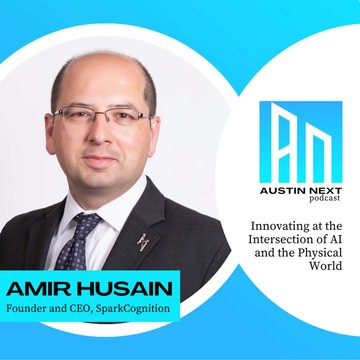
Jan 23, 2024 • 50min
Innovating at the Intersection of AI and the Physical World with Amir Husain, Founder and CEO of SparkCognition
The next phase of AI's evolution focuses on its convergence with the real world and the built environment, a key theme in my discussion with Amir Husain, Founder and CEO of SparkCognition. We explore the intersection of digital bits and physical atoms, examining the implications and challenges of creating solutions in this space, the progression of AI hardware, and Austin's potential as a hub for autonomy.Episode HighlightsSparkCognition aims to develop an AI-powered operating system for the global $100 trillion existing infrastructure and the upcoming $100 trillion.The unpredictability and rarity of real-world events, such as machinery failures, introduce unique complexities in applying AI to physical systems, necessitating innovative approaches to data and modeling.Crucial for effective interaction with the physical world, multimodal AI integrates varied data types, such as temperature, vibration, and vision, thereby enhancing real-world applications.Edge AI is essential for real-time, autonomous decision-making, embedded locally within hardware, especially in high-stakes scenarios like defense and aviation, where cloud access is often unreliable or unavailable.What's Next Austin?“I would like Austin to be the birthplace…within which this new type of technology is formed, where systems that can take care of themselves, that are entirely self-contained, that can run on their own, optimize themselves, resolve issues within themselves to the maximum degree possible, can become the new infrastructure of this planet. And if that is a gift that Austin can give to the world, it would be one of the greatest gifts ever.”Amir Husain: Website, X/Twitter, LinkedIn, Generative AI for Leaders SparkCognition: Website, X/Twitter, Facebook, Instagram, LinkedIn
-------------------Austin Next Links: Website, X/Twitter, YouTube, LinkedInEcosystem Metacognition Substack
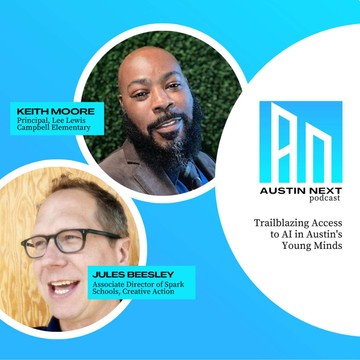
Jan 17, 2024 • 44min
Trailblazing Access to AI in Austin's Young Minds
We shift focus from the broad, macro-level implications of AI to its tangible effects on the ground, as Austin increasingly becomes a hub for educational innovation. Joining me are Principal Keith Moore of Austin's Campbell Elementary and Jules Beesley from Creative Action. We discuss their efforts in bringing AI and other cutting-edge technologies to their scholars, emphasizing the importance of providing access to these tools and technologies for students today and their impact on our future.Episode HighlightsThe goal of integrating AI in early education is to create access and provide opportunities for learning and exploring new technologies.They strive to integrate the latest tools, keeping pace with their rapid evolution while ensuring effective learning experiences for students.Demonstrating endless imagination, 4th graders created audio-visual poems combining their written and spoken words with striking images, while 5th graders produced science shows, integrating curriculum topics with personal creativity.Austin's education market is increasingly becoming a hub for experimentation, characterized by the emergence of creative groups, unique partnerships, and new schools/universities, all offering diverse paradigms in education and technology.What's Next Austin?Principal Moore: Greater opportunities for scholars, through increasing the use of technology, in these wonderful ways, to connect core curriculum to the arts.Mr. Beesley: How can we use these tools to tell stories, to use our imaginations, as well as explore issues of how we create.Campbell Elementary School: Website, InstagramCreative Action
-------------------Austin Next Links: Website, X/Twitter, YouTube, LinkedInEcosystem Metacognition Substack
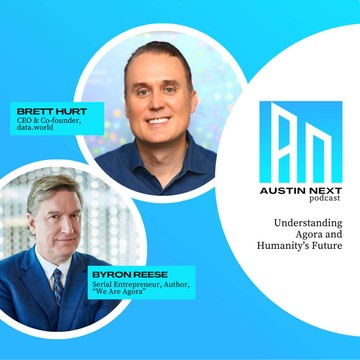
Jan 9, 2024 • 1h 13min
Understanding Agora and Humanity's Future with Byron Reese and Brett Hurt
In this thought-provoking episode, we are joined by Byron Reese, author of 'We are Agora,' and Brett Hurt, serial entrepreneur, to explore the intersections of superorganisms, technology, and human potential. The ideas presented in Byron's book, serve as a springboard to discuss how evolving technologies shape our future and the unfolding narrative of humanity.Episode HighlightsByron new book "We are Agora" explores superorganisms, drawing parallels between natural examples like beehives and emergent entities from human activity.The concept of Agora is debated in relation to Adam Smith's invisible hand, free will, and human evolution, highlighting both the areas of convergence and divergence.Human knowledge progression is traced from DNA to language to writing to the printing press to the internet, and now AI, each phase enhancing our ability to build upon previous knowledge.The role of individual kindness and positive human actions is emphasized as crucial in sustaining and advancing the societal superorganism.What’s Next?Byron: “We will spread to a billion planets, and we'll populate each of them with a billion people. and each of those billion people will be empowered to live their best possible life… Every Da Vinci will paint their Mona Lisa. Every Marie Curie would make her discoveries. Everybody would be empowered to achieve the most that they could they could”Brett: “Along the way of shooting high like, whether it's colonizing other planets, where it's inventing AGI, whether it's merging with the machines, whatever it is, we will invent so many things that are so bewilderingly great and make humanity better than ever before. That's our natural destiny”The 4 Billion-Year History of AI’s Large Language Models by Byron Reese & Brett HurtWe are Agora by Byron ReeseByron Reese: Website, LinkedIn, X/Twitter Brett Hurt: Website, LinkedIn, X/Twitter, data.world
-------------------Austin Next Links: Website, X/Twitter, YouTube, LinkedInEcosystem Metacognition Substack
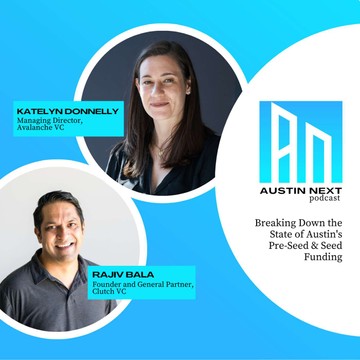
Dec 19, 2023 • 51min
Breaking Down the State of Austin's Pre-Seed & Seed Funding with Katelyn Donnelly and Rajiv Bala
The impetus for this episode was a recent viral tweet stating that "Austin desperately needs another real pre-seed fund." This sparked fierce debate around the health and scalability of Austin's earliest-stage investing landscape. Looking to settle the controversy, I interviewed two Austin-based VCs laser-focused on pre-seed and seed - Avalanche VC's Katelyn Donnelly and Clutch VC's Rajiv Bala. We discuss how we define the stages, the evolution of the Austin market, and what trends they saw this year and heading into next.Episode HighlightsAvalanche VC invests in the first institutional round of companies transforming how people learn, earn, and own. Their focus areas include edtech, future of work, SaaS for small businesses, and companies related to home ownership or data ownership.Clutch VC is a pre-seed and seed stage fund focused on Texas B2B software businesses. They aim to be the first institutional money in, participating in angel rounds up to $2 million pre-seed rounds.The pre-seed round definition is usually less than $2 million raised, no revenue or early revenue/pilots. Seed rounds are around $3-5 million raised with $500k-$1.5 million ARR.There is a lack of dedicated, local pre-seed funds in Austin compared to ecosystems like Seattle. More diverse early-stage managers are needed in Austin to cover the variety of companies starting up.Katelyn observes a variety of small firms and solo GPs in Austin with vertical focuses, contrasting this with more generalist early-stage funds in other regions.Rajiv provides a historical perspective on venture capital in Texas, highlighting the evolution from telecom and semiconductor to software and the shift of VC focus to Austin post-dot-com crash.What’s next Austin?Rajiv: “I am just so excited about the opportunity set of the companies that are going to be built here in the next decade. I think the next $10 billion, $100 billion company is going to come out of Austin.”Katelyn: “I've been using the word ‘Austin's Scenius which is a combination of ‘genius’ plus ‘scene.’ I just feel this momentum of this collective genius in Austin, which is mixing and percolating and coming together for maker weekends and building things and trying things out. I think there's going to be amazing companies that are coming out of Austin, and they will be started next year and the year after that.”Katelyn Donnelly: Linktree, LinkedIn, X/TwitterAvalanche VC: Website, LinkedIn, X/TwitterRajiv Bala: LinkedIn, X/TwitterClutch VC: Website, LinkedIn, X/Twitter
-------------------Austin Next Links: Website, X/Twitter, YouTube, LinkedInEcosystem Metacognition Substack
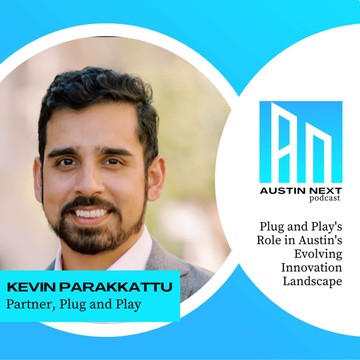
Nov 28, 2023 • 50min
Plug and Play's Role in Austin's Evolving Innovation Landscape with Kevin Parakkattu, Partner at Plug and Play
As Austin continues to attract leading tech players and establish itself as a magnet for innovation, the role of new entrants becomes increasingly pivotal in shaping its future. In this episode, I talk with Kevin Parakkattu, Partner at Plug and Play, to explore their distinct approach to the entrepreneurial ecosystem. We cover a range of topics including the effects of their strategies on local markets, why Austin’s manufacturing, bio/health, and aerospace/defense sectors are key focus areas, and the broader implications for tech development and regional innovation.Episode HighlightsPlug and Play's unique model combines physical space, corporate innovation, and venture capital to foster startup growth and ecosystem development.Evolving from real estate to venture capital with early stakes in Google and PayPal, Plug and Play has now accelerated over 2,500 startups worldwide, including more than 35 unicorns.Shortly after initiating their program in Alberta, their presence has already prompted notable local shifts, with three cohort companies relocating and four establishing second headquarters.Austin's corporate growth, increasing number of unicorns, and tech promise were decisive in its selection as a new Plug and Play hub, with an emphasis on the region's emerging strengths in advanced manufacturing, bio/health, and aerospace/defense sectors.Locating Plug and Play in Cedar Park, outside the central core of Austin, mirrors the region's evolution into a multi-hub area. This choice aligns with the needs of specific industries, as exemplified by the practicality of "You can’t build a rocket downtown."As Austin's innovation landscape rapidly evolves, there's a growing focus on merging new ideas from recent transplants with local expertise, balancing the infusion of fresh attitudes while preserving the region's unique character.What’s next Austin? “Plug and Play in Cedar Park, where we will become the innovation hub of the region.” Kevin Parakkattu: LinkedIn, X/TwitterPlug and Play: Website, LinkedIn, X/Twitter, Facebook
-------------------Austin Next Links: Website, X/Twitter, YouTube, LinkedInEcosystem Metacognition Substack

Nov 14, 2023 • 42min
From the Archive: Austin's Next Innovation Hub - The Vision Behind the University of Austin with Pano Kanelos
An update since our original episode aired on May 9, 2023: The University of Austin is now accepting applications for their first undergraduate class starting fall 2024. To mark this milestone, we are resharing our interview with founding president Panos Kanelos. The University of Austin is a new and promising institution set to open its doors to full time students in just over a year. The university is the brainchild of a few individuals who believe that an institution based on a new model is necessary. The school is committed to freedom of inquiry, a core tenet of any great university, that allows for the pursuit of truth. Today’s guest is the founding president, Pano Kanelos, a distinguished academic that had a successful tenure at St. John's College. We discuss the university's mission, building new institutions, and how they fit within Austin’s education and innovation ecosystems.Episode HighlightsThe University of Austin aims to become a new center for innovation and academic freedom in the city.UATX aspires to become the "Stanford to Berkeley" for Austin, complementing the University of Texas.By working closely with industry leaders, the university seeks to co-develop programs, offer internships, and provide support for student-led projects.The Polaris Project emphasizes real-world application and impact on pressing global problems, while fostering interdisciplinary collaboration among students.They want to inspire new institutions around the world by proving that it’s possible to build a new university todayWhat’s next Austin? “A dozen years from now, there is a thriving campus in the Austin area that is attracting scholars, practitioners, and young people from across the country and across the world who are building things that we haven't yet dreamed of.”University of Austin: Website, Undergraduate Application, X/Twitter, LinkedIn
-------------------Austin Next Links: Website, X/Twitter, YouTube, LinkedInEcosystem Metacognition Substack

Nov 7, 2023 • 39min
From the Archive: There’s Always an Us in Austin with Roy Spence, Co-Founder and Chairman of GSD&M and Founder of the Make it Movement
Guest Roy Spence, Co-Founder and Chairman of GSD&M and Founder of the Make it Movement, talks about the challenge of preserving Austin's core while stimulating progress. They discuss the original GSD&M plan, Austin's evolution into a city of new ideas, and the Make It Movement's goal of helping young people discover their potential. Roy also highlights the need for Austin to rediscover its purpose and embrace individual freedom and collective responsibility.

Oct 31, 2023 • 13min
How My 10-Year-Old Son Became a ChatGPTer
Today I explore how AI is reshaping learning and challenging traditional expertise. Through my own experiences with my 10-year-old son, we'll look at the potential of AI as a new educational frontier. Don't miss this intimate journey into the transformative impact of technology on the next generation.Episode HighlightsAs new technology empowers not just a new wave of entrepreneurs, it is also challenging traditional expertise, and raising questions about the role of AI in shaping the next generation.With AI, a 10-year-old navigates vocabulary lessons, receives a tailored educational thought partner with ChatGPT, and explores startup dynamics through a bespoke interactive game.AI's role in education foretells democratized access to knowledge and a potential overturning of the traditional teaching paradigmWhat’s Next? “Whether it be the “Non Creative Creative Class”, the “Non Scientist Researcher”, the AI natives or as my son is starting to call us the ChatGPTers, this quickly approaching new era is going to be powered by those who are fearless, curious, and ready to explore.”The Tech Tipping point w/Whurley & Brett HurtDecentralized Science and the Future of DiscoveryHow AI & Automation are Creating a New Wave of Entrepreneurs w/ Sameer Gulati
-------------------Austin Next Links: Website, X/Twitter, YouTube, LinkedInEcosystem Metacognition Substack

Oct 24, 2023 • 18min
How Austin Can Write Its Own Innovation Roadmap
In this special solo episode, I dive into what makes Austin not just another 'Silicon Something' and about how we can transform into a generational ecosystem. After defining our region’s superpowers, I introduce a new mental model that synthesizes Austin's eclectic influences, from bleeding-edge technology to advanced manufacturing to the intellectual and creative spheres. All of this puts us on path to offer a promising vision for What’s Next Austin.Episode HighlightsAs cities worldwide strive to become the next Silicon Valley, adopting monikers like "Silicon Hills" in Austin, the real key to becoming a superstar innovation hub lies in leveraging unique local "superpowers" and assets.Among Austin's 'superpowers' are its ability to invent and then deploy groundbreaking technologies locally, such as 3D-printed neighborhoods, and to radiate a 'cool factor' via iconic events like SXSW and brands like Yeti, as well as excelling in physical innovations like electric vehicles, advanced semiconductors, and rockets.In stark contrast to more hierarchical ecosystems that resemble an 'onion,' Austin's open networks and culture of collaboration make room for creative collisions, fostering a dynamic and accessible environment.A new framework is introduced that positions Austin as a unique blend of Silicon Valley's technological prowess, 1950s Detroit's manufacturing ingenuity, and 1920s Paris's intellectual and creative richness.What's Next Austin? "In the longer term, our focus should be on increasing the density of founders, funders, and innovators within our region. Just like in ancient Athens or Renaissance Florence, I want to bump into the next Socrates or Da Vinci as I take a walk through Austin."📘Zero to One by Peter Thiel 📘Startup Communities by Brad Feld 🎙️The Cities that Shaped Us w/Chelsea Follett 📘Centers of Progress by Chelsea Follett 🎙️There’s Always an Us in Austin w/Roy Spence 🎙️ Catalyzing Innovation in Austin w/Kaitlyn DeBernardo & Aaron Perman 🎙️The Future of Innovation: Austin and the New Creative Class w/Richard Florida 📘Rise of the Creative Class by Richard Florida 🎙️Can A Simple Walk Revolutionize Networking w/Elle Beecher
-------------------Austin Next Links: Website, X/Twitter, YouTube, LinkedInEcosystem Metacognition Substack

