

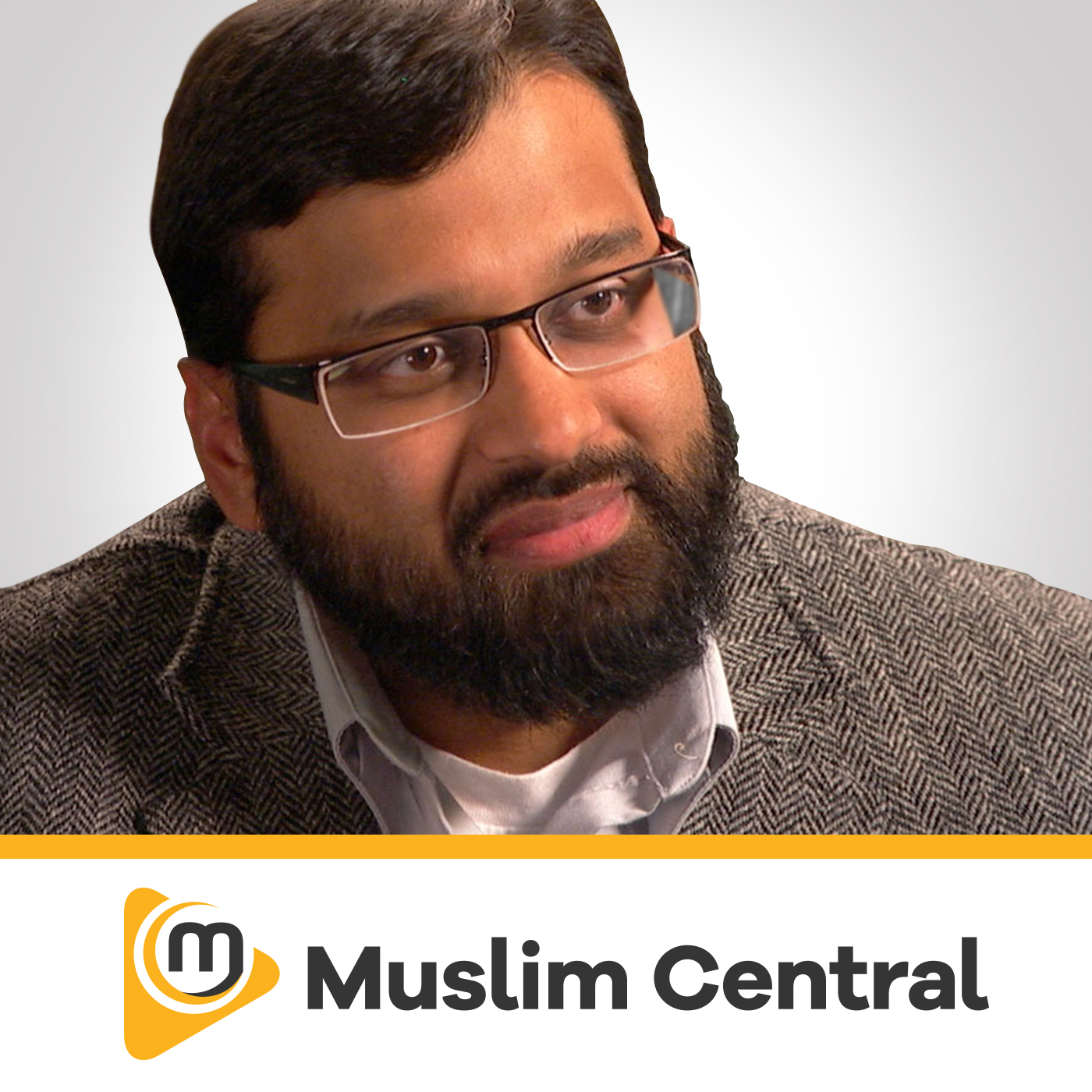
Yasir Qadhi
Muslim Central
Yasir Qadhi was born in Houston, Texas and completed his primary and secondary education in Jeddah, Saudi Arabia. He graduated with a B.Sc. in Chemical Engineering from the University of Houston, after which he was accepted as a student at the Islamic University of Madinah.
After completing a diploma in Arabic, he graduated with a B.A. from the College of Hadith and Islamic Sciences.
Thereafter, he completed a M.A. in Islamic Theology from the College of Dawah, after which he returned to America and completed his doctorate, in Religious Studies, from Yale University. Currently he is teaching at Rhodes College, in Memphis, TN.
After completing a diploma in Arabic, he graduated with a B.A. from the College of Hadith and Islamic Sciences.
Thereafter, he completed a M.A. in Islamic Theology from the College of Dawah, after which he returned to America and completed his doctorate, in Religious Studies, from Yale University. Currently he is teaching at Rhodes College, in Memphis, TN.
Episodes
Mentioned books

Aug 31, 2014 • 1h 14min
Seerah – 86 Recap & Lessons from Hunayn & Ta'if
Shaykh Yasir Qadhi recaps for us the previous lectures in the series and in particular we reacquaint ourselves with some of the benefits that can be extracted from the battle of Hunayn and the siege of Ta'if:
Trust in Allah should be at the forefront and the basis of every victory about which the Muslims had a brief lapse.
Being drawn towards worldly desires, power, ambition and wealth is a given with mankind as was even shown in the case of the Ansar when the Ghaneema was being distributed.
The mode of action that should be adopted when dealing with past offences.
Thorough understanding of the human psychology is paramount as was also exhibited by the Prophet ﷺ.
The topic of the prisoners of war and subsequently the issue of slavery in Islam.
The conversion of Ka'b ibn Zuhair to Islam after the battle of Hunayn.
Very clear laws have been stated with regards to slavery such as:
Islam only allowed one source of slaves - prisoners of wars who weren't ransomed.
Legislated proper treatment of the slaves.
What was the impact of the battle of Hunayn and Ta'if?
A clear victory in hijaz with the entire tribe converting to Islam.
Complete abolishment of Idolatry such that it resulted in the annihilation of shirk completely from Arabia and within 22 years of the Prophethood of the Prophet ﷺ.
Conversion of the entire tribe to Islam.
Aug 31, 2014 • 1h 18min
85 Miracles of Prophet Muhammad
Shaykh Yasir Qadhi now delves into a very interesting and mesmerising topic which is the miracles of the Prophet ﷺ.
What is a mu'jiza or a miracle? A mu'jiza is anything that the remainder of mankind is incapable of recreating and it is something that we are unaccustomed to. It proves the claim of Prophethood to a large extent but it is not the only factor for designating oneself as a Prophet. It is the sunnah of Allah that he has sent Prophets with miracles to reassert the fact that the human who is a Prophet has been sent down by Allah SWT.
Imam al Bayhaqi accounts around 1000 miracles that have occurred in the life of the Prophet ﷺ. Hatim ibn Hajar, the master of hadith, quotes Imam Nawawi that there are approximately 1200 miracles documented from the Messenger of Allah ﷺ.
There are 10 categories of miracles that transpired in the life of the Prophet ﷺ:
Miracles related to inanimate objects.
Miracles with animals.
Miracles with food and water.
Allah’s protection given to the Prophet ﷺ.
Knowledge of the unseen given to the Prophet ﷺ.
Predictions of the future.
The healing of the Prophet ﷺ.
Immediate response to his Dua.
Stories of the previous Prophets.
Miscellaneous.
Jul 3, 2014 • 1h 34min
Fiqh of Umrah
Shaykh Yasir Qadhi delivers an amazing lecture on the Fiqhs of Umrah.
What is Umrah? The explanation given is a beautiful one. Umrah gets rid of sins and poverty just like a furnace gets rid of impurity from iron. Next, the Shaykh discusses the rewards and benefits of Umrah, followed by the Fiqh rulings and most common issues pertaining to Umrah to the house of Allah.
The Prophet ﷺ performed four Umrahs in his lifetime - an Umrah during Dhul-Qa'dah; the Umrah of Al-Hudaibiyah, an Umrah with his Hajj, and an Umrah from Al-Ji'ranah when he divided up the war spoils of Hunain.
Benefits of Umrah:
Expiation of sins
Eradication of poverty and attainment of wealth in your life.
Jihad of weak people such as elderly and women.
Mutamir are the guests of Allah - if they ask, then Allah will give them.
Increase the acceptance of Dua
Basics of the Fiqh of Umrah:
Arkan of Umrah - Ihram, Tawaf, Saee
Wajibat of Umrah - entering into Ihram at Meeqat, shaving or trimming of the hair.
Sunnah of Umrah
What is the Meeqat? What is Ihram from a Fiqhi perspective? The concept of Talbiyah is also pondered upon. It should be said incessantly when in Ihram until one arrives at the Bait al Haram.
What should not be done in Ihram?
No shaving or cutting hair
No cutting nails
No perfume
No stitched garments for men
No garment should be covering the head for men and women are not to wear niqab or gloves
No acts of intimacy
What is Tawaf and Saee? Shaykh Yasir Qadhi answers explicitly and also some Hadiths are shared relating to Zamzam.
Can we do multiple Umrahs? Various positions of Imams are shared and we get a clear opinion on the same.
Jun 17, 2014 • 29min
Du'a of Adam Vs. Du'a of Shaytan
Shaykh Dr. Yasir Qadhi makes a critical analysis in the magnitude of difference between the Du'a of Adam AS and the Du'a of Shaytan.
After eating from the forbidden tree as against the command of Allah, Adam AS supplicated for forgiveness in front of Allah SWT and Allah in His Infinite Mercy forgave Adam AS.
In a similar fashion, Shaytan or Iblis too supplicated to Allah SWT after disobeying His command. Iblis was also granted what he wished for.
So, what is the difference between these two situations? The difference lies in what was asked and how it was asked to Allah. Listen intently and be riveted in the lecture.
May 13, 2014 • 58min
Seerah – 84 Conversion of Ka'b ibn Zuhayr
Shaykh Yasir Qadhi delves into the story behind the conversion to Islam of one of the most illustrious poet of the time - Ka'b ibn Zuhayr who was the son of Zuhayr ibn Abi Salma. Zuhayr was a celebrated poet himself having written the seven hanging poems. He had died before the advent of Islam but his son Ka'ab had huge animosity for the Muslims writing poetry against them and also belittling women in the worst way possible.
Ka'ab thought about conversion to Islam on the insistence of his newly converted Muslim brother and this brings him to Madinah to the Prophet ﷺ. And he eventually does enter the religion of Islam. How does it happen? Listen intently.
'The poem of Banat Su'ad' is an important topic for discussion which was given the name - 'the poem of the Burda'.how did this come to be?what is the story behind this?There are two Burdas: the original Burda (cloak) which is the original one and this is was written by Ka'b.
When the Prophet ﷺ heard this poem, he was immensely moved and hence, he took off his cloak and handed it to him. Imagine! This could be the unparalleled prestige and honour that could be granted to a poet. The version of the Burda that is commonly recited in this time is - the Burda of Busairi.
Also, Shaykh Yasir discusses the incidents that transpired between Tufail ibn Amr and the destruction of the idol named Dhil Kafayn. Also, the story of Ali ibn Abi Talib being sent on a mission to At-Thay for the same purpose make up the next part of the video.
The death of the daughter of Prophet ﷺ, Zainab bint Muhammad who was his eldest daughter happened in the 8H. Zainab, Ruqayyah and Umm Kulthum RA - this is the order of the death of his daughters. Fatima RA died 6 months post the death of the Prophet ﷺ.
Apr 29, 2014 • 1h 25min
83 Battle of Hunayn Part 2
Shaykh Yasir Qadhi makes a detailed lecture on the incidents that transpired in the battle of Hunayn.
When the Muslims were helped by the angels sent down by Allah during the course of this battle, some of them did see the angels or felt their presence and one amongst them was Jubayr ibn Mut'im who was the son of Mut'im ibn Adi.
The returns of the battle, the ghaneema was the most that the Muslims had ever laid hands upon - 24,000 camels, 40,000 goats and much more. The Prophet ﷺ accumulated all this in a valley called Ji'ranah.
When the returns of the war were being distributed amongst the Quraysh such as Abu Sufyan, Safwan etc, the Ansar had a feeling of being left out from this although they were an essential part of the battle and they were the most trusted of the lot to the Prophet ﷺ. The Messenger of Allah ﷺ senses and asks for all the Ansar to be gathered in one room. What transpires next? What does the Prophet ﷺ say to them? Does it have the desired effect? What is the wisdom in the decision made? Get all these answers by Shaykh Yasir Qadhi and take a moment to feel mesmerised by the man that Prophet ﷺ is.
The story of Shayma is next up in line for discussion and is an interesting one that is worth a listen.
The battles of Badr and Hunayn have been mentioned in the Qur'an and there are similarities of sorts in both these battles. How so? Badr was a spiritual victory and Hunayn was a financial victory. Allah sent angels down in both these Ghazwa and also, the Muslims won these battles because of the appropriate and timely assistance that was meted out to them in the difficult, trying and testing times.
The next point is the Umrah that the Prophet ﷺ did from Jiranah. How many Umrahs have been done by the Prophet ﷺ? And how did they happen? Shaykh Yasir Qadhi answers.
Apr 26, 2014 • 1h 18min
Umrah #2 - Fiqh rulings, blessings & practical tips with Q&A
Apr 24, 2014 • 37min
Opposing Extremist Groups in Islam (ISIS, Kharijites,etc)
Apr 24, 2014 • 20min
Last 10 nights of Ramadan and Laylatul Qadr - How to take advantage
Apr 24, 2014 • 38min

