

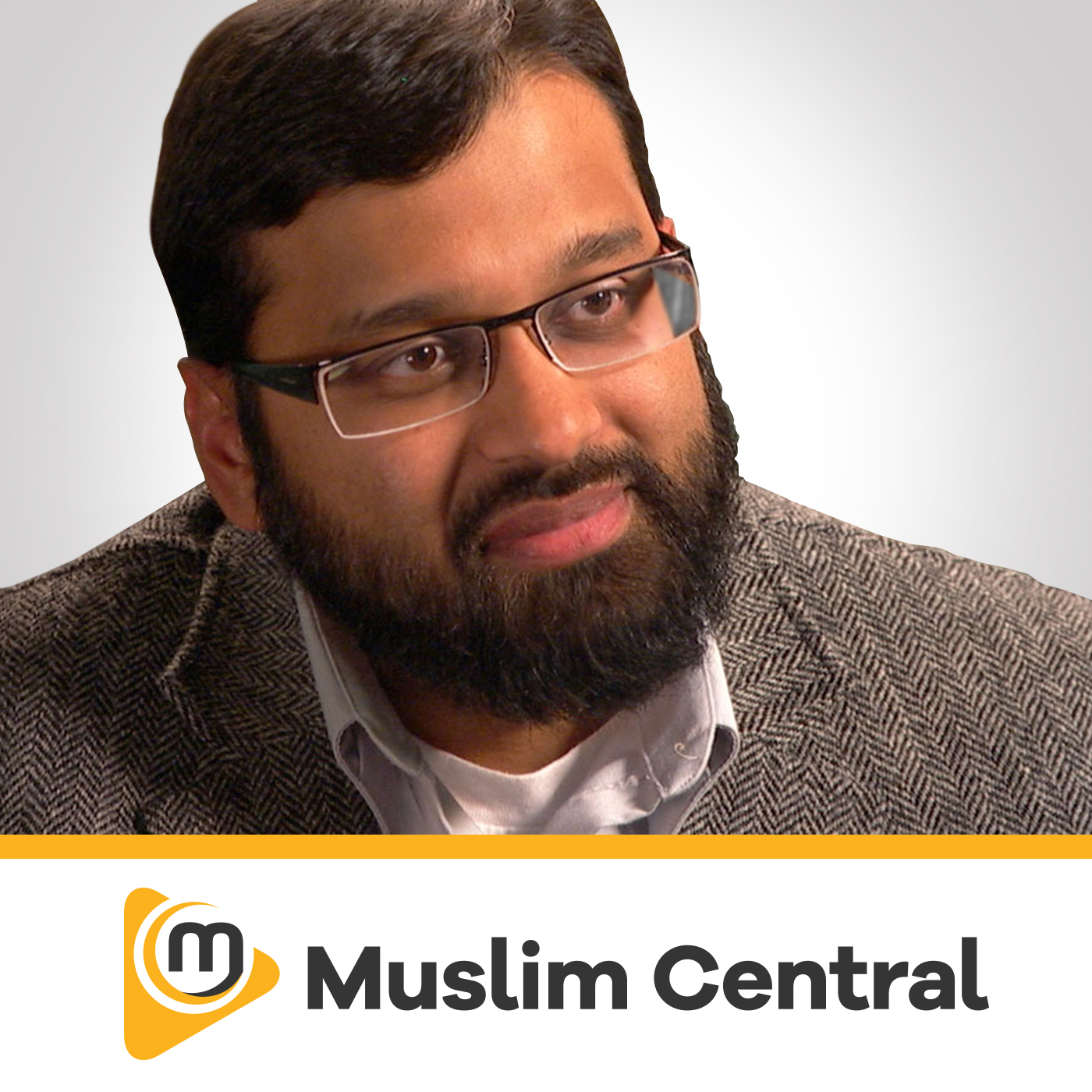
Yasir Qadhi
Muslim Central
Yasir Qadhi was born in Houston, Texas and completed his primary and secondary education in Jeddah, Saudi Arabia. He graduated with a B.Sc. in Chemical Engineering from the University of Houston, after which he was accepted as a student at the Islamic University of Madinah.
After completing a diploma in Arabic, he graduated with a B.A. from the College of Hadith and Islamic Sciences.
Thereafter, he completed a M.A. in Islamic Theology from the College of Dawah, after which he returned to America and completed his doctorate, in Religious Studies, from Yale University. Currently he is teaching at Rhodes College, in Memphis, TN.
After completing a diploma in Arabic, he graduated with a B.A. from the College of Hadith and Islamic Sciences.
Thereafter, he completed a M.A. in Islamic Theology from the College of Dawah, after which he returned to America and completed his doctorate, in Religious Studies, from Yale University. Currently he is teaching at Rhodes College, in Memphis, TN.
Episodes
Mentioned books

Nov 26, 2014 • 1h 20min
Seerah – 96 The Year of Delegations - Part 3
Shaykh Yasir Qadhi continues about the delegations sent and we are in the final part of this topic.
The delegations are as follows:
Banu Hanifa - The leader was Musaylimah al Khadhab
Azd - The large tribes of Yemen, who were placed under Surad ibn Abd'Allah al Azdi
Himyar, from Yemen
Banu Kuld
Christians of Najran
And many more.
Thus, we see that in the 9 H, Islam expanded considerably in Arabia such as that from Yemen, Najran, Oman, Najd etc. Hence, an Islamic State is formed and history is created in the fact that the entire Muslim Ummah is joined under one political entity.
We learn numerous things from the incidents :
People exhibit different levels of Iman and not everyone falls in the same stature as that of Abu Bakr RA, Umar RA and more such greats of Islam.
Masjids can also function as a place of hospitality for the Non Muslims and there is no issue with that as is seen in the case of the tribe of Taqif.
On the arrival of delegates, the onus is upon us to host them to the best of our ability and means as deemed fit.
Nov 26, 2014 • 1h 15min
95 The Year of Delegations - Part 2
Shaykh Yasir Qadhi continues to divulge details on the different delegations that were sent as part of their prerogative to make as many as possible people convert to Islam.
A few listed in this lecture are as follows:
Wa'il ibn Hujr - He is from the town of Hadramaut, Yemen
Delegation of Taif - Urwah ibn Mas'ud, who was the leader of the Taqif tribe in Taif accepted Islam.
The conversion of the pagans of Taqif was a long and arduous process as their belief in idols was unparalleled. How did the impossible then become possible? Listen intently to discover interesting facts.
An interesting issue that happened in Taif is relating to the statement made by the Prophet ﷺ to the people of Taif wherein he told them initially that they need not pay Zakat and do Jihad, only to withdraw the statement and reverse his statement. What made him do this?
He believed that the light of Iman would finally make a foray into their hearts even though they were opposing now.
The leader has the right to accept aforesaid conditions for new Muslims for a short duration of time but he can at any point in time reverse his decision in order to implement the right rules of Islam.
Nov 26, 2014 • 1h 4min
94 The Year of Delegations Part 1
Shaykh Yasir Qadhi divulges details on the happenings of the 9th year of Hijrah which is also called the ‘ Year of Delegations'. It is not as if delegations did not happen prior to this, but this year was special as the number had reached large numbers.
What comprises a delegation? It is when a tribe sends a representative to negotiate with the Prophet ﷺ on their eagerness to embrace Islam or not.
There are 15 delegations of interest and are discussed elaborately. Some of the delegations discussed in this lecture are:
Abdul Qais - the Christian tribe who lived close to modern day Bahrain.
Banu Sa'd ibn Bakr the tribe of Haleema RA.
Banu Amr ibn Sa'sa - the tribe that was responsible for the well of Bir Maoona
Tamim ad Dari - a christian from a northern tribe.
There is also an interesting miracle that transpired when the tribe of Muzayana came to embrace Islam and the Prophet ﷺ asked Umar RA to refill their food supplies. What was this miracle? Listen intently as Shaykh Yasir answers.
Nov 26, 2014 • 1h 16min
93 Tafsir of Surat AtTawbah & Tabuk
Shaykh Yasir Qadhi now elaborates on the tafsir of Surah Tawbah in the light of the Battle of Tabuk.
After the return of the Prophet ﷺ, there was the death of the leader of the Munafiqun - Abdullah ibn Ubayy ibn Salool, who was involved in the battle of Uhud where he backstabbed the Muslims and also played a major part in the horrendous and most terrible deed which is the slander of Aisha RA.
Another topic of discussion is the beginning of Surah Tawbah. It is the only Surah which does not begin with 'Bismillah.' Why is there no Bismillah? There are two opinions which warrant some understanding:
Uthman RA , who was in charge of the compilation of the Mushaf , said that the reason for this was the joining of Tawbah with Anfal because the content is basically the same.
When Ali RA was asked by one of his sons about the same question, he said that Surah Tawbah is precisely when Allah cuts off his ties with the pagans and thus, it is deemed unfit to begin the Surah with mercy and so is the case for the rest of the Surah which is very harsh.
The tafseer of this powerful Surah Tawbah is explicitly explained and we gather unsurmountable evidence on the plight of the pagans in the wake of disobedience to Islam.
Nov 7, 2014 • 1h 13min
Seerah – 92 Battle of Tabuk 5
Shaykh Yasir Qadhi now moves to the final part in the series related to the famous Battle of Tabuk.
We begin with the six things that the Prophet ﷺ instructed to be counted before the Day of Judgement. Among them, a few are:
The death of the Messenger of Allah ﷺ.
The conquest of Baitul Maqdas .
Two plagues that would eliminate .
A fitnah that no house of the Arabs (Muslims) will be unaffected by it.
A truce between Muslims and Romans."
A prominent incident that transpired in the duration of Tabuk 20 nights was related to Abdur Rahman ibn Awf RA what was this coveted privilege and honour? He was only among the two behind whom the Prophet ﷺ prayed in his lifetime.
Also, in this time,Abdullah dhul be Jardain died and the Prophet ﷺ showed his ultimate care and affection for his people by giving him a befitting burial.
On the way back from Tabuk, a number of events unfolded. The Prophet ﷺ passed by Al Hijr, the place of Thamud and the people of Saleh. The Sahabas were perplexed and enquired him about the same. What did the Prophet ﷺ answer? What was the wisdom behind this? Shaykh Yasir answers.
Another appalling incident that happened was the assassination attempt made on the Prophet ﷺ by the Munafiqun. When the Prophet ﷺ was atop a cliff on a dangerous location along with Ammar ibn Yasir and Hudhayfa, some bandits attempted to take charge of the camel of the Prophet ﷺ. They were going to throw the Prophet ﷺ from the cliff and obviously they failed badly due to Allah’s help.
The Prophet ﷺ finally returned back to Madinah after almost 50 to 60 days and he was welcomed rejoicing by the people of Thaniyatul Wada'a.
Nov 7, 2014 • 1h 4min
Seerah – 91 Battle of Tabuk 4
Shaykh Yasir Qadhi now discusses the happenings on leaving Madinah enroute the Battle of Tabuk by the Prophet ﷺ.
Post passing the Thaniyat Al Wada, the Prophet ﷺ paused to organise the troops into battalions, leaders, sub-leaders and many more such divisions. Mu'adh ibn Jabal RA narrated that the Prophet ﷺ prayed Fajr on the way to Tabuk where he stayed for 20 days and the people were on their camels. An incident happened there relating the camels which makes for an interesting listen. The Prophet ﷺ gave a Khutbah the first thing in the morning of their arrival to Tabuk.
In addition to the above incident, he also sent Khalid ibn Waleed with a small entourage on a mini expedition to one of the neighbouring tribes in Tabuk called Jomatul Jandan which was a very famous and one of the largest Christian Arab tribes in Arabia. They were on amicable terms with the then emperor of Rome and were renowned for their bravery and warriorship,
The Prophet ﷺ gave clear instructions to Khalid Ibn Waleed RA of the whereabouts of their chieftain - Ookaydil and how he ought to be captured.he followed the instructions to the tee. Though it was a bit odd, Khalid RA achieved success and the emperor was captured and brought to the Prophet SAW where he agreed to sever all ties with the Romans, pay the jizya to the Prophet ﷺ, and not harm the Muslims. In a similar fashion, other tribe leaders also agreed to side with the Muslims and hence, imminent victory against the Romans was a given.
Oct 13, 2014 • 1h 21min
Seerah – 90 Battle of Tabuk 3
Shaykh Yasir Qadhi now elaborates on the events that are happening in preparation for the Battle of Tabuk.
Amongst them, the first and foremost is the collection of money for the Battle. Many incidents occur in this time such as the famous incident of the competition between Abu Bakr As Siddeeq RA and Umar Ibn Al Khattab RA for the largest amount of money that would be given. Eventually, Umar RA had to accept defeat at the hands of Abu Bakr RA as he knew heart in heart that it would be impossible to match what Abu Bakr RA was ready to part with to please the Prophet ﷺ.
Other incidents that occur are related to Abdur Rahman ibn Awf RA who gave 200 ooqiyas for the battle.but the story that triumphs all of these is the story of Uthman ibn Affan RA who gave the largest amount of his wealth for the battle.
The story of Al Waathida Al Asqa is also an interesting one where he had promised a reward of granting his share of the Ghanimah for the one who would take him on the Ghazwa (he was a bit delayed). The story of Abu Kaythama al Ansari is next up for discussion and his situation was almost the same as that of Ka’b Ibn Malik. But he ultimately made it. How did it happen? Also, an interesting incident is related to Abu Dharr al Gifaali who seemed to be having some problems with his camel.
The construction of the Masjid Durar by ibn Salool stands out as one of the key developments of the battle of Tabuk. What was Allah’s instruction to the Prophet ﷺ on this Masjid?
Allah revealed Surah Tawbah from verse 107 to 108 highlighting this particular masjid as a cause of harm, kuffar, division of the believers,pain and immense suffering and hence, Allah asked the Prophet ﷺ to not step inside or anywhere in the vicinity of the Masjid.
Oct 13, 2014 • 1h 17min
89 Story of Ka'b b. Malik
Shaykh yasir Qadhi continues to shed light on Ka’b Ibn Malik and how he got his forgiveness from Allah and what transpired next.
When Ka’b Ibn Malik heard that he had been forgiven and all the Sahaba had rushed to congratulate him for the same, he rushed to meet the Prophet ﷺ where Talhah Bin Ubaidillah stood up to greet him. This was a huge moment for Ka’b and he cherished it to the most.
There are numerous benefits that one can derive from the story of this sahaba, some of which are listed below:
The permissibility of telling the stories of sinners and repenters.
The permissibility of boasting of your achievements.
The continuity of the nobility of your existence.
Narration of sins if confined to permissible limits.
The stature of the sacrifice done by the Sahaba in the way of Islam and as a measure of complete obedience to the Prophet ﷺ.
The measure of ur Tawbah is decisive on the measure of the guilt you feel.
The mishaps of delays and procrastination
The importance of commiting to always say the truth.
Hypocrisy is valid when excuses are made to accomplish good deeds.
Clear confrontation with your frank feelings when dealing with a Muslim.
Necessity of being a bit harsh when required.
Pain and suffering cleanses us of our sins.
Victory is eminent at our weakest moment and in the darkest time.
We also derive Fiqh benefits from this beautiful story:
The permissibility of non Muslims entering Mecca and Madinah albeit for a legitimate reason.
Buying and selling from people of other faiths.
Permissibility of entering the semi private property of someone when one is certain that it would not be a cause of concern or dispute.
Sajda e Shukr
Sharing of good news with the largest number of people one can.
Sep 24, 2014 • 1h 8min
Seerah – 88 Battle of Tabuk 2
Shaykh Yasir Qadhi divulges details about the Battle of Tabuk and we gather some more details.
In this lecture, the most prominent story that is discussed is that of Ka'b ibn Malik and what transpired with him in the time of the battle of Tabuk. We also extrapolate valid lessons to imbibe and inculcate regarding sins and their repentance.
Who was Ka'b ibn Malik? He was from the Ansar, particularly from the tribe of Banu Salama. He has the honour of converting to Islam before the Prophet ﷺ immigrated and also was a part of the Baiatul Aqabah.
Procrastination became the ultimate undoing of Ka'b Ibn Malik when he could not be a part of the Ghazwa Tabuk. But he was defended wholly by Mu'adh ibn Jabal RA. When the Prophet ﷺ returned to Madinah, Ka'b Ibn Malik rushed to offer his apologies with the hope that he would be forgiven. But he along with Murara ibn Rabiah and Hilal ibn Umayyah were forbidden from being talked to by anyone in the entire city of Madinah for 50 nights.
Meanwhile, he also receives a letter from the Gassanid king asking him to side with them - only with the sole purpose of destroying the unity and brotherhood of the Muslims and also to comprehend the functioning of the Muslims in order to be better prepared.
What happens at the end of 50 nights? Does he get acceptance of the repentance he had so wholeheartedly wished for and for which he tried his ultimate best? Yes, Allah did accept their repentance after 60 nights.
Sep 24, 2014 • 1h 3min
Seerah – 87 Battle of Tabuk 1
Shaykh Yasir Qadhi now moves on to the topic of the battle of Tabuk and a detailed description is discussed in the lecture.
The battle of Tabuk took place in the month of Rajab, 9 H. What was the reason behind the occurrence of this battle?The meaning of Tabuk is shared and we get the reference from the Prophet ﷺ when he refers it to a type of spring. Why did the name of the battle get named so? Listen intently to discover the details. Another name that is synonymous with this Ghazwa is that of 'Jaysh Al Usra'. What is the reasoning behind this? It is an interesting one.
This particular battle was a very difficult one. There are some reasons for this:
The size of the Muslim army was the largest that Arabia had ever seen.
The length of the distance that had to be undertaken by the Muslim army was the largest that they had ever attempted.
The Prophet ﷺ began accumulating funds for the battle and clearly, a huge amount was required. Most of the Sahabas contributed generously and the largest share was that of Uthman Ibn Affan RA.

