

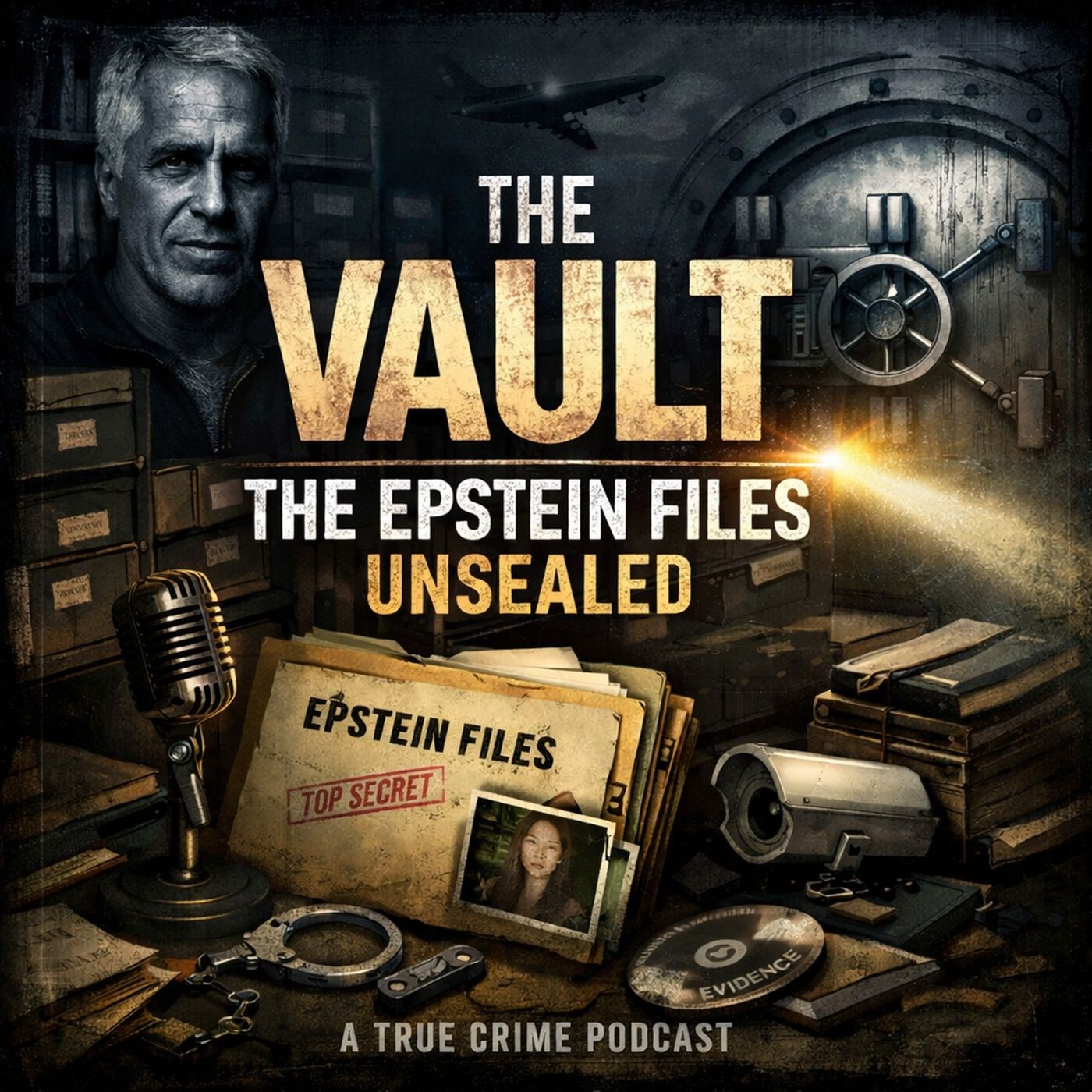
The Vault: The Epstein Files
Bobby Capucci
The Vault: The Epstein Files Unsealed is a deep-dive investigative podcast that pulls back the curtain on one of the most protected criminal networks in modern history. This series is built from the ground up on the actual paper trail—unsealed court records, depositions, exhibits, emails, and filings that were never meant to be read by the public. No pundit panels. No spin. Just the documents themselves, examined line by line, name by name, connection by connection—paired with precise, document-driven analysis that explains what the record truly shows.Each episode opens the vault on newly unsealed or long-buried Epstein files and walks listeners through what they actually reveal about power, money, influence, and the systems that failed survivors at every turn. Alongside the filings themselves, informed commentary breaks down the legal strategy, the institutional behavior, the contradictions, and the implications hiding between the lines. From judges’ orders and sealed exhibits to sworn testimony and back-channel communications, the show connects the dots the media often won’t—or can’t. Patterns emerge. Timelines collapse. Excuses fall apart.The Vault is a working archive in audio form, a living record of the Epstein case as told by the courts themselves—supplemented by rigorous analysis that provides context, challenges official narratives, and exposes where the record has been distorted, sanitized, or deliberately ignored. Every claim is grounded in filings. Every episode is anchored to the record. Listeners aren’t told what to think—they are shown what exists, what was said under oath, and what the commentary reveals about how those facts were buried, softened, or misrepresented.If you want to understand how Jeffrey Epstein was protected, who circled him, how institutions closed ranks, and why accountability keeps slipping through the cracks, The Vault: The Epstein Files Unsealed is where the record finally speaks for itself—and where the commentary ensures the documents do what no press release ever will.
Episodes
Mentioned books

Feb 7, 2026 • 18min
Alex Acosta Goes To Congress: Transcripts From The Alex Acosta Deposition (Part 12) (2/7/26)
When Alex Acosta sat before Congress to explain himself, what unfolded was less an act of accountability and more a masterclass in bureaucratic self-preservation. He painted the 2008 Epstein plea deal as a “strategic compromise,” claiming a federal trial might have been too risky because victims were “unreliable” and evidence was “thin.” In reality, federal prosecutors had a mountain of corroborating witness statements, corroborative travel logs, and sworn victim testimony—yet Acosta gave Epstein the deal of the century. The so-called non-prosecution agreement wasn’t justice; it was a backroom surrender, executed in secrecy, without even notifying the victims. When pressed on this, Acosta spun excuses about legal precedent and “jurisdictional confusion,” never once admitting the obvious: his office protected a rich, politically connected predator at the expense of dozens of trafficked girls.Even more damning was Acosta’s insistence that he acted out of pragmatism, not pressure. He denied that anyone “higher up” told him to back off—even though he once told reporters that he’d been informed Epstein “belonged to intelligence.” Under oath, he downplayed that statement, twisting it into bureaucratic double-speak. He even claimed the deal achieved “some level of justice” because Epstein registered as a sex offender—a hollow justification that only exposed how insulated from reality he remains. Acosta never showed remorse for the irreparable damage caused by his cowardice. His congressional testimony reeked of moral rot, the same rot that let a billionaire pedophile walk free while survivors were left to pick up the pieces.to contact me:bobbycapucci@protonmail.comsource:Acosta Transcript.pdf - Google Drive
Feb 7, 2026 • 12min
Alex Acosta Goes To Congress: Transcripts From The Alex Acosta Deposition (Part 11) (2/6/26)
When Alex Acosta sat before Congress to explain himself, what unfolded was less an act of accountability and more a masterclass in bureaucratic self-preservation. He painted the 2008 Epstein plea deal as a “strategic compromise,” claiming a federal trial might have been too risky because victims were “unreliable” and evidence was “thin.” In reality, federal prosecutors had a mountain of corroborating witness statements, corroborative travel logs, and sworn victim testimony—yet Acosta gave Epstein the deal of the century. The so-called non-prosecution agreement wasn’t justice; it was a backroom surrender, executed in secrecy, without even notifying the victims. When pressed on this, Acosta spun excuses about legal precedent and “jurisdictional confusion,” never once admitting the obvious: his office protected a rich, politically connected predator at the expense of dozens of trafficked girls.Even more damning was Acosta’s insistence that he acted out of pragmatism, not pressure. He denied that anyone “higher up” told him to back off—even though he once told reporters that he’d been informed Epstein “belonged to intelligence.” Under oath, he downplayed that statement, twisting it into bureaucratic double-speak. He even claimed the deal achieved “some level of justice” because Epstein registered as a sex offender—a hollow justification that only exposed how insulated from reality he remains. Acosta never showed remorse for the irreparable damage caused by his cowardice. His congressional testimony reeked of moral rot, the same rot that let a billionaire pedophile walk free while survivors were left to pick up the pieces.to contact me:bobbycapucci@protonmail.comsource:Acosta Transcript.pdf - Google Drive
Feb 7, 2026 • 14min
Alex Acosta Goes To Congress: Transcripts From The Alex Acosta Deposition (Part 10) (2/6/26)
When Alex Acosta sat before Congress to explain himself, what unfolded was less an act of accountability and more a masterclass in bureaucratic self-preservation. He painted the 2008 Epstein plea deal as a “strategic compromise,” claiming a federal trial might have been too risky because victims were “unreliable” and evidence was “thin.” In reality, federal prosecutors had a mountain of corroborating witness statements, corroborative travel logs, and sworn victim testimony—yet Acosta gave Epstein the deal of the century. The so-called non-prosecution agreement wasn’t justice; it was a backroom surrender, executed in secrecy, without even notifying the victims. When pressed on this, Acosta spun excuses about legal precedent and “jurisdictional confusion,” never once admitting the obvious: his office protected a rich, politically connected predator at the expense of dozens of trafficked girls.Even more damning was Acosta’s insistence that he acted out of pragmatism, not pressure. He denied that anyone “higher up” told him to back off—even though he once told reporters that he’d been informed Epstein “belonged to intelligence.” Under oath, he downplayed that statement, twisting it into bureaucratic double-speak. He even claimed the deal achieved “some level of justice” because Epstein registered as a sex offender—a hollow justification that only exposed how insulated from reality he remains. Acosta never showed remorse for the irreparable damage caused by his cowardice. His congressional testimony reeked of moral rot, the same rot that let a billionaire pedophile walk free while survivors were left to pick up the pieces.to contact me:bobbycapucci@protonmail.comsource:Acosta Transcript.pdf - Google Drive
Feb 7, 2026 • 12min
Alex Acosta Goes To Congress: Transcripts From The Alex Acosta Deposition (Part 9) (2/6/26)
When Alex Acosta sat before Congress to explain himself, what unfolded was less an act of accountability and more a masterclass in bureaucratic self-preservation. He painted the 2008 Epstein plea deal as a “strategic compromise,” claiming a federal trial might have been too risky because victims were “unreliable” and evidence was “thin.” In reality, federal prosecutors had a mountain of corroborating witness statements, corroborative travel logs, and sworn victim testimony—yet Acosta gave Epstein the deal of the century. The so-called non-prosecution agreement wasn’t justice; it was a backroom surrender, executed in secrecy, without even notifying the victims. When pressed on this, Acosta spun excuses about legal precedent and “jurisdictional confusion,” never once admitting the obvious: his office protected a rich, politically connected predator at the expense of dozens of trafficked girls.Even more damning was Acosta’s insistence that he acted out of pragmatism, not pressure. He denied that anyone “higher up” told him to back off—even though he once told reporters that he’d been informed Epstein “belonged to intelligence.” Under oath, he downplayed that statement, twisting it into bureaucratic double-speak. He even claimed the deal achieved “some level of justice” because Epstein registered as a sex offender—a hollow justification that only exposed how insulated from reality he remains. Acosta never showed remorse for the irreparable damage caused by his cowardice. His congressional testimony reeked of moral rot, the same rot that let a billionaire pedophile walk free while survivors were left to pick up the pieces.to contact me:bobbycapucci@protonmail.comsource:Acosta Transcript.pdf - Google Drive
Feb 7, 2026 • 11min
Alex Acosta Goes To Congress: Transcripts From The Alex Acosta Deposition (Part 8) (2/6/26)
When Alex Acosta sat before Congress to explain himself, what unfolded was less an act of accountability and more a masterclass in bureaucratic self-preservation. He painted the 2008 Epstein plea deal as a “strategic compromise,” claiming a federal trial might have been too risky because victims were “unreliable” and evidence was “thin.” In reality, federal prosecutors had a mountain of corroborating witness statements, corroborative travel logs, and sworn victim testimony—yet Acosta gave Epstein the deal of the century. The so-called non-prosecution agreement wasn’t justice; it was a backroom surrender, executed in secrecy, without even notifying the victims. When pressed on this, Acosta spun excuses about legal precedent and “jurisdictional confusion,” never once admitting the obvious: his office protected a rich, politically connected predator at the expense of dozens of trafficked girls.Even more damning was Acosta’s insistence that he acted out of pragmatism, not pressure. He denied that anyone “higher up” told him to back off—even though he once told reporters that he’d been informed Epstein “belonged to intelligence.” Under oath, he downplayed that statement, twisting it into bureaucratic double-speak. He even claimed the deal achieved “some level of justice” because Epstein registered as a sex offender—a hollow justification that only exposed how insulated from reality he remains. Acosta never showed remorse for the irreparable damage caused by his cowardice. His congressional testimony reeked of moral rot, the same rot that let a billionaire pedophile walk free while survivors were left to pick up the pieces.to contact me:bobbycapucci@protonmail.comsource:Acosta Transcript.pdf - Google Drive
Feb 6, 2026 • 11min
Alex Acosta Goes To Congress: Transcripts From The Alex Acosta Deposition (Part 7) (2/6/26)
When Alex Acosta sat before Congress to explain himself, what unfolded was less an act of accountability and more a masterclass in bureaucratic self-preservation. He painted the 2008 Epstein plea deal as a “strategic compromise,” claiming a federal trial might have been too risky because victims were “unreliable” and evidence was “thin.” In reality, federal prosecutors had a mountain of corroborating witness statements, corroborative travel logs, and sworn victim testimony—yet Acosta gave Epstein the deal of the century. The so-called non-prosecution agreement wasn’t justice; it was a backroom surrender, executed in secrecy, without even notifying the victims. When pressed on this, Acosta spun excuses about legal precedent and “jurisdictional confusion,” never once admitting the obvious: his office protected a rich, politically connected predator at the expense of dozens of trafficked girls.Even more damning was Acosta’s insistence that he acted out of pragmatism, not pressure. He denied that anyone “higher up” told him to back off—even though he once told reporters that he’d been informed Epstein “belonged to intelligence.” Under oath, he downplayed that statement, twisting it into bureaucratic double-speak. He even claimed the deal achieved “some level of justice” because Epstein registered as a sex offender—a hollow justification that only exposed how insulated from reality he remains. Acosta never showed remorse for the irreparable damage caused by his cowardice. His congressional testimony reeked of moral rot, the same rot that let a billionaire pedophile walk free while survivors were left to pick up the pieces.to contact me:bobbycapucci@protonmail.comsource:Acosta Transcript.pdf - Google Drive
Feb 6, 2026 • 12min
From Cynicism to Certainty: How The Epstein Scandal Confirmed the Rigged Game (Part 2) (2/6/26)
Americans were taught to believe in blind justice, but scandal after scandal has stripped that belief bare. The Jeffrey Epstein case shattered whatever illusions remained, exposing a system that bent over backwards to shield a wealthy predator while silencing his victims. The secret deals, the protection from prosecutors, the suspicious death in federal custody—all of it confirmed what many had long suspected: the United States operates under a two-tiered justice system where money and connections outweigh truth and accountability.Epstein’s scandal resonated more deeply than past betrayals because it involved the most vulnerable—children and young women—and still, justice was denied. It showed in stark terms that the law is not broken by accident but by design, functioning to protect elites while crushing the powerless. In doing so, it left Americans angry, disillusioned, and convinced that equal justice under the law is a myth. The lingering outrage is not just about Epstein—it is about the collapse of trust in the very institutions meant to defend fairness, a collapse that may take generations to repair, if it can be repaired at all.to contact me:bobbycapucci@protonmail.com
Feb 6, 2026 • 14min
From Cynicism to Certainty: How The Epstein Scandal Confirmed the Rigged Game (Part 1) (2/6/26)
Americans were taught to believe in blind justice, but scandal after scandal has stripped that belief bare. The Jeffrey Epstein case shattered whatever illusions remained, exposing a system that bent over backwards to shield a wealthy predator while silencing his victims. The secret deals, the protection from prosecutors, the suspicious death in federal custody—all of it confirmed what many had long suspected: the United States operates under a two-tiered justice system where money and connections outweigh truth and accountability.Epstein’s scandal resonated more deeply than past betrayals because it involved the most vulnerable—children and young women—and still, justice was denied. It showed in stark terms that the law is not broken by accident but by design, functioning to protect elites while crushing the powerless. In doing so, it left Americans angry, disillusioned, and convinced that equal justice under the law is a myth. The lingering outrage is not just about Epstein—it is about the collapse of trust in the very institutions meant to defend fairness, a collapse that may take generations to repair, if it can be repaired at all.to contact me:bobbycapucci@protonmail.com
Feb 6, 2026 • 15min
Ghislaine Maxwell’s Emails Blow Up the Andrew Pizza Parlor Alibi (2/6/26)
Newly released emails from Ghislaine Maxwell appear to confirm the authenticity of the infamous photograph showing Andrew Mountbatten‑Windsor with his arm around Virginia Giuffre — a photo long disputed by both Maxwell and Andrew. In a 2015 draft statement sent to Jeffrey Epstein, Maxwell wrote that in 2001 she was in London when Giuffre met several of her friends, including Andrew, and that a picture was taken “as I imagine she wanted to show it to friends and family,” effectively acknowledging the image was real and that she had introduced them. Maxwell’s email also stated Andrew visited her home, although she continued in the correspondence to claim she had no knowledge of “anything improper” occurring between Giuffre and Andrew.The release of these messages comes as part of a massive tranche of documents tied to Epstein that the U.S. Department of Justice disclosed recently. The emails contradict longstanding denials by both Maxwell and Andrew about the meeting and undercut Andrew’s past arguments that the photo might have been doctored. Giuffre, who died by suicide in 2025, had maintained the photograph supported her allegations that she was trafficked and abused; her family has described the new emails as vindicating her claims. Andrew settled a civil lawsuit with Giuffre in 2022 without admitting liability and has repeatedly denied wrongdoing. Buckingham Palace declined to comment, and UK police have so far not launched a full criminal investigation based on these revelations.to contact me:bobbycapucci@protonmail.comsource:That photo of Andrew with his arm around Virginia Giuffre IS REAL and I introduced them, admits Ghislaine Maxwell in damning emails that blow Pizza Express alibi apart | Daily Mail Online
Feb 6, 2026 • 11min
Jeffrey Epstein: The Ultimate Free Agent in the Global Information Market (2/6/26)
Jeffrey Epstein operated as a free agent in the information market, not as a loyal asset of any single government, intelligence service, or political faction, but as a broker who understood that information itself was currency. He cultivated access to powerful people across finance, academia, politics, intelligence, and royalty, positioning himself as the connective tissue between elites who otherwise would not openly associate. Epstein gathered kompromat not just through sexual abuse, but through proximity—private flights, secluded residences, off-the-books meetings, and social environments where guardrails disappeared. He traded in favors, introductions, secrets, and silence, making himself useful to multiple parties simultaneously. That usefulness is what insulated him for so long: he was not owned, but leased—temporarily valuable to anyone who needed discretion, leverage, or deniability. In that ecosystem, Epstein’s power came not from allegiance, but from optionality.At the core of it all, Epstein’s only loyalty was to himself. He did not operate as a patriot, an ideologue, or a true intelligence operative in the traditional sense; he operated as a survivalist within elite power structures. He provided information where it benefited him, withheld it when it didn’t, and shifted alliances as needed to maintain protection. This is why he could simultaneously assist different governments, ingratiate himself with rival power centers, and still remain untouchable for decades. Epstein’s genius—if the term can be used—was recognizing that being indispensable to everyone meant being accountable to no one. His operation was built on mutual exposure and shared risk, ensuring that when the walls finally began to close in, there were too many people with too much to lose for the system to act swiftly. In the end, Epstein wasn’t a pawn—he was a freelance operator who sold access, secrets, and silence, always in service of preserving his own power and immunity.to contact me:bobbycapucci@protonmail.com

