

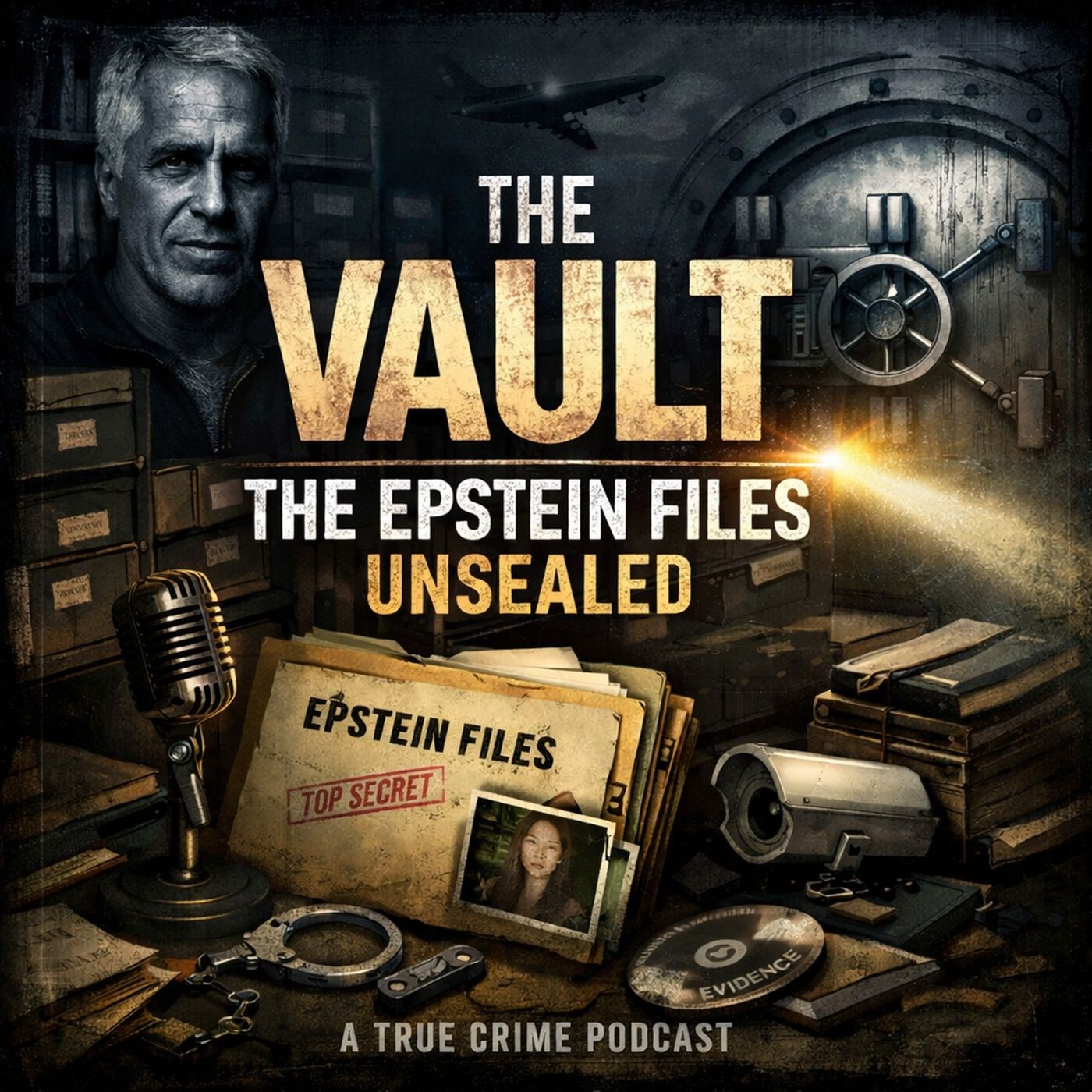
The Vault: The Epstein Files
Bobby Capucci
The Vault: The Epstein Files Unsealed is a deep-dive investigative podcast that pulls back the curtain on one of the most protected criminal networks in modern history. This series is built from the ground up on the actual paper trail—unsealed court records, depositions, exhibits, emails, and filings that were never meant to be read by the public. No pundit panels. No spin. Just the documents themselves, examined line by line, name by name, connection by connection—paired with precise, document-driven analysis that explains what the record truly shows.Each episode opens the vault on newly unsealed or long-buried Epstein files and walks listeners through what they actually reveal about power, money, influence, and the systems that failed survivors at every turn. Alongside the filings themselves, informed commentary breaks down the legal strategy, the institutional behavior, the contradictions, and the implications hiding between the lines. From judges’ orders and sealed exhibits to sworn testimony and back-channel communications, the show connects the dots the media often won’t—or can’t. Patterns emerge. Timelines collapse. Excuses fall apart.The Vault is a working archive in audio form, a living record of the Epstein case as told by the courts themselves—supplemented by rigorous analysis that provides context, challenges official narratives, and exposes where the record has been distorted, sanitized, or deliberately ignored. Every claim is grounded in filings. Every episode is anchored to the record. Listeners aren’t told what to think—they are shown what exists, what was said under oath, and what the commentary reveals about how those facts were buried, softened, or misrepresented.If you want to understand how Jeffrey Epstein was protected, who circled him, how institutions closed ranks, and why accountability keeps slipping through the cracks, The Vault: The Epstein Files Unsealed is where the record finally speaks for itself—and where the commentary ensures the documents do what no press release ever will.
Episodes
Mentioned books

Feb 7, 2026 • 14min
Alex Acosta Goes To Congress: Transcripts From The Alex Acosta Deposition (Part 16) (2/7/26)
When Alex Acosta sat before Congress to explain himself, what unfolded was less an act of accountability and more a masterclass in bureaucratic self-preservation. He painted the 2008 Epstein plea deal as a “strategic compromise,” claiming a federal trial might have been too risky because victims were “unreliable” and evidence was “thin.” In reality, federal prosecutors had a mountain of corroborating witness statements, corroborative travel logs, and sworn victim testimony—yet Acosta gave Epstein the deal of the century. The so-called non-prosecution agreement wasn’t justice; it was a backroom surrender, executed in secrecy, without even notifying the victims. When pressed on this, Acosta spun excuses about legal precedent and “jurisdictional confusion,” never once admitting the obvious: his office protected a rich, politically connected predator at the expense of dozens of trafficked girls.Even more damning was Acosta’s insistence that he acted out of pragmatism, not pressure. He denied that anyone “higher up” told him to back off—even though he once told reporters that he’d been informed Epstein “belonged to intelligence.” Under oath, he downplayed that statement, twisting it into bureaucratic double-speak. He even claimed the deal achieved “some level of justice” because Epstein registered as a sex offender—a hollow justification that only exposed how insulated from reality he remains. Acosta never showed remorse for the irreparable damage caused by his cowardice. His congressional testimony reeked of moral rot, the same rot that let a billionaire pedophile walk free while survivors were left to pick up the pieces.to contact me:bobbycapucci@protonmail.comsource:Acosta Transcript.pdf - Google Drive
Feb 7, 2026 • 12min
Minimization as Complicity: How Epstein Is Still Being Enabled (2/7/26)
There is nothing unclear about Jeffrey Epstein’s crimes, and anyone pretending otherwise is not confused, they are cowardly. The files are explicit and repetitive, documenting a system of abuse built on recruitment, payment, silence, and protection, not isolated misconduct. Minimization does not require denial, only dilution: urging people to “move on,” reframing accountability as obsession, or shaming anger as irrational. That behavior slows momentum, protects power, and preserves the same structures that shielded Epstein for decades. Many doing this now once demanded transparency and justice, but their courage vanished when accountability threatened their own political tribe. The facts did not change; their loyalties did. This is surrender disguised as restraint, and it actively enables a predator’s legacy.What makes this especially vile is the erasure of victims in real time. Former advocates don’t dispute the evidence; they simply stop amplifying it, redirect attention, and fall silent when pressure appears. That silence is tactical, and it mirrors the discretion Epstein relied on to operate. Anger and disgust are not excess here—they are the appropriate response to industrialized abuse and institutional failure. Claims that continued scrutiny “helps Epstein” invert reality; silence, deference, and respectability helped him, while exposure damaged him. Ending scrutiny protects enablers, not survivors. This moment is a moral sorting: comfort versus courage, tribe versus truth. Those minimizing the record are not being nuanced—they are enabling abuse, even now, even after death.to contact me:bobbycapucci@protonmail.com
Feb 7, 2026 • 12min
Epstein Was an Asset — Just Not the Way They’re Telling You (2/7/26)
Jeffrey Epstein was an asset, but not a traditional, state-controlled intelligence asset and certainly not a Russian-owned operative. He functioned as a free-agent asset, meaning he was useful to many power centers simultaneously without being loyal to any of them. He provided services that powerful people and institutions could not provide for themselves openly: access, secrecy, trafficking logistics, financial maneuvering, and deniability. His value came from non-exclusivity, not allegiance. Russia was part of his operational environment, just as the United States, Europe, Israel, and other regions were. Epstein worked with Russian interests where it benefited him, particularly through trafficking pipelines and financial interactions, but he did not work for Russia. Treating him as a singular Russian spy fundamentally misunderstands both Epstein and how power actually operates.Epstein thrived in gray zones where criminals, oligarchs, intelligence services, and elites overlap, extracting profit and protection from all sides. His greatest protections came from Western institutions, including prosecutors, banks, and political elites, not from Moscow. The Russia-only narrative serves as misdirection by externalizing blame and shielding domestic systems that enabled him for decades. Understanding Epstein as a free-agent asset expands accountability rather than narrowing it, implicating global financial, legal, and political structures instead of offering a convenient foreign scapegoatto contact me:bobbycapucci@protonmail.com
Feb 7, 2026 • 13min
The Epstein Maelstrom Comes For Multiple High Level European Politicians (2/7/26)
Recent, publicly released documents from the Epstein files show that French politician Jack Lang had a documented personal relationship with convicted sex offender Jeffrey Epstein that extended over several years. Lang’s name and correspondence appear numerous times in Department of Justice files, including emails thanking Epstein for hospitality and evidence that Lang and his family accepted favors such as use of Epstein’s vehicles. Epstein also made donations and financial contributions tied to Lang’s circle, including to a French nonprofit and film projects linked to Lang’s daughter; those connections have already prompted professional consequences for her. Lang has maintained that he did not know about Epstein’s criminal activities at the time and has denied wrongdoing, but the documented correspondence and interactions are now a significant part of the broader scrutiny of how Epstein cultivated relationships with influential figures.Similarly, former Norwegian prime minister and Thorbjørn Jagland appears in the Epstein archives with documented contact and communications. Emails published from the files show repeated exchanges between Jagland and Epstein, including plans discussed regarding trips and requests involving contacts overseas, and interactions that span years. Norwegian authorities have now opened a formal criminal investigation into Jagland for gross corruption related to these ties, focusing on whether he received improper benefits such as paid travel, medical bills, or other financial advantages during his time in prominent positions like head of the Norwegian Nobel Committee and Secretary-General of the Council of Europe. Jagland has acknowledged the contacts and described them in diplomatic terms, but the emerging evidence and ongoing investigations mean his relationship with Epstein is under active legal and public scrutiny.to contact me:bobbycapucci@protonmail.comsourceFrance's former culture minister Jack Lang summoned over Epstein links - France 24Norway investigates former prime minister over Epstein ties - ABC News
Feb 7, 2026 • 12min
Alex Acosta Goes To Congress: Transcripts From The Alex Acosta Deposition (Part 15) (2/7/26)
When Alex Acosta sat before Congress to explain himself, what unfolded was less an act of accountability and more a masterclass in bureaucratic self-preservation. He painted the 2008 Epstein plea deal as a “strategic compromise,” claiming a federal trial might have been too risky because victims were “unreliable” and evidence was “thin.” In reality, federal prosecutors had a mountain of corroborating witness statements, corroborative travel logs, and sworn victim testimony—yet Acosta gave Epstein the deal of the century. The so-called non-prosecution agreement wasn’t justice; it was a backroom surrender, executed in secrecy, without even notifying the victims. When pressed on this, Acosta spun excuses about legal precedent and “jurisdictional confusion,” never once admitting the obvious: his office protected a rich, politically connected predator at the expense of dozens of trafficked girls.Even more damning was Acosta’s insistence that he acted out of pragmatism, not pressure. He denied that anyone “higher up” told him to back off—even though he once told reporters that he’d been informed Epstein “belonged to intelligence.” Under oath, he downplayed that statement, twisting it into bureaucratic double-speak. He even claimed the deal achieved “some level of justice” because Epstein registered as a sex offender—a hollow justification that only exposed how insulated from reality he remains. Acosta never showed remorse for the irreparable damage caused by his cowardice. His congressional testimony reeked of moral rot, the same rot that let a billionaire pedophile walk free while survivors were left to pick up the pieces.to contact me:bobbycapucci@protonmail.comsource:Acosta Transcript.pdf - Google Drive
Feb 7, 2026 • 15min
Alex Acosta Goes To Congress: Transcripts From The Alex Acosta Deposition (Part 14) (2/7/26)
When Alex Acosta sat before Congress to explain himself, what unfolded was less an act of accountability and more a masterclass in bureaucratic self-preservation. He painted the 2008 Epstein plea deal as a “strategic compromise,” claiming a federal trial might have been too risky because victims were “unreliable” and evidence was “thin.” In reality, federal prosecutors had a mountain of corroborating witness statements, corroborative travel logs, and sworn victim testimony—yet Acosta gave Epstein the deal of the century. The so-called non-prosecution agreement wasn’t justice; it was a backroom surrender, executed in secrecy, without even notifying the victims. When pressed on this, Acosta spun excuses about legal precedent and “jurisdictional confusion,” never once admitting the obvious: his office protected a rich, politically connected predator at the expense of dozens of trafficked girls.Even more damning was Acosta’s insistence that he acted out of pragmatism, not pressure. He denied that anyone “higher up” told him to back off—even though he once told reporters that he’d been informed Epstein “belonged to intelligence.” Under oath, he downplayed that statement, twisting it into bureaucratic double-speak. He even claimed the deal achieved “some level of justice” because Epstein registered as a sex offender—a hollow justification that only exposed how insulated from reality he remains. Acosta never showed remorse for the irreparable damage caused by his cowardice. His congressional testimony reeked of moral rot, the same rot that let a billionaire pedophile walk free while survivors were left to pick up the pieces.to contact me:bobbycapucci@protonmail.comsource:Acosta Transcript.pdf - Google Drive
Feb 7, 2026 • 22min
Alex Acosta Goes To Congress: Transcripts From The Alex Acosta Deposition (Part 13) (2/7/26)
When Alex Acosta sat before Congress to explain himself, what unfolded was less an act of accountability and more a masterclass in bureaucratic self-preservation. He painted the 2008 Epstein plea deal as a “strategic compromise,” claiming a federal trial might have been too risky because victims were “unreliable” and evidence was “thin.” In reality, federal prosecutors had a mountain of corroborating witness statements, corroborative travel logs, and sworn victim testimony—yet Acosta gave Epstein the deal of the century. The so-called non-prosecution agreement wasn’t justice; it was a backroom surrender, executed in secrecy, without even notifying the victims. When pressed on this, Acosta spun excuses about legal precedent and “jurisdictional confusion,” never once admitting the obvious: his office protected a rich, politically connected predator at the expense of dozens of trafficked girls.Even more damning was Acosta’s insistence that he acted out of pragmatism, not pressure. He denied that anyone “higher up” told him to back off—even though he once told reporters that he’d been informed Epstein “belonged to intelligence.” Under oath, he downplayed that statement, twisting it into bureaucratic double-speak. He even claimed the deal achieved “some level of justice” because Epstein registered as a sex offender—a hollow justification that only exposed how insulated from reality he remains. Acosta never showed remorse for the irreparable damage caused by his cowardice. His congressional testimony reeked of moral rot, the same rot that let a billionaire pedophile walk free while survivors were left to pick up the pieces.to contact me:bobbycapucci@protonmail.comsource:Acosta Transcript.pdf - Google Drive
Feb 7, 2026 • 18min
Alex Acosta Goes To Congress: Transcripts From The Alex Acosta Deposition (Part 12) (2/7/26)
When Alex Acosta sat before Congress to explain himself, what unfolded was less an act of accountability and more a masterclass in bureaucratic self-preservation. He painted the 2008 Epstein plea deal as a “strategic compromise,” claiming a federal trial might have been too risky because victims were “unreliable” and evidence was “thin.” In reality, federal prosecutors had a mountain of corroborating witness statements, corroborative travel logs, and sworn victim testimony—yet Acosta gave Epstein the deal of the century. The so-called non-prosecution agreement wasn’t justice; it was a backroom surrender, executed in secrecy, without even notifying the victims. When pressed on this, Acosta spun excuses about legal precedent and “jurisdictional confusion,” never once admitting the obvious: his office protected a rich, politically connected predator at the expense of dozens of trafficked girls.Even more damning was Acosta’s insistence that he acted out of pragmatism, not pressure. He denied that anyone “higher up” told him to back off—even though he once told reporters that he’d been informed Epstein “belonged to intelligence.” Under oath, he downplayed that statement, twisting it into bureaucratic double-speak. He even claimed the deal achieved “some level of justice” because Epstein registered as a sex offender—a hollow justification that only exposed how insulated from reality he remains. Acosta never showed remorse for the irreparable damage caused by his cowardice. His congressional testimony reeked of moral rot, the same rot that let a billionaire pedophile walk free while survivors were left to pick up the pieces.to contact me:bobbycapucci@protonmail.comsource:Acosta Transcript.pdf - Google Drive
Feb 7, 2026 • 12min
Alex Acosta Goes To Congress: Transcripts From The Alex Acosta Deposition (Part 11) (2/6/26)
When Alex Acosta sat before Congress to explain himself, what unfolded was less an act of accountability and more a masterclass in bureaucratic self-preservation. He painted the 2008 Epstein plea deal as a “strategic compromise,” claiming a federal trial might have been too risky because victims were “unreliable” and evidence was “thin.” In reality, federal prosecutors had a mountain of corroborating witness statements, corroborative travel logs, and sworn victim testimony—yet Acosta gave Epstein the deal of the century. The so-called non-prosecution agreement wasn’t justice; it was a backroom surrender, executed in secrecy, without even notifying the victims. When pressed on this, Acosta spun excuses about legal precedent and “jurisdictional confusion,” never once admitting the obvious: his office protected a rich, politically connected predator at the expense of dozens of trafficked girls.Even more damning was Acosta’s insistence that he acted out of pragmatism, not pressure. He denied that anyone “higher up” told him to back off—even though he once told reporters that he’d been informed Epstein “belonged to intelligence.” Under oath, he downplayed that statement, twisting it into bureaucratic double-speak. He even claimed the deal achieved “some level of justice” because Epstein registered as a sex offender—a hollow justification that only exposed how insulated from reality he remains. Acosta never showed remorse for the irreparable damage caused by his cowardice. His congressional testimony reeked of moral rot, the same rot that let a billionaire pedophile walk free while survivors were left to pick up the pieces.to contact me:bobbycapucci@protonmail.comsource:Acosta Transcript.pdf - Google Drive
Feb 7, 2026 • 14min
Alex Acosta Goes To Congress: Transcripts From The Alex Acosta Deposition (Part 10) (2/6/26)
When Alex Acosta sat before Congress to explain himself, what unfolded was less an act of accountability and more a masterclass in bureaucratic self-preservation. He painted the 2008 Epstein plea deal as a “strategic compromise,” claiming a federal trial might have been too risky because victims were “unreliable” and evidence was “thin.” In reality, federal prosecutors had a mountain of corroborating witness statements, corroborative travel logs, and sworn victim testimony—yet Acosta gave Epstein the deal of the century. The so-called non-prosecution agreement wasn’t justice; it was a backroom surrender, executed in secrecy, without even notifying the victims. When pressed on this, Acosta spun excuses about legal precedent and “jurisdictional confusion,” never once admitting the obvious: his office protected a rich, politically connected predator at the expense of dozens of trafficked girls.Even more damning was Acosta’s insistence that he acted out of pragmatism, not pressure. He denied that anyone “higher up” told him to back off—even though he once told reporters that he’d been informed Epstein “belonged to intelligence.” Under oath, he downplayed that statement, twisting it into bureaucratic double-speak. He even claimed the deal achieved “some level of justice” because Epstein registered as a sex offender—a hollow justification that only exposed how insulated from reality he remains. Acosta never showed remorse for the irreparable damage caused by his cowardice. His congressional testimony reeked of moral rot, the same rot that let a billionaire pedophile walk free while survivors were left to pick up the pieces.to contact me:bobbycapucci@protonmail.comsource:Acosta Transcript.pdf - Google Drive

