

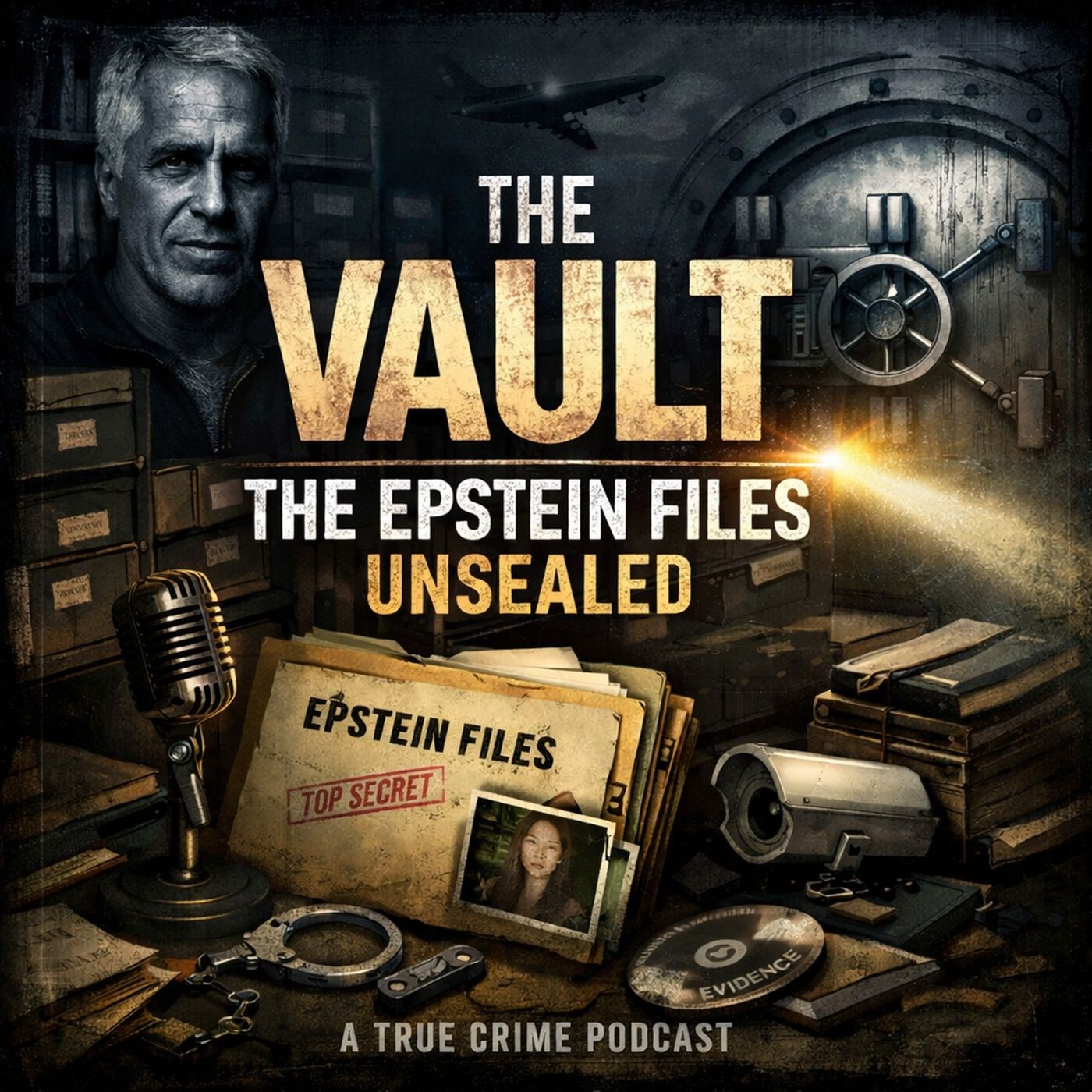
The Vault: The Epstein Files
Bobby Capucci
The Vault: The Epstein Files Unsealed is a deep-dive investigative podcast that pulls back the curtain on one of the most protected criminal networks in modern history. This series is built from the ground up on the actual paper trail—unsealed court records, depositions, exhibits, emails, and filings that were never meant to be read by the public. No pundit panels. No spin. Just the documents themselves, examined line by line, name by name, connection by connection—paired with precise, document-driven analysis that explains what the record truly shows.Each episode opens the vault on newly unsealed or long-buried Epstein files and walks listeners through what they actually reveal about power, money, influence, and the systems that failed survivors at every turn. Alongside the filings themselves, informed commentary breaks down the legal strategy, the institutional behavior, the contradictions, and the implications hiding between the lines. From judges’ orders and sealed exhibits to sworn testimony and back-channel communications, the show connects the dots the media often won’t—or can’t. Patterns emerge. Timelines collapse. Excuses fall apart.The Vault is a working archive in audio form, a living record of the Epstein case as told by the courts themselves—supplemented by rigorous analysis that provides context, challenges official narratives, and exposes where the record has been distorted, sanitized, or deliberately ignored. Every claim is grounded in filings. Every episode is anchored to the record. Listeners aren’t told what to think—they are shown what exists, what was said under oath, and what the commentary reveals about how those facts were buried, softened, or misrepresented.If you want to understand how Jeffrey Epstein was protected, who circled him, how institutions closed ranks, and why accountability keeps slipping through the cracks, The Vault: The Epstein Files Unsealed is where the record finally speaks for itself—and where the commentary ensures the documents do what no press release ever will.
Episodes
Mentioned books

Feb 8, 2026 • 13min
Marie Villafana And Her Defense Of Jeffrey Epstein's NPA (Part 2) (2/8/26)
In a sworn affidavit filed in 2017, Marie Villafaña, a Department of Justice official, laid out the government’s formal defense of how federal prosecutors handled the Crime Victims’ Rights Act during the Jeffrey Epstein non-prosecution agreement. Her core argument was that the CVRA’s notice and participation requirements did not apply because Epstein had not been federally charged at the time the deal was negotiated, framing the agreement as a pre-charge exercise of prosecutorial discretion rather than a criminal proceeding triggering victims’ rights. Villafaña asserted that prosecutors were operating within long-standing DOJ interpretations of the law, emphasizing that the CVRA was never intended to require victim notification during confidential plea negotiations or before formal charges were filed. She presented the government’s position as legally cautious rather than deceptive, insisting that secrecy was necessary to preserve the integrity of negotiations and avoid jeopardizing a potential federal case.Villafaña also used the affidavit to push back against allegations that prosecutors intentionally misled Epstein’s victims or acted in bad faith, repeatedly stressing that DOJ personnel believed they were complying with the law as it was understood at the time. She argued that internal DOJ guidance supported limiting disclosure to victims before charges, and that there was no clear judicial precedent then requiring broader notification under the CVRA in pre-indictment settings. Framed this way, the affidavit portrayed the Epstein deal not as a calculated effort to sidestep victims’ rights, but as a legally defensible—if controversial—exercise of prosecutorial judgment. That position would later come under severe criticism from courts and victims’ advocates, but in 2017 Villafaña’s filing stood as the DOJ’s most explicit attempt to justify its handling of the Epstein case under the CVRA.to contact me:bobbycapucci@protonmail.comsource:gov.uscourts.flsd.317867.403.19.pdf
Feb 8, 2026 • 12min
Marie Villafana And Her Defense Of Jeffrey Epstein's NPA (Part 1) (2/8/26)
In a sworn affidavit filed in 2017, Marie Villafaña, a Department of Justice official, laid out the government’s formal defense of how federal prosecutors handled the Crime Victims’ Rights Act during the Jeffrey Epstein non-prosecution agreement. Her core argument was that the CVRA’s notice and participation requirements did not apply because Epstein had not been federally charged at the time the deal was negotiated, framing the agreement as a pre-charge exercise of prosecutorial discretion rather than a criminal proceeding triggering victims’ rights. Villafaña asserted that prosecutors were operating within long-standing DOJ interpretations of the law, emphasizing that the CVRA was never intended to require victim notification during confidential plea negotiations or before formal charges were filed. She presented the government’s position as legally cautious rather than deceptive, insisting that secrecy was necessary to preserve the integrity of negotiations and avoid jeopardizing a potential federal case.Villafaña also used the affidavit to push back against allegations that prosecutors intentionally misled Epstein’s victims or acted in bad faith, repeatedly stressing that DOJ personnel believed they were complying with the law as it was understood at the time. She argued that internal DOJ guidance supported limiting disclosure to victims before charges, and that there was no clear judicial precedent then requiring broader notification under the CVRA in pre-indictment settings. Framed this way, the affidavit portrayed the Epstein deal not as a calculated effort to sidestep victims’ rights, but as a legally defensible—if controversial—exercise of prosecutorial judgment. That position would later come under severe criticism from courts and victims’ advocates, but in 2017 Villafaña’s filing stood as the DOJ’s most explicit attempt to justify its handling of the Epstein case under the CVRA.to contact me:bobbycapucci@protonmail.comsource:gov.uscourts.flsd.317867.403.19.pdf
Feb 8, 2026 • 11min
Howard Lutnick And The Jersey Boys Scandal (Part 2) (2/7/26)
In 2011, Cantor Gaming stormed into Las Vegas with the swagger of Wall Street, led by Howard Lutnick at the helm of the parent company Cantor Fitzgerald and Lee Amaitis running the Nevada operation. Known for pioneering mobile sports wagering and accepting unprecedented high-limit bets—sometimes as large as $500,000—Cantor positioned itself as the cutting edge of sports gaming. To many, it looked like a revolution: bettors flocked to its books at the M Resort and beyond, drawn by the promise of action other operators wouldn’t touch. But behind the gloss of innovation, Cantor became entangled in one of the largest illegal betting scandals in modern history. The so-called “Jersey Boys,” an East Coast ring with deep ties to organized bookmaking, infiltrated the operation through Cantor executive Michael “The Computer” Colbert. With Colbert as their insider, the crew laundered millions through Cantor’s system, exploiting the company’s appetite for volume and its disregard for traditional risk limits.The scheme collapsed in 2012 when Colbert and more than two dozen associates were arrested in a sweeping FBI crackdown. Nevada regulators soon levied one of the largest fines in state history—$5.5 million—citing Cantor’s lack of oversight. Amaitis stepped down in 2016, his reputation scarred, while the Cantor brand itself was rebranded as CG Technology in a failed attempt to shed its baggage. By 2020, the company was sold to William Hill, its ambitions of dominating Las Vegas reduced to a cautionary tale. The Jersey Boys scandal not only crippled Cantor but reshaped the entire sports gaming industry, ushering in stricter compliance, tighter wagering oversight, and a lasting reminder that unchecked ambition and Wall Street arrogance could topple even the flashiest of innovators.to contact me:bobbycapucci@protonmail.com
Feb 8, 2026 • 12min
Howard Lutnick And The Jersey Boys Scandal (Part 1) (2/7/26)
In 2011, Cantor Gaming stormed into Las Vegas with the swagger of Wall Street, led by Howard Lutnick at the helm of the parent company Cantor Fitzgerald and Lee Amaitis running the Nevada operation. Known for pioneering mobile sports wagering and accepting unprecedented high-limit bets—sometimes as large as $500,000—Cantor positioned itself as the cutting edge of sports gaming. To many, it looked like a revolution: bettors flocked to its books at the M Resort and beyond, drawn by the promise of action other operators wouldn’t touch. But behind the gloss of innovation, Cantor became entangled in one of the largest illegal betting scandals in modern history. The so-called “Jersey Boys,” an East Coast ring with deep ties to organized bookmaking, infiltrated the operation through Cantor executive Michael “The Computer” Colbert. With Colbert as their insider, the crew laundered millions through Cantor’s system, exploiting the company’s appetite for volume and its disregard for traditional risk limits.The scheme collapsed in 2012 when Colbert and more than two dozen associates were arrested in a sweeping FBI crackdown. Nevada regulators soon levied one of the largest fines in state history—$5.5 million—citing Cantor’s lack of oversight. Amaitis stepped down in 2016, his reputation scarred, while the Cantor brand itself was rebranded as CG Technology in a failed attempt to shed its baggage. By 2020, the company was sold to William Hill, its ambitions of dominating Las Vegas reduced to a cautionary tale. The Jersey Boys scandal not only crippled Cantor but reshaped the entire sports gaming industry, ushering in stricter compliance, tighter wagering oversight, and a lasting reminder that unchecked ambition and Wall Street arrogance could topple even the flashiest of innovators.to contact me:bobbycapucci@protonmail.com
Feb 8, 2026 • 11min
Alex Acosta Goes To Congress: Transcripts From The Alex Acosta Deposition (Part 19) (2/7/26)
When Alex Acosta sat before Congress to explain himself, what unfolded was less an act of accountability and more a masterclass in bureaucratic self-preservation. He painted the 2008 Epstein plea deal as a “strategic compromise,” claiming a federal trial might have been too risky because victims were “unreliable” and evidence was “thin.” In reality, federal prosecutors had a mountain of corroborating witness statements, corroborative travel logs, and sworn victim testimony—yet Acosta gave Epstein the deal of the century. The so-called non-prosecution agreement wasn’t justice; it was a backroom surrender, executed in secrecy, without even notifying the victims. When pressed on this, Acosta spun excuses about legal precedent and “jurisdictional confusion,” never once admitting the obvious: his office protected a rich, politically connected predator at the expense of dozens of trafficked girls.Even more damning was Acosta’s insistence that he acted out of pragmatism, not pressure. He denied that anyone “higher up” told him to back off—even though he once told reporters that he’d been informed Epstein “belonged to intelligence.” Under oath, he downplayed that statement, twisting it into bureaucratic double-speak. He even claimed the deal achieved “some level of justice” because Epstein registered as a sex offender—a hollow justification that only exposed how insulated from reality he remains. Acosta never showed remorse for the irreparable damage caused by his cowardice. His congressional testimony reeked of moral rot, the same rot that let a billionaire pedophile walk free while survivors were left to pick up the pieces.to contact me:bobbycapucci@protonmail.comsource:Acosta Transcript.pdf - Google Drive
Feb 8, 2026 • 17min
Alex Acosta Goes To Congress: Transcripts From The Alex Acosta Deposition (Part 18) (2/7/26)
When Alex Acosta sat before Congress to explain himself, what unfolded was less an act of accountability and more a masterclass in bureaucratic self-preservation. He painted the 2008 Epstein plea deal as a “strategic compromise,” claiming a federal trial might have been too risky because victims were “unreliable” and evidence was “thin.” In reality, federal prosecutors had a mountain of corroborating witness statements, corroborative travel logs, and sworn victim testimony—yet Acosta gave Epstein the deal of the century. The so-called non-prosecution agreement wasn’t justice; it was a backroom surrender, executed in secrecy, without even notifying the victims. When pressed on this, Acosta spun excuses about legal precedent and “jurisdictional confusion,” never once admitting the obvious: his office protected a rich, politically connected predator at the expense of dozens of trafficked girls.Even more damning was Acosta’s insistence that he acted out of pragmatism, not pressure. He denied that anyone “higher up” told him to back off—even though he once told reporters that he’d been informed Epstein “belonged to intelligence.” Under oath, he downplayed that statement, twisting it into bureaucratic double-speak. He even claimed the deal achieved “some level of justice” because Epstein registered as a sex offender—a hollow justification that only exposed how insulated from reality he remains. Acosta never showed remorse for the irreparable damage caused by his cowardice. His congressional testimony reeked of moral rot, the same rot that let a billionaire pedophile walk free while survivors were left to pick up the pieces.to contact me:bobbycapucci@protonmail.comsource:Acosta Transcript.pdf - Google Drive
Feb 8, 2026 • 14min
Alex Acosta Goes To Congress: Transcripts From The Alex Acosta Deposition (Part 17) (2/7/26)
When Alex Acosta sat before Congress to explain himself, what unfolded was less an act of accountability and more a masterclass in bureaucratic self-preservation. He painted the 2008 Epstein plea deal as a “strategic compromise,” claiming a federal trial might have been too risky because victims were “unreliable” and evidence was “thin.” In reality, federal prosecutors had a mountain of corroborating witness statements, corroborative travel logs, and sworn victim testimony—yet Acosta gave Epstein the deal of the century. The so-called non-prosecution agreement wasn’t justice; it was a backroom surrender, executed in secrecy, without even notifying the victims. When pressed on this, Acosta spun excuses about legal precedent and “jurisdictional confusion,” never once admitting the obvious: his office protected a rich, politically connected predator at the expense of dozens of trafficked girls.Even more damning was Acosta’s insistence that he acted out of pragmatism, not pressure. He denied that anyone “higher up” told him to back off—even though he once told reporters that he’d been informed Epstein “belonged to intelligence.” Under oath, he downplayed that statement, twisting it into bureaucratic double-speak. He even claimed the deal achieved “some level of justice” because Epstein registered as a sex offender—a hollow justification that only exposed how insulated from reality he remains. Acosta never showed remorse for the irreparable damage caused by his cowardice. His congressional testimony reeked of moral rot, the same rot that let a billionaire pedophile walk free while survivors were left to pick up the pieces.to contact me:bobbycapucci@protonmail.comsource:Acosta Transcript.pdf - Google Drive
Feb 7, 2026 • 14min
Alex Acosta Goes To Congress: Transcripts From The Alex Acosta Deposition (Part 16) (2/7/26)
When Alex Acosta sat before Congress to explain himself, what unfolded was less an act of accountability and more a masterclass in bureaucratic self-preservation. He painted the 2008 Epstein plea deal as a “strategic compromise,” claiming a federal trial might have been too risky because victims were “unreliable” and evidence was “thin.” In reality, federal prosecutors had a mountain of corroborating witness statements, corroborative travel logs, and sworn victim testimony—yet Acosta gave Epstein the deal of the century. The so-called non-prosecution agreement wasn’t justice; it was a backroom surrender, executed in secrecy, without even notifying the victims. When pressed on this, Acosta spun excuses about legal precedent and “jurisdictional confusion,” never once admitting the obvious: his office protected a rich, politically connected predator at the expense of dozens of trafficked girls.Even more damning was Acosta’s insistence that he acted out of pragmatism, not pressure. He denied that anyone “higher up” told him to back off—even though he once told reporters that he’d been informed Epstein “belonged to intelligence.” Under oath, he downplayed that statement, twisting it into bureaucratic double-speak. He even claimed the deal achieved “some level of justice” because Epstein registered as a sex offender—a hollow justification that only exposed how insulated from reality he remains. Acosta never showed remorse for the irreparable damage caused by his cowardice. His congressional testimony reeked of moral rot, the same rot that let a billionaire pedophile walk free while survivors were left to pick up the pieces.to contact me:bobbycapucci@protonmail.comsource:Acosta Transcript.pdf - Google Drive
Feb 7, 2026 • 12min
Minimization as Complicity: How Epstein Is Still Being Enabled (2/7/26)
There is nothing unclear about Jeffrey Epstein’s crimes, and anyone pretending otherwise is not confused, they are cowardly. The files are explicit and repetitive, documenting a system of abuse built on recruitment, payment, silence, and protection, not isolated misconduct. Minimization does not require denial, only dilution: urging people to “move on,” reframing accountability as obsession, or shaming anger as irrational. That behavior slows momentum, protects power, and preserves the same structures that shielded Epstein for decades. Many doing this now once demanded transparency and justice, but their courage vanished when accountability threatened their own political tribe. The facts did not change; their loyalties did. This is surrender disguised as restraint, and it actively enables a predator’s legacy.What makes this especially vile is the erasure of victims in real time. Former advocates don’t dispute the evidence; they simply stop amplifying it, redirect attention, and fall silent when pressure appears. That silence is tactical, and it mirrors the discretion Epstein relied on to operate. Anger and disgust are not excess here—they are the appropriate response to industrialized abuse and institutional failure. Claims that continued scrutiny “helps Epstein” invert reality; silence, deference, and respectability helped him, while exposure damaged him. Ending scrutiny protects enablers, not survivors. This moment is a moral sorting: comfort versus courage, tribe versus truth. Those minimizing the record are not being nuanced—they are enabling abuse, even now, even after death.to contact me:bobbycapucci@protonmail.com
Feb 7, 2026 • 12min
Epstein Was an Asset — Just Not the Way They’re Telling You (2/7/26)
Jeffrey Epstein was an asset, but not a traditional, state-controlled intelligence asset and certainly not a Russian-owned operative. He functioned as a free-agent asset, meaning he was useful to many power centers simultaneously without being loyal to any of them. He provided services that powerful people and institutions could not provide for themselves openly: access, secrecy, trafficking logistics, financial maneuvering, and deniability. His value came from non-exclusivity, not allegiance. Russia was part of his operational environment, just as the United States, Europe, Israel, and other regions were. Epstein worked with Russian interests where it benefited him, particularly through trafficking pipelines and financial interactions, but he did not work for Russia. Treating him as a singular Russian spy fundamentally misunderstands both Epstein and how power actually operates.Epstein thrived in gray zones where criminals, oligarchs, intelligence services, and elites overlap, extracting profit and protection from all sides. His greatest protections came from Western institutions, including prosecutors, banks, and political elites, not from Moscow. The Russia-only narrative serves as misdirection by externalizing blame and shielding domestic systems that enabled him for decades. Understanding Epstein as a free-agent asset expands accountability rather than narrowing it, implicating global financial, legal, and political structures instead of offering a convenient foreign scapegoatto contact me:bobbycapucci@protonmail.com

