

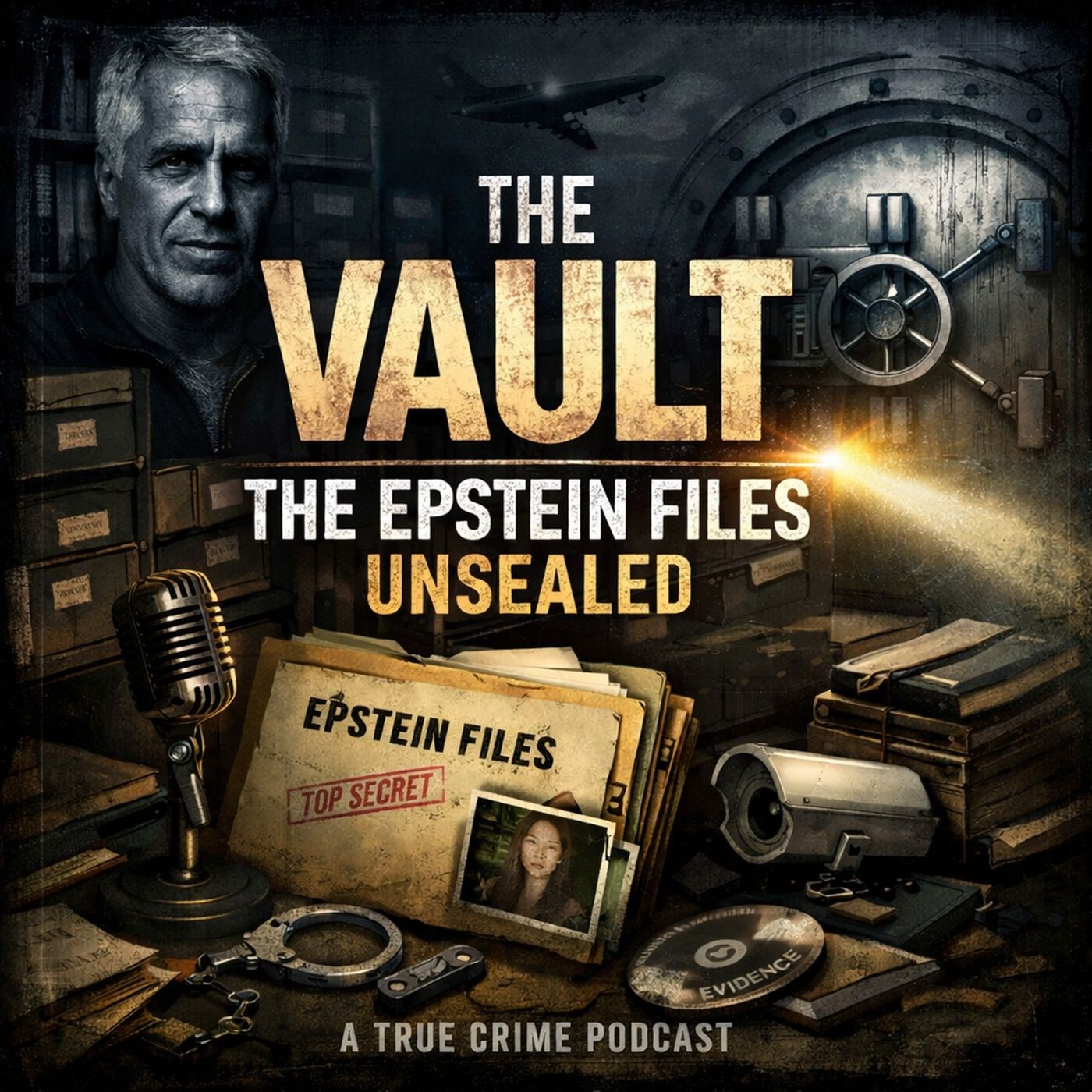
The Vault: The Epstein Files
Bobby Capucci
The Vault: The Epstein Files Unsealed is a deep-dive investigative podcast that pulls back the curtain on one of the most protected criminal networks in modern history. This series is built from the ground up on the actual paper trail—unsealed court records, depositions, exhibits, emails, and filings that were never meant to be read by the public. No pundit panels. No spin. Just the documents themselves, examined line by line, name by name, connection by connection—paired with precise, document-driven analysis that explains what the record truly shows.Each episode opens the vault on newly unsealed or long-buried Epstein files and walks listeners through what they actually reveal about power, money, influence, and the systems that failed survivors at every turn. Alongside the filings themselves, informed commentary breaks down the legal strategy, the institutional behavior, the contradictions, and the implications hiding between the lines. From judges’ orders and sealed exhibits to sworn testimony and back-channel communications, the show connects the dots the media often won’t—or can’t. Patterns emerge. Timelines collapse. Excuses fall apart.The Vault is a working archive in audio form, a living record of the Epstein case as told by the courts themselves—supplemented by rigorous analysis that provides context, challenges official narratives, and exposes where the record has been distorted, sanitized, or deliberately ignored. Every claim is grounded in filings. Every episode is anchored to the record. Listeners aren’t told what to think—they are shown what exists, what was said under oath, and what the commentary reveals about how those facts were buried, softened, or misrepresented.If you want to understand how Jeffrey Epstein was protected, who circled him, how institutions closed ranks, and why accountability keeps slipping through the cracks, The Vault: The Epstein Files Unsealed is where the record finally speaks for itself—and where the commentary ensures the documents do what no press release ever will.
Episodes
Mentioned books

Feb 9, 2026 • 13min
Transcripts From The Bill Barr Epstein Related Congressional Deposition (Part 4) (2/8/26)
Bill Barr’s deposition before Congress on Jeffrey Epstein was a masterclass in calculated deflection. While Barr insisted that Epstein’s death was “absolutely” suicide, he conceded that the prison surveillance system had “blind spots”—a detail that conveniently leaves just enough room for speculation without providing definitive answers. His reliance on flawed or incomplete camera footage, combined with his dismissal of alternative forensic perspectives, came off less like transparency and more like institutional damage control. Instead of holding the Bureau of Prisons accountable, Barr’s narrative positioned the failures as unfortunate but inconsequential, a stance that fails to satisfy the public demand for clarity.Just as troubling was Barr’s evasiveness when pressed about Donald Trump’s knowledge of Epstein. He admitted to having spoken with Trump about Epstein’s death but couldn’t recall when one of those conversations occurred—an astonishing lapse considering the gravity of the matter. His reasoning that “if there were more to it, it would have leaked” was not only flippant but dismissive of the very real history of suppression, obstruction, and selective disclosure that has defined the Epstein saga. By leaning on institutional trust in a case defined by betrayal of that very trust, Barr’s testimony did little more than reinforce suspicions that the Department of Justice has long been more concerned with containment than accountability.to contact me:bobbycapucci@protonmail.comsource:Barr-Transcript.pdf
Feb 9, 2026 • 11min
Transcripts From The Bill Barr Epstein Related Congressional Deposition (Part 3) (2/8/26)
Bill Barr’s deposition before Congress on Jeffrey Epstein was a masterclass in calculated deflection. While Barr insisted that Epstein’s death was “absolutely” suicide, he conceded that the prison surveillance system had “blind spots”—a detail that conveniently leaves just enough room for speculation without providing definitive answers. His reliance on flawed or incomplete camera footage, combined with his dismissal of alternative forensic perspectives, came off less like transparency and more like institutional damage control. Instead of holding the Bureau of Prisons accountable, Barr’s narrative positioned the failures as unfortunate but inconsequential, a stance that fails to satisfy the public demand for clarity.Just as troubling was Barr’s evasiveness when pressed about Donald Trump’s knowledge of Epstein. He admitted to having spoken with Trump about Epstein’s death but couldn’t recall when one of those conversations occurred—an astonishing lapse considering the gravity of the matter. His reasoning that “if there were more to it, it would have leaked” was not only flippant but dismissive of the very real history of suppression, obstruction, and selective disclosure that has defined the Epstein saga. By leaning on institutional trust in a case defined by betrayal of that very trust, Barr’s testimony did little more than reinforce suspicions that the Department of Justice has long been more concerned with containment than accountability.to contact me:bobbycapucci@protonmail.comsource:Barr-Transcript.pdf
Feb 9, 2026 • 14min
Transcripts From The Bill Barr Epstein Related Congressional Deposition (Part 2) (2/8/26)
Bill Barr’s deposition before Congress on Jeffrey Epstein was a masterclass in calculated deflection. While Barr insisted that Epstein’s death was “absolutely” suicide, he conceded that the prison surveillance system had “blind spots”—a detail that conveniently leaves just enough room for speculation without providing definitive answers. His reliance on flawed or incomplete camera footage, combined with his dismissal of alternative forensic perspectives, came off less like transparency and more like institutional damage control. Instead of holding the Bureau of Prisons accountable, Barr’s narrative positioned the failures as unfortunate but inconsequential, a stance that fails to satisfy the public demand for clarity.Just as troubling was Barr’s evasiveness when pressed about Donald Trump’s knowledge of Epstein. He admitted to having spoken with Trump about Epstein’s death but couldn’t recall when one of those conversations occurred—an astonishing lapse considering the gravity of the matter. His reasoning that “if there were more to it, it would have leaked” was not only flippant but dismissive of the very real history of suppression, obstruction, and selective disclosure that has defined the Epstein saga. By leaning on institutional trust in a case defined by betrayal of that very trust, Barr’s testimony did little more than reinforce suspicions that the Department of Justice has long been more concerned with containment than accountability.to contact me:bobbycapucci@protonmail.comsource:Barr-Transcript.pdf
Feb 9, 2026 • 13min
Transcripts From The Bill Barr Epstein Related Congressional Deposition (Part 1) (2/8/26)
Bill Barr’s deposition before Congress on Jeffrey Epstein was a masterclass in calculated deflection. While Barr insisted that Epstein’s death was “absolutely” suicide, he conceded that the prison surveillance system had “blind spots”—a detail that conveniently leaves just enough room for speculation without providing definitive answers. His reliance on flawed or incomplete camera footage, combined with his dismissal of alternative forensic perspectives, came off less like transparency and more like institutional damage control. Instead of holding the Bureau of Prisons accountable, Barr’s narrative positioned the failures as unfortunate but inconsequential, a stance that fails to satisfy the public demand for clarity.Just as troubling was Barr’s evasiveness when pressed about Donald Trump’s knowledge of Epstein. He admitted to having spoken with Trump about Epstein’s death but couldn’t recall when one of those conversations occurred—an astonishing lapse considering the gravity of the matter. His reasoning that “if there were more to it, it would have leaked” was not only flippant but dismissive of the very real history of suppression, obstruction, and selective disclosure that has defined the Epstein saga. By leaning on institutional trust in a case defined by betrayal of that very trust, Barr’s testimony did little more than reinforce suspicions that the Department of Justice has long been more concerned with containment than accountability.to contact me:bobbycapucci@protonmail.comsource:Barr-Transcript.pdf
Feb 8, 2026 • 12min
Jeffrey Epstein And The Myth Of The "Perfect Victim" (Part 2) (2/8/26)
The myth of the “perfect victim” is the poisonous illusion that a person must be flawless, pure, and morally spotless to deserve justice—and it’s the very lie that allowed Jeffrey Epstein to operate in plain sight. He built his empire on exploiting society’s prejudices, targeting poor and vulnerable girls precisely because he knew people would doubt them. When his crimes surfaced, the world didn’t ask how he got away with it; it asked what his victims had done wrong. That obsession with perfection became his greatest shield—turning every imperfection into a reason for disbelief, every scar into supposed evidence of guilt.This narrative isn’t just cruel—it’s complicit. It teaches the powerful that they can destroy lives as long as their victims don’t fit the fairy-tale mold of innocence. It conditions the public to defend predators and question survivors, ensuring the next Epstein will thrive in the same moral vacuum. The truth is, real victims are messy, human, and imperfect—and that humanity should never disqualify them from justice. The “perfect victim” never existed; she was invented by monsters who needed a way to keep their hands clean. The sooner we kill that myth, the sooner we end the culture that keeps making predators untouchable.to contact me:bobbycapucci@protonmail.com
Feb 8, 2026 • 13min
Jeffrey Epstein And The Myth Of The "Perfect Victim" (Part 1) (2/8/26)
The myth of the “perfect victim” is the poisonous illusion that a person must be flawless, pure, and morally spotless to deserve justice—and it’s the very lie that allowed Jeffrey Epstein to operate in plain sight. He built his empire on exploiting society’s prejudices, targeting poor and vulnerable girls precisely because he knew people would doubt them. When his crimes surfaced, the world didn’t ask how he got away with it; it asked what his victims had done wrong. That obsession with perfection became his greatest shield—turning every imperfection into a reason for disbelief, every scar into supposed evidence of guilt.This narrative isn’t just cruel—it’s complicit. It teaches the powerful that they can destroy lives as long as their victims don’t fit the fairy-tale mold of innocence. It conditions the public to defend predators and question survivors, ensuring the next Epstein will thrive in the same moral vacuum. The truth is, real victims are messy, human, and imperfect—and that humanity should never disqualify them from justice. The “perfect victim” never existed; she was invented by monsters who needed a way to keep their hands clean. The sooner we kill that myth, the sooner we end the culture that keeps making predators untouchable.to contact me:bobbycapucci@protonmail.com
Feb 8, 2026 • 18min
Written Receipts: How Epstein’s Emails Caught Prince Andrew Lying (2/7/26)
The newly released emails between Jeffrey Epstein and Prince Andrew directly contradict the central claims Andrew made during his disastrous Newsnight interview, where he insisted he had severed contact with Epstein years earlier and had no meaningful relationship after Epstein’s 2008 conviction. The correspondence shows sustained, friendly communication well beyond the timeframe Andrew publicly acknowledged, including coordination around meetings, travel logistics, and tone that reflects familiarity rather than estrangement. This is not casual or incidental contact; the emails demonstrate continuity, comfort, and mutual access. Andrew’s insistence that he had “nothing to do” with Epstein post-conviction collapses when placed alongside written evidence showing otherwise. The language used undercuts any claim of a reluctant or distant association. Instead, it paints a picture of an ongoing relationship that Andrew later tried to erase retroactively. The gap between what he said on camera and what he wrote privately is no longer debatable. It is documented.Even more damaging is how the emails dismantle Andrew’s explanation for the now-infamous 2010 meeting at Epstein’s Manhattan townhouse, which he framed as a one-time, honorable attempt to “end the friendship.” The correspondence shows no clean break, no finality, and no discomfort—only continuity before and after that meeting. This makes Andrew’s Newsnight narrative read less like confusion and more like deliberate misrepresentation. The emails also undermine his claims about memory lapses, timing, and lack of awareness by anchoring events to specific dates and exchanges he cannot plausibly deny. Taken together, the record shows that Andrew didn’t merely misstate details; he constructed a false storyline designed to minimize exposure once Epstein’s crimes became impossible to ignore. The emails prove he wasn’t distancing himself—he was managing optics. And once those private words are read alongside his public denials, the conclusion is unavoidable: Prince Andrew lied, plainly and repeatedly, in an interview meant to salvage his credibility.to contact me:bobbycapucci@protonmail.comsource:Girls coming 'after school' and $5,000 cash floats: The full sordid truth about Andrew's wild NINE-DAY visit to Jeffrey Epstein's New York mansion | Daily Mail Online
Feb 8, 2026 • 21min
Someone Went Up the Stairs the Night Epstein Died—So Why Were We Told No One Did? (2/8/26)
Newly released Department of Justice documents from the ongoing Epstein Files review include surveillance logs that appear to contradict parts of the official narrative of Jeffrey Epstein’s death in 2019. The logs describe an orange-colored figure moving up a staircase toward Epstein’s locked housing tier at the Metropolitan Correctional Center late on the evening before his death, around 10:39 p.m. That movement—possibly an inmate or corrections officer carrying linen—was logged differently by the FBI and the DOJ’s inspector general, and was not mentioned in earlier official accounts that asserted no one entered the tier that night. Experts reviewing the camera footage say the single working camera angle was limited, leaving uncertainty about whether someone could have approached the tier unnoticed, even as past statements from officials like former Attorney General Bill Barr maintained there were no additional entries.The newly released files also include interviews with prison staff and logs showing procedural failures on the night Epstein died, such as missed wellness checks and inconsistent inmate counts. The discrepancies between the surveillance observations and prior public claims have fueled fresh questions about the events surrounding his death, which was officially ruled a suicide. Though no new definitive evidence of foul play has been established, the details in the video logs and related records have underscored gaps and contradictions in the historical record of what happened inside the jail that night.to contact me:bobbycapucci@protonmail.comsource:Who entered Epstein's jail tier the night of his death? Newly released video logs appear to contradict official accounts. - CBS News
Feb 8, 2026 • 14min
Marie Villafana And Her Defense Of Jeffrey Epstein's NPA (Part 3) (2/8/26)
In a sworn affidavit filed in 2017, Marie Villafaña, a Department of Justice official, laid out the government’s formal defense of how federal prosecutors handled the Crime Victims’ Rights Act during the Jeffrey Epstein non-prosecution agreement. Her core argument was that the CVRA’s notice and participation requirements did not apply because Epstein had not been federally charged at the time the deal was negotiated, framing the agreement as a pre-charge exercise of prosecutorial discretion rather than a criminal proceeding triggering victims’ rights. Villafaña asserted that prosecutors were operating within long-standing DOJ interpretations of the law, emphasizing that the CVRA was never intended to require victim notification during confidential plea negotiations or before formal charges were filed. She presented the government’s position as legally cautious rather than deceptive, insisting that secrecy was necessary to preserve the integrity of negotiations and avoid jeopardizing a potential federal case.Villafaña also used the affidavit to push back against allegations that prosecutors intentionally misled Epstein’s victims or acted in bad faith, repeatedly stressing that DOJ personnel believed they were complying with the law as it was understood at the time. She argued that internal DOJ guidance supported limiting disclosure to victims before charges, and that there was no clear judicial precedent then requiring broader notification under the CVRA in pre-indictment settings. Framed this way, the affidavit portrayed the Epstein deal not as a calculated effort to sidestep victims’ rights, but as a legally defensible—if controversial—exercise of prosecutorial judgment. That position would later come under severe criticism from courts and victims’ advocates, but in 2017 Villafaña’s filing stood as the DOJ’s most explicit attempt to justify its handling of the Epstein case under the CVRA.to contact me:bobbycapucci@protonmail.comsource:gov.uscourts.flsd.317867.403.19.pdf
Feb 8, 2026 • 13min
Marie Villafana And Her Defense Of Jeffrey Epstein's NPA (Part 2) (2/8/26)
In a sworn affidavit filed in 2017, Marie Villafaña, a Department of Justice official, laid out the government’s formal defense of how federal prosecutors handled the Crime Victims’ Rights Act during the Jeffrey Epstein non-prosecution agreement. Her core argument was that the CVRA’s notice and participation requirements did not apply because Epstein had not been federally charged at the time the deal was negotiated, framing the agreement as a pre-charge exercise of prosecutorial discretion rather than a criminal proceeding triggering victims’ rights. Villafaña asserted that prosecutors were operating within long-standing DOJ interpretations of the law, emphasizing that the CVRA was never intended to require victim notification during confidential plea negotiations or before formal charges were filed. She presented the government’s position as legally cautious rather than deceptive, insisting that secrecy was necessary to preserve the integrity of negotiations and avoid jeopardizing a potential federal case.Villafaña also used the affidavit to push back against allegations that prosecutors intentionally misled Epstein’s victims or acted in bad faith, repeatedly stressing that DOJ personnel believed they were complying with the law as it was understood at the time. She argued that internal DOJ guidance supported limiting disclosure to victims before charges, and that there was no clear judicial precedent then requiring broader notification under the CVRA in pre-indictment settings. Framed this way, the affidavit portrayed the Epstein deal not as a calculated effort to sidestep victims’ rights, but as a legally defensible—if controversial—exercise of prosecutorial judgment. That position would later come under severe criticism from courts and victims’ advocates, but in 2017 Villafaña’s filing stood as the DOJ’s most explicit attempt to justify its handling of the Epstein case under the CVRA.to contact me:bobbycapucci@protonmail.comsource:gov.uscourts.flsd.317867.403.19.pdf

