

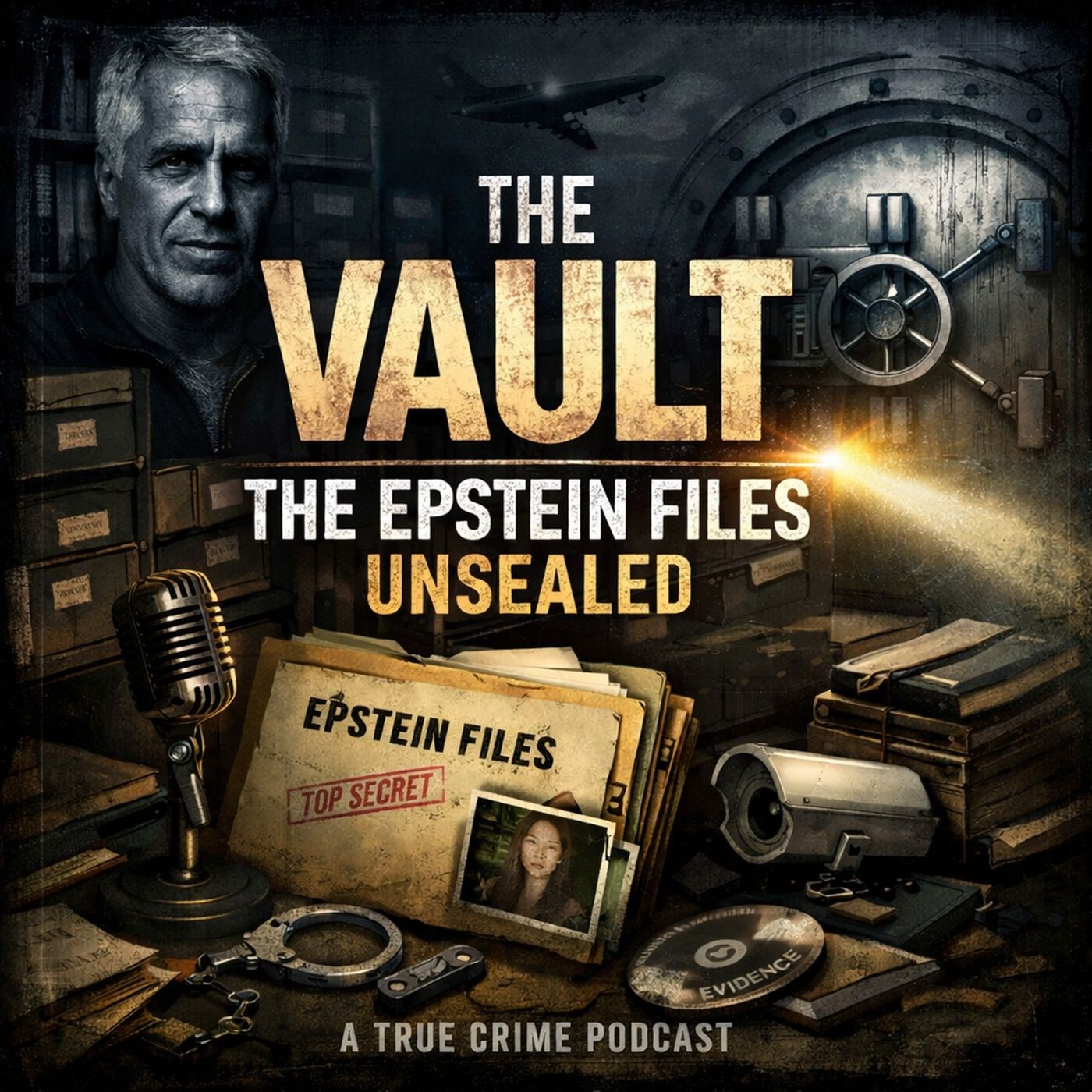
The Vault: The Epstein Files
Bobby Capucci
The Vault: The Epstein Files Unsealed is a deep-dive investigative podcast that pulls back the curtain on one of the most protected criminal networks in modern history. This series is built from the ground up on the actual paper trail—unsealed court records, depositions, exhibits, emails, and filings that were never meant to be read by the public. No pundit panels. No spin. Just the documents themselves, examined line by line, name by name, connection by connection—paired with precise, document-driven analysis that explains what the record truly shows.Each episode opens the vault on newly unsealed or long-buried Epstein files and walks listeners through what they actually reveal about power, money, influence, and the systems that failed survivors at every turn. Alongside the filings themselves, informed commentary breaks down the legal strategy, the institutional behavior, the contradictions, and the implications hiding between the lines. From judges’ orders and sealed exhibits to sworn testimony and back-channel communications, the show connects the dots the media often won’t—or can’t. Patterns emerge. Timelines collapse. Excuses fall apart.The Vault is a working archive in audio form, a living record of the Epstein case as told by the courts themselves—supplemented by rigorous analysis that provides context, challenges official narratives, and exposes where the record has been distorted, sanitized, or deliberately ignored. Every claim is grounded in filings. Every episode is anchored to the record. Listeners aren’t told what to think—they are shown what exists, what was said under oath, and what the commentary reveals about how those facts were buried, softened, or misrepresented.If you want to understand how Jeffrey Epstein was protected, who circled him, how institutions closed ranks, and why accountability keeps slipping through the cracks, The Vault: The Epstein Files Unsealed is where the record finally speaks for itself—and where the commentary ensures the documents do what no press release ever will.
Episodes
Mentioned books

Feb 10, 2026 • 14min
Transcripts From The Bill Barr Epstein Related Congressional Deposition (Part 7) (2/9/26)
Bill Barr’s deposition before Congress on Jeffrey Epstein was a masterclass in calculated deflection. While Barr insisted that Epstein’s death was “absolutely” suicide, he conceded that the prison surveillance system had “blind spots”—a detail that conveniently leaves just enough room for speculation without providing definitive answers. His reliance on flawed or incomplete camera footage, combined with his dismissal of alternative forensic perspectives, came off less like transparency and more like institutional damage control. Instead of holding the Bureau of Prisons accountable, Barr’s narrative positioned the failures as unfortunate but inconsequential, a stance that fails to satisfy the public demand for clarity.Just as troubling was Barr’s evasiveness when pressed about Donald Trump’s knowledge of Epstein. He admitted to having spoken with Trump about Epstein’s death but couldn’t recall when one of those conversations occurred—an astonishing lapse considering the gravity of the matter. His reasoning that “if there were more to it, it would have leaked” was not only flippant but dismissive of the very real history of suppression, obstruction, and selective disclosure that has defined the Epstein saga. By leaning on institutional trust in a case defined by betrayal of that very trust, Barr’s testimony did little more than reinforce suspicions that the Department of Justice has long been more concerned with containment than accountability.to contact me:bobbycapucci@protonmail.comsource:Barr-Transcript.pdf
Feb 9, 2026 • 14min
How Epstein’s Operation Required a Network the DOJ Won’t Confront (2/9/26)
The Department of Justice’s long-standing claim that Jeffrey Epstein and Ghislaine Maxwell acted alone is contradicted by the government’s own records. Federal prosecutors explicitly acknowledged the existence of multiple co-conspirators as early as the 2007–2008 Florida investigation, including in the Non-Prosecution Agreement that granted immunity to Epstein and unnamed others. Sworn testimony, sealed filings, and investigative activity confirm that Epstein’s crimes required an organized network of recruiters, schedulers, transporters, financial managers, and legal fixers operating across jurisdictions for years. Despite this, the DOJ has consistently narrowed its framing to portray the case as a two-person operation, avoiding any comprehensive conspiracy prosecution. That decision was not driven by a lack of evidence, but by institutional restraint, selective inquiry, and an unwillingness to confront the broader implications of its own past decisions.The DOJ continues to justify secrecy by invoking victim privacy, even though survivors themselves were excluded from key prosecutorial decisions and have repeatedly called for transparency. Redactions, sealed documents, and the refusal to name co-conspirators function less as victim protection and more as insulation for the government and its prior conduct. A full accounting would expose prosecutorial failures, political interference, and decades of discretionary choices that allowed Epstein to operate with impunity. The continuity of this behavior across administrations—including during the Trump DOJ—demonstrates that the issue is structural, not partisan. At bottom, the DOJ is not merely protecting Epstein’s associates; it is protecting itself and the institutional role it played in creating, enabling, and shielding one of the most consequential criminal enterprises in modern history.to contact me:bobbycapucci@protonmail.com
Feb 9, 2026 • 12min
Mark Epstein Says His Brother Was Murdered And He Thinks Trump Is Responsible (2/9/26)
Mark Epstein has consistently stated that he does not believe his brother, Jeffrey Epstein, died by suicide and has instead argued that he was murdered while in federal custody. From the beginning, Mark has pointed to what he sees as glaring irregularities in the circumstances of Jeffrey Epstein’s death, including the failure of jail staff to properly monitor him, the broken or unusable surveillance cameras, and the rapid rush by authorities to declare the death a suicide. He has said these failures go far beyond ordinary negligence and suggest, at minimum, a system that allowed Epstein to die when powerful interests may have preferred him silent. Mark has emphasized that his brother had recently been taken off suicide watch and, in his view, showed no signs consistent with an imminent suicide at that moment. He has repeatedly framed these facts as incompatible with the official narrative offered by the Bureau of Prisons and the DOJ.Mark Epstein has also cited medical and forensic concerns to support his belief that his brother was killed. He has publicly referenced findings from the autopsy that noted fractures in Jeffrey Epstein’s neck bones, arguing that these injuries are more commonly associated with strangulation than with hanging. Mark has said that the refusal of authorities to seriously address these findings, combined with the lack of accountability for the jail failures, reinforces his suspicion of foul play. He has further argued that Jeffrey Epstein was uniquely dangerous to powerful people because of what he knew, and that his death conveniently prevented testimony, cooperation, or further exposure of co-conspirators. For Mark Epstein, the issue is not just personal grief but what he describes as a profound failure of justice, where unanswered questions have been buried rather than investigated with the seriousness such a death demands.to contact me:bobbycapucci@protonmail.comsource:Trump accused of role in Epstein’s death in explosive email sent to FBI, documents reveal | The Independent
Feb 9, 2026 • 12min
Caught in Black and White: How Epstein Emails Expose Howard Lutnick’s Lies (2/9/26)
In the newly released tranche of the Epstein files—millions of internal emails and documents made public by the U.S. Department of Justice—correspondence involving Howard Lutnick has revealed details that contradict his long-held public statements about his relationship with Jeffrey Epstein. Lutnick had repeatedly claimed that he and his wife cut ties with Epstein around 2005 and that he had “limited interactions” with the disgraced financier, even saying at one point that he would “never be in a room” with him again after a weird encounter as neighbors in New York. However, the newly disclosed emails show that in 2012, years after Epstein’s conviction on sex offense charges, Lutnick and his family actually planned and carried out a visit to Epstein’s private Caribbean island, Little Saint James, agreeing to lunch with him there and coordinating logistics via email. Other messages show continued email contact into 2017 and references to Epstein contributing to a charitable dinner associated with Lutnick, undermining his repeated assertions that he had cut all contact decades earlier.These revelations have significantly weakened Lutnick’s credibility on this issue because they directly contradict his public narrative of distancing himself from Epstein after 2005. Instead of “limited interactions,” the emails indicate ongoing contact and social engagement well into the 2010s, including family travel arrangements and personal communication long after Epstein’s criminal conduct was widely known. When confronted with these files, Lutnick’s office has downplayed the interactions and reiterated that he was never accused of wrongdoing, but the factual email trail—showing lunches, island visits, and cordial correspondence—stands in stark contrast to his earlier statements of severance and minimal contact, raising questions about why he misrepresented the extent of his relationship.to contact me:bobbycapucci@protonmail.comsource:Lutnick and Epstein were in business together, Epstein files show - CBS News
Feb 9, 2026 • 15min
All Questions, No Answers: Ghislaine Maxwell And Her Deposition Before Congress (2/9/26)
Today, convicted sex-trafficker Ghislaine Maxwell is scheduled to sit for a deposition before the U.S. House Oversight and Government Reform Committee as part of Congress’s ongoing investigation into the crimes of Jeffrey Epstein and his network. Lawmakers have arranged for Maxwell to appear—likely by videolink from prison—to answer questions about her role in Epstein’s operations, her connections with powerful individuals, and related matters that have come to light after the release of millions of federal documents linked to the Epstein case. Committee members, including Representative Ro Khanna, outlined specific questions they intend to ask, spanning alleged co-conspirators, unindicted individuals, and high-profile figures with ties to Epstein’s world.However, Maxwell’s legal team has made clear she intends to invoke her Fifth Amendment right against self-incrimination and will refuse to answer substantive questions during this deposition, effectively pleading the Fifth throughout the session rather than provide testimony. According to lawmakers, Maxwell plans to read a prepared statement at the outset and then decline to respond to individual inquiries—citing her constitutional privilege and concerns about jeopardizing ongoing legal matters, including a habeas petition challenging her conviction. This strategy means Congress may not get direct answers from her today, even as it pursues broader scrutiny of Epstein’s activities and associations.to contact me:bobbycapucci@protonmail.comsource:Ghislaine Maxwell is set to plead the fifth as she appears before the US Congress board investigating Jeffrey Epstein today | Daily Mail Online
Feb 9, 2026 • 16min
How The Federal Government Broke The Law When It Comes to Epstein And The CVRA (Part 2) (2/9/26)
The Crime Victims’ Rights Act (CVRA) was supposed to guarantee fairness and transparency for victims—making sure they were informed, included, and respected in the legal process. But when Jeffrey Epstein came along, that promise evaporated. Federal prosecutors secretly cut a Non-Prosecution Agreement that protected not only Epstein but also his “potential co-conspirators,” violating the very law designed to stop such backroom deals. The victims weren’t told; they found out months later from the press. The same Department of Justice that preaches accountability deliberately hid the deal, broke federal law, and then argued that the CVRA didn’t apply because no federal charges were filed—an argument so twisted it turned their own crime into a loophole.Instead of punishment, Epstein got 13 months in county jail with daily work release, while the prosecutors who betrayed the victims got promotions. The courts sided with the government, ruling that since the feds never formally charged Epstein, the survivors technically weren’t “victims” under the CVRA. The result was a legal farce that showed how easily the system bends for the powerful. The law that was supposed to protect victims ended up protecting predators, proving once again that in America, justice isn’t blind—it just looks away when the wrong people are involved.to contact me:bobbycapucci@protonmail.com
Feb 9, 2026 • 12min
How The Federal Government Broke The Law When It Comes to Epstein And The CVRA (Part 1) (2/9/26)
The Crime Victims’ Rights Act (CVRA) was supposed to guarantee fairness and transparency for victims—making sure they were informed, included, and respected in the legal process. But when Jeffrey Epstein came along, that promise evaporated. Federal prosecutors secretly cut a Non-Prosecution Agreement that protected not only Epstein but also his “potential co-conspirators,” violating the very law designed to stop such backroom deals. The victims weren’t told; they found out months later from the press. The same Department of Justice that preaches accountability deliberately hid the deal, broke federal law, and then argued that the CVRA didn’t apply because no federal charges were filed—an argument so twisted it turned their own crime into a loophole.Instead of punishment, Epstein got 13 months in county jail with daily work release, while the prosecutors who betrayed the victims got promotions. The courts sided with the government, ruling that since the feds never formally charged Epstein, the survivors technically weren’t “victims” under the CVRA. The result was a legal farce that showed how easily the system bends for the powerful. The law that was supposed to protect victims ended up protecting predators, proving once again that in America, justice isn’t blind—it just looks away when the wrong people are involved.to contact me:bobbycapucci@protonmail.com
Feb 9, 2026 • 13min
Transcripts From The Bill Barr Epstein Related Congressional Deposition (Part 6) (2/9/26)
Bill Barr’s deposition before Congress on Jeffrey Epstein was a masterclass in calculated deflection. While Barr insisted that Epstein’s death was “absolutely” suicide, he conceded that the prison surveillance system had “blind spots”—a detail that conveniently leaves just enough room for speculation without providing definitive answers. His reliance on flawed or incomplete camera footage, combined with his dismissal of alternative forensic perspectives, came off less like transparency and more like institutional damage control. Instead of holding the Bureau of Prisons accountable, Barr’s narrative positioned the failures as unfortunate but inconsequential, a stance that fails to satisfy the public demand for clarity.Just as troubling was Barr’s evasiveness when pressed about Donald Trump’s knowledge of Epstein. He admitted to having spoken with Trump about Epstein’s death but couldn’t recall when one of those conversations occurred—an astonishing lapse considering the gravity of the matter. His reasoning that “if there were more to it, it would have leaked” was not only flippant but dismissive of the very real history of suppression, obstruction, and selective disclosure that has defined the Epstein saga. By leaning on institutional trust in a case defined by betrayal of that very trust, Barr’s testimony did little more than reinforce suspicions that the Department of Justice has long been more concerned with containment than accountability.to contact me:bobbycapucci@protonmail.comsource:Barr-Transcript.pdf
Feb 9, 2026 • 13min
Transcripts From The Bill Barr Epstein Related Congressional Deposition (Part 5) (2/9/26)
Bill Barr’s deposition before Congress on Jeffrey Epstein was a masterclass in calculated deflection. While Barr insisted that Epstein’s death was “absolutely” suicide, he conceded that the prison surveillance system had “blind spots”—a detail that conveniently leaves just enough room for speculation without providing definitive answers. His reliance on flawed or incomplete camera footage, combined with his dismissal of alternative forensic perspectives, came off less like transparency and more like institutional damage control. Instead of holding the Bureau of Prisons accountable, Barr’s narrative positioned the failures as unfortunate but inconsequential, a stance that fails to satisfy the public demand for clarity.Just as troubling was Barr’s evasiveness when pressed about Donald Trump’s knowledge of Epstein. He admitted to having spoken with Trump about Epstein’s death but couldn’t recall when one of those conversations occurred—an astonishing lapse considering the gravity of the matter. His reasoning that “if there were more to it, it would have leaked” was not only flippant but dismissive of the very real history of suppression, obstruction, and selective disclosure that has defined the Epstein saga. By leaning on institutional trust in a case defined by betrayal of that very trust, Barr’s testimony did little more than reinforce suspicions that the Department of Justice has long been more concerned with containment than accountability.to contact me:bobbycapucci@protonmail.comsource:Barr-Transcript.pdf
Feb 9, 2026 • 13min
Transcripts From The Bill Barr Epstein Related Congressional Deposition (Part 4) (2/8/26)
Bill Barr’s deposition before Congress on Jeffrey Epstein was a masterclass in calculated deflection. While Barr insisted that Epstein’s death was “absolutely” suicide, he conceded that the prison surveillance system had “blind spots”—a detail that conveniently leaves just enough room for speculation without providing definitive answers. His reliance on flawed or incomplete camera footage, combined with his dismissal of alternative forensic perspectives, came off less like transparency and more like institutional damage control. Instead of holding the Bureau of Prisons accountable, Barr’s narrative positioned the failures as unfortunate but inconsequential, a stance that fails to satisfy the public demand for clarity.Just as troubling was Barr’s evasiveness when pressed about Donald Trump’s knowledge of Epstein. He admitted to having spoken with Trump about Epstein’s death but couldn’t recall when one of those conversations occurred—an astonishing lapse considering the gravity of the matter. His reasoning that “if there were more to it, it would have leaked” was not only flippant but dismissive of the very real history of suppression, obstruction, and selective disclosure that has defined the Epstein saga. By leaning on institutional trust in a case defined by betrayal of that very trust, Barr’s testimony did little more than reinforce suspicions that the Department of Justice has long been more concerned with containment than accountability.to contact me:bobbycapucci@protonmail.comsource:Barr-Transcript.pdf

