

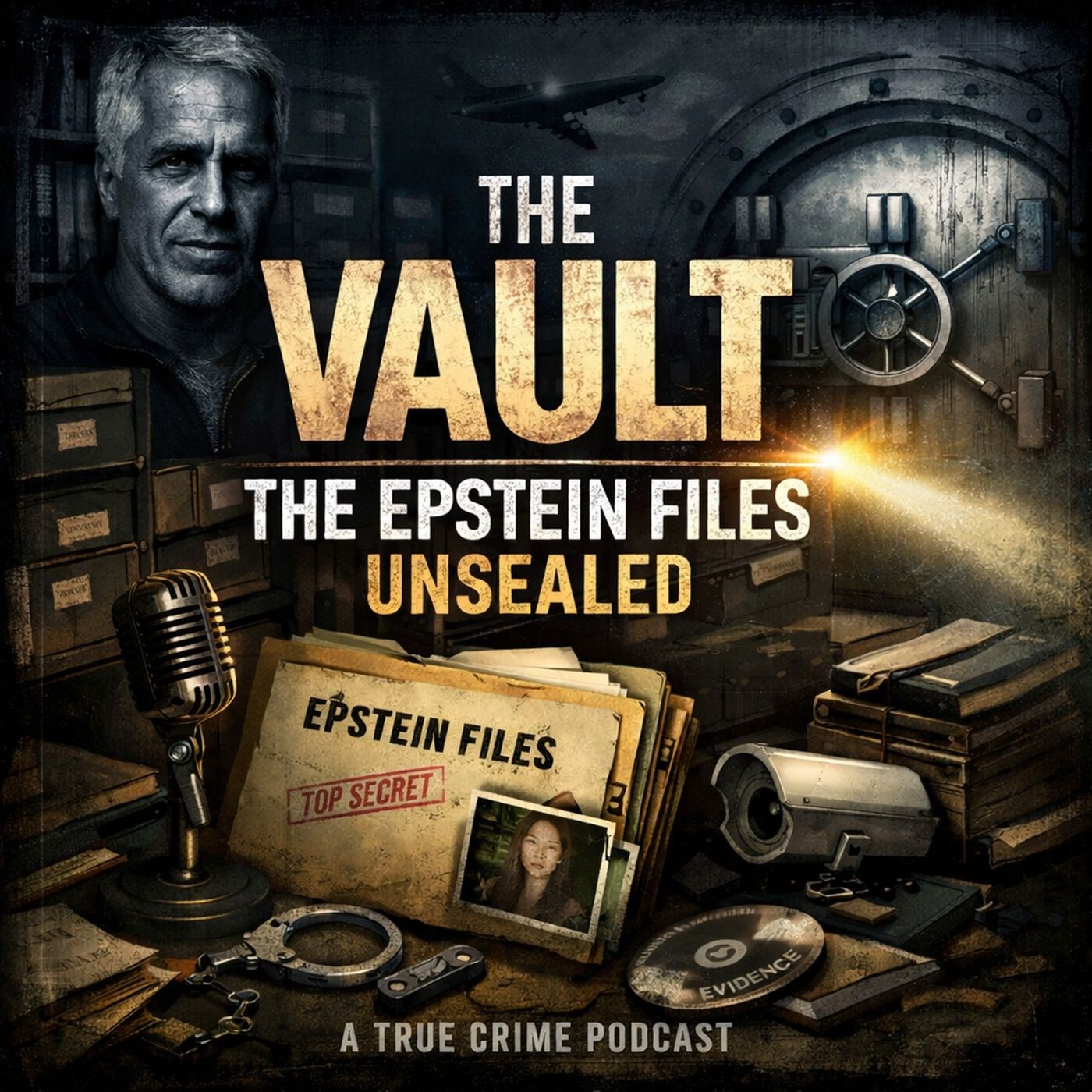
The Vault: The Epstein Files
Bobby Capucci
The Vault: The Epstein Files Unsealed is a deep-dive investigative podcast that pulls back the curtain on one of the most protected criminal networks in modern history. This series is built from the ground up on the actual paper trail—unsealed court records, depositions, exhibits, emails, and filings that were never meant to be read by the public. No pundit panels. No spin. Just the documents themselves, examined line by line, name by name, connection by connection—paired with precise, document-driven analysis that explains what the record truly shows.Each episode opens the vault on newly unsealed or long-buried Epstein files and walks listeners through what they actually reveal about power, money, influence, and the systems that failed survivors at every turn. Alongside the filings themselves, informed commentary breaks down the legal strategy, the institutional behavior, the contradictions, and the implications hiding between the lines. From judges’ orders and sealed exhibits to sworn testimony and back-channel communications, the show connects the dots the media often won’t—or can’t. Patterns emerge. Timelines collapse. Excuses fall apart.The Vault is a working archive in audio form, a living record of the Epstein case as told by the courts themselves—supplemented by rigorous analysis that provides context, challenges official narratives, and exposes where the record has been distorted, sanitized, or deliberately ignored. Every claim is grounded in filings. Every episode is anchored to the record. Listeners aren’t told what to think—they are shown what exists, what was said under oath, and what the commentary reveals about how those facts were buried, softened, or misrepresented.If you want to understand how Jeffrey Epstein was protected, who circled him, how institutions closed ranks, and why accountability keeps slipping through the cracks, The Vault: The Epstein Files Unsealed is where the record finally speaks for itself—and where the commentary ensures the documents do what no press release ever will.
Episodes
Mentioned books

Feb 6, 2026 • 25min
Silicon Valley’s Dirty Secret: Jeffrey Epstein and the Tech Elite (2/6/26)
Federal prosecutors have released a massive tranche of documents connected to the late financier and convicted sex offender Jeffrey Epstein as part of a transparency law, and those files show his extensive ties to powerful figures in tech and beyond. The documents include emails and correspondence involving prominent tech leaders such as Elon Musk and Bill Gates, among others, discussing social plans, personal matters, and interactions with Epstein long after his 2008 conviction for soliciting prostitution involving a minor. Though appearing in the files does not imply criminal wrongdoing, the records show Musk asked Epstein about boat and holiday plans and expressed interest in visiting Epstein’s private Caribbean island, while Epstein drafted unsent emails containing unverified and salacious allegations about Gates. Both tech figures have publicly denied impropriety, with spokespersons and social media posts rebutting any misconduct and characterizing their connections as limited or misinterpreted.Beyond individual interactions, the broader batch of more than three million pages paints a picture of Epstein’s enduring access to elite social and business circles, including Silicon Valley and philanthropic networks. Documents suggest that Epstein remained welcome at exclusive dinners and gatherings with billionaire tech and finance leaders, and he even invested in early cryptocurrency ventures like Coinbase alongside major venture capital firms despite his criminal past. While the Justice Department has stated that the material does not establish a basis for new criminal charges, the release has reignited scrutiny of Epstein’s relationships with influential people and sparked political and public calls for fuller accountability for those whose names appear in the files.to contact me:bobbycapucci@protonmail.comsource:Jeffrey Epstein files reveal deep tech ties, from Musk to Gates
Feb 6, 2026 • 14min
Lawyers For Epstein Survivors Seek Judicial Intervention Due To Redaction Issues (2/6/26)
The letter urges immediate judicial intervention by Judges Berman and Engelmayer after what the authors describe as a serious failure by the Department of Justice in releasing Epstein-related records. According to the letter, on January 30, 2026, the DOJ released more than 3.5 million documents while failing to properly redact victims’ names and other personally identifying information in thousands of instances. This occurred despite repeated assurances from the DOJ that redaction was the sole reason for delaying the release and explicit acknowledgments that failure to redact would cause extraordinary harm to victims. The letter outlines a long paper trail showing that concerns about victim protection were raised well before the mass release. The authors note that warnings were first directed to Attorney General Pam Bondi in February 2025 following the release of “The Epstein Files: Phase 1,” and later escalated to Judge Berman in August 2025 to ensure compliance with the Crime Victims’ Rights Act. Despite these efforts, the DOJ proceeded with flawed releases as public and congressional interest intensified, including a November 2025 release of 20,000 documents by the House Oversight Committee. The letter argues that the DOJ’s conduct reflects a pattern of mismanagement and disregard for victim safeguards, and it asks the court to step in to prevent further harm and enforce lawful redaction obligations.to contact me:bobbycapucci@protonmail.comsource:gov.uscourts.nysd.518649.102.0_1.pdf
Feb 6, 2026 • 12min
Alex Acosta Goes To Congress: Transcripts From The Alex Acosta Deposition (Part 6) (2/5/26)
When Alex Acosta sat before Congress to explain himself, what unfolded was less an act of accountability and more a masterclass in bureaucratic self-preservation. He painted the 2008 Epstein plea deal as a “strategic compromise,” claiming a federal trial might have been too risky because victims were “unreliable” and evidence was “thin.” In reality, federal prosecutors had a mountain of corroborating witness statements, corroborative travel logs, and sworn victim testimony—yet Acosta gave Epstein the deal of the century. The so-called non-prosecution agreement wasn’t justice; it was a backroom surrender, executed in secrecy, without even notifying the victims. When pressed on this, Acosta spun excuses about legal precedent and “jurisdictional confusion,” never once admitting the obvious: his office protected a rich, politically connected predator at the expense of dozens of trafficked girls.Even more damning was Acosta’s insistence that he acted out of pragmatism, not pressure. He denied that anyone “higher up” told him to back off—even though he once told reporters that he’d been informed Epstein “belonged to intelligence.” Under oath, he downplayed that statement, twisting it into bureaucratic double-speak. He even claimed the deal achieved “some level of justice” because Epstein registered as a sex offender—a hollow justification that only exposed how insulated from reality he remains. Acosta never showed remorse for the irreparable damage caused by his cowardice. His congressional testimony reeked of moral rot, the same rot that let a billionaire pedophile walk free while survivors were left to pick up the pieces.to contact me:bobbycapucci@protonmail.comsource:Acosta Transcript.pdf - Google Drive
Feb 6, 2026 • 22min
Alex Acosta Goes To Congress: Transcripts From The Alex Acosta Deposition (Part 5) (2/5/26)
When Alex Acosta sat before Congress to explain himself, what unfolded was less an act of accountability and more a masterclass in bureaucratic self-preservation. He painted the 2008 Epstein plea deal as a “strategic compromise,” claiming a federal trial might have been too risky because victims were “unreliable” and evidence was “thin.” In reality, federal prosecutors had a mountain of corroborating witness statements, corroborative travel logs, and sworn victim testimony—yet Acosta gave Epstein the deal of the century. The so-called non-prosecution agreement wasn’t justice; it was a backroom surrender, executed in secrecy, without even notifying the victims. When pressed on this, Acosta spun excuses about legal precedent and “jurisdictional confusion,” never once admitting the obvious: his office protected a rich, politically connected predator at the expense of dozens of trafficked girls.Even more damning was Acosta’s insistence that he acted out of pragmatism, not pressure. He denied that anyone “higher up” told him to back off—even though he once told reporters that he’d been informed Epstein “belonged to intelligence.” Under oath, he downplayed that statement, twisting it into bureaucratic double-speak. He even claimed the deal achieved “some level of justice” because Epstein registered as a sex offender—a hollow justification that only exposed how insulated from reality he remains. Acosta never showed remorse for the irreparable damage caused by his cowardice. His congressional testimony reeked of moral rot, the same rot that let a billionaire pedophile walk free while survivors were left to pick up the pieces.to contact me:bobbycapucci@protonmail.comsource:Acosta Transcript.pdf - Google Drive
Feb 6, 2026 • 15min
Alex Acosta Goes To Congress: Transcripts From The Alex Acosta Deposition (Part 4) (2/5/26)
When Alex Acosta sat before Congress to explain himself, what unfolded was less an act of accountability and more a masterclass in bureaucratic self-preservation. He painted the 2008 Epstein plea deal as a “strategic compromise,” claiming a federal trial might have been too risky because victims were “unreliable” and evidence was “thin.” In reality, federal prosecutors had a mountain of corroborating witness statements, corroborative travel logs, and sworn victim testimony—yet Acosta gave Epstein the deal of the century. The so-called non-prosecution agreement wasn’t justice; it was a backroom surrender, executed in secrecy, without even notifying the victims. When pressed on this, Acosta spun excuses about legal precedent and “jurisdictional confusion,” never once admitting the obvious: his office protected a rich, politically connected predator at the expense of dozens of trafficked girls.Even more damning was Acosta’s insistence that he acted out of pragmatism, not pressure. He denied that anyone “higher up” told him to back off—even though he once told reporters that he’d been informed Epstein “belonged to intelligence.” Under oath, he downplayed that statement, twisting it into bureaucratic double-speak. He even claimed the deal achieved “some level of justice” because Epstein registered as a sex offender—a hollow justification that only exposed how insulated from reality he remains. Acosta never showed remorse for the irreparable damage caused by his cowardice. His congressional testimony reeked of moral rot, the same rot that let a billionaire pedophile walk free while survivors were left to pick up the pieces.to contact me:bobbycapucci@protonmail.comsource:Acosta Transcript.pdf - Google Drive
Feb 6, 2026 • 12min
Alex Acosta Goes To Congress: Transcripts From The Alex Acosta Deposition (Part 3) (2/5/26)
When Alex Acosta sat before Congress to explain himself, what unfolded was less an act of accountability and more a masterclass in bureaucratic self-preservation. He painted the 2008 Epstein plea deal as a “strategic compromise,” claiming a federal trial might have been too risky because victims were “unreliable” and evidence was “thin.” In reality, federal prosecutors had a mountain of corroborating witness statements, corroborative travel logs, and sworn victim testimony—yet Acosta gave Epstein the deal of the century. The so-called non-prosecution agreement wasn’t justice; it was a backroom surrender, executed in secrecy, without even notifying the victims. When pressed on this, Acosta spun excuses about legal precedent and “jurisdictional confusion,” never once admitting the obvious: his office protected a rich, politically connected predator at the expense of dozens of trafficked girls.Even more damning was Acosta’s insistence that he acted out of pragmatism, not pressure. He denied that anyone “higher up” told him to back off—even though he once told reporters that he’d been informed Epstein “belonged to intelligence.” Under oath, he downplayed that statement, twisting it into bureaucratic double-speak. He even claimed the deal achieved “some level of justice” because Epstein registered as a sex offender—a hollow justification that only exposed how insulated from reality he remains. Acosta never showed remorse for the irreparable damage caused by his cowardice. His congressional testimony reeked of moral rot, the same rot that let a billionaire pedophile walk free while survivors were left to pick up the pieces.to contact me:bobbycapucci@protonmail.comsource:Acosta Transcript.pdf - Google Drive
Feb 6, 2026 • 16min
Alex Acosta Goes To Congress: Transcripts From The Alex Acosta Deposition (Part 2) (2/5/26)
When Alex Acosta sat before Congress to explain himself, what unfolded was less an act of accountability and more a masterclass in bureaucratic self-preservation. He painted the 2008 Epstein plea deal as a “strategic compromise,” claiming a federal trial might have been too risky because victims were “unreliable” and evidence was “thin.” In reality, federal prosecutors had a mountain of corroborating witness statements, corroborative travel logs, and sworn victim testimony—yet Acosta gave Epstein the deal of the century. The so-called non-prosecution agreement wasn’t justice; it was a backroom surrender, executed in secrecy, without even notifying the victims. When pressed on this, Acosta spun excuses about legal precedent and “jurisdictional confusion,” never once admitting the obvious: his office protected a rich, politically connected predator at the expense of dozens of trafficked girls.Even more damning was Acosta’s insistence that he acted out of pragmatism, not pressure. He denied that anyone “higher up” told him to back off—even though he once told reporters that he’d been informed Epstein “belonged to intelligence.” Under oath, he downplayed that statement, twisting it into bureaucratic double-speak. He even claimed the deal achieved “some level of justice” because Epstein registered as a sex offender—a hollow justification that only exposed how insulated from reality he remains. Acosta never showed remorse for the irreparable damage caused by his cowardice. His congressional testimony reeked of moral rot, the same rot that let a billionaire pedophile walk free while survivors were left to pick up the pieces.to contact me:bobbycapucci@protonmail.comsource:Acosta Transcript.pdf - Google Drive
Feb 5, 2026 • 13min
Alex Acosta Goes To Congress: Transcripts From The Alex Acosta Deposition (Part 1) (2/5/26)
When Alex Acosta sat before Congress to explain himself, what unfolded was less an act of accountability and more a masterclass in bureaucratic self-preservation. He painted the 2008 Epstein plea deal as a “strategic compromise,” claiming a federal trial might have been too risky because victims were “unreliable” and evidence was “thin.” In reality, federal prosecutors had a mountain of corroborating witness statements, corroborative travel logs, and sworn victim testimony—yet Acosta gave Epstein the deal of the century. The so-called non-prosecution agreement wasn’t justice; it was a backroom surrender, executed in secrecy, without even notifying the victims. When pressed on this, Acosta spun excuses about legal precedent and “jurisdictional confusion,” never once admitting the obvious: his office protected a rich, politically connected predator at the expense of dozens of trafficked girls.Even more damning was Acosta’s insistence that he acted out of pragmatism, not pressure. He denied that anyone “higher up” told him to back off—even though he once told reporters that he’d been informed Epstein “belonged to intelligence.” Under oath, he downplayed that statement, twisting it into bureaucratic double-speak. He even claimed the deal achieved “some level of justice” because Epstein registered as a sex offender—a hollow justification that only exposed how insulated from reality he remains. Acosta never showed remorse for the irreparable damage caused by his cowardice. His congressional testimony reeked of moral rot, the same rot that let a billionaire pedophile walk free while survivors were left to pick up the pieces.to contact me:bobbycapucci@protonmail.comsource:Acosta Transcript.pdf - Google Drive
Feb 5, 2026 • 18min
The Epstein Reckoning Comes for Britain’s Political Class And Has Keir Starmer On The Ropes (2/5/26)
Keir Starmer is increasingly on the defensive as the Epstein scandal widens and scrutiny turns toward the political class that benefited from years of selective blindness. While Starmer has not been accused of direct involvement in Epstein’s crimes, the pressure comes from his positioning as a moral reformer while presiding over a system now exposed as having repeatedly failed victims and protected powerful men. Critics argue that his leadership has coincided with evasive answers, cautious language, and an instinct to manage optics rather than confront the full scale of institutional rot revealed by the Epstein disclosures. For a prime minister who built his brand on legality, integrity, and prosecutorial seriousness, even the perception of hedging or delay has proven politically toxic.What has put Starmer “on the ropes” is not a single revelation but the cumulative effect of public anger: survivors demanding accountability, advocates calling out transatlantic protection networks, and voters increasingly intolerant of leaders who appear more concerned with reputational containment than justice. The Epstein scandal has become a litmus test for whether Starmer will meaningfully challenge entrenched power or default to the same cautious establishment instincts he once criticized. Each non-answer, each procedural dodge, and each appeal to process over accountability feeds the narrative that he is out of his depth—or unwilling—to confront elites implicated by proximity, silence, or prior association. In a moment defined by moral clarity for the public, Starmer’s careful lawyering is being read not as prudence, but as weakness.to contact me:bobbycapucci@protonmail.comsource:Secret texts with PM's chief aide, what PM knew about Epstein links, and huge 'golden goodbye'... the grim trove of Mandelson papers due for publication that could end Starmer | Daily Mail Online
Feb 5, 2026 • 15min
The Epstein Files Were Released—The Truth Was Not (2/5/26)
The Justice Department’s latest release of Epstein-related files has only reinforced suspicions that transparency is being managed, not delivered. While the DOJ claims it complied with the Epstein Files Transparency Act by publishing more than three million pages, victims’ advocates and attorneys argue this disclosure is incomplete by design. The government previously acknowledged that roughly six million pages of material were potentially responsive, yet has offered no credible, document-by-document accounting for why nearly half never saw the light of day. Instead, the DOJ has leaned on vague explanations about “duplicates” and “non-responsive” material—language that critics say has long been used to quietly bury politically inconvenient or institutionally embarrassing records, particularly when powerful interests are implicated.What has angered advocates most is not just the volume gap, but the pattern: delayed deadlines, sweeping redactions, missing correspondence, and an apparent reluctance to expose how Epstein’s protection actually functioned inside federal systems. Survivors and their lawyers argue that the DOJ continues to frame secrecy as victim protection while simultaneously shielding officials, prosecutors, and well-connected associates who failed—repeatedly—to intervene. Lawmakers pushing for further disclosure have accused the department of treating transparency as a public-relations exercise rather than a legal and moral obligation. Taken together, the delays, omissions, and shifting explanations have fueled the perception that the DOJ is still policing the narrative of the Epstein scandal, not reckoning with its own role in enabling it.to contact me:bobbycapucci@protonmail.comsource:New Epstein files fail to quell outrage as advocates claim documents are being withheld | Jeffrey Epstein | The Guardian

