

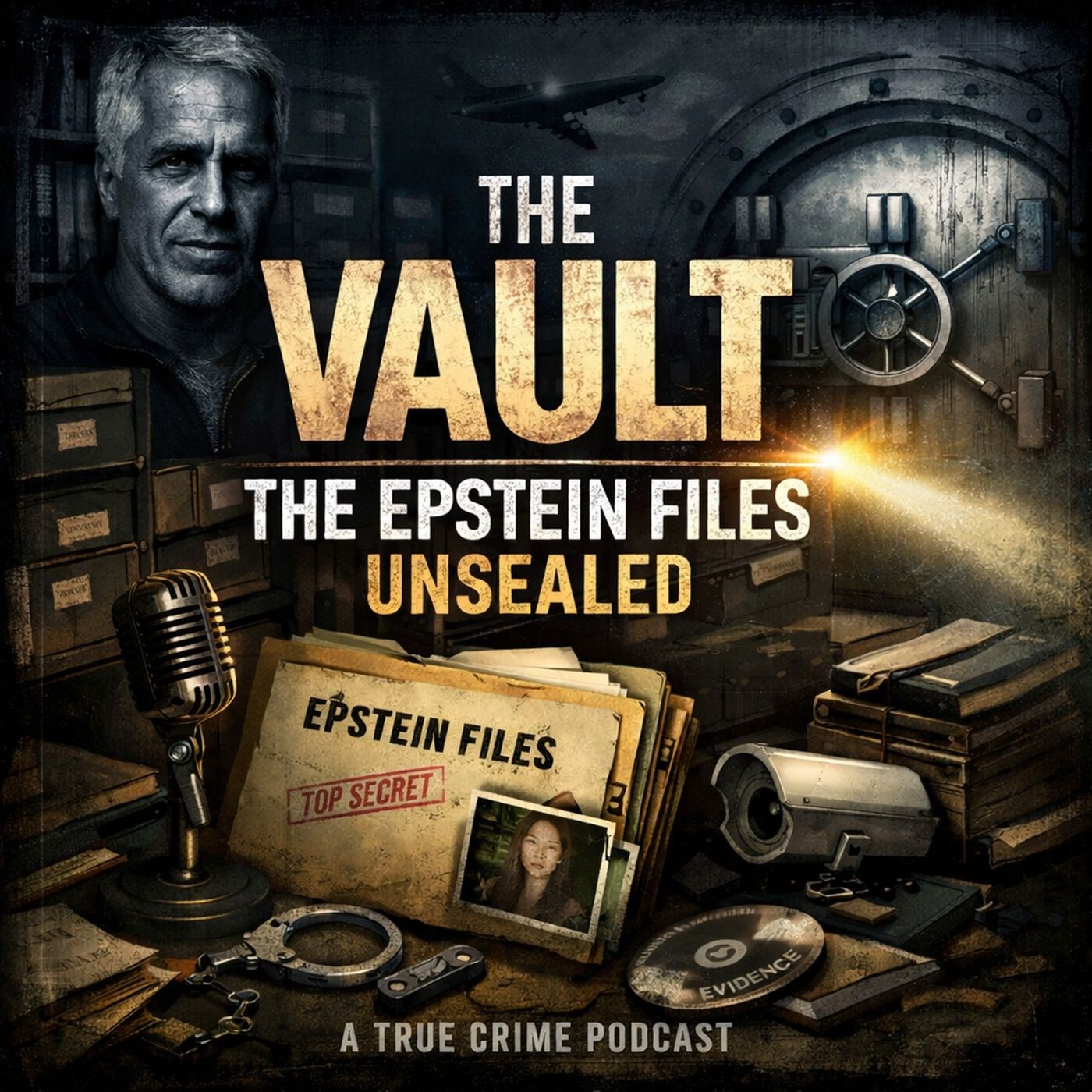
The Vault: The Epstein Files
Bobby Capucci
The Vault: The Epstein Files Unsealed is a deep-dive investigative podcast that pulls back the curtain on one of the most protected criminal networks in modern history. This series is built from the ground up on the actual paper trail—unsealed court records, depositions, exhibits, emails, and filings that were never meant to be read by the public. No pundit panels. No spin. Just the documents themselves, examined line by line, name by name, connection by connection—paired with precise, document-driven analysis that explains what the record truly shows.Each episode opens the vault on newly unsealed or long-buried Epstein files and walks listeners through what they actually reveal about power, money, influence, and the systems that failed survivors at every turn. Alongside the filings themselves, informed commentary breaks down the legal strategy, the institutional behavior, the contradictions, and the implications hiding between the lines. From judges’ orders and sealed exhibits to sworn testimony and back-channel communications, the show connects the dots the media often won’t—or can’t. Patterns emerge. Timelines collapse. Excuses fall apart.The Vault is a working archive in audio form, a living record of the Epstein case as told by the courts themselves—supplemented by rigorous analysis that provides context, challenges official narratives, and exposes where the record has been distorted, sanitized, or deliberately ignored. Every claim is grounded in filings. Every episode is anchored to the record. Listeners aren’t told what to think—they are shown what exists, what was said under oath, and what the commentary reveals about how those facts were buried, softened, or misrepresented.If you want to understand how Jeffrey Epstein was protected, who circled him, how institutions closed ranks, and why accountability keeps slipping through the cracks, The Vault: The Epstein Files Unsealed is where the record finally speaks for itself—and where the commentary ensures the documents do what no press release ever will.
Episodes
Mentioned books

Feb 12, 2026 • 13min
The Man in the Cockpit: Larry Visoski’s 2009 Deposition (Part 9) (2/11/26)
In his October 2009 deposition, taken during the Jeffrey Epstein v. Bradley Edwards defamation lawsuit, longtime Epstein pilot Larry Visoski described his decades of employment under Epstein and the routine nature of his work. Questioned by victims’ attorney Bradley Edwards, Visoski confirmed that he had flown Epstein, Ghislaine Maxwell, and numerous guests—some of them prominent figures—across Epstein’s properties in New York, Florida, New Mexico, and the Virgin Islands. Represented by Critton & Reinhardt, Visoski repeatedly emphasized that his duties were strictly professional: piloting aircraft, maintaining schedules, and ensuring safe transport. When pressed about the ages of female passengers, he claimed he never knowingly flew minors and denied witnessing any sexual activity or misconduct aboard Epstein’s planes.to contact me:bobbycapucci@protonmail.com
Feb 12, 2026 • 12min
The Man in the Cockpit: Larry Visoski’s 2009 Deposition (Part 8) (2/11/26)
In his October 2009 deposition, taken during the Jeffrey Epstein v. Bradley Edwards defamation lawsuit, longtime Epstein pilot Larry Visoski described his decades of employment under Epstein and the routine nature of his work. Questioned by victims’ attorney Bradley Edwards, Visoski confirmed that he had flown Epstein, Ghislaine Maxwell, and numerous guests—some of them prominent figures—across Epstein’s properties in New York, Florida, New Mexico, and the Virgin Islands. Represented by Critton & Reinhardt, Visoski repeatedly emphasized that his duties were strictly professional: piloting aircraft, maintaining schedules, and ensuring safe transport. When pressed about the ages of female passengers, he claimed he never knowingly flew minors and denied witnessing any sexual activity or misconduct aboard Epstein’s planes.to contact me:bobbycapucci@protonmail.com
Feb 12, 2026 • 13min
The Man in the Cockpit: Larry Visoski’s 2009 Deposition (Part 7) (2/11/26)
In his October 2009 deposition, taken during the Jeffrey Epstein v. Bradley Edwards defamation lawsuit, longtime Epstein pilot Larry Visoski described his decades of employment under Epstein and the routine nature of his work. Questioned by victims’ attorney Bradley Edwards, Visoski confirmed that he had flown Epstein, Ghislaine Maxwell, and numerous guests—some of them prominent figures—across Epstein’s properties in New York, Florida, New Mexico, and the Virgin Islands. Represented by Critton & Reinhardt, Visoski repeatedly emphasized that his duties were strictly professional: piloting aircraft, maintaining schedules, and ensuring safe transport. When pressed about the ages of female passengers, he claimed he never knowingly flew minors and denied witnessing any sexual activity or misconduct aboard Epstein’s planes.to contact me:bobbycapucci@protonmail.com
Feb 12, 2026 • 11min
The Man in the Cockpit: Larry Visoski’s 2009 Deposition (Part 6) (2/11/26)
In his October 2009 deposition, taken during the Jeffrey Epstein v. Bradley Edwards defamation lawsuit, longtime Epstein pilot Larry Visoski described his decades of employment under Epstein and the routine nature of his work. Questioned by victims’ attorney Bradley Edwards, Visoski confirmed that he had flown Epstein, Ghislaine Maxwell, and numerous guests—some of them prominent figures—across Epstein’s properties in New York, Florida, New Mexico, and the Virgin Islands. Represented by Critton & Reinhardt, Visoski repeatedly emphasized that his duties were strictly professional: piloting aircraft, maintaining schedules, and ensuring safe transport. When pressed about the ages of female passengers, he claimed he never knowingly flew minors and denied witnessing any sexual activity or misconduct aboard Epstein’s planes.to contact me:bobbycapucci@protonmail.com
Feb 11, 2026 • 19min
Epstein Investigations Abroad Move Forward as U.S. Accountability Freezes (Part 2) (2/11/26)
Across the Atlantic, European nations have responded to the release of Jeffrey Epstein–related files with a comparatively aggressive and public reckoning over elite complicity. In the United Kingdom, Norway, Poland, and elsewhere, the fallout from the documents has triggered formal investigations, high-profile resignations, and political consequences for figures whose names surfaced in the records, even if their involvement was peripheral or social. British politicians and advisers have stepped down amid public scrutiny, and Norwegian elites connected to Epstein are under investigation, with some issuing apologies and cooperating with authorities. Poland’s government has launched its own probe after identifying possible Polish victims in the documents — a sign that European governments are treating the revelations as a matter of serious legal and moral accountability rather than political spin control. This has unfolded amid significant media coverage and public pressure that frames Epstein’s abuses and networks as a cross-border scandal requiring transparent and sober investigation — not just partisan talking points.In contrast, the United States’ political and institutional response has been markedly more cautious, politicized, and slow, drawing sharp criticism from lawmakers, survivors, and commentators. Despite enacting the Epstein Files Transparency Act to force the release of millions of pages of investigative documents, the Justice Department missed legal deadlines, issued heavily redacted material, and has only gradually rolled out portions of the files, leading critics to accuse it of protecting powerful figures and delaying justice. Congressional hearings have been stymied by Maxwell’s refusal to cooperate, with her attorney openly suggesting she might only testify in exchange for presidential clemency — a development that illustrates how accountability has been bogged down in political negotiation rather than pursued with urgency. Meanwhile, public opinion polls show overwhelming dissatisfaction with how the U.S. government has handled the disclosures and lingering suspicion that elites are being shielded. This contrast — Europe acting with visible political consequences and institutional scrutiny, and the U.S. dragging its feet amid partisan posturing and limited tangible accountability — underscores deep weaknesses in American mechanisms for confronting abuses tied to wealth and influence.to contact me:bobbycapucci@protonmail.comsource:Analysis: New roadblocks slow US reckoning over Epstein as Europe races ahead | CNN Politics
Feb 11, 2026 • 14min
Epstein Investigations Abroad Move Forward as U.S. Accountability Freezes (Part 1) (2/11/26)
Across the Atlantic, European nations have responded to the release of Jeffrey Epstein–related files with a comparatively aggressive and public reckoning over elite complicity. In the United Kingdom, Norway, Poland, and elsewhere, the fallout from the documents has triggered formal investigations, high-profile resignations, and political consequences for figures whose names surfaced in the records, even if their involvement was peripheral or social. British politicians and advisers have stepped down amid public scrutiny, and Norwegian elites connected to Epstein are under investigation, with some issuing apologies and cooperating with authorities. Poland’s government has launched its own probe after identifying possible Polish victims in the documents — a sign that European governments are treating the revelations as a matter of serious legal and moral accountability rather than political spin control. This has unfolded amid significant media coverage and public pressure that frames Epstein’s abuses and networks as a cross-border scandal requiring transparent and sober investigation — not just partisan talking points.In contrast, the United States’ political and institutional response has been markedly more cautious, politicized, and slow, drawing sharp criticism from lawmakers, survivors, and commentators. Despite enacting the Epstein Files Transparency Act to force the release of millions of pages of investigative documents, the Justice Department missed legal deadlines, issued heavily redacted material, and has only gradually rolled out portions of the files, leading critics to accuse it of protecting powerful figures and delaying justice. Congressional hearings have been stymied by Maxwell’s refusal to cooperate, with her attorney openly suggesting she might only testify in exchange for presidential clemency — a development that illustrates how accountability has been bogged down in political negotiation rather than pursued with urgency. Meanwhile, public opinion polls show overwhelming dissatisfaction with how the U.S. government has handled the disclosures and lingering suspicion that elites are being shielded. This contrast — Europe acting with visible political consequences and institutional scrutiny, and the U.S. dragging its feet amid partisan posturing and limited tangible accountability — underscores deep weaknesses in American mechanisms for confronting abuses tied to wealth and influence.to contact me:bobbycapucci@protonmail.comsource:Analysis: New roadblocks slow US reckoning over Epstein as Europe races ahead | CNN Politics
Feb 11, 2026 • 19min
Groomed at 14, Branded “Culpable” at 40: The Moral Collapse Behind Anna Paulina Luna’s Epstein Take (2/11/26)
In this episode, we’re taking a hard look at the narrative being pushed by Congresswoman Anna Paulina Luna, who has suggested that some of the girls abused within Jeffrey Epstein’s trafficking network bear culpability themselves. We’re talking about minors—14, 15, 16 years old—who were groomed, manipulated, and conditioned to believe that what was happening to them was normal. The framing of her comments ignores the fundamental reality of grooming: that predators like Epstein and Ghislaine Maxwell deliberately used psychological coercion, normalization, and dependency to control their victims. Instead of centering the adults who built and profited from the operation, this rhetoric shifts attention onto the very people who were targeted and exploited. It blurs the line between coerced minors and knowing adult facilitators, creating a narrative that risks rewriting victims as participants without acknowledging the power imbalance that defined the entire system.We break down why this kind of framing is not just controversial, but dangerous. Publicly branding abused minors as traffickers—without clear context about coercion, age, and grooming—can chill cooperation, fracture survivor communities, and redirect outrage away from the architects of the criminal enterprise. Real accountability starts with the adults who organized, financed, protected, and benefited from the abuse network—not the children who were conditioned inside it. The episode examines how language, timing, and political incentives shape public perception, and why shifting blame downward ultimately protects power at the top. At the center of this discussion is a simple question: who benefits when the focus moves from abusers to the abused?to contact me:bobbycapucci@protonmail.com
Feb 11, 2026 • 12min
Pam Bondi Is Set For An Epstein Related Grilling By Congress Today (2/11/26)
Today, U.S. Attorney General Pam Bondi is slated to testify before the House Judiciary Committee in a high-stakes hearing focused on the Department of Justice’s handling of millions of documents tied to convicted sex trafficker Jeffrey Epstein. Lawmakers from both parties are expected to press her on why the DOJ’s release of more than 3 million pages under the Epstein Files Transparency Act featured extensive redactions that critics say obscured key information about possible associates while failing to adequately protect victims’ identities. Members of Congress, including Republicans like Rep. Thomas Massie who helped pass the transparency law and Democrats such as Rep. Jamie Raskin, have criticized the rollout and some have suggested Bondi could face contempt proceedings if she does not provide satisfactory explanations. Lawmakers recently reviewed unredacted files in a secure DOJ facility, and many now want answers on what remains unreleased and why certain names were withheld.Bondi’s appearance marks her first Capitol Hill testimony since a turbulent October hearing and comes amid continued backlash from Epstein survivors and advocates, who argue that the DOJ’s approach has been sloppy and insufficient. Victims’ groups even ran a Super Bowl ad this week urging fuller disclosure of the files, adding public pressure to the political scrutiny. Republican leaders have also criticized her handling of the matter, making this a rare bipartisan flashpoint over transparency, accountability, and justice for Epstein’s victims. The hearing is likely to probe both procedural decisions and broader questions about whether the DOJ under Bondi has adequately complied with the law and fully served the public interest.to contact me:bobbycapucci@protonmail.comsource:Bondi to face questions on Epstein files in House testimony | Reuters
Feb 11, 2026 • 14min
Jeffrey Epstein and the Cult of DNA: Inside His Obsession With Genetics (2/11/26)
Jeffrey Epstein cultivated a long-running, unsettling interest in genetics, DNA research, and ideas that echo historical eugenics movements. He embedded himself in elite scientific and academic circles, donating money to researchers, hosting scientists at his homes, and presenting himself as a patron of cutting-edge biological research. According to multiple accounts from people who interacted with him, Epstein spoke obsessively about heredity, intelligence, and the transmission of “desirable” traits, often framing these ideas in quasi-scientific language that blurred the line between legitimate genetics and discredited eugenic thinking. He reportedly fixated on the notion that intelligence and success were primarily genetic, downplaying environment, ethics, or social responsibility, and used this belief system to flatter powerful figures while positioning himself as a visionary thinker rather than a financier with a criminal record.More disturbingly, this fascination appeared to extend beyond abstract theory into personal ambition. Epstein allegedly discussed plans to seed the human population with his own DNA, including proposals involving artificial insemination and the creation of a private genetic legacy, ideas that alarmed many who heard them. His interest in young women and control over their bodies intersected grotesquely with these beliefs, reinforcing concerns that his fixation on genetics was not merely academic but deeply tied to power, domination, and self-mythologizing. Taken together, Epstein’s engagement with DNA science and eugenics-adjacent ideas paints a picture of a man attempting to cloak predatory behavior and grandiose self-importance in the language of science, while exploiting respected institutions and researchers to legitimize views that history has repeatedly shown to be dangerous and dehumanizing.to contact me:bobbycapucci@protonmail.comsource:Jeffrey Epstein Had a Bizarre Obsession With "Improving" Human DNA, and He Was Emailing With Top Scientists About It
Feb 11, 2026 • 19min
What the Newly Released FBI Files Reveal About Trump and the Epstein Investigation (2/11/26)
Newly released FBI documents included in the Department of Justice’s public release of the Epstein files reveal that in 2006 then-businessman Donald Trump called the Palm Beach, Florida, police chief investigating Jeffrey Epstein to express support for the probe. According to a summary of a 2019 FBI interview with former Palm Beach Police Chief Michael Reiter, Trump told him, “thank goodness you’re stopping him,” saying that “everyone has known he’s been doing this” and that Epstein was “disgusting.” He additionally urged investigators to “focus on” Ghislaine Maxwell, referring to her as “evil” and Epstein’s operative. Trump also claimed to have distanced himself from Epstein after seeing teenagers around him and said he had thrown Epstein out of his Mar-a-Lago club.The disclosure comes as Maxwell, who is serving a 20-year sentence for her role in Epstein’s trafficking network, recently invoked her Fifth Amendment right during a closed-door deposition before the House Oversight Committee, declining to answer questions about her involvement or about others. Her attorney suggested she might cooperate if granted clemency, a notion the White House has dismissed. The timing of the document release and Maxwell’s deposition spotlights ongoing scrutiny of the Epstein case and Trump’s past connections with Epstein and Maxwell, even as Trump has repeatedly denied wrongdoing or knowledge of Epstein’s crimes.to contact me:bobbycapucci@protonmail.comsource:Epstein files: Trump bashed ex-pal, Maxwell to police

