

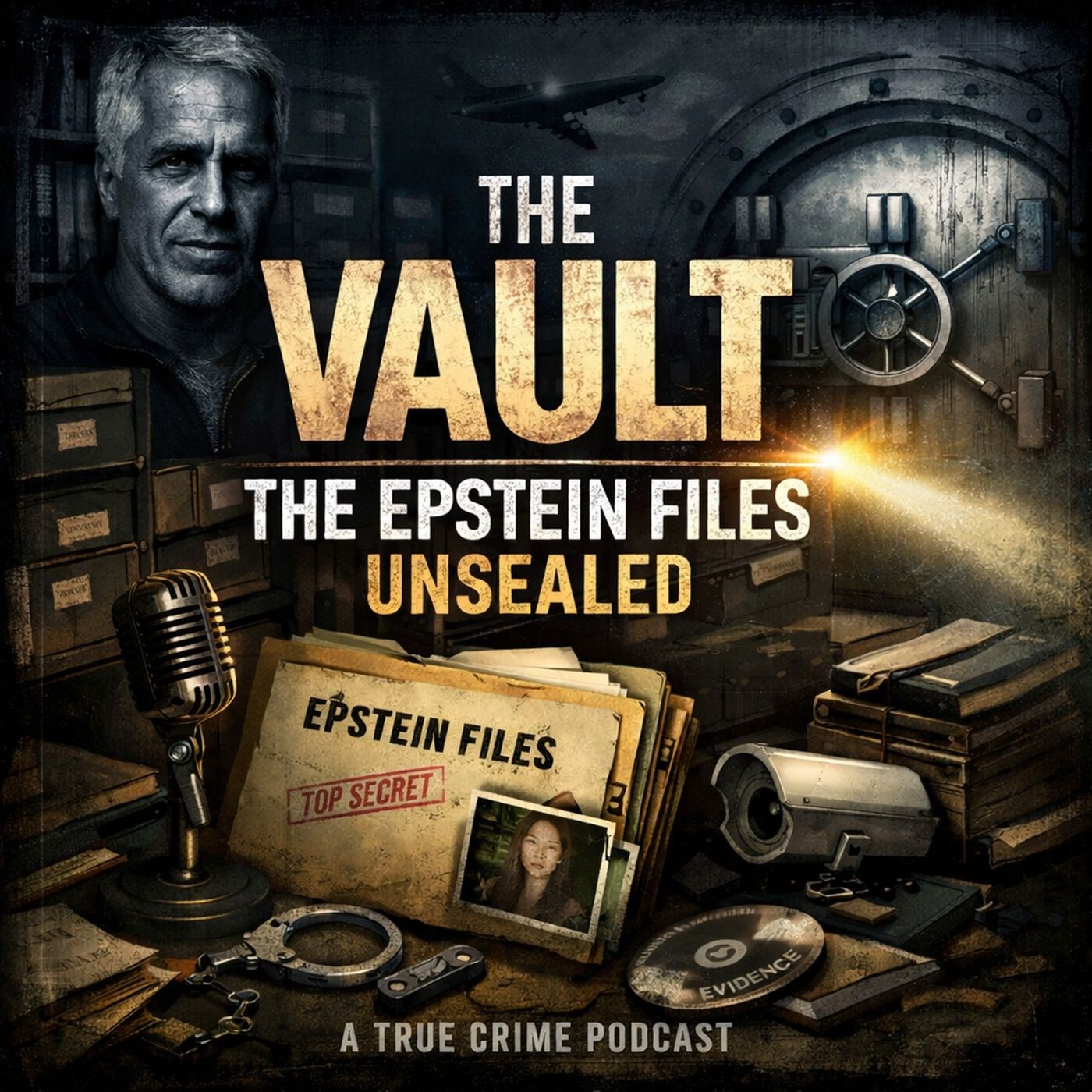
The Vault: The Epstein Files
Bobby Capucci
The Vault: The Epstein Files Unsealed is a deep-dive investigative podcast that pulls back the curtain on one of the most protected criminal networks in modern history. This series is built from the ground up on the actual paper trail—unsealed court records, depositions, exhibits, emails, and filings that were never meant to be read by the public. No pundit panels. No spin. Just the documents themselves, examined line by line, name by name, connection by connection—paired with precise, document-driven analysis that explains what the record truly shows.Each episode opens the vault on newly unsealed or long-buried Epstein files and walks listeners through what they actually reveal about power, money, influence, and the systems that failed survivors at every turn. Alongside the filings themselves, informed commentary breaks down the legal strategy, the institutional behavior, the contradictions, and the implications hiding between the lines. From judges’ orders and sealed exhibits to sworn testimony and back-channel communications, the show connects the dots the media often won’t—or can’t. Patterns emerge. Timelines collapse. Excuses fall apart.The Vault is a working archive in audio form, a living record of the Epstein case as told by the courts themselves—supplemented by rigorous analysis that provides context, challenges official narratives, and exposes where the record has been distorted, sanitized, or deliberately ignored. Every claim is grounded in filings. Every episode is anchored to the record. Listeners aren’t told what to think—they are shown what exists, what was said under oath, and what the commentary reveals about how those facts were buried, softened, or misrepresented.If you want to understand how Jeffrey Epstein was protected, who circled him, how institutions closed ranks, and why accountability keeps slipping through the cracks, The Vault: The Epstein Files Unsealed is where the record finally speaks for itself—and where the commentary ensures the documents do what no press release ever will.
Episodes
Mentioned books

Feb 11, 2026 • 19min
What the Newly Released FBI Files Reveal About Trump and the Epstein Investigation (2/11/26)
Newly released FBI documents included in the Department of Justice’s public release of the Epstein files reveal that in 2006 then-businessman Donald Trump called the Palm Beach, Florida, police chief investigating Jeffrey Epstein to express support for the probe. According to a summary of a 2019 FBI interview with former Palm Beach Police Chief Michael Reiter, Trump told him, “thank goodness you’re stopping him,” saying that “everyone has known he’s been doing this” and that Epstein was “disgusting.” He additionally urged investigators to “focus on” Ghislaine Maxwell, referring to her as “evil” and Epstein’s operative. Trump also claimed to have distanced himself from Epstein after seeing teenagers around him and said he had thrown Epstein out of his Mar-a-Lago club.The disclosure comes as Maxwell, who is serving a 20-year sentence for her role in Epstein’s trafficking network, recently invoked her Fifth Amendment right during a closed-door deposition before the House Oversight Committee, declining to answer questions about her involvement or about others. Her attorney suggested she might cooperate if granted clemency, a notion the White House has dismissed. The timing of the document release and Maxwell’s deposition spotlights ongoing scrutiny of the Epstein case and Trump’s past connections with Epstein and Maxwell, even as Trump has repeatedly denied wrongdoing or knowledge of Epstein’s crimes.to contact me:bobbycapucci@protonmail.comsource:Epstein files: Trump bashed ex-pal, Maxwell to police
Feb 11, 2026 • 14min
The Man in the Cockpit: Larry Visoski’s 2009 Deposition (Part 5) (2/11/26)
In his October 2009 deposition, taken during the Jeffrey Epstein v. Bradley Edwards defamation lawsuit, longtime Epstein pilot Larry Visoski described his decades of employment under Epstein and the routine nature of his work. Questioned by victims’ attorney Bradley Edwards, Visoski confirmed that he had flown Epstein, Ghislaine Maxwell, and numerous guests—some of them prominent figures—across Epstein’s properties in New York, Florida, New Mexico, and the Virgin Islands. Represented by Critton & Reinhardt, Visoski repeatedly emphasized that his duties were strictly professional: piloting aircraft, maintaining schedules, and ensuring safe transport. When pressed about the ages of female passengers, he claimed he never knowingly flew minors and denied witnessing any sexual activity or misconduct aboard Epstein’s planes.to contact me:bobbycapucci@protonmail.com
Feb 11, 2026 • 12min
The Man in the Cockpit: Larry Visoski’s 2009 Deposition (Part 4) (2/11/26)
In his October 2009 deposition, taken during the Jeffrey Epstein v. Bradley Edwards defamation lawsuit, longtime Epstein pilot Larry Visoski described his decades of employment under Epstein and the routine nature of his work. Questioned by victims’ attorney Bradley Edwards, Visoski confirmed that he had flown Epstein, Ghislaine Maxwell, and numerous guests—some of them prominent figures—across Epstein’s properties in New York, Florida, New Mexico, and the Virgin Islands. Represented by Critton & Reinhardt, Visoski repeatedly emphasized that his duties were strictly professional: piloting aircraft, maintaining schedules, and ensuring safe transport. When pressed about the ages of female passengers, he claimed he never knowingly flew minors and denied witnessing any sexual activity or misconduct aboard Epstein’s planes.to contact me:bobbycapucci@protonmail.com
Feb 11, 2026 • 16min
The Man in the Cockpit: Larry Visoski’s 2009 Deposition (Part 3) (2/10/26)
In his October 2009 deposition, taken during the Jeffrey Epstein v. Bradley Edwards defamation lawsuit, longtime Epstein pilot Larry Visoski described his decades of employment under Epstein and the routine nature of his work. Questioned by victims’ attorney Bradley Edwards, Visoski confirmed that he had flown Epstein, Ghislaine Maxwell, and numerous guests—some of them prominent figures—across Epstein’s properties in New York, Florida, New Mexico, and the Virgin Islands. Represented by Critton & Reinhardt, Visoski repeatedly emphasized that his duties were strictly professional: piloting aircraft, maintaining schedules, and ensuring safe transport. When pressed about the ages of female passengers, he claimed he never knowingly flew minors and denied witnessing any sexual activity or misconduct aboard Epstein’s planes.to contact me:bobbycapucci@protonmail.com
Feb 11, 2026 • 14min
The Man in the Cockpit: Larry Visoski’s 2009 Deposition (Part 2) (2/10/26)
In his October 2009 deposition, taken during the Jeffrey Epstein v. Bradley Edwards defamation lawsuit, longtime Epstein pilot Larry Visoski described his decades of employment under Epstein and the routine nature of his work. Questioned by victims’ attorney Bradley Edwards, Visoski confirmed that he had flown Epstein, Ghislaine Maxwell, and numerous guests—some of them prominent figures—across Epstein’s properties in New York, Florida, New Mexico, and the Virgin Islands. Represented by Critton & Reinhardt, Visoski repeatedly emphasized that his duties were strictly professional: piloting aircraft, maintaining schedules, and ensuring safe transport. When pressed about the ages of female passengers, he claimed he never knowingly flew minors and denied witnessing any sexual activity or misconduct aboard Epstein’s planes.to contact me:bobbycapucci@protonmail.com
Feb 11, 2026 • 15min
The Man in the Cockpit: Larry Visoski’s 2009 Deposition (Part 1) (2/10/26)
In his October 2009 deposition, taken during the Jeffrey Epstein v. Bradley Edwards defamation lawsuit, longtime Epstein pilot Larry Visoski described his decades of employment under Epstein and the routine nature of his work. Questioned by victims’ attorney Bradley Edwards, Visoski confirmed that he had flown Epstein, Ghislaine Maxwell, and numerous guests—some of them prominent figures—across Epstein’s properties in New York, Florida, New Mexico, and the Virgin Islands. Represented by Critton & Reinhardt, Visoski repeatedly emphasized that his duties were strictly professional: piloting aircraft, maintaining schedules, and ensuring safe transport. When pressed about the ages of female passengers, he claimed he never knowingly flew minors and denied witnessing any sexual activity or misconduct aboard Epstein’s planes.to contact me:bobbycapucci@protonmail.com
Feb 11, 2026 • 19min
Transcripts From The Bill Barr Epstein Related Congressional Deposition (Part 14) (2/10/26)
Bill Barr’s deposition before Congress on Jeffrey Epstein was a masterclass in calculated deflection. While Barr insisted that Epstein’s death was “absolutely” suicide, he conceded that the prison surveillance system had “blind spots”—a detail that conveniently leaves just enough room for speculation without providing definitive answers. His reliance on flawed or incomplete camera footage, combined with his dismissal of alternative forensic perspectives, came off less like transparency and more like institutional damage control. Instead of holding the Bureau of Prisons accountable, Barr’s narrative positioned the failures as unfortunate but inconsequential, a stance that fails to satisfy the public demand for clarity.Just as troubling was Barr’s evasiveness when pressed about Donald Trump’s knowledge of Epstein. He admitted to having spoken with Trump about Epstein’s death but couldn’t recall when one of those conversations occurred—an astonishing lapse considering the gravity of the matter. His reasoning that “if there were more to it, it would have leaked” was not only flippant but dismissive of the very real history of suppression, obstruction, and selective disclosure that has defined the Epstein saga. By leaning on institutional trust in a case defined by betrayal of that very trust, Barr’s testimony did little more than reinforce suspicions that the Department of Justice has long been more concerned with containment than accountability.to contact me:bobbycapucci@protonmail.comsource:Barr-Transcript.pdf
Feb 10, 2026 • 15min
Transcripts From The Bill Barr Epstein Related Congressional Deposition (Part 13) (2/10/26)
Bill Barr’s deposition before Congress on Jeffrey Epstein was a masterclass in calculated deflection. While Barr insisted that Epstein’s death was “absolutely” suicide, he conceded that the prison surveillance system had “blind spots”—a detail that conveniently leaves just enough room for speculation without providing definitive answers. His reliance on flawed or incomplete camera footage, combined with his dismissal of alternative forensic perspectives, came off less like transparency and more like institutional damage control. Instead of holding the Bureau of Prisons accountable, Barr’s narrative positioned the failures as unfortunate but inconsequential, a stance that fails to satisfy the public demand for clarity.Just as troubling was Barr’s evasiveness when pressed about Donald Trump’s knowledge of Epstein. He admitted to having spoken with Trump about Epstein’s death but couldn’t recall when one of those conversations occurred—an astonishing lapse considering the gravity of the matter. His reasoning that “if there were more to it, it would have leaked” was not only flippant but dismissive of the very real history of suppression, obstruction, and selective disclosure that has defined the Epstein saga. By leaning on institutional trust in a case defined by betrayal of that very trust, Barr’s testimony did little more than reinforce suspicions that the Department of Justice has long been more concerned with containment than accountability.to contact me:bobbycapucci@protonmail.comsource:Barr-Transcript.pdf
Feb 10, 2026 • 34min
Taxpayer Dollars and the 2008 Bailout That Quietly Protected Jeffrey Epstein (Part 2) (2/10/26)
Liquid Funding Ltd. didn’t survive the 2008 financial collapse by skill or luck—it survived because the system bent itself into a pretzel to protect elite balance sheets with public money. Chaired by Jeffrey Epstein, Liquid Funding sat on billions in mortgage-linked liabilities just as the global economy imploded. When the government rushed in to stabilize failing institutions, those interventions didn’t just rescue household-name banks—they quietly backstopped the opaque offshore machinery that fed off them. As emergency facilities and taxpayer-backed rescues absorbed toxic assets and restored liquidity, Liquid Funding’s obligations were made whole. The end result was grotesque: a vehicle overseen by a known predator emerging intact from a crisis that annihilated ordinary people.What makes it sickening is the silence around it. While families lost homes and retirement savings evaporated, bailout architecture designed to “save the system” effectively covered the tab for Epstein’s offshore empire—through the rescue of counterparties like Bear Stearns, its fire-sale to JPMorgan Chase, and the emergency actions of the Federal Reserve. No vote asked taxpayers if they were willing to underwrite the continued solvency of a man already accused of unspeakable crimes. No hearing explained why his structure deserved protection while the public absorbed the losses. It was a quiet, revolting transfer of risk upward—proof that when the system panics, it shields the worst actors first and sends the bill to everyone else.to contact me:bobbycapucci@protonmail.comsource:Epstein's Really Big Short: How US Taxpayers (And Big Bankers) Bailed Him Out - National Memo
Feb 10, 2026 • 19min
Taxpayer Dollars and the 2008 Bailout That Quietly Protected Jeffrey Epstein (Part 1) (2/10/26)
Liquid Funding Ltd. didn’t survive the 2008 financial collapse by skill or luck—it survived because the system bent itself into a pretzel to protect elite balance sheets with public money. Chaired by Jeffrey Epstein, Liquid Funding sat on billions in mortgage-linked liabilities just as the global economy imploded. When the government rushed in to stabilize failing institutions, those interventions didn’t just rescue household-name banks—they quietly backstopped the opaque offshore machinery that fed off them. As emergency facilities and taxpayer-backed rescues absorbed toxic assets and restored liquidity, Liquid Funding’s obligations were made whole. The end result was grotesque: a vehicle overseen by a known predator emerging intact from a crisis that annihilated ordinary people.What makes it sickening is the silence around it. While families lost homes and retirement savings evaporated, bailout architecture designed to “save the system” effectively covered the tab for Epstein’s offshore empire—through the rescue of counterparties like Bear Stearns, its fire-sale to JPMorgan Chase, and the emergency actions of the Federal Reserve. No vote asked taxpayers if they were willing to underwrite the continued solvency of a man already accused of unspeakable crimes. No hearing explained why his structure deserved protection while the public absorbed the losses. It was a quiet, revolting transfer of risk upward—proof that when the system panics, it shields the worst actors first and sends the bill to everyone else.to contact me:bobbycapucci@protonmail.comsource:Epstein's Really Big Short: How US Taxpayers (And Big Bankers) Bailed Him Out - National Memo

