

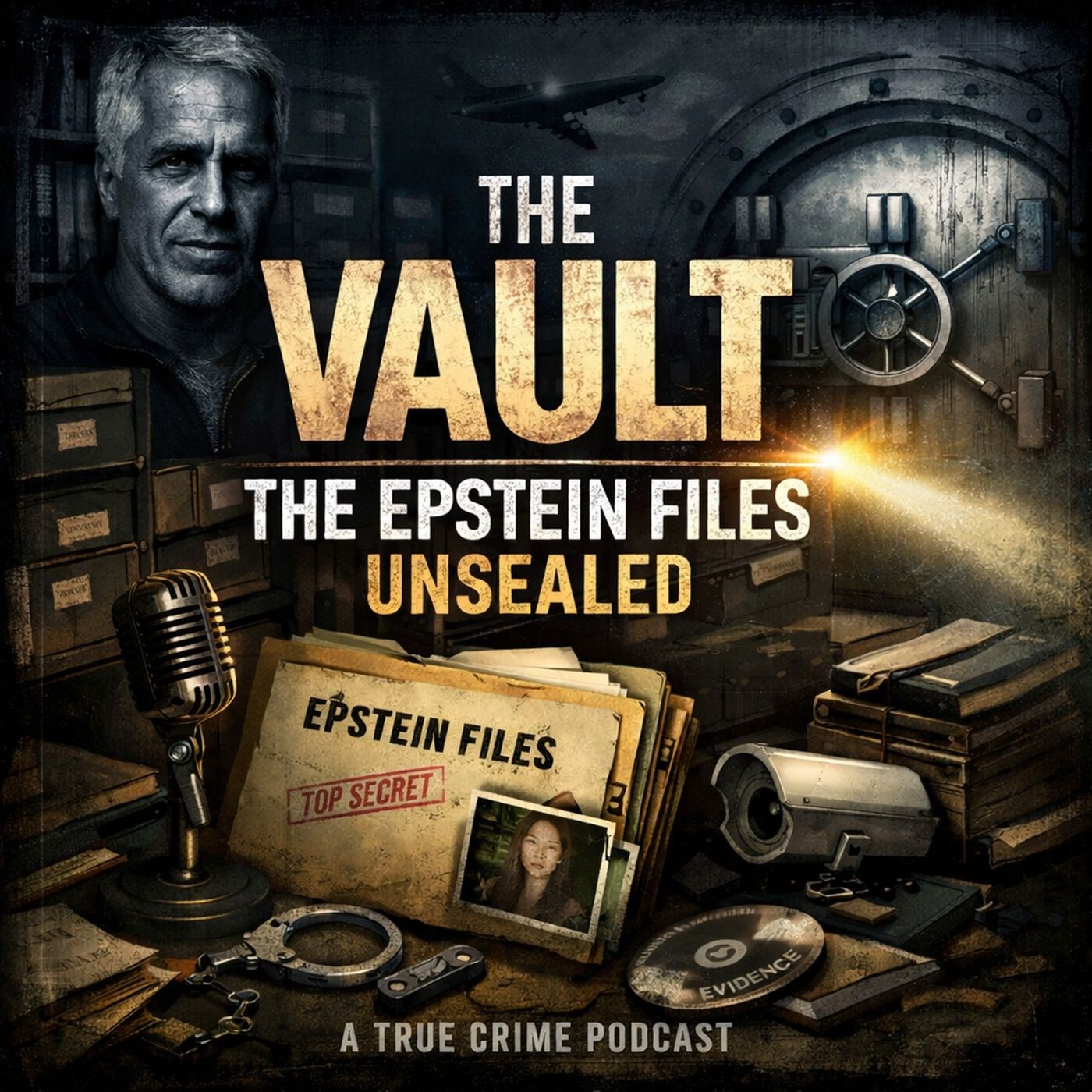
The Vault: The Epstein Files
Bobby Capucci
The Vault: The Epstein Files Unsealed is a deep-dive investigative podcast that pulls back the curtain on one of the most protected criminal networks in modern history. This series is built from the ground up on the actual paper trail—unsealed court records, depositions, exhibits, emails, and filings that were never meant to be read by the public. No pundit panels. No spin. Just the documents themselves, examined line by line, name by name, connection by connection—paired with precise, document-driven analysis that explains what the record truly shows.Each episode opens the vault on newly unsealed or long-buried Epstein files and walks listeners through what they actually reveal about power, money, influence, and the systems that failed survivors at every turn. Alongside the filings themselves, informed commentary breaks down the legal strategy, the institutional behavior, the contradictions, and the implications hiding between the lines. From judges’ orders and sealed exhibits to sworn testimony and back-channel communications, the show connects the dots the media often won’t—or can’t. Patterns emerge. Timelines collapse. Excuses fall apart.The Vault is a working archive in audio form, a living record of the Epstein case as told by the courts themselves—supplemented by rigorous analysis that provides context, challenges official narratives, and exposes where the record has been distorted, sanitized, or deliberately ignored. Every claim is grounded in filings. Every episode is anchored to the record. Listeners aren’t told what to think—they are shown what exists, what was said under oath, and what the commentary reveals about how those facts were buried, softened, or misrepresented.If you want to understand how Jeffrey Epstein was protected, who circled him, how institutions closed ranks, and why accountability keeps slipping through the cracks, The Vault: The Epstein Files Unsealed is where the record finally speaks for itself—and where the commentary ensures the documents do what no press release ever will.
Episodes
Mentioned books

Feb 13, 2026 • 12min
The Man in the Cockpit: Larry Visoski’s 2009 Deposition (Part 12) (2/12/26)
In his October 2009 deposition, taken during the Jeffrey Epstein v. Bradley Edwards defamation lawsuit, longtime Epstein pilot Larry Visoski described his decades of employment under Epstein and the routine nature of his work. Questioned by victims’ attorney Bradley Edwards, Visoski confirmed that he had flown Epstein, Ghislaine Maxwell, and numerous guests—some of them prominent figures—across Epstein’s properties in New York, Florida, New Mexico, and the Virgin Islands. Represented by Critton & Reinhardt, Visoski repeatedly emphasized that his duties were strictly professional: piloting aircraft, maintaining schedules, and ensuring safe transport. When pressed about the ages of female passengers, he claimed he never knowingly flew minors and denied witnessing any sexual activity or misconduct aboard Epstein’s planes.to contact me:bobbycapucci@protonmail.com
Feb 12, 2026 • 14min
The Man in the Cockpit: Larry Visoski’s 2009 Deposition (Part 11) (2/12/26)
In his October 2009 deposition, taken during the Jeffrey Epstein v. Bradley Edwards defamation lawsuit, longtime Epstein pilot Larry Visoski described his decades of employment under Epstein and the routine nature of his work. Questioned by victims’ attorney Bradley Edwards, Visoski confirmed that he had flown Epstein, Ghislaine Maxwell, and numerous guests—some of them prominent figures—across Epstein’s properties in New York, Florida, New Mexico, and the Virgin Islands. Represented by Critton & Reinhardt, Visoski repeatedly emphasized that his duties were strictly professional: piloting aircraft, maintaining schedules, and ensuring safe transport. When pressed about the ages of female passengers, he claimed he never knowingly flew minors and denied witnessing any sexual activity or misconduct aboard Epstein’s planes.to contact me:bobbycapucci@protonmail.com
Feb 12, 2026 • 15min
From Trade Envoy to Police Probe: The Andrew-Epstein Fallout Takes A Possible Criminal Turn (2/12/26)
British police, specifically Thames Valley Police, are currently assessing a complaint alleging that Prince Andrew, now Andrew Mountbatten-Windsor, may have shared confidential government and trade information with the late convicted sex offender Jeffrey Epstein. The inquiry was triggered by newly released U.S. Department of Justice documents showing email exchanges from 2010, while Andrew was serving as a UK trade envoy, in which he appears to have forwarded official reports on trade missions — including sensitive commercial and investment data — to Epstein shortly after receiving them. These actions have prompted a complaint from anti-monarchy campaigners alleging misconduct in public office and potential breaches of Britain’s Official Secrets Act. Thames Valley Police have confirmed they are “assessing the information in line with our established procedures” and have held discussions with the Crown Prosecution Service to decide whether the case should advance into a full criminal investigation. Meanwhile, Buckingham Palace has stated that King Charles III and the royal family will support and cooperate with any legitimate police inquiry into the matter, and senior royals including Prince William and Princess Catherine have expressed deep concern over the ongoing revelations.The scope of the police inquiry extends beyond the alleged transmission of confidential trade reports: reports suggest authorities are also examining broader aspects of Andrew’s relationship with Epstein, including claims regarding how that relationship persisted after Epstein’s 2008 conviction. The inquiry remains in its early phases, with no formal charges filed yet, but the involvement of prosecutors and senior investigators underscores its seriousness. Andrew, who was stripped of his royal titles and duties in 2025 amid longstanding criticism over his ties to Epstein, denies wrongdoing, and the police have not committed to a timeline for a decision on whether to launch a formal investigation. The developments have intensified public scrutiny of both the former royal’s conduct and the wider implications of the Epstein files for British public figures.to contact me:bobbycapucci@protonmail.comsource:Andrew probed by criminal prosecutors over Epstein scandal as police issue major update after latest file bombshell
Feb 12, 2026 • 11min
Kleenex Boxes and Hidden Lenses: Inside Epstein’s Surveillance Web (2/12/26)
Jeffrey Epstein relied heavily on his longtime pilot, Larry Visoski, to handle a range of logistical tasks that went far beyond simply flying his planes. According to court testimony and investigative reporting, Visoski purchased surveillance equipment at Epstein’s direction, including hidden cameras that were allegedly concealed inside everyday objects such as Kleenex boxes. The intent, as described in multiple civil proceedings tied to Epstein’s trafficking operation, was to quietly record activity inside his properties without alerting guests. These devices were reportedly placed in bedrooms and other private areas within residences like his Manhattan townhouse and Palm Beach estate, reinforcing long-standing allegations that Epstein used surveillance as leverage. The suggestion has been that Epstein treated information as currency—gathering compromising material on powerful visitors who passed through his homes. While Visoski has maintained that he was following orders and was unaware of criminal intent, his role in procuring equipment has drawn scrutiny as part of the broader enterprise. The existence of hidden recording devices has been cited by victims’ attorneys as evidence of a calculated, systematic operation rather than impulsive misconduct. It feeds into the larger portrait of Epstein as someone obsessed with control, secrecy, and insurance against exposure.The Kleenex-box concealment detail is particularly disturbing because it illustrates the deliberate effort to disguise surveillance in objects no one would question. This aligns with broader allegations that Epstein wired his properties with cameras positioned to capture intimate encounters. Survivors and investigators have long argued that Epstein’s power stemmed not just from wealth, but from the potential kompromat he could hold over influential figures. Although definitive proof of how any recordings were used remains limited in the public record, the pattern of hidden monitoring has become a recurring theme in lawsuits and depositions tied to his estate. Visoski himself was granted immunity in exchange for cooperation during certain proceedings, underscoring how deeply embedded staff members were in Epstein’s day-to-day operations. Ultimately, the surveillance allegations contribute to the image of Epstein not merely as a trafficker, but as an operator who understood the strategic value of secrets. The hidden cameras in Kleenex boxes symbolize the covert infrastructure that many believe underpinned his ability to maintain influence for so long.to contact me:bobbycapucci@protonmail.comsource:Epstein directed aide to obtain hidden video cameras | The Seattle Times
Feb 12, 2026 • 21min
“Everyone Knew”: The Statement That Undermines Trump’s Epstein Denials (2/12/26)
Newly surfaced reporting that Donald Trump allegedly told Palm Beach Police Chief Michael Reiter after Jeffrey Epstein’s first arrest that “everyone knew” what Epstein and Ghislaine Maxwell were has triggered a predictable attempt to recast him as a whistleblower. But the timing undercuts that narrative. A whistleblower acts before or during the commission of crimes, not after an arrest has already made the conduct public. A post-arrest phone call acknowledging what was widely known does not constitute risk, exposure, or meaningful accountability; it looks more like reputational positioning once the scandal was unavoidable. Framing this as bravery ignores the central issue: the statement suggests awareness, not ignorance.That awareness collides directly with Trump’s later public posture that he knew little or nothing about Epstein or Maxwell. If “everyone knew,” then claims of total ignorance become difficult to reconcile. The real vulnerability here isn’t proximity alone—it’s inconsistency. Political damage often stems less from association than from shifting explanations meant to manage that association. The effort to brand this episode as heroic only amplifies the contradiction, because it highlights prior knowledge while leaving prior denials intact. In a scandal defined by elite impunity and public distrust, credibility—not spin—is the currency that determines whether a narrative survives.to contact mebobbycapucci@protonmail.com
Feb 12, 2026 • 12min
Pam Bondi Crashes Out During Her Congressional Hearing (2/12/26)
Yesterday’s Pam Bondi congressional hearing before the House Judiciary Committee utterly derailed into chaos as lawmakers — Republicans and Democrats alike — pressed her relentlessly over the Justice Department’s handling of the explosive Jeffrey Epstein files. Bondi faced sharp criticism for the department’s bungled release of millions of pages of documents, which included unredacted victims’ names and sensitive material while obscuring details about potential perpetrators, drawing outrage from survivors present in the hearing room. Rather than directly addressing these concerns or apologizing to victims, she repeatedly deflected, launching into partisan attacks, invoking unrelated topics such as the strength of the stock market, and fiercely defending President Trump’s record when pressed about investigations into high-profile figures linked to Epstein. Lawmakers — including some from her own party — condemned her evasiveness and lack of accountability, accusing her of dodging core questions about indictments, investigations, and protection of victims’ identities.The session rapidly deteriorated into a combative spectacle, with Bondi lashing out at Democrats with personal insults and shouting matches instead of sober legal explanations, at one point dismissing inquiries as “ridiculous” and railing against members she characterized as partisan adversaries. She refused to explicitly answer fundamental questions about whether the Department of Justice would investigate Epstein co-conspirators or remedy its redaction failures, opting instead to attack critics and pivot to broader political narratives that had little to do with the substance of the oversight. Survivors in attendance were visibly frustrated, and none indicated confidence that the DOJ under Bondi would support their pursuit of justice, underscoring the deepening controversy and a perception among many lawmakers that the attorney general’s performance was not just defensive but unmoored from the scrutiny she faced.to contact me:bobbycapucci@protonmail.com
Feb 12, 2026 • 12min
The Decoy Operation: How MCC Allegedly Misdirected the Media After Epstein’s Death (2/12/26)
After Jeffrey Epstein’s apparent suicide in August 2019, newly unsealed internal documents allege that MCC staff staged a decoy to mislead reporters gathered outside the prison. According to the files, guards concerned about the intense media presence assembled what looked like a human body from boxes and sheets and placed it in a white medical examiner’s van. Reporters then followed that vehicle as it left the facility, while Epstein’s actual body was reportedly loaded into a separate black vehicle and driven away unnoticed. The documents suggest this tactic was intended to “thwart” the press and protect the privacy of the removal process amidst heavy public scrutiny.The material comes from a large tranche of records related to how prison staff responded in the hours after Epstein was found unresponsive in his cell and later pronounced dead. While the official ruling was suicide by hanging, Epstein’s death has been mired in controversy due to documented failures at the jail, including malfunctioning cameras and missed welfare checks, which have fueled speculation and alternative narratives. The “fake body” claim is part of that broader set of troubling details but has not been independently verified outside the reports in the released files.to contact me:bobbycapucci@protonmail.comsource:Epstein jail guards used 'fake body' to trick media waiting outside the prison while paedophile's real corpse was loaded into van 'unnoticed', files claim | Daily Mail Online
Feb 12, 2026 • 11min
Narrow Scope, Narrow Results: How The Epstein Case Was Designed to Fail (2/11/26)
From the start, the Epstein investigation was engineered to produce narrow results. Narrow charges do not emerge naturally when evidence points to a sprawling criminal enterprise fueled by money, access, and institutional protection. The focus on Epstein alone was a deliberate choice designed to avoid following the financial infrastructure that made his crimes possible. The released emails and documents show awareness, coordination, and active containment, not ignorance. Sexual abuse was treated as the whole story because it could be isolated, while financial crimes would have exposed banks, intermediaries, and elite beneficiaries. Every dollar Epstein moved should have been treated as evidence of enterprise-level criminality, yet that scrutiny was avoided. RICO was never used because it would have forced prosecutors to acknowledge pattern, facilitation, and mutual benefit. That would have dragged the financial sector into the light, and that outcome was unacceptable to those in power. This was not incompetence or oversight. It was a controlled, scoped-down operation from the beginning.When Epstein became a liability who might talk, the narrow investigation became untenable, but his removal did not erase the evidence. Financial records, emails, and transaction histories still exist and still point to beneficiaries who profited while keeping their hands “clean.” The unanswered questions are all financial: who received money, who structured the vehicles, who vouched for him, and who chose profit over accountability. The contrast with cases like Martha Stewart exposes the hypocrisy of enforcement priorities, where market disruption is punished but elite stability is protected. Figures like Leon Black and Les Wexner exemplify how proximity to power insulates culpability through delay and fragmentation. The investigation was tilted long before Epstein’s death, designed to deliver a villain without a reckoning. Survivors were denied full accountability, and the public was given closure without truth. Until the financial architecture that enabled Epstein is confronted, justice has not begun—it has been deliberately postponed.to contact me:bobbycapucci@protonmail.com
Feb 12, 2026 • 16min
The Man in the Cockpit: Larry Visoski’s 2009 Deposition (Part 10) (2/11/26)
In his October 2009 deposition, taken during the Jeffrey Epstein v. Bradley Edwards defamation lawsuit, longtime Epstein pilot Larry Visoski described his decades of employment under Epstein and the routine nature of his work. Questioned by victims’ attorney Bradley Edwards, Visoski confirmed that he had flown Epstein, Ghislaine Maxwell, and numerous guests—some of them prominent figures—across Epstein’s properties in New York, Florida, New Mexico, and the Virgin Islands. Represented by Critton & Reinhardt, Visoski repeatedly emphasized that his duties were strictly professional: piloting aircraft, maintaining schedules, and ensuring safe transport. When pressed about the ages of female passengers, he claimed he never knowingly flew minors and denied witnessing any sexual activity or misconduct aboard Epstein’s planes.to contact me:bobbycapucci@protonmail.com
Feb 12, 2026 • 13min
The Man in the Cockpit: Larry Visoski’s 2009 Deposition (Part 9) (2/11/26)
In his October 2009 deposition, taken during the Jeffrey Epstein v. Bradley Edwards defamation lawsuit, longtime Epstein pilot Larry Visoski described his decades of employment under Epstein and the routine nature of his work. Questioned by victims’ attorney Bradley Edwards, Visoski confirmed that he had flown Epstein, Ghislaine Maxwell, and numerous guests—some of them prominent figures—across Epstein’s properties in New York, Florida, New Mexico, and the Virgin Islands. Represented by Critton & Reinhardt, Visoski repeatedly emphasized that his duties were strictly professional: piloting aircraft, maintaining schedules, and ensuring safe transport. When pressed about the ages of female passengers, he claimed he never knowingly flew minors and denied witnessing any sexual activity or misconduct aboard Epstein’s planes.to contact me:bobbycapucci@protonmail.com

