

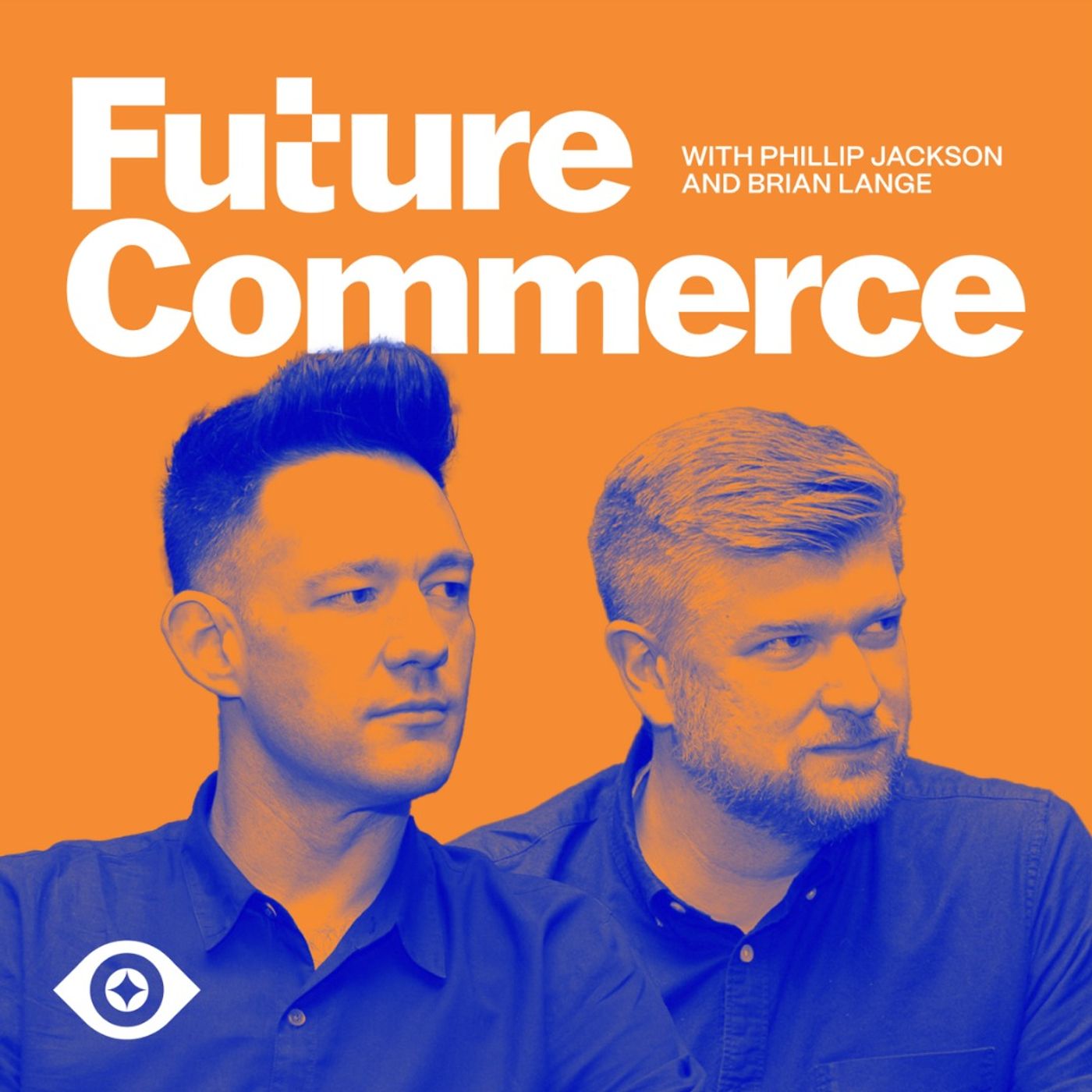
Future Commerce
Phillip Jackson, Brian Lange
Future Commerce is the culture magazine for Commerce. Hosts Phillip Jackson and Brian Lange help brand and digital marketing leaders see around the next corner by exploring the intersection of Culture and Commerce.
Trusted by the world's most recognizable brands to deliver the most insightful, entertaining, and informative weekly podcasts, Future Commerce is the leading new media brand for eCommerce merchants and retail operators.
Each week, we explore the cultural implications of what it means to sell or buy products and how commerce and media impact the culture and the world around us, through unique insights and engaging interviews with a dash of futurism.
Weekly essays, full transcripts, and quarterly market research reports are available at https://www.futurecommerce.com/plus
Trusted by the world's most recognizable brands to deliver the most insightful, entertaining, and informative weekly podcasts, Future Commerce is the leading new media brand for eCommerce merchants and retail operators.
Each week, we explore the cultural implications of what it means to sell or buy products and how commerce and media impact the culture and the world around us, through unique insights and engaging interviews with a dash of futurism.
Weekly essays, full transcripts, and quarterly market research reports are available at https://www.futurecommerce.com/plus
Episodes
Mentioned books

Apr 17, 2018 • 41min
"Leading Indicators of Unchecked Inflation"
We're back! Brian joins Amazon, we talk subscription movie passes driving return to the shopping malls; and are we seeing leading indicators of unchecked inflation? PLUS: Who is the Nordstrom customer?
Main Takeaways:
Have Phillip and Brian run out of things to talk about?
Odd-couple partnerships have become a thing in retail.
Brian can never talk about Amazon, ever.
GDPR: Friend or foe to small business?
Brian makes a prediction that may change the way we regard the economy.
Big Box Retail Crossover: Odd Couple Edition:
Brian and Phillip graciously request a check from Magento for all the promoting they are doing this episode.
Retail crossover is happening, and all the big box retailers are super into it.
Nordstrom is now offering Anthropologie Home in their stores, will this bring new customers into Nordstroms?
JCPenny is partnering up with Sephora (one of the easiest places to get lost in), which will remind customers that JC Penny still exists.
Also, regarding Lord and Taylor and Walmart, the ultimate odd couple, can Wallmart upscale its offerings?
Barbara Thau poses the question: Are retailers becoming mini malls?
Kohl's is downsizing some of its stores, and adding German grocer Aldi's to their space, can discount shopping, and local produce make for a better retail experience?
Brian points out that retailers are now free to be frenemies.
Phillip wonders where these retailers are sourcing their data from, in deciding to form what may be the best crossover episodes ever.
Can Movie Pass Bring Theaters Back From The Dead?
Random movie news: Malls are trading the ghosts of retail's past for luxury movie theaters.
In an effort to get people to actually go to the movies, Movie Pass is basically trying to be the Netflix for movie theaters.
Brian is not all about movies, but find Movie Pass interesting.
Phillip brings up a Retail Wire article that questions whether Movie Pass can reveive dying malls?
One really interesting data point from the article: 54% of Americans prefer to watch movies at home, with only 13% preferring to go to the theaters.
Brian points out that this makes sense: people can have an equitable movie theatre experience at home, especially with the emergence of streaming services like Netflix, and Hulu, and Amazon Prime.
Phillip only uses Netflix to watch The Office (and Jessica Jones) which is pretty strange to anyone who has ever binge-watched anything on Netflix (which is basically everyone).
Brian calls Phillip old.
Does Anyone Really Understand GDPR?
Phillip laments that only large business will have the resources to follow GDPR to the letter of the law.
Many e-commerce platforms are only following the spirit of the law, not the letter, and it's putting all the onus on small business.
If any e-commerce platforms are interested, here are the actual compliance regulations.
Brian says he wants to wait before he makes a full prediction on how GDPR will impact small business.
Are people okay with data sharing as long as they get some value in exchange?
Brian says that government has a role to play in ensuring companies are not taking advantage of their customers.
Sheryl Sandburg has said that for users who want to opt out of data sharing, there may be a premium Facebook product in the works. This may be a little daunting to some, who still want to believe that Facebook is totally harmless.
Phillip wonders why the US government cannot just tattoo our foreheads.
Could Economic Growth be Different Based on Social Class?
Brian broaches an idea: Perhaps everyone is wrong about inflation, and the markers for economic growth.
Brian is a big fan of The Atlantic.
What if money is worth a lot less than we think, and what if that is what is confusing people about rate of economic growth?
Seattle passes a $15 minimum wage to bolster wage growth, and somehow the world doesn't suddenly combust.
Phillip points out that buying power depends on socio-economic status, so not everyone is really gaining the same from the uptick in economic growth.
And as usual, the middle class will get the least and pay the most.
Go over to Futurecommerce.fm and give us your feedback! We love to hear from our listeners!
Retail Tech is moving fast and Future Commerce is moving faster. Hosted by Simplecast, an AdsWizz company. See pcm.adswizz.com for information about our collection and use of personal data for advertising.

Mar 30, 2018 • 1h 7min
Retail Renaissance: A Review of Shoptalk 2018
"Hopefully, GDPR is the medicine we need to start putting our customers at the center of the story, and not our conversion rates." We review Shoptalk 2018 in the wake of Cambridge Analytica with a discussion about the content, the vendors, the experience, and how merchants can take the knowledge gained at a show like Shoptalk and turn it into actionable results.
"Hopefully, GDPR is the medicine we need to start putting our customers at the center of the story, and not our conversion rates." We review Shoptalk 2018 in the wake of Cambridge Analytica with a discussion about the content, the vendors, the experience, and how merchants can take the knowledge gained at a show like Shoptalk and turn it into actionable results.
Main Takeaways:
Brian and Phillip recap some of the standouts of Shoptalk 2018 and how these standouts made lasting impressions.
AR and VR are being implemented in new and creative ways and could very well be shaping the future of the retail industry.
The technology that was being developed a few years ago is now being used in the state of the current retail industry but is there room for its development?
Cambridge Analytica happened and shook the public to its core but will data security regulations like GDPR be able to prevent future leaks?
One Beef, Two Beef, Red Beef, Blue Beef:
Brian and Phillip start by bringing up some beef between them that they at this year's Shoptalk Conference.
Brian registered for Press Passes for Shoptalk and listed himself as Host of Future Commerce, and Phillip as the co-host. (Scandalous!)
The Future Commerce content team accompanied Brian and Phillip this year to help capture the show and be active on social media.
Brian and Phillip went out to Red Rock Canyon, and even though they got stranded out in the desert, they can not recommend the location highly enough.
Brian's Big Shoptalk Announcement: The Career Change:
Brian made a big announcement at Shoptalk and let us know that he is now employed by Amazon (cue music)
Expect the tone of the show to shift so that now Phillip will prod Brian until he is forced to recuse himself from the conversation.
Brian is super excited to be on board at Amazon and thinks that his role working with the pay team and eCommerce platforms is a great fit.
VR in eCommerce: Separating the Virtual World from the Real World:
Brian hosted a panel at Shoptalk in which he spoke with Brian Cavanagh from the Hershey Company, Mike Festa from Wayfair Next, and Greg Jones from the Google AR Team.
The Hershey Company is partnering with goPuff to create a VR Shopping App that will allow consumers to purchase convenience store items within a VR experience.
The first thing that jumped out to Phillip as he was watching the panel was the Hershey Company's unique take on VR, which is to not replicate a commerce experience in the real world in VR.
Phillip describes the Hershey VR experience as a Willy Wonka-esque experience in which you can explore a colorful world and purchase almost everything you see.
The Retail Renaissance: A Recurring Shoptalk Theme:
Phillip recalls that a recurring theme at this year's Shoptalk was the fact that retail is not dead, but rather, we are going through a Retail Renaissance. (And thus a show title was born.)
Someone even compared the artistic progression of Picasso throughout his life to the evolution of retail to where it is today.
Digital Hurdles: Overcoming VR Roadblocks:
We still think about the online shopping experience in regards to aisles and carts, but with VR being such an expressive medium, the possibilities are endless.
What's the most efficient way to shop versus what's the most experiential way to shop?
The biggest challenge that retailers will face when trying to get into AR or VR is creating a library of 3D assets.
Brian predicts that the 3D asset problem is not a problem that retailers should have to solve, but instead, brands themselves will provide the assets from the point of origin to retailers.
Predictions Become Reality: Future Commerce at Shoptalk:
Phillip talks about how nice it was to see so many listeners at Shoptalk and brings up how, for avid listeners of the show, a lot of the topics that were brought up at Shoptalk were things that they had already heard on Future Commerce.
Iterations of things that Brian and Phillip had predicted on the show have come to fruition in the real world by brands known across the globe.
Trevor Sumner from Perch gave a rundown of the store of the future that incorporates responsive and interactive displays that interact with physical items from store shelves.
All of the information that we have available online is now available to us in new and dynamic ways right when we need it as we shop.
Trends and Topics: The Arcs of Future Commerce:
Phillip takes us back in time and talks about some of the arcs of Future Commerce as defined by the main conversation points of each year: the first year was voice and conversational technology, the second year was AR and VR, and this year's focus has been disruption and protecting our private data.
Back in October of 2017, Phillip and Brian advised a retailer that stated not to believe anyone that said they were using AI or machine learning because AI has been reduced to a marketing term without any actual functionality.
Phillip couldn't believe that Shoptalk had an entire area devoted to AI and Machine Learning and that the application of what could be a transformational technology to retail is abysmal at this point in 2018. (Phillip's feeling spicy today.)
Brian brings up a past episode with Jonathan Epstein from 2 years ago that had one of the best applications of machine learning that he's ever seen, and there hasn't been much more innovation in those two years by other players in the industry.
Making an Impression: The Standouts of Shoptalk:
Phillip did not recognize the Handy booth until around the third day at which point he saw that they were everywhere.
Handy has partnered with Walmart and will provide handyman services to Walmart customers in over 2,000 stores nationwide.
Phillip also gives accolades to the startup Hemster, a technology/services company that provides tailoring and alterations (that are incredibly cheap) to business and individuals in addition to free delivery service of the alterations.
Another standout was Mizzen+Main for the simple fact that it was an actual fashion brand at the show with clothes and that their domain name is comfortable.af. (Brian got to bring a Mizzen+Main shirt home and agrees that it is indeed Comfortable AF.)
Three Shoptalks Later: Using the Past to Predict the Future:
Brian states that we have hit a spot in technology where what is being spoken about in Shoptalk is similar to what was spoken about in Shoptalk 1 (which was two years ago).
Brian also predicts that the technology that we are using now will be used for the next 3-5 years and will power the next wave of commerce.
"There is too much to do with the technology that we have and too much opportunity to make money on it so people will put their dollars and effort towards that and we will probably see IRCE and NRF follow in this direction as well."
Is it a good thing that other conferences will start to look more like Shoptalk with the current technology stack?
Phillip Goes on a Rant: Technology is Not a Replacement for Quality:
There was more than one brand that Phillip spoke with that had filed for Chapter 11 Bankruptcy in the past 12-18 months that ranged from big-box retailers to actual fashion brands and the fact that some of these companies were looking at AR and VR as a means to save their business was terrifying to him.
The current technologies that are emerging today are not replacements for the fundamentals of being a good brand with a good product that connects with your customer.
Brian agrees that if you are looking at any one technology to save your business, you are looking in the wrong spot as you have made some bad business decisions to get where you are today.
"If you are in eCommerce and you are not connecting with your customers regularly, then you are missing out on a fundamental".
The State of Data Security: Cambridge Analytica Fallout:
Brian references Episode 55 in which predictions were made for what was going to happen in 2018 and Brian predicted the idea of giving shoppers access to their data to help them leverage that data to accomplish things and sure enough, companies are beginning to do this.
If you are affected by GDPR, you should probably consider that you don't want to run two different data strategies across channels and start planning your future data strategies now.
Data security could not be more timely as the Cambridge Analytica scandal came to light during Shoptalk.
What do you we actually need in our commerce experiences that can minimize data requirements as opposed to including everything just because we have the capability of plugging it in?
"We need to put our customers at the center of the story instead of our conversion rates at the center of our story."
Phillip predicts that in the same way that companies became "green" in response to customer demand, he sees an opportunity for companies to go private in which they will not partner with third-party companies to protect your data.
As always: We want to hear what our listeners think! Should AR and VR play a bigger role in the future of retail? Does the Cambridge Analytica breach change the face of data privacy and will GDPR be a step in the right directions towards the protection of customer data?
Let us know in the content section on Futurecommerce.fm, or reach out to us on Twitter, Facebook, Instagram or Linkedin.
Have any questions or comments about the show? You can reach out to us at info@futurecommerce.fm or any of our social channels, and we love hearing from our listeners!
Retail Tech is moving fast, but Future Commerce is moving faster. Hosted by Simplecast, an AdsWizz company. See pcm.adswizz.com for information about our collection and use of personal data for advertising.

Mar 23, 2018 • 55min
"Leadership is Not a Destination" - An Interview with David J. Katz
"No company can afford to stand still" - we sat down with David J. Katz - a Linked In Top Voice in Retail - to discuss how technology is changing consumer demands and pushing companies into creating better experiences.
Show Notes:
Main Takeaways:
David J. Katz is here from Randa, the world's largest men's accessory company, that ships more than 75 million units of product a year.
With the ever-changing technological landscape, retail has is being disrupted with advancements made in technology, and therefore, it's important to change approaches to fit the current retail environment.
Digitizing the traditional brick-and-mortar shopping experience is essential today when customers rely on their phones for information and recommendations.
Entertainment has taken a more significant role in retail than ever before but is there a worthwhile and lucrative space for entertainment in the coming years in the commerce world?
The Most Rational, Logical Path You Can Imagine:
David recounts the journey that got him to where he is today: a journey that began with him as a medical student studying neuroscience that granted him a unique view into the psychology and physiology of human behavior.
Thanks to a bribe from his family, David took a year deferment before spending the next nine years in med school, and he ended up not going back and eventually went to business school instead.
He got hands-on experience in operating businesses that had wholesale products and selling those to retailers.
Brian points out some of David's prolific achievements, such as being named one of LinkedIn's Top Voice in Retail.
Stimulating Customer Response to Grow Your Business:
Because Randa is dominant in their market, their goal is to stimulate customer response to buy more product as opposed to getting a larger share of the market.
Phillip brings up a recent Merchant to Merchant live podcast in which he spoke to Filson about how they are combatting the vertical challenge of modern technology by going horizontal with their product line.
David illustrates Randa's strategy of increasing consumer exposure to belts by surrounding the pants sections of department stores with their products. (Can you sense some of that psychology education here?)
With their market share and their marketing spend capability, Randa can ensure that every color in every brand is always in stock.
What happens when you are shopping online? Do all the infrastructure specifications and display strategies put in place by David get disrupted?
Growing Up Technological: The Cycle of Disruption:
David takes us through the cycle of retail (from the days of the Wells Fargo wagon in fact) and how as technology advances, the retail cycle is disrupted.
Phillip brings up that he has seen some recent advances in belt technology and asks David if they are able to improve and drive technology advancement to capture those areas of the market.
"David responds with some serious pearls of wisdom by saying, "Nothing is so perfect, so ideal that you cannot reinvent, reimagine, and innovate to make it better and more relevant."
As an example of some innovations made in the world of belts, there is belt that is also a phone charger. Talk about squeezing the last bit of power out of your smartphone.
David brings up that women are typically faster at adapting to new technologies, which is why there aren't as many advancements in men's fashion as there are in women's fashion.
Brian also brings up another technological advancement in the form of RFID-blocking wallets, an advancement that prevents the scanning of your id through your wallet.
Digitizing the Brick-and-Mortar Experience: How to Recreate the In-Store Experience Online:
Brian asks David what he is investing in or working on in regards to online shopping to mirror the amazing strategies that Randa has in place in regards to their brick-and-mortar installations.
Randa is using a lot of digital technologies to dynamically display appropriate accessories to compliment what the customer is shopping for, and then they will continue to market those accessories even after the customer has finished their online shopping session.
David also brings up that even while shopping in a physical store, customers still resort to their phones for product information, so it's essential for Randa to have an online presence, even for customers that are shopping at brick-and-mortar locations.
Ever Changing Bits and Pieces: What is a brand today?
Brian brings up an article recently published by Future Commerce alumnus Richard Kestenbaum (check out his episode) that defines "ingredient brands" and asks David how he sees brands evolving.
Ingredient brands are essentially the things inside a product that make it more valuable (think Intel Inside).
Randa has invented and patented belt technologies like Exact Fit that can be considered ingredient branding that they put inside other brands.
The word brand initial came from cattle branding which dates back centuries and is found across many cultures, and we still identify ourselves as part of a "tribe" with similarly branded others which grant you membership and validation.
Brian brings up that when customers used to associate themselves with a brand, they were assured of three things: A certain lifestyle coordination with that brand, value coordinating with the cost of items from that brand, and the benefit of being identified by other because of their brand choice.
Today, with social media and online verification while shopping, you can see thousands and thousands of reviews and comments on any given product instantly.
David predicts that there will be a tiny number of influential national and global brands that still mean something valuable, but there will be hundreds of thousands of digitally native brands that are targeting specific niches of customers.
The Modern Proprietor: Big Data Knows What You Need:
The ability to target the interests of customers on such a granular level is a powerful tool that will lead to changing the face of branding itself.
David also brings everything full circle by comparing the data mining of today to the proprietors of old, both know their customers needs, interests, and wants and can custom tailor their products and recommendations to fit those needs.
New data points are being created all the time, such as data related to your body that can even further customize personal product recommendations.
David explains how they are just beginning to use AI to recommend products based on an image, essentially superimposing a belt onto the image that compliments what you're wearing.
The Shiny Factor: Not All That Glimmers is Gold:
Phillip asks if David thinks that people will follow technology into the future of if he foresees people overinvesting in technology as we see it today.
David responds by saying the situation is a double-edged sword: on the one hand, people are distracted by whatever is new and shiny that people might think is valuable, but is only just shiny (like this security robot that took a nosedive into a fountain), but on the other hand, when technology provides a better experience for your associates and peers, then it provides an incredible value.
Brian harkens back to a past episode with Sucharita Mulpuru in which she advocates the sentiment that just because you can build something, doesn't mean you should.
Are You Not Entertained?: Entertainment's Role in Retail:
What is the role of entertainment in retail experiences and does entertainment have a place in retail in the next couple of years?
David says that Starbucks is an excellent example of entertainment in retail: you spend getting your coffee, and then you spend an hour on your laptop in their store and going through their carefully curated experience.
On one of his stints on QVC, David recalls that when he was doing a bit dressed as a doctor, viewership went up, but fewer people were ordering because the entertainment factor alone did not convince people to order when the entertainment didn't show why the product was relevant.
The key factor in making entertainment work for your brand is to engage your customers in a way that helps your brand and increases conversion over time.
As always: We want to hear what our listeners think! What is the meaning of brands today, and how is that changing in this compressed supply change environment? Do you see entertainment playing a more significant role in retail in the next few years?
Let us know in the content section on Futurecommerce.fm, or reach out to us on Twitter, Facebook, Instagram or Linkedin.
Have any questions or comments about the show? You can reach out to us at info@futurecommerce.fm or any of our social channels, and we love hearing from our listeners!
Guest
David J. Katz, EVP and CMO, Randa Accessories Hosted by Simplecast, an AdsWizz company. See pcm.adswizz.com for information about our collection and use of personal data for advertising.

Mar 13, 2018 • 43min
"Deep Fakes" - Weaponizing Artificial Intelligence
What happens when you no longer control your own likeness? Is there an ethical line to be crossed with posthumous product spokesmanship? We skirt the line in this episode and get topical - talking about the subject of ethics and artificial intelligence and how online communities have banned "Deep Fakes" - pornographic simulations produced by artificial intelligence.
Deep Fakes: weaponizing AI
We're seeing a really gross intersection of what we talked about on our prediction show around digital personal identity rights with body timage and data technology and how it advances with consumer products.
The Verge and an AP article both discuss the emergence of "deep fakes:" applying people's likenesses using AI in a pornographic way. These communities take hi-res videos and still frames from notable actresses for training data and apply their likeness to nude photos.
There's no real legal consensus on deep fakes and their consequences, so a lot of these online sites have come together and banned them and their communities.
This is hitting right on the topic of that scary, black mirror-esque world we now live in where your face can be unwittingly applied without your consent to literally any context in some of the seediest and darkest ways with no way for you to manage it.
Legal Ramifications of Deep Fakes
The legal ramifications are unclear because we've never had this sophisticated level of technology.
This is something that will come up in law, and we'll probably start to see entire bills at the federal level.
There's been no federal regulations yet that address how to handle your body data.
The Historical Blind Eye to Invasive Technology
It's troubling that there were a lot of communities that turned a blind eye for years to still images.
There was this incredible story in Wired about 10-12 years ago about how Gillian Anderson at one point was the most photoshopped face on the internet, and many of the photos were suggestive.
They were suggesting it was because of facial symmetry.
Those types of images have been around for decades with no one doing anything about it.
We can all agree that it's harmful to somebody in some way when they're applying your likeness in that way.
The advent of AI assisted fakery is taking it to the next level and blurring the line of realism.
Incredibly complex technology in the hands of the people:
We were talking to Greg Steinberg at Something Digital and he asked hypothetically, what if we applied this to products? You could change any scene, from commercials to videos, to represent your product with AI.
You could apply the Coke filter to any image and anything anyone holding is a can of coke.
Amazing movie technology is now available in the palm of your hand.
It's now available for consumers and businesses to take advantage of in a pretty easy way.
In 2016 at the Adobe max creativity conference they announced a tool that with creative cloud suite, that after 20 minutes of training spoken word data, you could train an AI or ML algorithm to parrot back phrases in another person's voice that you typed in.
A year and a half ago tech demo showcased a face to face algorithm that was applied to fake CNN broadcasts that used a source actor and overlaid that actor with political figures to show that GW and Vladimir Putin saying things they didn't actually say.
Is there even one way that this is a positive contribution to society?
Manipulative technology for sales
There are ways it could be used to leverage selling things, and businesses can use this type of tech as a tool.
We touched on this in episode 8.
People will have control of their body data and can leverage it for various reasons: they can sell it, it will outlast you posthumously, and you'll need someone to monitor and be in charge of it after you die.
For models (and maybe everyone's a model now) they'll be able to give companies access to their body data for specific reasons.
The question is: how are we going to enforce this?
It's such powerful tech that if we don't have good governance than it's going to get out of control real quick.
But just because we legislate this new reality, it doesn't mean that it's going to control people's behavior. Just because it's illegal won't make it cease to exist.
The difficult and expensive road to wiping your image from the internet
What's required to wipe your image off the internet, especially if it's someone's likeness or personal image, takes a lot of work: people have to trademark their face, or send DMCA take down notices to sites like Reddit to actually enforce their copyright.
At some point, what's coming in weaponized tech and disinformation campaigns. In no way is it helpful for humankind.
Policy Update with Danny Sepulveda!
The political traction net neutrality has is fascinating.
What happened immediately, and even before Ajit Pai repealed it, was a fairly widespread uprising of folks supporting net neutrality.
Nonetheless the department went forward with repealing it.
A number of States have gone forward with their own net neutrality rules.
The original net neutrality rules were over 400 page long with fairly complex issues.
"I've been working in this for over 20 years, and I've never seen an issue that's gotten so much traffic."
Reasons for the traction:
People love the idea of the internet as a public space open and accessible to everyone as a relatively egalitarian basis
People don't appreciate a regulator behaving in the best interest of the regulated as opposed to the interests of the public.
Republicans believe that if you own pipes going into somebody's house, you should have the freedom to contract with the providers for different treatment for better ROI, and consequently, this would encourage additional investment in infrastructure around the country.
But there's a tremendous amount of incentive to manipulate that gatekeeper function for non-productive ends to extract tolls and rents.
Most Democrats believe net neutrality should be upheld because it works.
The way people access internet now without intervention with internet service provider has worked really well with innovation.
What's next
Congress is considering repealing the FCC's decision.
It's highly unlikely to work due to Republican control of both Congress and the house.
Right now 49 Senators wish for repeal. We only need 1 or 2 more Senators to agree to repeal the rule, but it's highly unlikely the House would agree.
Even if the House voted to go back to net neutrality, the President could still veto the effort.
We are unlikely to see a restoration of net neutrality during this administration.
There are also lawsuits against it right now.
The courts could throw it out. Which would return us to Obama era rules.
Once the courts decide, either way, it will create a political dynamic in which members of Congress will have to come to some decision about whether they wish to write into law some kind of compromise.
In all likelihood, Net neutrality won't be restored.
But there's been a lot of activism, and we'll see what it means politically in the midterms going forward.
BACK TO THE DUDES
BODY DATAAAA!
In a commerce context, body data is really useful. But using it to accomplish things with people's image is just dangerous.
We don't see it not being used.
It's a tech that exists now, and it'll be used by businesses, and they'll find use cases for it. Now that it exists, we can't go back.
Aside from spokesperson and generational licensing groups like the Elvis and Marilyn Monroe estates, all I see this being novel for in a commerce context is us having more and more Reba Mcentire and KFC Colonel Sanders mash ups.
We don't need more Jim Gaffigan colonel Sanders to make me buy fried chicken, but that's where we're heading.
Consider though, the Micro-Spokesperson: using AI to determine the best person to influence another set of customers.
That influencer will sell their digital body rights to influence a certain set of people based of specific sets of DNA factors.
DNA TESTING, FOLKS!
23andme was spamming the heck out of us on the Winter Olympics.
If you've watched the Olympics, you probably saw the ads at least 50 times.
It's just one example of new DNA testing groups.
There's a ton of other really specific stuff going on with DNA testing.
It's getting better and better, and you're able to determine more stuff with it.
A company is matching DNA to medications: you get your DNA scanned and then get better understanding of what medications will work better for you based off your results.
It's personalized medication for you.
BACK TO INFLUENCERS! (Honey I shrunk the influencers.)
Venturebeat talks about Influential, a company that just launched a social intelligence platform. They find influencers for brands using the help of IBM Watson.
They can find people based on microsegment affinities to predict whether or not they would be influential for a brand for micro-influencer engagement.
Imagine if they took training data from dating apps, and then used that data to help create influencers based off of attraction factors that would allow people to trust somebody more, or like them more, because they look a specific way ro have a certain personality. (We so need GDPR in the US).
Who will influence the influencers?
Everything is happening on instagram.
There's a story on L2 called, "Can Nike keep snapchat alive?"
Nike was the first company to sell directly on snapchat, and that collaboration is signaling that snapchat might be moving into e commerce.
But in the same week, Kendall Jenner tweeted the snapchat 1 milliion dollar dip in their market valuation.
Even when you're doing interesting things in retail, when influencers are doing things in retail, and have the products to engage in 1 to 1, even then it comes down to a handful of people having the eyeballs to really determine the fate of those platforms.
So there are influencers for the influencers.
The success will be in if you can keep the attention of the people who matter.
And there's no amount of AI to keep the attention of capricious people.
Ad Age recently talked about all the data that shows how micro-influencers are having an insane affect on people above and beyond the standard celebrity influencers.
If you're a brand, you probably don't want a big celebrity, you probably want a series of micro-influencers.
Instagram influencers wouldn't traditionally have any corporate sponsorship, but they do because they have million and millions of eyeballs.
It's only because of their engagement in social. It has nothing to do with any accolade or aptitude.
15-20 years ago you'd have to be an athlete or actor to gain it.
Now anybody can do it for just about anything for anybody.
Or we can fake you with AI.
Back to Body Data!
Shoutout to Shapescale.com: a 3D body scanning tool for fitness tracking and visualization. You stand on their scale and it records your body and then you can get a picture of yourself from a 3D view and actually visualize different things, like how you should go about changing your body to see what you want to do.
It looks at fat and muscle mass, and you get heat maps of where your body's changing, and you get visual goal tracking.
It's marketed as the next gen of scales beyond the "smart" scale we have no.
Beyond it being "cool," but we have to wonder, where does it go from here other than being cool?
Perhaps you can mine the data and do your own A/B tests on your body?
It does do is allow someone to attack weight loss or health like a business problem: and treat their life like something they can test and try something out on.
Despite this wealth of technology and data, we're more depressed than we've ever been as a country.
Maybe it's not actually helping us.
That concludes our awesome meandering and tangential show, and we'd love to hear what you have to say. Go to futurecommerce.fm. Hit us up and lend more to conversation. Or Email us at and Hosted by Simplecast, an AdsWizz company. See pcm.adswizz.com for information about our collection and use of personal data for advertising.

Feb 28, 2018 • 9min
Bonus Episode: Interview with E-commerce Braintrust Podcast: Voice Commerce
We're bringing you a bonus episode - we sat down with Kiri Masters of Ecommerce Braintrust Podcast to talk about the proliferation of voice and voice commerce - and how it's changing the perception of what a brand is and how they engage their customers. To listen to the WHOLE thing head over to ecommercebraintrust.com and listen to Episode 19!
Special thanks to Kiri Masters, Julie Spear and the Ecommerce Braintrust podcast for featuring us!
Listen to the whole thing: https://www.ecommercebraintrust.com/episodes/voice-commerce-the-future-is-here Hosted by Simplecast, an AdsWizz company. See pcm.adswizz.com for information about our collection and use of personal data for advertising.

Feb 27, 2018 • 44min
Voice Commerce: Distribution vs. Brand (w/ Ryan MacInnis, Voysis)
Voice is dominating commerce experiences: but is it kitsch or is it kismet? What separates retailers who are implementing voice strategies? Ryan MacInnis of Voysis joins us to talk about how to give your brand a voice in a world spoken by Alexa. Plus: Facebook Fiona and Aloha - one more smart speaker / tablet to contend for our attention.
Show Notes
Coming soon Hosted by Simplecast, an AdsWizz company. See pcm.adswizz.com for information about our collection and use of personal data for advertising.

Feb 19, 2018 • 47min
We Pay a Visit to Amazon Go
We fulfill a promise to our listeners and provide an in-depth review of Amazon Go - including food, assortment, experience, and how the technology will be applied and extended into the future.
Show Notes
Main Takeaways
Brian and Phillip take a trip to flagship Amazon Go Store in Seattle and enjoy the experience.
How is an Amazon Go location set up, and what are some of the logistics in its day to day operations?
Can the Amazon Go model be applied to other retailers?
Shipping With Amazon might be Amazon's most significant business venture to date.
Is Amazon Go the Future?
Phillip says yes, and that future is now.
Amazon Go is basically a grocery store that allows you to pick up any item and that item is automatically tagged, added to your cart, and is then charged to your Amazon Prime account upon leaving (as long as you have the app)).
Phillip and Brian were excited about Amazon Go over a year ago.
Did the Experience Live Up to the Hype?
Brian and Phillip ventured to an Amazon Go location together to see what the experience was actually like.
Brian says the Amazon Go experience was "good, easy, and exactly what it was advertised to be."
Brian also experimented with picking items up and then putting them back on the shelf.
Phillip says that he loved the experience.
Amazon Go: The Set Up:
Phillip and Brian agree that the store is not huge, but more akin to a convenience store (Or a "Whole Foods) convenient store" according to Brian).
Phillip describes the products as "a really wide selection of a lot of things with unique selections in between" and goes into some serious detail of all the food items that are for sale.
There was also a good selection of high-end items.
How does the set-up contribute to the overall experience?
Phillip points out that some of the sensors that track customer activity looked more commercial as opposed to industrial.
What kinds of sensors are being used to detect what products are removed from the shelves?
Amazon Go: The Haul:
Since it was breakfast time, Brian walked out with a sandwich from a locally sourced bakery that was pretty good (for a convenience store breakfast sandwich).
Phillip also left with a breakfast sandwich.
Both Brian and Phillip agree that there were some pretty good, higher-end selections to be found.
In addition to free cream cheese for bagel purchases, there was also free Cholula Hot Sauce and Sriracha packages. Bless.
Alert: there was no hot coffee to be found anywhere in the store. (Unless Brian and Phillip couldn't find it.)
For the products that were of the local variety (as in not pre-packed or mass produced), Phillip points out that there were unique QR codes that must help the sensors identify these items.
The Logistics and the Competitive Landscape:
Brian questions what the minimum number of staff would be to run a store like this, given the unique new factors this retail set up introduces.
Will Amazon release any numbers detailing what it costs to staff a store like this (especially for a store that is not a flagship store).
Phillip hopes that he sees some sort of Moore's Law that comes with this sort of tech innovation.
Philip also points out that there are other companies that are implementing this technology in much larger stores than the Amazon Go store.
Phillip thinks there will be innovation from a lot more players aside from just Amazon.
Brian adds that we will see a lot more examples of this, a lot quicker than we might think.
Will Amazon make this technology available for other retailers? (Probably not for Walmart.)
Beyond Amazon: Implementing Consumer Ecosystems:
Phillip wonders if other retailers would find success in a retail model like Amazon Go without the existing ecosystem that Amazon has established with its customers.
Will this technology be useful in any other retail experience aside from a convenience store?
With the phasing out of physical media for music, Best Buy is giving Phillip fewer reasons to shop there. (Who knew CDs would be such a trigger point for Phillip?)
Brian reveals that he only shops at Amazon and Costco.
Brian cleverly states that "there is no reason to go out of your way to have more convenience."
Shipping with Amazon: A New Goliath on the Horizon:
Shipping WIth Amazon (SWA) is probably a bigger announcement than Amazon Go.
Phillip predicts that SWA might be the biggest part of Amazon's business in five years.
Phillip calls FedEx and UPS the "cockroaches of logistics."
With Target's recent acquisition of Shipt, Phillip points out that other entities are rising to compete with Amazon.
Brian wonders if UPS or FedEx are anticipating the shrinkage that may occur once SWA gets up and running.
Final Thoughts on Amazon Go:
To harken back to Episode 21, Brian exclaims that Amazon Go "is the future of shopping."
Phillip says that a few years ago, he would have made fun of Amazon for a venture like Amazon Go, but Amazon has continued to prove that they can deliver on experiences like this.
Brian wonders if Amazon will release a new phone this year.
Go over to Futurecommerce.fm and give us your feedback! We love to hear from our listeners! Hosted by Simplecast, an AdsWizz company. See pcm.adswizz.com for information about our collection and use of personal data for advertising.

Feb 8, 2018 • 59min
An Anagram for Weyland-Yutani Corporation
Amazon just won't leave us alone (healthcare?!). Plus we talk cell phone free zones, taking back control of personal data, and an open source voice assistant.
Future Commerce featured in retail TouchPoints:
We were wondering where all our new listeners came from. It came from this review in retail TouchPoints.
Klaudia Tirico shoutout. Thanks for featuring us!
Either we've elevated ourselves to Jason and Scott and the official NRF podcast level, or we've brought them all down to our level.
We're currently in Seattle for a live show with Merchant to Merchant. We'll be joined in a panel with merchants from Filson and Mervin Manufacturing.
Buzz Marketing alert! Filson's got a dope flagship store: it even manufactures products in store. (And Filson's been around since the Yukon Gold Rush).
Amazon's a for-profit venture now to the tune of 1.9 Billion last quarter:
Washington Post reports on their profits for Q4.
Amazon attributes a good portion of the profit and gross sales to Echo device demand.
Bezos: "Expect us to double down." Watch out, people.
AWS drove profits. 26% of operating margin in Q4. AWS sales rose 45% to 5.1 Billion.
Charlie O'shea: "Growth, growth, and more growth."
Buzz Marketing! Amazon's Super Bowl commercial.
Could they be teasing replacing Alexa's voice? Maybe a user configurable voice? (Please let it be J.A.R.V.I.S.)
Brian's "wouldn't it be weird" moment: what if we could record snippets of our voice and turn them into audio assistant voices?
Phillip geeks out and shares a Star Trek anecdote: Majel Barrett-Roddenberry, the original voice of the Star Trek computer, had every part of her voice phonetically captured before she died. Now they could embody her posthumously into a device using this data.
CIA and FBI shout out!
Another shout out! We were just on Kiri Master's podcast, Ecommerce Brain Trust. Check it out. We talked a lot. Thanks, Kiri!
Hot take: Amazon is killing Whole Foods:
(Brian says it's fake news)
Is Brian ever going to say anything negative about Amazon? Probably not.
Business insider reports on new procedures for Whole Foods that make people cry.
Brian's take: Actually, Amazon is the savior. Whole Foods rolled out OTS before the merger and it didn't work. Amazon wants to fix the problem.
Phillip's take: millennials now have to operate like an actual business. Sadness.
Amazon again? Alexa added voice activated texting as a feature:
Retail TouchPoints says Amazon's adding voice activated texting to Alexa.
Brooks Brothers are an early adopter for Alexa business. They're using it for Business enablement on the back end.
Seriously, more Amazon? Amazon healthcare, anyone? (free delivery for Prime members):
Partnering with JP Morgan Chase and Warren Buffet to improve healthcare in some mysterious way.
If you rearrange the letters in their names, it's an anagram for Weyland-Yutani Corporation.
Wow, Brian is excited about this? No way! The all benevolent Amazon will use our personal data to improve our lives.
Brian's privatized universal healthcare.
Phillip says we're all already working for Amazon in some way.
Chris Rock bans phones at shows:
Chris Rock is using the yondr pouch at shows.
A new move toward cell phone free spaces?
People on Twitter are celebrating this.
This is almost 5 years too late.
Is there a social quotient? AQ.
Yondr markets cell phone cases that lock your phone until the end of the event.
Google clips camera Segue:
It came out.
Brian: We don't have to be involved. You can be in the moment and review the information later.
Phillip: "You would not be saying this if you had watched Black Mirror."
But a possible positive trend: we might wind up creating privacy and cell phone free zones.
We can still live and have technology but still respect the boundaries of technology free areas.
Strava Data Issues:
This year, it turns out a bunch of US military personnel revealed secret US military bases by logging their activities on fitness trackers.
This is a human flaw. Shouldn't they know better than to log their personal activity on secret military sites?
What's the balance between personal and company/government responsibility?
What responsibility do companies have over publishing body data?
We should have greater control over how body data is used and published.
EU's GDPR compliance. ZDnet article says 22% of businesses aren't near compliant in the next 12 months. Check it out.
GDPR big decision: you not only have the right to your anonymity, but you can delete yourself from the internet.
Merchants: make your customers data available to them and let them control it. Build partnerships with your customers.
Open Source Voice Assistant:
Mycroft just launched a Kickstarter for an open source voice assistant.
They have a physical device you can actually source the parts and build it yourself.
A third party company could make their own version.
It's the Mark II device. The Mark I already exists as a private device.
Brian is worried about this.
They have a lot of interesting partners including Ubuntu foundation Mozilla foundation is supporting it. You have large partners supporting it.
Open source alternative.
Look out for a keynote on open source upcoming from Phillip.
Phillip is stoked about it.
Hosted by Simplecast, an AdsWizz company. See pcm.adswizz.com for information about our collection and use of personal data for advertising.

Jan 29, 2018 • 40min
"It's Twenty-Bleeping-Eighteen"
Show notes
Family Date Night at the Olive Garden Special Episode.
Homepod: more like yawn-pod. Plus: retail investment is gaining steam, mobile advertising to overtake traditional advertising, and bye bye sales! Finally, Nike makes the foam sole more personal.
Homepod: nobody cares
Actually, people do care: they care to talk about how irrelevant it is.
Business insider even gives you 7 reasons not to buy it.
It's just a giant ipod and it only works with itunes.
Hey, Apple, it's 20 bleepin' 18 already.
At least it's more competition for sonos?
In episode 1, we talked about Apple's exciting developments. Unfortunately, they haven't followed through of them.
The lesson: Apple gonna Apple.
Amazon Go:
Amazon Go is live!
2 weeks from today: we're going to the store and doing a review. Get ready.
Bob Schwartz, friend of the pod, stood in line on day 2 of the launch said it worked seamlessly. But caveat: he didn't like the sandwich he bought.
We're we get all these new listeners?
Thanks, new listeners.
Thanks, NRF.
Thanks, Branden Moskwa, for all of the new listeners.
The actual "Big News":
A lot of positive news in retail.
News from NRF: it's not a retail apocalypse, it's just a transformation.
The Wall Street Journal reports on a 65 million dollar retail investment in Manhattan. Because Manhattan needs more retail :)
But it makes sense to develop your own retail space without being entangled with existing retail lease agreements.
A lot of people are redeveloping retail space.
Developers taking expensive real estate and turning it into retail space is a really positive sign.
Phillip's family bet: is the new development in the neighborhood going to be a Walgreens? Probably.
You know what's still relevant? Digital Advertising:
Goldman Sachs predicting digital advertising will Account for over half of all advertising globally
Facebook and Google probably gobble up 94% of it.
Traditional advertising still on the decline.
Amazon now has a paid self-service platform for advertising, so does Snapchat.
Instagram integrated into Facebook's digital advertising model.
They predict video will have a breakout year.
Meg Whitman went from CEO of HP to a CEO of a startup of a Jeffrey Katzenberg backed venture called new TV.
They're specializing in scripted content under 10 minutes long.
From Digital to Brick and Mortar:
Dollar shave club is opening a pop-up store in London. It looks like a retail experience with an old timey barber shop setup.
Ecommerce companies starting to invade larger retail experiences.
Potential Future Commerce field trips galore?
We're Interested to see how the traditional market responds to this.
There seem to be at least 2 responses:
1: adapt to the new models, like Nordstrom.
2: stop catering to bargain and passive shoppers, like Michael Kors, Gap, and Ralph Lauren.
A disruptor company like Dollar Shave Club is interested in looking at the dollar cost average spent, not the per person purchase.
Alexa reminds us that time for this episode is almost over.
Nike's new foam:
Nike's using robots to make their shoes.
And specifically, the new React foam running shoe.
Instead of taking a sample size of a shoe design, they're creating a perfectly designed shoe.
It's an algorithmically designed shoe so that it has the exact same performance for every particular shoe made.
This is getting us much closer to what we've been predicting for personalized products.
It's Brian's hammer!
Nike is boasting a 13% energy return because of the foam sole.
Verdict: Future Commerce makes us want to spend way too much money. Hosted by Simplecast, an AdsWizz company. See pcm.adswizz.com for information about our collection and use of personal data for advertising.

Jan 24, 2018 • 1h 2min
"Zero Mentions of Omnichannel" - LIVE at NRF 2018
We recap NRF 2018 in a way that only Future Commerce can - LIVE from the show floor at The Big Show! Plus: is retail real estate in trouble? Have we left Omni Channel behind?
We're live from NRF 2018
Probably (definitely) exactly 3.619 times bigger than IRCE
This year feels livelier than last year. Definitely better than shop.org this year.
Brian was here all week. Flew in all the way from Seattle.
Shoutout to Branden Moskwa here from eCommerce Allstars with the IBM social influencer team.
Shoutout to Jason Del Rey from recode. "he's quite a voice."
Tantric Commerce (you heard it here first):
Social proof: you want to hear about other experiences before you make the purchase yourself. Example: thewirecutter.com
Example from comedians in cars getting coffee. Jimmy Fallon jokes about how a commercial promises the product is going to change your life.
You get excited about the product being a life changing experience.
So you're happy when you buy it, you're happy when it arrives, and you're happy when you open it. The whole experience, you're happy.
The product at the end of the day could be terrible, because you're satisfied all along the way.
Platforms like Wish have capitalized on this where the actual thing you're buying is happiness in purchasing.
That's what we call tantric commerce: the anticipation is so enjoyable that the product is almost unnecessary.
Yes, you have to have a good product at the end of the day,
But if 50% of the enjoyment of the product is engagement with the platform, then the product that you have is not just the thing you sell, you're in fact selling the whole experience.
The things in the NRF innovation lab aren't going to save your company if your business doesn't know how to give it's voice to those things. They're assistive, not the holistic.
Brand Voice Segue:
You have to be able to put a voice behind the brand.
For example, when you're product ships, make sure your client knows about it.
Allbirds is a great example of consistent and satisfying brand voice that adds credibility to the product.
Experience
Experience was the center of the conversation at NRF 2018.
The ones who are truly innovating are the ones making strides in experiential retail, not necessarily the ones presenting on stage.
Interesting Doug McMillon Interview Part 1:
Matthew Shay, NRF president, interviewed of Doug McMillon of Walmart.
McMillon talked a lot about how they care for their employees and their employment culture.
They've increased benefits and increased pay.
But of note, Shay did not ask McMillon about Sam's Club closings and the weird way it was executed. People showed up to work with doors chained. That seems a poor way of treating your employees and customers.
It communicates more to not ask about it than to have a canned answer.
Walmart's huge and knows what it's doing. They obviously assume it will pay off for them, but it sure looks bad.
And it's an inconsistent move considering how they talk about treating their employees and customers.
This sullies a good two year run of positive Walmart developments.
Interesting Doug McMillon Interview Part 2:
McMillon talked about learning from other countries. He said they're learning more about retail from China than any other place in the world.
Shout out to Phillip's prediction in episode 55 of retail dominance leaving America.
Retailers: consider putting Alipay on your 2018 roadmap. It's a first step to position your brand for a global audience.
Global Commerce
Impact of international commerce law and activity having a large impact on US brands.
CVS in Europe bans photo manipulation on all products. Anyone doing business in Europe and France will have to comply with changes.
Those things will shape and guide retail and commerce. The US used to be guiding the world in this, whereas we're now complying with global trends.
Something from the comments of episode 57: calling us out on our take on bitcoin as a commodity. We made a distinctly US take on commoditized cryptocurrency. There are nations that are actually using it as currency, not as a commodity. Our point of view is very Ameri-centric.
US leading the way is not always going to be the case anymore. Not just tech, but retail too.
NRF Gala
The elite of retail gathering together to celebrate each other.
They had an award ceremony with all the trappings including a red carpet and honored guests.
Emily Weiss from glossier won an award.
Jeff Barnett, CEO of Salesforce Commerce Cloud won an award. (Brian may be biased)
Omar Miller Emceed. Brian said "what's up" to him. Pic or it didn't happen, Brian.
Five years ago this gala wouldn't have even been a thing.
Retail is getting the royal treatment. It drives industry.
Yes, the people who are driving this forward should get recognized, but maybe not a red carpet.
Notable absences:
Shopify (they're probably out in the Bronx somewhere)
Amazon (guest coming soon!). 4% of all retail in US: you're a stakeholder. Where you at?
Omnichannel: that word disappeared
Diminished footprint: Google.
Our whole approach to thinking about retail is pragmatic futurism. If you wanted to think about omnichannel, you'd probably want to talk with Amazon. Guess what, you can't; they're not here.
3 years ago NRF was way more brick and mortar focused. Starting last year you could see the shift.
Salty Phillip statement of the day: what's going through your mind when you name your company chargebacks 911?
The Innovation Lab: The Bomb.
Phillip's vision of store of the future: 7-Eleven in 2090: a drone hovers in front of you and reads you an in user license agreement that you have to verbally commit to before buying your Slurpee reminding you that, hey, if you enter this place, you're going to be tracked by cameras.
4 Shoutouts
We're going to have short mini interviews with these folks on our FC Insiders. Sign up for exclusive content like this in the future.
June 20: a next generation kiosk platform for in-store product comparison.
It provides a window into products and reviews through a tablet platform right in the store.
They've created a tablet system on a rail that allows you to slide the tablet along the product display.
It uses a camera and sensor to identify products to show you more detail: you can see videos, see reviews, see product features. You can even send yourself a text message through it and buy it online.
It's a next level platform experience for a natural left to right timeline walkthrough for in-store experiences. Just like you would online, you can do a convenient personalized walkthrough in store.
Focal systems: are an actual camera and machine vision in store system.
They have cameras on shopping carts that do 2 things: they have an in cart presence for in stock items and out of stock items. They sense and read the images with machine vision (not beacons) of products that should be on the shelves and notifies staff to restock.
They also utilize real time cart analysis. The system shows you real time tracking of the shopping cart that's doing the shopping for you.
Lastly they have a tablet that's affixed to the shopping cart for wayfinding: for finding sales and products in store.
Today, a camera fixed to a cart may be the most elegant way to track products.
Optoro shout out. Sign up to FC Insiders for the mini interview.
Fit3D: is an in-store body data scanner. They store the data, the retailer stores the data, and you have complete control over the data. They use a device in store to scan, as opposed to a 2D model to convert to 3D.
The Vast NRF Burroughs Roundup
There's so much here and it's impossible to cover it all.
Come out one year to NRF.
50% of innovation lab were either brands I'd seen earlier at an innovation lab. The news ones took me by surprise.
Another shout out: Authentic Media. They demoed an HTC Vive Cadillac showroom. It had a really cool feeling of presence.
The modeling is tricky and representing real life material like paint and leather are challenging, so any old retailer isn't going to have a VR showroom, you're going to need a big budget.
Same is true for AR. You need 3D models. But there are more companies popping up that are doing retail AR. In the enxt couple of years it will be easier to do it.
Upcoming events to see us at:
Shoptalk in March in Vegas.
Etail West: Brian's at the LA one in February.
Shoptalk in mid March. Brian has a session March 19th at 5pm hosting a panel with Greg Jones, head of AR and VR at Google, Brian Kavanagh, head of retail evolution at the Hershey Company, and Mike Festa, head of Wayfair Next.
NRF is the big show. Get here next year. If you're a retailer, it's practically free. Don't forget to sign up for FC Insiders for exclusive content. Hosted by Simplecast, an AdsWizz company. See pcm.adswizz.com for information about our collection and use of personal data for advertising.

