

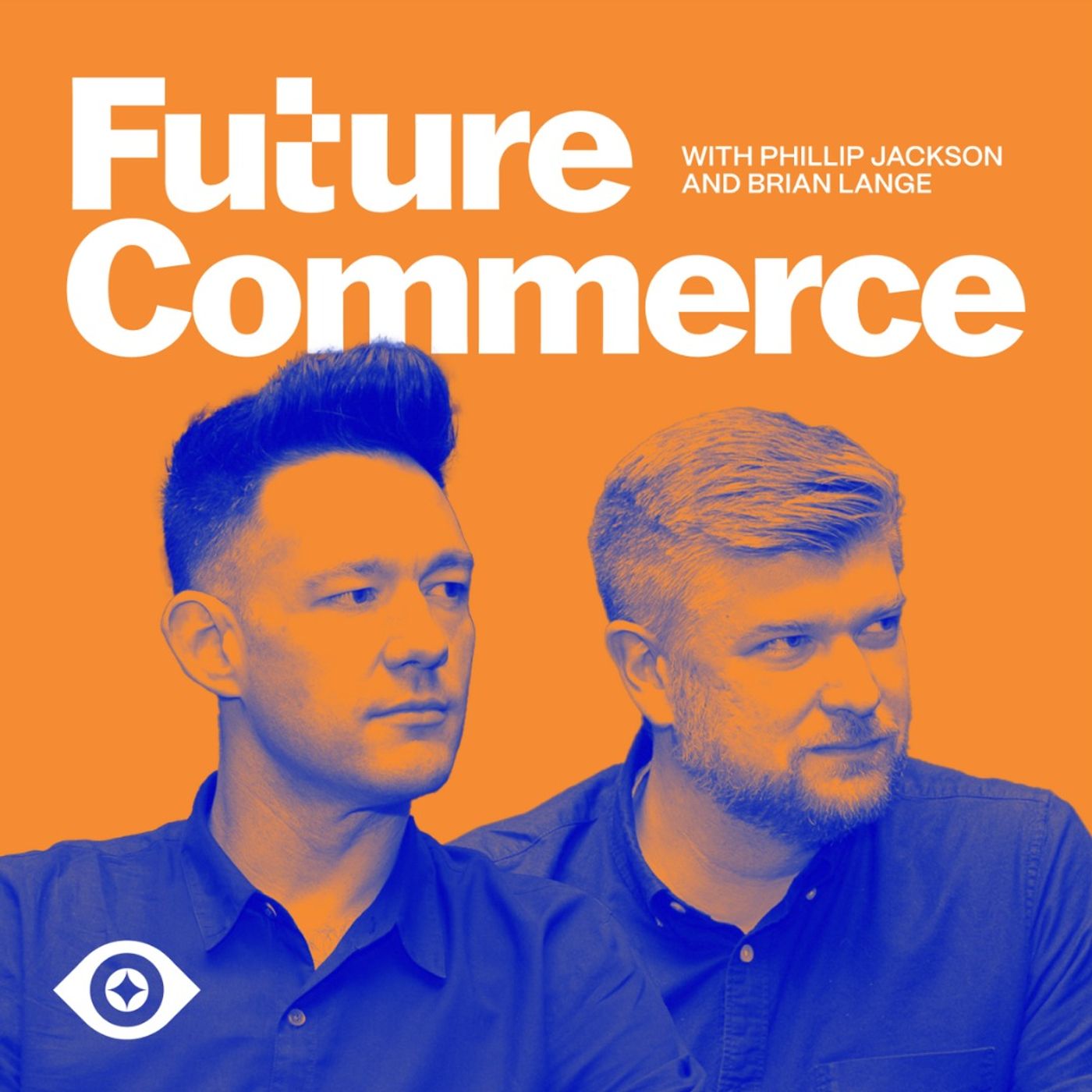
Future Commerce
Phillip Jackson, Brian Lange
Future Commerce is the culture magazine for Commerce. Hosts Phillip Jackson and Brian Lange help brand and digital marketing leaders see around the next corner by exploring the intersection of Culture and Commerce.
Trusted by the world's most recognizable brands to deliver the most insightful, entertaining, and informative weekly podcasts, Future Commerce is the leading new media brand for eCommerce merchants and retail operators.
Each week, we explore the cultural implications of what it means to sell or buy products and how commerce and media impact the culture and the world around us, through unique insights and engaging interviews with a dash of futurism.
Weekly essays, full transcripts, and quarterly market research reports are available at https://www.futurecommerce.com/plus
Trusted by the world's most recognizable brands to deliver the most insightful, entertaining, and informative weekly podcasts, Future Commerce is the leading new media brand for eCommerce merchants and retail operators.
Each week, we explore the cultural implications of what it means to sell or buy products and how commerce and media impact the culture and the world around us, through unique insights and engaging interviews with a dash of futurism.
Weekly essays, full transcripts, and quarterly market research reports are available at https://www.futurecommerce.com/plus
Episodes
Mentioned books

Jan 24, 2018 • 1h 2min
"Zero Mentions of Omnichannel" - LIVE at NRF 2018
We recap NRF 2018 in a way that only Future Commerce can - LIVE from the show floor at The Big Show! Plus: is retail real estate in trouble? Have we left Omni Channel behind?
We're live from NRF 2018
Probably (definitely) exactly 3.619 times bigger than IRCE
This year feels livelier than last year. Definitely better than shop.org this year.
Brian was here all week. Flew in all the way from Seattle.
Shoutout to Branden Moskwa here from eCommerce Allstars with the IBM social influencer team.
Shoutout to Jason Del Rey from recode. "he's quite a voice."
Tantric Commerce (you heard it here first):
Social proof: you want to hear about other experiences before you make the purchase yourself. Example: thewirecutter.com
Example from comedians in cars getting coffee. Jimmy Fallon jokes about how a commercial promises the product is going to change your life.
You get excited about the product being a life changing experience.
So you're happy when you buy it, you're happy when it arrives, and you're happy when you open it. The whole experience, you're happy.
The product at the end of the day could be terrible, because you're satisfied all along the way.
Platforms like Wish have capitalized on this where the actual thing you're buying is happiness in purchasing.
That's what we call tantric commerce: the anticipation is so enjoyable that the product is almost unnecessary.
Yes, you have to have a good product at the end of the day,
But if 50% of the enjoyment of the product is engagement with the platform, then the product that you have is not just the thing you sell, you're in fact selling the whole experience.
The things in the NRF innovation lab aren't going to save your company if your business doesn't know how to give it's voice to those things. They're assistive, not the holistic.
Brand Voice Segue:
You have to be able to put a voice behind the brand.
For example, when you're product ships, make sure your client knows about it.
Allbirds is a great example of consistent and satisfying brand voice that adds credibility to the product.
Experience
Experience was the center of the conversation at NRF 2018.
The ones who are truly innovating are the ones making strides in experiential retail, not necessarily the ones presenting on stage.
Interesting Doug McMillon Interview Part 1:
Matthew Shay, NRF president, interviewed of Doug McMillon of Walmart.
McMillon talked a lot about how they care for their employees and their employment culture.
They've increased benefits and increased pay.
But of note, Shay did not ask McMillon about Sam's Club closings and the weird way it was executed. People showed up to work with doors chained. That seems a poor way of treating your employees and customers.
It communicates more to not ask about it than to have a canned answer.
Walmart's huge and knows what it's doing. They obviously assume it will pay off for them, but it sure looks bad.
And it's an inconsistent move considering how they talk about treating their employees and customers.
This sullies a good two year run of positive Walmart developments.
Interesting Doug McMillon Interview Part 2:
McMillon talked about learning from other countries. He said they're learning more about retail from China than any other place in the world.
Shout out to Phillip's prediction in episode 55 of retail dominance leaving America.
Retailers: consider putting Alipay on your 2018 roadmap. It's a first step to position your brand for a global audience.
Global Commerce
Impact of international commerce law and activity having a large impact on US brands.
CVS in Europe bans photo manipulation on all products. Anyone doing business in Europe and France will have to comply with changes.
Those things will shape and guide retail and commerce. The US used to be guiding the world in this, whereas we're now complying with global trends.
Something from the comments of episode 57: calling us out on our take on bitcoin as a commodity. We made a distinctly US take on commoditized cryptocurrency. There are nations that are actually using it as currency, not as a commodity. Our point of view is very Ameri-centric.
US leading the way is not always going to be the case anymore. Not just tech, but retail too.
NRF Gala
The elite of retail gathering together to celebrate each other.
They had an award ceremony with all the trappings including a red carpet and honored guests.
Emily Weiss from glossier won an award.
Jeff Barnett, CEO of Salesforce Commerce Cloud won an award. (Brian may be biased)
Omar Miller Emceed. Brian said "what's up" to him. Pic or it didn't happen, Brian.
Five years ago this gala wouldn't have even been a thing.
Retail is getting the royal treatment. It drives industry.
Yes, the people who are driving this forward should get recognized, but maybe not a red carpet.
Notable absences:
Shopify (they're probably out in the Bronx somewhere)
Amazon (guest coming soon!). 4% of all retail in US: you're a stakeholder. Where you at?
Omnichannel: that word disappeared
Diminished footprint: Google.
Our whole approach to thinking about retail is pragmatic futurism. If you wanted to think about omnichannel, you'd probably want to talk with Amazon. Guess what, you can't; they're not here.
3 years ago NRF was way more brick and mortar focused. Starting last year you could see the shift.
Salty Phillip statement of the day: what's going through your mind when you name your company chargebacks 911?
The Innovation Lab: The Bomb.
Phillip's vision of store of the future: 7-Eleven in 2090: a drone hovers in front of you and reads you an in user license agreement that you have to verbally commit to before buying your Slurpee reminding you that, hey, if you enter this place, you're going to be tracked by cameras.
4 Shoutouts
We're going to have short mini interviews with these folks on our FC Insiders. Sign up for exclusive content like this in the future.
June 20: a next generation kiosk platform for in-store product comparison.
It provides a window into products and reviews through a tablet platform right in the store.
They've created a tablet system on a rail that allows you to slide the tablet along the product display.
It uses a camera and sensor to identify products to show you more detail: you can see videos, see reviews, see product features. You can even send yourself a text message through it and buy it online.
It's a next level platform experience for a natural left to right timeline walkthrough for in-store experiences. Just like you would online, you can do a convenient personalized walkthrough in store.
Focal systems: are an actual camera and machine vision in store system.
They have cameras on shopping carts that do 2 things: they have an in cart presence for in stock items and out of stock items. They sense and read the images with machine vision (not beacons) of products that should be on the shelves and notifies staff to restock.
They also utilize real time cart analysis. The system shows you real time tracking of the shopping cart that's doing the shopping for you.
Lastly they have a tablet that's affixed to the shopping cart for wayfinding: for finding sales and products in store.
Today, a camera fixed to a cart may be the most elegant way to track products.
Optoro shout out. Sign up to FC Insiders for the mini interview.
Fit3D: is an in-store body data scanner. They store the data, the retailer stores the data, and you have complete control over the data. They use a device in store to scan, as opposed to a 2D model to convert to 3D.
The Vast NRF Burroughs Roundup
There's so much here and it's impossible to cover it all.
Come out one year to NRF.
50% of innovation lab were either brands I'd seen earlier at an innovation lab. The news ones took me by surprise.
Another shout out: Authentic Media. They demoed an HTC Vive Cadillac showroom. It had a really cool feeling of presence.
The modeling is tricky and representing real life material like paint and leather are challenging, so any old retailer isn't going to have a VR showroom, you're going to need a big budget.
Same is true for AR. You need 3D models. But there are more companies popping up that are doing retail AR. In the enxt couple of years it will be easier to do it.
Upcoming events to see us at:
Shoptalk in March in Vegas.
Etail West: Brian's at the LA one in February.
Shoptalk in mid March. Brian has a session March 19th at 5pm hosting a panel with Greg Jones, head of AR and VR at Google, Brian Kavanagh, head of retail evolution at the Hershey Company, and Mike Festa, head of Wayfair Next.
NRF is the big show. Get here next year. If you're a retailer, it's practically free. Don't forget to sign up for FC Insiders for exclusive content. Hosted by Simplecast, an AdsWizz company. See pcm.adswizz.com for information about our collection and use of personal data for advertising.

Jan 15, 2018 • 57min
Mine Bitcoin with Kodak for Fun and Profit (CES 2018 Review)
This week, Brian and Phillip get bullish on VR, talk hype in cryptocurrency, and wish for a facial recognition burger ordering system. Listen in for a recap of CES 2018 and all the interesting news in retail tech.
Future Commerce Tells the Future:
Predictions we made in December have already come true: 10 days in:
Phillip is Eating a hat with Costco ketchup, because:
Brian predicted VR fitness, and BlackBox VR made it so.
Choice quotes:
"All the nerds are going to be the fit ones now."
"We're going to have a super race of Crypto Bros."
Phillip predicted that companies would start using personal attributes to tailor products to you. Two new strange developments to report on that prediction:
1st: Ars Technica reported on an ingestible pill that tracks personal fart development in real time on your phone.
Ikea wants you to pee on their ad. Ad Week wrote about Ikea's pregnancy advertisement for discounted cribs. How to prove you're pregnant? Pee on the ad and bring it into the store.
Bitcoin:
Either we're idiots or wise pundits depending on when you listened to our episode discussing Bitcoin
Worth watching: Seth Meyers Bitcoin commercial
Bitcoin reminds us of the early dotcoms. The local news coverage of the "world wide web" is very similar to the reporting happening on cryptocurrency.
Bitcoin in the news:
Warren buffet says cryptocurrencies will end badly.
Long Island Iced Tea corporation rebrands for blockchain.
No word on how DJ Khaled, fanboy of Rich Cigars, feels about its business model pivot to a cryptocurrency only company.
By no means our last words on bitcoin:
If bitcoin is the AOL of cryptocurrency, then we are only at the very beginning of this conversation.
Note to merchants: using bitcoin on your website is an antiquated understanding of cryptocurrency.
Bitcoin is now a commodified investment similar to oil.
It uses up a ton of energy. As much as Denmark.
If Visa was on the blockchain, it would take the equivalent of 5000 nuclear reactors to meet its needs.
Our favorite bitcoin tweet of the week comes from Petter Brannen, author of The Ends of the World.
Remember: cryptocurrency has nothing to do with buying and selling goods right now.
Will Amazon buy Target?
NOPE - But Brian says they probably will continue to buy companies like body labs to acquire tech or patent that will take too long to develop on their own.
But there might be a logical progression to this idea:
Target did just acquire shipt.
Then they announced they were rolling out $99 year same day delivery.
This leads to a logical end: Target and Walmart can truly compete with Amazon. They could probably beat Amazon. So Amazon may have incentive to buy Target - but they won't do it.
Target having $99 same day delivery shipping is compelling. It's an interesting turn of events.
CES:
Intel CEO gave keynote. Despite spectre meltdown, and seemingly being out of touch, almost every computing device you use is powered by Intel in some degree.
They made a bunch of cool announcements in transportation, including a vertical takeoff and landing device at the show.
Quote of the episode: "Dear 1950s, you're version of the future is finally here."
Pizza Hut announced self driving pizza delivery cars.
This gets back to Phil's supply chain theory: property doesn't have to be a physical brick and mortar place anymore.
CVS doesn't have to be just a building with pharmaceuticals. CVS can actually be a fleet of vehicles always wandering around, omnipresent, you just have to hail it like an uber and it will be there in a minute to deliver your order.
We're very bullish on AR and VR techs with a context that makes sense for retail. 2018? Probably not. But more of it will keep coming.
Why we talk about seemingly tangential tech:
It's important for retailers to know what's happening in these tech spaces.
Consumer product technology adoption will create consumer demand for good experiences in your retail spaces. That doesn't have to be just digital commerce.
No one is safe in brick and mortar. The element of experiential retail will follow even into the retail experience.
This is why we talk about CES, bitcoin, and all of these things.
We want you to know them to avoid being blindsided by your customers.
Technology affects commerce. You don't have to be an early adopter.
You can bide your time on a lot of this technology.
But they come fast. Voice is hear, even though it was a far tech a year and a half ago.
The rate of adoption is faster and faster. Know what these developments are and how they apply to you.
Brian's tangential segue into toys and tech:
Sphero mini is an app enabled toy for kids to learn how to code.
Earlier Sphero released a Lightning McQueen toy that shows the future for what's next with toys.
Toy tech and robotics are getting to the point where we can tell even more engaging stories There's even an updated Teddy Ruxpin (although, Teddy Ruxpin is, and always will be terrifying).
More on voice and recognition:
Apple slept on Siri in a big way.
Amazon realized they've been sleeping for a year on Echo, and CES proved they've woken up.
Everything has alexa built into it now.
And it's not because amazon is so smart developing this tech, but that they've opened it up for others to develop.
Facial recognition for burgers is a thing. Caliburger's kiosks can now repeat and order based off facial recognition.
Phillip wants a facial recognition burger chain to look at his face and place an order based off what it sees.
We'll be at NRF next week!
We'll be in the podcast booth from 3-5 on Tuesday, and then walking the show floor throughout.
Innovation lab on site looks amazing. This one sounds cooler than Shop.org's:
Shoutout List to a few of the exhibitors:
Bond: handwritten cards
Starship Robotics
Locus Robotics
Optoro
Tangiblee
Deep Magic AI
Face Note
Kimetric
Transcript
Coming Soon! Hosted by Simplecast, an AdsWizz company. See pcm.adswizz.com for information about our collection and use of personal data for advertising.

Dec 27, 2017 • 52min
Virtual Reality You Can Feel (w/ Greg Bilsland, HaptX)
We're joined for a special interview with Greg Bilsland of HaptX to talk about VR for Commerce and how touch in VR isn't as elusive as you may believe.
Impossible technology worth paying attention to now: how realistic haptics will add another dimension to our immersive experiences in retail and training.
What is HaptX?
Jake Rubin founded HaptX in 2012. HaptX's vision is for a full body system to deliver realistic touch to VR users.
The ultimate promise of virtual reality is to open up impossible worlds and experiences to you and experience them with unprecedented realism.
What is the specific definition of symbolic and realistic haptics?
It's the science and Technology of touch.
It's understanding how our body interacts with all the things around us.
Most people experience it in your phone, the touchpad in your mouse, or the rumble in a gaming controller.
Remember the Nintendo Rumble Pak? That was early haptics. That technology was an offset motor spinning around to create vibrational effect: that's symbolic haptics. It's only representing something happening in an abstract way.
Realistic haptics delivers the actual sense of displacement on your skin when you touch something.
Tactile feedback: Imagine putting your finger against the tines of a fork and you see all those points that are physically displacing on your finger. That's where you're actually feeling those points.
Force feedback: imagine trying to bend a spoon: you're pushing on it and feeling resistance.
Combine those two things and you get realistic haptics. A sense that you're touching a real object even though you're in the virtual world.
This seems like far future technology, but you're talking about it as current technology. Where do the technologies come from and what are its current and practical uses?
Jake Rubin found that you could leverage the current game engine tech, Unity and Unreal, to bring touch to them.
It turns out is has huge implications across commerce and retail and training.
Imagine flight simulators taking VR and using haptic gloves to utilize training for pilots.
Any professional role that needs training can utilize haptics in VR.
What is the broad industry specific use of this tech? Is there anything currently existing? How do you see haptics being applied in the consumer space?
Long term, haptic devices are going to make their way into the consumer space because VR will be part of retail experience.
Short term, It's more of an enterprise tool.
Companies doing commerce that benefit the most from haptic: a large physical space where consumers do their shopping or a large physical space they have to store something.
Consider companies like Lowes and Home Depot. They have huge stores that are expensive to lease and keep tstocked.
They're looking to VR to reduce that footprint so that their customers can have the whole store experience brought to them in a small package.
Ikea is doing the same thing.
You'll see more consumers using VR and haptics when at locations that can install VR and haptics.
What's your endgame goal for seeing retail applying haptics?
The long term vision is doing things and navigating immersive environments using your hands instead of using controller. We're a long way off before the price point makes that a feasible scenario.
Can you tell us the price point? Do you have a new product?
HaptX gloves: we have the first haptic glove to deliver realistic feedback all in one package.
We're sharing that at Sundance in a few weeks.
It's the first hardware product to debut at Sundance since Oculus. We're only selling a LImited amount of these products to strategic investors and companies.
Will you see your product initially showcased by different companies showing off their tech to customers?
Experience centers will be initial major way for consumers to interact with this technology.
You might see them at VR arcades at places like malls or experiential centers.
Entertainment will be a space for consumers to use haptic experiences.
Branded experiences: the brands doing VR right are companies like Disney partnering with Nissan to do a Star Wars experience.
To be successful, they create a real sense of value among the consumer. They're delivering utility to customers.
Future Policy with Danny Sepulveda
President Trump's proposal is to close the borders to competition and do something on the tax side to put more money in people's pockets. And he's executed on that.
Two relevant books: Between the World and Me by Ta-Nehisi Coates and the Hillbilly Elegy by J.D. Vance.
JD Vance theoretically explains the destruction of the low wage white Appalachian culture.
Coate's book is about what it means, and what it takes, to grow up black in America.
The reason these issues are important is because the policy decisions we make occur within not just economics and commerce, they occur within the four corners of law, human ingenuity, and regulation.
How we react to how commerce is changing fundamentally affects the manner in which human beings live within their communities, govern themselves, and view themselves.
As we look to struggling communities, like the ones described by Coates and Vance, we see centers of production, wealth, and commerce concentrating in specific places and the rest of the country living of off it.
It's unsustainable because of what it means to the American promise that birth is not destined.
Once social mobility is restricted we lose the american promise.
That is the fundamental problem.
The concentration of power, wealth, and authority will be central to our conversations going forward and what that means for people's everyday lives.
Could you address any critics that say your technology only further isolates people from having real world experiences?
Haptics ultimately have the ability to bridge distance and bring touch to what would normally be an isolating experience.
Consider using Skype to give your parents a hug or hold their hand while you're talking to them. The isolation criticism has always been there going back to the argument that TV would rot our brains.
But It depends on the content makers and their users to discipline themselves to how they use that technology.
Brian says that the more realistic we can make them and mimic the real world, the closer to a real world experience will enhance that connectedness.
Touch is something we've been missing from media. How do you foresee CMOs and marketers building out branding experiences with this?
VR is still a novelty for a lot of consumers and so brands will try to use experiences to wow their consumers to create a really strong brand impression.
Eventually consumers will become savvy enought to recognize the good from the bad VR experiences.
That's when marketers are going to want a deeper level of immersion to create a competitive edge over their competitors.
Imagine going to REI and be able to try on gear and ascend Mt Rainier. It's easy to see how immersion helps sell the experience.
So how much can you feel? Can feel something slimy? Can you feel weight? Texture?
Slimy and textures are challenging simply because they're a function of vibration.
When you run your hand over something, the sensation is actually your hand vibrating at various frequencies.
That's something we're working on to get the actuator technology.
Actuators are little bubbles that inflate and deflate that create the sensation of texture.
Slime is a little ways off.
But running your hands over wheat, or a rocky surface, or even over a wall is something we can do really well.
Weight is an interesting challenge: to feel something truly weighty, you need a full body exoskeleton to apply the downward pressure on your arm.
Are you heading toward full body suits?
Our original vision was to create full body suits, and that remains a goal, but our expertise is in touch.
We're really good at translating the digital into tactile experience.
Other companies doing really awesome exoskeleton systems.
Long term training, if you want to give them a true fully immersive experience, that's where we'd probably partner with a company who could do the exoskeleton type experiences to create the "climb eht mountain" experience.
Does haptics add to presence illusion?
There's a lot of progress to be made.
While we've been able to simulate touch better than any other company, it's going to take time to continue to progress.
Example: when black and white TV first came out, it was amazing. Then color arrived and black and white was no longer interesting. Same with HD television, our standards increase.
The goal posts are always moving.
We're always going to try to move with the advancements in the field.
VR is still a novel experience
Retailers are starting to understand that certain tech can only be utilized and work in certain mediums. Are you enabling experiences and interfaces that couldn't already be realized?
We want to create areas where you are able to use your hands in an immersive environment to interact with 3D objects in a way that feels intuitive.
Have you explored the medical community as well?
We've had a number of universities and medical communities reach out to us, especially in the training field.
Imagine how much more comfortable you'd feel going into an operation that a doctor has already performed on you with VR and realistic haptics?
What's the use case for Augmented Reality and HaptX?
Haptics and AR are compatible but it's a much bigger technical challenge due to the way that most AR hardware works.
AR uses a kind of inside out tracking, taking a lot of snapshots of the environment and using complicated math to tell the relative position of the device so an object can remain locked in the virtual environment.
Where that gets tricky is that haptics requires a really high level of precision to be able to deliver a realistic experience.
If you're going to reach out your hand and poke a button, you need that button to push back against you at precisely where you see that button, otherwise it's going to feel wrong.
You need submillimeter accuracy to make that work.
AR isn't there yet with the tech. Until we hear more from customers demanding haptics from AR its not something that we're going to focus on.
Any advice to our merchant listeners about when they should be investing in this?
Is there anything we should be doing in this coming year? Anything about VR? What should we avoid? What about next 5 years? What should we be prepared for?
VR is still a novelty for most consumers so merchants can rely on that to create experiences that are memorable.
Adoption curve for VR that's more like the 90s cell phone market. I don't think in 5 years we're going to turn around and see 90% of Americans owning VR headsets.
It always comes down to thinking about your business and how you're solving your consumers' problems. If you're in the travel industry: give them a 360 or VR experience to help solve your customers problems. But that's not going to be true of every industry.
The branded AR and VR experiences are going to have a real long tail for brands and merchants who invest in delivering utility and value to their customers.
The 5 year outlook is thinking about how VR and Haptics are going to apply to how you're going to train your workforce and how you're designing products.
How you're using the new tools of VR and Haptics to build prototypes.
Look at what the big companies are doing and if they're not investing in AR and VR then it might not be time to make those investments yet.
If you're interested in VR now, then you're ahead of the curve.
Immersive and wearable computing is going to be the next wave of technological adoption. It's worth paying attention to even if it doesn't match your business right now.
Thanks, Greg Bilsland. Go check out HaptX.com for more information on this new technology.
Guests
Greg Bilsland of HaptX
Transcript
Coming soon! Hosted by Simplecast, an AdsWizz company. See pcm.adswizz.com for information about our collection and use of personal data for advertising.

Dec 18, 2017 • 47min
"Don't Underestimate What Can Happen in Just 1 Year"
"You just went super future on me, man, and I love it." We do predictions as only Future Commerce can - with honest insight into what the retail year ahead in 2018 may hold. Buckle up - it's a fast and furious ride!
Let us know your predictions for 2018! Who knows, maybe we'll share them on the show. Go super future on us, we'll love it.
Applause, Applause:
Congratulation Google 5 Home Mini winners! Thanks, and congratulations to all the winners.
Remember to sign up for our FC Insiders for more weekly content and giveaways.
LEGITIMATE PREDICTIONS EPISODE
We reserve the right to predict more things as the year goes on.
A wise person once said: "How can you achieve your 10 year plan in the next 6 months?"
Round 1
Rolling thunder round: retail consolidation:
More retailers that don't belong in the landscape will go out of business.
We'll continue to see retailers coming together that belong together
And we'll continue to see a weeding out of retailers that belong in the landscape.
Invest in tech. If you can't invest in tech, you're marching toward bankruptcy.
We'll see more services like Westfield's OneMarket: retailers sharing data and tech to provide high end experiences for their customers.
Physical space is no longer at a premium.
The premium space will be experiences in, and access to, tech and data.
Philip's challenge: if you can only come up with technology for technology's tech, then you're in for some woes in your business.
Round 2
Flagship retail will move to true showroom:
We'll see more stores without any merchandise because they're:
Easier to stand up.
Easier to roll into markets.
Require less commitment.
They'll give digital consumers the ability to have the tactile experience
We'll have more experiential retail.
Delayed gratification can work in a retailer's favor: 48 hours for a product is a trained expectation, and an experiential showroom can leverage this expectation in your favor.
Round 3
Hyper-personalization:
Glossier is already pointing in this direction.
We'll see more and more 1 to 1 personalization at a product level.
Retailers will be able to have more customizable products based on your data.
Imagine perfectly fitted hammers for your little hands: do it soon, hammer companies.
Future plug: R Riveter is coming on the show to talk about innovation in their manufacturing process soon.
Brian Says: "Expect to see improvements in manufacturing that result in hyper personalization in products and even services."
Change in supply chain and manufacturing will allow for more personalized products.
A company called ubiome has a product called smart gut: probiotics tailored to you.
Whether you like that with that is irrelevant, we're going to see more and more of this type of specialization.
Round 4
More instability in marketplace security:
Yet another Fortune 500 will succumb to a massive data breach like Uber's data breach that it kept under wraps for 14 months or so.
These data breaches are just following the economics of where people happen to be and be shopping.
Recently, Starbucks access points in Argentina were compromised for bitcoin mining.
It's not that retail is under attack, it's that all the eyeballs are heading there.
Macs serve as an example: they were insulated for so many years not because they were so secure, but because they had less market share.
These insecurities will become a fact of life.
FUTURE POLICY Ecommerce and job disruption:
When deciding policy, you bring in experts who can bring data to the conversation.
Nobody really knows what the impact will really be. But you do have analogs to look at to predict future possibilities.
If robotics in automation just affect specific companies in specific places, then the idea that we should let things be is correct.
If automation is economically structural, then we have a communal responsibility to deal with this structurally.
Think globalization and trade: the same conversations happened on both sides.
There are free and open market debates vs. we should close off our borders and insure our jobs stay as they are vs. the middle ground where we believe there's a net/net good outcome, but we ought to provide assistant for workers whose jobs are lost.
The problem is it worked in a geographically lopsided way.
It worked in California, but not in coal mining regions.
It's the same problem with retail: there are more ecommerce jobs being created than local retail jobs being lost.
But you have a geography problem again.
The distribution of ecommerce goods is concentrated.
And that causes huge disruptions in areas where people are losing their jobs.
The next part of the challenge is republicans and democrats coming together and dealing with what we could and should do about this emerging lopsided job problem.
Round 5
Identity management and persistent login and single sign on will advance:
Amazon will really push on this. It's already available, but marketed poorly.
More control over single sign on.
Amazon will lead.
Payments companies can move into log on beyond just payments.
Brian says, "I would rather run my life through Amazon."
Google has made single sign on really convenient in their ecosystem.
Brendan Eich recently started a nonprofit called Brave that values privacy over all else.
There's a growing trend of heightened consciousness of security and identity management and more tools to manage them coming in 2018.
Round 6
AR proliferation - of the Merchant-enablement variety:
It's not ubiquitous yet, but a lot of companies are investing in it.
A lot of interesting "AR lite" experiences already.
Amazon is testing AR to let you see furniture in your own rooms.
Target has a lego display that uses their app for AR experiences in store.
Ultimately, we'll see ad tech advancements in this field.
A lot more AR but specifically around tool enablement and Ad Tech for commerce.
You don't need tech to create an experience, instead AR is a tech to help retailers, not a gimmick for experiences.
Round 7 Brian's biggest prediction of the year: personal big data:
The New York Times explored mining your own personal data back in 2012 using your own email.
In 2018 the digital data we have is massive.
Each person is their own set of big data: body, health, financial, purchasing, relationship and social, personality, location, time, usage, efficiency data, and reading history, browsing history, search history, chat and voice history.
There's a great Ted Talk by Talithia Williams on owning your own body's data.
But the trend is restarting a general market idea about people leveraging their own data to make better decisions and have better lives.
Merchants: help your customers use their data.
We're not all about converging on the spot, we're about lifetime customer value.
The best way to make a repeat customer is to help them make better decisions with their data.
Look for tools to help customers understand their own patterns and trends.
Give them the ability to do what they should do or want to do with that data.
Businesses and merchants have the opportunity to be transparent about how data is used and can really allow customers to use it in the same way that businesses do it.
Round 8
Two-part prediction: AI and American decline in tech supremacy:
First:
Businesses are battling market fatigue around machine learning and artificial intelligence.
Much like watson has become a brand, AI terms are becoming brand terms.
Example - Shopify Hatchful: they launched an actual branding assistant that didn't do anything that couldn't be human curated. It was nothing more than a brand term.
At the same time, China is starting to grow leaps and bounds ahead of the US in artificial intelligence.
Eric Schmidt said that the US needs to get its act together in AI competition with China.
It's not going to bode well for us is a more stringent globalization economic policy in the us with a more astringent guidelines around immigration will create a brain drain in the US
Therefore:
Market fatigue and overuse of term AI will lead to stagnation and apathy and we'll lose the global race to artificial intelligence dominance which will lead to jobs overseas, which might then lead to new and interesting products that are actually in markets outside the US first.
We'll then have to experience something that we haven't had to yet: that other markets are more competitive than us, and products won't be English language first, and maybe not US dollar based.
All of these technologies will become part of a larger whole.
The thing that emerges from the ashes of those sorts of tech terms will be brand.
Brand affinity and inspiration from brands is powered from how they fit into your life and the things you identify with and integrate into your life.
You heard it hear first on FutureCommerce. Let us know your predictions for 2018 on futurecommerce.fm. Who knows, maybe we'll share them on the show. Go super future on us, we'll love it.
Credits
Transcription - Mallory Triana
Editing - Christopher Harry / Podsherpa
Theme Music - Spectral Wolf
Transcript
Coming soon! Hosted by Simplecast, an AdsWizz company. See pcm.adswizz.com for information about our collection and use of personal data for advertising.

Dec 12, 2017 • 45min
"Microsoft Paint, but for Augmented Reality"
From the Gutenberg Press to Twitter - how tech innovation gives legitimacy to our words. Phillip gets down and dirty with AI and warns retailers of marketing confusion. Also - what exactly is Deep Learning?
Show Notes
Vibe notice: if the vibe is different, it's because this is the first in-person episode with Phillip and Brian and they're having way too much fun with no imbibing of ethyl alcohol before recording.
For more information about the evolution of media and journalism check out Understanding Media by Marshall McLuhan, a fascinating read covering the evolution of media in the Western World.
Shoutout to Kiri Masters:
We're sorry we forgot to mention your great podcast on episode 52. We're sorry; we're the worst.
Come on the show to talk about building a brand!
In the meantime, folks, go listen to Kiri Masters' Ecommerce BrainTrust.
Our Inaugural NPS:
Very first NPS went really well. It was fun to hear from our listeners.
The FutureCommerce's copywriter's job is in jeopary: thanks NPS commenter.
The Big Think Segment
What can HAM radio teach us about decency in the social Age?
Evolution of the written word: the Gutenberg Press gave authority to printed material due to the medium in which it was distributed.
When something is in print, it carries weight and authority.
Journalistic practices evolved out the necessity for us to bring ethics to the printed medium.
Fast forward and Facebook and Twitter over the last 5 years have become the authoritative choice for disseminating news.
Riley Florence tweeted parallels between Twitter and HAM radio's early toxicity of the medium.
Early adopters had to come up with a set of guidelines to root out rampant toxicity.
Retail Prophet
Retail Prophet Doug Stevens first podcast says the future of commerce is social.
Implications for retail: if some of our greatest thinkers say social is the next frontier for retailers, and social is a toxic place, then we need to know how to behave ourselves as retailers and consumers in the social medium.
New mediums create paradigms that require getting used to and understanding.
Facebook Messenger Kids
What you think it is vs. what it actually is:
What you probably think it is: we don't need another product to help our kids get on chat.
There's an Inherent creepiness to marketing chat to kids.
A real fear that creepy people can subvert the platform for dangerous purposes.
What it actually is: a way to control and keep your kids safe when chatting online.
It gives parents the tools to keep your kids safe when using a chat platform.
It's like kik or snapchat with parental controls.
It's, "I as a parent get to moderate who gets to talk to you." Which is smart and healthy.
Important to shepherd and teach our children that these can be mediums for both good and bad.
Future Policy with Former Deputy Assistant Secretary of State, Daniel Sepulveda:
Episode 51's conversation about the Digital Divide serves as a good frame for the policy conversations we're going to have.
It's exactly how the legislative process works: a conversation between 2 people from either side of the aisle hashing out problems and solutions.
Together they come up with a zone of agreement and bring it to their bosses and the bosses talk to each other, and then bring it to their colleagues and they take it to their colleagues, and eventually a solution is proposed.
Brian took the course of free market economics and the rise of innovation as the natural course of economics, so net net it will be a positive.
Phillip worries that we have responsibilities to each other and and have communal responsibilities for those who are going to lose out that aren't being discussed.
They each held two different points of view, each listened to each other and have a natural respect for one another and were able to have a respectful conversation. / What's missing today is the ability to come together with mutual respect and listen and examine the question to eventually come to a solution
That's what Danny hopes we would do as we talk about future issues going forward.
Machine Learning and AI and Marketing Confusion:
Google Brain's auto machine learning (Auto ML) created its own Artificial Intelligence.
The researchers at Google Brain announced the creation of autoML, an AI that is capable of creating its own AI. The babies are having babies.
It created something called NASnet that recognizes objects in video at real time and has an 82.9% success rate.
Brian wants you to watch Person of Interest.
AI term and the Machine Learning terms are being abused because people don't understand the difference.
See episode 14 for an overview of this with Jonathan Epstein from Sentient Technologies.
Retailers: caveat emptor! Be highly skeptical of any technology provider telling you they're using deep learning or AI.
It's only been recently that Google and Amazon have productized deep learning.
Explanation of Machine Learning
Machine learning is trying to find the best fit algorithm. Think of a scatter plot in Microsoft Excel
You can make a best fit straight line with a particular slope that will try to hit an average or median between all of the points on your scatter plot
Imagine what that looks like. You'll see that the straight line is really far off the mark from most of those points because it's an average. That means there are major outliers.
The difference of machine learning is the straight line. The deep learning continues to perform refinements to the line to get it closer to all of those data points.
That's called gradient descent. It's not just 2D it's a multidimensional scatter plot.
It's still just trying to find a better fit line, and n finding that better line, it can begin to make predictions about where a particular data point may fall along that line.
What most people are selling you is the straight line. They're selling you a really average product.
It's the difference between A/B testing and 1 to 1 personalization.
Most are doing A/B testing and calling it 1 to 1 because they don't have the means to do it.
Retailers: if you're being sold that you have to bake AI into something, or every single product has AI branded on it, don't be fooled.
If they are not using Google, IBM, Amazon, Microsoft or Sentient technology, it's probably not legitimate.
If you're listening to this right now in 2017, be skeptical.
Future AI/ML
In a while it may become so simple any founder can use: think Amazon Rekognition and Google Poly.
Think of them like the Gutenberg Press: at first it was a highly skilled profession that only a few could use, and now any numbskull can start a tumblr and share their thoughts.
Amazon Sumerian for example: anyone can make 3D now.
Microsoft Paint for VR.
Wrap it Up! Bitcoin Edition:
We're making a commitment to getting a Bitcoin expert on our show!
It's doubling again: 16K as we speak.
Two news reports have come out. One: Bank of America won a patent for cryptocurrency.
Two: JP Morgan put out a buy rating for Bitcoin for 15K. Buy at 15K.
We know nothing about bitcoin, so we need to get an expert on with us.
Finally:
Our 2018 prediction show is coming up! Subscribe to our podcast anywhere you listen to your favorite podcasts and sign up for FC INSIDERS for exclusive content.
Hosted by Simplecast, an AdsWizz company. See pcm.adswizz.com for information about our collection and use of personal data for advertising.

Dec 5, 2017 • 47min
"Consumerism is our Religion"
"If consumerism is our religion, then malls were our temples. Our temple now is the internet." Episode 53 is all about how Amazon owned Black Friday and while our heads were spinning they decided to take over Augmented Reality as well.
Did You Recover from the Holiday Shopping Blitz?
Brian favorite deal: buy a Google Home for $29 and link it up with your Google Express accounts to get a $25 credit for walmart.com.
Phillip's favorite: Timbuk2 had a 70% off sale on cyber monday. Brian is unimpressed.
Voice is Big in the News this Week:
Amazon's top selling item for Black Friday was the Amazon Echo Dot.
Conversational commerce is here.
Even our giveaway was a voice device, because the price was so ludicrous.
Voysis' exclusive report shows that 50% of retailers are investing in voice.
They reference Mary Meeker's 2016 report that 75% of all content consumption will happen via mobile by 2017.
The pull quote:
"voice is not the future it's the present."
Retailer Challenge: go to your top search terms, or your long tail of search from 2 years ago, and compare those results to today. You'll see more verbose and natural language formatted searches because people are speaking into your websites. Check it out, the data will prove it out.
Toaster.co has an article called "Giving Brands a Voice," discussing how to modify your brand in a UI-less conversational interface and what the growth of Voice First devices could do to your brand.
If you have thought to yourself "why should I, as a brand, care," then read that article.
Market Equilibrium Watch:
Data and colo center competition is causing a surplus of space in their centers.
Because of that, price points are dropping.
So we're seeing price competitive options for people to build out impressive private clouds for very little money, bringing some degree of equilibrium back to the market.
The Most Impressive Thing Brian Has Ever Seen:
Amazon Sumerian, "the fastest and easiest way to create AR, VR, and 3D experiences."
Lets you create all of the above quickly and easily without any specialized expertise.
Did they just win? We think Amazon just won.
They're aiming to educate the marketplace on how to create these environments.
Brian let's Philip know that he's going to build out a FutureCommerce HQ in VR. Merry Christmas, Philip.
Retailers: it's still going to be difficult to create experiences in AR and VR in retail if you don't have accurate models of the products you're selling.
You might be able to create spaces for the products to live, but the hardest part is getting your models in there.
The amount of data you have to maintain is next level difficult.
Check with your brands to see if they have models of their products.
Amazon Sumerian Hosts:
You can create a digital narrator to narrate a scene you create.
This is a clear use case for their acquisition of body labs.
There's a lot a lot of personalized interaction options ahead with this technology.
Reminder: it's still in preview, and it's a novel concept, and of course we've seen a lot of things sunset that seemed novel and unique at the time.
Google Poly Program:
Google just announced the Google Poly Program.
A way to address the difficulty of modeling your products for 3D.
Working backwards from the endpoint you can see Google in this space for decades.
3D generation has been part of google's masterplan for a while and follows very similarly their Voice plan.
They build on prior success working towards an end goal.
They have a vision that helps guide their product roadmap.
Black Friday? Black November.
Brian's been a nerd about Black Friday for years.
Thanksgiving day sales were up by 18% online.
They kicked off their sales the morning of Thanksgiving this year.
Philip wonders if it's a response to companies responding to REI and others distancing themselves from Black Friday.
Brian thinks it's just about cold hard cash. The businesses looking to capitalize on Black Friday madness will find any angle they can to make more sales.
If the numbers say start sales earlier, then start them earlier. And now with online sales, it doesn't even matter if you open your store.
Holy Cow! Digital commerce 360 said that early numbers point to more than 46% of revenue coming from mobile sales.
Web sales were 18% higher than last year. 61% of visits to retail site were mobile, and 46% of the sales came from mobile
Have we solved the gap that we keep hearing about in ecommerce that people don't want to purchase on mobile?
Brian's theory: A two year old flagship phone can still do a lot of shopping. Those phones are now in the hands of a broader market of people. So a larger percentage of people are equipped to purchase items easily on mobile.
2 Black Friday Takeaways:
The idea that mobile doesn't convert is getting debunked. It doesn't just have to be the small device they don't want to convert on, it seems many people are motivated to purchase.
If you look across the brands we manage professionally, the numbers are up for all of November. It's not just black Friday. Black Friday is dispersing throughout the year and creating a lower margin for business.
Brick and Mortar
Brick and mortar sales were only down by 1.5%. Last year they were flat.
There's a certain person that loves that (Brian! Cough, cough.)
There's an excitement and buzz to be a part of a very specific American ritual.
If our god is consumerism, then the malls were certainly our temple. Our temple is now the internet.
Final Thoughts:
We're slowly moving away from aggregate portals for search and starting to become brand loyalists when searching for goods and services.
See Episode 40 and our conversation with Richard Kestenbaum for a in-depth look at this from a passive commerce perspective.
All of this is subject to change and nothing is fixed, but this upward trajectory is going to continue in the short term but is ripe for disruption in the future.
Hosted by Simplecast, an AdsWizz company. See pcm.adswizz.com for information about our collection and use of personal data for advertising.

Nov 27, 2017 • 37min
"One Technology Leading to Another"
Technology can help you take your next step in retail - so we review the current landscape of retail-tech-focused podcasts, provide critique and offer insight into our favorite resources for keeping up to date on retail news.
Show Notes
Retail Tech Podcast Roundup
Jason and Scot | The Jason and Scot Show
Retail Geek
https://www.linkedin.com/in/jasongoldberg/
https://www.linkedin.com/in/thescotwingo/
Andrew Younderain eCommerce Fuel
Private community
Podcast
https://www.linkedin.com/in/andrew-youderian-ba74a623/
Jose Chan and Todd Harris, Brick and Data
LOVE this show
AR goes BOOM
https://www.linkedin.com/in/jos%C3%A9-p-chan-b4a73446/
https://www.linkedin.com/in/toddjharris/
Leyton and Trent Kling Retail Focus
https://www.linkedin.com/in/trent-kling/
Melissa Campanelli and Joe Keenan Total Retail Talks
https://www.linkedin.com/in/melissacampanelli/
https://www.linkedin.com/company/16365/
NRF/Bill Thorne/Jessica - Retail Gets Real
https://nrf.com/blog/neiman-marcus-ceo-karen-katz-putting-digital-first
eCommerce Masterplan - Chloe Thomas
https://www.linkedin.com/in/chloethomasecommerce/
No audio clips
Brandon Moskwa eCommerce All Stars
Andrea Wasserman Captain Customer
Hosted by Simplecast, an AdsWizz company. See pcm.adswizz.com for information about our collection and use of personal data for advertising.

Nov 22, 2017 • 4min
FC INSIDERS Giveaway - PLUS - sneak peek at Episode 52
BONUS EPISODE! We're giving away FIVE GOOGLE HOME MINIS! Sign up for FC INSIDERS newsletter before December 1st to receive one of FIVE Google Home Minis! PLUS - A quick shout out to Deborah Weinswig and a preview of Episode 52 of Future Commerce Hosted by Simplecast, an AdsWizz company. See pcm.adswizz.com for information about our collection and use of personal data for advertising.

Nov 20, 2017 • 55min
AI, Classism, and the Digital Divide
The Digital Divide and New Classism
This week we've entered The Odd Couple territory. Brian's relentless optimism and hope for harnessing technology for a bright future contrast with Phillip's expressed skepticism that advancements in AI and automation will benefit the working class without regulatory oversight.
Get out your Xanax and buckle up!
Making Walmart cool again
Lord and Taylor will start selling on walmart.com with their own special homepage.
It seems to Phillip that they've transformed from a prestige based brand to a value shopping brand.
Why does Lord and Taylor make this move? Walmart's official press release gives us the answer. To reach a larger market and increase their digital presence.
And this advances Walmart's own upmarket brand strategy.
The Digital Divide:
Many Americans are in a lower market tier based in cash only transactions, and companies like Walmart are trying to enable these customers to purchase digitally. But how do Walmart's upmarket aspirations affect the working class market?
Brian thinks Walmart's just appealing to all markets, not just moving up. The middle class is a new opportunity, and they have the scale to expand.
Brian's optimistic about the future of technology and the working class: "maybe there will be more people in the lower class, but the lower class won't suck as much."
He thinks technology is enabling us to be more efficient and provide better products, better services, and better life for the working class.
Counterpoint: Only the top 1% of earners will benefit from AI and machine learning: Robby Berman posits that AI will serve and make life better for humans, but only the top 1% of humans.
A Princeton study on bias in bots explores how AI has the problematic ability to target people for committing potential crimes based off the bias and prejudice of the bot creators.
Walmart has a litigious history of negative workforce practices partly due to their workforce scheduling algorithm.
Brian sees the problem as cultural. He wants business leadership to create ethical algorithms and let the responsibility rest on individual business leaders making ethical decisions.
Retail Apocalypse:
Bloomberg's collaborative article explores the reasons behind the "retail apocalypse."
It's not just about how many people have real estate and retail debt but about the number of people delinquent per capita in certain markets.
The consumers in debt don't have the income and opportunity to pay it back due to lack of employment in retail.
"You can be as rosy as you want about the corporate ethics, if there are no jobs, then it doesn't matter what how ethical the corporation is."
Brian thinks we can create better jobs and pay better wages, and maybe it's ok that retail jobs shrink over time. He considers Amazon's warehouse workforce.
And Brian takes comfort in the employment rate being at an all time high.
AI enabling job elimination:
Chris Gardner from Forrester predicts that automation will eliminate 9% of jobs in 2018.
"These jobs are not low end jobs, they're white collar jobs being replaced."
Brian is again optimistic: a whole new host of jobs will be created for creating and servicing AI.
Bank of Amazon:
Internal rumblings that Amazon might also become a bank. Some regulators are willing to explore this option.
Brian's optimist view: As Amazon has a view into our finances, they're going to start to help us like mint does by keeping track of our purchases and how they relate to other items.
They might even create living type packages. Amazon will aggregate your financial data and help you craft a livable and economically responsible lifestyle.
Phillip feels like the foxes are guarding the hen house in that scenario.
When you rely on a few companies that do way too many things so that they become ingrained in society, then when that company fails, a disproportionate amount of the population is negatively affected.
AI and Permanence:
Reuters reported that a son used data to recreate his dad as a chatbot.
Listen to this week's FC INSIDERS Exclusive Content on the possibilities of body data and machine learning.
Download Transcript Hosted by Simplecast, an AdsWizz company. See pcm.adswizz.com for information about our collection and use of personal data for advertising.

Nov 13, 2017 • 56min
"Retail Tech Moves Fast, We're Moving Faster"
A Day of Days to Toot Our Horns! Future Commerce hit some amazing achievements over this year:
In just a year's time, you our listeners, have propelled us into thought leadership.
It all started with a podcast partnership with the Jason and Scot show.
Accolades for the humble:
Forbes listed us as one of the 6 tech podcasts worth your time.
Rated one of the 5 best retail podcasts for consumer brands.
Brian takes award for most things predicted:
Called Amazon's Whole Foods acquisition.
And called Amazon's Body Data acquisition.
The ghosts of future past: 50 episodes ago there was no:
Snap spectacles.
Snap stock, whole foods acquisition.
Google home.
Pokemon go.
Introducing Passive Commerce to you:
Wouldn't you know it: Study released claims passive commerce is the means of marketing consumer packaged goods.
Actual data is proving theories we've had for many years.
All Amazon all the time:
Brian keeps the dream alive: maybe swole Jeff Bezos is listening to this show acting on Brian's suggestions?
Conversational Commerce:
Scott Emmons, one of our first guests, called conversational commerce a fad.
If it's not a fad, at least it's overhyped.
Like VR, the enthusiasm outstrips the reality of the technology. Wait on it, it'll come back.
Remember drake bot?
Thank you to our far flung listeners:
We're going worldwide: Japan, Argentina, Brazil, South Africa, Australia, India, Pakistan, Iran, Spain, UK, the Nordic countries, Iceland, and even one lonely listener logging in from Mongolia.
You're a world wide audience engaged in making strategic decisions about the future retail technology you're going to use.
And you're using futurecommerce to make those decisions: thank you!
Our most popular guest: Nick Vu, Adidas:
Nick Vu explained how you need to tailor your approach to bringing innovation into your organization based on culture and size.
Amanda Manna from Lowe's Innovation lab:
Explained how Lowe's uses story telling to advance rapid innovation.
The answer is super powers. No really, Iron Man-like exo-suits. They use them.
Temper that with Sucharita Mulpuru's advice:
Don't do technology just for the sake of technology
Retailers can embrace basic ideas such as putting a marketplace on their website.
But Saku Panditharatne gives a more urgent view of technological adoption:
Tech is central to everything, so can't skimp out on it.
##Fang Cheng from Linc discusses practical transparency in bot customer service:
Unrealistic to expect bots to be able to do everything we can do on day one.
Be open and transparent with your customers when they are conversing with a bot or human.
##Brian Roemmele humorously tells us that we're making the decisions of our own destruction:
"Everyone who thinks they have job security, they don't. Nobody has job security any longer. Everybody is going to be out of a job."
##Jason Baptiste talks voice interfaces and how to harness "fun":
"A big problem I have with Silicon valley is that it's dry and not fun. Snapchat was smart to go into L.A. and do things that are fun."
How to get customers to interact with your products:
Products have to be fun and engaging and make our lives better.
Another Brian prediction? 2018 is going to be the year of entertainment.
Customers want to enjoy and be entertained by an experience.
Dazzle your customers. See episode 22 and our discussion with Amber Armstrong.
But don't knock TJ Maxx, man. The hunt is the most dangerous game.
Sears, on the other hand, that's the death of retail.
Stand out episode: Body Labs. Using innovative technology to disrupt verticals:
Episode 29: Body labs approach using their products and applying them in new and unexpected ways.
"If you could easily provide businesses with the 3D shape of that consumer...you could unlock this whole other realm of both shape based analytics and size recommendations."
Stand out episode: the last word goes to Caleb Light of Power Practical:
Episode 42: "You're not taking a pot and making electricity with every product... sometimes those super innovative products don't sell that well as something like an LED strip that you thrown on the back of your television."
"Even if you don't have super heavy tech products, you can still think of ways of bundling it or packaging it so you can make it a clean experience so that someone wants to come back to your brand to buy whatever's new."
Caleb embodies what future commerce is all about: Taking the tools available to him and maximizing them for his success in business.
We're living in the new retail:
Things that used to work aren't going to work anymore.
The new retail means constantly poking and prodding and finding new ways of doing things.
Find people that can interpret different data, and smaller sets of data, and come up with meaningful insights that direct your business.
You can become the new retail. Join FC Insiders:
you can expect more of the same in the future.
Expect more thoughtful insights, great interviews, and thought leadership.
Together we're going to build a community of retail futurists to help us bring tomorrow into today.
Remember: "The future is moving fast, but Future Commerce is moving faster."
Download Transcript Hosted by Simplecast, an AdsWizz company. See pcm.adswizz.com for information about our collection and use of personal data for advertising.

