

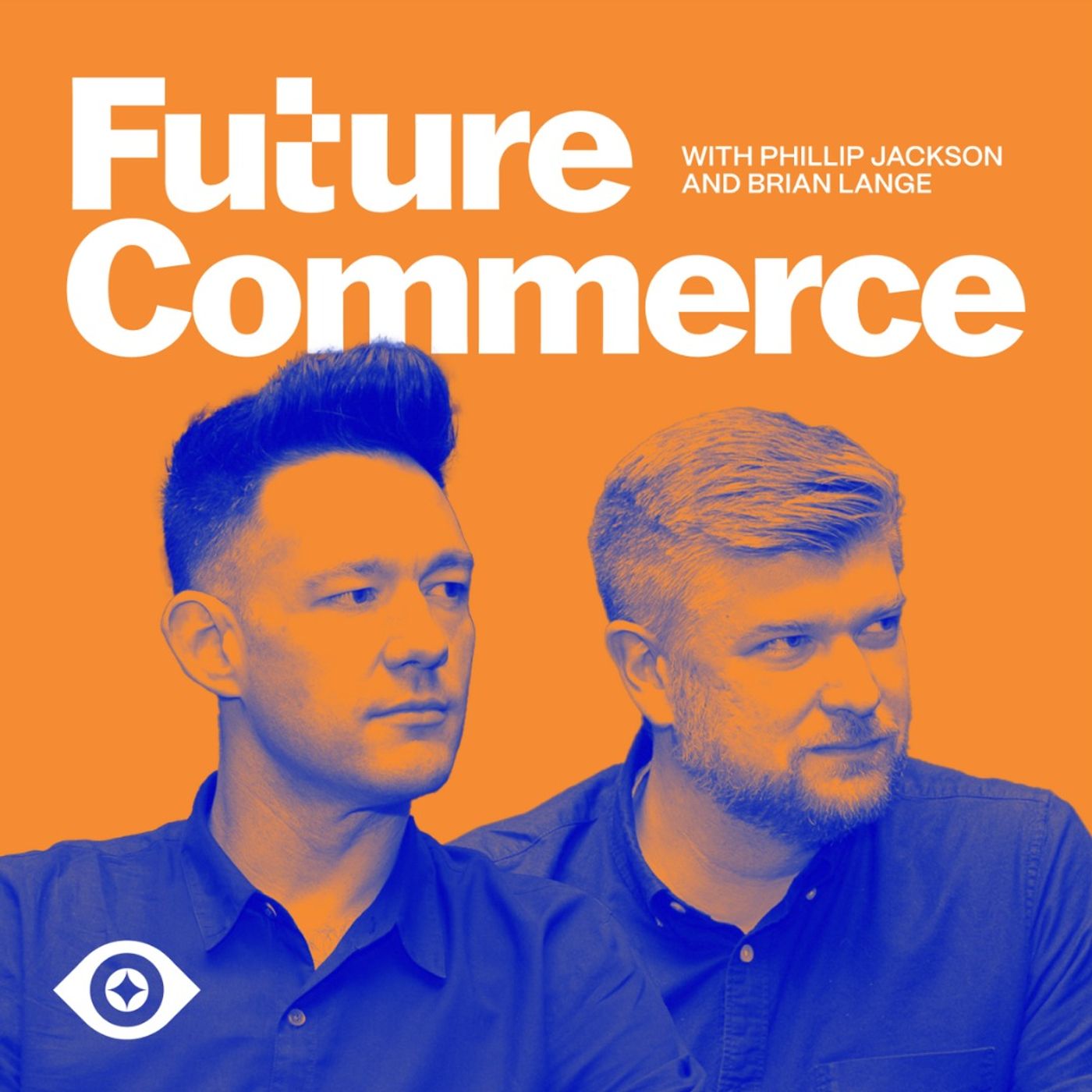
Future Commerce
Phillip Jackson, Brian Lange
Future Commerce is the culture magazine for Commerce. Hosts Phillip Jackson and Brian Lange help brand and digital marketing leaders see around the next corner by exploring the intersection of Culture and Commerce.
Trusted by the world's most recognizable brands to deliver the most insightful, entertaining, and informative weekly podcasts, Future Commerce is the leading new media brand for eCommerce merchants and retail operators.
Each week, we explore the cultural implications of what it means to sell or buy products and how commerce and media impact the culture and the world around us, through unique insights and engaging interviews with a dash of futurism.
Weekly essays, full transcripts, and quarterly market research reports are available at https://www.futurecommerce.com/plus
Trusted by the world's most recognizable brands to deliver the most insightful, entertaining, and informative weekly podcasts, Future Commerce is the leading new media brand for eCommerce merchants and retail operators.
Each week, we explore the cultural implications of what it means to sell or buy products and how commerce and media impact the culture and the world around us, through unique insights and engaging interviews with a dash of futurism.
Weekly essays, full transcripts, and quarterly market research reports are available at https://www.futurecommerce.com/plus
Episodes
Mentioned books

Jul 25, 2018 • 50min
"There is No One Best Experience" (w/ Monika Kochhar, Smartgift)
Show Notes
About Monika Kochhar
Monika Kochhar is the co-founder of Smartgift, a gifting platform that is working to solve the complexity of shopping for others.
About Smartgift
Consumer brands use Smartgift's platform to let gift recipients customize their gifts or swap them for other gifts of their choice from comparably priced recommendations. Gift senders pay for the item after the recipient has made their pick.
A deeper look into the "Science of Gifting"
Smartgift is taking rich qualitative and quantitative data to map out human behavior in gifting and shopping for others. By better understanding human behavior in gifting, they can make this process much easier for shoppers.
A function built into Smartgift called the Intelligence Swapping Mechanism learns semantically over time and maps out buying preferences such as color, fit, and size. This helps shoppers easily buy the perfect gift for an occasion for a particular person.
Smartgift hopes that over time analyzing gifting data will close the gap between what a gift shopper gives and what the recipient ultimately picks on their platform.
Is tech changing people or empowering people?
More specifically, are the way people gift or are gifting patterns affecting the way tech is created?
Monika mentions that ecommerce only accounts for less than 10% of all shopping which points to the fact that we are still in the early stages of online shopping and what it could be in the future. The more technology begins to evolve and grow, the more we'll see changing mindsets and the more shoppers will use ecommerce as a way to shop for themselves and others.
Amazon's Prime Day is an example of technology changing the way customers shop by encouraging people to shop online in large numbers for no other reason except that Amazon declared Prime Day a national holiday. Maybe the ability to purchase anything instantly has changed customers' impulse buying habits.
One area in which technology is going to change based on the user is in the end-to-end giving journey. There is going to be a deeper need to get the gift right. For too long, the receiver experience has been an afterthought in retail. Monika believes in using data mapping to build a better shopping experience that places equal emphasis on the gifter and the recipient.
Maybe the process starts with voice and ends with an augmented reality visceral experience of opening a gift. The recipient still has a choice on the physical gift after opening a digital version of the original gift sent by the gifter.
How will Aunt Brenda feel when she finds out you didn't like the polka dot sweater she picked?
How does the gift-giver feel in having their gift idea being replaced by the recipient. Does this diminish the satisfaction of the giver?
Smartgift has found that, for the gifter, the joy comes in the expression of gift-giving and also in not having the guilt of giving something less thoughtful, like a gift card.
Through Smartgift, happiness has been maximized on both ends of gift-giving; for the recipient and the sender.
As long as gift-givers are allowed to express themselves thoughtfully in gifting, they are still happy if the recipient decides on something different.
Is there room for personalization within smart giving?
Gifters have started to express personalization in gift-giving through special notes and selecting digital gift wrapping. Gifters want to participate in the delight of gift-giving digitally so that it doesn't just feel like some sort of emotionless transaction.
Thank you notes on the recipients side is an area of personalization that happens in smart gifting that has provided a wealth of data which helps us understand how recipients feels about a product or brand.
How Smartgift can help users give back.
Smartgift allows recipients the choice of sending cookies back to the gifter as a thank you gift after receiving flowers from the sender.
Smartgift sees an opportunity to use in-kind gifting as a way to encourage recipients to get involved with giving back where the recipient is given the option to give to a charitable cause of the sender's choice as a thank you.
In the future, Smartgift would like to partner with charities to make giving back more accessible to on their platform.
Our best practices around conversion rate optimization might be misguided
Our efforts are focused to one persona, the buyer, or the person purchasing for themselves. Smartgift is focused on a different persona, someone who is purchasing for someone else.
Ecommerce has evolved to create a great shopping experience and now we're at a point where we can dive deeper into the metadata and what else is happening within the shopping journey. We can now work toward answering questions such as, "Why are they shopping?" and "Are they shopping for someone else?"
Hosted by Simplecast, an AdsWizz company. See pcm.adswizz.com for information about our collection and use of personal data for advertising.

Jul 16, 2018 • 50min
"PANDA-MONIUM": The Great Build-a-Bear crisis of 2018
Show Notes
We're turning two!
After 7 years and 2 billion dollars Magic Leap created... Snap Spectacles?
Magic Leap is a U.S. startup company that is working on a head-mounted virtual retinal display, called Magic Leap One, which superimposes 3D computer-generated imagery over real-world objects, by "projecting a digital light field into the user's eye", involving technologies potentially suited to applications in augmented reality and computer vision.
After 7 years of funding and almost 2 billion dollars, Magic Leap shows off new Magic Leap One.
The general reaction of the Magic Leap One has been disappointment. Magic Leap has partnered with several companies, including AT&T as a carrier partner for their wireless, who Phil asserts is the "worst carrier" in the US.
They are "sort of definitely shipping"? We hear this every three months, so who knows when we'll actually have it.
How has Build-A-Bear outlasted Toys-R-Us?
Almost too good to be true "pay your age promotion" from Build-A-Bear seems bigger than any iPhone release, with lines of people wrapping around malls.
Creative promotion, fun experience, a product that people build themselves and that lasts a long time.
Innovative toy brands like Funko that have experiential retail or take a more storied approach to engage with customers tend to do better than those who don't.
Build-A-Bear has more licensed products than not. Customers can further customize products they already know and love. Our modern mythology is influenced heavily by storytelling through movies, comic books, etc. (see Super Heroes: A Modern Mythology by Richard Reynolds) and these tie into the retail experience for fanbases.
Build-A-Bear, but for adults
Consortium is a NYC pop-up clothing shop that allows customers to customize their products much like Build-A-Bear but instead with fashion.
Brands like Coach, Consortium, and even Nike are capitalizing on customers needs to have an affiliation with luxury goods. They have in-store offers in certain stores where personalized items can be made to order and the customer can take them home in a matter of minutes.
The Nike Kicks Lounge in Omotesando, Tokyo sells blank shoes that customers can commission local artists to paint a design on them. They then dry the paint and the customer can take them home in about 20-30 minutes.
Doing this adds a deeper meaning to the product by having a long-lasting piece of art that is connected to your community. This could play into different products that are longer lasting such as jackets, coats, and bags.
AR in customization
AR has become a powerful tool in customized products. Brands have been utilizing AR to allow customers to see products in their home. Amazon has also been pushing their AR functionality, which is already built into their app.
Starbucks Innovation - The Grown Up Sippy Cup
The inception of the Starbucks "sippy cups" started with nitro cold brew and now that the iconic green straws are leaving, the sippy cups are the future.
What produces more backwash: straw or sippy cup?
Dunkin Donuts bragged that they are getting rid of styrofoam by 2020.
It's time for companies to make changes like this, even if it hurts their "brand". It's a positive example of companies that are saying, "it's not worth it".
Adidas has partnered with Parley to create a running shoe that is made from 95% recycled materials. Yes, it's a good and positive message, but it could also spur some innovation and create new jobs and technologies.
In 2023 we'll be styrofoam free and Jeff Bezos will be colonizing the moon trying to prove his rocket is bigger than Elon Musk's. It's the space race of the 60's but for Lex Luthor types.
Full Circle
The future consistently hasn't been delivering as quickly as we all hoped it would. Ex: Magic Leap
We're in a sweet spot where there is too much technology in commerce to take advantage of. So much so that the advancement of technology in retail and commerce won't happen until we capitalize on what's here already.
This show will become "Future Iterations of Things We've Already Been Talking About for a Long Time Commerce"
One thing that hasn't changed is that consumers want a personalized experience. Now retailers are being challenged to have deeper meanings and stories for their products.
Hosted by Simplecast, an AdsWizz company. See pcm.adswizz.com for information about our collection and use of personal data for advertising.

Jul 6, 2018 • 53min
"We Shouldn't Have to Wear Juggalo Makeup"
"FREAKING PRIVACY? HOW DOES IT WORK?" We dig into the privacy impacts of advancements in facial recognition software and how it has vast impacts on Global Commerce. PLUS: Brian has a huge announcement! Listen now!
Show Notes
Brian said "Sayonara" to Amazon. Now he's allowed to say Amazon.
Amazon! Amazon! Amazon!
Pills Prime
Amazon acquired online pharmacy PillPack
If your health food and supplements from Whole Foods don't work, now you can get your pills from Amazon too.
This will likely play into whatever power move Berkshire Hathaway, Amazon, and JP Morgan Chase are working on in healthcare.
In the future, are pharmacists just glorified phone operators?
Will physical pharmacies pivot and use their pickup windows for other purposes?
What will move into your local Toys"R"Us?
What will happen to our other shuttered retail spaces as ecommerce expands.
How will digital native brands utilizing these vacant spaces?
Capital One Cafe
AKA How hard is trying to hard?
Capital One is opening locations that double as coffee shops.
Don't want facial recognition used on you? Become a juggalo.
Facial recognition is ineffective in identifying people wearing juggalo makeup
Whoop Whoop
2018 is kinda like Enemy of the State with Will Smith and Gene Hackman
Except it's real life. All our favorite electronics may or may not be watching us and recording our every move.
Amazon is piloting selling facial recognition to law enforcement.
Speaking of Insane Clown Posse...
Noveto is designing sound technology that beams sound directly to your ears, and your ears alone.
Seriously.
In the near future: You're walking through a store with no employees looking for an HDMI cable and you suddenly hear "Hi, can I help you find something?"
How much do the tech giants really know about me?
Facebook and the likes have extensive "profiles" with tremendous amounts of data about their users. Facial recognition can bind this digital information with the real world.
GDPR Lite
California has passed its own digital privacy law, similar to GDPR.
This could have a large domino effect for internet retail.
In the future, we might see service companies dedicated to manage privacy adherence for companies.
Hosted by Simplecast, an AdsWizz company. See pcm.adswizz.com for information about our collection and use of personal data for advertising.

Jun 18, 2018 • 30min
"Choose Your Own Adventure" (w/ Dave Pelton, Vertex)
LIVE from IRCE 2018! The Supreme Court of the United States is about to make a decision in a landmark case which may affect how sales tax nexus is calculated for merchants in all 50 states. Dave Pelton, Product Line Leader at Vertex, breaks down how this decision could affect retail and how - regardless of the outcome - online merchants may be impacted going forward.
Show notes
LIVE from IRCE 2018 with Dave Pelton, Vertex
Hi Dave
Dave Pelton is the Product Line Leader at Vertex.
Vertex is the leading and most-trusted provider of comprehensive, integrated tax technology solutions, having helped 10000+ businesses since 1978. They have services companies such as Amazon, Apple, Best Buy, and Target. Recently, within the last 5 years, they have moved into the ecommerce space. They have brought all of their knowledge from the high demands of bigger brands down to the mid-market at the right price point and service level.
Taxes aren't the sexiest thing to talk about at a meet-and-greet cocktail party, but anybody who sells anything is a potential customer for Vertex.
A lot of times businesses don't think about how they do their taxes as integral to their business, especially if they have them done in-house. It's very difficult for a company to make the switch to a tax provider.
If a company is only in a small number of states, they opt to just put in the rules and rates themselves because it's not that big of a job. It's when a company starts getting into a larger number of states where things get messy because sales tax is different in every state.
States crying foul
States realize that by 2020, 40% of all sales will be online. That is a massive amount of revenue that they lose if they aren't collecting sales tax.
To collect sales tax, the states must have a nexus.
Nexus, also called "sufficient physical presence," is a legal term that refers to the requirement for companies doing business in a state to collect and pay tax on sales in that state.
A lot of ecommerce business try and stay out of nexus so that they don't have to pay sales tax, causing the states to cry foul.
The Supreme Court, after not seeing Congress act on this, is currently hearing a case that could change the rule of nexus from not whether you have physical presence but whether you are actually selling into a state.
The case Wayfair vs South Dakota. In January the Court decided to hear the case and in order for them to do that, 4 out of the 5 justices had to say, "yeah, I think it's worthwhile to talk about this."
Choose your own hypothetical adventure
What happens if the Supreme Court decides if the rule stays the same?
If it stays the same, the states will continue to go after the customers that aren't paying sales tax.
What happens if the Supreme Court decides to create some federal standard by which we have to transact through?
The Court doesn't want to be too burdensome on companies, but also wants to make sure that states receive their fair share.
Is there any middle ground?
One way or the other, it will be more/less burdensome for companies, and limit/increase sales tax revenue for states.
Ok, so why Wayfair?
Wayfair was picked for this case possibly because they have a smaller amount of nexus and because they sell large items in which sales tax can become significant.
Bigger companies (like Amazon) might have seen this coming and have decided to comply to a certain degree.
At one point, Amazon did have nexus in a small number of states but then started to move warehouses into more and more states for faster delivery. This gave them more and more physical nexus as well as the biggest target on their back.
At the end of the day, whether companies have large or small nexus, everyone will be affected by the Court's ruling of Wayfair vs South Dakota.
How would this affect the global economy, Dave?
It will affect companies in other countries that are trying to sell their products to the US. Those international countries may even decide to tighten up their system and make sure they are getting dollars for every sale that's made in the US.
This will affect everyone in the next year or two, so it's better to know all about it now and be prepared whether you're going to take that burden on yourself or not.
Hey merchants
Most businesses want to be acquired in the future. If you haven't taken care of your collection and remittance, the acquiring company will typically take an escrow out of the amount that they pay you, saying, "maybe you didn't get audited, but we're going to get audited".
Companies need to think about other important reasons why they might want to collect and remit.
Hosted by Simplecast, an AdsWizz company. See pcm.adswizz.com for information about our collection and use of personal data for advertising.

Jun 8, 2018 • 38min
Community as a Retail Differentiator
Community-building is powering everything from product innovation to commerce platforms. In this episode we dive into how to build a community and how to do it with authenticity. Plus: how did Kanye West's Yeezy brand shape the entire footwear industry in just 5 years?
Show Notes
Main Takeaways:
Phillip realizes that some content ages better than others.
Retail renaissance will always be relevant.
How does community impact the world around us?
Adidas vs Nike: Battle of the User Experience:
Adidas cracks the Global Top 100 Brands 2018 list.
Nike remains on the list at #29.
According to Phillip, Nike is setting the stage for where footwear should be but is Adidas's app changing the buyer experience?
Phillip almost buys Adidas after Nike sneaker sells out in 31 minutes.
Adidas app seems to allow for a unique user experience, while Nike just seems like a responsive website.
Does Adidas's unique approach to customer engagement mean they will pull ahead of Nike?
Does Brian love Kanye like Kanye loves Kanye?
Kanye's "Yeezy" changed the footwear game forever.
Yeezy's used to be a luxury product, but production is ramping up to over a million pairs for the upcoming sneaker.
Kanye West's ability to be a content creator and foster community is unparalleled in the sneaker industry.
Yeezy is the brand other brands love to copy.
Brian is definitely a Kanye West fan.
Social Platforms and Communities:
Reddit becomes the third most-used website behind Amazon and Youtube.
Reddit surged ahead and surpassed Facebook.
Facebook users seem to be all about engaging with Facebook and known social contacts.
Reddit users create distinct communities and engage in community-based conversation.
Commerce works in a similar structure to Reddit in terms of engagement: sharing experiences and sharing ideas.
Magento is a great example of a "commerce-based community."
Beyond the $$: Community Building is Helping Companies Grow:
Early adopters of the web self-organized into enthusiastic communities like dial-up BBS.
Phillip realizes he may, in fact, be older than Brian.
Former Payless shoe rep built XO communications by installing dial-up services in Payless stores and is successful because he focuses on community rather than company building.
Throughout the 90's and early 2000's, companies like Microsoft and Google follow this path as well.
Everything comes down to community building: where products are sourced, how they are made, and the ethics of the process.
Community Building Basics:
Don't try to control the conversation or the message.
Tell a story as a brand that fosters conversation.
Let users engage in the conversation, and listen to feedback.
Always be open to change and adaptation.
Examples of Community Builders: King of Pops and Bitter Southerner:
King of Pops makes popsicles popular by setting up shop at every music festival in Atlanta in 2018.
King of Pops create community and conversation at their popsicles stands.
The Bitter Southerner an online opinion magazine gives a voice to opinionated southerners sick of being caricatures, with related apparel.
Wearing Bitter Southerner apparel opens up conversations about real "southern values", and allows for community building.
The future of branding is all about having conversations.
Retail tech is moving fast, and Future Commerce is moving faster. Hosted by Simplecast, an AdsWizz company. See pcm.adswizz.com for information about our collection and use of personal data for advertising.

May 31, 2018 • 43min
"Nirvana of Personalization"
Main Takeaways:
Adobe moves to acquire Magento Commerce, an e-commerce platform with a massive community.
Netflix manages to beat out everyone in a battle of the best content.
If users agree to pay for social media, would Facebook ever change its ad-based model?
Social media advertising may of turned Phillip into a sneakerhead.
America's Second-Hand Economy: A Tale as Old as Time.
Phillip and Brian celebrate landing in the for "second-hand commerce."
Second-hand commerce is not a new concept, even beyond the modern sharing economy, and online secondhand retailers like Poshmark and eBay.
Garage sales, where people could purchase previously owned items have always been a popular form of second-hand commerce.
In fact entrepreneur Gary Vaynerchuk has lauded garage sales as a great way for people to find valuable items to re-sell for profit.
The only entity that would probably care about statistics on garage sales is the IRS. And only to be able to collect back taxes on vintage video games being resold.
Adobe and Magento: An Acquisition Made in Community Commerce Heaven:
Adobe acquires Magento Commerce an open-source e-commerce platform for 1.6 B. Considering Magneto' loyal community base, and growth it seems like this was a high-value buy.
Magento posted sales of 170MM in 2017 and has done a lot to move upmarket.
Adobe is kind of the master of enterprise level market, and has managed to get their product into every arena including business analytics, data storage, and consumer creative.
This is the fifth straight episode about Magento, is this a Future Commerce record?
Should Shopify be fearful of this acquisition? Shopify stock was down 4.2% at market close on the day that Adobe made this announcement.
Perhaps Shopify should be afraid, Adobe could actually use Magento to compete with Shopify in their own market class.
This deal is also indicative that e-commerce is not only not dead it may be what Phillip termed a "boom town".
Also there is still tons of room for retailers to go and sell, because the retail apocalypse is still not a thing.
Netflix Rises by Changing the Face of Content Forever:
Netflix as of this episode has surpassed all other to be the largest peer to peer content provider. It only lasted a few hours, but they beat out Disney, a company with almost one hundred years of content production.
Netflix offers users commercial free(and ad-free) content, and really has something for everyone, from cooking shows to comedy.
Phillip recommends a comedy special on Netflix called "Jay Acaster Repertoire"
Because of paid-platforms like Netflix content is able to evolve beyond just the traditional advertiser based systems, and it will be interesting to watch what this "freedom of the screen" will produce.
Is Premium Social Media the Future of Online Socialization?
Will Facebook abandon their ad-based model in favor of a paid subscription model, and how would users react?
If social media sites did start charging users (or offered premium accounts), it would follow the evolution of content, which through platforms like Netflix and Hulu have moved beyond being dependent on advertisers.
Having social media sites dependent on user fees (at least in part) could lead to Facebook becoming a lot more user focused, instead of advertiser focused. This could mean more security and privacy.
Advertising on Social Media: Have Consumers Lost Their Agency to Ads?
How do advertisers market to consumers through social media in a way that can best serve their needs?
Phillip gives some credit to social media advertising for turning him into a stylish sneakerhead.
Advertisers offer what looks like a sweetheart deal to consumers: give us your data, and we will help you build your best self. Is this too good to be true?
Phillip questions whether there is choice involved: are users being suckered into buying things they like but don't need? The short answer to this is that no one really knows.
Want to know how Facebook targets ads to users? Facebook uses 98 personal data points to make ads as relevant as possible. Data privacy is not a thing, and Facebook users should be aware of that.
Or is targeted advertising actually offering a better quality of life in exchange for personal data?
Also: due to privacy concerns, Twitter is offering users the ability to turn data sharing off which can lead to different problem.
Since Twitter like Facebook is heavily dependent on ads, Twitter users would still have to deal with ads, but it would be much broader.
Brian says that he would much prefer relevant ads.
So the question remains: How much of what we buy is because of ads that are specifically targeted to our data?
GDPR may affect Facebook and Twitter's ability to use targeted advertising or push ads onto their EU customers.
Recent lawsuits that have hit Facebook and Google (to the tune of $8.8B) may lead to sweeping enforcement. These companies will want to move quickly to avoid further litigation.
Retail Tech is moving fast and Future Commerce is moving faster.
Go over to Futurecommerce.fm and give us your feedback! We love to hear from our listeners! Hosted by Simplecast, an AdsWizz company. See pcm.adswizz.com for information about our collection and use of personal data for advertising.

May 25, 2018 • 57min
Manufactured Scarcity: Secondhand Commerce
Main Takeaways:
The sharing economy is helping regular people lead their best lives.
Real-sized model diversity is actually becoming a reality with big brands
In 2018 retail pretty much runs our lives
Levi Jean jackets + Google enabled tech= less impressive than expected
The Retail Apocalypse is as likely as a Zombie Apocalypse
The Sharing Economy: Aspirational Luxury Goes Mainstream:
The sharing economy is now allowing consumers unprecedented access to products and services, with a much lower price tag.
And companies have sprung up around this concept, services people now use without a second thought like Uber and Airbnb.
JetBlue has a private jet company that allows users to share a private jet for less.
"Is this all just manufactured scarcity?
Subscription Models Allow Users to Upgrade Their Lives:
On Retail Dive CEO of Rent the Runway Jennifer Hyman talks about how the company fits into the "the sharing economy." , Most people, know Rent the Runway as the place where we can all rent clothes we couldn't otherwise afford.
Something all retail enthusiasts will be excited to hear; Hyman says that her entire closet is in "the cloud."
Volvo's subscription service: Care by Volvo is pretty epic, and is indicative of a societal need to upgrade regularly.
Mercedes Benz is also offering a subscription model, so maybe "subscription leasing" is the future of car-commerce.
Phillip and Brian discuss whether a similar model could be used in fashion, so basically StitchFix, Letote for mid-price style, and Stitch fix offering a lux option if you want to feel fancy.
Diversity of Size: Finally, a Priority For Retailers?
Bonobos (a popular men's retailer) is finally "sizing up" to address diversity of size, and is adding to the sizes it offers its customers.
Bonobos new campaign 172 different men of diverse backgrounds and body types, is meant to put on display the retailer's dedication to offering options to men of all shapes and sizes.
Nike has been utilizing diversity of both size and color in their ads, so at least they are doing something right these days.
If more retailers emphasize addressing the sizing needs of their customers, then they can open their brands up to much more significant market space.
Levi's "Jacquard" is the Palm Pilot of Tech-Enabled Clothes:
Phillip goes on a fun field trip to Levi's flagship store in Chicago to check out the "Jacquard."
While the Jacquard has a super cool name, it's actual tech is basic.
The jacket allows the wearer to know when they get a text or call, through a vibrating cuff.
One major letdown? The Jacquard doesn't even have a headphone jack.
The Levi-Google jacket collab also seems to be made of a burlap material which pretty much defeats the purpose of a jean jacket.
The Retail Apocalypse: More of a Supply Chain Apocalypse:
The retail apocalypse is not a thing, so maybe there is another reason that so many brands are going out of business.
Many of the brands that are going out of business are poorly run and aren't adaptive enough.
Also, Brian makes the point that there are just cheaper and more efficient ways of doing business in 2018.
Indochino is expanding its brick and mortar presence,
CEO Drew Green is attaching Indochino's success to its understanding of "the lifetime value of a customer" And how a visit to a showroom can turn into obtaining a repeat online customer.
Dying malls are trying to keep themselves afloat by allowing churches and religious organization.
Also, dead malls are so eerie that people are touring them. Maybe tourists are hoping to witness a couple of ghosts of retail's past.
Go over to Futurecommerce.fm and give us your feedback! We love to hear from our listeners!
Retail Tech is moving fast, and Future Commerce is moving faster. Hosted by Simplecast, an AdsWizz company. See pcm.adswizz.com for information about our collection and use of personal data for advertising.

May 21, 2018 • 55min
"Sommoliers of Retail"
Main Takeaways:
Instagram discovers that Phillip has a thing for sneakers.
Facebook wants to venture into matchmaking, and they certainly have enough data to do it.
Can data-rich companies step up their security game?
Retailers are using real-time data to put employees in the right place at the right time.
Personalized wellness packs: The future of health?
Professors are leaving the classroom for a better paycheck.
Facebook Uses AI to Mine Data it Already Owns:
Facebook has decided to use artificial intelligence or AI to look at Instagram data, even though, they already have access to all that data anyway because they own Instagram.
So basically Facebook is reading your Facebook posts?
Instagram learns of Phillips very secret shoe obsession.
Everyone learns that Instagram(owned by Facebook) is somehow tracking shopping that goes beyond Instagram.
Phillip and Brian are shocked to learn that Facebook is sending out non-GDPR compliant emails.
Mark Zuckerberg Matchmaker Extraordinaire?
Facebook knows everything about everyone, even people who don't use its service.
Which means that Mark Zuckerberg knows you better than you do.
Also cringy? Mark Zuckerberg vs. Judiciary Committee: full of dinosaurs who survived the stone age of social media,
During the hearing, a Congressman thought it appropriate to discuss FaceMash, a pre-Facebook website that allowed users to rate other users based on their attractiveness. Zuckerberg called this a prank, but could that project be where his dreams of matchmaking emerged from?
Phillip says that because Facebook has all the data of pretty much everyone, they probably would be pretty successful in this endeavor, and that's what makes it all the more terrifying.
If you live in Columbia and trust Facebook's algorithms, Facebook has already launched a matchmaking service.
Brian says that this is actually a huge opportunity for commerce, where companies could use this info to push projects, or services facilitated towards these matches made in data heaven.
This could open up a massive market for experiential retail.
Phillip and Brian agree that 90's era romantic-comedies are the best movies.
Can Humans Adapt to the World's Triumphs and Troubles?
Since social media has changed everything, Facebook alone being home to 2 billion users, can humans catch us with the change in socialization?
Brian references a former IBM strategist in saying that adaptability quotient (AQ) outranks both IQ and EQ especially as it pertains to marketability and leadership.
Phillip wonders how long it will take for humans to be able to adapt to the current situation, in the days of information overload and global suffering.
Are modern global social networks going to lead to a Darwinist phenomenon where only the strong survive?
Twitter Needs to Get Rid of Its Ponytail:
330MM Twitter users were sent into a possible panic after Twitter sent out an email that the user's passwords had been exposed.
Twitter insists that even with this breach, the company didn't think that anyone's account had been compromised, but users should change their passwords anyway.
Phillip says that Twitter handled this perfectly well.
This was one of Phillip and Brian's predictions for 2016.
Are companies getting better at security, or just at owning up that their security is terrible?
Twitter was proactive in immediately making customers aware of this issue, but as Phillip makes clear, this breach wasn't as much a risk for customers, and showed Twitter putting their customers need for transparency first.
Can Stores Use Time-Tech to Improve In-Store Experience?
Ripple Metrics is providing data to retailers that will allow them to more efficiently handle their store staff. This is accomplished by monitoring store traffic, which sounds like great news for all customers who get super frustrated when there's no one there to help them in a store.
Brian is super excited about this tech, because it re-emphasizes that retail is becoming all about the in-store experience and how to provide that experience to customers.
Now, in-store customer analytics do exist but, the really innovative part of this technology is that it gives retailers the ability to place employees in the store when there is a need for them to be there.
This technology uses a combination of real-time analytics as well as predictive analytics to determine where and when to place workers in a way that would best serve customers.
Now, Walmart has utilized similar tech in the past, to keep track of their employees schedules to keep their employees from going full time.
Actually, Walmart has a somewhat checkered past of keeping their employees from benefits by keeping hours below full-time, and they were sued for it.
Phillip says that in-tracking has been used in some pretty crazy ways, in order to better understand the customer.
"Things that can be automated will be automated and things that can't require training and knowledge and those are the things you want to invest in".
In-Store Experience is Becoming a Mainstay For Retail:
Macy's acquires Story, proving that experiential retail is a thing, and that in-store experience is everything.
Phillip says that we are going to need "sommes of retail" to tell the story of how products come into being.
Brian says Nordstrom has already accomplished this.
And with experts in the field becoming necessary this may lead to even more automation of jobs that can be done by a machine.
Personalized Products Give Consumers a More Tailor-Made Fit:
Phillip is super excited about Care/of, a company that is created personalized wellness packs based on a customers individual needs.
This kind of product really drives the customer experience emphasis home: it doesn't just ask questions, it asks all the questions about diet, lifestyle, goals, allergies, and even your level of belief in supplements themselves.
care/of also asks about mental health to ensure that there won't be any negative interactions with the recommended supplements.
And if you are a skeptic like Phillip (and Phillip is indeed a skeptic), have no fear, because the service includes the number of double-blind studies on each supplement and its effectiveness.
The entire process is incredibly personal, from the questions, to the 30 daily-use packets with the customers name on each one, even down to the various inspirational quotes meant to improve the overall experience.
Facebook is Hiring Professors Away From The Classroom:
AI is growing rapidly, and salaries seem to match the demand for the skill set.
Facebook, is working to stay as ahead of the data curve as possible, by hiring three robotics professors for their new AI labs in Seattle and Pittsburgh.
Is it worth taking professors out of the classroom, and will this become a ongoing issue?
Brian makes the point that we do need better ways of educating in AI, and if schools lose their academics to tech companies cushy salaries and benefits, this may impact the education system, and future generations.
Retail Tech is moving fast and Future Commerce is moving faster.
Go over to Futurecommerce.fm and give us your feedback! We love to hear from our listeners! Hosted by Simplecast, an AdsWizz company. See pcm.adswizz.com for information about our collection and use of personal data for advertising.

May 16, 2018 • 59min
"Push Notifications for Chewbacca Bobble Heads"
Main Takeaways:
Baked by Melissa gives away 100,000 cupcakes to prove love and sugary treats really do win.
Oculus Go is better than a party trick.
Instagram decides that they want more than just dopamine-fueled likes from their users.
Amazon vs. Alibaba, who will win the battle of the commerce giants?
Did the world peak in the mid 90's?
Now we can all recognize all the Royal Wedding guests.
Magento Imagine: Coolest Kids on the E-Commerce Block:
Phillip was the MC for Magento Imagine, which is supremely cool.
Phillip was so excited to be able to be able to share the stage with the esteemable Sucharita Kodali.
On a slight side note: Phillip also got to interview Melissa Ben-Ishay on her business and how Baked By Melissa gave away 100,000 cupcakes in their #sidewithlove campaign, and to spread love and kindness.
Also: Phillip opened a merch store on his other podcast to raise awareness about mental health, with all the proceeds going to Open Sourcing Mental Illness.
Oculus Go: Cost-Effective Virtual Reality:
Brian is super excited about this, and apparently so is the President of Sony, and everyone else.
Could most of the hype surrounding Oculus be because of its price point?
Brian and Phillip agree that Oculus is well.. good for what it is, entry level VR.
One of the ways that this kind of tech would be incredibly valuable
Verge Cast has a great review of Oculus Go.
One of the ways that Oculus or similar technology can be really valuable is in the commerce space, in which basic level VR could be utilized to bring the storefront to the convenience of a customer's home or increase the value of an in-store experience.
Brian is ready to go out and purchase an Oculus Go, Philip was three seconds away from buying one.
Brian really doesn't want to hand his data over to Facebook.
Beyond Just Likes: Get Ready to Shop The {Insta} Gram!
Phillip decides that calling it "The Gram" might actually be worse than people who say "Insta".
Instagram has been steadily adding commerce features for a while, including Instagram business features, and shoppable, but now purchasing through Instagram is much simpler.
Now, nstagram will allow users to purchase directly through the Instagram app, and allow for payment information to be entered in the app.
Basically, feel free to shop in the privacy of Facebook's data centers.
Brian wonders if David Marcus had anything to do with this.
Phillip says that this will just cut out the middleman, because before people would just purchase products they saw on Instagram off of the Amazon website.
Will this hurt Amazon?
Spoiler alert: Phillip is a baby hypebeast with folders full of sneakers.
Will This Entire Episode be About Amazon?
Amazon seems to be simultaneously sending push notifications for Chewbacca bobbleheads and trying to make Snapchat (spark) a thing (it's never going to be a thing) for some reason.
If Amazon would bring Amazon pay into Instagram, then Phillip's life would be complete.
Amazon is also trying to go after Alibaba, by picking up the tab for new merchants.
Phillip says that it would be interesting to have Amazon pay buttons all over the internet, so that people could experience brands on Amazon even if the entire catalogue wasn't on Amazon.
Check out Eric Broussard Keynote from Magento Imagine to better understand this.
Everyone seems to have a different understanding of what Amazon actually is: music, streaming, echo? Or is Amazon two-day shipping?
The price increase in prime seems to be the end of the world, Phillip is going to beat Amazon at its own game by buying more things on Amazon.
The amount of Amazon prime users has reached 90MM people, and has exceeded any other voting bloc, including evangelicals.
"Your customer is Amazon's customer".
Brian can still not comment on anything Amazon related.
Does GenZ have Amazon Prime 2-Day Delivery Privilege?
Life seems pretty peachy for those born after the year 2000, especially regarding commerce.
Brian says people born in the 2000's are growing up in a post-Amazon world, where they can order anything and have it shipped in two days.
Brian also predicts that Phillip's shoe addiction might be long-lasting.
Phillip laments that he cannot get the sneakers he wants within two days, proving that Amazon prime may have spoiled everyone's shipping expectations forever.
Also: Phillip describes how ordering shoes used to work: and the process sounds both terrifying and exhausting.
Was there even a life before smartphones?
Bar banter is no longer a thing, which is kind of sad.
All TV world problems have already been solved.
Sky News is Using Facial Recognition to Identify Royal Wedding Guests:
Sky News has decided to make the royal wedding a bit more entertaining, by using facial recognition & AI to let everyone know who's who at Meghan Markle's upcoming wedding to Prince Harry.
This will be powered by Amazon's recognition cloud-based machine learning tool.
Phillip finds this all fascinating.
Brian says that this type of technology is an excellent opportunity for commerce and really could change the world.
Maybe the future of smart TV's is personalized context.
Brian cannot wait until Linkedin gets facial recognition so he can know everything about everyone when he goes to a conference.
Go over to Futurecommerce.fm and give us your feedback! We love to hear from our listeners!
Retail Tech is moving fast and Future Commerce is moving faster. Hosted by Simplecast, an AdsWizz company. See pcm.adswizz.com for information about our collection and use of personal data for advertising.

May 10, 2018 • 53min
"Secondhand is the New New" (w/ Ryan MacInnis)
"Secondhand Commerce" is changing the way that we purchase luxury goods - from watches and handbags to sneakers - secondary markets are finding life after the initial purchase. Plus: Macy's acquires Story in a move to bring experiential retail to the big department store. Special thanks to Ryan MacInnis of Voysis for joining us on this episode of Future Commerce!
Apologies for the audio quality in this episode as we encountered a technical issue. Should be fixed going forward! Thanks for listening!
Main Takeaways:
The advent of Voice, AR, and VR is allowing smaller retailers to compete with Amazon and Walmart.
Phillip is a hype-beast-in-training.
Second-hand and limited-edition may be calls-to-action for consumers.
Is Amazon at war with everyone?
Mobile-based-commerce may soon overtake desktop.
Ryan (or Brian) And The Rise of Voice in Commerce:
Ryan McIness of Voysis is standing in for Brian, and he seems pretty excited about it.
Ryan gives some insight into Voysis: "Voysis is a B2B solution that mimics the Alexa experience".
"If you have a brand and you want to voice-enable your mobile app, then you come to us, and we make sure its based off your data and your product catalog, the intelligence smart stuff that's related to your brand."
Apparently, everyone's going to Vegas to talk about commerce.
Voysis puts out an infographic that basically breaks the internet: The shock value may have made this go viral, in it Voysis claims that by 2020 75% of all households will have a voice-enabled device.
Phillip points out that a lot of people are really starting to see voice as part of their brands.
Also: "It makes you question how your brand voice translates to other mediums and how a brand goes beyond written word or logo."
Ryan says that the advent of Voice, as well as AR and VR, has allowed brands to actually compete with Amazon and Walmart.
But Amazon does have Alexa.
Old is The New Brand-New: Second-Hand Commerce Edition:
So consumers seem to be trying something new... ahem old by buying second-hand luxury items in a secondary market.
In fact: there's a resale report by ThreadUp that points to the fact that one in three women shopped second-hand last year.
Simon Birkhead writing in Daily Insights over at Gartner L2 talks about how second-hand purchases are becoming trendy, and resale sites like Poshmark, TheRealReal, and Depop are seeing a significant uptick in traffic.
Phillip asks sneakerhead Ryan if he has ever bought second-hand sneakers?
Ryan and Phillip discuss how Phillip is a hypebeast-in-training, and how he fell into the sneaker community by accident.
Spoiler alert: It involves orange sneakers, limited edition LeBron 15's and Casey Niestat.
The second-hand market does seem to defy all digital commerce logic
Phillip wonders if a big box retailer could get ahold of this and make a move, would it be on a retail roadmap?
Limited Edition Items Bring All The Consumers to The Yard:
Phillip has finally figured out segues.
Another Future Commerce alumni Richard Kestenbaum has written an article for Forbes on Macy's acquiring Story.
Why is Story so cool? Because in keeping with their name, every six-eight weeks the store completely changes, and new items all keeping with a chosen theme (chosen by founder Rachel Shechtman) are curated and sold for a limited time.
This kind of commerce is interesting because it creates a feeling of possible FOMO, and doesn't allow consumers to sit too long on purchasing situations.
Phillip points out that brands with evergreen products can use limited-edition items to take more risks and be more daring.
Voice can be a big part of this and allows brands to ahem... find their voice.
Ryan makes the point that limited-edition experiential retail may help bring customers in the door, and then allow brands to be innovative to keep them.
Is Walmart Trying to Challenge Amazon in India?
Walmart and Amazon may be going head to head in India.
So Walmart has acquired 77% of e-commerce brand Flipkart
Flipkart currently number one in India for e-commerce, can anyone guess who is number two?
In fact, Flipkart was started by two former Amazon employees.
Phillip says that this points to a long-term strategy by Walmart, and actually changes the way he thinks about Walmarts place in commerce.
Ryan says that this brings to mind Uber going into China and then selling its stake to its competitor (Grab), will Amazon buy Flipkart to step up its game?
One of the most innovative parts of Walmarts strategy is how they are trying to personalize recommendations, this might actually give them an edge over Amazon.
Amazon Sends Out a Siren's Call to Paypal Users:
Amazon may be trying to start its own war, with Paypal,
How is Amazon trying to compete? By hyper incentivizing Amazon Pay.
Amazon announces they will help negotiate lower fees, and help merchants with discounts if they adopt Amazon Pay.
This announcement caused Square and Paypal stock to short-circuit.
Why does everything always come back to Amazon?
Phillip points out that Brian wouldn't be able to discuss this since he works for Amazon.
Can The Rise of Mobile-Based-Commerce Change Everything?
Adobe says that we may soon be at the point where mobile-based-commerce overtakes desktop-commerce.
Also: Retailers are saying that 70% of their traffic is coming from mobile.
Ryan says that this shouldn't really surprise anyone.
Macy's came out and said that mobile is becoming a much bigger part of their brand, and their new mobile app is integrated with their retail stores .
Now, people never have to interact with another person, when in-store, or online, which sounds like a great idea?
Phillip points out that not all conversion is direct-to-purchase.
"Companies like Instagram enabling in-app purchasing is the path and the shortest path to purchase."
What brands must realize that there really is no one strategy and that some consumers want in-store, and some like to shop online, and experiential retail really is everything.
Go over to Futurecommerce.fm and give us your feedback! We love to hear from our listeners!
Retail Tech is moving fast and Future Commerce is moving faster. Hosted by Simplecast, an AdsWizz company. See pcm.adswizz.com for information about our collection and use of personal data for advertising.

