

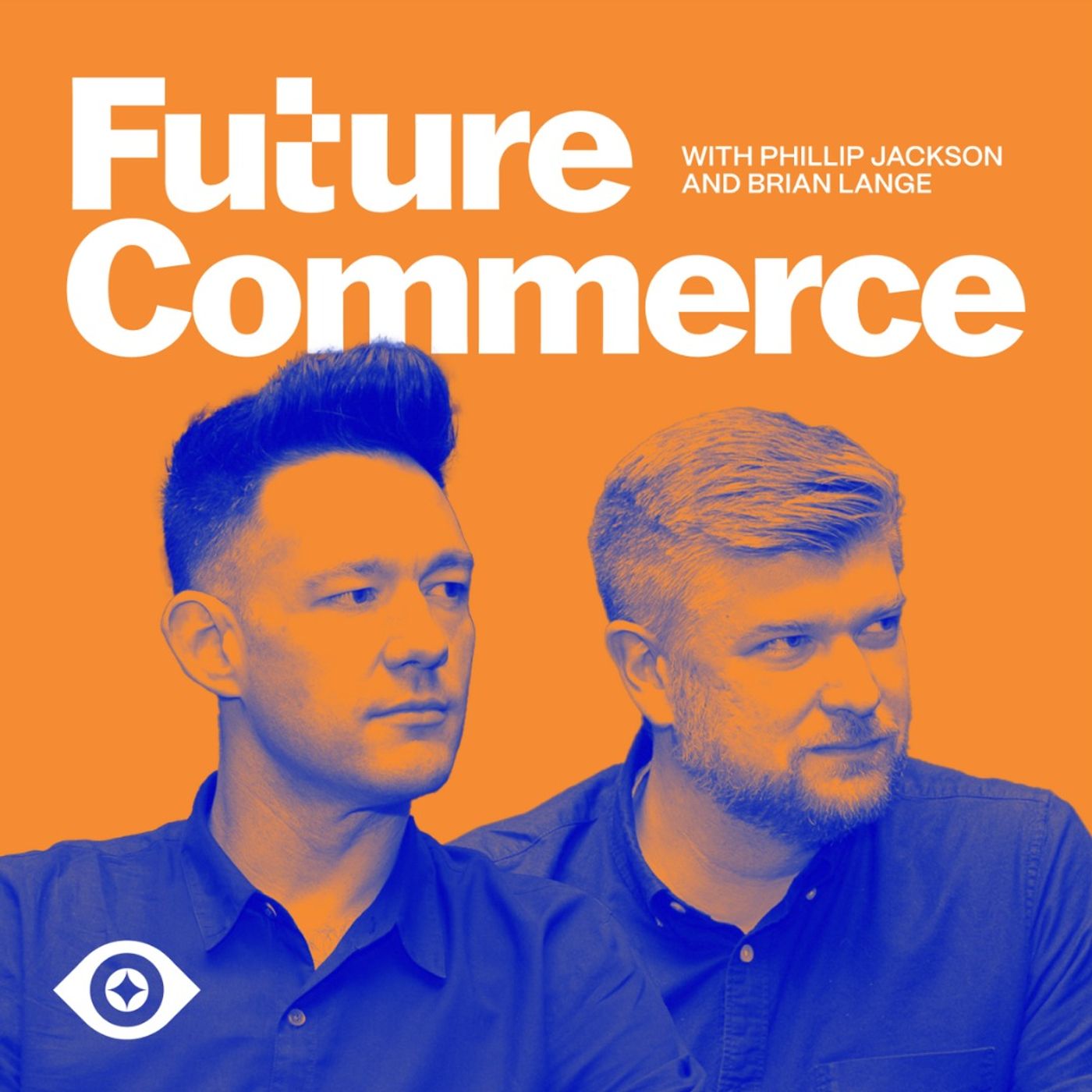
Future Commerce
Phillip Jackson, Brian Lange
Future Commerce is the culture magazine for Commerce. Hosts Phillip Jackson and Brian Lange help brand and digital marketing leaders see around the next corner by exploring the intersection of Culture and Commerce.
Trusted by the world's most recognizable brands to deliver the most insightful, entertaining, and informative weekly podcasts, Future Commerce is the leading new media brand for eCommerce merchants and retail operators.
Each week, we explore the cultural implications of what it means to sell or buy products and how commerce and media impact the culture and the world around us, through unique insights and engaging interviews with a dash of futurism.
Weekly essays, full transcripts, and quarterly market research reports are available at https://www.futurecommerce.com/plus
Trusted by the world's most recognizable brands to deliver the most insightful, entertaining, and informative weekly podcasts, Future Commerce is the leading new media brand for eCommerce merchants and retail operators.
Each week, we explore the cultural implications of what it means to sell or buy products and how commerce and media impact the culture and the world around us, through unique insights and engaging interviews with a dash of futurism.
Weekly essays, full transcripts, and quarterly market research reports are available at https://www.futurecommerce.com/plus
Episodes
Mentioned books

Dec 4, 2020 • 41min
Cooperation, Inspiration and Discovery, feat. Sherline, Founder and CEO of co-op Commerce
Today we talk with Ferris Jumah, CEO of Surge.AI, about big data, AI technology in consumer insights, and the evolution of purchasing funnels.
The New DIY
DIY used to have a connotation of poor quality or poor craftsmanship but today, it’s more indicative of participation.
Online marketplaces are booming with consumers and creators having more meaningful connections with items that could otherwise be more easily purchased.
Partnering with Gladly, we’ve created a new report: The New DIY: Creators, Crafts and Commerce.
“There is a cycle of inspiration that leads to education online, that leads to participation, which ultimately shapes the purchases that a person makes, which leads them back to inspire others into that same virtuous cycle.” - Phillip Jackson
The Consumer Insights Data Scientist and Surge.AI
Feris started out in CPG and retail, then ending up working at LinkedIn and joining the startup world.
“I’ve always been super focused on growth and [asking] how do we use data to generate actionable insights to help a business grow and to help businesses grow faster?” - Ferris Jumah
Surge is a real-time market research platform that helps brands quickly identify and target new audiences on search and social platforms. Surge helps businesses understand what those new audiences want and what they’re engaging with—and then ideates, creates, and distributes content for those audiences.
Surge was birthed from Ferris’s frustration with how long and expensive the process was of researching new audiences and figuring out how to market to them.
“Having fresh information is the biggest competitive advantage a company can have… your future audience is always evolving and digital channels [are changing] really quickly.” - Ferris Jumah
Robot Work vs. Human Work
Ferris says that in order to keep up with the ever changing data, businesses need AI—what he calls ‘robot work.’
“That’s robot work. [Surge] exists to create those robots for you so we can give you time back to do human work.” - Ferris Jumah
Surveys and panels are a useful tool for consumer and market research, but they don’t scale very well. Surveys and panels are reactive but there’s a lot of consumer behavior that is subconscious and free of biases that wouldn’t be found through classic consumer research.
The hypothesis for our report, The New DIY, was that the pandemic has accelerated the trend of DIY, which was an already existing consumer trend—and that trend is mapped in a cycle of inspiration, education, and participation. Surge helped to research the trends, provide real data, and tamp down on our own personal biases.
New vs. Old Purchasing Funnels
“We’re all familiar with the classic funnel… it’s just an analog to thinking about how people shop in the real world and trying to translate that to digital. And it’s not at all relevant anymore.” - Ferris Jumah
Ferris talks about reframing how we see the commerce funnel—not as a digital version of real world shopping, but as an amalgamation of the right audiences, the right searches, and the right content all at the right time.
“The new funnel is all about what’s happening on social, what people are searching for, and tying all of that together [to keep] track of it… You don't want to be reading about [the current trend] in an article because by then, you’re late to the party.” - Ferris Jumah
Ferris explains that search is now contextual because of its increasing number of channels. What used to be searched on Google might now be searched for on social, on marketplaces, or YouTube.
Robot Work vs. Human Work (Pt. 2)
Everything begins with ‘human work,’ in ideation and knowing a general lay of the land. Surge helps take that original input and give instant feedback on whether it’s trending, if there’s a related idea or more interesting idea, and giving that data back to be fuel for more ‘human work.’
An example of this would be a recent DTC office product brand wanting to focus on whiteboard sales because of their current demand. Surge was able to quickly identify that the communities most engaged with whiteboards as a product, particularly on social, are the workout/athletic community and the homeschooling community.
Given this data, Surge is able to give even more niche data such as the growing popularity of search trends with whiteboards: ‘portability’ or ‘reflective’.
Links
Check out Surge.AI
Check out our new report with Gladly: The New DIY
Check out our essay that was powered by insights by Surge, The New Formal
Check out Vertex Cloud
Check out Omnisend
If you have any comments or questions about this episode, you can reach out to us at hello@futurecommerce.fm or any of our social channels. We love hearing from our listeners! Hosted by Simplecast, an AdsWizz company. See pcm.adswizz.com for information about our collection and use of personal data for advertising.

Nov 27, 2020 • 58min
Robot Work vs. Human Work, feat Ferris Jumah, Founder and CEO of Surge.ai
Today we talk with Ferris Jumah, CEO of Surge.AI, about big data, AI technology in consumer insights, and the evolution of purchasing funnels.
The New DIY
DIY used to have a connotation of poor quality or poor craftsmanship but today, it’s more indicative of participation.
Online marketplaces are booming with consumers and creators having more meaningful connections with items that could otherwise be more easily purchased.
Partnering with Gladly, we’ve created a new report: The New DIY: Creators, Crafts and Commerce.
“There is a cycle of inspiration that leads to education online, that leads to participation, which ultimately shapes the purchases that a person makes, which leads them back to inspire others into that same virtuous cycle.” - Phillip Jackson
The Consumer Insights Data Scientist and Surge.AI
Feris started out in CPG and retail, then ending up working at LinkedIn and joining the startup world.
“I’ve always been super focused on growth and [asking] how do we use data to generate actionable insights to help a business grow and to help businesses grow faster?” - Ferris Jumah
Surge is a real-time market research platform that helps brands quickly identify and target new audiences on search and social platforms. Surge helps businesses understand what those new audiences want and what they’re engaging with—and then ideates, creates, and distributes content for those audiences.
Surge was birthed from Ferris’s frustration with how long and expensive the process was of researching new audiences and figuring out how to market to them.
“Having fresh information is the biggest competitive advantage a company can have… your future audience is always evolving and digital channels [are changing] really quickly.” - Ferris Jumah
Robot Work vs. Human Work
Ferris says that in order to keep up with the ever changing data, businesses need AI—what he calls ‘robot work.’
“That’s robot work. [Surge] exists to create those robots for you so we can give you time back to do human work.” - Ferris Jumah
Surveys and panels are a useful tool for consumer and market research, but they don’t scale very well. Surveys and panels are reactive but there’s a lot of consumer behavior that is subconscious and free of biases that wouldn’t be found through classic consumer research.
The hypothesis for our report, The New DIY, was that the pandemic has accelerated the trend of DIY, which was an already existing consumer trend—and that trend is mapped in a cycle of inspiration, education, and participation. Surge helped to research the trends, provide real data, and tamp down on our own personal biases.
New vs. Old Purchasing Funnels
“We’re all familiar with the classic funnel… it’s just an analog to thinking about how people shop in the real world and trying to translate that to digital. And it’s not at all relevant anymore.” - Ferris Jumah
Ferris talks about reframing how we see the commerce funnel—not as a digital version of real world shopping, but as an amalgamation of the right audiences, the right searches, and the right content all at the right time.
“The new funnel is all about what’s happening on social, what people are searching for, and tying all of that together [to keep] track of it… You don't want to be reading about [the current trend] in an article because by then, you’re late to the party.” - Ferris Jumah
Ferris explains that search is now contextual because of its increasing number of channels. What used to be searched on Google might now be searched for on social, on marketplaces, or YouTube.
Robot Work vs. Human Work (Pt. 2)
Everything begins with ‘human work,’ in ideation and knowing a general lay of the land. Surge helps take that original input and give instant feedback on whether it’s trending, if there’s a related idea or more interesting idea, and giving that data back to be fuel for more ‘human work.’
An example of this would be a recent DTC office product brand wanting to focus on whiteboard sales because of their current demand. Surge was able to quickly identify that the communities most engaged with whiteboards as a product, particularly on social, are the workout/athletic community and the homeschooling community.
Given this data, Surge is able to give even more niche data such as the growing popularity of search trends with whiteboards: ‘portability’ or ‘reflective’.
Links
Check out Surge.AI
Check out our new report with Gladly: The New DIY
Check out our essay that was powered by insights by Surge, The New Formal
Check out Vertex Cloud
Check out Omnisend
If you have any comments or questions about this episode, you can reach out to us at hello@futurecommerce.fm or any of our social channels. We love hearing from our listeners! Hosted by Simplecast, an AdsWizz company. See pcm.adswizz.com for information about our collection and use of personal data for advertising.

Nov 20, 2020 • 51min
[Step by Step] How to Build Sustainable CX and Avoid Burnout?
Customer support and burnout often co-exist in an organization. How do you prevent burnout and have sustainable CX, while running one of the most prestigious brands in the world? Jeffrey Newman, Manager of Customer Care at Porsche shares how he keeps it all in balance. Listen now! Hosted by Simplecast, an AdsWizz company. See https://pcm.adswizz.com
for information about our collection and use of personal data for
advertising.

Nov 19, 2020 • 38min
[Step by Step] How Does CX Address Modern Customer Expectations?
Customer Experience is about anticipating needs. For Native shoes, leading with their values helps them to do just that. Their brand promise - to live lightly - is woven into every interaction they have with a customer. To do this, they're using blended teams to help blur the lines between online interactions and offline interactions, creating a seamless, even channel-less, view of interacting with the customer. Listen now! Hosted by Simplecast, an AdsWizz company. See pcm.adswizz.com for information about our collection and use of personal data for advertising.

Nov 18, 2020 • 31min
[Step by Step] How Does CX Drive Lifetime Value? (feat. Melanie Travis, CEO at Andie Swim)
How do you scale truly personal customer experiences? One-to-one CX takes time, talent, and experience. But when you train your customers to be your frontline CX team, that's where the magic happens. In this episode of Step by Step, CEO and Founder of women's swimwear brand, Andie, unpacks how they use technology to scale their brand promise while making every interaction personal. Hosted by Simplecast, an AdsWizz company. See pcm.adswizz.com for information about our collection and use of personal data for advertising.

Nov 17, 2020 • 43min
[Step by Step] How to Move From a Contact Center to a Revenue Center?
Step by Step continues with Episode 2!
"Selling is Good Service" says Kate Showalter. She should know - Kate is the Senior Director for Customer Service at Crate and Barrel, overseeing global CX for the storied retailer. Since COVID under Kate's direction, Crate and Barrel has nimbly transitioned their once store-bound frontline sales operation to a fully-digital-capable organization. In this episode we'll learn how she did it, and how you can too, Step by Step. Hosted by Simplecast, an AdsWizz company. See pcm.adswizz.com for information about our collection and use of personal data for advertising.

Nov 16, 2020 • 40min
[Step by Step] How Do We Evolve from Customer Support to Customer Experience?
Welcome to Step by Step Season 3 by Future Commerce, presented by Gladly.
This season of Step by Step is all about customer experience. Consumers have reimagined the customer experience, and they expect far more from a service interaction than issue resolution. The service experience is now as important, if not more important, than the product experience. As customer expectations are evolving faster than ever, customers are rapidly moving toward brands that are engaging the way they want to engage, and away from brands that are not. Companies that can keep up with these ever-changing consumer expectations will be the ones driving long term revenue and winning over customers for life. Hosted by Simplecast, an AdsWizz company. See https://pcm.adswizz.com
for information about our collection and use of personal data for
advertising.

Nov 13, 2020 • 45min
Content is King, Channel is Queen, feat. Michelle Grant, Salesforce
Who is Michelle Grant?
Michelle got her start studying the retail industry in 2015 with Euromonitor, focusing on overall global strategy.
She started this year at Salesforce in their Strategy Insights group with a focus on technology in retail and consumer goods.
Michelle just launched Becoming Retail with Rob Garth—a content series focusing on executive interviews to understand the digital transformations behind brands; how they’re enacting digital change, what they’re learning, what their barriers are, etc.
“It’s really getting to know the people behind these changes that we’re seeing in the news, essentially.” - Michelle Grant
Michelle points out the major change in the last 5 years—a shift from a product mindset in retail to customer centricity.
“If content is king, then channel is queen. It’s essential.” - Brian Lange
In Becoming Retail and via Salesforce’s blog, Michelle is pushing out content about customer centricity.
Shipageddon 2020
Michelle points out that Salesforce has already seen the logistics system operate at capacity or overcapacity because of the unexpected spike in demand.
Fourth quarter during holiday is usually peak season for digital commerce anyway, but it’s expected to be much higher in 2020 than any other year.
“Your performance comes back to reflect on the brand, not necessarily on the environment in which the package is being shipped.” - Phillip Jackson on brand’s performances during holiday season 2020.
“Retailers are definitely hedging their bets by getting more third party quick last-mile delivery providers on-boarded for the holiday season.” - Michelle Grant on DoorDash, Postmates, Uber, and Instacart.
“I think people are more forgiving in the scrappiness of their local retailers.” - Michelle Grant on small, local businesses and their inability to meet the same delivery demands as larger businesses.
“You’re not necessarily [shopping locally] for the convenience. You’re doing it to keep that business alive in your community and people working there and spending money within the community… Consumers have a much higher threshold for inconvenience when they opt to shop at smaller stores than the big box retailers or Amazon.” - Michelle Grant
Prime Day and Live-stream Expansion
With Prime Day 2020, Amazon had a 71% increase of customer base over last year. But other retailers also grew by 21% during the same period, so this wave of digital transaction benefited businesses outside of just Amazon.
Amazon and other online retailers have pushed into nurturing the digital shopping experience into an entertainment experience.
Twitch, owned by Amazon, has moved beyond gaming and has now become a popular space for live streaming—especially in the beauty industry.
On Twitch: “We’ll see if they’re successful in enabling other types of live streaming communities to build up around different categories. And if they’re able to help those communities monetize through commerce.” - Michelle Grant
“If you slept on Tik Tok, don’t sleep on Twitch, because this is going to prove itself out.” - Phillip Jackson
Tik Tok just partnered with Shopify to make Tik Tok a shoppable platform.
Future Tech and Channel Investments in Retail
“I think first point of order for all retailers is to get their fulfillment as efficient as possible.” - Michelle Grant on future supply chain investments
Walmart has been testing new front-end innovations for their stores to be more efficient with fulfillment.
Michelle predicts that 2021 will see new store formats due to the pandemic, fewer stores overall because of the rise of digital commerce, and in general, more digital initiatives from retailers.
Links
Check out Michelle and Rob Garth’s content series, Becoming Retail.
Check out Salesforce’s blog.
Find Michelle Grant on Twitter!
If you have any comments or questions about this episode, you can reach out to us at hello@futurecommerce.fm or any of our social channels. We love hearing from our listeners! Hosted by Simplecast, an AdsWizz company. See pcm.adswizz.com for information about our collection and use of personal data for advertising.

Nov 6, 2020 • 53min
The Magic of Logistics? Data and Optimization, feat. Jason Murray, Co-Founder and CEO of Shipium
Shipping is extraordinarily complicatedShipium helps businesses by providing the tech behind the complicated processes of shipping to consumers.Jason says that shipping is a series of events that needs to be coordinated well to give customers the optimal experience: “Our belief is that coordination should happen with good technology.” - Jason MurrayJason had a long career at Amazon in which his career mostly focused on the merger between logistics and technology - eventually leading him to help launch FBA (Fulfillment by Amazon).Jason and the other co-founder of Shipium, Mac, both started working at Amazon together in 1999. After leaving Amazon, they both subsequently built similar software stacks for the businesses they were working on in managing their supply chains.They reconnected in 2019 and started discussing the idea that there was a gap of missing software in supporting the booming eCommerce industry.This gap could be solved by paying someone to do everything for you, but Jason and Mac wanted to solve the problem by building a platform that could enable partners and companies in eCommerce to run their logistics operations efficiently and cost-effectively.Logistically Speaking“Once companies reach a certain size, the physical properties of what they’re shipping become an important part of how the customer experience works and their cost structure overall.” - Jason MurrayJason says that once that size threshold is reached, businesses have to find a custom solution to fit their particular needs. Depending on the product and its specific needs, it becomes more cost-effective to build your process yourself which requires software for coordination.Companies like Amazon and Walmart are becoming increasingly vertical, owning everything from their warehouses to their 747s. There’s a lot more competition in the smaller business spaces which creates a need for smaller operations like label printing, for instance.“Logistics is much more than just the FedEx label you put on your box. It’s the entire linear sequence of making and delivering products. The key insight is that the linear sequence is very different for eCommerce and has its own areas to optimize… The bigger the company is, the more optimizing each link in the chain matters to the success and scale of that business.” - Jason MurrayMost businesses focus on front end experiences, but it’s actually fulfilling that purchase and everything that happens after a sale that makes customers happy - so optimizing your logistic processes and continuing to improve them over time is recommended.Shipageddon 2020 and the New Way of the WorldIn fairness, networks like UPS and FedEx didn’t have time to plan for the increase in shipping and eCommerce in Q4 - when reviewing capital expenditures in 2020, there was no way of having the hindsight to include a global pandemic in their plan for the year.Most carriers have been playing catch up since the beginning of the year: “There’s going to be a bigger supply problem than we’ve seen almost ever because of the combination of the pandemic and the holidays meshing together.” - Jason MurrayJason predicts that eCommerce isn’t going to return to its previous levels but will continue to grow much higher than its mean after the holiday season. After the 2008 recession, Amazon took a disproportionate amount of the consumer spending volume into eCommerce and it didn’t subside after—people shifted to eCommerce permanently.On the shift into eCommerce in 2020 not being temporary: “[Companies] should think about it as a need to strategically put energy into solving our eCommerce challenges because this is the new way of the world.” - Jason MurrayJason predicts that in 2021, we’ll see a lot of growth in local carriers and alternative shipping methods to compete with those that already exist or have not been able to rise to the occasion of growth we’ve seen in 2020.On logistics: “I would urge people not to think about it as a cost center, but to think of it as a living, breathing thing that’s part of the growth and dynamics of the business… There are these different stages you go through in all aspects of your business. And logistics and fulfillment and planning are all part of that.” - Jason MurrayJason’s prediction for the next 18 months or so: “Companies that were omnichannel and neglecting their eCommerce channels are going to either not survive or they’re going to invest in them - which is going to introduce more competition into the market. Delivery experience will become more and more important because consumers now have multiple options to choose from.” - Jason MurrayLinksCheck out our new report with Gladly: The New DIYCheck out Shipium If you have any comments or questions about this episode, you can reach out to us at hello@futurecommerce.fm or any of our social channels. We love hearing from our listeners! Hosted by Simplecast, an AdsWizz company. See pcm.adswizz.com for information about our collection and use of personal data for advertising.

Oct 30, 2020 • 53min
There's a Nerd For That - Farfetch, Instacart, and Connecting Shoppable Experiences
We discuss digital shopping experiences, their experimental evolution, Instacart, CARLY brands, and more. The New DIYDIY used to have a connotation of poor quality or poor craftsmanship but today, it’s more indicative of participation.Online marketplaces are booming with consumers and creators having more meaningful connections with items that could otherwise be more easily purchased.Partnering with Gladly, we’ve created a new report: The New DIY: Creators, Crafts and Commerce.“There is a cycle of inspiration that leads to education online, that leads to participation, which ultimately shapes the purchases that a person makes, which leads them back to inspire others into that same virtuous cycle.” - Phillip JacksonDigital Shopping ExperiencesKendall Jenner just released a $23 toothpaste on StockX. StockX has pioneered a drop platform called DropX. StockX was part of our Nine by Nine report as a brand introducing a new type of luxury to a new consumer. Since our report, StockX has constantly been pushing into new categories.Farfetch is moving into experimental shopping: partnering with Bambuser, they’re doing a six month trial to create more entertainment-focused digital commerce experiences.Shopping online is less entertainment than shopping physically. Farfetch is piloting the change in online shopping to a more entertaining experience.Immerss does live video shopping and trunk shows - both live streaming and pre-recording content, making online shopping a more entertaining experience.Shoptalk was different this year, being online and being less content-driven: “To me, this was the most successful Shoptalk ever. Period. Hands down.” - Phillip JacksonInstacartInstacart is launching a senior support service to help boomers (age 60+) create accounts and shop online.Instacart is pivoting to doing a lot more than just groceries. They are also mentioned in our Nine by Nine report for their help in closing the gap with everyday brands and Amazon Prime.There has been criticism of the bifurcation of the consumer during COVID-19 in which its been said that the upper class worked in their homes while the middle class became deliverers of consumer goods.Regardless of controversy, Instacart has made these delivery methods more available and accessible to everyone. Instacart has a lead over retailers’s own efforts in deliveries even if they are an intermediary for the experience.According to Instacart, there’s traffic of 2000 senior customers a day that specialists are spending 20% more account support time with on average.Seniors represent a major growth potential for online retailers because (according to eMarketer) 62% of baby boomers will make at least one online purchase this year.Aldi has made EBT available via Instacart. This is providing tech mobility and accessibility to those in different income classes.CARLY BrandsOn media becoming commerce: “By nature of being a new psychographic, stuff that tries to address the psychographic isn’t always going to land.” - Brian LangeThere’s a sense of self and importance of the self as a brand, which we refer to as the Existential Brand: “If you are a good brand that isn’t entirely self-focused, you actually create your identity through your community and your customers.” - Brian LangeThredup is a brand that is true to the digital shopping paradigm of heightening the real life experience via eCommerce: “If you look at in-store thrift[ing], there’s a different person who’s dropping off stuff than the person who shops there… [Thredup] is making a marketplace that you can participate in on both ends of the spectrum.” - Phillip JacksonLinksCheck out our new report with Gladly: The New DIYCheck out our friends at Surge for your consumer research!Immerss’s Crunchbase profileGrocery Dive article: “Instacart has introduced 60K seniors to online grocery shopping in the past month”Future Commerce Insiders #058: “The Existential Brand Part 2” If you have any comments or questions about this episode, you can reach out to us at hello@futurecommerce.fm or any of our social channels. We love hearing from our listeners! Hosted by Simplecast, an AdsWizz company. See pcm.adswizz.com for information about our collection and use of personal data for advertising.

