

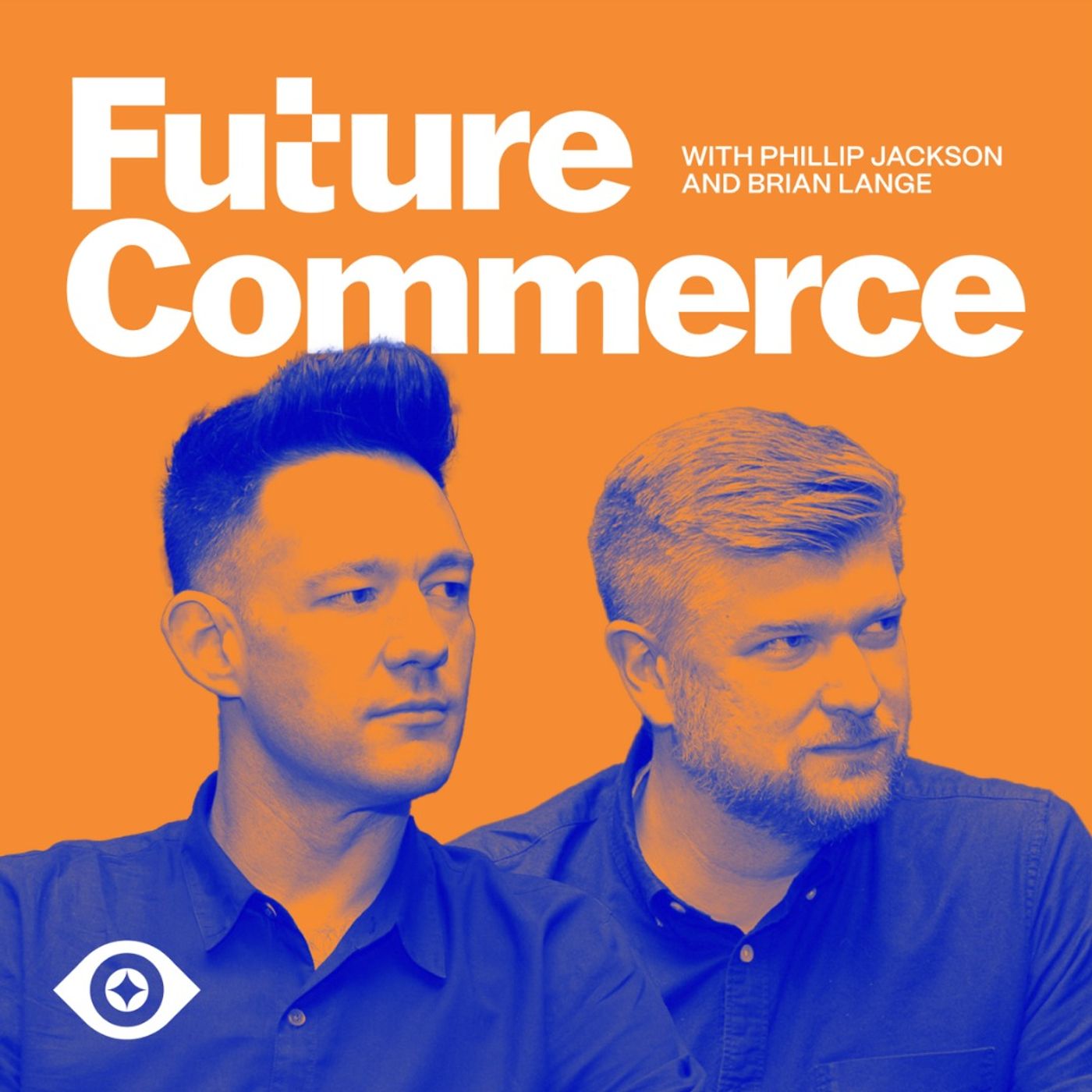
Future Commerce
Phillip Jackson, Brian Lange
Future Commerce is the culture magazine for Commerce. Hosts Phillip Jackson and Brian Lange help brand and digital marketing leaders see around the next corner by exploring the intersection of Culture and Commerce.
Trusted by the world's most recognizable brands to deliver the most insightful, entertaining, and informative weekly podcasts, Future Commerce is the leading new media brand for eCommerce merchants and retail operators.
Each week, we explore the cultural implications of what it means to sell or buy products and how commerce and media impact the culture and the world around us, through unique insights and engaging interviews with a dash of futurism.
Weekly essays, full transcripts, and quarterly market research reports are available at https://www.futurecommerce.com/plus
Trusted by the world's most recognizable brands to deliver the most insightful, entertaining, and informative weekly podcasts, Future Commerce is the leading new media brand for eCommerce merchants and retail operators.
Each week, we explore the cultural implications of what it means to sell or buy products and how commerce and media impact the culture and the world around us, through unique insights and engaging interviews with a dash of futurism.
Weekly essays, full transcripts, and quarterly market research reports are available at https://www.futurecommerce.com/plus
Episodes
Mentioned books

Jan 8, 2021 • 52min
"Your Tool, Your Sword, Your Treasure": Corporate Leadership in the post-Trump era
Today, Brian and Phillip talk about the extension of 2020 into 2021, corporate leadership, and personal data.
Corporate Leadership, Shopify, and Your Personal Data
Anything related to Donald Trump is effectively not what Shopify wants to promote. Facebook, Twitter, Instagram, and Snapchat have all suspended Donald Trump’s account across their services. This brings to question businesses and their corporate leadership stepping forward.
Elon Musk has surpassed Jeff Bezos as the world’s richest man. Musk found ways of implementing what the future could be—compared to Bezos, who just found the most efficient way to do things.
eCommerce, being all around us, is in a unique position. Comparing it to the time when viruses weren’t on Macs because they were less popular than PCs, Shopify has seen an amount of stores as fraudulent/risky. Just as Macs were on the rise and were ripe for fraud, so is the world of e-Commerce.
In 2020, you’re responsible for managing your own data—with whom and what your data is used for.
Many retailers are becoming advertisers in and of themselves using this data—like Amazon, who brought in more ad revenue in 2020 through its own ad network than Twitter has brought in revenue in its entire existence.
Stealth Luxury
“Every brand is either a marketplace today or will have to adapt to become one.” - Phillip Jackson
As marketplaces (or curators), brands all interweave and interact with other brands and their stories.
Bottega Veneta deleted all of its social accounts—a deliberate move to build their brand identity of luxury. In a noise-filled world, silent spaces (like flying first class) can feel more luxurious.
From the GQ article on Bottega Veneta: “[The move] is the ultimate act of stealth luxury. It will now be a brand that travels strictly by word of mouth.”
Tied into this, Parade Underwear has taken a new spin on influencer marketing, in delivering free underwear to Instagram users with fewer than a thousand followers in exchange for posting.
There’s a separation in the market for luxuries vs price-centered items. Amazon and other marketplaces are saturated with knockoff brands so Brian predicts that the brands that are going to see the most success in the 2020s are brands that are marketed for broad markets and brands that are extreme luxury. The middle ground of “premium mediocre” brands is thinning.
Links
Check out our sponsors for today’s episode. Vertex is tax solution for businesses of all sizes, and MarketerHire, a platform for hiring teams of expert marketers for you.
The New York Post: One in five Shopify stores reportedly pose a risk to shoppers
Future Commerce Insiders #066: Your 2020 Body is a Dataland
GQ: Why Did Bottega Veneta Delete Its Social Media Accounts?
If you have any comments or questions about this episode, you can reach out to us at hello@futurecommerce.fm or any of our social channels. We love hearing from our listeners! Hosted by Simplecast, an AdsWizz company. See pcm.adswizz.com for information about our collection and use of personal data for advertising.

Jan 1, 2021 • 42min
"2-Day is Too Slow": How Darkstore's FastAF is Delivering on the New Customer Expectation, feat. Lee Hnetika, Founder and CEO
Lee Hnetinka, Founder and CEO of FastAF joins the podcast to talk about how FastAF is not only revolutionizing delivery but also offering its members a thoughtful, curated selection of products as a fresh take on the DTC marketplace.FastAF Now & 2021 ScalingFastAF is a two-hour delivery app to get premium essentials delivered, working with the likes of Aesop, Bala Bangles, and Vybes. FastAF is currently available in Los Angeles and New York.Currently, FastAF has micro-fulfilment centers to deliver their inventory from. In 2021, they’re planning on expanding cities and expanding geo-coverage within their existing cities.Lee launched Darkstore because of the lack of marketplaces for classic premium brands. There are marketplaces for groceries and basics, but not for premium products that customers have high affinities for.“These platforms were built for two-day delivery, not two-hour delivery.” - Lee Hnetinka on Shopify partnerships.“Two day is, not to be cliche, too old. It is not what is the norm today. Consumers have higher expectations of two hour or faster with food, with movies, with renting a home, getting a car at the tap of a button.” - Lee HnetinkaOn marketplaces and DTC brands moving to Amazon: “That’s where we came in and said the brands of tomorrow are not going to sell on Amazon. They don’t want to because of competitive reasons. They don’t want to because they [wouldn’t] have a customer relationship with the customer… [We saw] that it was not in line with the values of today’s customer and today’s brands. So that’s where FastAF came in.” - Lee HnetinkaCuration, Marketplaces, & EfficiencyHappy Valley Tool is a tool built to pull Google Maps data and Uber drive data to pull gradients over maps so they know street-level statistics of where to build their next Darkstore.Consumers don’t really know what they want until they’re provided with it: “We needed to show to both brands and consumers what [two hour delivery] looks like in order to have them become believers.” - Lee HnetinkaLee doesn’t see FastAF as a competitor of Amazon. “You can’t replicate the Amazon experience without billions of products. So we have to forge our own path.” - Phillip JacksonBecause of its careful curation, FastAF is leading to consumers finding new brands, thus becoming a discovery platform.On launching FastAF virtually with social help through influencer marketing: “[If asked a few years ago], could you launch a city entirely virtual? I would tell you no, but I would tell you we did… it’s been the right decision.” - Lee HnetinkaAfter consumers are exposed to more efficient deliveries and services, reverting back to inefficient ways is unseeable.LinksFind the FastAF app!Check out Future Commerce Insiders #036: Freaky Friday If you have any comments or questions about this episode, you can reach out to us at hello@futurecommerce.fm or any of our social channels. We love hearing from our listeners! Hosted by Simplecast, an AdsWizz company. See pcm.adswizz.com for information about our collection and use of personal data for advertising.

Dec 25, 2020 • 42min
Divergence: 2020 in Retrospect, feat. Sucharita Kodali, Vice President and Principal Analyst at Forrester
2017 to 2020, Sucharita the SoothsayerIn 2017, on FC Ep 2432041, Sucharita said “In the future, brands should be thinking about how they can become marketplaces,” which has come to be true in eCommerce today.In 2020, Sucharita says that divergence is the broad theme of the year: divergence in political thought, essential businesses vs. nonessential businesses, employed vs unemployed, etc.There will be recovery for businesses affected by this divergence, but it might be a longer recovery than what’s ideal.Retail in 2021: Efficiency vs. TraditionRetail was hit the hardest in 2020. Merchants had to pivot their businesses drastically in order to keep up because of the pandemic: curbside pickup, inventory visibility across channels, etc.“[This] showed the possibility of how fast things can move when [businesses] set their mind to it and everyone’s aligned.” - Sucharita KodaliSucharita worries that retail businesses will see this from a different perspective. Instead of seeing the opportunity of quickly changing direction and focus, they’ll see 2020 as a dodged bullet and go back to business as usual (slow decision making, hesitance in change and exploring possibilities) in 2021.CIO and CDO positions in organizations were prioritized this year because that’s where innovation was required. Sucharita hopes this change will stick, allowing businesses to move fast and do things differently.Working from home was tied in with these changes—Sucharita suspects that 20% of businesses will stick with this change and 80% will revert to pre-pandemic ways. Sucharita says this 20/80 rule will probably be true with consumer behaviour affected by the pandemic, as well.Sucharita says that DIY home improvement retailers, mass merchants, and grocery stores did exceptionally well during the pandemic.Restaurants, department stores, and apparel stores have had a decrease in demand during the pandemic. Though they might have a pent-up demand waiting for them once the pandemic ends, Sucharita doesn’t think that pent-up demand will make up for all that was lost.Shifting Our Public SpacesMalls were considered public places, though they were commercial spaces, for the better part of three decades. Because of the pandemic, the commons has moved online and businesses are being affected by their ESG values - environmental, social, governmental.For example, Starbucks implemented social distancing before any state or federal government had any action forcing them to do so.“Corporations can be ambassadors and capital markets will fund them if they’re doing the right thing that resonates with what the general populace believes is ‘good for society’,” - Phillip JacksonRetail Roadmap for 2021“I can imagine that over time, [we will] start to see more creativity… whether it’s leveraging business development partnerships or thinking more creatively about how they fulfill things, now is the time that these companies have the opportunity to experiment and there is an appetite to try new and different things.” - Sucharita KodaliRetailers in the past year have started to invest in advertising and media networks: “They are monetizing their eyeballs, their foot traffic, and they’re looking at themselves as media properties.” - Sucharita KodaliSucharita predicts that we will see a lot of creativity in the physical spaces that were previously occupied by retail.Phillip and Brian suspect that outdoor spaces will see creative redirections as well, or we’ll all be wearing personal yurts.LinksFind Sucharita Kodali on Twitter or LinkedIn.Check out Sucharita’s other appearances on Future Commerce:Episode #132: “Tracksmith: Unapologetically Premium”Episode #77: “Zucchini in a Cucumber Pile”Episode #41: “Technology, for Technology’s Sake”Forrester: Ted Schadler’s “The Pandemic Recession Demands a Digital Response”Slate: The Post Pandemic Style If you have any comments or questions about this episode, you can reach out to us at hello@futurecommerce.fm or any of our social channels. We love hearing from our listeners! Hosted by Simplecast, an AdsWizz company. See pcm.adswizz.com for information about our collection and use of personal data for advertising.

Dec 18, 2020 • 50min
Are We Human, or Are We Just a Bunch of Sensory Inputs? What's the difference exactly? feat. Daniel Dixon, Co-Founder of Mixy
Hot Sauces & Future Commerce v2: Conspiracy TheoryThe Killers have released a hot sauce collab, each named after one of their albums.Phillip used to listen to conspiracy theory radio as a child and was exposed to conspiracies about the X-Files being a vehicle to desensitize us to alien life.Elements of Disney’s The Mandalorian could be seen as a conspiracy theory: Baby Yoda, being cute in his vehicle by The Mandalorian’s side, could be allowing us to normalize putting our children in pandemic-proof bubbles.What Is Mixy?“It’s a place to get your brand out in front of new people.” - Daniel DixonMixy is a marketplace that helps DTC brands get their brand discovered by new consumers and incentivize those consumers by saving them money.Daniel came from the DTC world from an omnichannel sports nutrition brand. Mixy came from working inside of a brand and working as a consultant for brands—trying to solve the problem of encouraging consumers to try new brands.Mixy provides consumers with five $20 gift cards under the stipulation that they can’t spend it all in the same place, which encourages them to try new brands.Mixy solves challenges in DTC by bringing like-minded brands together and benefits customers in the form of discount without brands actually discounting.Mixy is bringing bundling, which has been done in the digital product space, to physical products.The Future for MixyAs for now, Mixy is only integrated with Shopify and would like to expand to new platforms.“When [consumers] think of gift cards, they think of Nike or Amazon… They’re not thinking of gift cards for great small to medium sized DTC brands.” - Daniel Dixon on how Mixy is getting consumers comfortable with using gift cards for smaller brands.Mixy is looking into expanding their product selection, currently adding one brand every week. These brands are curated and fit together to be mutually beneficial to brands and consumers.LinksCheck out Season Four of Step by Step, where we talk about competing with big brands as a smaller DTC brand.Read Phillip’s article on dead celebrities: Insiders #059: “Virtual Influencers Killed The Dead Celebrity”.Check out Future Commerce Episode 29: “Body Data is the Next Revolution”Subscribe to our new weekly newsletter, The Senses. If you have any comments or questions about this episode, you can reach out to us at hello@futurecommerce.fm or any of our social channels. We love hearing from our listeners! Hosted by Simplecast, an AdsWizz company. See pcm.adswizz.com for information about our collection and use of personal data for advertising.

Dec 17, 2020 • 52min
[Step by Step] What Tools Can a Small Brand Use to Automate Customer Engagement? feat. Kaylin Marcotte, Founder and CEO of JIGGY
Show Notes:
If you’re like us, you’ve done an insane amount of jigsaw puzzles in your quarantining.
After getting into jigsaw puzzles, Kaylin was tired of staring at stock photos and watercolor scenery and longed to look at beautiful pieces of art while completing puzzles. Thus, the idea for JIGGY was born. Kaylin partners with emerging female artists to create beautiful, artful puzzles for both her customers to enjoy and her artists to make an income. Everything from the puzzle itself, to the packaging, is thoughtfully curated for a totally immersive experience.
JIGGY launched in November 2019 and it’s almost as if they looked into a crystal ball and knew that the demand would go up in March…
Previously, Kaylin was the director of Marketing at Skimm, so you could say she had a bit of experience in building community. She brought that experience into building community around JIGGY:
“I really led with what I knew, which was our story, my story, our artists, their stories. And so starting with the more kind of narrative channels being email and set up on Omnisend made it easy to just set up.”
KEY TAKEAWAYS
JIGGY has seen great success in helping develop analog experiences for individuals.
Kaylin began building community through storytelling, email marketing with Omnisend and leveraging partnerships with artists to gain affiliate traction.
Respect the inbox. When JIGGY sends out an email, it’s because they have something of value to share.
Pay attention to your customer and what they’re interested in.
Kaylin walks through some easy first steps in automating your community engagement.
How JIGGY is an authentically missional, community-driven brand.
NOTABLE QUOTES
“I don't need to send an email for the sake of it. I'm going to send an email when we have something to say or something to share that I feel would actually be valuable for our community. And just "Respect the inbox," I think is my overall philosophy on email. And being that it is me still writing them, it is very personal and we do send them.”
“We did a customer survey recently, and about half of our customers had never bought a jigsaw puzzle before JIGGY. So we really are reaching this new audience who's curious and interested. But puzzles weren't a part of their lives before, or just art fans and they want to support female artists and think it's cool to kind of have a hand in constructing it and putting it together.”
Learn more about Kaylin and JIGGY on their website, Instagram, or Twitter.
Connect with us at Futurecommerce.fm, or follow us on Twitter, Facebook, Instagram, or LinkedIn.
Have any questions or comments about the show? You can reach out to us at Hello@futurecommerce.fm or any of our social channels; we love hearing from our listeners! Hosted by Simplecast, an AdsWizz company. See pcm.adswizz.com for information about our collection and use of personal data for advertising.

Dec 16, 2020 • 41min
[Step by Step] What Tools Can Help Me to Tell My Brand Story?
In episode 3 of Step by Step Season 4, James Le Compte tells us a story of conservation and preservation, and how they have created a luxury brand around an otherwise commonplace confection — chocolate. We dive deep into the psychology of brand storytelling, how you can tell those stories in every channel, and how you can bring tools along to inspire the customer in their purchase journey. Listen now! Hosted by Simplecast, an AdsWizz company. See pcm.adswizz.com for information about our collection and use of personal data for advertising.

Dec 15, 2020 • 50min
[Step by Step] How Can I Use Marketing Automation to Get More Done with Less?
How does a small-but-mighty team compete with big global brands? Bahzad Trinos tells us exactly how his passion — his obsession — for denim has helped the brand Naked and Famous rise to the top of innovation and admiration from those in-the-know. The denim brand is pushing the limits of what is possible, creating new and exciting opportunities for engagement with the customer. From marketing automation to absurd product innovation, Bahzad teaches us how they're doing more with less, and converting more shoppers into customers, Step by Step. Hosted by Simplecast, an AdsWizz company. See pcm.adswizz.com for information about our collection and use of personal data for advertising.

Dec 14, 2020 • 37min
[Step by Step] How Can My DTC Brand Compete with Established Brands?
It’s tougher than ever to attract an online shopper. It feels like everywhere you turn, you have to spend money to acquire a customer, and then spend MORE money to buy their loyalty. How do the big brands do it? How can a startup compete? There are so many channels for customers today and making sense of acquiring, converting, and reactivating these customers is more complicated than ever. Customers are no longer as loyal as they once were and float between brands, and channels, more fluidly than ever. In our fourth season of Step by Step we'll ask the question, "How can a DTC brand compete with established brands?". Hosted by Simplecast, an AdsWizz company. See pcm.adswizz.com for information about our collection and use of personal data for advertising.

Dec 11, 2020 • 1h 22min
Smelling the Roses with Sunny Chadha, Co-Founder and CEO of Venus ET Fleur
Founded in 2015 by Sunny Chadha and his wife, Seema, Venus ET Fleur takes a modern approach to floral design. Inspired by beautiful Parisian hat boxes and featuring Eternity Roses, which are real roses that last a year, the brand hit 20 million dollars in revenue in its first three years and has grown to over half a million followers on Instagram. In this episode, Sunny shares with us his entrepreneurial journey from growing up in New Jersey and working for his father's electronic company, to a disappointing Valentine's Day that sparked the idea for his company. Sunny talks with us about how Instagram posts from the Kardashians affected the business, why he believes in vision boards, and what it's like to run a business with your spouse.
###In This Episode You’ll Hear About:
How growing up in New Jersey/New York with an entrepreneurial father laid the groundwork for both he and his brother to become entrepreneurs as well
How he learned to be adaptive and find the good in change after his mom became an entrepreneur following a major shift in his home life
Why he left college to work with his dad to learn what real life business experience would teach him
How he and his brother learned even more about business through a popular brunch spot and nightclub they started in Manhattan in 2013 and then through a commercial lending business they started with their friend and roommate
Why a disappointing Valentine’s Day turned into a pretty awesome business idea that Sunny and Seema quickly started to develop, even in the midst of their very new relationship with each other
How they used social media to grow their business, which included some posts from the Kardashians that brought in more traffic than they expected and the brilliant idea Sunny had to navigate that in the moment
What led to the development of the Eternity Rose and why that has become the next big thing in florals
Ways they continue to innovate, add product offerings, educate their customers and offer new and beautiful ways to have florals in homes, offices, and really anywhere
What advice Sunny has for keeping the morale strong within the team culture, hiring people you trust, and creating vision boards to keep your eyes fixed on the future of your brand
###To Find Out More:
VenusETFleur.com
###Quotes:
“Through life you go through things like that, and as long as you look at it to sort of bring out the positive, it's always going to teach you something good. There's always going to be something that you take out of it to develop yourself.”
“We were able to do something very, very foreign to us, but it kind of taught us that as long as we work hard at it, we have the right team, the right support, the right hard workers, we can do it.”
“I love getting opinions from people that are close to me, but also the more opinions, the more complicated your decision becomes.”
“I think not getting too much sort of cloudiness in your thoughts and just like still staying true to what you're thinking and what your gut tells you.”
“That's one of the beautiful things about a business is like if it feels right, do it. You're the one that's going to be doing all the work. So make sure you just sign off on it yourself and just hit the ground running as fast as you can.”
“It was like this feeling of like this is going to be different. This is going to be new. And this is going to be something that is going to be big.”
“Once we were able to inject the perfect version, being our Eternity Rose, into the florals...that lifted that restriction on geography for me. And I was able to continue to try and grow as fast as we could. So that was a big thing.”
“I think development everywhere is what keeps me going. It keeps me really sort of on my toes. Like, what can we keep doing? How can we continue to grow?”
“We started to introduce these new product categories to where we educated customers on where else you can utilize florals within your space.”
“You can plan for demand and you can buy inventory, but you also have to make sure that you have enough people that can package and design and so on. And then also customer service. As we grow, all the sides of the business grow and it's important for people to remember all those other parts of the business as well.”
“I think it's very important for couples out there that are looking to get into business together to make sure from the beginning that you have that alignment and understanding.”
“You want to move quickly. So a lot of people might just be like, "Hey, we'll figure it out as we go," but then as you go and those things become pain problems, it can also negatively impact the business, but more so even the personal relationship.”
“We need to have that work/personal life balance, which is very, very important for sure. And I always recommend that.”
“I think team building and really understanding who those people are is super important.”
“It's something that I'd say is not just to hope to get to the goal and then look back at the journey. Also embrace it as you go through the journey.” Hosted by Simplecast, an AdsWizz company. See pcm.adswizz.com for information about our collection and use of personal data for advertising.

Dec 9, 2020 • 2min
"How Can DTC Brands Compete?" Step by Step Season 4 Trailer
It’s tougher than ever to attract an online shopper. It feels like everywhere you turn, you have to spend money to acquire a customer, and then spend MORE money to earn their loyalty. How do the big brands do it? How can a startup compete? Find out in our next season of Step by Step, coming next week. Hosted by Simplecast, an AdsWizz company. See pcm.adswizz.com for information about our collection and use of personal data for advertising.

