

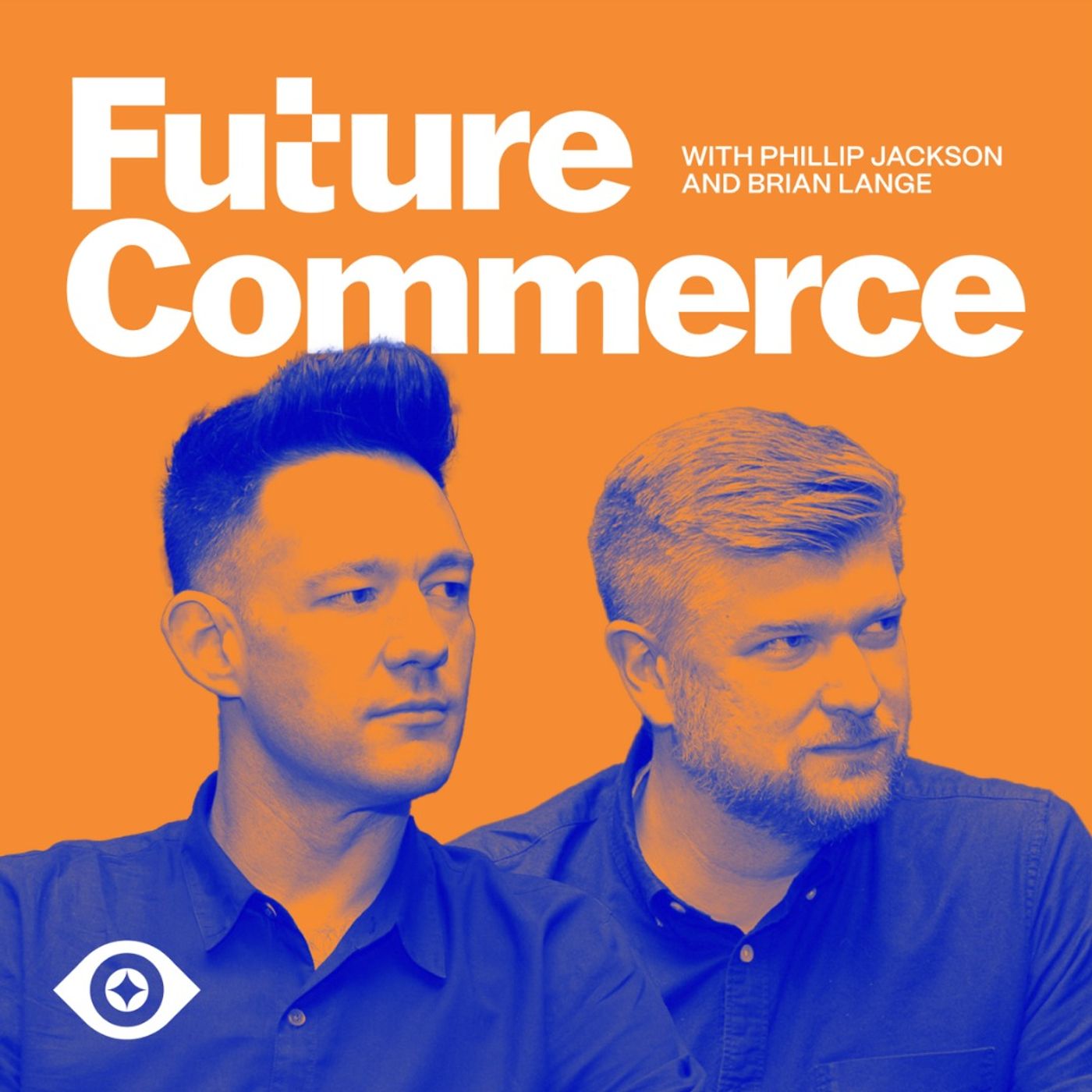
Future Commerce
Phillip Jackson, Brian Lange
Future Commerce is the culture magazine for Commerce. Hosts Phillip Jackson and Brian Lange help brand and digital marketing leaders see around the next corner by exploring the intersection of Culture and Commerce.
Trusted by the world's most recognizable brands to deliver the most insightful, entertaining, and informative weekly podcasts, Future Commerce is the leading new media brand for eCommerce merchants and retail operators.
Each week, we explore the cultural implications of what it means to sell or buy products and how commerce and media impact the culture and the world around us, through unique insights and engaging interviews with a dash of futurism.
Weekly essays, full transcripts, and quarterly market research reports are available at https://www.futurecommerce.com/plus
Trusted by the world's most recognizable brands to deliver the most insightful, entertaining, and informative weekly podcasts, Future Commerce is the leading new media brand for eCommerce merchants and retail operators.
Each week, we explore the cultural implications of what it means to sell or buy products and how commerce and media impact the culture and the world around us, through unique insights and engaging interviews with a dash of futurism.
Weekly essays, full transcripts, and quarterly market research reports are available at https://www.futurecommerce.com/plus
Episodes
Mentioned books

Mar 19, 2021 • 1h 9min
Ecom for New Moms: The future of parenting at the intersection of technology and digital commerce (feat. Ingrid Milman-Cordy)
This week, Ingrid joins Phillip & Brain to talk about her impressive baby registry, different mommy personas, and how monoculture is affecting their kids.Instacart for CMOs and PodcastsIngrid helped contribute to Kiri’s new book: “The power that Instacart unlocks has never really been in the hands of retailers or brands. In the year 2020, it has gotten significantly more advanced in the ways we’re able to actually market to a new consumer.” - Ingrid “I think to stand out in podcasting is the same challenge to stand out in the brand world… it’s all suffering from the same challenge, which is there’s too much of it.” - Phillip Jackson“Discoverability is so hard that having this one kitschy thing is a way to stand out. I don’t know if it’s the way to stand out forever and be durable, but it certainly grabs people’s attention.” - Phillip JacksonPandemic Pregnancy and the Enthusiast Economy Ingrid is pregnant and has dug into research and registries. “[Being pregnant] is sort of the ultimate enthusiast economy because once you have your baby, there’s no going back. You become an enthusiast.” - BrianIngrid goes into different types of moms: the sustainable minimalist eco mom, the boujee mom, and the Target mom - all of which have marketing geared towards them.Ingrid explains her own choice anxiety, giving the differences between her detailed registry versus a friend’s simplified, non-brand specific registry. Monoculture has died. In reference to children: “The only things that are relevant are the things that are influencing them at this exact moment.” - Phillip JacksonLinksCheck out Kiri Master’s new book Instacart for CMOs on Amazon and listen to our latest episode with Kiri. Check out our newest report, Vision 2021. If you have any comments or questions about this episode, you can reach out to us at hello@futurecommerce.fm or any of our social channels. We love hearing from our listeners! Hosted by Simplecast, an AdsWizz company. See pcm.adswizz.com for information about our collection and use of personal data for advertising.

Mar 12, 2021 • 52min
Shopper Discovery and the Convergence of the Meta & the Physical
The Instacart Paradox can easily confuse brands and advertisers. Instacart is part marketplace, part last-mile delivery, part advertising space, and yet not fully any of these all at the same time. Kiri Masters joins the pod to explain Instacart and how brands can leverage Instacart as a marketing strategy.Instacart for CMOsKiri just wrote a new book called “Instacart for CMOs.”“There wasn’t as much written about Instacart as there was about other retail marketplaces and there’s a huge thirst for information from brands.” - Kiri MastersThis book is a comprehensive guide on how to approach Instacart and how to understand it for your business.Fulfillment and ROI“[Instacart] doesn’t quite fit the definition of a delivery app and it doesn't quite fit the definition of a marketplace.” - Kiri MastersInstacart isn’t a traditional two-party marketplace, but a four-sided marketplace—the retailer, the in-store shopper, the delivery gig-worker, and the brands that advertise via Instacart.Delivery is a complex issue for businesses in making them profitable. Kiri suggests that fulfillment as a service is a new business model and Amazon is way ahead. Other retailers need their own infrastructure, but are far behind.Instacart is better positioned for the long-term because grocers, for example, are in the grocery business—not the innovation, technology, logistics, and fulfillment business.10 out of the 10 clients assessed for the book said that Instacart is their highest ROI on ad auctions.Repurchasing is 20-25 percent of shopping activity and Instacart helps drive this by setting up its UI to recommend previously ordered product to its customers again and again.The Instacart Paradox and the Complexity of Ad NetworksInstacart offers great ROI for an advertiser and the demand is there. However, there’s a lack of control over the availability, the content, and the pricing.For example, if a certain geography is out of a certain product because of a retailer’s inventory, a competitor could win those advertising bids.Ad investments are fractionalized across many platforms, so in order for brands to build their own infrastructure, a lot of work would have to be done to bring in-house skill and capabilities to the table.LinksFind Kiri’s new book Instacart for CMOs, written with Stefan Jordev. If you have any comments or questions about this episode, you can reach out to us at hello@futurecommerce.fm or any of our social channels. We love hearing from our listeners! Hosted by Simplecast, an AdsWizz company. See pcm.adswizz.com for information about our collection and use of personal data for advertising.

Mar 5, 2021 • 47min
Instacart for CMOs: The Four-Sided Marketplace, feat. Kiri Masters, Author of Instacart for CMOs
The Instacart Paradox can easily confuse brands and advertisers. Instacart is part marketplace, part last-mile delivery, part advertising space, and yet not fully any of these all at the same time. Kiri Masters joins the pod to explain Instacart & how brands can leverage Instacart as a marketing strategy. Hosted by Simplecast, an AdsWizz company. See https://pcm.adswizz.com
for information about our collection and use of personal data for
advertising.

Feb 26, 2021 • 47min
Non-Fungible Podcast: NBA Top Shot, Fractional Ownership, and Meta Mortgages
Dapper Labs gets a $2B valuation so it's high time we break down NFTs and relate it back to themes from our Vision report. Listen now! Hosted by Simplecast, an AdsWizz company. See https://pcm.adswizz.com
for information about our collection and use of personal data for
advertising.

Feb 19, 2021 • 50min
“Adorkable” Brands, Blands, and CARLY (feat. Ben Schott, Bloomberg)
What Are Blands? What are Dazzle Brands? What are Adorkables?“Blands are the identikit army of disruptive direct to consumer startups.” - Ben SchottBlands are DTC brands that all have a neutral and friendly aesthetic, who claim to be unique, but are all the same in terms of their identikit formula, business model, and tone of voice.In WWI, a british artist created a new form of Marine camouflage called Dazzle Painting, which didn’t aim to make anything hidden, but to make it difficult to target.Ben correlates this to brands that distract consumers: persuading consumers that bad is good (potato chips), that good is bad (margarine), or bad is bad (Death Cigarettes).“Adorkables are a growing gang of disruptive brands that definitely target Gen Z with a jarring, visual aesthetic and authentic emotional appeal.” - Ben Schott“While Blands seduce millenials with an ever receding notion of self-actualization, Adorkables double down on Gen Z’s internal conflict between self-consciousness and self-promotion.” - Ben SchottPunks and Posers of Gen ZBen theorizes that big brands will absorb the culture of Gen Z brands: “That’s exactly what big brands do. They look for the marginal edge trends and they devour them.”In much of the way that punk rock killed disco deliberately, Ben wonders how much Gen Z is faking its aesthetic - because Gen Z brands are naturally ‘rebellious,’ but are run by the establishment.There’s a dissonance between the target market of CARLY (Can’t Afford Real Life Yet) brands and the actual price point of those brands - which moreso matches HENRY (High Earner Not Rich Yet) brands.Gen Z has a link with impermanence - renting, subscription services vs. buying products directly, etc. This impermanence “changes your attitude towards saving, towards money… [it becomes] about experiences… That instant surge gratification you get from consumption, that then leaves you empty. By that stage, it’s time to consume again.” - Ben SchottOn a positive note: “Experiences are very important. It’s not just pure consumption, but it’s about living in the moment.” - Ben SchottLinksFind Ben Schott on Bloomberg!Read Ben’s recent article, “Generation Z, You’re Adorkable,” on Bloomberg. If you have any comments or questions about this episode, you can reach out to us at hello@futurecommerce.fm or any of our social channels. We love hearing from our listeners! Hosted by Simplecast, an AdsWizz company. See pcm.adswizz.com for information about our collection and use of personal data for advertising.

Feb 12, 2021 • 48min
“The Most Sustainable Product is One That Already Exists” feat. Adam Siegel, Founder of Recurate
Adam Siegel, founder of Recurate, joins the show to chat about how Recurate is promoting retained sustainability through peer to peer resale.The Birth of Recurate and Branded ResaleAdam spent over eight years at RILA, the Retail Industry Leaders Association, leading their sustainability and ethical production program and eventually leading the association's first innovation and emerging technology function, now known as RILA’s Retail Innovation Center.Coming from his background in sustainability, Adam wanted to start something of his own and noticed the theme of circular economies—particularly the rental economy and the resale economy.“There are some other niche communities that have grown up like Stock X and Grailed and GOAT that have proven that second-hand products in some cases even have more value than first-hand products.” - Adam SiegelAdam noticed that once products were bought directly from a brand, the brand lost track of consumers through resale. Recurate started what they call “branded resale,” which brings the benefits of resale directly back to the brands that originally made those products.Benefit to All: Buyer, Seller, and BrandBuyers/Consumers of products are able to directly see their purchase history through their brand and are able to directly re-sell that item back to the brand they originally bought it from.This avoids third-party marketplaces that don’t know much about the item and relists the item for sale with original imagery, description, materials, etc.“Consumers are looking for higher quality items that retain their value over time.” - Adam SiegelBrands benefit by accessing data of their product after it’s out of the marketplace: data like how long their consumers hold their product, how many uses they’re getting, resale value, and more.How Recurate WorksRecurate is a scalable model because it is relatively low-cost.Items are directly sent back from the consumer to their original brand, not to Recurate.In order to keep the peer-to-peer quality uniform, Recurate’s first checkbox is to link consumers with their brands only via their direct purchase history with that brand and product.The next step is withholding payment to that seller until the item is delivered and the brand confirms the condition of the item.Brands can implement their own options, but so far, brands have given 100% of the sale price to sellers if they choose in-store credit or 70-80% if the seller wants cash.Apparel has been the focus of Recurate so far, but they have had early adopters in luxury footwear, denim, handbags, travel gear, outdoor gear, and sporting gear, and they are interested in expanding to kids toys and consumer electronics.Brands like REI, Patagonia, and Eileen Fisher already care about sustainability, circularity, and long-lasting products as brands. Recurate is trying to create a new model of brand resale that is more cost-effective and scalable for other businesses.Final Thoughts“There are certainly negative ways that you can groom people in this world, especially in consumerism. Why not encourage and incentivize people to do something that’s actually really good for the world? I think that using Recurate as a platform on which to build consumer and customer loyalty, and maybe even lifetime value, with something that’s inherently better for the planet… I love that.” - Adam SiegelAdam’s hope is that this will minimize discounting of new products because brands more closely understand the demand for products, first-hand and second-hand: “Our hope is that [Recurate] affects more than just the resale market itself, but the broader buying patterns of retailers and brands.”LinksCheck our our Vision 2021 report, which features Recurate!Find Recurate on their website. If you have any comments or questions about this episode, you can reach out to us at hello@futurecommerce.fm or any of our social channels. We love hearing from our listeners! Hosted by Simplecast, an AdsWizz company. See pcm.adswizz.com for information about our collection and use of personal data for advertising.

Feb 5, 2021 • 51min
The [Broken] Circle of LIfe
Jeff Bezos Steps Down & Starting SmallWhen Tim Cook took over at Apple, nobody knew who Tim Cook was and now he’s a household name. Andy Jassy will experience the same.Jeff Bezos started small with Amazon—by selling books. Marc Lore started small with Diapers.com—by selling a diaper. Now he’s building “a city of the future.” We have a new Insiders piece about this.Lean Luxe put out an email recently that mentioned Monocle’s “Digital Decency Manifesto” which was a better take of our Late Stage Retail where we toyed with the idea of a ‘consumer’s Bill of Rights.” This article also mentioned an Air Mail article about self documentaries.These “Me-Documentaries” started small—with Facebook and documenting our lives in a deeper way. Brian finds this both narcissistic and compelling: “I expect that we’re all headed towards having our own documentaries at some point.”StoryCorps has created kiosks to dive into stories with family members. Someone created a tech service that sends prompts to someone in order to compile a book that helps them to tell their story.Post-Truth SocietyThis documenting of life can lead to narcissism, but it could also lead to untruth—for example, making an AI chat bot from communications with a lost loved one to be able to cope with their loss.“Effectively, you can memorialize someone in such a way that even death itself can be post-truth.” - Phillip JacksonIn our new report, Vision 2021, we discuss some of these topics of post-truth: digital dysmorphia, the selfie industrial complex, and other trends in the future of consumerism.GameStop, the New Occupy Wall Street, and the Dark Before the DawnLinking back to our Vision report, GameStop became a brand as performance art. “It wasn’t the brands themselves that were doing it, but they became the performance art because we made them so.” - Brian LangeThis feeds into our new culture of cynicism where we’re not actually reckoning with real issues and problems. What happened with GameStop stocks, AMC stocks, and others is a cynical rebellion.People often fret over automation and technical innovation posing a threat in the job market, but we’re watching this take place digitally during this pandemic. A lot of retail is being consolidated into more powerful hands. GameStop, for example, is a retailer of products that are now increasingly going digital and subscription-based.This is all leading to a consolidation, an oligarchy/oligopoly of brands, which we talk about in our “Changing of the Guard” Insiders piece.On a positive note: in times of adversity, real innovation happens. The next Amazon, Google, Apple, is being born during this time. All of the tools needed are easily available for this to happen.LinksCheck out Insiders #071: “The Changing of the Guard Signals a Coming Post-Innovation Age”Check out Lean Luxe’s newsletter and it’s mention of Monocle’s “Digital Decency Manifesto” and Air Mail’s article: “Me-Documentaries are the New Status Symbol.”Check out our new report, Vision 2021, and sign up for our newsletter to be the first to be notified of new reports! If you have any comments or questions about this episode, you can reach out to us at hello@futurecommerce.fm or any of our social channels. We love hearing from our listeners! Hosted by Simplecast, an AdsWizz company. See pcm.adswizz.com for information about our collection and use of personal data for advertising.

Feb 1, 2021 • 2min
10 Trends. 70 Pages. 1 Future. Vision is here.
Our newest report is out now. You don't have to predict the future, we've already done it for you. Get it today at https://futurecommerce.fm/vision Hosted by Simplecast, an AdsWizz company. See pcm.adswizz.com for information about our collection and use of personal data for advertising.

Jan 22, 2021 • 47min
ShopShops Liyia Wu: “We’re Enabling a Generating of Prolific Creators”
Liyia Wu, founder and CEO of ShopShops, joins the show today to discuss ShopShops, the future of online shopping, and how ShopShops is creating the space for the next generation of content creators and influencers.
ShopShops and Consumer Behavior
“I believe the future of shopping is definitely live and video.” - Liyia Wu
Liyia states that they call themselves “Retail First” or “Retailtaimerce”, which is retail, entertainment, and commerce all in one as a platform that serves three sides of the market.
ShopShops tries to mimic the offline shopping experience for the online world: the sense of discovery via the physical spaces and environments.
Because of video calls, conferences, and the rise of live streaming and video forms on TikTok and Instagram, Liyia sees a user change behavior that’s acknowledging what video can offer.
Instead of a one-to-one experience, live streaming becomes one-to-hundreds. During livestream shopping or livestream entertainment, consumers start seeing relatedness to the person presenting and to other consumers in live chat features.
ShopShops’s influencers come from backgrounds of stylists, fashion designers, makeup artists themselves: “They very much have their own way to express their opinion about beauty.” - Liyia Wu
Just as Instagram and TikTok brought consumers in for entertainment purposes, ShopShops wants to focus on shopping - bringing consumers in to be entertained and learn something through that.
Entering the U.S. Market and Monetization
ShopShops is starting their expansion into the Western market by focusing on the vendor/seller side, having them start English versions of their live streams themselves in-store.
By the end of the year, ShopShops wants to open up the platform to more individual sellers who are willing to be hosts and curate their own content for the platform.
Currently, ShopShops charges a platform fixed fee based on seller’s transactions and in connecting hosts with retailers, they collect affiliate fees.
ShopShops currently curates which retailers and brands are platformed. Because of cross-border limitations in shipping and fulfillment, there’s a higher level of curation in the Chinese market. However, for their expansion into the U.S. market, ShopShops is open minded.
ShopShops shares insight, industry insights, cross-border insights, and analyzed data with their creators. This helps them identify and retain their customers.
On ShopShops’s female-focused audience: “I think women and men shop differently. Women shop for entertainment. Men shop for a purpose…” - Liyia Wu
ShopShops sees millennials as their primary focus in moving Westward - because of their mobile savviness, their quick adoption for what’s new, and their spending power.
Links
Find ShopShops on the Apple Store and if you’re interested in being a curator and content creator, find ShopShops Host.
Visit ShopShops’s website.
Check out Liyia Wu on the Modern Retail Podcast: ShopShops founder Liyia Wu on making digital QVC for China’s livestreaming generation
If you have any comments or questions about this episode, you can reach out to us at hello@futurecommerce.fm or any of our social channels. We love hearing from our listeners! Hosted by Simplecast, an AdsWizz company. See pcm.adswizz.com for information about our collection and use of personal data for advertising.

Jan 15, 2021 • 45min
Net Neutrality and the Deplatforming of Trump (feat. Danny Sepulveda - SVP Policy, MediaMath)
The Internet & Net Neutrality
Danny works for the CEO of MediaMath on internal and external policy, as well as projects related to data partnerships and issues around privacy and competition.
After leaving the Obama administration, Danny started at MediaMath answering the question of what is wrong with advertising.
“There are significantly more actors than in that supply chain than I was aware of beforehand.” - Danny Sepulveda on transparency, misinformation, and disinformation in advertising.
Danny says that when it comes to Shopify and other brand’s recent decisions on censorship: “It’s a policy thing and it’s a private thing.”
“We need to have a much larger and more inclusive conversation about what we want the future of the Internet to look like, who we want to make value and judgement decisions for the Internet, and whether or not it’s fulfilling its original promise.” - Danny Sepulveda
“When we talk about network neutrality, it is a concept which has historically been rooted on the idea of gatekeeper access to a commons, to the platform of the Internet.” - Danny Sepulveda
Danny explains that the Biden campaign committed to a restoration of Title 2 authority over Internet service providers, which would restore Title 2 provisions that provide net neutrality at the Internet service provider level - and Danny believes that a Democratic FCC will revisit this.
Danny on why Democrats support network neutrality: “It was to ensure that large entities could not snuff out small entities or that big voices could not silence small voices.”
Antitrust, Communication Tools, & the Near-Future
There have been many lawsuits of antitrust towards Facebook and Google.
“I think ensuring that you have competitive markets through antitrust law is necessary but insufficient to ensure that people and societies feel safe with the media ecosystem that we’re living in and dependent upon.” - Danny Sepulveda
Danny says that there are scenarios that aren’t questions of competition, but questions of culture and society that require tools outside of antitrust to solve. Danny states that privacy and content moderation falls into those categories.
“I would argue that almost all forms of media and communications start out as a tool.” - Danny Sepulveda on media companies being used for collective thought and communication.
“These media and communications and these companies, like every private activity that has come before them, will have to be subject to communal oversight and communal regulation or acceptable in order to gain acceptance… We’re scared because we don’t really have any faith in the idea that a large corporation is going to act in the public interest.” - Danny Sepulveda
Danny personally knows some of the individuals that the Biden administration is bringing into the picture for net neutrality: “They’re the most talented, most capable, most honorable people I’ve ever worked with in my life. I’m very hopeful for the next four years.”
“We are at a very interesting point in the development of the relationship between marketers and media and what kind of media is financed and how and subject to what rules and where it will provide the greatest ROI. Those are huge developments that are being driven.” - Danny Sepulveda
Links
Check out Danny Sepulveda’s other appearances on Future Commerce:
Episode #106: Are We Being Fairly Compensated For Our Data?
Episode #63: Deep Fakes
Episode #55: Don’t Underestimate What Can Happen in Just 1 Year
Episode #54: Microsoft Paint, but for Augmented Reality
Episode #49: Public Policy and Net Neutrality
Check out MediaMath, where Danny regularly writes blogs.
If you have any comments or questions about this episode, you can reach out to us at hello@futurecommerce.fm or any of our social channels. We love hearing from our listeners! Hosted by Simplecast, an AdsWizz company. See pcm.adswizz.com for information about our collection and use of personal data for advertising.

