

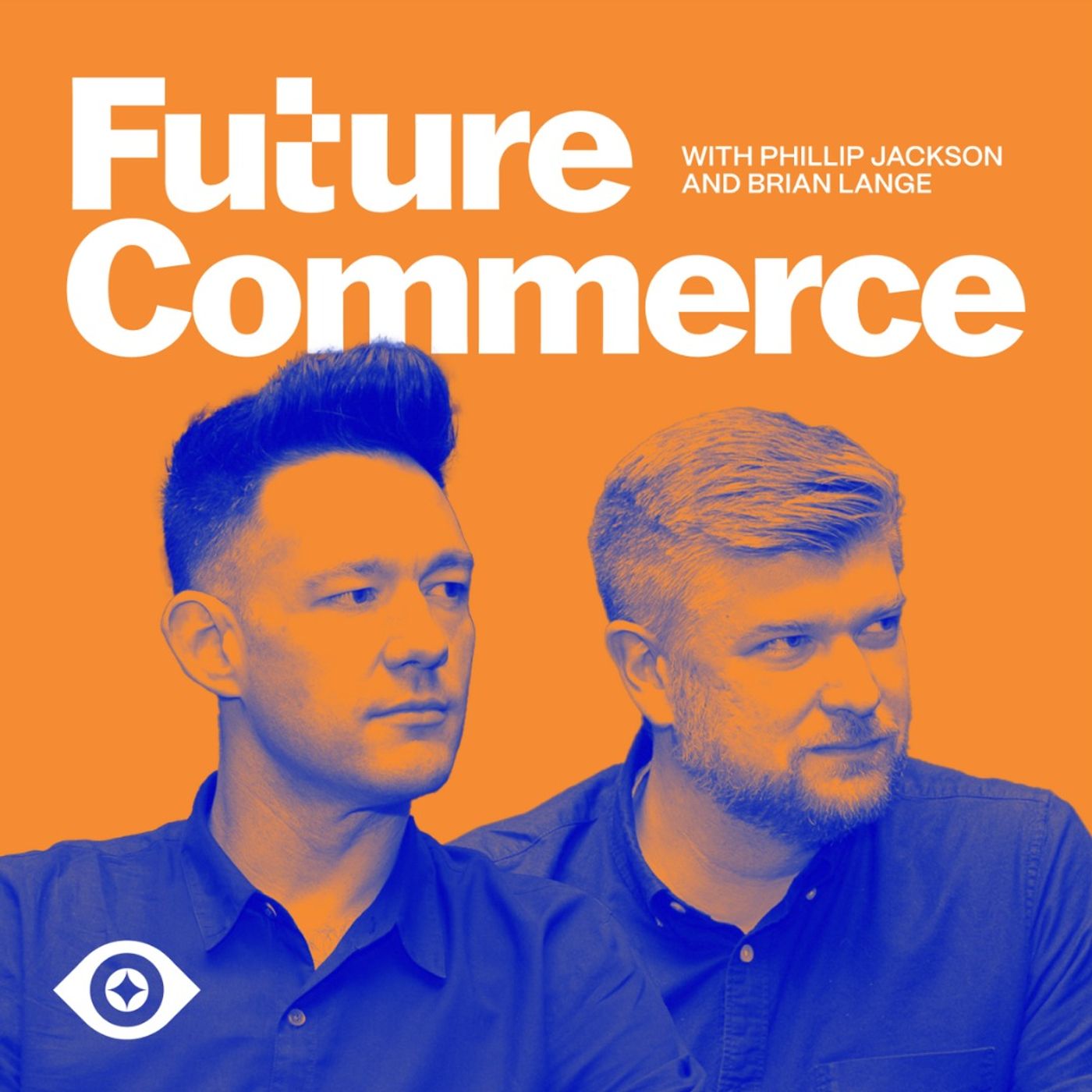
Future Commerce
Phillip Jackson, Brian Lange
Future Commerce is the culture magazine for Commerce. Hosts Phillip Jackson and Brian Lange help brand and digital marketing leaders see around the next corner by exploring the intersection of Culture and Commerce.
Trusted by the world's most recognizable brands to deliver the most insightful, entertaining, and informative weekly podcasts, Future Commerce is the leading new media brand for eCommerce merchants and retail operators.
Each week, we explore the cultural implications of what it means to sell or buy products and how commerce and media impact the culture and the world around us, through unique insights and engaging interviews with a dash of futurism.
Weekly essays, full transcripts, and quarterly market research reports are available at https://www.futurecommerce.com/plus
Trusted by the world's most recognizable brands to deliver the most insightful, entertaining, and informative weekly podcasts, Future Commerce is the leading new media brand for eCommerce merchants and retail operators.
Each week, we explore the cultural implications of what it means to sell or buy products and how commerce and media impact the culture and the world around us, through unique insights and engaging interviews with a dash of futurism.
Weekly essays, full transcripts, and quarterly market research reports are available at https://www.futurecommerce.com/plus
Episodes
Mentioned books

Oct 26, 2020 • 3min
The New DIY: Retail Opportunity in the Passion Economy
Today we acquire skills online, and those skills shape our purchasing habits. Our newest report dives deep into the Passion Economy, and the era of "do it yourself". We explore what this means for brands, and what retail stands to gain. Get the report today: https://futurecommerce.fm/thenewdiy Hosted by Simplecast, an AdsWizz company. See pcm.adswizz.com for information about our collection and use of personal data for advertising.

Oct 23, 2020 • 51min
“I Wouldn’t Allow Our Business to Become Dependent on One Channel" feat. Damian Soong, Co-Founder and CEO of Form Nutrition
Damian Soong, co-founder and CEO of Form Nutrition joins us to talk about Form and building a B-Corp brand that serves a wide audience.
The New DIY
DIY used to have a connotation of poor quality or poor craftsmanship but today, it’s more indicative of participation.
Online marketplaces are booming with consumers and creators having more meaningful connections with items that could otherwise be more easily purchased.
Partnering with Gladly, we’ve created a new report: The New DIY: Creators, Crafts and Commerce.
What is Form Nutrition and who is Damian Soong?
Form is a plant-based B corporation, built around the belief that you can be the best version of yourself while being mindful of others. They are the first UK protein brand to achieve B-Corp status.
Damian studied engineering and worked six years as an investment banker and analyst before getting his MBA, getting involved in startups, and running a contract manufacturing company. Damian was athletic while growing up so he was always interested in nutrition and eating well. This combined with his interest in the plant-based movement, Form Nutrition was born.
“... the important thing about Form as a brand is that we recognized early on that nutrition and wellness, by definition, [is] about the self. So we just thought, let’s turn that on its head and make it about others.” - Damian Soong
Form Nutrition’s Focus
Form created a protein that wasn’t only plant-based, but was branded around the idea that protein is more than just a subculture of performance gains; it’s not just a protein shake after the gym. It’s how you nourish your whole self.
“I think when you start to broaden the definition of nutrition to be more than just what you’re eating, but rather how you’re nourishing your whole self, it gives a brand a license to talk about a lot of other things like mindfulness, nutrition, education.” - Damian Soong
Form creates content to fit with their brand and their brand’s message of having a performance mindset in all areas of your life.
inForm is their email newsletter that caters towards those that perform not only in the gym, but in work, raising a family, etc. These newsletters empower individuals in being ethical, taking care of the planet, and doing everything to the best of their ability.
Form focused on building a community with their brand - in their articles promoting healthy, performance lifestyles and in their customer service habits.
Form started as a pure DTC brand. They were only eCommerce starting out but quickly had retailers wanting to stock them - starting with Planet Organic, one of the best retailers in London.
They wanted to keep control over how their product is priced and displayed, so they’ve chosen their retailers carefully: “[We chose] places that fit with our brand where we can add value to them, and they can add value to us.” - Damian Soong
Form Nutrition as a B-Corp
Damian describes B-Corps as businesses that use business as a force for good, focusing on people and the planet.
To become a B-Corp, the business has to go through an audit that inspects all aspects of your business - from supply chain impact to how you treat employees to what you do with your waste. B-Corps are re-audited every 2-3 years.
Everything from documents and employment contracts to employee handbooks have to address their goal in protecting people and the planet as a requirement for B-Corp status.
More on Form Nutrition’s Product and Plans
Form went with stand up pouches versus plastic tubs because they wanted sustainability and they wanted to create something different than their competition - again, focusing less on the “gym bro” customer and more towards a lifestyle consumer.
During COVID, Form has focused on their online presence in the US. Form is engaging in marketplaces like Amazon UK and Amazon US, but Damain would prefer that they don’t become dependent on marketplaces.
Form has subscription plans that are popular in the US. Having a background in engineering, Damian is invested heavily into data.
As commerce is now very omnichannel, Damian doesn’t want Form to have too much of a concentration in one customer or one segment.
“I’m in for the journey to create something lasting as a brand and as a sustainable, profitable business.” - Damian Soong on business sustainability versus business acquisition.
On raising capital: “...an interesting point is raising capital and how you do that and remembering that resourcefulness is just as important as capital. And sometimes constraints around capital really create creativity. We didn’t start with a big sum of money and I think that was a really, really good thing for us.” - Damian Soong
On competitive markets: “Sometimes crowded spaces are very easy to stand out in because they’re full of people doing the same thing. Sometimes a crowded space isn’t necessarily a scary place to enter. It can be an exciting place to enter if you’re able to stand out. That’s what I like to think that we managed to do with Form.” - Damian Soong
Links
Insiders #057: “The DIY Economy”
Check out Form Nutrition’s articles and newsletter, inForm.
Check out Form Nutrition’s website, Twitter, and Instagram
Find Damian Soong on Twitter
If you have any comments or questions about this episode, you can reach out to us at hello@futurecommerce.fm or any of our social channels. We love hearing from our listeners! Hosted by Simplecast, an AdsWizz company. See pcm.adswizz.com for information about our collection and use of personal data for advertising.

Oct 16, 2020 • 55min
A Tale of Two Recoveries: Popshelf, The K-Shaped Recovery, and Spending Power
In this episode, we talk about marketplaces, subscription services, the K-Shaped economy recovery, and more.“The Future of Every Brand is a Marketplace”In Future Commerce #041, Sucharita Mulpuru said that marketplaces are where businesses are going to thrive.“Consumers want more in their online shopping experience and they want to be able to transact more often with the brands that they know and love in products that aren’t just the core.” - Phillip JacksonMoving towards a marketplace strategy has a lot of moving factors—operations, partnerships, capabilities. “Implementing and managing a marketplace is not just about technology. It’s about strategy.” - Phillip JacksonMarketplace is becoming more normalized for eCommerce brands, in the same way that AR and VR have taken time to normalize and implement.K-Shaped RecoveryMarketplace shipping times haven’t been trusted recently and there’s a movement back into stores due to poor customer service in the rise in eCommerce during the spring.There’s an expectation of a 25-35% increase in eCommerce sales for the holidays, compared to 1-1.5% increase in retail. This is going to cause problems in supply/delivery chains for eCommerce and in social distancing and capacity limitations in retail.Customer service will be the most important thing for eCommerce during the holidays. With shipping delays and product supply challenges, merchants will need to proactively communicate with their shoppers.Walmart+11% of Americans have subscribed to Walmart+, Walmart’s subscription service for free deliveries and other benefits.Walmart+ is a direct competitor to Amazon Prime and Walmart has spent a lot of time strategically trying to “catch up to” Amazon. Different services have different appeals (for example: Walmart with fuel and groceries, Amazon with Prime Video) and Walmart is trying to see what sticks.Twilio/Segment Acquisition Twilio acquired Segment, a standalone CRM tool for eCommerce. Bundling and integrating the subscriber information from Twilio with a CRM like Segment is notable and could be powerful.Tanay Jaipuria, via Twitter: “Surprised Segment didn’t go public - could’ve been worth $5-7B in this market.” “[Segment is] doing 150-200 million in revenue… how much more powerful are [Twilio and Segment] together to have that much actual information on huge segments of the population?” - Phillip Jackson Dollar General Launches Pop ShelfDollar General is launching a five dollar chain that’s in competition with Five Below.Target market is millennials and individuals with up to $130,000 income. This has potential to tap into a “Woke” section - like organics and fair trade.Due to inflation, the buying power of a single dollar has gone down 20% over the past 10 years. Due to this and competition with eCommerce and the digital transition of retail businesses, Pop Shelf is stepping into the next tier and growing there with the current market.LinksCheck out Sucharita Mulpuru on Future Commerce #041: “Technology, for Technology’s Sake”Insiders #057: “The DIY Economy”Insiders #046: “The New Formal”Check out our new report: “The New DIY: Retail Opportunity in the Passion Economy” and subscribe to Future Commerce InsidersOn K-Shaped Recovery: Deloitte’s report “A Tale of Two Holiday Seasons”Tanay Jaipuria on Twitter If you have any comments or questions about this episode, you can reach out to us at hello@futurecommerce.fm or any of our social channels. We love hearing from our listeners! Hosted by Simplecast, an AdsWizz company. See pcm.adswizz.com for information about our collection and use of personal data for advertising.

Oct 9, 2020 • 29min
Parade: Reimagining a Value Brand, feat. Jack Defuria, Co-Founder and Chief Digital Officer
Jack DeFuria, Chief Digital Officer and Co-Founder of Parade, joins the show as he talks about founding Parade while in college with his co-founder, Cami Téllez, how Parade approaches their brand, and the pursuit of building America’s next great underwear company. What is Parade?Parade is a women’s underwear brand focused on ages 18-30.They were able to connect with potential customers in their target market very early on digitally using Facebook groups, sorority group chats, etc. and used other digital tech to promote their brand like setting up a Twitter bot that would reply to any tweet with the hashtag #botcottVS.Parade has always been ‘community-first’ in their product development strategy - by product being directly shaped by community feedback.Gen Z: The Psychographic“I think that Gen Z is really more a psychographic than it is a demographic.” - Jack DeFuriaParade’s customers grew up not only on the internet, but on their phones. Their internet was much more spatial, intimate, and focused on self-expression.On eCommerce growing more spatial and intimate: “We see Instagram as what the shopping mall was to the previous generation.” - Jack DeFuriaParade, being inclusive, features sizes XS through 3XL in every single product and even has changes to the models shown on their website with any given size chosen.Sustainability and social good play a part in maintaining the Gen Z ‘psychographic’ as well: all packaging is compostable and biodegradable, and 1% of profits are donated to Planned Parenthood.Partners of Parade have included organizations that have similar ways of seeing the world: Feeding America, GLITS, The Loveland Foundation.Investors and What Parade Has LearnedInvestors of Parade originally helped craft DTC 1.0: “Working with industry leaders and operators who have done it before has been extremely powerful for us. When we look at our vision for the category and where we see ourselves in the eCommerce landscape, where [our investors] brought categories online for the first time, we see our challenge as reimagining what a value brand looks like and distributing it through the internet.” - Jack DeFuria“One of the most important things [we’ve learned] is the value of authenticity and staying true to who you are, especially during periods of really fast growth.” - Jack DeFuriaHiring new employees and adding to their products during their first year of business and during a global pandemic, Parade has a singular mission to staying authentic and honest with their self-expression.LinksCheck out Parade’s websiteCheck out our Nine by Nine report, which features Parade Have any questions or comments about the show? You can reach out to us at info@futurecommerce.fm or any of our social channels, we love hearing from our listeners! Hosted by Simplecast, an AdsWizz company. See pcm.adswizz.com for information about our collection and use of personal data for advertising.

4 snips
Oct 2, 2020 • 1h 1min
Capital and the Creator Economy: Two Conversations with Sari Azout
Human CentricitySari is an early stage investor, a lead strategist at a startup studio, and a newsletter writer.“To me, being human-centered means you’re far more obsessed with the problem you’re solving than you are with a product that you’ve built. And what that gives you is the flexibility to evolve with your customer.” - Sari Azout“Being human-centered ultimately means that you don’t really sell your product. You sell your purpose.” - Sari AzoutThe brand ‘story’ is important for longevity. Brand stories and purposes are what resonates with consumers.“The story can’t be the marketing. The story has to be the strategy.” - Sari AzoutThe Degrowth Movement in DTC Capital“They’re not tech companies, they’re tech-enabled companies.” - Sari AzoutRetail vs. software company investments should be valued differently because of marginal costs of physical goods.The internet and DTC brands have allowed brands to be much more niche, so Sari suspects we are going to see “more like 5,100 million-dollar-brands and less like a billion plus outcomes.”The business model for VC relies on those billion dollar outcomes; however, we see in retail that the VC’s need billion dollar outcomes, but the founders do not. The founders are better off with smaller outcomes varied throughout smaller niche businesses which results in lower risk.Sara speculates that we’ll see an innovation in the way VC’s invest in these smaller, niche brands and that traditional VC will kill more companies than it creates.Generational Brands: Can the Brand Afford the Consumer?Gen Z is a different kind of consumer because of their digital nativity. In the past, ‘luxury’ items were brands based on status; now, symbols of status are changing to identity conscience - like podcasts or activities that individuals engage in and identify with.On Gen Z consumers: “They are self-interested as humans are, but they’re also spending with a conscience, as long as [the brand is] doing something that feeds their ego and identity and self-interest and also has a common good.” - Sari AzoutCompanies like Amazon have set the expectations for a lot of consumers which lean towards consumers ‘winning’ the margin - with things like free shipping, free returns, etc. But this is based on consumers with convenience as their highest priority instead of conscience or community.On conscious consumerism: “Where we need human ingenuity and innovation is ‘How can we build for a consumer that is increasingly conscious but also doesn’t want sacrifice?’” - Sari AzoutThe consumerization of enterprise and the enterpisation of the consumer: Transitioning from the gig economy to the passion economy, creators who previously didn’t have ways to monetize their talents are now seeing tools emerging to facilitate that monetization and make that possible.Part 2 - Post-COVIDThe world now is ‘post-place’ - everything is happening online.“I think the opportunity to build the tools for a world that is post-place has really opened up.” - Sari Azout“In the world of eCommerce, we’re realizing that the eCommerce infrastructure that we set up in the US was one hundred percent search-based. It wasn’t recreational. It wasn’t emotional. We optimize for price and speed and the Amazon kind of effect.” - Sari AzoutThe idea of ‘luxury’ has changed and is much more centered on accessibility than status. Brands are shifting from being exclusive to being membership-driven with shared ideology.Shifting Trust from Institutions to IndividualsOn the difference between influence and influencer: “Influence these days comes from authenticity, which ultimately comes from trust, whereas influencers are the result of commoditizing social media reach.” - Sari AzoutSari notes that Gen Z is reacting to this in seeing brands that are relatable, participatory, and welcoming as more appealing than the manufactured lives of influencers.There’s a distinction between the “participatory” economy and the influencer economy - consumers/fans are sharing in the connection and value with creators instead of being unidirectionally influenced.What Direction are Consumer Brands Headed?“I think what people are more interested in these days is far less individualistic and much more collective.” - Sari AzoutAs the economy moves online and continues to change, the lines between media and commerce and services get blurred.“What’s most exciting is being able to truly involve your customer in the creation of the product.” - Sari AzoutSari suspects we’ll see less venture-backed brands and more organically grown brands due to the niche demographics that brands can authentically serve in our ‘post-place’ world.“People will always gravitate towards what is easy. If you believe that, then that means if we create different toolkits that are equally easy… then brands are going to do it. And by doing so, they’re going to shape culture and create a different future… Tools matter.” - Sari AzoutSari states that raising venture is easier than other forms of debt, but as our tools change, new funding tools emerge which change our outcomes.LinksCheck out Sari’s Check Your Pulse newsletter.Find Sari on Twitter and InstagramCheck out Emily Singer’s newsletter, Chips + Dips.Have any questions or comments about the show? You can reach out to us at info@futurecommerce.fm or any of our social channels, we love hearing from our listeners! Hosted by Simplecast, an AdsWizz company. See pcm.adswizz.com for information about our collection and use of personal data for advertising.

Sep 25, 2020 • 45min
The Anti-Blands: Existential Brands and the New Dadaism
The New DadaismDadaism was an intellectual movement post-WWI that focused on subverting the serious.In response to the popularity of minimalism, maximalism has been on the rise. Brands have been using absurdity to reach their markets - specifically with Gen Z and Millennial brands.An Exploration in Brands in this Moment“Topicals really is the Anti-Bland” - PhillipTopicals is a skin care brand founded by two women of color. They have continuously been selling out, even after retailing with Nordstrom. They have individually branded, specified products which tailors to their market.Gen Z is into spiritualism which is reflected in Topical’s quiz to find your unique skin care needs.Faculty is a male skincare brand that has also stuck to the Gen Z and millennial generational experience - in dropping products periodically instead of restocking, in adding music to their brand experience, and in their use of SMS marketing.Brands are experiencing their own existentialism in the current global climate which has left room for refreshing and redefinition, even in larger CPG brands like Walmart, Pepsi, and Amazon, that are already set up for success regardless of the economy.LinksBrian’s Insider’s Piece, Insiders #054: “The Existential Brand - Part 1”Brian’s Insider’s Piece, Insiders #045: “The New Dada: Absurdism, Maximalism, and the Generational Divide”The New Yorker: “The North American Maximalism of Gigi Hadid’s and Drake’s Home Design”Bloomberg: “Welcome to Your Bland New World”Chips + Dips’ email newsletterThingtestingBrands MentionedTopicalsFacultyBirthdate CandlesSad Girls ClubBEHAVE CandySpringline CoffeeLeaf ShavingHave any questions or comments about the show? You can reach out to us at info@futurecommerce.fm or any of our social channels, we love hearing from our listeners! Hosted by Simplecast, an AdsWizz company. See pcm.adswizz.com for information about our collection and use of personal data for advertising.

Sep 18, 2020 • 58min
CPG: "Around You, On You, In You"
Jackson Jeyanayagam, VP of DTC at Clorox, joins us today to talk about Clorox’s DTC strategy, launching a new brand for an underserved, generation segment in the marketplace, and how his past experiences have prepared him and brought a fresh perspective to his current role.What’s Jeyanayagam’s story?Jeyanayagam started at a PR agency working with T-Mobile.Whenever the Sidekick was launched and subsequently hacked, his world opened up to social media and digital marketing.This digital marketing and social media focus was further solidified when Jeyanayagam had a role in Old Spice’s brand transformation in 2010.While in an agency role, Jeyanayagam worked with brands like NASCAR, P&G, Diageo, and Chipotle.Jackson then moved into the startup world with Boxed as their CMO.After moving on from Boxed, Jeyanayagam looked for an opportunity to grow personally and move towards his own dream of being the CEO or president of his own company.In his experience working with brands at their highs and their lows, Jeyanayagam learned to look past what brand is hot at the moment and into what the perfect role might be.He chose a position that would grow and challenge him - Clorox.Being a LeaderJayanayagam has brought his experience and knowledge to the Clorox family of brands and has received mentorship and guidance from his seniors there.“I don't care what generation we're in and how technologies evolve, there will be nothing that replaces people and valuing people.” - Jackson JeyanayagamIn the Mad men era, things were all about hierarchy and title. Now, great leaders should be adapting to the people they lead, not the other way around.Don’t Be Afraid of the MomentHaving experienced the rise and fall of “hot” brands, Jeyanayagam compares the experience to sports. Having a big lead mid-game is no guarantee that things will continue.Even at the top, you must continue to take the kinds of risks that brought you to that place.Many of the hottest brands today will fall. And likewise, those who have fallen may rise again.Microsoft is a powerful example of a brand that reinvented itself to see a second rise.Clorox DTCClorox owns many distinct brands - RenewLife, NeoCell, Natural Vitality, Rainbow Light, and Burt’s Bees.Clorox launched an in-house wellness brand called Objective, which is aimed at Gen X consumers, which are generally under marketed to.Clorox also has an in-house brand targeting Baby Boomers called Stop Aging Now.The Growth of Private BrandsWorking with Clorox, Jeyanayagam has the power of a 100+ year old recognizable brand.With the failure of Brandless, is there a message about the importance of brand?Traditional brands are facing pressure from knockoffs and generics that forces them to be creative about how they’ll compete.Private brand has become more popular through the likes of Amazon and Costco and there’s a lot of growth happening there.Around You, On You, In YouMost consumers will pay a premium for a recognizable brand when it’s a product that’s going in or on your body.In any given category, there are many brands that co-exist and compete at any given moment. Over the span of a decade or more, very few last. Brand is a key to this staying power.The closer the product is to you, the greater the challenge is to gain new customers.Around you is easiest - candles, for instance.On you becomes more challenging - lotions, shampoo, deodorant. People are less likely to try something now.For something consumed or put in you, consumers are much more sensitive.Consumer 3.0 Consumer expectations are changing and becoming heightened by the experience best-in-class brands provide.These expectations can be broken down into functionality and emotional appeal.Consumers today not only want to know that the product works, but they care what the brand stands for.Beyond that, expectations on things like fulfillment and delivery are rapidly rising because of Amazon. People want things fast and they don’t want to pay for shipping.More than demographic by generation, there is opportunity to create brands by psychographic - classifications by attitude and mindset.Gen X is a forgotten generation in marketing. They are funding and informing much of Gen Z, but they receive not nearly as much attention.Brands have the power to change the world through honesty and transparency. As we can see with brands like Everlane and Allbirds, there is a movement that encourages consumers to care about where their product comes from and the ethics of the brands they purchase from. LinksJohn Maxwell’s Five Levels of LeadershipClorox’s Family of BrandsPhillip’s conversation with Brian Kennedy from Ministry of Supply: “Rational vs. Emotional Purchases” Have any questions or comments about the show? You can reach out to us at info@futurecommerce.fm or any of our social channels, we love hearing from our listeners! Hosted by Simplecast, an AdsWizz company. See pcm.adswizz.com for information about our collection and use of personal data for advertising.

Sep 4, 2020 • 44min
"Low-Cost Indulgence" feat. Mayssa Chehata, Founder and CEO at BEHAVE Candy
What is BEHAVE?
BEHAVE makes candy that is better for you: low sugar, natural ingredients, no artificial ingredients, and good taste.
Currently, BEHAVE offers two options of gummies, sweet and sour.
BEHAVE started from a lack of alternative options in the candy department, which typically had people giving up candy altogether.
Originally, BEHAVE planned to be a mix of DTC and retail. Due to COVID, they’re now only doing DTC.
BEHAVE thrived throughout COVID by surrounding themselves with the right investors, partners, vendors, and employees.
Where is BEHAVE headed?
Self-awareness is a cornerstone of how we should operate, both as individuals and businesses. BEHAVE is engaging in their own self-awareness by seeing the current market and making decisions accordingly.
BEHAVE is recognizing the shift in the market towards comfort items and online shopping
Eventually, BEHAVE plans to get into retail.
BEHAVE is doing things differently - marketing towards adults instead of children. This effectively is bringing consumers back to the category of candy who have previously abandoned it.
When there is a product category that customers have abandoned, it is an opportunity to recapture customers.
LINKS
Check out BEHAVE’s website or Instagram.
Crunchbase listing for BEHAVE
Have any questions or comments about the show? You can reach out to us at hello@futurecommerce.fm or any of our social channels, we love hearing from our listeners! Hosted by Simplecast, an AdsWizz company. See pcm.adswizz.com for information about our collection and use of personal data for advertising.

Aug 28, 2020 • 46min
Walmart's Midlife Crisis: The Rise and Fall of Small Business in 2020
We chat with Ingrid Milman Cordy about business growth and decline in 2020 and Walmart’s new partnership. Our EconomyThe way our economy is set up, big businesses are bound to thrive, even during economic disruption like COVID-19.Small businesses seemed to be the ones to cope best with the disruption, but the distinction of “essential businesses” shifted from small business to big business.Businesses like Amazon and Shopify doing well also signifies that the small and medium businesses that sell through them are doing well. The difference between growth and decline in small businesses in 2020 comes directly from being in the right or wrong industries given the current circumstances.Branding and Positioning in a Changed MarketSmall businesses that have seen growth this year should be focusing on retention.Businesses that saw the most decline were retail in fashion and apparel - but they could bounce back given they rethink their branding and positioning in the current market.COVID-19 didn’t kill these brands, they just sped up their already growing decline.The best branding comes from getting consumers to be emotionally attached to a brand, not just buying a commodity.Marketing plays a much bigger role in our community - in connection. Walmart and ShopifyBig businesses should have a system to help small or local businesses.Walmart is teaming with Shopify and integrating small businesses into their model. They are realizing they cannot continue doing everything themselves and monopolizing markets.LinksIngrid Milman Cordy’s last appearance on Future Commerce, Episode 158: “Our Base Sense of Self is Heightened Right Now”Jeremy Cai from Italic on Future Commerce, Episode 170: “The Plan Was Always to Go Back to Membership”Walmart x Shopify Press Release: “Walmart Expands Its eCommerce Marketplace to More Small Businesses”Have any questions or comments about the show? You can reach out to us at info@futurecommerce.fm or any of our social channels. We love hearing from our listeners! Hosted by Simplecast, an AdsWizz company. See pcm.adswizz.com for information about our collection and use of personal data for advertising.

Aug 21, 2020 • 1h 3min
Pants = Tyranny: A Retail Rebirth Report Review
Read the Retail Rebirth Report here.
Read Insiders #045: The New Dada Here.
Read Insiders #046: The New Formal Here.
Find us at Futurecommerce.fm, or reach out to us on Twitter, Facebook, Instagram, or LinkedIn.
Have any questions or comments about the show? You can reach out to us at Hello@futurecommerce.fm or any of our social channels; we love hearing from our listeners! Hosted by Simplecast, an AdsWizz company. See pcm.adswizz.com for information about our collection and use of personal data for advertising.

