

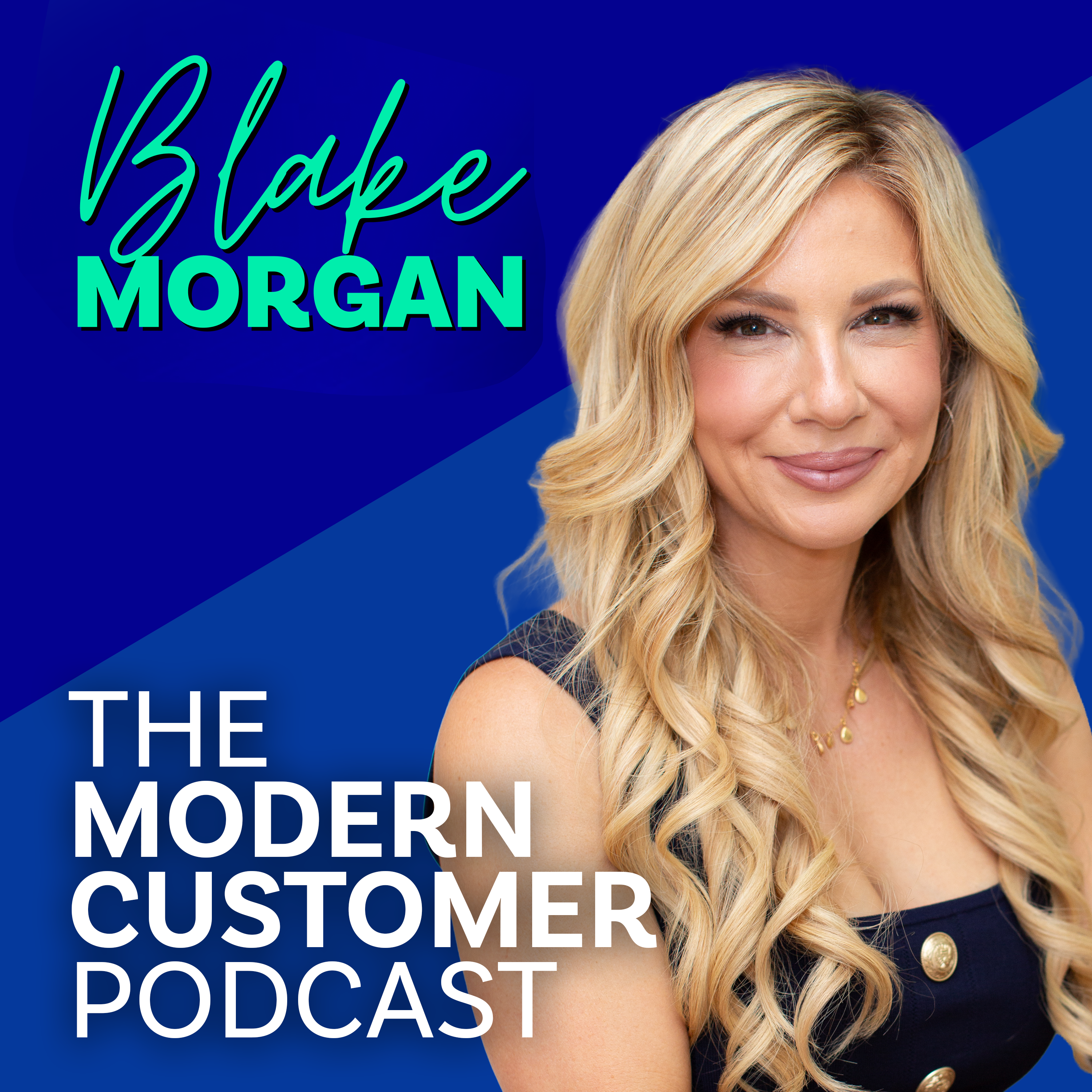
The Modern Customer Podcast
Blake Morgan
Go behind the scenes with customer experience speaker, and founder of CXO House Blake Morgan to explore the secrets of the world's most customer-centric companies.
Blake is one of the world's top keynote speakers, a leading authority on customer experience, and the bestselling author of three books on customer experience, including The 8 Laws of Customer-Focused Leadership. The Modern Customer reaches thousands of people each week, conveying the message that how we make people feel — in business and in life — matters. Her weekly show explores how businesses can make customers' lives easier and better, featuring experts who provide simple, tangible advice you can immediately apply in your own organization.
Today's customers have the luxury of choice. The answer is simple: choose customer experience, and customers will choose you. Learn how to put a stake in the ground for customer experience by tuning into The Modern Customer Podcast each week with Blake Morgan.
Blake is one of the world's top keynote speakers, a leading authority on customer experience, and the bestselling author of three books on customer experience, including The 8 Laws of Customer-Focused Leadership. The Modern Customer reaches thousands of people each week, conveying the message that how we make people feel — in business and in life — matters. Her weekly show explores how businesses can make customers' lives easier and better, featuring experts who provide simple, tangible advice you can immediately apply in your own organization.
Today's customers have the luxury of choice. The answer is simple: choose customer experience, and customers will choose you. Learn how to put a stake in the ground for customer experience by tuning into The Modern Customer Podcast each week with Blake Morgan.
Episodes
Mentioned books

Jan 19, 2021 • 33min
What Does Customer Loyalty Mean In 2021?
It seems nearly every company today has a loyalty program, but the meaning of loyalty itself is often still a mystery. Customer loyalty in 2021 looks different than it has in the past and even than how many companies view it. According to Bram Hechtkopf, CEO of loyalty marketing and technology company Kobie, loyalty is more than just how a customer behaves. A customer who regularly purchases from the same company can appear loyal, but what matters more than the transaction is their emotional loyalty, or how they feel about a brand. Hechtkopf breaks emotional loyalty into three areas: status, habit and reciprocity. Measuring customers in those three areas, combined with behavioral data, provides companies with the best view of loyalty. That data can be used to drive better personalization and engagement. Focusing on emotional loyalty goes against how many companies have traditionally viewed loyalty. In the past, loyalty was all about transactions, and the goal of a loyalty program was to get customers to the next purchase. In 2021, however, loyalty is more than just transactional. Modern brands have to think about the emotional drivers of loyalty. Instead of focusing on just their most loyal customers, Hechtkopf says the best programs cast a wider net to reach out to all customers and then use tiers and gamification to segment customers. These brands build relationships and foster loyalty through more than just points and perks. Like many aspects of customer experience, loyalty programs have faced changes and challenges during the pandemic. With supply chain strain and economic uncertainty, customers are more willing to try new brands instead of their trusted favorites. Hechtkopf says that brands that have established loyalty programs have seen the most success because they have been able to leverage their programs as their businesses have pivoted. Instead of focusing solely on transactions, these brands have been able to embrace pandemic trends and outperform the competition while still delivering a personalized experience that meets customers' needs. The companies that think about loyalty not as a program but as an outcome and enterprise strategy have the most success. Hechtkopf says the companies with the best loyalty programs have executives who realize that loyalty is crucial as more than just a transactional program. To tap into modern customer loyalty, brands need to ensure their loyalty strategy aligns with their brand strategy. Customer loyalty programs can be powerful drivers for relationships and revenue. But modern companies have to think about loyalty as a state of mind instead of just a program. Blake Morgan is a customer experience futurist, keynote speaker, and author of the bestselling book The Customer Of The Future. Sign up for her new course here. For regular updates on customer experience, sign up for her weekly newsletter here.
Jan 12, 2021 • 32min
How Bank Of America Pivoted To Serve Contactless Customers
For many people, the days of going to the bank to make a deposit or cash a check are gone forever. Like in many industries, the Covid-19 pandemic has led to a major shift away from in-person banking interactions towards digital services. The challenge now becomes how to pivot to best serve contactless customers. According to Holly O'Neill, Chief Client Care Executive at Bank of America, the switch to digital solutions was already in play for the company. The pandemic simply moved up the timeline. Bank of America's strategy has always been to deliver world-class service in a way that is convenient and easy both in person and virtually. That high-tech, high-touch approach was tailor-made for the current pandemic. Covid increased the need for companies, including Bank of America, to undergo a digital transformation or speed up their timeline. O'Neill defines digital transformation as making things easy for clients by putting everything they need right at their fingertips. The goal is to make the mobile and online experience so intuitive that clients don't need to go anywhere else because they have all the information they need right in front of them. And the ultimate goal is to have an experience that is so intuitive it answers questions before customers ask them. With a banking digital transformation, financial centers serve as a hub for advice and guidance instead of transactions. Everything else, like making deposits and checking balances, can be done virtually. Pivoting to reach contactless customers means understanding their needs and what they are really looking for. Bank of America leaned into its robust feedback program, which it rolled out a few years ago and has been crucial to understanding constantly changing customer needs. Each year, Bank of America sends out tens of millions of customer surveys. That information is collected in almost real-time and then sent to bank managers and the employees who are interacting with clients every day. Through a dashboard, these employees can daily changes in customer sentiment and feedback and then help customers in the most applicable ways. That feedback data is used to personalize the experience to give each customer exactly what matters to them, not to their neighbor. O'Neill says the real winners will be the companies that customize the experience for their clients. That customization comes from leveraging feedback data to pivot and quickly make changes as needed. The feedback data represents a wide range of customers, making it reliable and usable. Bank of America made a conscious effort to keep the surveys short and simple and deliver them through the mobile app, which has led to a high response rate. Although the pandemic has brought a major pivot to serve contactless customers, the digital transformation is far from over. O'Neill views building out and improving digital solutions as a continued evolution that will forever be a part of Bank of America. And as it continues to listen to feedback, personalize and deliver seamless digital solutions, the bank will be prepared to meet customers' needs, even long after the pandemic. Blake Morgan is a customer experience futurist, keynote speaker, and author of the bestselling book The Customer Of The Future. Sign up for her new course here. For regular updates on customer experience, sign up for her weekly newsletter here.
Jan 5, 2021 • 32min
How To Modernize Customer Interactions For The Smartphone Era
It's a common situation for customers: spending time on a company's app or website and then having to call customer service for help. Even after spending time searching online, the customer still has to wait on hold, log in or prove their identity and then re-explain the situation and wait to get connected to the right person. In recent years, many aspects of customer experience have been modernized and streamlined, such as the growth of chatbots and AI. However, even with these advancements, most customer interactions have stayed stagnant and without context. But that won't be able to continue for long. Modern customers realize the potential of their data and are increasingly becoming frustrated with companies that don't offer intuitive and connected experiences. Especially in industries like banking, healthcare and hospitality, customers can easily take their business elsewhere if they have a bad experience. According to Vasili Triant, COO of UJET, customers may start with a brand because of the product or price, but they stay because of the experience. He says the future of modern customer interactions involves channel blending or meeting customers where they are within a brand's app. Instead of pushing customers out of the app or website when they need to contact the brand, this modern approach stays within the app to seamlessly pass information to human agents. How a customer uses an app or how they search online provides rich data about their preferences, but brands are throwing that information away when they essentially make customers start over with each interaction. This approach not only saves the customer time by not requiring them to re-authenticate and then re-explain their situation, but it also makes it easier for brands to personalize the experience. If a customer is looking at a website in English, they shouldn't have to choose a language on the phone, just like a customer who has already authenticated in the app shouldn't have to do it again on the phone. According to Triant, leveraging in-app communication adds a vital aspect that is often missing from customer interactions: context. When a customer calls a company, the agent typically doesn't have much information about why they could be calling. But by connecting with customers through channels they already use and leveraging that data, agents automatically have context around the interaction and can more easily provide the right solution. Very few brands contextualize their customer experience, but as personalization and the need for convenience grows, customers will come to expect it. In the smartphone era, customers do nearly everything on their phones. They want and expect a seamless transition from self-service to being able to contact a brand. The companies that can take the step towards modernizing their experiences and offer context around the interaction will lead the way in personalization and customer loyalty. This approach to customer interactions is the future, and companies need to get on board to deliver strong, modern experiences. *Sponsored by UJET UJET is the world's first and only cloud contact center platform for smartphone era CX. By modernizing digital and in-app experiences, UJET unifies the enterprise brand experience across sales, marketing, and support, eliminating the frustration of channel switching between voice, digital, and self-service for consumers. Offering unsurpassed resiliency and the flexibility to deploy across leading public cloud infrastructures, UJET powers the world's largest elastic CCaaS tenant at up to 22,000 agents globally and is trusted by innovative, customer-centric enterprises like Instacart, Turo, Wag!, and Atom Tickets to intelligently orchestrate predictive, contextual, conversational customer experiences. Blake Morgan is a customer experience futurist, keynote speaker, and author of the bestselling book The Customer Of The Future. Sign up for her new course here. For regular updates on customer experience, sign up for her weekly newsletter here.
Dec 29, 2020 • 13min
Blake's 5% Rule For New Year's Resolutions
It's the time of year when everyone is making New Year's resolutions and setting goals for the coming year. What do you hope to achieve in 2021? How do you want to improve yourself and your career? For many of us, it's been a complicated year and we're looking for some change and improvement. But too often we fall into the trap of thinking we have to reinvent the wheel and start completely fresh. If we want to make more money, we have to start a brand new business. If we want to lose weight, we have to go on a crash diet. But that's not true—you don't have to start completely over to find success and happiness. Instead of setting New Year's resolutions, I follow the 5% rule. Each day, I try to be 5% better than the day before. I'm not starting over from nothing; I'm building on what I already have and trying my best to improve every day. I don't have to start over to get healthy or build a successful business. I work with what I have and improve it piece by piece. Over time, the 5% rule ends up increasing and accelerating the changes I'm trying to make. 2020 was a rough year. Instead of beating ourselves up when we don't achieve our lofty goals, we need to show ourselves grace and kindness. Talk to yourself kindly and do the best you can. Instead of feeling the pressure to create this big, amazing thing over night, the 5% rule lets you try your best every day and make small, incremental improvements. We don't need more rules. Instead, we need to give ourselves love and nourishment. We need to check in with ourselves emotionally to really see how we are doing and how we can grow and improve. Make 2021 your year, but don't feel like you have to do it all at once. Be kind to yourself. Aim to be 5% better each day and simply do your best. Over time, you'll find you've reached where you want to be and become the best version of yourself. To keep improving yourself and continue your entrepreneurial journey in 2020, be sure to check out the BYOB Podcast and our YouTube Channel for proven tips and useful advice. Blake Morgan is a customer experience futurist, keynote speaker, and author of the bestselling book The Customer Of The Future. Sign up for her new course here. For regular updates on customer experience, sign up for her weekly newsletter here.
Dec 22, 2020 • 33min
Shep Hyken's Prediction For 2021
What's the word of the year for customer service? According to business and CX expert Shep Hyken, it's empathy. Hyken has years of experience in customer service and is a popular speaker and author. Like all of us, he saw the dramatic challenges businesses faced in 2020 and the pivots they had to make. Businesses and customers are adjusting to their new way of interacting and facing constant change, especially as we head into the new year. Here are some of Shep Hyken's predictions for 2021: Customers Continue To Get Smarter Today's customers know what good customer service is. They experience it every day from companies like Amazon and Zappos and have come to expect and demand it from other businesses. Customers are learning from great companies and want that level of service in all their interactions. Customers Are Becoming Impatient Modern customers want what they want now. They've gotten used to getting their shipments within hours or overnight and now want everything right away. Companies need to meet that demand with quick service and delivery. Customers Expect Convenience Today's busy customers are willing to pay for convenience. A study by Hyken found that more than 67% of consumers are willing to pay more for a convenient experience, and that number jumps to 90% if that experience includes delivery. Convenience matters and goes a long way with customers, and they are willing to pay for that convenience. Personalization Is Getting More Personal Customers want an experience that is unique to them. They want and expect companies to know their preferences and experiences. Some companies are going further with micro-personalization that is tailored to each person's unique experience with specific product recommendations and preferences, not just general genres. Companies Are Getting Automation Happy Companies need a strong digital system to compete and deliver great experiences, but so many companies fall into the trap of relying too heavily on automation and not enough on the human experience. Hyken believes some companies get enamored with technology and use it to replace the human experience, which is a big mistake. The best companies create digital experiences but can seamlessly transition customers to humans if needed. There needs to be a balance between human and digital. Problems Can Be Predicted In a perfect world, if a problem can be predicted, it can be solved before the customer even knows about it. The most successful companies are continually looking for potential problems big and small and then proactively solving them before customers even realize they have a problem. The bottom line of delivering great customer service in 2021 is simply to be nice. Customers expect convenience and personalization, but more than anything they want to interact with individuals and companies who are nice. No matter what happens in the future, kindness will always be on-trend. Blake Morgan is a customer experience futurist, keynote speaker, and author of the bestselling book The Customer Of The Future. Sign up for her new course here. For regular updates on customer experience, sign up for her weekly newsletter here.
Dec 15, 2020 • 22min
Blake's Top 5 Customer Experience Predictions For 2021
Every year, I make predictions for what's to come in the world of customer experience. After doing this for seven years, I've gotten pretty good at predicting trends that really do end up influencing businesses and customers. But in 2020, no one could have predicted the COVID-19 pandemic. It's been a tough year. Between the pandemic, shutdowns and economic downturn, we've also faced environmental issues, a divisive election in the U.S., racial injustice and much more. These events might not seem tied to customer experience, but we don't live or work in a bubble—we're affected by what happens all over the world. And we'll definitely be feeling the effects of this year for years to come. With that in mind, here are my five customer experience predictions for 2021: 1 . How We Live And Work Has Forever Changed Thanks To COVID. Nearly every aspect of life and business this year was upended because of COVID. Although a vaccine is making great progress, we will be seeing the impact of the pandemic for at least the next five to ten years. Although most people want to get back to some semblance of normal life, they are hesitant to go back to how things were. 2 . 2021: Year Of The Uncomfortable Conversation. 2020 brought about a lot of uncomfortable conversations on topics ranging from health and safety to layoffs, Black Lives Matter and supporting women and essential workers. These conversations will intensify in 2021 as individuals and companies will have to look inwardly to address these major concerns and help support underrepresented groups that have been hit especially hard this year. Customers will expect companies to take a stand and really make a difference. 3 . Putting Employees And Customers Above Profits. Many companies made huge efforts in 2020 to support their employees and customers, even if that meant their profits suffered. They invested in employee relief funds and increased benefits, while also listening to customers and providing great service. That trend will continue, and the companies that focus on people instead of profits will see great success. 4 . Ecommerce Rose Immensely And Touchless CX Makes Unignorable Leap. Companies were forced to pivot this year as stores were shut down and in-person shopping was limited. Companies across all industries have increased their e-commerce offerings. And now that customers have experienced delivery and pickup, they don't want to go back to how things were. Touchless CX will make huge leaps in 2021 as brands work to build experiences for customers who feel vulnerable. In the coming year, brands will have to adopt digital models and creative touchless solutions. 5 . B2B Pivot. B2B companies struggled in 2020 because they depend on in-person conferences and networking that was cancelled or moved online. A number of B2B companies have already pivoted to new ways to connect with customers, and other companies must follow suit. B2B companies have to double down on customer experience through digital transformation and using thought leadership to generate leads because what worked in the past doesn't work anymore. In many ways, 2020 has set the stage for CX in 2021. As we come out of a difficult year, customers are looking for ease and personalization. They want companies to adapt and make a real difference in society. These trends show just how much 2020 changed us and how we can continue to recover and evolve in 2021. Blake Morgan is a customer experience futurist, keynote speaker, and author of the bestselling book The Customer Of The Future. Sign up for her new course here. For regular updates on customer experience, sign up for her weekly newsletter here.
Dec 8, 2020 • 32min
7 Trends Shaping CX In 2021
After a wild 2020, many companies are looking forward to 2021 and hoping to proactively engage with customers instead of reactively building or changing programs and services. But just because 2021 is a new year doesn't mean 2020 is gone and forgotten. The global pandemic and unrest of the year will stick with customers for the long term and greatly influence how they interact with companies going forward. With more virtual events and interactions than ever before, customers want human connection. The 2021 Deloitte Global Marketing Trends Report highlights seven trends shaping customer experience and business growth in 2021: Purpose, Agility, Trust, Talent, Participation, Fusion and Human Experience. Understanding these trends can help brands drive connection and engagement. Although each trend is unique and stands on its own, Deloitte CMO Suzanne Kounkel says the trends also work together to support and influence each other. A company that has built strong trust will also likely have a strong sense of participation, for example, while a company lacking in trust likely won't have as strong of customer participation or human experience. Of the seven trends, Kounkel says the most important may be purpose and agility. If a company or brand isn't grounded in a purpose, it's hard to land any of the other trends. Customers want to see the purpose of a brand and feel trust in an organization. It's no longer just about making a purchase or doing business—it's about building real connections with a brand, participating and believing in its greater purpose. Kounkel says that in a roller coaster year like 2020, it's important for companies to have purpose as their guiding course. People need to understand why things are being done because how they are being done is changing so quickly. The purpose keeps employees, customers and organizations moving steadily towards a goal or vision, even with the turbulences of chaos and uncertainty. An organization's purpose has to start at the top. Kounkel believes most organizations have a purpose, but many companies fall flat because their purpose isn't embedded or understood in a way that helps the company move forward. She recommends organizations and leaders perform a soul-searching exercise to determine their purpose. Be pragmatic and dogmatic, but do it quickly, because customers expect companies to have strong purposes that resonate in everything they do. Agility is also a powerful trend going into 2021. The year 2020 showed just how crucial agility is as companies were forced to pivot quickly with little warning. COVID has changed customer expectations, and consumers now expect brands to be more agile than ever before. Now, as we work through the pandemic, brands are starting to get back to doing what they want to do. For months we spent time doing what we had to do, but the agility now in place gives brands more freedom to get back to what they and their customers actually want to do. A new year brings a new slate. Customers want more connection than ever, and companies that tap into these seven trends can make that happen. Start with a sense of purpose and build those strong connections that will last into the future. Blake Morgan is a customer experience futurist, keynote speaker, and author of the bestselling book The Customer Of The Future. Sign up for her new course here. For regular updates on customer experience, sign up for her weekly newsletter here.
Dec 1, 2020 • 32min
How The Pet Industry Adapted During COVID
2020 has been a strange year. Many people coped with the loneliness and uncertainty of lockdowns and quarantines by adding a furry friend to the family. Pet ownership is way up because of the pandemic and has caused the pet industry to pivot and adapt. As the number of customers has greatly increased, the pet industry has also had to deal with pandemic restrictions and changing health regulations. The only way to survive has been to stay close to customers, adopt digital solutions and pivot. Brian Garish, president of Banfield Pet Hospital, said that although the way of doing business is now different, the company's focus is still on building connections with pets and keeping its associates healthy while they continue to give care. As an essential business, Banfield Hospitals has stayed open throughout the pandemic, but the store had to create new measures to keep associates, pets and clients safe. One of its major changes was introducing curbside dropoff for pets. Instead of owners walking their pets into the store, they now drop them off at the curb where a Banfield associate takes the pet into the hospital to perform the procedure and then brings them back when they are done. To help customers feel comfortable leaving their pets, Banfield built on its trustworthy reputation and increased its communication so that customers are still involved in every step of the process. One of the most crucial aspects of pivoting during COVID has been digital transformation. Banfield was already working on a digital transformation, but it was greatly accelerated by the pandemic. Now, clients can schedule services and access their pet's records online. Everything can be done through an online portal or app to remove concerns and make clients' lives easier and simpler. The move to digital transformation helps both clients and associates, which then leads to a better experience for the pets. Instead of being weighed down by paperwork, Banfield associates can upload notes digitally to keep owners in the loop. Banfield is also working towards a green initiative to email all paperwork and receipts instead of printing hard copies. Garish believes Banfield's digital transformation has been effective because it is rooted in empathy. In his mind, strategy without empathy is wasted. To create the most effective digital transformation, Banfield encourages and facilitates conversations with its clients and its associates. Digital transformation didn't come about because it was a trend or an idea executives had—it came from listening to customers and having true two-way conversations. Banfield aims to be part of its clients' lifestyles, even during a pandemic, but that can't happen without real dialogue. Those conversations have continued during the pandemic as Banfield keeps in continual communication with its clients and associates about what is and isn't working and how care can be improved. Garish doesn't see the pandemic pivot as temporary. He believes changes made in the last nine months will forever change the company and industry and re-affirm the need to put customers at the center of everything. Instead of a standardized path, customers want individual attention. The pandemic won't last forever, but the lasting effects of increased pet ownership will definitely stick around, and Banfield will be there every step of the way. Blake Morgan is a customer experience futurist, keynote speaker, and author of the bestselling book The Customer Of The Future. Sign up for her new course here. For regular updates on customer experience, sign up for her weekly newsletter here.
Nov 24, 2020 • 32min
4 CX Takeaways From 2020
What has been the biggest shift in customer experience in recent years? It's not the COVID-19 pandemic, though that has certainly played a large role. According to NICE inContact CEO Paul Jarman, the biggest change has been the democratization of opinion. Customers have more of a voice than ever before, which has forced companies to focus on experience. Brands learned that they have to provide an experience that individuals are excited about and will share with family and friends in order to gain customers. As Jarman says, the push towards customer experience has given more power to consumers in voice and choice. But what does customer empowerment look like in the midst of a global pandemic? Worldwide shutdowns and restrictions changed how companies do business and interact with their customers. It placed a larger emphasis on digital interactions and mobile service. And even after the pandemic is over, digital will still play a large role in customer experience, especially in the contact center. As companies navigate the new world with COVID-19, they need to know how things have changed and how those changes will impact the future. NICE inContact's 2020 Benchmark surveyed contact center leaders across the country to get a sense of how customer experience has changed this year and where it is going in the future. Here are four main takeaways to lead CX into 2021: 1 . A dramatic move to the cloud. After years of the technology growing and becoming more reliable, companies are now realizing that it is easier to be agile and innovative in the cloud. Nice InContact's survey found that 66% of contact center decision-makers plan to accelerate their move to the cloud because of the pandemic. Cloud-based CX technology allows for seamless service and a consistent experience across all channels. 2 . Significant increase in digital channels. Customers have gone digital, with 62% of contact centers reporting more digital interactions since COVID started. Even after the pandemic is over, customers will still expect to be able to communicate with companies digitally. Jarman says one of the main difficulties of companies going digital is that they have multiple systems that don't work together. The push from COVID to interact with customers digitally shows the importance of a single unified system to simplify the digital experience for both contact centers agents and customers. 3 . More mobile apps. Customers want to communicate with companies through mobile apps. Mobile apps saw the biggest growth in contact centers from 2019, increasing by 8% to 56% of companies using apps to communicate with customers. Mobile apps are especially important for younger consumers and Gen Z, who expect brands to interact with them in private social messaging apps. Effective mobile apps allow customers to contact a brand whenever it's convenient for them. 4 . Room for improvement for chatbots. Chatbots have long been billed as the future of customer service, especially in contact centers, but many customers haven't found chatbots to be reliable enough to use. Although many customers prefer self-service options like chatbots over other channels like talking to a human on the phone, 90% of CX practitioners believe chatbots need to get smarter before customers will be willing to use them regularly. Even with all of the digital growth in contact centers, the number of companies using chatbots stayed constant from 2019 at 46%. Customer experience is more strategic than ever before. Understanding changes helps companies build effective strategies as they allow contact centers to have more creativity and power to get things done. Jarman believes customer experience now needs to be the key focus for every company, but the good news is that the sky's the limit. With creativity and technology, brands can create powerful digital solutions that are boundless. ________________ This week's podcast is sponsored by NICE inContact NICE inContact works with organizations of all sizes to create extraordinary and trustworthy customer experiences that create deeper brand loyalty and relationships that last. With NICE inContact CXone, the industry's most complete cloud customer experience platform, the company combines best-in-class Customer Analytics, Omnichannel Routing, Workforce Optimization, Automation and Artificial Intelligence, all on an Open Cloud Foundation to help any company transform every single customer interaction. ________________ Blake Morgan is a customer experience futurist, keynote speaker, and author of the bestselling book The Customer Of The Future. Sign up for her new course here. For regular updates on customer experience, sign up for her weekly newsletter here.
Nov 17, 2020 • 31min
How Belvedere Vodka Shares Its Story Through CX
How do you create an experience around an all-natural vodka that shows its history and sustainability? Learn to tell a good story. Belvedere Vodka has long been known for its great quality and super-premium product, but only recently has the company began to focus on its historic roots and sustainable efforts. Sharing the story adds to the experience and helps customers feel more connected to the brand. Shifting To Storytelling Instead of simply rattling off talking points and qualities of its all-natural vodka, Belvedere turns to the power of storytelling. As customers are transported to the 110-year-old distillery where the vodka is made and learn the process of turning simple ingredients into amazing spirits, they build a connection with the brand that can't come in any other way. Though the shift to storytelling has been in the works for a while, the pandemic has played a role in changing what customers are looking for. According to president and CEO Rodney Williams, luxury products like Belvedere Vodka are now less about exclusivity and more about the values the brand stands for. Customers are now more aware of the power of nature, what they're eating and where it comes from. The focus on simple, wholesome ingredients is important to them. Belvedere's success comes in turning its ingredients into a story. It's one thing to list all-natural ingredients and say your brand is simple and wholesome—it's another to show the power of your ingredients and what they can become. Highlighting Sustainability Belvedere's new campaign, "Made With Nature" showcases the brand's history of combining simple ingredients from nature into extraordinary vodka. Belvedere has been sustainable and all-natural since before it was a major issue for consumers. For the past eight years, Belvedere has hosted the Raw Spirits Summit to bring together scientists and farmers to study cutting-edge techniques around sustainable agriculture. The company has been able to build on its past efforts in a time when sustainability is top of mind for many customers. Williams says "Made With Nature" comes at a time where consumers are increasingly ready to listen to brands that embrace a natural philosophy and are working towards meaningful change. The world cares about sustainability now more than ever before. Using Stories To Build Experience To start storytelling, Williams said the company looked at the brand's DNA and discovered the long commitment to craftsmanship and sustainability. The brand has always been committed to quality and craft, but it hasn't told the story directly before. Sharing that story resonates with younger consumers, who care about brands that are natural and have solid sustainability credentials. But sharing a brand story will land flat if it isn't rooted into authenticity. Just like with their ingredients, customers also want realness in their stories and connections with brands. In today's world, stories behind brands are what has lasting value to consumers. Customers are looking to build real relationships with brands and understand where they come from and what makes them tick. Focusing on authentic storytelling allows brands to connect with customers on a new level and build an amazing experience. Every brand has a story. If told well, that story can create an amazing customer experience. Like Belvedere Vodka shows, communicating your company's DNA can make for a fascinating story and build a strong experience. Blake Morgan is a customer experience futurist, keynote speaker, and author of the bestselling book The Customer Of The Future. Sign up for her new course here. For regular updates on customer experience, sign up for her weekly newsletter here.

