

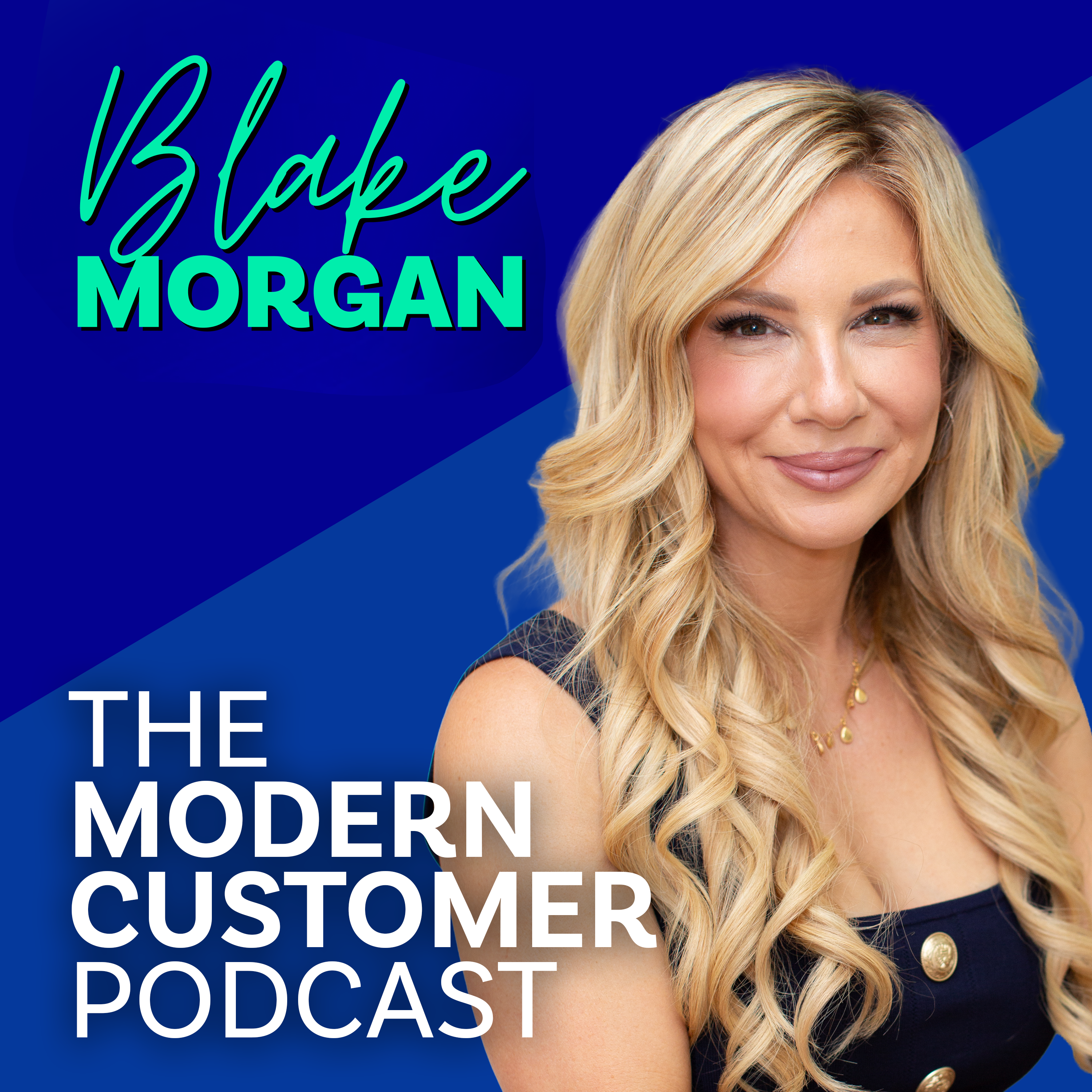
The Modern Customer Podcast
Blake Morgan
Go behind the scenes with customer experience speaker, and founder of CXO House Blake Morgan to explore the secrets of the world's most customer-centric companies.
Blake is one of the world's top keynote speakers, a leading authority on customer experience, and the bestselling author of three books on customer experience, including The 8 Laws of Customer-Focused Leadership. The Modern Customer reaches thousands of people each week, conveying the message that how we make people feel — in business and in life — matters. Her weekly show explores how businesses can make customers' lives easier and better, featuring experts who provide simple, tangible advice you can immediately apply in your own organization.
Today's customers have the luxury of choice. The answer is simple: choose customer experience, and customers will choose you. Learn how to put a stake in the ground for customer experience by tuning into The Modern Customer Podcast each week with Blake Morgan.
Blake is one of the world's top keynote speakers, a leading authority on customer experience, and the bestselling author of three books on customer experience, including The 8 Laws of Customer-Focused Leadership. The Modern Customer reaches thousands of people each week, conveying the message that how we make people feel — in business and in life — matters. Her weekly show explores how businesses can make customers' lives easier and better, featuring experts who provide simple, tangible advice you can immediately apply in your own organization.
Today's customers have the luxury of choice. The answer is simple: choose customer experience, and customers will choose you. Learn how to put a stake in the ground for customer experience by tuning into The Modern Customer Podcast each week with Blake Morgan.
Episodes
Mentioned books

Mar 30, 2021 • 32min
How Birchbox Meets Customers Where They Are
The beauty world is full of customers who love to experiment with new products, watch makeup tutorials and spend time finding the best items. But what about customers who care about their skin and beauty but don't want to spend the time finding and trying new products on their own? These are known as casual consumers. They want to try new things but are often overwhelmed or don't have time for the number of products on the market. Most beauty companies market to serious consumers, making casual consumers an unserved market, says Ali Edgerton, Birchbox U.S. President. Birchbox was founded in 2010 as a way to provide casual consumers great products without them having to find and experiment on their own. Birchbox was the first subscription box—an incredible accomplishment when considering the thousands of subscription boxes now on the market. The innovative concept is relatively simple: each month, consumers receive a box with five deluxe-sized samples of beauty products picked just for them. The model works well for casual consumers who want to try new things and get the right products for their hair, skincare and makeup routines, but who don't want to sort through products on their own. Birchbox has grown into a multi-faceted platform that allows consumers to subscribe for monthly products or simply buy products from the online storefront. Birchbox meets the modern customer where she is by creating a multi-channel experience that relies heavily on data and personalization. When users first subscribe, they answer a series of questions to set up their profile. Birchbox compares that data to how casual consumers relate to the beauty industry to put personalized items in each box. Customers also have the option to choose a few items on their own. Data continues after the box has been delivered with a robust review system that allows customers to give feedback for each item and gives Birchbox a better understanding of what is and isn't working for each customer. As Birchbox collects more data, it provides an increasingly personalized experience. Birchbox also stays on top of trends that appeal to casual beauty consumers and puts together curated packages separate from subscription boxes. These products are designed to help casual consumers tap into new beauty trends and get everything they need in one place. One of the most popular recent discovery kits includes everything consumers need to fight maskne, or acne caused by constant mask-wearing. Casual consumers would likely be overwhelmed trying to find the best products on their own, so Birchbox makes it easy for them to get everything in one click. And the strategy is working—the kits are in constant demand and are flying off the shelves. Edgerton says Birchbox uses data to create a picture of what customers want and need. Her greatest satisfaction comes from introducing something to a customer who didn't know they needed it. Relying on data to provide personalized experiences and meet customers where they are is a large part of the reason for Birchbox's success. It hopes to continue its innovative approach to beauty and retail as it sets the example for other subscription models. To try Birchbox for yourself, Edgerton is giving The Modern Customer Podcast listeners a discount with code VIP50. Blake Morgan is a customer experience futurist, keynote speaker, and author of the bestselling book The Customer Of The Future. Sign up for her new course here. For regular updates on customer experience, sign up for her weekly newsletter here.
Mar 23, 2021 • 35min
How Urban Air Pivoted To Thrive During COVID
Running the largest adventure park company in the country comes with challenges—especially during a global pandemic. There's no playbook for this type of scenario. But Michael Browning, founder and CEO of Urban Air, knows that speed and innovation always win, which fueled his strategy to react to information quickly as it came in. Reacting with speed allowed Urban Air to not only survive the pandemic but to thrive and find new ways to expand and grow. Browning encourages his franchisees and staff to stay close to customers and get their feedback. Although the indoor trampoline and adventure parks are aimed at kids, the company views moms as the customers and kids as the users. When states started opening back up, many customers weren't sure what was safe. Urban Air surveyed moms to ask what they wanted for their kids' activities. The more than 3 million responses helped establish health and safety guidelines for an Urban Air environment where moms felt comfortable bringing their kids. Browning took it one step further. Three hours after a visit to Urban Air, the company followed up with the parents asking if the location met their expectations about cleanliness and safety. Most moms said it definitely did. Urban Air then asked moms to shoot a short video of their experience and put it on YouTube. The company got hundreds of videos of parents sharing their authentic reactions and experiences, which was powerful in encouraging other families to return to the adventure park. Feedback has been crucial to keeping Urban Air going during the pandemic. It also led to one of the company's biggest pivots. While visiting with neighbors at an outdoor happy hour early in the pandemic, Browning heard frustration from parents about kids doing remote school. That frustration led to the creation of the Urban Air Learn and Fly Program, which opened up Urban Air locations for kids to do their virtual schooling with the help of certified teachers. The program was successful in Browning's home state of Texas until students went back to in-person school. Again, Urban Air pivoted to meet a need. Browning learned that many parents were unsatisfied with after-school programs and overwhelmed with having their kids home while they worked. The Urban Air After School Program was born. Every day, busses pick kids up from school and take them to Urban Air locations, where they do their homework with supervision and have a chance to play until their parents pick them up after work. The program is being tested in Texas and will roll out to Urban Air locations across the country this fall, making it one of the biggest after-school programs in the country. And that incredible growth came from pivoting during a challenging time. Experiential retail is the future of customer experience, but it comes with unique challenges, especially during a pandemic. Urban Air shows that the key to surviving and thriving at any time—not just during COVID—is to listen to customers, invite their feedback and then find ways to pivot to best meet their needs. Blake Morgan is a customer experience futurist, keynote speaker, and author of the bestselling book The Customer Of The Future. Sign up for her new course here. For regular updates on customer experience, sign up for her weekly newsletter here.
Mar 16, 2021 • 37min
How To Be An Effective Virtual Communicator
A year ago, most of us were speaking in meetings full of team members or giving presentations to rooms full of people. But those faces have now changed to boxes on a screen, and our messages have moved from in-person to virtual. Being an effective communicator is a challenge on its own, but doing it virtually adds even more complications. According to Matt Abrahams, co-founder and principal at Bold Echo Communications Solutions, virtual communication only accentuates the challenges we've always had with public speaking. He says being an effective virtual communicator requires overcoming three challenges: Getting and holding attention Being clear and concise Maintaining engagement Attention is the most precious commodity in the world today. When people aren't in the same room as the speaker, it's much easier for them to get distracted. It's up to speakers to hold their attention. Many of these challenges can be addressed by focusing on your audience. Abrahams says too many people are fixated on what they want to say instead of thinking about what would be valuable to their audience. He says speaking without focusing on the audience is like writing a love letter and addressing it To Whom It May Concern. Before preparing a speech or presentation, take time to reflect on who your audience is and what they need to hear. Once you understand your audience, you can structure your message to be clear and concise. Abrahams recommends structuring your communication to answer three simple questions: What? Say what it is. So What? Share why it's important. Now What? Teach what you can do with that information. Understanding the audience and following a structure creates a speech that is clear, concise and on message. People are much more likely to pay attention to clear content that applies to them. Doing the work upfront to understand your audience and structure your presentation can help overcome all three of the virtual communication challenges. Storytelling is also a valuable tool, especially for virtual communication. People connect with and remember stories far more than they remember statistics. Abrahams recommends having a goal for your story and telling it in six words. If you can convey your key point in six words, it can be your starting point for crafting a larger story. The best way to become a great storyteller is to practice and listen to other great storytellers. Even after the pandemic has subsided, virtual communication is here to stay. Abrahams believes that in the future we'll see a hybrid approach with both in-person and virtual speeches and presentations. Being a successful communicator in the future will require these strong virtual communication skills. Blake Morgan is a customer experience futurist, keynote speaker, and author of the bestselling book The Customer Of The Future. Sign up for her new course here. For regular updates on customer experience, sign up for her weekly newsletter here.
Mar 9, 2021 • 33min
How One Mom Created An Organization To Help New Moms
Just weeks after Sarah Steinhardt had her first baby, she had to make a quick run to the store to get more diapers. On a New York City street corner, diapers in hand, she started crying. It was at that moment she realized how fortunate she was to be able to quickly get the necessities for her baby when mothers around the country didn't have the same ability. That experience led Steinhardt to create Welcome Baby USA, a nonprofit focused on providing at-risk and low-income mothers with the essentials for their baby's first month of life. Welcome Baby partners with clinics and hospitals across the country to provide boxes with diapers, newborn clothes, a baby carrier, and other essentials that these women would likely not be able to otherwise afford. Mothers receive the boxes during their third trimester so they have everything they need to bring a baby home. Steinhardt's career started in broadcast journalism, which opened her eyes to the countless people and stories around the world. In many instances, these mothers and babies don't have a voice and need advocates to support them and share their stories. Steinhardt says the Welcome Baby box is meant to alleviate stress for mothers who can't afford necessities and hopefully gives the baby a level playing field in their first month of life that they can move from. But building and scaling a nonprofit hasn't been easy, especially during a global pandemic when children face more needs than ever before. When she started Welcome Baby more than two years ago, Steinhardt and her co-founder packaged the boxes in their homes and hand-delivered them to local hospitals and clinics. As the organization grew, it partnered with a company to source, pack, and ship the boxes. But in the early days of the pandemic when supply chains were in chaos, it was nearly impossible to find some of the most important parts of the boxes, like thermometers. Steinhardt said she had to re-think logistics, but the new thinking and partnerships allowed Welcome Baby to scale and grow during a difficult year. New motherhood can be incredibly isolating, especially for mothers who don't have basic necessities for their children. Steinhardt hopes her organization can take away some of the stress of having a baby by providing much-needed supplies. Her story shows how women can support each other and make a difference during the most vulnerable and important times in life. Blake Morgan is a customer experience futurist, keynote speaker, and author of the bestselling book The Customer Of The Future. Sign up for her new course here. For regular updates on customer experience, sign up for her weekly newsletter here.

Mar 2, 2021 • 29min
Branding In The Era Of Racial Justice
2020 changed the world in many ways, including a renewed push for racial justice and equality in the United States. That demand must now be echoed in how companies brand and market their products. With increased calls for racial justice, Kirstyn Nimmo saw how she could bring her marketing expertise and experiences as a Black woman to help brands act authentically and impact racial equality. Nimmo founded Good Worx and consults numerous big brands on social causes. Branding in the era of racial justice brings unique challenges, but also new opportunities to connect with customers and make meaningful changes. A recent example of the need for inclusive branding comes from Aunt Jemima. The company, which is owned by Quaker Oats and PepsiCo, has received complaints for years about its branding and inclusion of a racist stereotype on its packaging. Those complaints grew in 2020 to calls for Aunt Jemima to change its name. Quaker Oats and PepsiCo responded by essentially erasing the history and changing the name to the Pearl Milling Company. Instead of engaging in a conversation with its customers and members of the Black community, it appears the company erased any reference to Black culture from its product. Nimmo acknowledges that this is a complex issue, but also says that PepsiCo missed the mark. Although there was complicated history around Aunt Jemima, it was also Black representation on a popular product, which is important. Rather than engaging in conversations with the Black community to understand the history and its significance, many companies take the easy route to delete issues. PepsiCo had the opportunity to evolve into a new brand identity that could have highlighted the Black community and its roots instead of just covering it up. People don't want to feel uncomfortable, but in this era of racial justice, those uncomfortable conversations need to happen. Nimmo has three tips for branding in the era of racial justice: Be open to feedback from consumers. Brands need to create channels for feedback and listen to what customers have to say. Use the feedback as a way to connect with people on a deeper level and learn from their experiences. Take accountability for what is being called out. Too many brands only change once they face extreme public pressure. Brands need to be brave and acknowledge their past and see how they can change. Instead of ignoring the problem or trying to erase it, brands need to be accountable for their past actions. Reverse the harm. Brands should do whatever is needed to realize how their actions have harmed people. Nimmo says brands need to reverse the harm by swinging the pendulum the other way to create equity and equality. This new era of racial justice is more than a passing phase—it is a lasting push for equality. Brands need to realize the importance of the current issues and listen to their customers from all backgrounds to successfully lead representation and change. Links to further resources mentioned in the show: How the Aunt Jemima Rebrand Missed the Mark Kirstyn Nimmo's article Uncle Ben - Saturday Night Live skit Aunt Jemima CANCELLED, Replaced With "Pearl Milling Company" with Anthony Brian Logan Blake Morgan is a customer experience futurist, keynote speaker, and author of the bestselling book The Customer Of The Future. Sign up for her new course here. For regular updates on customer experience, sign up for her weekly newsletter here.
Feb 23, 2021 • 29min
An Innovative Approach To The Future Of Returns
It's a common experience for online shoppers: an item arrives in the mail, either doesn't fit or is no longer needed and now must be returned. But the process of making the return is cumbersome and requires printing shipping labels, packaging the item, making a trip to the post office and then waiting up to a few weeks to get the refund. With all the advancements in customer experience and online shopping, the return process for many companies has stayed the same—inconvenient and outdated. But an innovative approach to returns improves both the customer experience and sustainability. David Sobie is co-founder and CEO of Happy Returns, a company that partners with DTC and e-commerce brands to provide streamlined return practices. When a customer needs to return an item from a Happy Returns partner, they start the return online and get a QR code and directions to one of 2,600 drop-off locations around the country. Customers bring their items to the Happy Returns return bar, drop them off without worrying about packaging and get a receipt and an instant refund. That part of the process greatly improves the customer experience. But Happy Returns' real work is just beginning. The drop-off centers collect items from dozens of brands and then ship them together in reusable totes to a Happy Returns regional processing hub. There, the items are sorted by store and then bulk shipped back to each merchant to re-sell or use how they want. The entire process is a win for everyone involved. Customers get a much smoother and faster return experience, e-commerce brands save on return shipping by sending items back in bulk and the reusable totes save the environment from an influx of cardboard and packaging materials. Sobie had the idea for Happy Returns years ago, but it wasn't until the partnership of Kohl's accepting Amazon returns that people came around to the idea and saw what was possible. The idea has taken off recently due to the huge increase in online shopping (and returns) during the pandemic. This modern approach to the return process shows the importance of prioritizing customers in all aspects of the customer experience, from start to finish. Sobie says that to be successful, companies must have physical and digital systems working together for cohesive software and logistics. This innovative approach to returns should spread to other companies and showcase the creative ways brands can improve their customer experience and reduce friction. Blake Morgan is a customer experience futurist, keynote speaker, and author of the bestselling book The Customer Of The Future. Sign up for her new course here. For regular updates on customer experience, sign up for her weekly newsletter here.
Feb 16, 2021 • 32min
Why Search Matters To E-Commerce Now More Than Ever
E-commerce has seen tremendous growth during the COVID-19 pandemic. But with so many customers going online, it's never been more important for brands to make their products visible. According to Sarah Hofstetter, President of Profitero, search is the hottest and most important topic in the e-commerce world right now. When customers shop in stores, they tend to browse until something catches their eye. But when customers shop online at places like Amazon, they already have a brand or category they are looking for. Instead of just seeing what's out there, customers come to buy with an exact purpose and search for a specific brand or type of item. How a product shows up in the search results can make or break a potential sale. But Hofstetter says it's more than just showing up high in search results. Companies also need to ensure they have ratings and reviews to back up their standing. They also have to actually have the items in stock that customers are searching for. Succeeding in e-commerce and search comes down to being able to understand and leverage data and analytics. Marketers and customer service leaders need to know not only how their own products are showing up in search, but also how their competitors approach e-commerce, including what sales they are running and where they land in the search results. Hofstetter says investing in data analytics for search is crucial to a company's success. The pandemic has shown the huge growth potential for e-commerce, and even after customers are comfortable shopping in brick-and-mortar stores, a large number will stick with the convenience of shopping online. Ignoring the potential of search and analytics could leave brands in the dust. E-commerce and data leaders need to show their leaders and executives the impact of inaction and translate it into terms they understand. Hofstetter recommends putting the impact of search into financial terms for the CFO, operational terms for the COO and corresponding language for each type of team or leader. Search may be an often-overlooked aspect of e-commerce, but it is truly the lifeblood of gathering customers and making sales. Without a strong understanding of search data analytics, brands won't be able to survive the new e-commerce frontier. Blake Morgan is a customer experience futurist, keynote speaker, and author of the bestselling book The Customer Of The Future. Sign up for her new course here. For regular updates on customer experience, sign up for her weekly newsletter here.
Feb 9, 2021 • 28min
Behind The Scenes Of The Early Days Of Amazon
Before Amazon became one of the world's largest retailers, it was simply an online bookstore shipping items within the U.S. But even in its early days, founder and CEO Jeff Bezos had a vision to build earth's most customer-centric company. That mentality still holds strong today and is a driving force behind Amazon's continual success. Colin Bryar joined Amazon in 1998, just four years after it was founded. Of his 12 years on the Amazon leadership team, he spent two of them working as Bezos' Chief of Staff, where he had an inside view of what it takes to build a customer-centric company. The early days of Amazon weren't smooth sailing, but instead of focusing on stock price or what the press was saying, Bezos encouraged his employees to look at customer experience data. Focusing too much on stock price was a roller coaster—it could go up 30% one month and make you feel 30% smarter, but then drop 30% the next month and make you feel 30% dumber. Instead, the mentality at Amazon was to stay focused on the customer. Employees knew that if they did right with the customer, things would work out. From the company's beginning, customers came first. Bryar tells the story of how the customer service experience became even more customer-centric. All leaders at Amazon spend a few days every two years in the contact center, listening to calls, responding emails and eventually answering phone calls. On one occasion, Bryar and Bezos were listening in on a call from a customer who had received damaged lawn furniture. The call center agent asked for the product number, and as the customer was looking for it, looked at Bezos and Bryar and guessed exactly which product it was of the millions Amazon sold. The agent was right and explained that they had received multiple calls about that particular set arriving damaged—clearly, there was an issue with the packaging. Amazon's typical process for that type of issue was to have the call center agent file a report, which would then be forwarded to the feedback manager for that area. But with the calls coming so spread out, it would be difficult for the manager to notice a pattern and take action to solve the problem. Instead, Amazon took a page from Toyota's book to create an Andon Cord. In manufacturing, anyone on the assembly line can pull the cord if they detect a problem. Bezos created a virtual Andon Cord for the call center. If a customer service agent notices multiple calls for the same item, they can press a big red button that immediately removes the option to buy that product on Amazon. Bryar explains that it is better for customers to not be able to buy something no matter how painful the revenue loss is for Amazon than to send a defective product and have to deal with it later. Once the issue is addressed, the product is able to be sold on Amazon. The idea of the contact center Andon Cord seems simple, but it shows how Amazon is working to operational excellence, even in its early years. Bryar believes that focusing on customers, especially the example set by Jeff Bezos, is what has propelled Amazon to such great success. The company shows that no matter the industry or size, putting customers first always pays off. Blake Morgan is a customer experience futurist, keynote speaker, and author of the bestselling book The Customer Of The Future. Sign up for her new course here. For regular updates on customer experience, sign up for her weekly newsletter here.
Feb 2, 2021 • 33min
What Modern Customers Want In Light Of COVID
Nearly a year into the global pandemic, what modern customers are looking for in the brands they interact with has permanently changed. At the top of the list of customer priorities are health and safety. Research from Volvo and Harris Poll found that COVID has altered the mindsets of consumers. In an unpredictable world, customers are looking for stability from brands they know and trust, which often translates into safety. Despite economic uncertainty, Volvo has seen growth and success during the pandemic. According to Jim Nichols, Head of Product, Technology & Brand Communications at Volvo Cars, that's because people know they can count on the company and its dedication to safety and stability. In light of COVID, the consumer definition of safety has expanded to be much broader than it was before. Instead of just avoiding accidents, safety now includes giving people their own space away from the germs of others and mitigating an accident to not only reduce the risk but to decrease the severity. Volvo's research also found that consumers are now less likely to want to show off their luxury, largely out of respect for people who haven't fared as well during the pandemic. Although many consumers want to invest in luxury products that prioritize health and safety, they don't want to be viewed as opulent or over the top. Brands like Volvo that offer understated luxury combined with safety have seen strong growth in recent months. Understanding that modern customers are prioritizing health and safety without wanting to look luxurious is only half the battle. Companies then need to take that information and apply it to the customer experience to deliver products customers want in a way that makes their lives safer and less complicated. These measures can be large or small and often involve giving customers options to take care of things from home and without having to put their personal health at risk. Nichols says Volvo ramped up pilot testing for its valet service that has technicians pick up cars from a customer's home or work, perform the maintenance and then return the car the same day. The customer doesn't have to change their schedule or sit in a waiting room around other people. These solutions are always valuable to customers, but especially at a time when many people are concerned about their overall health and wellbeing. Even after the pandemic subsides, the changed consumer mindset will linger. In light of COVID, modern customers want health and safety and are willing to prioritize that over other factors. Brands that can deliver health and safety in ways that make customers' lives less complicated will continue to see success. Blake Morgan is a customer experience futurist, keynote speaker, and author of the bestselling book The Customer Of The Future. Sign up for her new course here. For regular updates on customer experience, sign up for her weekly newsletter here.
Jan 26, 2021 • 32min
6 Ways To Break Free From Boring Meetings
Everyone who has sat through an irrelevant or bloated meeting knows the pain it can cause. Meetings that are too long, have too many people or wander from point to point can be counterproductive and put a drain on creativity. And somehow, during the COVID-19 pandemic, people are finding themselves in more meetings than ever before. According to Steven Rogelberg, author of The Surprising Science of Meetings: How You Can Lead Your Team to Peak Performance, the problem isn't that there are too many meetings, it's that there are too many bad meetings. He suggests taking a science-based approach to break free from boring meetings and embrace meetings that encourage innovation and creativity. Here are just six of Rogelberg's tips to running a better meeting. Use silence. Research has found that silent brainstorming in meetings generates twice as many ideas as vocal group brainstorming, and the ideas tend to be more creative. Don't feel like you have to fill every meeting with endless talking. Lean into silence on occasion to build engagement. Be sensitive to the role as a facilitator. As the person leading a meeting, your job isn't to dominate, but rather to build inclusion and an environment where people can collaborate and get results. Create a thoughtful agenda. When structuring your agenda, put the most pressing items first. If the meeting runs long or you don't have a chance to get to everything, at least you addressed the most important issues. Ask for input from attendees about what agenda items should be addressed. Build an agenda around questions. Instead of building an agenda around a set of topics to discuss, frame the agenda as a set of questions to be answered. This approach creates different thinking and gives you a better idea of who to invite who can best answer the questions. When the questions have been answered, the meeting is over. Run a pre-mortem. Many companies use post-mortems to follow up on meetings and what can be improved for next time. But Rogelberg suggests taking a few minutes before a meeting for a pre-mortem. Ask yourself what could go wrong, then make adjustments to prevent those things from happening. This quick thought exercise can completely change a meeting. Start with positivity. Leaders set the tone for the meeting. When you start with positivity and optimism, it creates the same collective mentality for attendees. Take time at the beginning of the meeting to set collective expectations so everyone knows their role. Meetings will forever be part of the business world—especially now, when people are separated and working from home. But they don't have to be boring! With a few simple adjustments, you can lead meetings that get results and encourage creativity and innovation. Blake Morgan is a customer experience futurist, keynote speaker, and author of the bestselling book The Customer Of The Future. Sign up for her new course here. For regular updates on customer experience, sign up for her weekly newsletter here.

