

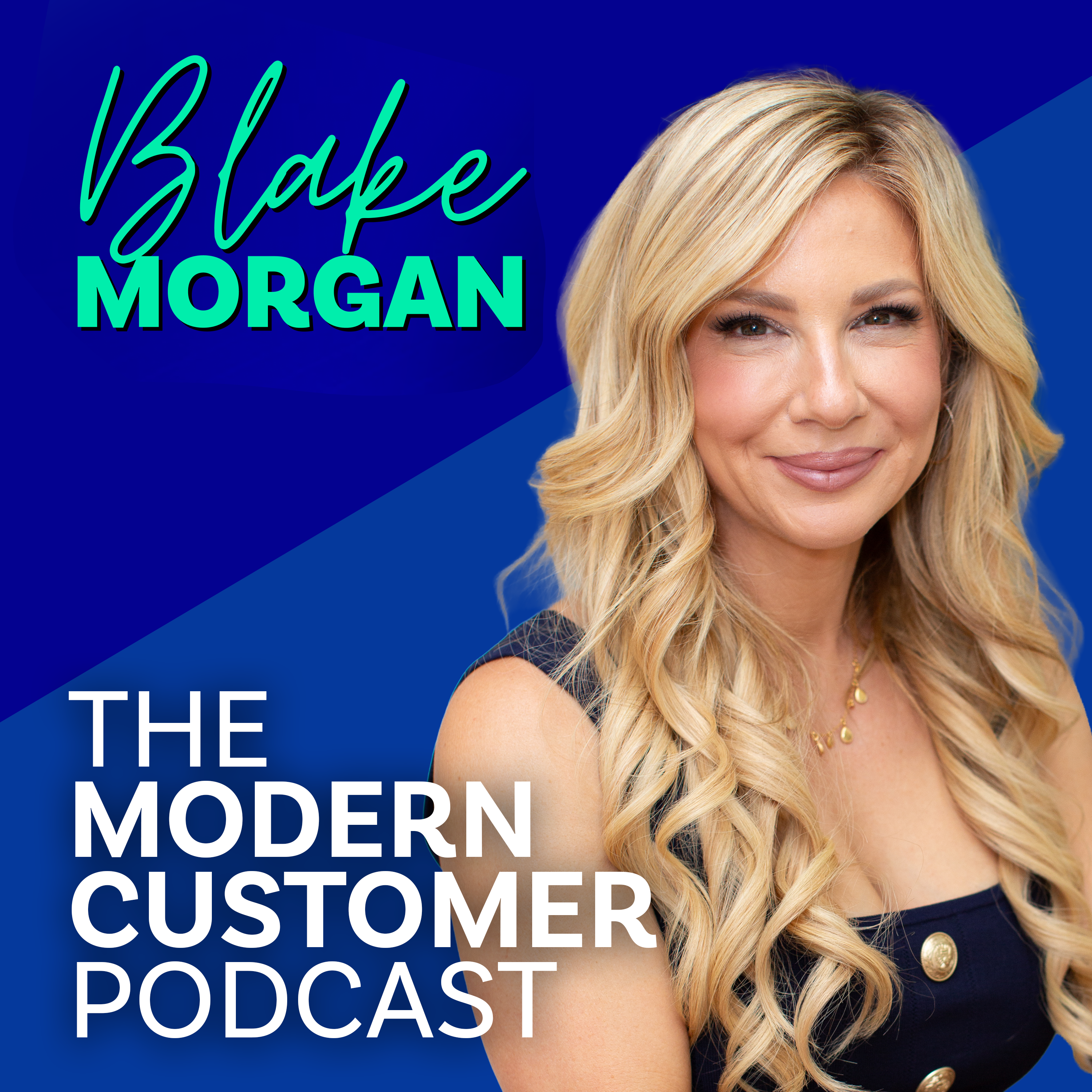
The Modern Customer Podcast
Blake Morgan
Go behind the scenes with customer experience speaker, and founder of CXO House Blake Morgan to explore the secrets of the world's most customer-centric companies.
Blake is one of the world's top keynote speakers, a leading authority on customer experience, and the bestselling author of three books on customer experience, including The 8 Laws of Customer-Focused Leadership. The Modern Customer reaches thousands of people each week, conveying the message that how we make people feel — in business and in life — matters. Her weekly show explores how businesses can make customers' lives easier and better, featuring experts who provide simple, tangible advice you can immediately apply in your own organization.
Today's customers have the luxury of choice. The answer is simple: choose customer experience, and customers will choose you. Learn how to put a stake in the ground for customer experience by tuning into The Modern Customer Podcast each week with Blake Morgan.
Blake is one of the world's top keynote speakers, a leading authority on customer experience, and the bestselling author of three books on customer experience, including The 8 Laws of Customer-Focused Leadership. The Modern Customer reaches thousands of people each week, conveying the message that how we make people feel — in business and in life — matters. Her weekly show explores how businesses can make customers' lives easier and better, featuring experts who provide simple, tangible advice you can immediately apply in your own organization.
Today's customers have the luxury of choice. The answer is simple: choose customer experience, and customers will choose you. Learn how to put a stake in the ground for customer experience by tuning into The Modern Customer Podcast each week with Blake Morgan.
Episodes
Mentioned books

Jun 8, 2021 • 34min
The Future of Customer Service Is Conversational
10 years ago, people used to email, call, or text their friends and family. Today, the vast majority of conversation happens via messengers. Business communication is set to follow the same pattern. According to Paul Adams, VP of Product at Intercom, messengers like WhatsApp, WeChat, and Facebook messenger have become the dominant way people communicate. It's a fundamental change that is impacting the business world. Most companies still rely on phone and email to communicate with customers, but Adams believes the future of business communication and customer service is conversational. Moving away from traditional communication channels and towards messengers is a win for both companies and customers. Messengers can be scaled much more easily and cost-effectively than phone or email, and customers appreciate the convenience of self-service. However, Adams is quick to acknowledge that messengers aren't the perfect fit for every situation. Messengers can be incredibly effective for simple, repetitive questions, but deeper human assistance can be needed for more complicated issues. Adams believes the future of support looks like a funnel with three layers: Proactive support. This includes outbound messaging to check on customers and their products and address any issues before they arise. Automated self-service support. Messengers can easily answer simple questions, such as checking on the status of an order or making a basic account change. Self-service options allow customers to get help when needed without having to wait. Human support. For more complicated issues, customers can be transferred to a human to provide personalized service. Although messengers are the future of business communication and customer service, Adams says it's really about marrying the scenario to the communication channel. A messenger might not always work, just like a human isn't the best option in every scenario. But leaning into messengers and using human support when needed can deliver seamless customer interactions and lead to strong business insights. In the end, successful business communication is all about staying close to customers. Messengers will see huge growth in the coming years as more companies turn to self-service options. And when those interactions help companies stay connected with customers, everyone benefits. *Sponsored by Intercom Intercom is a Conversational Relationship Platform that helps businesses build better customer relationships through personalized, messenger-based experiences. The company is bringing a messenger-first experience to all business-to-customer communication, powering 500 million conversations per month and connecting 4 billion end-users worldwide across its more than 30,000 customers, including Facebook, Amazon, and Lyft. _______________ Blake Morgan is a customer experience futurist, keynote speaker, and author of the bestselling book The Customer Of The Future. Sign up for her new course here. For regular updates on customer experience, sign up for her weekly newsletter here.
Jun 1, 2021 • 33min
3 Crucial CX Metrics
The wireless industry may be the most competitive in the world. To attract more customers, companies are constantly working to improve their services. That means delivering seamless, convenient experiences that modern customers crave. T-Mobile's goal is to make customers' lives easier as it connects them to the world. Competing on customer experience requires a strong understanding of the effectiveness of products, services and the overall experience. And that comes down to data, says Jon Freier, EVP of Consumer Group at T-Mobile. There are numerous metrics to measure customer experience, but Freier looks at three main categories and activities: What is the experience like for people who aren't T-Mobile customers and want to join? What is the experience like for existing customers who want to expand their relationship with T-Mobile? What is the experience like for existing customers when an issue pops ups? Measuring these three areas—joining, expanding and resolving issues—helps the company track the level of effort. Freier says T-Mobile chases and tracks anything that can measure how hard or easy it is to do those things. Freier believes companies are moving past traditional metrics like CSAT and NPS and towards measuring the level of effort. T-Mobile considers and tracks the level of efforts for customers to join, expand and resolve issues. That includes tracking if the experience is hard or easy, how long it takes and even how many clicks it takes to join or resolve issues digitally. If the current experience takes 25 clicks to solve an issue, Freier wants his team to get it down to 20 clicks. And then once it's down to 20 clicks, the goal is to simplify it down to 15 clicks. Simplifying the product and customer experience puts more power in customers' hands with self-service options. The goal of all companies, regardless of industry, should be to make customers' lives easier. Tracking the level of effort to join, grow and solve problems can help all companies better understand their customers and continually improve the experience. _______________ Blake Morgan is a customer experience futurist, keynote speaker, and author of the bestselling book The Customer Of The Future. Sign up for her new course here. For regular updates on customer experience, sign up for her weekly newsletter here.
May 25, 2021 • 44min
How Kate Johnson Leads Change At Microsoft
When Kate Johnson became president of Microsoft US four years ago, the stock price was at $44. Today, it's around $260. What's the reason for the immense growth? Continual digital transformation and a commitment to change. At Microsoft, Johnson is a powerful change agent who works with CEO Satya Nadella and other executives to set the company on a fast track to the future. Johnson believes that companies can have all of the ingredients for success, including a strong mission and employee experience. But if they don't have a culture that enables change, their success will be temporary. Lasting success comes from a culture that enables and promotes change and that is continually evolving and looking towards the future. But change doesn't just come from culture; it comes from people. Leaders working for change will find that their people fall into three buckets: The people who adore change and are all in. The people who hate change and try to block it. The people who are on the fence and trying to figure out which group to join. Johnson says that great change leaders listen to all three groups but specialize in helping the people on the fence join the supporters. When that happens, roughly two-thirds of people will be supportive of change, which helps leaders reach critical mass for the change they are trying to achieve. Being a change agent requires a variety of skills, including the courage to muscle through negative feedback and figure out which signals are real and which are just noise. Change agents have to be great listeners and be both real and pragmatic. Even with the challenges, Johnson says it is the most fulfilling job imaginable. Johnson's favorite problems to solve are the complex challenges that are steeped in people. She says that's where the best and most impactful change occurs. But working with people means working with their egos. One of Johnson's proven ways of calming egos is simply asking people, "Tell me more." The simple sentence helps people realize she is listening and allows them to share their viewpoint calmly and without ego. It doesn't mean she always agrees with the other side, but it helps her better understand people and make progress. Microsoft's digital transformation has brought about many changes, but Johnson says the main focus has been changes related to customers. She believes that if the company is going to obsess over one thing, it needs to be customers. Customer-centric leaders need to be change agents. By understanding people, cutting through ego and obsessing over customers, leaders can make lasting and impactful change within their organizations. *Sponsored by Wix Answers It's been a year of change for businesses. What's making this period most challenging is the lack of clarity. But, that's also where there's an opportunity to stand out by building trust in your relationships with your customers with agile communication. Wix Answers takes a new approach to customer support by helping you adapt quickly to know exactly what your customer needs and when they need it. Go and see for yourself today at WixAnswers.com. _______________ Blake Morgan is a customer experience futurist, keynote speaker, and author of the bestselling book The Customer Of The Future. Sign up for her new course here. For regular updates on customer experience, sign up for her weekly newsletter here.
May 18, 2021 • 38min
An Economist On Why Price Gouging Regulation Actually Caused More COVID Cases And Deaths
At the height of the COVID pandemic in spring 2020, toilet paper and hand sanitizer were the hottest items on store shelves. The search for these essential items grew to a fever pitch, with customers lining up for hours and scouring the internet to get their hands on these hot commodities. As demand skyrocketed and shelves cleared, many states and retailers put price gouging regulations into effect. But those efforts to help consumers may have actually led to more COVID cases and deaths. Gavin Roberts, assistant professor of economics at Weber State University, studied the impacts of price gouging regulation during the pandemic. Typically, price gouging regulation is put in place by state governments during localized public emergencies. Roberts gave the example of a hurricane, which may only affect one or two states. In that case, the affected states may enact price gouging regulation, which says that retailers can't increase the price for essential items, such as gas, toilet paper and hotel rooms, beyond a certain percentage of increase or what some states call an "exorbitant increase". But the COVID pandemic affected the entire world, leading to widespread price gouging regulations like we've never seen. Economists widely believe that price gouging regulations cause shortages, which was definitely the case during COVID. Price gouging regulation limits what companies want to sell. If companies can't make much money, they aren't as motivated to sell their products, which leads to a shortage of items. Roberts observed that customers increased their internet searches for items like toilet paper and hand sanitizer, which follows the pattern of price gouging regulation. When goods are in shortage, people search for them more. But the widespread COVID pandemic took things one step further. When customers couldn't find what they needed online, they searched in person. Price gouging led to a shortage of products and customers rushing to brick-and-mortar stores, right during the push for virus mitigation efforts and a need to stay at home. Roberts' research shows the rush of customers to stores to buy toilet paper and hand sanitizer led to a wider spread of COVID cases and deaths. Price gouging regulation is often put in place so that low-income individuals don't get priced out of essential items. But Roberts believes price gouging regulation isn't an effective measure in supporting low-income families. We need to take the next step to think about if the policy actually helps those in need. Going forward, he wants companies and governments to carefully consider if the policies and regulations they put in place actually help the people they are intended to or if they cause more harm than good. The early days of the COVID pandemic were unlike anything we've ever seen, largely due to the lack of essential items like toilet paper. The pandemic has caused us to re-evaluate many practices and policies, including price gouging regulation. *Sponsored by Wix Answers It's been a year of change for businesses. What's making this period most challenging is the lack of clarity. But, that's also where there's an opportunity to stand out by building trust in your relationships with your customers with agile communication. Wix Answers takes a new approach to customer support by helping you adapt quickly to know exactly what your customer needs and when they need it. Go and see for yourself today at WixAnswers.com. _______________ Blake Morgan is a customer experience futurist, keynote speaker, and author of the bestselling book The Customer Of The Future. Sign up for her new course here. For regular updates on customer experience, sign up for her weekly newsletter here.
May 11, 2021 • 36min
How the Former Impossible Foods Brand Lead Created A Plant-Based Drink Brand
Of all the industries to break into, the beverage space is among the most difficult. The hyper-competitive market and domination from big brands make it incredibly challenging for entrepreneurs to get their products on shelves. But Jordan Schenck has experience and grit on her side. As the former Head of Global Consumer Marketing at Impossible Foods, Schenck knows how to build a plant-based food brand. She spent nearly four years traveling the world and talking to people about their relationship with plants and played a huge role in the growth of the plant-based trend. She used that experience to co-found Sunwink, a wellness company focused on plant-based drinks. Schenck says the beverage section is the only area of the grocery store consumers use multiple times daily. It's a space with hyper-consumption that's also super high-touch. But Schenck says there's not much on the shelf that is actually good--it's dominated by soda and products with ingredients that may claim to be good but actually aren't that healthy. Schenck and her co-founder started Sunwink because they were excited to be in a high-velocity space and also have the opportunity to make statements and do creative work. Building such an innovative brand in a competitive industry starts with knowing customers. The Sunwink founders spent a year sampling its many variations in grocery stores. They had to understand what works with flavors, which audiences organically opted in and who would be their easy-win customers. It took grit and determination to show up at grocery stores and convince them to demo the drinks and maybe sell one product on the shelf. That work paid off. When Sunwink launched, Schenck said it was amazing the amount of nascent demand for a product that is not only beautiful on the outside but also beautiful on the inside. As the company started to scale online, they did a lot of surveying and constantly asked customers what they wanted to see and what was and wasn't working. Although Sunwink initially launched primarily in grocery retail, it split soon after the pandemic started and grew in the DTC space. It's rare to find a DTC beverage company, especially because of the high shipping costs, but Sunwink saw 14x growth on the channel and found creative solutions to lower shipping costs. E-commerce quickly became the primary revenue driver during the pandemic and created a huge community through email and social media. As Sunwink grows, Schenck aims to spread the plant-based message and show a wider view of wellness. She defines wellness as having your cake and eating plants too. Sunwink is vocal about the fact that wellness isn't about perfection and how incredible your yoga backbend is—it's about your journey as an individual to find wholeness. Yes, you can have the cocktail and the donut and drink plants. Schenck says it's about the little moments of taking care of yourself. Schenck hopes to continue Sunwink's success and build a brand around plant-powered wellness. Her goal is to create a brand that has cultural resonance about caring for your body and caring for your planet. She's breaking down barriers as a female entrepreneur and showing the power of plants for total wellness. *Sponsored by Wix Answers It's been a year of change for businesses. What's making this period most challenging is the lack of clarity. But, that's also where there's an opportunity to stand out by building trust in your relationships with your customers with agile communication. Wix Answers takes a new approach to customer support by helping you adapt quickly to know exactly what your customer needs and when they need it. Go and see for yourself today at WixAnswers.com. _______________ Blake Morgan is a customer experience futurist, keynote speaker, and author of the bestselling book The Customer Of The Future. Sign up for her new course here. For regular updates on customer experience, sign up for her weekly newsletter here.
May 4, 2021 • 34min
How To Meet Customers Where They Are With Knowledge Management
It's something all customers have faced: they have a problem or question, but the only way to resolve it is to wait on hold with the contact center or fill out a contact request form. The process is long and frustrating. Modern customers want another approach to solving their problems. Knowledge management is a way to connect the dots and keep communication lines open with customers. Instead of companies holding all the answers, knowledge management shares resources like articles and self-service portals so customers can solve their own issues and provides a platform for communication across all channels. Naomi Rozenfeld, VP of Revenue at Wix Answers, says effective knowledge management is all about meeting customers where they are. Up until recently, knowledge management was difficult for many companies to talk about. Rozenfeld narrows it down to two main challenges: a lack of executive support within the company and technology limitations with support divided into silos that created a fragmented experience for customers and employees. But over the past year, COVID has accelerated the need for self-service knowledge management. As the world was shutting down, companies realized that customers still needed support. Instead of waiting and reacting to customer issues and questions, companies need to proactively answer customer questions and provide resources. Customers want to be in control of their service. Rozenfeld says knowledge management is now a need, not a want. She believes that what's going to win business over for future transactions is how quickly a company can resolve an issue or how easy it is for customers to resolve their own issues. Rozenfeld calls it the iceberg effect, or the idea that for every one person who opens a ticket or contacts the care team, there are nine people who don't. That 90% of customers who don't get in touch leave frustrated. Effective knowledge management provides resources and helps all customers, especially the vast majority who don't want to have to spend time reaching out to a company. Effective knowledge management starts by addressing the two main challenges. Rozenfeld says companies must have an executive sponsor to understand the impact on revenue and the company. CX managers and change agents need to make sure leaders understand why they need to invest in the tools to enable customers to solve problems on their own. The second challenge is around technology. Companies need to stop looking at support through silos. Rozenfeld says silos and unconnected channels create gaps for customers to fall. But when channels are tied together and speaking the same language, the customer only has one entry point. It doesn't matter where they started or how they communicate with the brand. Customer interactions are simplified and the agent can see the entire path instead of only having a view of one part of the problem. Knowledge management is on its way to becoming a cornerstone of the modern customer experience. Meeting customers where they are and proactively providing great service creates empowered and satisfied customers. *Sponsored by Wix Answers It's been a year of change for businesses. What's making this period most challenging is the lack of clarity. But, that's also where there's an opportunity to stand out by building trust in your relationships with your customers with agile communication. Wix Answers takes a new approach to customer support by helping you adapt quickly to know exactly what your customer needs and when they need it. Go and see for yourself today at WixAnswers.com. _______________ Blake Morgan is a customer experience futurist, keynote speaker, and author of the bestselling book The Customer Of The Future. Sign up for her new course here. For regular updates on customer experience, sign up for her weekly newsletter here.
Apr 27, 2021 • 33min
CMO Lessons From Bruno Mars' Brand SelvaRey Rum
In a sea of celebrity brands, how can a company stand out and attract customers? It comes down to being passionate, innovative and empathetic. Many celebrities are only involved with their brands as far as simply putting their name on a product, but Bruno Mars' rum brand SelvaRey is different. He spent three years redesigning the SelvaRey packaging to create a stylish and eye-catching bottle and is passionate about the brand and its products. That passion and innovation extends to the entire team and is what attracted CMO Brielle Caruso to the brand. Caruso joined the company six months ago, making her the first female Asian American CMO in the U.S. wine and spirits industry. Caruso has helped build numerous brands and knows what it takes to stand out. Marketing is really about communicating and building relationships. Caruso believes communication means everything and that brilliant communicators must have strong observational awareness. It's impossible to be a great marketer without being a great listener. At SelvaRey, that means listening to customers and understanding the context of what they are looking for. In her career, it means actively listening to her team members and building real connections. Over the past six months, SelvaRey has launched four new products, some of which sold out in days. Part of Caruso's job has been to educate customers about rum and break down stereotypes and showcase the wide range of products. Listening to customers led the brand to release products at different entry points. Marketers are often taught that it's all about themselves—about sharing their message and pushing their products. But Caruso believes that people who step back and listen, not to respond but to understand and add empathy, become better leaders. With that empathy and listening comes humility. Caruso says it's important to be grounded, which she does by writing down her goals and gratitudes. Especially after a difficult year, she believes it's important to reach out to people and check in on them instead of assuming everyone is fine. Building those relationships and being humble helps marketers stay focused and grounded, which only adds to their success. In a world full of ego and self-promotion, truly caring about other people can help you stand out. Many women in male-dominated industries face the challenge of being the only woman in the room. But Caruso has learned that her unique assets are valuable and important and that she needs to speak up to represent female customers. Women drink alcohol, so companies can't just have men creating the strategic goals and marketing. They need a woman's insight and will listen to the women in the room, even if there's only one. Caruso believes companies need to push for employees and marketers who are representative of the population who is using the product. Standing out in the marketing world isn't always about being the flashiest. It comes down to being passionate, innovative and empathetic. The loudest campaigns may catch customers' eyes, but lasting success comes to the companies and marketers that know how to build relationships and stay grounded. SelvaRey shows that strong communication can build a winning brand. *Sponsored by Pegasystems #PegaWorld It's almost time for PegaWorld iNspire, the annual conference from Pegasystems. Join them online for free on May 4 from 9 a.m. – 11:30 a.m. Eastern Time to learn how the world's most impactful companies are driving digital transformation. They'll have compelling keynotes, demos, and case studies in a highly interactive virtual format and a few surprises as well. Go to www.pegaworld.com to register for free and check out the full agenda. I've attended the last several PegaWorlds in person, and virtual, and I can't recommend it enough, so go register today! That's www.pegaworld.com. Blake Morgan is a customer experience futurist, keynote speaker, and author of the bestselling book The Customer Of The Future. Sign up for her new course here. For regular updates on customer experience, sign up for her weekly newsletter here.
Apr 20, 2021 • 23min
The State Of The Economy In 2021
Saying 2020 was a rocky year may be the ultimate understatement. But after the turmoil and uncertainty, customers, brands and investors want to know what the economy looks like in 2021. According to Fox Business Network's Charles Payne, there's reason to be extremely optimistic. In 2021, consumer savings are near record highs. That, combined with government stimulus money, means that there is a lot of money and the ability to spend it once consumer confidence levels pick up. Part of the reason to expect economic growth in 2021 is the concept of revenge shopping or revenge travel as the pandemic starts to subside. After more than a year of shutdowns and quarantines, customers are eager to spend money, have experiences and travel. Payne predicts that customers will want to make up for lost time, which will be great for the economy. Although there has been tremendous job loss and countless businesses closing during the pandemic, new business applications have gone through the roof in recent months. The fact that people are confident enough to start businesses is a good sign for the economy, and consumers will likely give a special effort to support small businesses, at least initially. Small businesses are poised for success, and the economy needs them to thrive. But Payne points out that these businesses don't exist in a vacuum, and uncertainty and actions taken towards big businesses could potentially hurt smaller businesses. For new small businesses to thrive, they need continued customer support. The growth of the economy is also tied to the growth of construction and real estate. Over the last year, we've seen a growing exodus from expensive cities to less expensive suburbs. Just a few years ago, consumers wanted to rent everything instead of owning, but in today's world, customers want the control and confidence that comes from owning things, especially homeownership. To rebound after the pandemic exodus, Payne says cities will have to reinvent themselves and become experience hubs. That growth and change could foster new business growth as consumers look to make up for lost experiences. The economy is certainly changing in 2021, but overall, things are looking up. With consumers eager to spend, small businesses on the rise and a change and reinvention for cities and suburbs, this year will have a lasting impact on the economy—for the positive. *Sponsored by Pegasystems #PegaWorld It's almost time for PegaWorld iNspire, the annual conference from Pegasystems. Join them online for free on May 4 from 9 a.m. – 11:30 a.m. Eastern Time to learn how the world's most impactful companies are driving digital transformation. They'll have compelling keynotes, demos, and case studies in a highly interactive virtual format and a few surprises as well. Go to www.pegaworld.com to register for free and check out the full agenda. I've attended the last several PegaWorlds in person, and virtual, and I can't recommend it enough, so go register today! That's www.pegaworld.com. Blake Morgan is a customer experience futurist, keynote speaker, and author of the bestselling book The Customer Of The Future. Sign up for her new course here. For regular updates on customer experience, sign up for her weekly newsletter here.
Apr 13, 2021 • 36min
How To Be A B2B Marketer In A Pandemic
Technology doesn't stop during a pandemic. Because of that, VMware needs to stay connected to customers and showcase its multi-cloud technology. But in the B2B industry, which is traditionally driven by in-person events and marketing, building relationships and growing leads virtually poses a challenge. VMware CMO Carol Carpenter stepped into her role in the middle of the COVID pandemic and had to quickly move to virtual marketing. Although there have been challenges, she says B2B marketing during a pandemic has also had some positive impacts. The root of Carpenter's marketing approach is communication and data. She aims to over-communicate, both to her team of more than 700 people and to customers and prospects. Her team also relies heavily on data—especially during the pandemic—to track its progress and tailor experiences and marketing campaigns that resonate with customers. Carpenter says being able to understand a customer's needs, thoughts and values is crucial. As marketing shifted online, Carpenter's team unleashed its creativity. Using communication and data as a foundation, it moved traditionally in-person events to virtual venues. VMware has hosted events like chocolate tastings, whisky tastings and concerts with famous musicians. As a bonus, customers and prospects are able to include their families, which adds to the relationship-building. Moving online has allowed B2B marketers to better engage their prospects and clients. In the physical world, a company can track who attended a dinner and event. But it can be difficult to know if the person was actually engaged or interested in the product. When things move online, however, companies can track who participated, what they looked at, who they talked to and what they talked about. It provides a much fuller picture of what each person did at the event and allows marketers to follow up with specific questions and comments. Although in-person events have paused, Carpenter says B2B marketers still have incredible opportunities to build relationships when they focus on communication, data and creativity. COVID has brought challenges for all industries, especially B2B, but marketers around the industry and at VMware are finding the positive, pivoting and keeping their companies moving forward. *Sponsored by Pegasystems #PegaWorld It's almost time for PegaWorld iNspire, the annual conference from Pegasystems. Join them online for free on May 4 from 9 a.m. – 11:30 a.m. Eastern Time to learn how the world's most impactful companies are driving digital transformation. They'll have compelling keynotes, demos, and case studies in a highly interactive virtual format and a few surprises as well. Go to www.pegaworld.com to register for free and check out the full agenda. I've attended the last several PegaWorlds in person, and virtual, and I can't recommend it enough, so go register today! That's www.pegaworld.com. Blake Morgan is a customer experience futurist, keynote speaker, and author of the bestselling book The Customer Of The Future. Sign up for her new course here. For regular updates on customer experience, sign up for her weekly newsletter here.
Apr 6, 2021 • 34min
How To Build A Loyalty Program In A Post-COVID World
Loyalty programs are an important part of many brands' customer engagement strategies, but yesterday's loyalty programs won't necessarily be successful today. According to Francis Hondal, President of Loyalty & Engagement at Mastercard, the recent growth of tech, digital commerce and data have redefined opportunities for brands to serve their customers in the way they expect to be served. Those opportunities have changed even more over the last year with the global COVID pandemic. One of the biggest trends coming out of COVID is the un-calendarized year, meaning that everything has shifted from when it normally occurs. Things like sports seasons, events and travel are now happening on a different schedule than years past. In response, Hondal says brands need to focus on providing flexibility to their customers. The best loyalty programs adapt to meet customers' current needs and offer them flexibility and choices. Hondal gives the example of an airline that changed its rewards program to allow customers to use their airline loyalty points to buy groceries and support local businesses. With fewer people traveling, it was a way for the airline to stay connected to customers and for customers to meet their everyday spending needs with their existing points. Customers crave optionality. They don't want to be boxed into using a loyalty program in one certain way. Customers are hesitant to be stuck with just one way of doing things now that they've seen just how much the world and their personal situation can change. When brands are flexible, it drives long-term engagement and continues to make the company relevant, even during uncertain and chaotic times. There are different ways of engaging with customers than typical rewards programs. Flexibility and newness are hot right now, and brands that can tap into those trends can build real connections with their customers. Hondal says creating an amazing loyalty program starts by understanding consumers, both new and existing. Companies need to use data and have a strong data management system in place so they can stay on top of changing customer demands and trends. She says one of the most important pieces of delivering a seamless customer experience is connecting the dots within the company so that customers have a consistent experience and don't have to repeat themselves. In this COVID and post-COVID world of loyalty programs, brands need to focus on contextual connections with customers and connecting with people when it matters most. By truly understanding customers and knowing what they need and when they need it, brands can stay relevant and offer options and flexibility. Loyalty programs aren't what they used to be, especially after COVID. By leveraging data and focusing on flexibility and optionality, brands can create and strengthen bonds with loyal customers for years to come. *Sponsored by Pegasystems #PegaWorld It's almost time for PegaWorld iNspire, the annual conference from Pegasystems. Join them online for free on May 4 from 9 a.m. – 11:30 a.m. Eastern Time to learn how the world's most impactful companies are driving digital transformation. They'll have compelling keynotes, demos, and case studies in a highly interactive virtual format and a few surprises as well. Go to www.pegaworld.com to register for free and check out the full agenda. I've attended the last several PegaWorlds in person, and virtual, and I can't recommend it enough, so go register today! That's www.pegaworld.com. Blake Morgan is a customer experience futurist, keynote speaker, and author of the bestselling book The Customer Of The Future. Sign up for her new course here. For regular updates on customer experience, sign up for her weekly newsletter here.

