

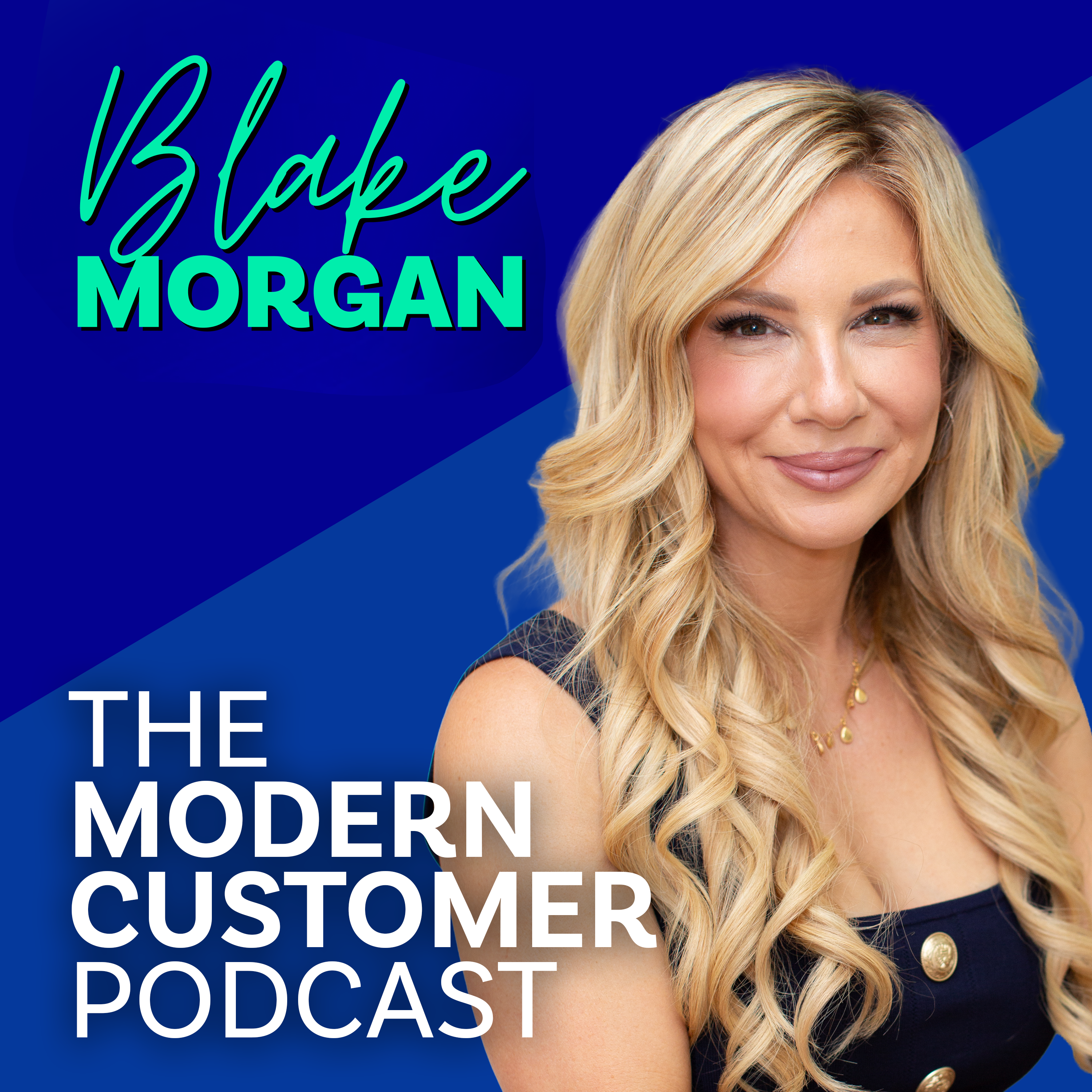
The Modern Customer Podcast
Blake Morgan
Go behind the scenes with customer experience speaker, and founder of CXO House Blake Morgan to explore the secrets of the world's most customer-centric companies.
Blake is one of the world's top keynote speakers, a leading authority on customer experience, and the bestselling author of three books on customer experience, including The 8 Laws of Customer-Focused Leadership. The Modern Customer reaches thousands of people each week, conveying the message that how we make people feel — in business and in life — matters. Her weekly show explores how businesses can make customers' lives easier and better, featuring experts who provide simple, tangible advice you can immediately apply in your own organization.
Today's customers have the luxury of choice. The answer is simple: choose customer experience, and customers will choose you. Learn how to put a stake in the ground for customer experience by tuning into The Modern Customer Podcast each week with Blake Morgan.
Blake is one of the world's top keynote speakers, a leading authority on customer experience, and the bestselling author of three books on customer experience, including The 8 Laws of Customer-Focused Leadership. The Modern Customer reaches thousands of people each week, conveying the message that how we make people feel — in business and in life — matters. Her weekly show explores how businesses can make customers' lives easier and better, featuring experts who provide simple, tangible advice you can immediately apply in your own organization.
Today's customers have the luxury of choice. The answer is simple: choose customer experience, and customers will choose you. Learn how to put a stake in the ground for customer experience by tuning into The Modern Customer Podcast each week with Blake Morgan.
Episodes
Mentioned books

Nov 10, 2020 • 33min
5 Tips To Create The Perfect Customer Survey
The backbone of a strong customer experience is feedback. And it's never been more important than it is now. According to Tom Hale, president of SurveyMonkey, digital surveys and feedback have seen tremendous growth during the COVID-19 pandemic. With companies forced into new ways of doing business and interacting with their customers, feedback has never been more crucial. Surveys allow companies to check their progress and see what needs to be improved, especially at a time when so many things are new and changing. New research from SurveyMonkey found that 87% of CX professionals say customer feedback is more important now than it was before COVID. Customer experience and feedback has taken a higher priority because of the pandemic, and Hale doesn't think it will ever change back. The struggle then becomes how to get the most effective and useful feedback. In order to get great feedback, companies must know how to create a great survey. Here are five tips to creating the perfect customer survey: Start with NPS. Hales says the gold standard for customer feedback is a question about NPS (Net Promoter Score), which is an accurate way of measuring how likely customers are to recommend the company. A high NPS means customers are generally quite satisfied with the experience. Start the survey by asking, "Would you recommend this product/service to a friend?" and allow customers to rate their response on a scale from 0-10. Leave space for open responses. Great surveys combine numerical answers and free responses. When asking about NPS, follow it up with an open text box to encourage customers to elaborate on why they would or wouldn't recommend the company. Open responses can be used to elaborate on nearly any question and add more depth to the survey responses. Think through the entire experience. The perfect customer survey isn't just about the questions—it's about the entire experience. Hale shared his own example of when he bought a new treadmill and received the follow-up survey just after it was delivered when he was in the thick of assembling the complicated machine. Too many companies ask for feedback at the wrong time. Hale's response would have been very different if he had received the survey a few days later after he had time to assemble and try the treadmill instead of receiving it when he was distracted and stressed. Make it easy for customers to respond. Think through the entire experience of when a customer will receive the survey, how long it will take them to complete and how they will feel when they're completing the survey. Customers are much less likely to respond to feedback requests that are too complicated or have too much friction, such as when they receive a printed receipt with a long survey link they have to type in themselves. Great, accurate customer feedback comes when it is easy for customers to give responses. As Hale says, much of designing the experience is the communication around the experience, including how you ask the questions. Give surveys throughout the entire customer lifecycle. Successful customer feedback doesn't just come after a customer has made a purchase. SurveyMonkey surveys its own customers at all parts of the lifecycle to have metrics and feedback about the entire experience from start to finish. The surveys look slightly different based on where they are given in the customer journey, but the information pinpoints areas for improvement and helps prioritize what needs to be changed first. The root of the perfect customer survey is customer-centricity. When a company has a culture of being customer-centric, it comes through in their entire experience, including asking for feedback. When companies truly care for their customers and design experiences around them, it shows in useful feedback that guides the customer experience and improves all aspects of the journey. Blake Morgan is a customer experience futurist, keynote speaker, and author of the bestselling book The Customer Of The Future. Sign up for her new course here. For regular updates on customer experience, sign up for her weekly newsletter here.
Nov 3, 2020 • 31min
How Shake Shack Grows Its Brand Through CX
If you've been to one of Shake Shack's 300-plus locations around the world, chances are you've had to wait in line. The restaurant draws a crowd with its fresh ingredients and elevated take on fast food. The entire brand is built around great food and great service, and it's a hit with customers. Shake Shack stands out because of its fine dining-inspired approach to burgers and fries. The restaurant uses real ingredients, fresh flavors, and great chefs to make food to order. The wait might be a little longer, but customers don't mind standing in line to get amazing food. According to CMO Jay Livingston, delivering a strong customer experience has been part of Shake Shack's brand since the beginning. The company doesn't just want to use the fine-dining approach in its food, it also wants to use fine dining to inspire its experience. The company aims to provide great hospitality and an elevated guest experience. Employees offer personalized service and customize each meal instead of simply rushing to put food on the plate. Employees at all levels give their best to customers, no matter where they work or how busy they are. Every Shake Shack employee spends their first five days at the company working all the stations in a restaurant, including prepping the food, manning the grill, and working the cash register. Livingston says it instills in employees, even those who don't work in the actual restaurants, the work that goes into delivering fine dining food to customers quickly and hammers home the brand promise. Shake Shack uses customer experience to build its brand by being transparent and authentic in every interaction it has with customers. The company is moving to become more data-driven to better understand guests and test ideas more quickly. That hasn't changed during the COVID-19 pandemic, as Shake Shack has been forced to speed up the buildout of its digital products. Customers can now order online or through the app for pickup and delivery as a way to expand the experience to what customers need most. It even rolled out a DIY burger kit so customers can make their favorite Shake Shack burgers at home and will unveil drive-thrus in 2021—all in the name of delivering great food just how customers want it. Shake Shack has a strong online presence and regularly collaborates with top chefs on its social channels to show their process for making food. The collaborations give guests a behind-the-scenes look into how the food is developed and cooked. The goal isn't to sell hamburgers, it's to connect with guests on a deeper level and involve them in the many sides of Shake Shack. Customer experience is the foundation of Shake Shack's brand. Continually developing CX and relating it back to the major brand promises of elevated food and service has helped Shake Shack see incredible growth. Blake Morgan is a customer experience futurist, keynote speaker and author of the bestselling book The Customer Of The Future. Sign up for her new course here. For regular updates on customer experience, sign up for her weekly newsletter here.
Oct 27, 2020 • 31min
What Marketers Really Need To Know About Gen Z
For years, experts have talked about millennials and looked towards the future of Generation Z, the generation to follow. But Gen Z is now here and already having a massive impact, both as employees and as consumers. Marketers need to understand Gen Z to realize its full impact and to separate the truth from long held myths. Generational researcher Jason Dorsey is an expert on all things Gen Z. He studies generational behavior so that leaders, marketers, employers and others can understand the differences between each generation. But he warns against putting generations in boxes. The wide range of ages and life experiences means that within a generation are multiple different groups. However, generations offer powerful clues that can drive trust and help marketers create valuable experiences by bringing them one step closer to understanding their consumers. Contrary to what many people think, Gen Z isn't made up entirely of teenagers. The group is growing up, so that the oldest members are now approaching their mid-20s. Gen Z is the fastest growing generation in the workforce. Most people view Gen Z as the next wave of millennials, but Dorsey's research shows that Gen Z is actually very different. He calls Gen Z a throwback generation that actually has more in common with baby boomers than millennials. Gen Z is one of the most frugal generations. They are more likely to use coupons and find deals than their millennial predecessors. They want to graduate college without debt and tend to care more about their workplace benefits. A large number of Gen Z is even already saving for retirement. Dorsey's research also found that Gen Z will soon leapfrog some millennials in the workforce, creating a strange combination of generations and ideologies. Gen Z is more likely to trust an influencer or someone like them over someone with advanced degrees. And because they've grown up with technology and smartphones, Gen Z values social media and the news it provides, but realizes it creates many mental health triggers. Gen Z doesn't remember 9/11, which was the generational defining event for millennials. Gen Z doesn't know life before 9/11, and their lives aren't shaped by the changes that happened after the event. Gen Z doesn't represent change because this is all they've ever known. In many ways, the COVID-19 pandemic will be the generational defining event for Gen Z and impact their mindset moving forward. So what does this mean for marketers? Understanding that Gen Z isn't simply millennials 2.0 is an important differentiation. Gen Z values different things than millennials and has different priorities. They also aren't the teenagers many have long considered Gen Z to be. Gen Z will have a tremendous impact on the workforce and the economy going forward as they become the most powerful generation. Understanding generations gives marketers clues and tools to know their consumers. With this understanding of generational cues, marketers can create more personalized experiences that best target this influential group. Blake Morgan is a customer experience futurist, keynote speaker and author of the bestselling book The Customer Of The Future. Sign up for her new course here. For regular updates on customer experience, sign up for her weekly newsletter here.
Oct 20, 2020 • 30min
How Digital Transformation Is Helping Create A COVID Vaccine
In the midst of a global pandemic, pharmaceutical companies around the world are rushing to develop a vaccine to COVID-19. In an industry that typically takes years to create, test and market new drugs, the incredible time crunch for the COVID vaccine is pushing companies to their limits. But it's not just pharmaceutical companies that are in the race to create a vaccine. There are also companies helping behind the scenes with digital transformation. NECI and its president Tom Ramundo are working with pharmaceutical companies to create a digital stack so they can bring their product to market much more quickly. Digital transformation and industrial automation greatly speed up the testing process by using data and predictive analytics to see how a vaccine performs in trial. Ramundo says that many of the companies working to create a COVID vaccine were born to be digital companies. They are taking the digital fingerprint of the protein that makes up the virus and utilizing it to develop their product. When working on a project that changes the timeline from months and years to days and weeks, companies must be digitally enabled. Without a digital transformation, companies couldn't come close to creating a COVID vaccine in record time. Companies don't need to be finding the cure to a global pandemic to undergo a digital transformation. Ramundo says it's critical for every company, no matter the industry, to adopt digital solutions to improve their processes and become more efficient. Ramundo's work on the COVID vaccine has highlighted three digital transformation trends: It's not all about technology. Digital transformation centers around digital tools and capabilities, but the people are equally important. Without passionate people, a digital transformation can fall flat. Ramundo says the COVID team at NECI all volunteered to work on the project because they are passionate about the cause, which helps things move even faster. Leadership must be engaged. Everyone has to be on board for a successful digital transformation. Starting from the top, leaders and executives must be engaged and lead the cause. Leaders also need to develop a plan for employee buy-in to get everyone on board and show the value of the changes. Digital transformation includes everyone, from IT to HR, finance and beyond. Don't take your eye off the ball. Digital transformation is about smart, integrated technology, but at the end of the day, it has to solve problems. A digital solution that is flashy but doesn't actually improve the company is a waste. What are the problems you are trying to solve? Ramundo recommends starting small, achieving business results and then repeating the process on other problems. Digital transformation is paving the way for a COVID vaccine to be introduced in record time. It can have an equally transformative effect on companies that focus on strategy and tie the digital offerings back to their business goals. Blake Morgan is a customer experience futurist, keynote speaker and author of the bestselling book The Customer Of The Future. Sign up for her new course here. For regular updates on customer experience, sign up for her weekly newsletter here.
Oct 14, 2020 • 33min
How Companies Can Involve Customers In The Fight Against Carbon Emissions
Most companies and consumers know they should fight against climate change and want to make a difference, they just don't know how. With carbon emissions increasing across the globe, it can feel overwhelming to make a difference. Companies don't know how to start or even if their efforts will pay off and actually have an impact. Austin Whitman is founder and CEO of Climate Neutral, a non-profit organization that makes it simple for companies to track and offset their carbon emissions and certifies companies that are actively working to reduce their carbon emissions. The goal is to provide companies a turn-key addition to their sustainability work and to start conversations with consumers about climate change. Whitman believes that the fight against carbon emissions is improved when companies involve customers in their eco-friendly initiatives. Not only does it empower customers, but it also creates a powerful partnership for good. Here are three ways to connect with customers on climate change: Make it simple for customers to make a difference. Modern consumers are overwhelmed by choices. Many consumers want to make responsible choices but simply don't know how. Climate Neutral makes it easy for customers to purchase the most eco-friendly products. Companies that have gone through the certification process can put a label on their products to show customers their products are fighting against climate change. When customers are faced with options of products to buy, they can simply choose the product with the Climate Neutral symbol and know they are making the best choice. The goal of companies should always be to make customers' lives easier, especially when it comes to making sustainable choices. Show customers change is possible. Whitman says it's powerful when brands engage with their customers on climate change. Brands need to show consumers that fighting against climate change can lead to real results. Show customers that brands can still deliver high-quality items while reducing their carbon emissions. Focus on what's achievable. Many consumers are hesitant to make eco-friendly purchases because they don't want to change from their favorite products or dramatically alter their lives. But when brands showcase that progress can happen without taking away products and quality customers enjoy, it can lead to real change. Offer optimistic solutions. Instead of using scare tactics to engage customers in the fight against climate change, brands should stay hopeful and optimistic. The key is to start a conversation and provide solutions instead of just highlighting the problems. Many consumers feel they're on their own to make the best decisions to limit their carbon footprints. Show them that it's a collaboration between brands and customers and that together, we can all make progress. Climate change is a real problem for our world, but customers and companies can make a positive difference when they work together. Climate Neutral shows organizations that it's possible to take a real stand against carbon emissions. When brands involve their customers in the conversation and action, the movement becomes even more powerful. Blake Morgan is a customer experience futurist, keynote speaker and author of the bestselling book The Customer Of The Future. Sign up for her new course here. For regular updates on customer experience, sign up for her weekly newsletter here.
Oct 7, 2020 • 35min
How Retailers Can Build Trust In A Post-COVID World
After months of quarantine and isolation, consumers are slowly starting to adjust to a new life with COVID-19. As stores reopen and re-adjust, they are faced with customers who are drastically different than they were just six month ago. According to Walter Robb, former co-CEO of Whole Foods, in order to transition and move forward, stores must re-build consumer trust. Moving forward in the pandemic starts by understanding what customers are thinking and feeling. Robb's current company, S2G Ventures, recently published a report about the future of food in the age of COVID and uncovered many changes to customers' mindsets. Today's customers are out of their pre-COVID rhythm and are trying to find and settle into new routines while wrapping their heads around all the changes. Customers are adjusting and adapting by doing more things at home, leaning on different experiences and connecting with friends and brands digitally. Amidst all these changes, what customers really want is trust. They want the safety, security and transparency of trusting the companies they do business with. That includes things like knowing where their food comes from and understanding the manufacturing process for their clothes and home items. According to Robb, today's retailers are at a tipping point: with a new generation of shoppers and a new world situation, companies have to contribute to solutions—they can't just sit back. Retailers must actively work to build consumer trust by being transparent and authentic. Robb says retailers can re-earn trust and loyalty through three key principles: Act with integrity in every interaction. Customers interact with brands in a number of ways, from apps to in-store experiences and new digital platforms. Each interaction is a chance for a brand to re-earn trust and loyalty. Lasting trust comes from consistent actions. Customers have to know what to expect and that they will get great service every time they interact with the brand. Building trust doesn't require huge actions—it's the simple, everyday interactions that make a difference when they are authentic and consistent. Be willing to serve customers. Some customers say they want to be served in certain ways, such as grocery customers saying they want to pick up items in store or have certain things delivered. It's up to brands to develop the capabilities to serve customers how and when they want to be served. Brands earn trust when they listen to customers and are willing to meet their needs. Use data to understand customers. Most customers are willing to share their personal information with a brand if it leads to more personalized experiences. Modern customers expect companies to know who they are and act according to their individual preferences. Brands can't build unique experiences and establish trust if they don't know their customers. COVID has changed how customers think and act, and retailers need to respond accordingly. To build trust, brands must understand modern customers and find ways to rebuild trust every day. Blake Morgan is a customer experience futurist, keynote speaker and author of the bestselling book The Customer Of The Future. Sign up for her new course here. For regular updates on customer experience, sign up for her weekly newsletter here.
Sep 29, 2020 • 30min
Six Ways To Support Employees During COVID-19
What do you do when everything about how you run a business goes out the window? Software company Red Hat is regularly recognized as one of the best places to work, in part because of its strong community and culture. But when the COVID-19 pandemic forced employees around the world to work from home, the company had to find new ways to support its employees. DeLisa Alexander, Red Hat's Chief People Officer, is leading efforts to stay connected to remote employees and support them to become their best selves, even in times of stress and uncertainty. Here are six ways to support employees during COVID-19 and how Red Hat has turned a crisis situation into an opportunity to continue to build its strong culture. Start with yourself. Alexander says that leaders and managers have to breathe before they can help others breathe. If a manager is stressed with their own life, they won't be able to connect with employees and help them work through their stress. Leaders at all levels need to build their resilience and take time to re-energize themselves so they can best lead others. Alexander regularly reminds herself and other leaders that it isn't selfish to take time to do what you need to do to generate energy to lead your team. Let them grieve. Not everyone has lost loved ones, but the seismic changes to everyday life because of the pandemic have caused people to lose other things, including trips, family time and expected experiences. Employees are grieving for missed opportunities and the loss of their normal lives. Leaders need to acknowledge that it is fine to grieve and to work together to overcome those feelings. Red Hat hired a chaplain to create a grief framework to provide its employees with the best emotional outlets to handle these major changes to their lives. Give them time to recharge. With most people working from home, employees around the world are working more than ever and feel the need to be constantly available. Red Hat realized its employees needed more time to themselves but weren't actually taking their available paid time off. Red Hat instituted Recharge Days when the company is shut down for one day a quarter and no one is allowed to work. Alexander says the two Recharge Days so far have worked wonders with employees and brought everyone back feeling refreshed and ready to jump back into work without feeling burnt out. Allow for flexibility. With so much of the world in flux, leaders and organizations must be flexible to meet their employees' needs. Managers need to lead teams in a way that people can be open and honest about their challenges. If someone needs to cut back on their work, someone else steps in, no questions asked. Teams work together to get the work done in whatever way that entails. Flexibility allows for employees to feel supported at work and that they can be their whole selves. Instead of feeling they must always be performing at peak levels, even amidst their many trials, employees know they can have an honest conversation with their manager to get help when needed. Build community. Even though employees aren't together physically, they still crave human connections and community. Soon after everyone started working from home, a group of Red Hat associates volunteered to curate content for regular newsletters. The weekly employee newsletter provides updates and resources for everything from childcare to remote work. Red Hat also moved the viewing of its internal video program "The Show" online and had thousands of employees from around the world sign on to watch together and chat. Community improves productivity and is a huge boost to employee morale. Involve employees. Even as employees have settled into some sort of rhythm of working remotely over the last six months, there is still plenty of uncertainty for the future. As Red Hat works to solidify future plans, it regularly updates employees and requests their feedback. A team of employees is looking at the future openly and transparently with employees to think through the best options for the company. Alexander and her team are upfront with people that things have changed and include everyone in creating meaningful experiences that engage employees, no matter where they are working. No matter the global situation, Red Hat believes employees should always feel supported and empowered to bring their whole selves to work. COVID-19 has changed how that happens, but staying flexible and finding new ways to support employees has helped the company continue to grow its culture. Blake Morgan is a customer experience futurist, keynote speaker and author of the bestselling book The Customer Of The Future. Sign up for her new course here. For regular updates on customer experience, sign up for her weekly newsletter here.
Sep 22, 2020 • 32min
How To Create Customer-Centric B2B Experiences
The B2B space is often an overlooked area for customer experience. But customer-centric experiences are crucial in the B2B world and come from listening to customers and continually evolving. When Kristi Langdon joined Daimler Trucks, she saw the company was incredibly product-focused, but not very customer-focused. The company was successful because of its great products, but Langdon knew B2B was shifting its focus to give more power to customers. She stepped into her current role as Daimler's Head of Customer Experience and worked with the CEO to lead an effort to put customers at the center of Daimler's B2B experiences. Daimler's true first effort into customer-centricity came in November 2017 with its Customer Experience Day. All 22,000 Daimler employees around the world paused their normal work and spent the day listening to customers and learning about their experiences of doing business with Daimler. During those sessions, one customer made a comment that has become a driving force in the company: "You have great people and an amazing product, but your processes need work. We've got to work together on your processes." Customer Experience Day also introduced employees to design thinking, Daimler's new approach to customer experience. Employees broke into groups with trained facilitators to practice empathetic listening and creating prototypes to solve problems and improve processes. The entire day showed employees the true customer experience, what can be improved and how their work makes a difference. Daimler's Customer Experience Day is now an annual occurrence and reminder that everyone in the company has a role to play in customer experience. By listening to customers, Langdon and her team learned that customers' main pain points were a lack of communication and nearly everything about truck service and repairs. From there, the customer experience team looked for ways to automate processes to create smoother customer interactions and more self-service options. Leaning in to technology to better serve customers requires removing silos, especially between the business and IT sides of the company. As Langdon says, customer-centric models require partnerships between departments. Daimler is focused on shifting technology investments and increasing skills of the workforce so its people and developers know how to best serve customers and help with automation. Creating customer-centric experiences means being vulnerable and willing to listen to feedback that isn't always pleasant. Langdon and her team discovered that Daimler customers have to contact the company an average of six times to get a problem solved, which was much higher than they thought. Daimler is working to lower the number so that customers only have to contact the company once or even not at all because of proactive service that reaches out to customers before problems arise. Getting regular feedback from customers and being willing to listen and improve the unpleasant aspects of the business helps Daimler stay connected with customers and constantly improve. Daimler's push towards customer-centricity is continual. Building customer relationships, opening feedback channels and leveraging technology help the company deliver strong B2B experiences and create a competitive advantage. This week's podcast is sponsored by TTEC. Imagine an interaction that's so simple and easy, that you don't even think about it! TTEC calls this 'mastering the effortless experience'… and it's the future of CX. When your competition is just a click away, how do you ensure your customers stay loyal? How do you keep your employees engaged and motivated? How do you make sure your brand thrives? Managing over 3.5 million interactions daily, TTEC are CX experts who know what it takes to deliver amazing and effortless customer experiences. They combine CX strategy with proven-processes, award-winning people engagement and best-of-breed technology to deliver holistic solutions focused on driving real-world results for their clients every day. Don't get lost in a sea of competitors. Effortless is not a destination. It's a journey. And TTEC can be your guide to an effortless future. To find out more about how TTEC can help you transform your customer experience visit TTECDigital.com
Sep 15, 2020 • 33min
3 Ways Companies Can Stay Human During A Crisis
No one could have ever predicted what would happen in 2020. Aside from the pandemic and its impact on the global economy, unemployment, remote learning and a host of other issues, there are also widespread cries to end systemic racism, fires and natural disasters and a tumultuous presidential election. It's more than anyone could ever have imagined, and it's taking a toll on consumers. But even with these unique conditions, companies are moving forward and working to grow and provide great service to customers. The question many companies face is how to connect with customers when so much about the world has changed and people are facing so much stress. Amelia Dunlop, Chief Experience Officer at Deloitte Digital, refers to it as the emotional toll COVID-19 has taken on people. No matter how it affects each person, the pandemic and other crises have caused stress and exhaustion and changed people. Deloitte Digital set out to get a pulse on how customer behavior is changing amidst all of the chaos. A survey of 28,000 Americans introduced numerous stories about the changing human experience and showcased what Americans are going through, where they need help and what companies can do to stay relevant. It comes down to one key area: be human. Consumers want companies that are empathetic and see them as individuals in the middle of a crisis, not just shoppers who are the same as they were six months ago. Deloitte Digital's results found three ways companies can become more human during a crisis: Build trust. Companies have to balance the natural tension between the safety of the group with each individual customer's freedom in a way that builds trust with customers and is open and authentic. Signal safety. Customers are concerned about safety and often don't know who to trust. Companies need to create a comprehensive safety plan and clearly communicate it to customers. People look for safety signs that they can see, feel, hear and smell. Redefine connection. Companies must change their approach to physical and virtual interactions to meet the human need to connect while still being safe. Customers still want connection, even if it comes in a different form. Being human requires companies to understand their customers and especially how they are reacting to challenges of the current crisis. The Deloitte Survey also found that people fit into three different clusters: Protectors: These are the people who are more concerned about health risks and tend to only trust themselves or their immediate family in regards to safety. They feel anxious and are acting with concern. Prevailers: This group is skeptical about how long the crisis will last. They are optimistic about reopening the economy and are likely to be the first for in-person experiences. Prevailers feel skeptical and are acting with confidence. Pragmatists: This group falls in between the others and tries to balance health and safety with a push to return to normal. People who fall into this category are feeling calm and acting with balance. Although everyone is going through the same crises, Dunlop says each person values different things. For companies to stay relevant and stay human, they have to build empathy and softer experiences for stressed consumers. Crises will always be part of doing business, even when they are as unpredictable as 2020 has shown. Keeping a good understanding of customers and staying human can help companies navigate crises and maintain strong relationships. This week's podcast is sponsored by TTEC. Imagine an interaction that's so simple and easy, that you don't even think about it! TTEC calls this 'mastering the effortless experience'… and it's the future of CX. When your competition is just a click away, how do you ensure your customers stay loyal? How do you keep your employees engaged and motivated? How do you make sure your brand thrives? Managing over 3.5 million interactions daily, TTEC are CX experts who know what it takes to deliver amazing and effortless customer experiences. They combine CX strategy with proven-processes, award-winning people engagement and best-of-breed technology to deliver holistic solutions focused on driving real-world results for their clients every day. Don't get lost in a sea of competitors. Effortless is not a destination. It's a journey. And TTEC can be your guide to an effortless future. To find out more about how TTEC can help you transform your customer experience visit TTECDigital.com
Sep 8, 2020 • 34min
How To Stay Innovative In A COVID-19 World
The COVID-19 pandemic may have upended nearly everything about how we live and work, but it hasn't stopped innovation. While many people and businesses are struggling to stay afloat and work through their day-to-day issues, Lisa Bodell, founder and CEO of FutureThink, says there's never been a better time to be innovative. She views COVID-19 as the great reset that has paved the way for innovative changes. Innovation is more important now than ever, but it requires a new approach in our new world. COVID-19 can act as a catalyst for innovation and allow us to turn changes we were forced into by a global pandemic into productive and long-term changes in our organizations. Here are three ways to stay innovative in the age of COVID-19. Question Assumptions How we innovate is based on our assumptions. The key to strong innovation and being open to new ideas is to question the assumptions we've always had or that are part of society. For years, we've assumed certain things that are now being challenged. Many companies assumed they couldn't have their employees work from home. But when they were forced to let go of those assumptions, they realized remote work can be effective for their teams. Questioning that assumption has allowed companies to create innovative remote work practices. As you set out to innovate, question the assumptions you hold personally or within your organization. Ask yourself why you think a certain way and why things matter. Innovation comes when people are willing to find creative solutions and re-create norms. Simplify When processes are inefficient or redundant, people can feel burnt out or too busy to innovate. The goal of simplicity isn't to get more work done, it's to do the work that matters. Bodell says anything can be simplified, but especially our processes, mindsets and schedules. Start by stripping things away to the essentials and only adding back in the things that matter most. Evaluate every aspect of your schedule or process to ensure it is valuable and not just busy work. Pharmaceutical company Novartis simplified its processes to drive collaboration and innovation. Video is now mandatory for all meetings, and any meeting longer than 30 minutes requires permission. Other companies are only allowing meetings to be scheduled on certain days of the week so that employees can focus on their own work the rest of the week. When your mind and schedule is free of pointless or busy tasks, you have more energy to dedicate to innovation and can clear the space for better ways of doing things. Know Your Skillset And Pivot Innovation requires individuals and companies to pivot to something new. Successful innovation is often based on your skills and abilities. Instead of trying something completely new, you can pivot to an area where you know you will be strong. Bodell recommends knowing your skillset and pivoting within those boundaries. Start by examining your skills and abilities. Where are areas you excel or that you know you can thrive? Use those skills as a jumping off point for innovation. Bodell shares the example of Dyson, a company that has a well-established production process. When COVID-19 first hit, the company was able to easily pivot from manufacturing vacuums to manufacturing respirators. Because of the company's expertise in manufacturing and established culture of curiosity, Dyson could pivot to a new product area and innovate. COVID-19 has proven to be a catalyst for innovation. To keep innovation moving forward, focus on questioning assumptions and simplifying so you and your organization can become agile and be able to pivot, no matter what is happening in the world. This week's podcast is sponsored by TTEC. Imagine an interaction that's so simple and easy, that you don't even think about it! TTEC calls this 'mastering the effortless experience'… and it's the future of CX. When your competition is just a click away, how do you ensure your customers stay loyal? How do you keep your employees engaged and motivated? How do you make sure your brand thrives? Managing over 3.5 million interactions daily, TTEC are CX experts who know what it takes to deliver amazing and effortless customer experiences. They combine CX strategy with proven-processes, award-winning people engagement and best-of-breed technology to deliver holistic solutions focused on driving real-world results for their clients every day. Don't get lost in a sea of competitors. Effortless is not a destination. It's a journey. And TTEC can be your guide to an effortless future. To find out more about how TTEC can help you transform your customer experience visit TTECDigital.com

