

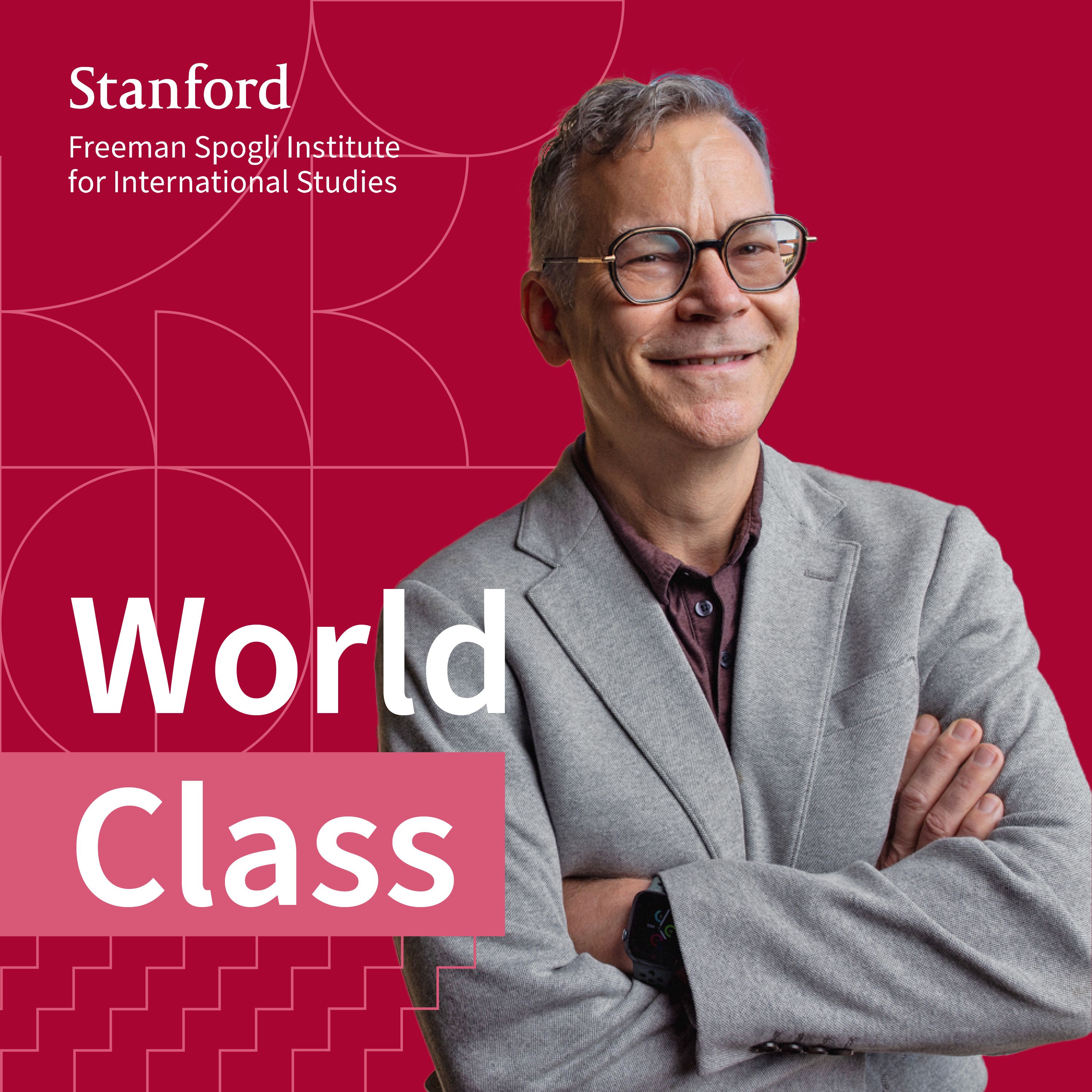
World Class
Freeman Spogli Institute for International Studies, Stanford University
Podcast from the Freeman Spogli Institute for International Studies (FSI) at Stanford University, featuring Director Colin Kahl, former under secretary of defense for policy at the U.S. Department of Defense. Colin and his guests dive into critical international issues, offering insights into the history and context of the biggest stories in the news.
Episodes
Mentioned books

Jul 27, 2018 • 20min
How to Make a New Country
It's not so easy to create a whole new country, and the world map is much more fixed than it used to be. While there are many secessionist and independence movements around the globe, the truth is that international powers are extremely reluctant to redraw borders. Where are the unrecognized states in the world, and what commonalities do they share? What happens when our normal understanding of "sovereignty" breaks down? In this conversation with FSI Deputy Director Kathryn Stoner, Joshua Keating shares stories from his new book, Invisible Countries: Journey’s to the Edge of Nationhood. Keating is a foreign policy analyst and a staff writer at Slate.
If you like what you hear, you can get additional content from scholars at the Freeman Spogli Institute for International Studies by following us on X, Facebook, LinkedIn, Instagram, and YouTube, and by subscribing to our newsletters and updates.

Jul 20, 2018 • 22min
A Democracy Divided: The Roots of our Political Polarization
The gulf between right and left in America is widening by the day. How long has this been going on, and what can we learn by studying other Western democracies? Didi Kuo is an expert on democratization and political parties. She's a research scholar at the Center on Democracy, Development, and the Rule of Law at FSI, and she has a new book called, Clientelism, Capitalism, and Democracy: The Rise of Programmatic Politics in the United States and Britain.
If you like what you hear, you can get additional content from scholars at the Freeman Spogli Institute for International Studies by following us on X, Facebook, LinkedIn, Instagram, and YouTube, and by subscribing to our newsletters and updates.

Jul 13, 2018 • 25min
When Your Government Doesn’t Want to Govern
The Venezuelan economy is disintegrating, yet president Nicolas Maduro has thus far been successful in squashing his political opposition. How has Maduro been able to remain in power, and what's the best-case scenario for Venezuela's future? We're joined today by Harold Trinkunas to examine the situation in Venezuela since the death of Hugo Chavez. Later in the conversation we also talk with Trinkunas about his book, Militants, Criminals, and Warlords: The Challenge of Local Governance in an Age of Disorder.
If you like what you hear, you can get additional content from scholars at the Freeman Spogli Institute for International Studies by following us on X, Facebook, LinkedIn, Instagram, and YouTube, and by subscribing to our newsletters and updates.

Jul 6, 2018 • 1h 22min
Rebroadcast: Both Sides of The Border
Today's episode is a rebroadcast. In November of 2016, FSI's Center on Democracy, Development & The Rule of Law co-hosted a panel with Stanford's Center for Latin American studies. At this event, Latin scholars, students, and staff at Stanford explored what Donald Trump's election would mean on the US's southern border. Now, almost two years later the analysis and perspectives of our panelists continue to resonate.
If you like what you hear, you can get additional content from scholars at the Freeman Spogli Institute for International Studies by following us on X, Facebook, LinkedIn, Instagram, and YouTube, and by subscribing to our newsletters and updates.

Jun 29, 2018 • 40min
Daniel Ellsberg on the continuing nuclear threat – from the US
Daniel Ellsberg is well-known for the Pentagon Papers, but few people realize he also has extensive experience with US nuclear weapons policy dating back to the 1950s and 60s. Last year, Ellsberg published a memoir called "The Doomsday Machine," where he argues that US developed immoral and dangerous policies during the Cold War, and that surprisingly little has changed in the years since. Ellsberg recently visited FSI’s Center for International Security and Cooperation (CISAC), where he participated in a Q&A about his new book.
If you like what you hear, you can get additional content from scholars at the Freeman Spogli Institute for International Studies by following us on X, Facebook, LinkedIn, Instagram, and YouTube, and by subscribing to our newsletters and updates.

Jun 25, 2018 • 24min
Siegfried Hecker on Denuclearization
After the June 12th meeting between Kim Jong-un and Donald Trump, the US is pushing for rapid denuclearization. But, even in a best case scenario, what is a realistic timetable? And now that North Korea has nuclear military capabilities, how might the US encourage the North Koreans to develop nuclear energy for their electrical grid instead?
Dr. Siegfried Hecker is the former director of the Los Alamos National Laboratory, a senior fellow at FSI, and an expert on denuclearization. He is also the only American scientist to have toured North Korea’s nuclear plants for enriching uranium. In this timely conversation with FSI director Michael McFaul, Hecker explains the logistical challenges of denuclearization, how the North Korean case is different from Iran, and what scenarios to watch for as the US contemplates a new relationship with the North Koreans.
If you like what you hear, you can get additional content from scholars at the Freeman Spogli Institute for International Studies by following us on X, Facebook, LinkedIn, Instagram, and YouTube, and by subscribing to our newsletters and updates.

Jun 22, 2018 • 28min
Robin Hood isn’t coming: Why democracies don’t always correct income inequality
As income inequality soars, we expect democracies to correct it with higher taxes on the rich. But time and again, the average voter rejects this idea at the ballot box. Why does this happen? In a country founded on the ideal that we are all equal, who gets to decide what’s fair? We talk with Professor Kenneth Scheve, an FSI senior fellow and professor of political science, about our ideas of fairness and how they impact the way our societies work.
If you like what you hear, you can get additional content from scholars at the Freeman Spogli Institute for International Studies by following us on X, Facebook, LinkedIn, Instagram, and YouTube, and by subscribing to our newsletters and updates.

Jun 15, 2018 • 26min
Former Ambassadors Kathleen Stephens and Michael McFaul on the North Korea Summit
Kim Jong-un and Donald Trump met in Singapore on June 12th, and everyone is still working to make sense of the meeting. What led up to this meeting, what are the key takeaways from the summit itself, and what can we expect going forward? Former South Korean Ambassador Kathleen Stephens, who is also the William J. Perry Fellow at FSI’s Shorenstein Asia-Pacific Research Center at FSI, joins FSI Director Michael McFaul to offer her candid analysis of everything that unfolded, and what to watch for next.
If you like what you hear, you can get additional content from scholars at the Freeman Spogli Institute for International Studies by following us on X, Facebook, LinkedIn, Instagram, and YouTube, and by subscribing to our newsletters and updates.

Jun 8, 2018 • 23min
What if "the people" are a threat to democracy?
What exactly is populism and why is it suddenly everywhere? Are the different movements around the world connected to each other, or are they popping up independently? What are the underlying conditions that give rise to populism, and what risks does it present to democracy?
Anna Gryzmala-Busse is a senior fellow at FSI and the new director of our Europe Center. Together with Michael McFaul and Frank Fukuyama, Gryzmala-Busse recently launched a project to study and report on populist movements. In this conversation with FSI director Michael McFaul, Gryzmala-Busse outlines some of the reasons populism is on the rise, why the current wave is ultimately about the breakdown of political parties, and what we can expect from the current populist movement in America.
If you like what you hear, you can get additional content from scholars at the Freeman Spogli Institute for International Studies by following us on X, Facebook, LinkedIn, Instagram, and YouTube, and by subscribing to our newsletters and updates.

Jun 1, 2018 • 28min
Larry Diamond with Cambodian Human Rights Activist Mu Sochua
Fears are growing that Cambodia is coming under authoritarian rule. Prime Minister Hun Sen, the world’s longest-serving government leader, has dissolved the opposition party and started arresting its leadership in September 2017. Deputy opposition leader and human rights activist Mu Sochua, fearing imprisonment herself, went into exile last October. In this conversation with FSI senior fellow Larry Diamond, she talks about how Cambodia has changed the since the time Khmer Rouge genocide, how events on the ground are unfolding, and what steps she hopes the US and other governments will take in order to put Cambodia back on a path towards democracy.
If you like what you hear, you can get additional content from scholars at the Freeman Spogli Institute for International Studies by following us on X, Facebook, LinkedIn, Instagram, and YouTube, and by subscribing to our newsletters and updates.

