

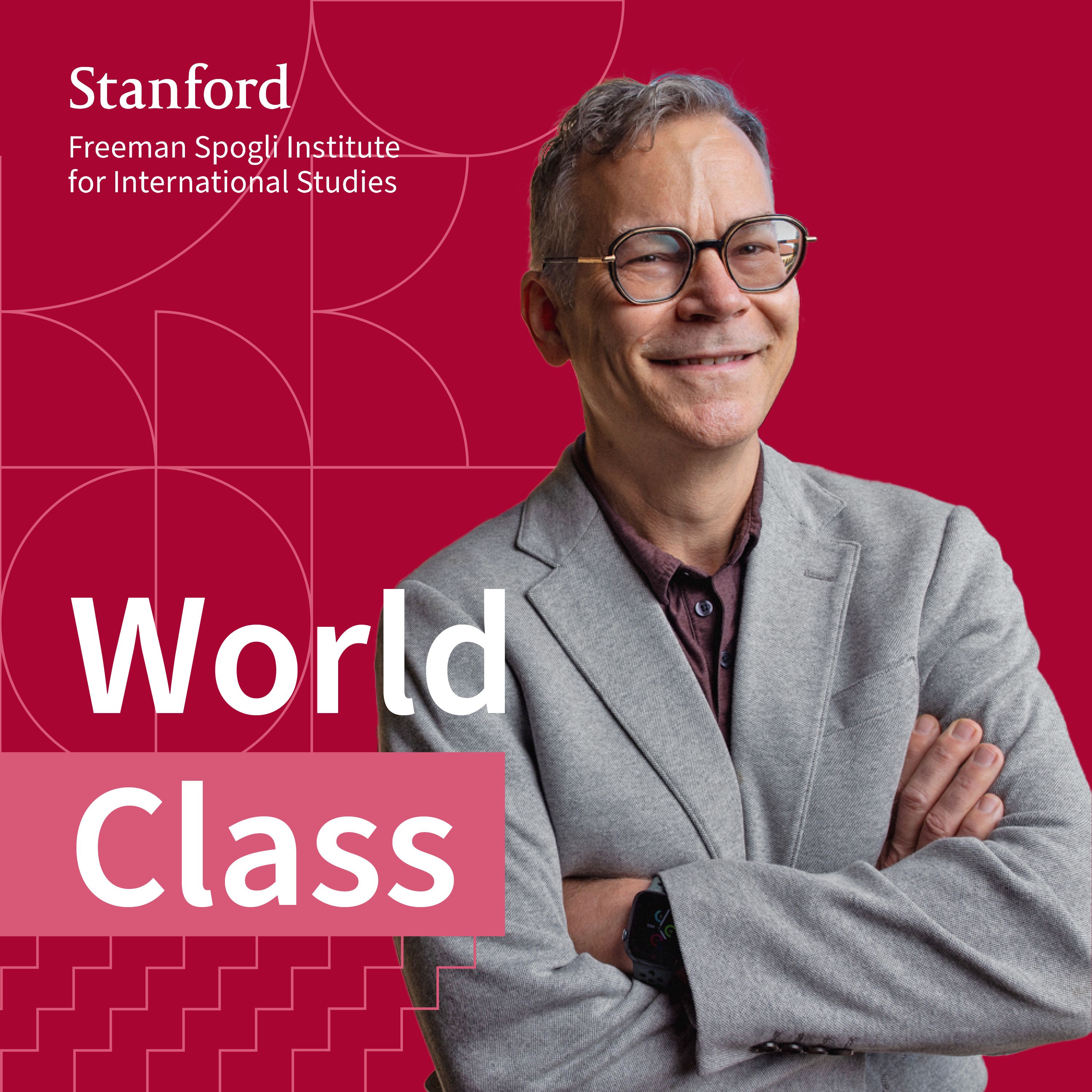
World Class
Freeman Spogli Institute for International Studies, Stanford University
Podcast from the Freeman Spogli Institute for International Studies (FSI) at Stanford University, featuring Director Colin Kahl, former under secretary of defense for policy at the U.S. Department of Defense. Colin and his guests dive into critical international issues, offering insights into the history and context of the biggest stories in the news.
Episodes
Mentioned books

Dec 28, 2018 • 14min
Marshall Burke on the Surprising Relationship between Suicide Rates and Climate Change
Climate change is likely to have far reaching impacts, and some consequences are particularly unexpected. In a provocative study, Marshall Burke and his colleagues demonstrate that suicide rates increase on hot days, regardless of other factors. Burke's findings raise significant questions. Are the underlying drivers of this relationship tied to economic forces, or are there human biological factors that exacerbate mental health issues? Can we forecast the overall effect as greenhouse gases and temperatures rise in the coming decades? What steps might we take now to mitigate the damages? In this conversation with World Class producer, Nicole Feldman, Burke offers a clear-eyed perspective on the wide-ranging implications of his research. Burke is the deputy director of FSI’s Center on Food Security and the Environment.
If you like what you hear, you can get additional content from scholars at the Freeman Spogli Institute for International Studies by following us on X, Facebook, LinkedIn, Instagram, and YouTube, and by subscribing to our newsletters and updates.

Dec 14, 2018 • 26min
Casper Klynge, Denmark's Ambassador to Silicon Valley
Silicon Valley's role in the world is now so big that some people argue the power of tech firms is similar to the powers of a nation-state. So maybe it's not too surprising to learn that Denmark has taken an unusual step, and has dispatched career diplomat Casper Klynge to serve as the world’s first tech ambassador. Klynge's role is to create avenues for dialogue, to work with firms to establish appropriate regulations, and to engage with Silicon Valley from a foreign policy perspective. In this conversation, Ambassador Klynge tells the story of how this came about, how he views his priorities, and how western societies are working to nurture innovation while simultaneously protecting the core principles of open democracy.
If you like what you hear, you can get additional content from scholars at the Freeman Spogli Institute for International Studies by following us on X, Facebook, LinkedIn, Instagram, and YouTube, and by subscribing to our newsletters and updates.

Nov 30, 2018 • 27min
Ambassador Wendy Sherman on negotiating the Iran Nuclear Deal
From 2011 to 2015 Ambassador Wendy Sherman was Under Secretary of State for Political Affairs, the fourth-ranking official in the State Department. She was the lead U.S. negotiator on the Iran nuclear deal, and before that she served as policy coordinator on North Korea for President Clinton. She has a new book, Not for the Faint of Heart: Lessons in Courage, Power and Persistence. In this conversation, Ambassador Sherman shares the backstory on the Iran nuclear deal, the future of relations with Iran, and what it's like being the only woman in the room doing diplomacy.
If you like what you hear, you can get additional content from scholars at the Freeman Spogli Institute for International Studies by following us on X, Facebook, LinkedIn, Instagram, and YouTube, and by subscribing to our newsletters and updates.

Nov 16, 2018 • 24min
How Do We Stop a Man-Made Pandemic? with David Relman and Megan Palmer
Biosecurity threats are often overlooked. For years scientists have been saying that the world is overdue for a pandemic, and there's an ongoing risk that terrorists or nation states might weaponize diseases. If that's not worrying enough, the risks of pandemics increase as climate change worsens. What steps are we taking to understand and prepare for the next outbreak?
David Relman is a senior fellow and Megan Palmer a senior research scholar at FSI’s Center for International Security and Cooperation. They are part of an interdisciplinary research initiative working to assess the threats posed by biological agents. In this wide-ranging conversation with Michael McFaul, Relman and Palmer unpack the complex issues, and offer their perspectives on how best to counter these threats.
If you like what you hear, you can get additional content from scholars at the Freeman Spogli Institute for International Studies by following us on X, Facebook, LinkedIn, Instagram, and YouTube, and by subscribing to our newsletters and updates.

Nov 6, 2018 • 22min
Colin Kahl on Khashoggi and Where the US Stands with Saudi Arabia
It is now clear that the murder of Washington Post journalist Jamal Khashoggi at the Saudi embassy in Turkey was a pre-planned execution, likely ordered by people at the very top of the Saudi government. The incident has sparked an international outcry, and raises questions about the US’s relationship with the Saudis. What is the underlying nature of the US-Saudi alliance? How has Trump's strategy differed from Obama’s, and what impact might all of this have on relations with Iran and elsewhere across the Middle East?
Colin Kahl was deputy assistant to President Obama and a national security advisor to Vice President Biden from 2014 to 2017. He’s now the co-director of FSI’s Center for International Security and Cooperation, and the head of its Middle East Initiative. In this discussion with Michael McFaul, Kahl outlines the unease some American diplomats feel towards our relationship with Saudi Arabia. He explains steps that President Obama took to restructure the alliance, and he argues that President Trump’s decision to double-down in Saudi Arabia has narrowed the options for responding to an increasingly fractured relationship.
If you like what you hear, you can get additional content from scholars at the Freeman Spogli Institute for International Studies by following us on X, Facebook, LinkedIn, Instagram, and YouTube, and by subscribing to our newsletters and updates.

Nov 2, 2018 • 22min
Ambassador Eileen Donahoe on Digital Threats to the Midterm Elections
With the US midterms fast approaching, we are still trying to make sense of everything that happened in the 2016 elections. What do we now know about vulnerabilities in our democratic processes? What risks do we face from foreign adversaries? Beyond the US, how are governments around the world adjusting to threats posed by digital technologies?
Eileen Donahoe was the first US Ambassador to the United Nations Human Rights Council during the Obama Administration. She’s now the Executive Director for the Global Digital Policy Incubator at FSI. Her current research focuses on cyber sovereignty, digital literacy, election security, protecting freedom of expression, and the impact of AI. In this conversation with Michael McFaul, Ambassador Donahoe frames the various threats posed by digital technologies, and the implications for the midterm elections.
If you like what you hear, you can get additional content from scholars at the Freeman Spogli Institute for International Studies by following us on X, Facebook, LinkedIn, Instagram, and YouTube, and by subscribing to our newsletters and updates.

Oct 19, 2018 • 23min
Francis Fukuyama Explains Identity Politics
“Identity politics" has become a driving force in political conversations in the U.S. and abroad, but what exactly is it? Where did it come from, and how will it shape the future of our society? FSI Olivier Nomellini Senior Fellow and CDDRL Mosbacher Director Francis Fukuyama joins host Michael McFaul to explain how his new book, “Identity: The Demand for Dignity and the Politics of Resentment,” sheds light on these questions and reveals how our political trajectory from the civil rights era to 21st century populism has been shaped by a universal human desire for respect and recognition.
If you like what you hear, you can get additional content from scholars at the Freeman Spogli Institute for International Studies by following us on X, Facebook, LinkedIn, Instagram, and YouTube, and by subscribing to our newsletters and updates.

Oct 5, 2018 • 24min
Improving Black Men's Health in a Single Step
African American men have the lowest life expectancy of any major demographic group in the U.S. The reasons for this are many and complex, but new research from FSI's Stanford Health Policy suggests that there may be a straightforward solution: hiring doctors who look like the patients they're treating. Dr. Marcella Alsan, an associate professor of medicine at Stanford Health Policy, and her research partner, Dr. Owen Garrick, President and CEO of Bridge Clinical Research, join host Michael McFaul to discuss the reasons behind the health disparities for African American men; the theory, ethics and outcomes of their study; and what their findings should mean for the future of health care.
If you like what you hear, you can get additional content from scholars at the Freeman Spogli Institute for International Studies by following us on X, Facebook, LinkedIn, Instagram, and YouTube, and by subscribing to our newsletters and updates.

Sep 12, 2018 • 1h 23min
Who Won the Trump-Kim Summit?
President Trump says the nuclear threat is behind us, but do the experts agree? Gi-Wook Shin, Scott Sagan, Kathleen Stephens, and Michael McFaul tell us about the winners and losers from the 2018 U.S.-North Korean Summit, what we should worry about, what denuclearization really means, and the eternal question: what comes next?
Kathleen Stephens is the former U.S. ambassador to South Korea and a William J. Perry fellow at FSI. Scott Sagan has authored many books and articles on nuclear weapons as a senior fellow at FSI’s Center for International Security and Cooperation. Gi-Wook Shin founded the Korea Program at FSI’s Shorenstein Asia-Pacific Research Center, which he directs. In addition to hosting World Class, Michael McFaul is the former U.S. ambassador to Russia and current director of FSI.
If you like what you hear, you can get additional content from scholars at the Freeman Spogli Institute for International Studies by following us on X, Facebook, LinkedIn, Instagram, and YouTube, and by subscribing to our newsletters and updates.

Aug 3, 2018 • 22min
Michael McFaul: When Geopolitics Gets Personal
What’s it like to have a dictator after you? In the wake of Vladimir Putin’s “request” to interrogate former ambassador and World Class host Michael McFaul, the US public backlash was swift and strong. It’s extremely unlikely that McFaul will be asked to respond to Russian investigators - but many Americans were unnerved at the Trump administration’s response. Where do US-Russia relations stand in the aftermath of Helsinki? What are the practical implications for McFaul, and what will be the lasting impact for transgressing the diplomatic norms? Michael McFaul addresses all these questions in this candid conversation.
If you like what you hear, you can get additional content from scholars at the Freeman Spogli Institute for International Studies by following us on X, Facebook, LinkedIn, Instagram, and YouTube, and by subscribing to our newsletters and updates.

