

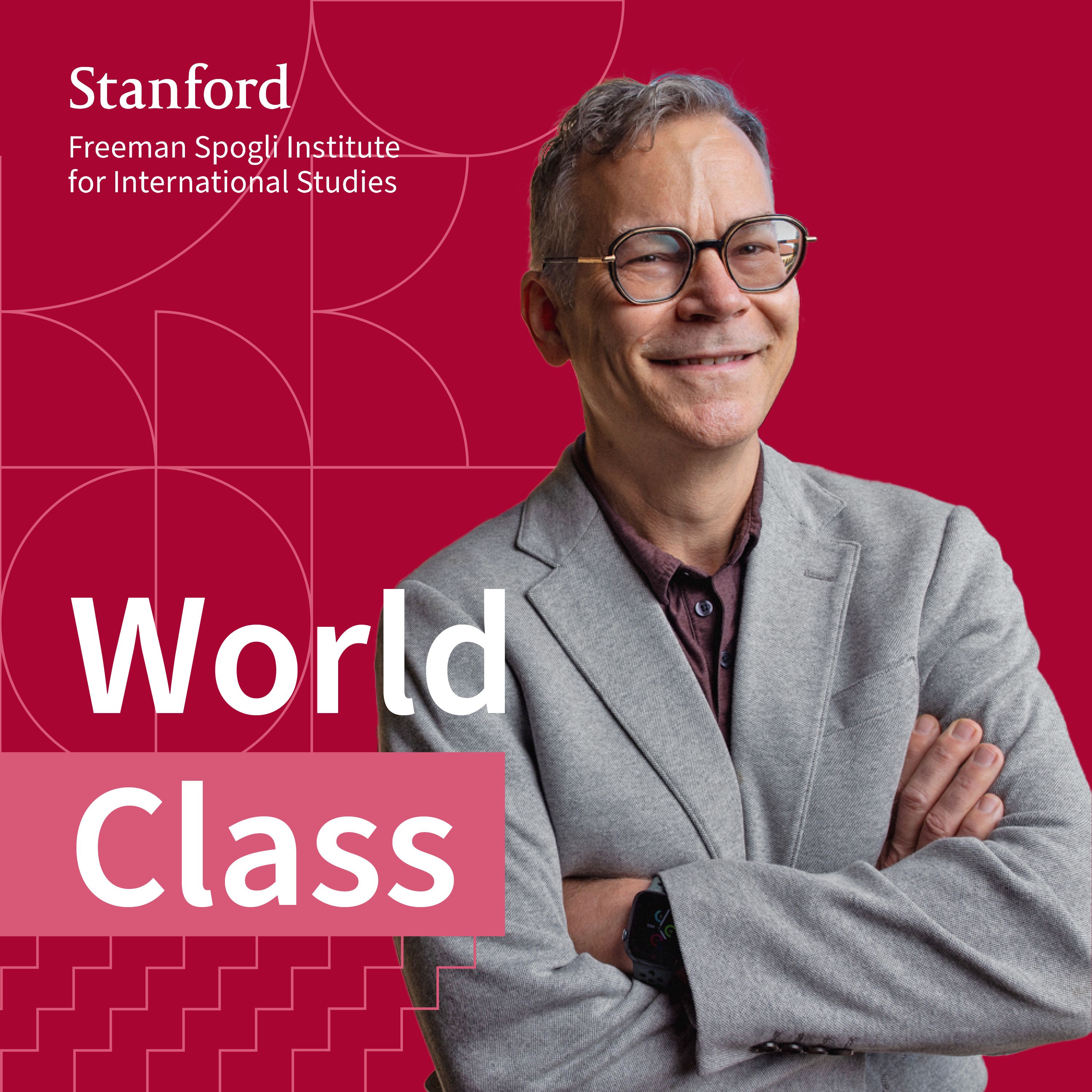
World Class
Freeman Spogli Institute for International Studies, Stanford University
Podcast from the Freeman Spogli Institute for International Studies (FSI) at Stanford University, featuring Director Colin Kahl, former under secretary of defense for policy at the U.S. Department of Defense. Colin and his guests dive into critical international issues, offering insights into the history and context of the biggest stories in the news.
Episodes
Mentioned books

Jun 12, 2019 • 19min
The 2020 Election is a Big Test for Democracies Worldwide, with Nathaniel Persily
More needs to be done to protect against foreign interference in the 2020 U.S. election, and not just by the American government. Nathaniel Persily, co-director of the Cyber Policy Center and a senior Fellow at FSI updates us on how technology companies have changed the way they display political advertising, why other countries need to be on the lookout for disinformation campaigns, and how Americans’ attitudes toward the media could impact who becomes the next U.S. president.
If you like what you hear, you can get additional content from scholars at the Freeman Spogli Institute for International Studies by following us on X, Facebook, LinkedIn, Instagram, and YouTube, and by subscribing to our newsletters and updates.

Jun 4, 2019 • 21min
The Presidential Standoff in Venezuela, with Harold Trinkunas
The standoff over the presidency in Venezuela continues, with two men, Nicolás Maduro and Juan Guaidó, still claiming the office. Dr. Harold Trinkunas, deputy director of the Center for International Security and Cooperation at FSI, updates us on how the situation has evolved since the beginning of the political conflict, the interests of the U.S. and Russia in the country, and explains the three most likely scenarios of what might happen next.
If you like what you hear, you can get additional content from scholars at the Freeman Spogli Institute for International Studies by following us on X, Facebook, LinkedIn, Instagram, and YouTube, and by subscribing to our newsletters and updates.

May 9, 2019 • 23min
Facebook’s Former Chief Security Officer Alex Stamos Weighs in On the Mueller Report
Three weeks after the release of the Mueller Report, much of its content is still off-limits to the public. In this episode, former Facebook Chief Security Officer Alex Stamos shares his thoughts on what was and was not included in the public report, and what surprised him the most.
A cybersecurity expert, business leader and entrepreneur, Alex Stamos is an adjunct professor at the Freeman Spogli Institute and a visiting scholar at the Hoover Institution.
If you like what you hear, you can get additional content from scholars at the Freeman Spogli Institute for International Studies by following us on X, Facebook, LinkedIn, Instagram, and YouTube, and by subscribing to our newsletters and updates.

Apr 5, 2019 • 21min
A Journalist’s Perspective on the Russia Investigation, with Greg Miller
Special Counsel Robert Mueller has submitted his report to the Attorney General, but additional investigations into Russia’s interference in the 2016 U.S. election are now expected. Greg Miller and Mike McFaul discuss the challenges that policymakers and journalists face in investigating Russia, and how democracy in the U.S. has fared since 2016.
Greg Miller is a national security correspondent for the Washington Post, a two-time Pulitzer Prize winner, and a Stanford alumnus (MA ’93). He is the author of "The Apprentice: Trump, Russia and the Subversion of American Democracy," a book exploring Russia’s effort to undermine the 2016 election.
This podcast was recorded on March 20, 2019, two days before Special Counsel Robert Mueller submitted his report on Russian interference in the 2016 election.
If you like what you hear, you can get additional content from scholars at the Freeman Spogli Institute for International Studies by following us on X, Facebook, LinkedIn, Instagram, and YouTube, and by subscribing to our newsletters and updates.

Mar 20, 2019 • 23min
Demystifying the U.S.-North Korea Relationship, with Scott Sagan
The United States-North Korea summit in Hanoi, Vietnam, was cut short and did not produce any agreement between the two countries on denuclearization. What does this outcome mean for the prospect of future diplomacy and the potential for armed conflict?
Scott Sagan is a professor of political science at Stanford University, and a senior fellow at FSI and the Center for International Security and Cooperation. He has written and edited several books and articles on nuclear strategy and security, and the risks and proliferation of nuclear weapons worldwide. In this episode, Sagan analyzes President Trump’s uneven relationship with Kim Jong-un, assesses potential outcomes of an armed conflict with North Korea, and presents recent polling data on the American public’s support of nuclear weapon use.
If you like what you hear, you can get additional content from scholars at the Freeman Spogli Institute for International Studies by following us on X, Facebook, LinkedIn, Instagram, and YouTube, and by subscribing to our newsletters and updates.

Mar 8, 2019 • 25min
The Roots of Political Polarization, with Murat Somer
There’s a range of issues dividing voters in America today. As it turns out, though, the current polarization is not limited to the U.S. political system. What is triggering polarization, and what is the relationship between polarization and the populist movements underway globally? What, if anything, can be done to alleviate deepening political divides?
Murat Somer is a Professor of Political Science and International Relations at Koç University in Istanbul, Turkey and a Visiting Scholar at Stanford. He has written several articles and books on polarization, democracy and democratic erosion across the world. In this conversation he explores the roots of polarization, the surprising similarities between Turkey and the US, and how we might heal divisions by taking a different approach to democratic politics.
If you like what you hear, you can get additional content from scholars at the Freeman Spogli Institute for International Studies by following us on X, Facebook, LinkedIn, Instagram, and YouTube, and by subscribing to our newsletters and updates.

Feb 22, 2019 • 21min
The Science of Gun Safety and Violence, with David Studdert
Gun violence is one of the most polarizing topics in America, and the gun debate is about to heat up. The Supreme Court has decided to hear a significant gun rights case, and House Democrats recently unveiled a landmark bill requiring background checks. All of this comes in the wake of the worst year for gun deaths in two decades. Gun violence goes beyond homicides – a large share of deaths are attributed to accidents and suicides. For many in the medical community this is a public health crisis, and they are working to understand the impacts on the health and safety on Americans.
David Studdert is a professor of medicine and law at Stanford, and a core faculty member at Stanford Health Policy at FSI. In this discussion he shows us how emerging science may be able to clarify some of the most contentious issues surrounding gun safety.
If you like what you hear, you can get additional content from scholars at the Freeman Spogli Institute for International Studies by following us on X, Facebook, LinkedIn, Instagram, and YouTube, and by subscribing to our newsletters and updates.

Feb 8, 2019 • 22min
How Southeast Asian Nations Balance China-US Relations, with Don Emmerson
The economic and diplomatic tensions between the US and China are creating ripple effects across Southeast Asia. China is pursing an aggressive agenda of economic development throughout the region, and while there is undoubtedly a strong need for infrastructure projects, the Chinese strategy could limit the future autonomy of the Southeast Asian nations. If the US-China trade war were to escalate, Southeast Asia could be the battleground for a new cold war.
Political Science professor Don Emmerson has spent his career working with scholars and policymakers in the region. Emmerson is a senior fellow at FSI and director of the Southeast Asia Program. In this interview he helps us understand the ASEAN coalition, why the South China Sea remains an area of contention, and what steps the US Congress is taking to assure Southeast Asian nations that it is committed to progress across the region.
If you like what you hear, you can get additional content from scholars at the Freeman Spogli Institute for International Studies by following us on X, Facebook, LinkedIn, Instagram, and YouTube, and by subscribing to our newsletters and updates.

Jan 25, 2019 • 21min
Religion, Rationality, and Democracy, with Dan Edelstein
Ever since the the scientific revolution of the 17th century, there has been tension between the institutions of science and religion. This tension between religion and science has a direct effect on governance. After all, the United States was conceived as a system of democratic institutions that valued reason and deliberation. But are religious beliefs and rationality completely at odds with one another? What exactly does it mean to be "rational?" Might it be necessary to understand more religious forms of rationality in order to heal some of the polarization present in America today?
In this conversation we talk with Dan Edelstein, who is the William H. Bonsall Professor of French and an affiliate of the Freeman Spogli Institute's Europe Center. Professor Edelstein helps us understand the conflict between religion and rationality, how this conflict continues to play out in the present day, and what it all means for democratic institutions around the world.
If you like what you hear, you can get additional content from scholars at the Freeman Spogli Institute for International Studies by following us on X, Facebook, LinkedIn, Instagram, and YouTube, and by subscribing to our newsletters and updates.

Jan 11, 2019 • 24min
Former Facebook Chief Security Officer Alex Stamos on Russian Election Interference
We are still learning the details about Russia’s disinformation and manipulation campaigns during the US 2016 elections. Tech companies have come under intense scrutiny, and, according to former Facebook’s Chief Security Officer Alex Stamos, much of the spotlight on Big Tech is warranted. However, Stamos also argues that our government, the media, and we as citizens all have a role to play in the security of our elections. Stamos is now the William J. Perry Fellow at FSI, and in this conversation he offers an unrivaled diagnosis of everything that went wrong during the 2016 election cycle. In a future episode, Stamos will share his ideas of what we can do to prevent similar failures in the future.
If you like what you hear, you can get additional content from scholars at the Freeman Spogli Institute for International Studies by following us on X, Facebook, LinkedIn, Instagram, and YouTube, and by subscribing to our newsletters and updates.

