

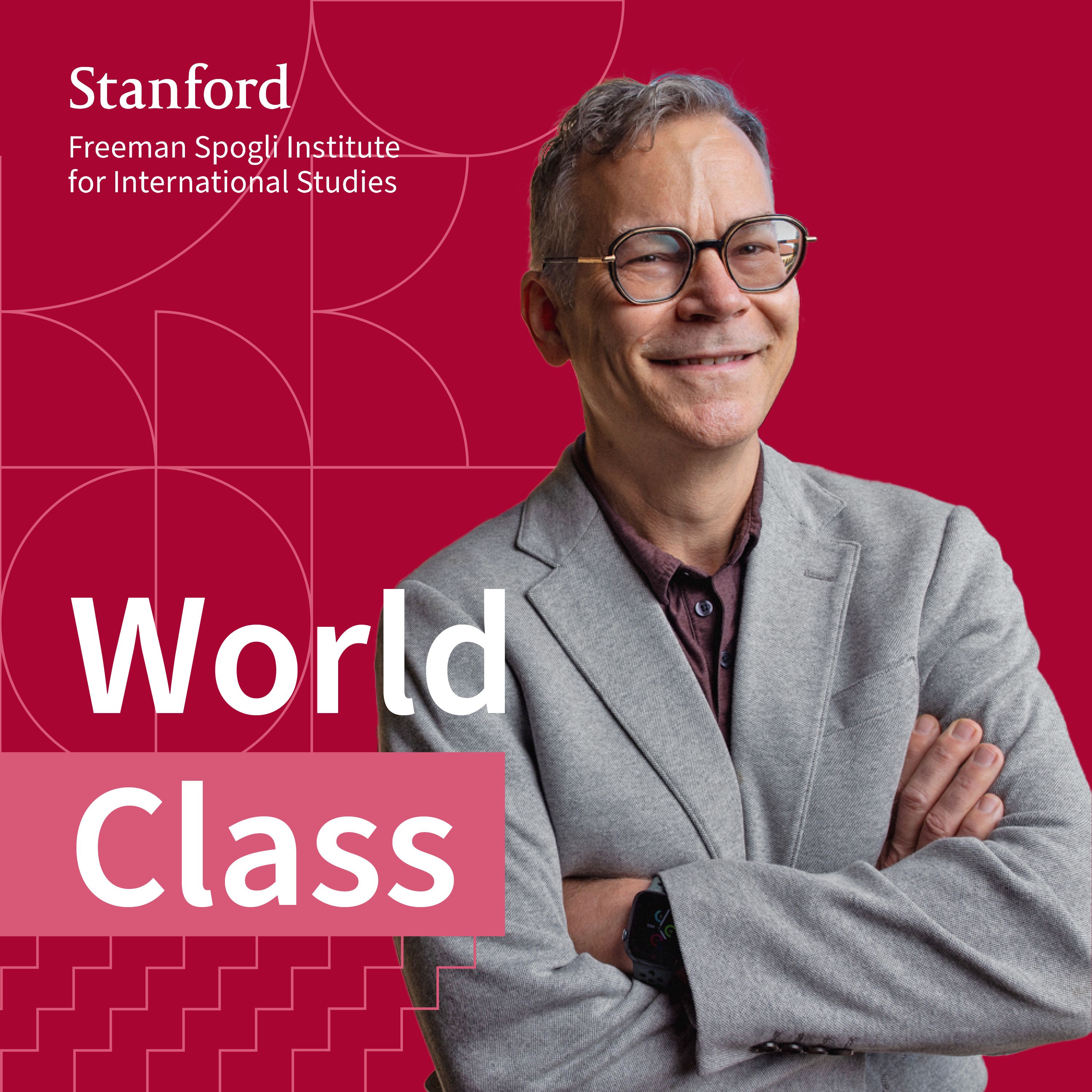
World Class
Freeman Spogli Institute for International Studies, Stanford University
Podcast from the Freeman Spogli Institute for International Studies (FSI) at Stanford University, featuring Director Colin Kahl, former under secretary of defense for policy at the U.S. Department of Defense. Colin and his guests dive into critical international issues, offering insights into the history and context of the biggest stories in the news.
Episodes
Mentioned books

May 25, 2018 • 26min
From Cold War to Hot Peace: Michael McFaul on his new book
Michael McFaul, director of FSI, former US ambassador to Russia, and host of World Class, has a new book out. It's called From Cold War to Hot Peace, and it offers an unparalleled perspective on US–Russia relations. In this conversation with FSI's deputy director Kathryn Stoner, herself a Russia expert who has co-authored two books with Amb. McFaul, he shares the story of how he first became interested in Russia, his experiences during his time as ambassador, and why he's still optimistic that someday US–Russia relations will improve.
If you like what you hear, you can get additional content from scholars at the Freeman Spogli Institute for International Studies by following us on X, Facebook, LinkedIn, Instagram, and YouTube, and by subscribing to our newsletters and updates.

May 18, 2018 • 37min
Sir Nick Clegg on Brexit, with host Gerhard Casper
Is it too late to stop Brexit? As the deadline for exiting approaches, what are the pros and cons of trying to halt Brexit at this late juncture? Regardless of what happens, what might we expect for the future relationship between the United Kingdom and the European Union? In this conversation Sir Nick Clegg, former Deputy Prime Minister from 2010-2015, sits down with former Stanford president and senior fellow at FSI, Gerhard Casper, to talk about how we got here – and what lies ahead.
If you like what you hear, you can get additional content from scholars at the Freeman Spogli Institute for International Studies by following us on X, Facebook, LinkedIn, Instagram, and YouTube, and by subscribing to our newsletters and updates.

May 11, 2018 • 26min
Armenia's new leadership: How did we get here?
Armenia is in a state of transition. Peaceful protests led by Nikol Pashinyan have dislodged Serzh Sargsyan from his seat of power, and suddenly the country looks poised for dramatic change. Is this a grassroots movement, or are outside forces pulling the strings? What's the role of social media in all this? And why now, exactly? To take stock of these fast moving developments, we're joined by FSI's Sarah Shirazyan and Yeghishe Kirakosyan of the Stanford Law School for perspective and what to watch as the story unfolds.
If you like what you hear, you can get additional content from scholars at the Freeman Spogli Institute for International Studies by following us on X, Facebook, LinkedIn, Instagram, and YouTube, and by subscribing to our newsletters and updates.

May 4, 2018 • 24min
Turbulence in Taiwan
Since the 1980s, Taiwan has been a model of democracy in East Asia, but there are challenges on the horizon. Domestically, Taiwan is experiencing slow economic growth and a polarized electorate. Meanwhile across the region leaders are navigating tensions on the Korean peninsula, disputes in the South China Sea, and the possibility of a US-China trade war. In this conversation, former president of Taiwan Ma Ying-jeou talks with Professor Francis Fukuyama about all these issues, as well as the future of Taiwan's relationship with China.
If you like what you hear, you can get additional content from scholars at the Freeman Spogli Institute for International Studies by following us on X, Facebook, LinkedIn, Instagram, and YouTube, and by subscribing to our newsletters and updates.

Apr 27, 2018 • 36min
Democracy at Risk in Kenya
Kenya is in a state of polarization, and its democracy is at risk. Maina Kiai was the United Nations Special Rapporteur on the rights to freedom of peaceful assembly and of association from 2011 – 2017, and in this conversation with FSI's Larry Diamond he discusses Kenya’s 2017 disputed presidential election. The stakes are high. As Kiai wrote last year, "Elections in Kenya are not a civil political competition; they are an all-out contest for power and resources." The growing democratic recession in Africa may be undermining the country's electoral democracy.
If you like what you hear, you can get additional content from scholars at the Freeman Spogli Institute for International Studies by following us on X, Facebook, LinkedIn, Instagram, and YouTube, and by subscribing to our newsletters and updates.

Apr 20, 2018 • 21min
How do you stop a pandemic in the middle of a war? on "World Class with Michael McFaul"
When we think of health in conflict zones, we usually think of the victims of violence. But more people can die due to other healthcare disruptions than they do from combat wounds. War-torn states are vulnerable to malnutrition, contaminated water, and – most terrifying – outbreaks such as Ebola and Zika. If physicians can't do their work, the wrong set of conditions could set off a global pandemic. What lessons can we draw from the past few years, and what steps are we taking now to be ready for the next inevitable outbreak?
Michele Barry and Paul Wise are two of the eight FSI scholars confronting civil war threats with the "Civil Wars, Violence, and International Responses" project. Supported by the American Academy of Arts and Sciences, FSI's Karl Eikenberry and Stephen Krasner gathered experts from around the world to talk about changing international policy to meet these new challenges. We will be speaking with each of the scholars about how civil wars are changing, how they might affect the rest of the world, and what we can do about it. To learn more about the project, check out the fall 2017 and winter 2018 issues of Daedalus, the journal of the American Academy of Arts and Sciences, and the outreach projects Eikenberry and Krasner are embarking on around the world: www.amacad.org/content/Research/…ject.aspx?d=22262.
If you like what you hear, you can get additional content from scholars at the Freeman Spogli Institute for International Studies by following us on X, Facebook, LinkedIn, Instagram, and YouTube, and by subscribing to our newsletters and updates.

Apr 13, 2018 • 59min
Why Can’t We Feed the World?
Dealing with world hunger has never been easy, but in recent years the challenge has less to do with natural disasters and much more to do with human conflict. In this lecture, Ertharin Cousin, former director of the World Food Programme and a visiting scholar at FSI’s Center on Food Security and the Environment, reflects on her experiences and identifies key strategies for helping to end world hunger.
If you like what you hear, you can get additional content from scholars at the Freeman Spogli Institute for International Studies by following us on X, Facebook, LinkedIn, Instagram, and YouTube, and by subscribing to our newsletters and updates.

Apr 6, 2018 • 1h 13min
Doctors in the Crosshairs
Medical and humanitarian workers are increasingly in the crosshairs as hospitals and aid centers have become part of the battlefield in today's wars. In this panel discussion, the producers of the new documentary, The New Barbarianism, and FSI faculty discuss this crisis, its causes, the limited international response and possible ways forward. They build off the film, a CSIS Global Health Policy Center original, which features original footage obtained from inside Syria, Yemen and Afghanistan, to analyze the profound surge of violence seen across several open-ended conflicts.
This episode is brought to you by the Stanford Center for Innovation in Global Health (CIGH). It is moderated by Michele Barry, CIGH's director and an FSI senior fellow by courtesy. Panelists include Steve Morrison, director of The New Barbarianism; Justin Kenny, writer and co-director of The New Barbarianism; Ertharin Cousin, former Executive Director of the UN World Food Program and current Payne Distinguished Lecturer at FSI; and Paul Wise, FSI senior fellow.
If you like what you hear, you can get additional content from scholars at the Freeman Spogli Institute for International Studies by following us on X, Facebook, LinkedIn, Instagram, and YouTube, and by subscribing to our newsletters and updates.

Mar 30, 2018 • 23min
When the War Next Door Reaches You, on "World Class with Michael McFaul"
When jihadists get involved in civil wars, they push the conflict well beyond its original borders. Since 1990, the rate of jihadist involvement in civil conflict has jumped from 5% to 40%. What's changed? FSI senior fellow Martha Crenshaw, a counterterrorism expert, tells FSI director Michael McFaul how jihadism has grown in the last 30 years and how terrorism and civil wars affect each other.
Crenshaw is one of eight FSI scholars confronting civil war threats with the "Civil Wars, Violence, and International Responses" project. Supported by the American Academy of Arts and Sciences, FSI's Karl Eikenberry and Stephen D. Krasner gathered experts from around the world to talk about changing international policy to meet these new challenges. We will be speaking with each of the scholars about how civil wars are changing, how they might affect the rest of the world, and what we can do about it.
To learn more about the project, check out the fall 2017 and winter 2018 issues of Daedalus, the journal of the American Academy of Arts and Sciences, and the outreach projects Eikenberry and Krasner are embarking on around the world: www.amacad.org/content/Research/…ject.aspx?d=22262.
If you like what you hear, you can get additional content from scholars at the Freeman Spogli Institute for International Studies by following us on X, Facebook, LinkedIn, Instagram, and YouTube, and by subscribing to our newsletters and updates.

Mar 24, 2018 • 24min
Why Does My Colonoscopy Cost so Much?
Ever wonder how Medicare pricing works? It affects us all more than you might think. Prices for procedures set by Medicare often trickle over to the private sector, so Medicare effectively sets the cost of procedures for the health-care market as a whole. David Chan and Jay Bhattacharya explain how an independent committee gives recommendations on how much each procedure will cost. Because the committee is largely made up of specialists, many wondered whether their pricing might be biased against primary care doctors. The answer? Not much.
David Chan and Jay Bhattacharya are core faculty members at Stanford Health Policy, an FSI center. This episode originally aired live through the Stanford Institute for Economic Policy Research.
If you like what you hear, you can get additional content from scholars at the Freeman Spogli Institute for International Studies by following us on X, Facebook, LinkedIn, Instagram, and YouTube, and by subscribing to our newsletters and updates.

