

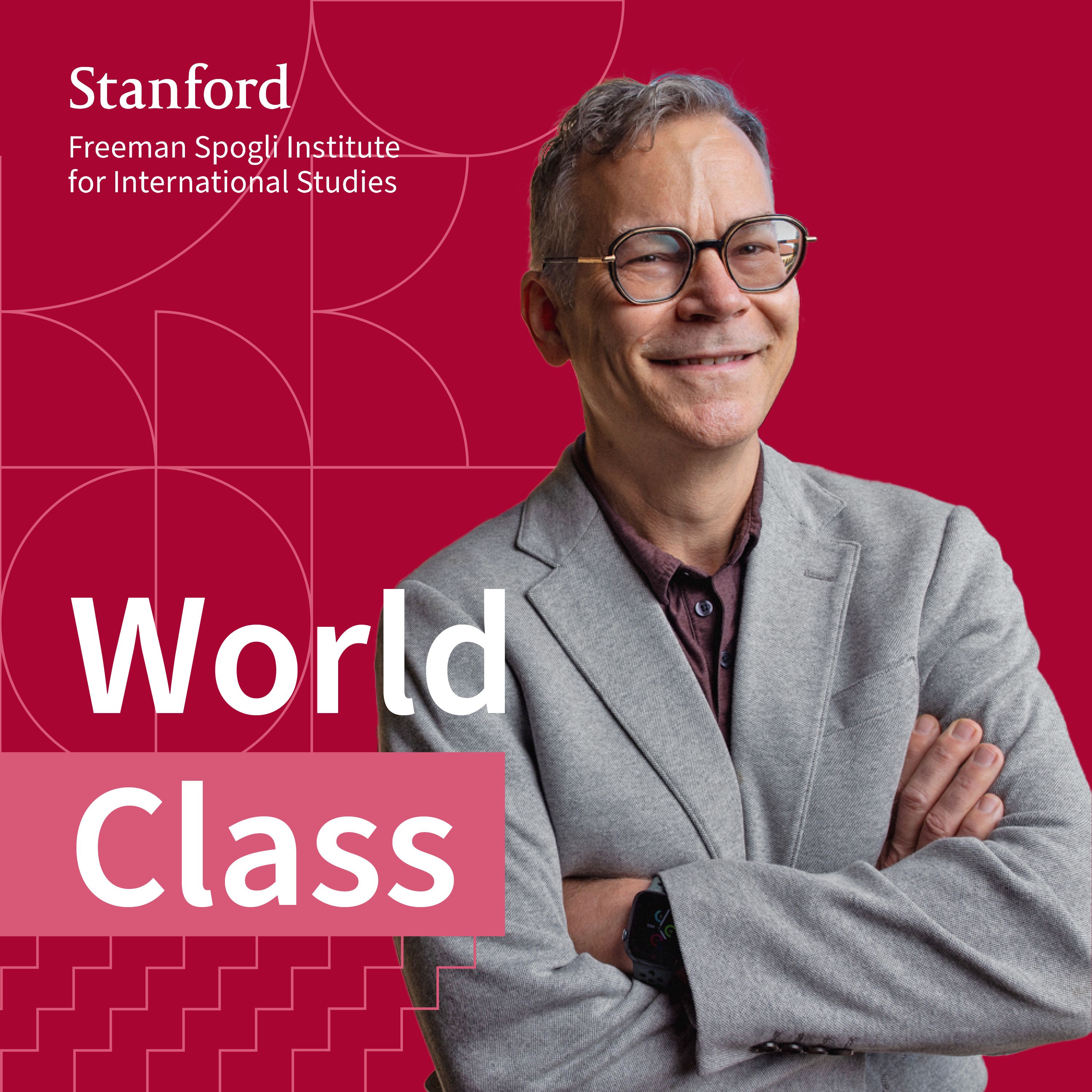
World Class
Freeman Spogli Institute for International Studies, Stanford University
Podcast from the Freeman Spogli Institute for International Studies (FSI) at Stanford University, featuring Director Colin Kahl, former under secretary of defense for policy at the U.S. Department of Defense. Colin and his guests dive into critical international issues, offering insights into the history and context of the biggest stories in the news.
Episodes
Mentioned books

Mar 16, 2018 • 44min
Can Liberal Democracy Survive Modern Technology?
Technology is threatening liberal democracy, say Toomas Hendrik Ilves and Francis Fukuyama. The internet has revolutionized society, but too often it is exploited by authoritarian leaders and populist groups. Fake news breeds more partisanship and disunity. Governments can do more to combat this, but there is a fine line between sensible regulation and encroaching on free speech. For instance, China already drastically regulates their citizens' media use, breeding political resentment. There are no easy answers, and citizens need to encourage a culture shift to continue fighting the toxic effects of these technologies.
Francis Fukuyama is the Mosbacher Director of the Center on Democracy, Development, and the Rule of Law and the Olivier Nomellini Senior Fellow at the Freeman Spogli Institute for International Studies. Toomas Ilves is the former President of Estonia and a current affiliate of the Center for International Security and Cooperation.
If you like what you hear, you can get additional content from scholars at the Freeman Spogli Institute for International Studies by following us on X, Facebook, LinkedIn, Instagram, and YouTube, and by subscribing to our newsletters and updates.

Mar 10, 2018 • 26min
Telegrams from Tehran on "World Class with Michael McFaul"
The way Iranians interact with their government is changing. With information more readily available through the internet, it is easier for citizens to organize protests but also to make an impact without leaving home. Since the Iranian Green Movement in 2009, the political elite has changed dramatically, but a small, stagnant group at the top still holds the most influence. Mehdi Yahyanejad, a senior researcher in computer science at USC, and Mehrzad Boroujerdi, a professor of political science at Syracuse University, spoke to FSI Director Michael McFaul about how Iran's youth are changing the way the country interacts with its politicians. They visited Stanford to speak at a conference about whether politics and culture are changing in Iran, co-hosted by FSI and and the Hamid and Christina Moghadam Program in Iranian Studies.
If you like what you hear, you can get additional content from scholars at the Freeman Spogli Institute for International Studies by following us on X, Facebook, LinkedIn, Instagram, and YouTube, and by subscribing to our newsletters and updates.

Mar 2, 2018 • 24min
Government Can't Save Us from Cyberattacks, but Facebook Can
The 2016 cyber campaign to influence the U.S. election has been well documented, but represents only a fraction of what information technology makes possible. Drawing on extensive experience in both the private and public sectors, Paul Stockton, the managing director of Sonecon, outlines how foreign adversaries might use information operations for an increasing number of alarming purposes, sowing discord in a manner that U.S. security forces are unequipped to deal with. Stockton also explains the devastating impact that a cyberattack on American power grids could have, and urges the government to draw on the expertise of the private sector to stay one step ahead of potential threats.
If you like what you hear, you can get additional content from scholars at the Freeman Spogli Institute for International Studies by following us on X, Facebook, LinkedIn, Instagram, and YouTube, and by subscribing to our newsletters and updates.

Feb 24, 2018 • 23min
The Modern Civil War
Civil wars have changed. In the last 20 years, the average duration has increased and organizations like the UN have had a harder time keeping the peace. This has been particularly true in the Middle East and North Africa where most peace-keeping and state-building efforts have failed. James "Jim" Fearon, an FSI senior fellow, tells us why civil wars have changed.
Fearon is one of eight FSI scholars confronting civil war threats with the "Civil Wars, Violence, and International Responses" project. Supported by the American Academy of Arts and Sciences, FSI's Karl Eikenberry and Stephen D. Krasner gathered experts from around the world to talk about changing international policy to meet these new challenges. We will be speaking with each of the scholars about how civil wars are changing, how they might affect the rest of the world, and what we can do about it.
To learn more about the project, check out the fall 2017 and winter 2018 issues of Daedalus, the journal of the American Academy of Arts and Sciences, and the outreach projects Eikenberry and Krasner are embarking on around the world: www.amacad.org/content/Research/…ject.aspx?d=22262.
#civilwarthreats
#endingcivilwars
If you like what you hear, you can get additional content from scholars at the Freeman Spogli Institute for International Studies by following us on X, Facebook, LinkedIn, Instagram, and YouTube, and by subscribing to our newsletters and updates.

Feb 16, 2018 • 1h 34min
Revolutionizing Africa's Food Systems
Ertharin Cousin, the former Executive Director of the United Nation's World Food Programme, leads a panel discussion on the future of African agriculture. African political leaders from the Alliance for a Green Revolution in Africa concur that more private industry and technological advancement is needed for the continent. Given that famine and corruption is still all too common, African governments need to increase their focus on the security of their food systems. In order to do so, AGRA is working on developing a disease-resistant strain of cassava, a common starch grown throughout the continent. However, high-tech research is not the only solution. Paying attention to the demands of small farmers and creating simple phone apps to track fertilizer use and rainfall can bring just as much benefit.
If you like what you hear, you can get additional content from scholars at the Freeman Spogli Institute for International Studies by following us on X, Facebook, LinkedIn, Instagram, and YouTube, and by subscribing to our newsletters and updates.

Feb 9, 2018 • 1h 18min
The Baltics Are Back
Countries created after the Soviet Union dissolved provide a unique window into state development. The Baltic states — Estonia, Latvia, and Lithuania — have emerged as geopolitical and economic leaders in Eastern Europe. Former President of Estonia and FSI Affiliate Toomas Hendrik Ilves and FSI Director Michael McFaul discuss the reasons for these states’ unlikely success, delve into Estonian history, and discuss the ongoing challenges posed by Russia.
If you like what you hear, you can get additional content from scholars at the Freeman Spogli Institute for International Studies by following us on X, Facebook, LinkedIn, Instagram, and YouTube, and by subscribing to our newsletters and updates.

Feb 2, 2018 • 24min
The Facts on Climate Change on "World Class with Michael McFaul"
Looking for a reliable source on climate change? Marshall Burke is an assistant professor in the Department of Earth System Science at Stanford University and an FSE fellow. He has studied climate change extensively throughout his career. He tells FSI Director Michael McFaul how the world has already warmed one degree Celsius since pre-industrial times, causing more extreme weather events, a small rise in sea levels and a greater amount of carbon dioxide in the atmosphere. There is virtually no disagreement among scientists that the world is warming, he says, and the vast majority of scientists agree that humans are causing the change. Unless we reduce our emissions, the world will warm four to five degrees in the next century, making bad weather worse and gradually increasing average temperatures everywhere. If this happens, the world's GDP will decrease by about 20 percent, causing massive disruption to the world's economy.
If you like what you hear, you can get additional content from scholars at the Freeman Spogli Institute for International Studies by following us on X, Facebook, LinkedIn, Instagram, and YouTube, and by subscribing to our newsletters and updates.

Jan 26, 2018 • 1h 20min
America as a Defender of Democracy with Robert Kagan
The liberal world order that arose after World War II did not occur because of the intellectual superiority of liberal ideas, argues Dr. Robert Kagan, a senior fellow at the Brookings Institution. Instead, it was the military and geopolitical might of the United States that converted countries like Germany and Japan into Western-style democracies. However, in today's world, Kagan believes the United States is ceding this role as a worldwide protector of liberal values, enabling countries like Russia and China to become more authoritarian and threatening the world order. Going forward, only a realistic foreign policy that employs military strength to spread American democratic values can prevent a further decay of democracy, he says.
If you like what you hear, you can get additional content from scholars at the Freeman Spogli Institute for International Studies by following us on X, Facebook, LinkedIn, Instagram, and YouTube, and by subscribing to our newsletters and updates.

Jan 20, 2018 • 22min
Are Protests in Iran Here to Stay? on "World Class with Michael McFaul"
With double-digit unemployment, widespread corruption and inequality, and a youth population ready for change, the recent protests in Iran are no surprise, says Abbas Milani, Stanford’s Hamid and Christina Moghadam Director of Iranian Studies. After arresting more than 3,700 protesters, the Iranian regime has quelled the demonstrations for now. Should we expect more, or will the government succeed in shutting them down? Milani tells FSI Director Michael McFaul that the recent demonstrations are more widespread than, for instance, the 2009 protests against a rigged presidential election. They are concentrated in small, religious towns with little history of anti-government action. Iran’s economic woes are not going away, and Milani expects protests will continue until they do.
If you like what you hear, you can get additional content from scholars at the Freeman Spogli Institute for International Studies by following us on X, Facebook, LinkedIn, Instagram, and YouTube, and by subscribing to our newsletters and updates.

Jan 12, 2018 • 21min
The State of the Constitution on "World Class with Michael McFaul"
How has the United States Constitution been holding up during President Trump's first year in office? Pretty well, says constitutional law expert Gerhard Casper. The three branches of government are still operating independently, and President Trump has actually scaled back the power of his branch by overturning some of President Obama’s executive orders. The American people are politically engaged and have made energetic use of the first amendment. So why the political turmoil? It is our primary system that needs fixing, according to Casper.
After serving as dean of the University of Chicago Law School, Casper joined Stanford in 1992 as the university’s ninth president. He was also the director of FSI from 2012 to 2013.
If you like what you hear, you can get additional content from scholars at the Freeman Spogli Institute for International Studies by following us on X, Facebook, LinkedIn, Instagram, and YouTube, and by subscribing to our newsletters and updates.

