

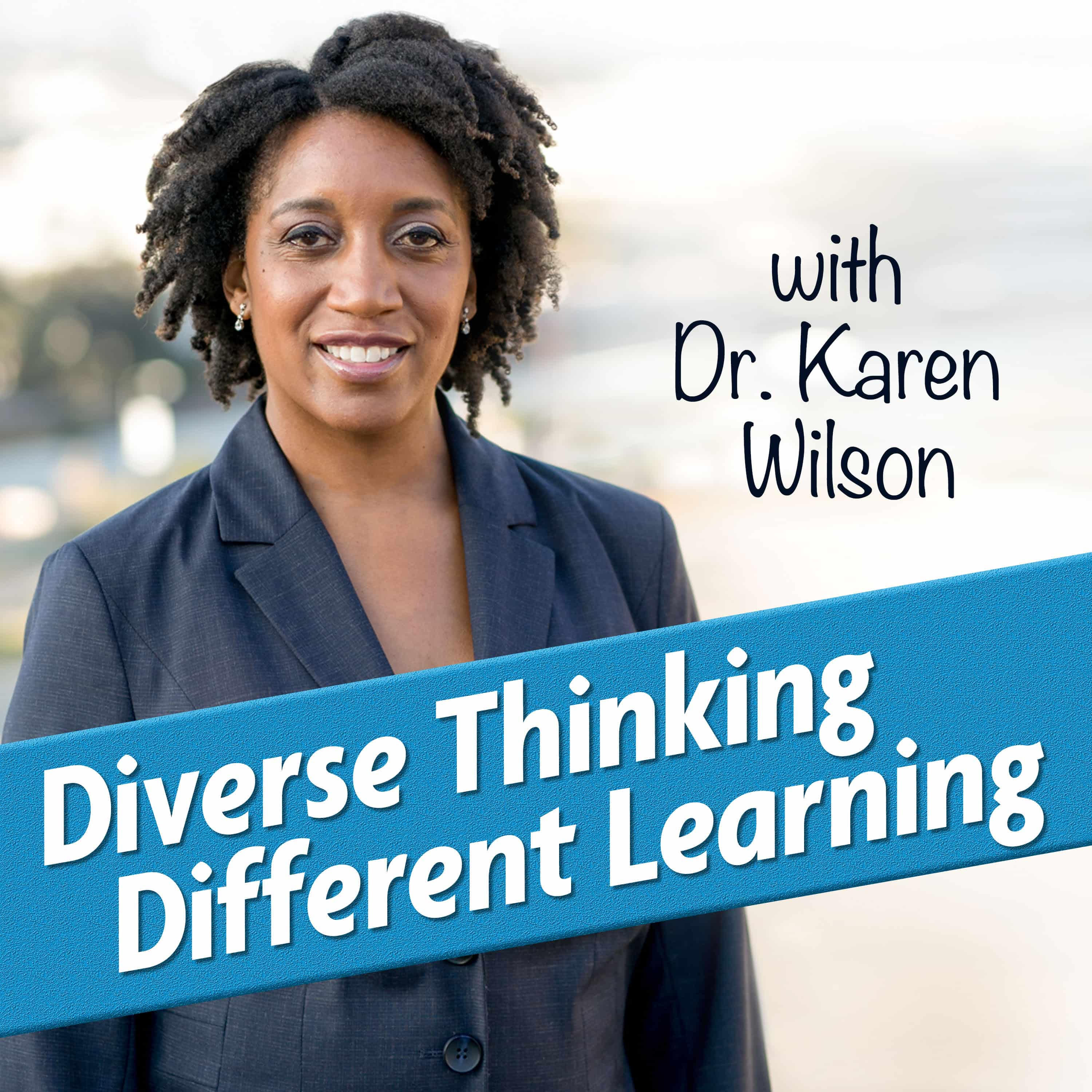
Diverse Thinking Different Learning
Dr. Karen Wilson
Diverse Thinking · Different Learning is hosted by pediatric neuropsychologist and mom of two, Dr. Karen Wilson. Each week, Dr. Wilson shares expert insights, science-based strategies, and conversations with leading specialists to help parents and educators better understand ADHD, dyslexia, autism, executive functioning challenges, learning differences, and youth mental health.
Through engaging interviews and practical guidance, the podcast translates research into real-world tools that empower adults to support neurodivergent children, struggling learners, and students with learning and thinking differences.
Trusted by families and professionals alike, Diverse Thinking · Different Learning is a go-to resource for reliable information and actionable strategies to help children learn, grow, and thrive.
Explore episodes and resources at https://diversethinkingpodcast.com/
Through engaging interviews and practical guidance, the podcast translates research into real-world tools that empower adults to support neurodivergent children, struggling learners, and students with learning and thinking differences.
Trusted by families and professionals alike, Diverse Thinking · Different Learning is a go-to resource for reliable information and actionable strategies to help children learn, grow, and thrive.
Explore episodes and resources at https://diversethinkingpodcast.com/
Episodes
Mentioned books

Jun 28, 2022 • 32min
Ep. 87: Why Dyslexic Students Can Excel in Tech with Jeannette Roberes
We often talk about ways to help students with dyslexia while in the classroom. But what happens when they are ready to enter the workplace and they still feel like their learning challenges will hinder them? There is a place for everyone and, in reality, those with dyslexia are a true asset to many companies, specifically those in the tech industry. Today's guest is Jeannette Roberes and she wears a lot of different hats. She is an author, speech pathologist, educator, and software engineer. While it sounds like a disconnected career path, Jeanette has used her multitude of experiences and passions to guide her to her role today: an advocate for individuals with dyslexia to pursue careers in tech. She works tirelessly to help organizations be better equipped and accessible to those with dyslexia, and she helps companies understand that individuals with dyslexia come with their own set of superpowers that can be a true asset. Show Notes: [2:21] - Jeannette is on the board for Smiles for Speech and she explains her role there alongside previous podcast guest, Sandy. [4:06] - As a speech pathologist, Jeanette found the work extraordinary and she explains how she became an advocate for those with dyslexia. [5:34] - Jeannette is also a software engineer and she shares why she sought a career change by utilizing her interests. [7:01] - This experience allowed Jeannette to see how she could be multi-passionate. [8:03] - In the past, we've seen our parents and grandparents work one job for their whole career, but things are different these days. [9:12] - She now focuses on helping technology companies hire neurodiverse individuals. [10:27] - Dyslexia is a language-based disorder that results in a high level of difficulty in reading. Dr. Wilson shares a bit about dyslexia. [11:12] - Jeannette's book outlines ways for employers to create accessible work spaces for those with dyslexia and what they bring to the job. [12:33] - Many educators are not familiar with dyslexia and are inadvertently providing their students with a negative experience. [13:49] - There is a mindset shift that needs to take place for not only employers but for those with dyslexia to know that they are valuable. [15:54] - We want to tap into our interests and work in a space that allows us to do that. [17:17] - Jeannette and Dr. Wilson discuss tools that can be used to better prepare someone with dyslexia to become proficient in technology. [19:16] - There are several products available and assistive technologies that have a huge impact; however, many parents and students think it is "cheating." [21:22] - It is not the case that working harder results in success. It is so much more than who works the hardest. [24:02] - No matter the learning difference, we need to embrace every dynamic, including employers. [26:43] - Not only do employers and educators need to embrace their differences, individuals need to know that they are assets. About Our Guest: Jeannette Roberes is an author who has worked as a speech pathologist, software engineer, and educator. She has spoken in over 40 countries and has earned recognition in The Washington Post and U.S. News & World Report, among other media acknowledgements. Jeannette's commitment to life-long learning is noted through her LETRS ® early childhood facilitator certification, TEACCH ® , Fast ForWord ® and PROJECT READ ® curriculum certifications. Her debut book, Technical Difficulties: Why Dyslexic Narratives Matter in Tech, has received 5 star reviews across Goodreads and Amazon. Jeannette is the chief academic officer of Bearly Articulating and a board member of Smiles for Speech. Connect with Jeannette Roberes: Barely Articulating Website Smiles for Speech Technical Difficulties: Why Dyslexic Narratives Matter in Tech by Jeannette Roberes Links and Related Resources: 6 Quick Questions for Parents Concerned About Dyslexia Dyslexia Episode 21: What You Know and Don't Know About Dyslexia with Dr. Lauren McClenny Rosenstein Episode 22: How Students with Dyslexia Can Develop the Skills Needed For Reading with Forough Azimi Episode 27: Why We Need to Support Parents Whose Kids Struggle With Learning with Maria Fagan Hassani Join our email list so that you can receive information about upcoming webinars - ChildNEXUS.com The Diverse Thinking Different Learning podcast is intended for informational purposes only and is not a substitute for medical or legal advice, diagnosis, or treatment. Additionally, the views and opinions expressed by the host and guests are not considered treatment and do not necessarily reflect those of ChildNEXUS, Inc or the host, Dr. Karen Wilson.

Jun 21, 2022 • 46min
Ep. 86: How to Provide Meaningful Intervention to Struggling Kids with Toni-Ann Millen
Today's guest is a force. She is a change maker and a passionate advocate who works with the schools in her community to develop programs that facilitate neurodiversity. Hailing from Jamaica, Toni-Ann Millen joins the Diverse Thinking Different Learning Podcast to discuss building trust, normalizing making mistakes, facilitating inclusion and belonging, and creating a safe space. These are the first steps to intervention for kids who learn and think differently. Toni-Ann and I connected through LinkedIn and moving forward, we plan to work together to bring more awareness and education to parents and educators. Be sure to also listen till the end of the episode as ChildNEXUS has an exciting announcement about doing just that through virtual learning sessions for parents. Show Notes: [2:39] - Toni-Ann is based in Jamaica and works actively in her community. [4:07] - It's important for educators to stay up to date on research and best practices. [5:32] - Sometimes parents decide to relocate their family to gain access to services for their child. Toni-Ann describes Jamaica's accessibility. [7:42] - Awareness in many areas is a problem. [8:20] - In some schools, there may be 50 students in one classroom with one teacher. [9:32] - Toni shares common comments from teachers and parents as a result of lack of awareness. [11:49] - To bring awareness to the abilities of children, Toni has done many things in her community including meeting with the Prime Minister. [13:14] - The private schools in Jamaica should be replicated and become the norm in rural areas as well. [15:20] - Parents who can afford private schooling have the advantage. This is not a lot of families which causes larger class sizes in public schools. [17:09] - It is just one piece to have access to assessments. [18:23] - In her private practice, Toni-Ann found that when reports were sent to schools, they went into a file and nothing was done with them. [20:31] - If there are not enough resources to support private school placement for students who are struggling, support should be integrated into all schools. [21:52] - Toni-Ann is passionate about the term "neurodiversity." [22:42] - We need to move from "What do you have?" to "What do you need?" [24:03] - Toni-Ann knows there is a need in her country and is passionate about working in her community. [25:24] - EduPhase came out of Toni-Ann's desire to do more. [26:36] - EduPhase gives support to parents to find the resources they need. [28:10] - When students start with EduPhase and Toni-Ann, her first priority is creating a safe environment. [29:14] - Toni-Ann admits frustration but shares how she controls it. [31:10] - Toni-Ann makes it a point to normalize making mistakes. [32:18] - A major concern is when parents think that a child's behavior or struggle is due to learning loss from the pandemic. [34:00] - A child without any challenge in learning will catch up, but people may miss the opportunity to help students who need intervention. [35:55] - Virtual learning groups are available and accessible from anywhere in the world to help educate parents in what can be done at home. [37:20] - In Jamaica, a disabilities act was very recently written but it takes time to implement change. [39:07] - Toni-Ann shares her dream for Jamaica regarding neurodiversity. [40:24] - If a teacher doesn't feel like a child belongs, the child won't feel safe. [41:23] - Toni-Ann shares an experience of a parent who felt hurt and broken when they didn't feel like they belonged. [42:46] - Special needs classes are not a bad thing, but it shouldn't be the first plan. [43:50] - Dr. Wilson and Toni-Ann will be partnering together. [44:29] - Dr. Wilson announces Virtual Learning sessions for parents to help increase understanding of learning differences and provide guidance on how to support children at home. About Our Guest: Toni-Ann Millen is currently working with schools in the development of school programs that facilitate neurodiversity in Jamaica. She has a private practice where she provides educational assessments to provide targeted individualized learning programs for students with learning challenges and disabilities who need support in the general classroom. She also has experience working as a Special Educator, Special Education Coordinator, Lecturer in Special Education, and Education Consultant. Connect with Toni-Ann Millen: EduPhase Website LinkedIn Phone: (876) 433-8331 Links and Related Resources: Is Your Child Struggling in School? What Are the Indicators of Learning Disabilities? Classroom and Home Accommodations for More Effective Learning Episode 5: Educational Therapy, Distance Learning, and Social Justice with Dr. Bibi Pirayesh Episode 37: Literacy: A Social Justice Issue with Resha Conroy Episode 62: How Lessons Learned in 2021 Can Help All Students Join our email list so that you can receive information about upcoming webinars and our new virtual learning groups - ChildNEXUS.com The Diverse Thinking Different Learning podcast is intended for informational purposes only and is not a substitute for medical or legal advice, diagnosis, or treatment. Additionally, the views and opinions expressed by the host and guests are not considered treatment and do not necessarily reflect those of ChildNEXUS, Inc or the host, Dr. Karen Wilson.

Jun 14, 2022 • 37min
Ep. 85: How a Personalized, Differentiated Curriculum Helps Students with Erika Sneath
How do differentiated curriculum integrated with SEL support students with learning differences and mental health challenges? It's safe to say that this type of instruction is fantastic for any student as it targets individual needs and strengths and today's guest has all the answers. Joining today is Erika Sneath, a former classroom teacher turned Curriculum Specialist at the unique Pacific Preparatory School where individualized curriculum isn't only possible, it's the norm. She is passionate about her job and creates lessons that are engaging, rigorous, and support the needs of all students. In this episode, we dive into those three components of a strong curriculum, why they are important, and how Pacific Preparatory School is able to provide that. She answers questions about flexibility and how students can get what they need in a 100% virtual setting. Show Notes: [2:08] - Through her years of teaching, Erika learned so much about kids who learn differently. [3:11] - There is so much involved in being a student. Erika describes the lessons she learned from her students. [4:37] - As a teacher, sometimes Erika felt that she couldn't give every student exactly what they needed as an individual. She learned to give herself grace. [6:00] - When there's a relationship, learning soars because it is a safe, collaborative learning environment. [7:14] - Curriculum and lessons should be engaging, rigorous, and supportive, but as a classroom teacher, Erika felt that she had to pick and choose. [8:27] - What is appropriate for a student's access point? [9:49] - In a classroom, the access point might be all over the place. Where did students start with their learning and where can they go? [11:29] - A lot of times, students who learn differently can get lost in a classroom of many students and fall behind without the level of support they need. [12:50] - Erika gives an example of how she learned student behavior is linked to rigor, engagement, and support. [15:42] - There are some questions teachers can ask themselves about lessons and individual students when individualizing curriculum. [16:46] - Erika describes how the curriculum works at Pacific Preparatory School. [17:50] - Customized curriculum looks different for each student and even takes into consideration a student's anxiety. [20:40] - As parents, ask questions. Pacific Preparatory School is very collaborative. [22:20] - Virtual learning can be overwhelming, but reaching out for support is helpful. [24:23] - How is Social Emotional Learning integrated into a fully online setting? [25:57] - Growth Mindset is a large component of the curriculum at Pacific Preparatory School. [27:02] - Social Emotional Learning cannot take place without a safe and collaborative learning environment. [29:20] - In addition to collaborating with parents, other professionals are brought into conversations to help customize a student's curriculum. [31:15] - Pacific Preparatory School includes extracurricular activities that give students opportunities to socialize. [33:18] - A flexible schedule creates new opportunities for students to socialize. About Our Guest: Erika graduated with a Bachelor of Arts in Elementary Education from Whitworth University before completing her Masters of Science degree in Curriculum and Instruction from Portland State University. She was a dedicated elementary classroom teacher for several years, and saw herself continuing along that path, until her passion for creating engaging curriculum led her to become the Curriculum Specialist & Academic Dean at Pacific Preparatory School. There she works with families and teachers to support the individualized curriculum development process. She is passionate about ensuring that lessons are engaging, rigorous, and support the needs of all students. In her free time, she enjoys spending time with her friends and family, working on a puzzle, getting outside, and reading. She is currently in the process of writing her own children's book, which seeks to highlight the ordinary in inclusion and difference. Connect with Erika Sneath: Pacific Preparatory School Website ChildNEXUS Provider Profile: Pacific Preparatory Email: Erika@PacificPreparatory.com Phone: (314) 722-7737 Links and Related Resources: Episode 52: How a 1:1 Instruction Model Helps Students with Jaime Porras and Vailet Yarijanian Episode 18: How Non-Public Schools Meet the Needs of Diverse Learners with Dr. Jason Bolton Episode 17: How Micro Schools Use an Innovative and Personalized Approach to Help Students Thrive with Dr. Maureen O'shaughnessy Schools that serve kids who think and learn differently Join our email list so that you can receive information about upcoming webinars - ChildNEXUS.com The Diverse Thinking Different Learning podcast is intended for informational purposes only and is not a substitute for medical or legal advice, diagnosis, or treatment. Additionally, the views and opinions expressed by the host and guests are not considered treatment and do not necessarily reflect those of ChildNEXUS, Inc or the host, Dr. Karen Wilson.

Jun 7, 2022 • 40min
Ep. 84: Dynamic Assessments with Dr. Daniel Franklin
We've discussed assessments before in previous episodes, but today's episode is unique. Parents and educators may be unfamiliar with dynamic assessments and how they can not only benefit the educator in driving instruction, but also help the student learn more about the ways they learn and achieve success. Dr. Daniel Franklin is no stranger to the ChildNEXUS community as a ChildNEXUS provider and the Diverse Thinking Different Learning Podcast. In a previous episode, Dr. Franklin discussed his book Helping Your Child with Language-Based Learning Disabilities and he joins me today to share his expertise on the topic of dynamic assessments. For the conversation today, Dr. Franklin discusses this type of assessment from the point of view of the practitioner, but he also shares a lot of the history and science behind why dynamic assessments can benefit students and educators. What sets these assessments apart from other forms? Listen to find out more. Show Notes: [2:24] - Dynamic assessments are not as well known as other forms of assessments to parents and educators. [3:12] - Dynamic assessments involve a high level of interaction in varying degrees. [4:23] - Dr. Franklin describes the history of dynamic assessments dating back to the 1930's. [5:46] - The younger the student is, the more necessary it is for instruction to be mediated. [6:32] - How can we use assessments dynamically to determine a student's potential? [8:44] - You can have two kids get the same exact score on the exact same test but they can have their score for very different reasons. [10:55] - When a child takes a test, they may have a behavioral or psychological difference that impacts their ability to perform on the test. [12:04] - Dr. Franklin demonstrates how he proctors a dynamic assessment. [13:27] - You can have a child take a test that they should do very well on, but they may shut down on the first question. [14:52] - Teachers may not be available to provide a dynamic assessment. [15:51] - Dynamic assessments are a reasonable and appropriate accommodation on a student's IEP. [17:33] - Are guidance and prompts permitted during dynamic assessments? Dr. Franklin says there are different approaches. [21:14] - Repeated mistakes can be examined quickly. [23:02] - The valuable information gathered from a dynamic instruction is why a student is struggling. [24:51] - Another key element to dynamic assessments is in writing. [26:32] - Within writing support, there is the concern about authorship. [27:31] - Practitioners should be in contact with educators to clarify all the notes taken and the legitimacy of the assessment particularly in the area of writing. [29:17] - Standardized tests are given to all students under the same conditions and cannot be deviated from the set guidelines. [30:50] - Dr. Wilson gives an example of how she creates a report to show what a child could do outside a standardized test and what information can help guide teachers in their instruction. [32:52] - One of the benefits of dynamic assessments is determining the potential of a child. [34:02] - If children continue to experience struggle and failure, it can unfortunately become how they perceive themselves. [35:18] - Sharing your observations with the child is an opportunity to model instruction and boost confidence. [36:53] - A parent can also use a homework assignment dynamically to help determine where they can help in a meaningful way. [37:50] - Traditional testing often makes the assumption that every child comes to the assessment with the same tools. About Our Guest: Dr. Franklin is the author of Helping Your Child with Language-Based Learning Disabilities, and a co-editor of The Los Angeles Psychologist. He holds a master's degree from the Harvard Graduate School of Education and a PhD from UCLA in Education. Dr. Franklin has over 30 years of experience in education as a teacher, administrator, and educational consultant. Connect with Dr. Daniel Franklin: FranklinEd.com (310) 571-1176 ChildNEXUS Provider Profile: Dr. Daniel Franklin Facebook Twitter Links and Related Resources: Episode 4: Helping Your Child with Language Based Learning Disabilities with Dr. Daniel Franklin Episode 2: Demystifying the Assessment Process How to Initiate a Special Education Assessment Helping Your Child with Language-Based Learning Disabilities by Daniel Franklin PhD Supporting Parents of Children with Language-Based Learning Disabilities Join our email list so that you can receive information about upcoming webinars - ChildNEXUS.com The Diverse Thinking Different Learning podcast is intended for informational purposes only and is not a substitute for medical or legal advice, diagnosis, or treatment. Additionally, the views and opinions expressed by the host and guests are not considered treatment and do not necessarily reflect those of ChildNEXUS, Inc or the host, Dr. Karen Wilson.

May 31, 2022 • 34min
Ep. 83: What Students with Disabilities Should Do When Starting College with Eric Endlich, Ph.D
In this informative episode, we take a look at college for students with disabilities. Oftentimes, we focus our energy on children with learning differences when they are young, but what happens when students reach young adulthood and express a desire to attend college? Are they ready? What does ready mean? Dr. Eric Endlich is today's guest and he offers key strategies and mindsets that can help set students up for success. He has said that students with disabilities may have tremendous potential as well as exceptional needs but to fulfill that potential in college, they need to be sufficiently prepared. Dr. Endlich also shares that it is never too early and it is never too late to start working on skills that prepare students for higher education. Show Notes: [2:42] - We spend a lot of time ensuring that students get the support they need when they are young, but there comes a time when students may want to go to college and lack preparation. [4:01] - Dr. Endlich helps students find colleges that meet their needs and also helps college-bound students complete the application process. [5:35] - There are a lot of things that Dr. Endlich looks at regarding skills that ensure independence. [6:56] - Individuals with the same diagnosis have different needs and the college selection process is very important. [8:14] - Graduation rates are lower for students with learning differences. [9:16] - It is important to not only consider the colleges that students can get into, but also colleges where students can be successful and finish their program. [10:02] - Parents and students should not wait until senior year in high school to ask questions and should consider what things their child can do independently. [12:25] - Academic coaching is available at some colleges. [13:34] - When should you begin working on skills needed for independence? Dr. Endlich says it is never too early and never too late. [15:04] - Executive functioning and adaptive living skills are things that can be asked about. There may be support available. [16:30] - Community colleges are excellent at providing study and financial skills courses and many school districts offer dual enrollment with community colleges. [18:32] - Self-awareness comes first. Students need to know what they are good at and what their deficits are. [20:21] - If they have self-awareness and can then self-advocate, students are on their way to success. [21:48] - In most colleges, it is up to the student to approach the professors with their list of accommodations. [23:21] - In many cases, students have not yet had to solve their own problems. [25:44] - Dr. Endlich was involved with a film called Autism Goes to College and describes some of his students on the panel. [27:55] - Obsessions or special interests seen in autism may lead to a career. [29:27] - It is so important for students to find their community. If they get into a college and are unable to make friends there, they will often want to leave. About Our Guest: Eric Endlich, Ph.D., clinical psychologist and founder of Top College Consultants®, helps neurodivergent students transition to college. Dr. Endlich is on the Learning Differences/Neurodiversity Committee and Diversity/Equity/Inclusion Committee of the Independent Educational Consultants Association, and has been awarded the "Making a Difference" award by the IECA. He co-manages a 2,400-member Facebook group, Parents of College Bound Students with Learning Disabilities, ADHD and ASD. A professional writer and national presenter, he has been interviewed by Forbes, Business Insider, CollegeXpress, College Confidential and U.S. News & World Report. Connect with Eric Endlich, Ph.D.: Top College Consultants Website (617) 515-3568 Parents of College Bound Students with Learning Disabilities, ADHD, and ASD Facebook Group Links and Related Resources: Episode 15: From High School to College: Steps to Success for Students with Disabilities with Elizabeth C. Hamblet Episode 47: Helping Students Transition to Adulthood with Dr. Gwennyth Palafox Join our email list so that you can receive information about upcoming webinars - ChildNEXUS.com The Diverse Thinking Different Learning podcast is intended for informational purposes only and is not a substitute for medical or legal advice, diagnosis, or treatment. Additionally, the views and opinions expressed by the host and guests are not considered treatment and do not necessarily reflect those of ChildNEXUS, Inc or the host, Dr. Karen Wilson.

May 24, 2022 • 36min
Ep. 82: How to Foster a Teen's Independence with Nicole Kaplan and Peggy Oram
Does your teen have the necessary skills needed to achieve autonomy? If not, how can we build these skills through empowering rather than enabling? As parents, we often think we are doing the right thing by jumping in and helping with tasks and responsibilities, especially if they seem challenging or uncomfortable. But we may be doing more harm than good. On the Diverse Thinking Different Learning Podcast today, we have two guests, Nicole Kaplan and Peggy Oram. Both guests are members of the ChildNEXUS provider community, which is a tool you can use to search for providers of various expertise. Today, Nicole and Peggy share their expertise on the topic of executive functioning skills and independence in adolescents. If you are the parent, educator, or caregiver of a younger child however, they also share ways to avoid codependency by starting this skill development early on. Show Notes: [1:53] - Welcome to the show, Nicole and Peggy! [2:58] - We want to foster independence so adolescents are less reliant upon adult assistance. [4:02] - Sometimes we think we are doing the right thing by doing things for our children, but we may be causing more harm than good. [5:01] - There are some tasks that aren't chores, they're real responsibilities. By doing so many things for them, we set them up with bad habits. [6:16] - This is an ongoing process for teens and young adults. [7:10] - There is an important link between executive functioning skills and autonomy. [8:40] - Nicole and Peggy describe biological age and executive functioning age. [10:31] - Keep in mind that this is a rule of thumb. Every child learns differently. [11:35] - Executive functioning skills are only taught in school through academics. Many schools do not teach them at all. [13:13] - Just because you are intelligent doesn't necessarily mean you have the executive functioning skills to succeed in everyday life. [14:51] - It is human nature to jump in and take over to make things easier for your child. [15:45] - Peggy and Nicole explain the difference between empowering and enabling. [17:09] - Learning to manage frustration is key to learning EF skills. [18:41] - The framework in helping and stepping back is called scaffolding. [20:34] - The hardest part for the parent is to sit back and watch. [22:06] - Take tasks apart and look at each step. Using laundry as an example, teens might not know how to fold laundry because they've not thought about it. [24:45] - Knowing why each step is important is something adolescents need to understand. [27:14] - If we jump in too soon, we're sending the message that we don't think they can do it. [28:40] - These skills are teachable at any time. It's never too late to help build autonomy. [30:11] - Sometimes these skills feel very unnatural. [30:42] - Peggy and Nicole share some resources that are also linked below. [31:49] - We should start teaching kids to capitalize on their strengths. [33:10] - Keep in mind that these skills are not always easy for kids. Modeling is important, but kids need to move from observer to active participant. About Our Guests: Nicole Kaplan received her undergraduate degree in English Literature, with an emphasis in Education, from the University of California, Los Angeles. She went on to earn her Master's degree in Special Education with a specialization in Educational Therapy from California State University Northridge. She is also an active member of the Association of Educational Therapists. For over two decades, Nicole has seen clients in a private practice setting collaborating with students, parents, teachers, learning specialists, psychologists, and neuropsychologists to create a game plan tailored to her client's specific academic and emotional needs. She works from a strengths-based perspective, helping students from age 6 through adulthood to overcome or compensate for learning challenges. She is the founder of empowerED Learning, which provides holistic, comprehensive services for neurodiverse students and parents. Nicole and her team work in-person and virtually, depending on the students' academic needs. Peggy Oram graduated with a Master's Degree in Special Education with an emphasis in Educational Therapy. She has worked with neurodiverse students of all ages, from pre-K to young adults, for almost 30 years. Her primary focus is one-on-one remediation of various types of learning issues: reading, writing, mathematics, language skills, processing skills, social skills, and executive functioning skills. Through her practice and personal experience, she takes a special interest in children and teens with ADHD and/or diagnosed as being on the autism spectrum. These students need a strong foundation and important tools to succeed in an increasingly complex world, and she is excited to share how parents can learn how to support their children every step of the way. She recently moved from Los Angeles to the greater Nashville area, where she is seeing students in person and virtually. Connect with Nicole Kaplan: EmpowerED Learning Website Nicole's ChildNEXUS Profile (310) 709-4054 EdTherapy@NicoleKaplan.net Connect with Peggy Oram: EmpowerED Learning Website Peggy's ChildNEXUS Profile (310) 429-5621 Peggy.EdTherapy@gmail.com Links and Related Resources: Episode 47 - Helping Students Transition to Adulthood with Dr. Gwennyth Palafox Search for a Provider Join our email list so that you can receive information about upcoming webinars - ChildNEXUS.com The Diverse Thinking Different Learning podcast is intended for informational purposes only and is not a substitute for medical or legal advice, diagnosis, or treatment. Additionally, the views and opinions expressed by the host and guests are not considered treatment and do not necessarily reflect those of ChildNEXUS, Inc or the host, Dr. Karen Wilson.

May 17, 2022 • 35min
Ep. 81: Yes! Your Child Can with Victoria Waller, Ed.D
Welcome back for another exciting conversation, this time with an educator who has been working with children for over 40 years. Dr. Victoria Waller, author of Yes! Your Child Can: Creating Success for Children with Learning Differences, joins the Diverse Thinking Different Learning Podcast to help us identify the strengths of each child to unlock their full potential. Her focus for the last 40 years and counting is not what is wrong with children, but what is right. In our discussion today, Dr. Waller shares several of her experiences and student success stories that have resulted from focusing on interests and strengths. As parents and educators, sometimes we get caught up in honing in on deficits and while early intervention is crucial, we can better reach a child and develop a trusting relationship when we help them with the things they love. Releasing in June 2022, Dr. Waller's book is highly recommended for all parents. Show Notes: [2:07] - Victoria Waller's book is available for preorder for release in June 2022. [3:10] - Even 40 years ago, Victoria never called it a disability and sees kids' incredible abilities. [4:14] - Victoria shares the statistics that show that most parents think their child will "snap out of it" and educators think children with learning differences are "lazy." [6:01] - What inspired her to write this specific book? After putting the book aside, Victoria had two experiences that pushed her to publish. [8:19] - When you have a gut feeling, you have to get your child help. [10:40] - Sharing another story about a child's passion, Victoria proves the impact of using a child's interests in their learning. [12:32] - All children have positives and strengths and recognizing them is empowering. [13:53] - Some kids spend all day in school and every day in therapy after school and it can be detrimental to have too much going on. [14:59] - Most parents pay close attention to what their child can't do rather than what they can do. [16:12] - Sometimes you need to get creative to teach a skill using a child's passion. It connects their interest with learning and sparks more interest. [18:41] - Many children with learning differences can use their passions to create. [20:56] - In her book, Victoria takes readers on a step by step process. [23:06] - You can be smart, but still struggle. [24:23] - Parents tend to be afraid of learning problems and struggles can cause stress for both the parents and the student. [25:44] - While helping parents understand, Victoria's book is also helping empower students. [27:24] - Confidence is crucial and is even a key component of socializing. [30:01] - It is okay to reach out to a teacher or therapist. [31:21] - Victoria's book also provides educators with ways to communicate with parents about a child's strengths. About Our Guest: Victoria E. Waller, Ed.D. holds a B.S. in Education from Wayne State University, and both an M.Ed. as a certified reading specialist and an Ed.D. focusing on reading and learning differences from the University of Cincinnati. Dr. Waller has been awarded the University of Cincinnati's Distinguished Alumna College of Education Award, was one of three finalists for the L.A. Music Center's Bravo Award for Outstanding Teaching, and was named a Local Hero in the L.A. Times for her Printer Pal Program, connecting students with nursing home occupants. She was the creator of the Disney Busy Bags for Travel on Planes and Cars for Disney/Hyperion Books and has created backpacks and toys for M&M Mars, Inc. Connect with Victoria Waller, Ed.D: Victoria Waller, Ed.D. Website Instagram Links and Related Resources: Yes! Your Child Can: Creating Success for Children with Learning Differences by Dr. Victoria Waller Turning Kids' Passions and Enthusiasms into Superpowers with Barry Prizant, Ph.D., CCC-SLP Helping Your Child with Language-Based Learning Disabilities with Dr. Daniel Franklin Join our email list so that you can receive information about upcoming webinars - ChildNEXUS.com The Diverse Thinking Different Learning podcast is intended for informational purposes only and is not a substitute for medical or legal advice, diagnosis, or treatment. Additionally, the views and opinions expressed by the host and guests are not considered treatment and do not necessarily reflect those of ChildNEXUS, Inc or the host, Dr. Karen Wilson.

May 10, 2022 • 35min
Ep. 80: Turning Kids' Passions and Enthusiasms into Superpowers with Barry Prizant, Ph.D., CCC-SLP
What would happen if we switch from seeing problematic behaviors as a child being defiant and willfully uncooperative to seeing those behaviors as strategies to cope with anxiety and emotional dysregulation? Dr. Barry Prizant is here to show us what happens when we make that shift. In his recently updated and expanded book Uniquely Human: A Different Way of Seeing Autism, Dr. Prizant presents seemingly problematic behaviors as part of a range of strategies to cope with a world that feels chaotic and overwhelming. Rather than curb these behaviors, it's better to enhance abilities, build on strengths, and offer support that will lead to more desirable behavior and a better quality of life. In this episode, Dr. Prizant explains how different behaviors appear to us as parents and educators, but what would happen if we take the time to find out why the behaviors are occurring. He also helps us take deep interests and reframe how we see them to expand learning and ultimately boost confidence and motivation. Show Notes: [2:06] - Welcome to the show, Dr. Prizant! Karen highly recommends Dr. Prizant's book Uniquely Human. [3:26] - Books like Uniquely Human, humanize the experiences of those on the Autism spectrum. [4:50] - Dr. Prizant describes his background and in depth training. He looks through a developmental lens. [6:21] - For decades, parents have been wanting to understand the reason for a behavior but it is hard to understand if we don't ask them about their experience. [8:05] - We have to see a child's behavior as their way of coping with emotional dysregulation. [9:49] - When you justify a behavior or jump to conclusions, it gives you permission to not ask why. [10:38] - You have to find the underlying issue and find a solution rather than just trying to stop the behavior. [11:58] - Dr. Prizant's book is focused primarily on children with Autism, but these issues are seen in many others, too. [13:45] - Most often, we focus on things a child cannot do, but honoring a child's strengths is so crucial. [15:10] - Peaks could be characterized by intense interests. [16:48] - The most important thing is building trust. [17:57] - To demonstrate, Dr. Prizant shares a story about a child intensely interested in flags and about a child who was fascinated by calendars. [20:33] - What is the difference between an obsession and an enthusiasm? It's how we see the behavior. [22:06] - When we respect a child's interest, we build trust and expand their learning and engagement with others. [24:34] - We should show appreciation for a child's interest. Show your appreciation by engaging with them in their interest. [26:19] - Sometimes we can set special times for enthusiasms or integrate them into the day to day routines. [28:27] - The limitations are in our creativity in how we can see the possibilities of their interests. [30:36] - Dr. Prizant shares the story of a student who is hyperlexic. [32:46] - It is important to give every child the opportunity to shine with their unique strengths. About Our Guest: Dr. Barry Prizant is a speech-language pathologist with close to 50 years experience as a researcher and international consultant for autistic individuals and their families. He is a Visiting Scholar at Brown University and Director, Childhood Communication Services. Publications include The SCERTS Model manuals, an educational approach implemented in more than a dozen countries, four books and 130 scholarly chapters and articles. Barry has presented more than 900 seminars and keynote addresses internationally, including two invited presentations at the UN for World Autism Awareness Day. He has received numerous honors for his career contributions. Connect with Barry Prizant, Ph.D., CCC-SLP: Uniquely Human Podcast Website | LinkedIn | Facebook | Twitter Links and Related Resources: Episode 43: Building Social Competence and Enhancing Social Skills with Dr. Elizabeth Laugeson Episode 25: Raising Differently Wired Kids with Joy and Confidence with Debbie Reber Uniquely Human: Updated and Expanded: A Different Way of Seeing Autism by Barry Prizant, Ph.D. Join our email list so that you can receive information about upcoming webinars - ChildNEXUS.com The Diverse Thinking Different Learning podcast is intended for informational purposes only and is not a substitute for medical or legal advice, diagnosis, or treatment. Additionally, the views and opinions expressed by the host and guests are not considered treatment and do not necessarily reflect those of ChildNEXUS, Inc or the host, Dr. Karen Wilson.

May 3, 2022 • 31min
Ep. 79: How to Develop Social Thinking Skills with Michelle Garcia Winner, MA, CCC-SLP
In this brand new episode, guest Michelle Garcia Winner joins me as we discuss social thinking skills. If you have ever heard of the Zones of Regulation, Think Social, or Thinking About You Thinking About Me, you've got Michelle Garcia Winner to thank. Her work is recognized globally and she joins the Diverse Thinking Different Learning Podcast today in her mission to share the importance of social learning. Social Thinking is the ability to consider your own and others' thoughts, emotions, beliefs, intentions, and knowledge to help interpret and respond to the information in your mind and possibly through your social behavioral interactions. During the last two years, we have experienced never-before-seen changes in how we interact with others due to the pandemic. We know that socially, many children experienced social loss in addition to academic loss. But now what? How can we integrate evidence-based strategies to help children improve their social competencies? You don't want to miss this conversation. Listen to the brilliant Michelle Garcia Winner demonstrate the importance of social thinking skills and what we can do as parents and educators. Show Notes: [2:20] - Because of the pandemic, many children have experienced social loss in addition to academic loss. [3:11] - Kids don't only learn academics in schools, they learn how to be a part of a community. [4:01] - We tend to think that kids have a lot of these social skills when they start school. [5:02] - Social vocabulary is a component of the Social Thinking program. [6:31] - Michelle demonstrates a way to show kids to "think with their eyes." [7:56] - Social expectations and social rules are constantly changing and we have to be flexible. [9:23] - Problems are not all the same size and most young children react to all problems as if they are the same size. [10:40] - There are so many hidden social rules in different situations. [12:07] - We need to teach why we do things in certain situations. [13:54] - Social thinking impacts more than just social interactions, but also academics. [14:57] - In many cases, we don't tell kids what we expect or why. [16:03] - Imagination also plays a key role. [18:34] - Isn't it amazing what your brain is already doing? Kids did remarkably well imagining that they were still in a classroom when shifting to distance learning. [20:27] - When we empower kids to describe what they want from others, they have better tools to reflect on their own behavior. [21:56] - We have to give ourselves grace that these skills are not always taught well. Each of us cannot do this full throttle all of the time. [24:02] - There is a difference in how we communicate and thrive socially, virtually and in-person, especially in young children. [25:59] - Because of the extended amount of time on screens, kids did not experience social learning. [26:56] - It is never too late to start Social Thinking. [28:03] - This learning is preparing children to live independently and is important to integrate into all learning. About Our Guest: Michelle Garcia Winner, MA, CCC-SLP, is the founder of Social Thinking and a globally recognized thought leader, author, speaker, and social-cognitive therapist. She is dedicated to helping people of all ages develop social-emotional learning, including those with social learning differences. Across her 35+ year career she has created numerous evidence-based strategies, treatment frameworks, and curricula to help interventionists foster social competencies in those they support. Michelle's work also teaches how these competencies impact a person's broader life, including their ability to maintain relationships and their success in school and career. Connect with Michelle Garcia Winner, MA, CCC-SLP: Social Thinking Website Links and Related Resources: Social Thinking Website What is Social Thinking? Episode 43: Building Social Competence and Enhancing Social Skills with Dr. Elizabeth Laugeson Bully-Proofing Strategies for Teens with Autism Spectrum Disorder and Other Social Challenges Join our email list so that you can receive information about upcoming webinars - ChildNEXUS.com The Diverse Thinking Different Learning podcast is intended for informational purposes only and is not a substitute for medical or legal advice, diagnosis, or treatment. Additionally, the views and opinions expressed by the host and guests are not considered treatment and do not necessarily reflect those of ChildNEXUS, Inc or the host, Dr. Karen Wilson.

Apr 26, 2022 • 42min
Ep. 78: Supporting Youth with Autism and ADHD with Holly Blanc Moses
With April being Autism Awareness and Acceptance Month, we want to do our part to increase acceptance and understanding as well as help parents and educators connect with the resources they need. So, today we are re-airing an episode with Holly Blanc Moses all about youth with both Autism and ADHD. We've had several episodes on them separately and while Autism and ADHD do have a lot of overlapping qualities, children who have both have unique differences. Today's guest is the perfect expert not only professionally, but personally as well because she is a parent to two differently wired boys. Holly Blanc Moses joins the podcast today as everyone's favorite behavior expert and licensed mental health therapist. She has over 23 years of experience in ADHD, Autism, and anxiety and is the host of The Autism ADHD Podcast. Listen on to find out ways we can not only support youth with Autism and ADHD, but also find the support we need as parents and educators. Show Notes: [3:11] - How are kids with both Autism Spectrum Disorder and ADHD different from those with one or the other? [3:56] - In the past, people were not allowed to be diagnosed with both. [5:05] - Autism and ADHD have a lot of overlapping characteristics. [6:47] - Dysregulation is a major topic of concern. [8:34] - Many parents may feel at a loss when it comes to needing support. Holly reminds us that you are not alone. [11:07] - Once you have your support in place, you can better regulate yourself and find the support and mentors for your child. [11:59] - There are many groups on social media full of parents in need of support. [13:38] - Parents are better parents when their own needs are met too. [17:10] - Be in tune to the reason behind behaviors observed. You have to address the reason before you can address the behavior. [18:36] - Holly tells a personal story that illustrates the reason behind a behavior. [22:17] - Children might be confused and afraid to ask questions due to anxiety, which can lead them to appear defiant or give up. [25:37] - With autism and ADHD, students are more likely to exhibit high anxiety and depression, and experience loneliness. [29:39] - Holly has an online course for setting your child up for social success. [31:07] - Be flexible in changing interventions if something isn't working. [32:07] - Once per year IEP meetings may not be sufficient. If something needs to change, parents should ask for additional meetings to review progress. [33:39] - Don't punish a child for poor grades or for things they cannot control. [35:42] - With differently wired kids, there is an emphasis on the challenges, but remember that everyone's wins are different. [37:07] - Practice shifting your mindset to one of celebration. [39:03] - Their wins are going to be different. As a parent or educator, it is important to celebrate every win possible. [41:03] - Holly has many resources on her website, hosts the Autism ADHD Podcast, and has a lot of groups to connect with her and other parents. About Our Guest: Holly Blanc Moses is a Licensed Psychological Associate, a Licensed Clinical Mental Health Counselor, and an ADHD Certified Clinical Services Provider with over 23 years of experience in ADHD, Autism, and anxiety. She understands from both a professional standpoint and a personal one as a mother of two differently wired boys. She is also the host of the Autism ADHD Podcast. Connect with Holly Blanc Moses: Holly Blanc Moses Home Page The Autism ADHD Podcast Free Behavior and Social Success Guides Autism/ADHD Facebook Group for Parents Links and Related Resources: Autism Spectrum Disorder Episode 25: Raising Differently Wired Kids with Joy and Confidence with Debbie Reber Episode 45: How Sensory Processing Impacts Communication with Jessie L. Ginsburg Episode 43: Building Social Competence and Enhancing Social Skills with Dr. Elizabeth Laugeson What is an Autism Mama Bear? Beyond Credentials: Three Extras to Look for in Your Child's Therapist Join our email list so that you can receive information about upcoming webinars - ChildNEXUS.com The Diverse Thinking Different Learning podcast is intended for informational purposes only and is not a substitute for medical or legal advice, diagnosis, or treatment. Additionally, the views and opinions expressed by the host and guests are not considered treatment and do not necessarily reflect those of ChildNEXUS, Inc or the host, Dr. Karen Wilson.

