

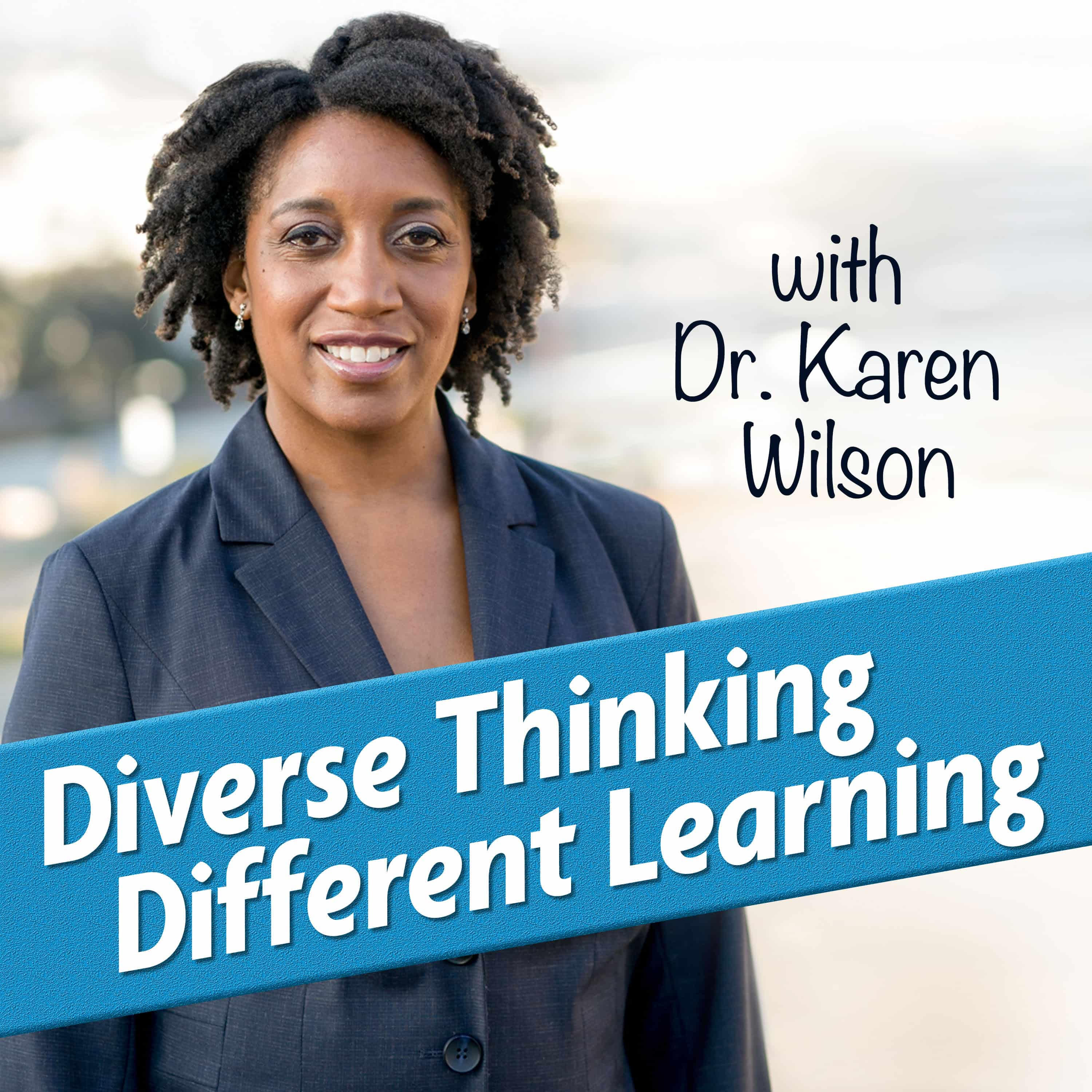
Diverse Thinking Different Learning
Dr. Karen Wilson
Diverse Thinking · Different Learning is hosted by pediatric neuropsychologist and mom of two, Dr. Karen Wilson. Each week, Dr. Wilson shares expert insights, science-based strategies, and conversations with leading specialists to help parents and educators better understand ADHD, dyslexia, autism, executive functioning challenges, learning differences, and youth mental health.
Through engaging interviews and practical guidance, the podcast translates research into real-world tools that empower adults to support neurodivergent children, struggling learners, and students with learning and thinking differences.
Trusted by families and professionals alike, Diverse Thinking · Different Learning is a go-to resource for reliable information and actionable strategies to help children learn, grow, and thrive.
Explore episodes and resources at https://diversethinkingpodcast.com/
Through engaging interviews and practical guidance, the podcast translates research into real-world tools that empower adults to support neurodivergent children, struggling learners, and students with learning and thinking differences.
Trusted by families and professionals alike, Diverse Thinking · Different Learning is a go-to resource for reliable information and actionable strategies to help children learn, grow, and thrive.
Explore episodes and resources at https://diversethinkingpodcast.com/
Episodes
Mentioned books

Sep 6, 2022 • 41min
Ep. 97: Building Communities of Support and Resistance with Dr. Bibi Pirayesh
This episode may make you angry but I am hoping that it will also motivate you to advocate for change. I've invited Dr. Bibi Pirayesh back to the Diverse Thinking Different Learning Podcast to talk about learning disabilities as a social justice issue. This topic is certainly charged and rightfully so. Today, we discuss whether our current education system was built for neurodiverse learners. It is hard for me to believe that Dr. Pirayesh fell into educational therapy by accident as she is extraordinary at the work she does. She is also an extraordinary advocate. Her work in the field is tireless and in this episode, she and I discuss the hardships we face as a society that does not allow all learners to reach their potential. Show Notes: [2:47] - Welcome back, Dr. Pirayesh! [3:53] - Learning disabilities is a social justice issue and in recent years social justice has become extremely politicized. [5:10] - While social justice is typically viewed as based around race, gender, and sex, it is all connected through ableism. [6:19] - Why people may feel frustrated and feel like they can't move forward. [8:19] - What is the ideology that fuels ableism in the education system? [9:57] - The way that it is, isn't necessarily the way it is supposed to be. It's just the way it was built and the education system is working exactly the way it was designed. [11:10] - The education system was designed to be competitive. [13:53] - When you read special education law, it becomes clear that this system is created in a specific way. [15:56] - As a system, we don't always interpret the science correctly. [16:54] - During the pandemic, people became more aware of learning problems and mental health issues, but this is not a new problem. [18:41] - Dr. Pirayesh was hopeful in the beginning of the pandemic when there were fast changes in education, but things are settling back to where they were as the pandemic slows. [20:18] - One positive change is access to mental health support, but we haven't made any shifts for marginalized students who learn differently. [22:10] - Reading is one area where research is plentiful and solid and yet we aren't making changes in the system. [23:16] - There is a connection between the prison system and education system. [26:09] - Many people, including Dr. Pirayesh, have felt at times hopeless for change. [27:45] - Small change is a starting point and Dr. Pirayesh sees the impact of individuals and schools being receptive to advocacy. [29:49] - Change is absolutely possible. [31:21] - Dr. Pirayesh shares some mindset shifts she has had to make in her business and personal life. [33:04] - There are hopeful things in a society that isn't built for everyone. Having these conversations isn't enough. There has to be action. [34:42] - How are people coming up against the system and what is the result? [37:10] - Share your story here. About Our Guest: Dr. Bibi Pirayesh holds a Bachelor's degree in Neuroscience and Education from the University of Pittsburgh and a Master's degree in Developmental Psychology from Columbia University where her work focused primarily on children's development of mathematical thinking and cognitive neuroscience. While the emphasis of Dr. Pirayesh's work is on remediating learning disabilities in a one-on-one setting, she is also a sought after speaker and community advocate for children and families around learning rights. Bibi works with children grades 1-12 and covers a wide range of learning difficulties including dyslexia, ADHD, and spectrum disorders. Dr. Pirayesh completed her doctoral work at Loyola Marymount University where she is also faculty and is involved with a number of service organizations including The Association of Educational Therapists. Connect with Dr. Bibi Pirayesh: The Difference is Not the Deficit Project: Share your story Links and Related Resources: Episode 5: Educational Therapy, Distance Learning, and Social Justice with Dr. Bibi Pirayesh 6 Quick Questions for Parents Concerned About Dyslexia Join our email list so that you can receive information about upcoming webinars - ChildNEXUS.com The Diverse Thinking Different Learning podcast is intended for informational purposes only and is not a substitute for medical or legal advice, diagnosis, or treatment. Additionally, the views and opinions expressed by the host and guests are not considered treatment and do not necessarily reflect those of ChildNEXUS, Inc or the host, Dr. Karen Wilson.

Aug 30, 2022 • 41min
Ep. 96: Why Early Intervention is Important with Tania Abouezzeddine
Why is intervention, particularly early intervention, so important? The answer is brain plasticity, which is the brain's ability to change, reorganize, and even develop more efficient pathways for processing information. Research into the neurological bases of reading disorders, for example, has shown the educational and cognitive strategies can reroute brain networks and the brain can reorganize to overcome reading obstacles. Today's guest shares with us all about early intervention. Dr. Tania Abouezzeddine is a licensed Clinical Neuropsychologist and is also a faculty member at Rosemead School of Psychology at Biola University. In today's episode she explains why early intervention is key and how it results in positive changes in the brain. She not only shares why early intervention is important but how it impacts the development of the brain and the science behind it all. Show Notes: [2:45] - It is important to understand why a child is struggling before deciding on the intervention. [3:31] - Any good intervention begins with an accurate diagnosis or assessment. [4:28] - What makes a good assessment? [5:52] - A lot of times, children are more likely to be labeled with behavior disorders. [6:55] - Tania shares research surrounding behavior disorders diagnosed to particular demographics that result in a negative trajectory. [9:09] - Tania describes some of the negative results of an inaccurate diagnosis or assessment. [10:18] - If an intervention has not begun by age 8, a child with a reading disorder will likely not bridge the gap in their reading. [11:48] - Reading disorders are hereditary. [14:03] - There is evidence that you can change the brain through good, consistent, and intense intervention. [15:19] - External interventions result in a positive change in the brain. [16:24] - The purpose of interventions is not to have a better reading score. [17:43] - Every brain is working at its own pace, but it will improve with intervention and depends on the severity of the disorder. [19:02] - There's a high percentage of children with more than one disorder. [20:17] - The child also needs to understand why an intervention is necessary. [21:59] - Tania works with high school graduates in college who have not been diagnosed and still cannot read independently. That window of time has been missed. [23:23] - Training the brain through early intervention can create new brain pathways that are similar to a child without a disorder over time. [24:46] - Sometimes parents are afraid to know and they avoid an assessment. [26:14] - Early intervention is also important because you can catch these problems before a child becomes jaded. [27:50] - The identification of strengths can help the intervention as well. [30:49] - Knowing strengths shows the child that their weaknesses don't define them. [32:19] - What happens when a child doesn't receive positive early intervention? [34:25] - We all have things we are not good at, but when it comes to reading and learning disorders they can have negative ramifications. [36:02] - Tania shares examples of students who choose majors or professions based on areas of weakness rather than their strengths. [38:41] - Students can also receive a charted plan to help with prioritizing. About Our Guest: Dr. Abouezzeddine is a licensed Clinical Neuropsychologist (across the lifespan with a specialty in Pediatrics) and is a full-time faculty member at Rosemead School of Psychology at Biola University. She obtained her doctoral degree from the University of Southern California where she specialized in childhood trauma and resilience, which continue to be areas of research interest. After the completion of her doctoral studies, Dr. Abouezzeddine went on to specialize in Clinical Neuropsychology, beginning with a clinical internship in Geriatric Neuropsychology at the West Los Angeles VA Medical Center and continuing on with two additional years of clinical postdoctoral studies in Pediatric Neuropsychology at UCLA's Semel Institute of Neuroscience. Dr. Abouezzeddine specializes in the cognitive assessment of children and adolescents with neurodevelopmental disorders (e.g. ADHD, Autism), Learning Disabilities (e.g. Reading, Math), as well as cognitive impairments related to Traumatic Brain injury or and other medical conditions (e.g. epilepsy). She also occasionally assesses adults and older adults in Arabic schedule permitting. She is fluent in both English and Arabic. Connect with Tania Abouezzeddine: Website Email: pedsneurola@gmail.com or Tania.Abouezzeddine@gmail.com ChildNEXUS Provider Profile Links and Related Resources: Episode 2: Demystifying the Assessment Process Episode 22: How Students with Dyslexia Can Develop the Skills Needed for Reading with Forough Azimi Episode 1: Uncovering Why a Child is Struggling Join our email list so that you can receive information about upcoming webinars - ChildNEXUS.com The Diverse Thinking Different Learning podcast is intended for informational purposes only and is not a substitute for medical or legal advice, diagnosis, or treatment. Additionally, the views and opinions expressed by the host and guests are not considered treatment and do not necessarily reflect those of ChildNEXUS, Inc or the host, Dr. Karen Wilson.

Aug 23, 2022 • 28min
Ep. 95: Hope for a New School Year with Lindsay Recknell
How are you feeling about this new upcoming school year? Would you say you feel hopeful about it? Now it is really important to feel hopeful about the upcoming school year, but it isn't enough to just hope that your child or client will have a better school year. We know that there are many pieces to the puzzle of having a great school year, but hope does matter. And today our guest talks about the science of hope and what that means for heading back to school. Lindsay Recknell is an expert in hope and in this episode, she explains what this intangible concept feels like within our brains. When you dig deep into it, it seems complicated with the Hope Theory, the Hope Circuit, the Hope Scale. But really, this concept is simple to grasp and even better, it can be taught. Hope is contagious and can absolutely change your mental health and wellbeing. In this episode, Lindsay also walks us through an incredibly useful exercise that you can do independently or even with your family as we cultivate hope for a new school year. Show Notes: [2:31] - This time of year is a time of new beginnings. [3:58] - When we think about the word hope, it feels intangible. [5:39] - Lindsay explains Positive Psychology. [6:40] - Hope Theory is when the action of hope comes into play. Lindsay also explains the Hope Circuit. [7:47] - This concept is simple to grasp. Hope can be taught. [8:38] - We all have hope, even if it is deep down. There is a scientifically validated test called The Hope Scale. [9:24] - Lindsay believes that hope is contagious. [10:16] - You can also increase your hope independently. [11:31] - The Hope Circuit connects to our intrinsic thoughts on hope. [12:40] - Lindsay explains the Hope Circuit and what happens in your brain. [14:13] - Do this activity with Lindsay. Pause and write these things down. [16:24] - As you think about the vision you've created, you will feel something. That's your brain on hope. [17:05] - If you can do this exercise over and over with your family when you need a hope booster, it is so powerful. [18:38] - Hopefulness is not all about feeling happy. Hope and optimism are related but are independent from each other. [19:42] - Lindsay's definition of hope is that the future will be better than today by taking action over the things we can control. [21:04] - What are some of the things we can do to help build hope? [23:01] - You don't have to start with something huge. [24:20] - The process of reaching the goal is more important than the goal itself in a lot of ways. [25:40] - We know that life is hard sometimes, but we have tools to help us leverage hope. About Our Guest: As an expert in hope and a Certified Psychological Health & Safety Advisor, Lindsay Recknell works with individuals and organizations to increase their levels of psychological health & safety in the workplace using Positive Psychology and the Science of Hope. She empowers individuals, strengthens teams and transforms organizations through her Self-Awareness Superhero, Dream Catalyst and Wellness Webinars programs. Lindsay lives in Calgary with her husband and their two Golden Retrievers. Connect with Lindsay Recknell: Expert In Hope Website Phone: 403-200-0943 Instagram Hope Motivates Action Podcast Links and Related Resources: Episode 51: How Parents and Educators Can Collaborate to Help Students Thrive with Shelley Lawrence Parent Professional Partnerships: Seven Tips for Success Reflections on Being Back in the Classroom: Reaching for Gains and Growing Pains Episode 15: From High School to College: Steps to Success for Students with Disabilities with Elizabeth C. Hamblet Join our email list so that you can receive information about upcoming webinars - ChildNEXUS.com The Diverse Thinking Different Learning podcast is intended for informational purposes only and is not a substitute for medical or legal advice, diagnosis, or treatment. Additionally, the views and opinions expressed by the host and guests are not considered treatment and do not necessarily reflect those of ChildNEXUS, Inc or the host, Dr. Karen Wilson.

Aug 16, 2022 • 35min
Ep. 94: Back to School: Key Principles of Homework with Josh Horwatt
Many argue that homework is not all that important in the grand scheme of things. Research actually shows that it has little to no beneficial effect on learning. But of course the independence and organization of schoolwork at home is absolutely helpful in building habits, and it is important to practice skills learned. But for many kids who think and learn differently, homework can be a struggle, and my guest today says it is not worth sacrificing important family time and certainly not your relationship with your child. Josh Horwatt is an educational therapist and founder of Beyond Bored Educational Services. In addition to working with kids through Beyond Bored, he is also a dad who has experienced homework from the parent's point of view as well. Listen as Josh gives some great pointers on how to manage homework and as he reminds us that it's not always a big deal. "It's just homework." Show Notes: [2:39] - Back to school can be exciting, but it is also a return to homework. Most students do not have a positive feeling about homework. [3:32] - After experiencing a 6 to 7 hour school day, students then complete more schoolwork at home in the form of homework. [4:42] - Students are at different stages; homework means something different and is more or less important depending on where they are. [6:09] - The type of homework has different levels of priority. [8:16] - Josh shares his approach to homework with his own kids and students. [9:35] - Setting a time limit for homework is a great strategy as well. The younger the student, the shorter the amount of time. [11:32] - Homework helps to develop work ethic and independence; it is not used to learn new skills. [12:38] - Some parents have a lot of hang-ups about homework. It's okay if it's not done. Most teachers are very reasonable. [13:45] - Some parents are intense about the details regarding homework and that can put strain on the parent-child relationship. [15:38] - If a learner did their homework incorrectly, don't make them go back and redo it. Make note of it and reach out to the teacher. [17:37] - Ask your child what help they need with their homework. This teaches them to reflect. [19:24] - A lot of parents have their own negative relationship with homework and may be repeating a lot of the things they experienced. [20:52] - Teachers receive the end result of homework, but don't know the strain and help that the student might have needed to complete it. [22:01] - Communication with teachers is so important. [23:34] - With neurodivergent students, homework comes on top of the work they do with educational therapists or outside therapists. [25:01] - Educators need to be cognizant of the homework load they're putting on students who have a lot on their plate already. [27:15] - If you can model to a family how to complete homework, it's worth it. [28:35] - Working with your own child is different from them working with a tutor or teacher. That's okay. [29:47] - Josh describes a personal experience of working with a challenging student and what he learned from working with him. [31:28] - Tutoring is academic, but connection is the ultimate goal. [33:19] - Take it slowly. Remember that there are stages. In the beginning, kids are going to be diligent, but their motivation may slide as time goes on. About Our Guest: Josh Horwatt is an educational therapist and founder of Beyond Bored Educational Services. He specializes in working with kids with dyslexia and kids who are highly resistant to intervention. Beyond Bored provides specialized tutoring for kids who are bored and detached from school using an approach called "Connection Tutoring." Josh is a father of 3 children and says he is a bad but avid surfer. Connect with Josh Horwatt: Beyond Bored Website Email: josh@beyondbored.org ChildNEXUS Provider Profile Links and Related Resources: Supporting Parents of Children with Language Based Learning Disabilities Classroom and Home Accommodations for More Effective Learning Reading With Your Child Find Support Join our email list so that you can receive information about upcoming webinars - ChildNEXUS.com The Diverse Thinking Different Learning podcast is intended for informational purposes only and is not a substitute for medical or legal advice, diagnosis, or treatment. Additionally, the views and opinions expressed by the host and guests are not considered treatment and do not necessarily reflect those of ChildNEXUS, Inc or the host, Dr. Karen Wilson.

Aug 9, 2022 • 36min
Ep. 93: How Social-Emotional Learning Helps Students Succeed with Jess Corinne
Learnfully's Jess Corinne discusses the importance of social-emotional learning for students. Topics include explicit instruction for neurodiverse students, the role of social environments in development, and the impact of growth mindset theory on learning success.

Aug 2, 2022 • 30min
Ep. 92: Executive Functioning Skills Over the Summer with Michelle Porjes
Discover how to enhance executive functioning skills in children during the summer break with expert Michelle Porjes. Learn practical tips like using structure, checklists, and intellectual activities. Find out how games and real-world experiences can improve planning and organization skills. Balance school prep and summer fun while involving kids in the planning process.

26 snips
Jul 26, 2022 • 48min
Ep. 91: Key Principles for Raising a Child with ADHD with Dr. Russell A. Barkley
In today's episode, we are revisiting an episode about Attention-Deficit/Hyperactivity Disorder (ADHD) with the incredible Dr. Russell Barkley. He has officially retired this year after a career in making significant contributions to understanding ADHD. I was honored to have him on the Diverse Thinking Different Learning Podcast last year as an internationally recognized authority in ADHD and I know that this discussion is a great resource for parents, families, educators, and clinicians working with the child with ADHD. Dr. Barkley is a clinical psychologist and a Clinical Professor of Psychiatry at the Virginia Commonwealth University School of Medicine. He is also an author of numerous books particularly on the subject of ADHD and today we discuss his most recent book The 12 Principles for Raising a Child with ADHD, which I highly recommend. In addition to sharing his vast amount of knowledge, Dr. Barkley also shares how ADHD has affected his own family that has helped lead to his passion for understanding it and guiding others. He has been incredibly supportive of ChildNEXUS and was gracious enough to allow me to republish his ADHD fact sheets on our website. So listen on to learn the science behind ADHD and several of the key principles for raising a child with the disorder. Show Notes: [3:16] - The fourth edition of Dr. Barkley's best selling book Taking Charge of ADHD: The Complete, Authoritative Guide for Parents became available in 2020. There is also a companion guide called The 12 Principles for Raising a Child with ADHD. [3:56] - Dr. Barkley explains that a superficial definition of ADHD is a neurodevelopmental disability in the emergence of two mental functions that we all possess: the capacity to pay attention and the ability to inhibit excessive action. [6:41] - When you look at ADHD beyond the superficial level, you can see how debilitating it can be. [7:22] - Dr. Barkley explains the inhibition dimension of ADHD and how it appears in children with ADHD. [9:37] - The hyperactivity we see not only affects movement, but also manifests as excessive talking and interrupting. [10:06] - Another type of impulsivity that most people don't talk about is motivational impulsivity. [11:04] - Those with ADHD don't value delayed gratification and consequences which can lead to problems with some types of intervention. [13:00] - The emotional impulsivity in ADHD is different from mood disorders because the emotions are rational, just not controlled. [14:20] - Many times, these impulsivities are missed especially when manifested in preschoolers with ADHD. [15:19] - Dr. Barkley describes how ADHD impacts a child's executive functioning development from preschool onward. [16:46] - Across development, ADHD is first and foremost a self-regulation problem. Relative to your age, one is not able to do what their peers can. [19:04] - What is normal age-appropriate behavior and what is cause for concern? ADHD begins where impairment begins. [20:11] - The dimensionality is something that can cause a lot of confusion and misconceptions. [22:20] - Raising a child with ADHD has been found through research to be as stressful and as challenging as raising a child with Autism Spectrum Disorder. [23:32] - In the 1970s when Dr. Barkley entered the field, it was believed that ADHD came from bad parenting. [25:14] - Dr. Barkley emphasizes the importance of finding strengths and aptitudes of a child with ADHD even if they are "outside the box." [27:12] - There are a lot of pathways to success and it's not all about making money. It is about finding something that is meaningful to you and following it. Those with ADHD can do that in spite of their difficulties. [28:45] - The next step is to find opportunities in the community that help the child with ADHD with their aptitude. Develop the non-traditional aptitude and be in their corner all the time. [30:04] - Focusing solely on excellence in school will not lead to success for children with ADHD. [31:51] - Dr. Barkley discusses the importance of true acceptance and throwing your ideas of "good parenting" out the window. [32:55] - Focusing on what is developmentally critical over the trivial can improve your relationship with your child. [35:33] - Because of a strong relationship, when consequences become inevitable, you won't be driving your child away. [37:23] - Dr. Barkley's book comes highly recommended for parents with practical strategies for raising a child with ADHD. [38:21] - Why did Dr. Barkley write The 12 Principles of Raising a Child with ADHD? [40:07] - The book is a great next step for parents after a diagnosis. [41:09] - Dr. Barkley shares the personal impact ADHD has had on him, including the death of his twin brother. [43:07] - Time blindness is something people with ADHD really suffer with and can be very demoralizing and devastating if not understood. About Our Guest: Russell A. Barkley, Ph.D. is an internationally recognized authority on Attention-Deficit/Hyperactivity disorder (ADHD) in children and adults who has dedicated his career to widely disseminating science-based information about ADHD. He is currently a Clinical Professor of Psychiatry at the Virginia Commonwealth University School of Medicine. Dr. Barkley has published numerous books, rating scales, and clinical manuals and more than 300 scientific articles and book chapters on ADHD and related disorders. He has presented more than 800 invited lectures in more than 30 countries, and he has appeared on nationally televised programs including 60 Minutes, the Today Show, Good Morning America, CBS Sunday Morning, CNN, and other programs. More Resources from Dr. Russell Barkley: RussellBarkley.org Links and Related Resources: What Causes ADHD? Episode 33: Attention Deficit Hyperactivity Disorder 101 with Dr. Nicholas Thaler Episode 40: Lifestyle Activities That Can Improve ADHD Symptoms with Dr. Joel Nigg Episode 63: Supporting Youth with Autism and ADHD with Holly Blanc Moses The Important Role of Executive Functioning and Self-Regulation in ADHD Taking Charge of ADHD: The Complete Authoritative Guide for Parents by Dr. Russell Barkley 12 Principles for Raising a Child with ADHD by Dr. Russell Barkley Executive Functions: What They Are, How They Work, and Why They Evolved by Dr. Russell Barkley Join our email list so that you can receive information about upcoming webinars - ChildNEXUS.com

Jul 19, 2022 • 48min
Ep. 90: Why You Need to Review IEP and 504 Plans Over the Summer with Vickie Brett and Amanda Selogie
During the summer months, parents have an opportunity to review some things to get ready for the next academic year. This is especially true for parents of a child who learns and thinks differently. Whether your child is attending summer school or taking a mental health break over the summer, there are things that you can do to ensure that your child's IEP, 504 Plan, or your child's need for an evaluation are ready to go. To help us understand this topic and our rights, powerhouses Vickie Brett and Amanda Selogie join the podcast today. Vickie and Amanda are both attorneys and founders of the Inclusive Education Project, which includes support groups, an IEP Learning Center, and a podcast. Ultimately, they are committed to strengthening and empowering clients who come to them beaten and broken down by their experience in the education system. Show Notes: [2:34] - Right now in the summer, Vickie and Amanda are feeling the need to recharge. [4:01] - There is a collective trauma as a result of the pandemic that we continue to be impacted by. [6:37] - Schools don't know if gaps in learning are due to Covid or if there are underlying issues that a student needs support for. [8:36] - The Individuals with Disabilities Education Act does not look at a student as compared to their peers. It looks at their needs and circumstances. [10:11] - If their experience is impacting them in the educational environment, a student may be eligible for an IEP. [12:52] - The majority of people working at schools do not have legal knowledge. [14:13] - If there is a suspicion of a disability, an assessment must be done, even if they don't believe they'll qualify. [15:53] - Include several people in an email when requesting assessments or IEP evaluations. [17:44] - If requested over the summer, the time frame begins on the first day of school. In California, schools have 15 days to complete an assessment. [19:41] - At the beginning of Covid-19 lockdowns, many parents experienced seeing their child learn for the first time. [21:14] - What do you get with an IEP that you don't get with a 504? [22:39] - Even if your child does not qualify for an IEP, the information gathered from the evaluation is valuable. [24:00] - You should not be getting pushback regarding an assessment. [27:07] - It is important to know that you can request an IEP meeting at any time. Vickie and Amanda share when to request one. [29:14] - Sending an email to all teachers is important to keep in contact about their IEP. [31:47] - IEP goals should be written concisely. Take a look at those goals and see what you can work on over the summer as well to see what they're able to do. [33:47] - Take every opportunity to ask questions. [35:08] - It is completely okay, however, to take the summer off for mental health breaks. [36:41] - Another valuable tip is to bring a friend to an IEP meeting to take notes. [38:14] - When should you reach out for legal help? [40:33] - Each school year brings increased academic demands. Bring concerns up to the school and request an IEP meeting. [41:57] - If you send an email over the summer, be aware that administrators may not prioritize this until the school year starts. About Our Guests: Vickie Brett was born and raised in Southern California and through the Inclusive Education Project she focuses on advocating and educating families about their legal rights. Vickie is committed to strengthening her clients who come to her disheartened and beaten down by the current education system. Because Vickie is bilingual, she represents and empowers many monolingual Spanish-speaking families. She is a dedicated pro-bono attorney for the Superior Court of Los Angeles's Juvenile and Dependency 317(e) Panel and, in the past, was a supervising attorney for the UCI Law School's Special Education Law Project. Amanda Selogie received a bachelor's degree in Child and Adolescent Development, specializing in Education from California State University, Northridge and a Juris Doctorate from Whittier Law School where she served as a Fellow in the prestigious Center for Children's Rights Fellowship Program and served in the school's pro-bono Special Education Legal Clinic. Amanda immersed herself in the world of civil rights and educational advocacy through her work in education, empowerment, and advocacy with the Inclusive Education project, supporting inclusion in early education through her appointment to the Orange County Child Care and Development Planning Council and their Inclusion Collaborative Committee, previous work serving as a supervising attorney for UCI Law School's Education Rights Pro-bono project and coaching of AYSO's VIP (Very Important Player) program coaching players living with disabilities and creating an inclusive soccer program. Connect with Vickie and Amanda: Inclusive Education Project Website Contact Inclusive Education Project Links and Related Resources: Episode 32: Advocating for Children with Special Needs with Heather Zakson Episode 2: Demystifying the Assessment Process What is a Comprehensive Evaluation and How Can It Help Support My Child's Learning? How to Initiate a Special Education Assessment Join our email list so that you can receive information about upcoming webinars - ChildNEXUS.com The Diverse Thinking Different Learning podcast is intended for informational purposes only and is not a substitute for medical or legal advice, diagnosis, or treatment. Additionally, the views and opinions expressed by the host and guests are not considered treatment and do not necessarily reflect those of ChildNEXUS, Inc or the host, Dr. Karen Wilson.

Jul 12, 2022 • 36min
Ep. 89: Understanding and Helping Kids Cope with Trauma with Dr. Cheryl Arutt
We have all experienced a lot of challenges in the last few years. While children have shown an incredible amount of resilience, we cannot dismiss the trauma that many have experienced and continue to experience in an unpredictable world. This episode with guest Dr. Cheryl Arutt is all about how to help kids cope with trauma. But first, what exactly is trauma? What distinguishes it from anxiety? And what happens when our bodies forget how to tell when we're safe? Dr. Cheryl Arutt is a nationally recognized expert on PTSD and in our conversation today, she shares her expertise and excitement over new trauma treatment. You will learn a great deal about what trauma is, what it does to the body, why even small traumas can be cumulative, and what we can do about it as parents and educators. Show Notes: [2:35] - Over the last three years, children have shown an incredible amount of resilience, but some have lasting trauma from recent experiences. [3:41] - Everyone experiences anxiety. But when your nervous system becomes overwhelmed, you can't tell when you are safe. [4:58] - With trauma, our brains are dysregulated and this is particularly impactful for children because their brains are still developing. [6:27] - We have been through so much with the pandemic and the barrage of school shootings. Unpredictability can cause trauma. [7:58] - It is very reassuring to keep things as predictable as possible in the home. [9:08] - fMRI was a huge game-changer for trauma treatment and understanding our brains. [10:44] - Parts of our brains are completely unavailable when you're dysregulated. [12:12] - Dr. Arutt shares a beneficial breathing exercise to do when dysregulated that can be done with children. [13:56] - Under the best circumstances, parenting is hard. With recent challenges, parenting got even tougher. Past trauma can also impact parents. [15:11] - Fear responses are meant to help in the moment. But when there is constant fear, a child's brain is not functioning fully. [16:56] - Dr. Arutt explains how PTSD triggers work. [17:59] - Seemingly small instances can be traumatizing. Everyone experiences this differently. For those with learning differences, school can be encoded as trauma. [19:43] - Children don't learn when they are dysregulated. [20:32] - Dr. Arutt describes EMDR treatment. [23:01] - EMDR can be done in groups and can be done with children. [24:15] - There is a misconception about "big T and little t" traumas. All traumatic experiences need to be addressed. [25:54] - Small traumas are insidious and cumulative. [28:04] - Connection protects us from a lot of trauma. [29:21] - What are some things parents can do to help support children at home and prepare them for the transition back to school? [31:12] - Dr. Arutt explains the difference between fight and flight. About Our Guest: Dr. Cheryl Arutt is a licensed clinical and forensic psychologist in private practice specializing in trauma recovery and creative artist issues. Her approach to therapy emphasizes insight, self-awareness, and empowerment to help people have more gratifying lives. Dr. Cheryl is also a nationally recognized expert on PTSD, a sought-after mental health commentator on national TV programs & podcasts, a high-profile speaker and a forensic consultant. She strongly believes in the human capacity to heal from trauma and is a passionate advocate for the understanding of mental health issues both in and beyond the consulting room. Connect with Dr. Cheryl Arutt: Dr. Cheryl's Website Instagram Links and Related Resources: Anxiety and the Family Anxiety and Depression in Adolescents Episode 8: Mindfulness with Dr. Kathleen Carroll Wray Episode 6: Managing Family Stress and Anxiety with Dr. Stephanie Mihalas Need anxiety and trauma support for your child? Psychologists (California) Marriage and Family Therapists (California) Licensed Clinical Social Workers (California) Join our email list so that you can receive information about upcoming webinars and community learning groups - ChildNEXUS.com The Diverse Thinking Different Learning podcast is intended for informational purposes only and is not a substitute for medical or legal advice, diagnosis, or treatment. Additionally, the views and opinions expressed by the host and guests are not considered treatment and do not necessarily reflect those of ChildNEXUS, Inc or the host, Dr. Karen Wilson.

Jul 5, 2022 • 41min
Ep. 88: The Importance of Mentoring and Enrichment Programs for 2e Students with Samuel Young
For many parents, it is a struggle to strike that perfect balance between supporting their child in their area of struggle while also developing areas of talent. This is especially true for 2e, or twice exceptional, kids. It is possible to boost an area of strength and talent while also working on skills that are more challenging and today's guest has developed an exciting program that can help strike that balance. Samuel Young is the founder of Young Scholars Academy, a virtual enrichment program that helps twice-exceptional students to feel seen, nurtured, confident, and happy. Their primary focus is to empower students to develop their interests and talents so that they may lead meaningful, fulfilling lives and be the creative agents of change that our world desperately needs. As a neurodivergent educator, Samuel knows firsthand how it feels to be on the brink of giving up, but through the connection with a mentor, he persevered and is now giving back to others through exciting virtual learning opportunities that are highly engaging and interesting. In this episode, Samuel demonstrates the power of a strong mentorship and why enrichment programs are crucial for 2e students to thrive. His passion for this topic is contagious and this interview will leave you feeling excited, empowered, and inspired. Show Notes: [2:30] - Samuel explains what is meant by twice exceptional or 2e students. [3:51] - There are three ways of masking which means that there are different ways someone is hiding their talents or deficits. [5:20] - Everyone has strengths and weaknesses. [6:22] - Samuel shares his own experience as a struggling student. [8:18] - Twice exceptional students are underserved because they aren't talked about often. Samuel explains why it is so rewarding to work with 2e students. [10:02] - Instead of being gifted or learning disabled, people can be both. [11:03] - Students are constantly being told what their challenges are; we need to also reinforce their strengths. [12:35] - Key ingredients to support are mentoring and like-minded peers. [13:29] - We love Superman because he has a weakness and a strength. [14:53] - Mentors can say the same thing as parents, but it will land differently for a student because of their similarities and connection. [16:12] - A good mentor is someone who can help students tap into their own voice, profile their own strengths, and allow them to understand their areas of growth. [17:48] - Because they are so asynchronous, social emotional skills may not be developing the same as their peers. [19:49] - Samuel is passionate about reaching marooned 2e students who are not getting the support they need through virtual mentoring. [21:57] - Samuel describes some of the ways he connects students together and demonstrates how they are creating something and truly owning it. [23:17] - If the offered solution to helping students with academics is taking away electives or extracurricular, don't do it. Don't take away something they love. [25:02] - We celebrate the people who are really good at what they love. [26:41] - Samuel describes the programs available at Young Scholars Academy that are not available through schools. [28:31] - There's also a course that creates intuitive writers that can tap into their own voice. [30:01] - Ultimately, it is important to take what students love and promote self-esteem. [33:38] - These are students who are the future of the world and they may be on the brink of giving up. [35:37] - We have to allow youngsters to fail with grace. We all fail and we need to normalize failure. [37:51] - Students are going to fail. We have to prepare them for that and show them how to cope with it and learn from it. About Our Guest: Samuel Young, MEd, is a growth-minded, two-time Fulbright Scholar and director of Young Scholars Academy, a strength-based, talent-focused virtual enrichment center that supports twice-exceptional students and their families. Samuel is a neurodivergent educator who has ADHD. As an ADHD learner, he has a tremendous understanding of, experience in, and respect for all things related to neurodiverse education. Samuel has been featured in the documentary 2e2: Teaching The Twice Exceptional, the textbook Understanding The Social and Emotional Lives of Gifted Students, 2nd Ed., Variations Magazine, 2e News, and other publications. Connect with Samuel Young: ChildNEXUS Member Profile Young Scholars Academy Website Phone: (424) 835-5324 Links and Related Resources: Young Scholars Blog: Mentoring 2e Kiddos Episode 38: Understanding the Gifted and Twice Exceptional Child with Dr. Nicole Tetreault 5 Tips for Fostering Social Emotional Development in Twice Exceptional Children Creative and Crushed Children Who Think Differently Find Additional Educational Therapists here.Find More Educational Specialists here. Join our email list so that you can receive information about upcoming webinars - ChildNEXUS.com The Diverse Thinking Different Learning podcast is intended for informational purposes only and is not a substitute for medical or legal advice, diagnosis, or treatment. Additionally, the views and opinions expressed by the host and guests are not considered treatment and do not necessarily reflect those of ChildNEXUS, Inc or the host, Dr. Karen Wilson.

