

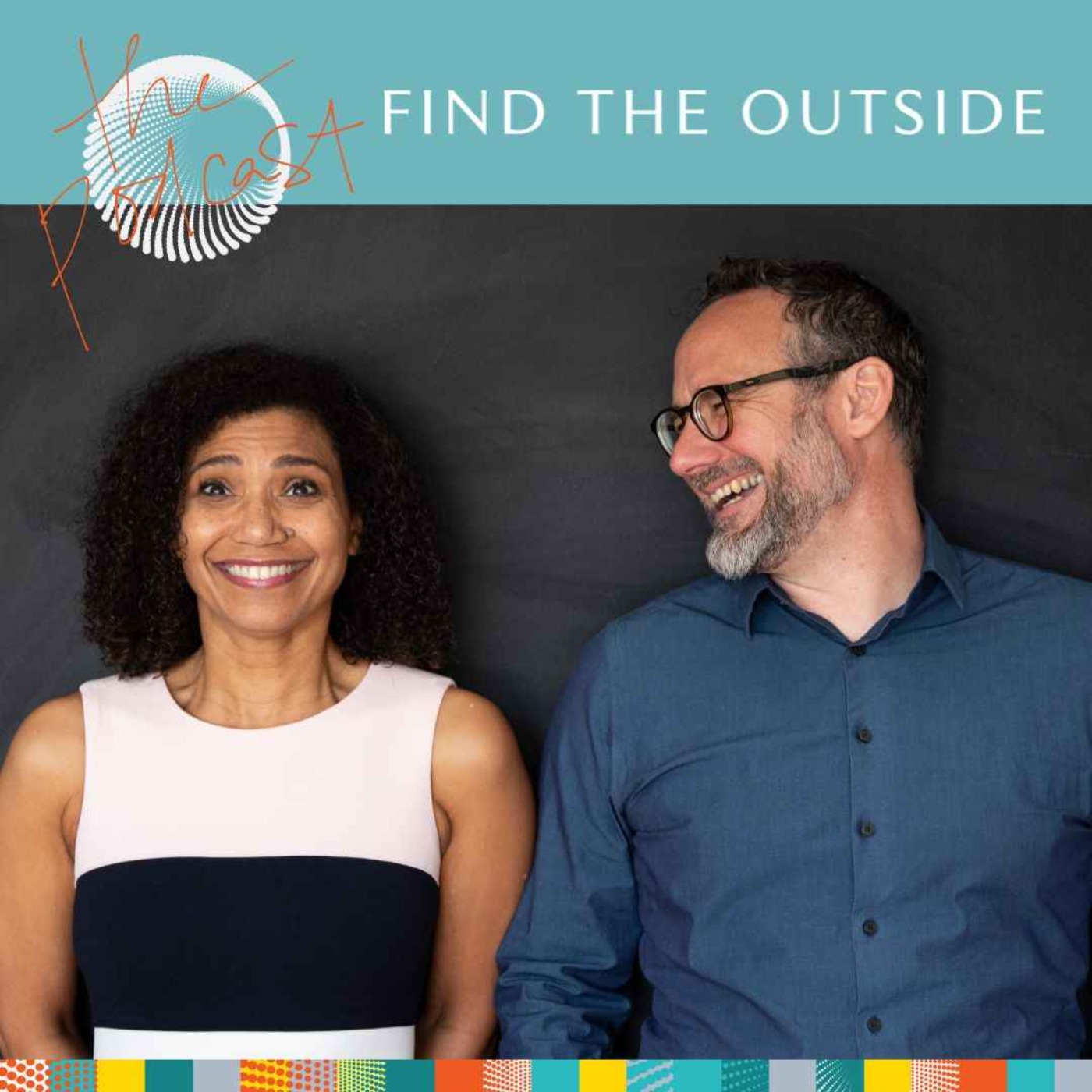
Find The Outside
Tim Merry & Tuesday Rivera
A lively, off-the-cuff conversation hosted by Tuesday Rivera and Tim Merry on large-scale systems change and equity. Together, Tim and Tuesday are THE OUTSIDE - systems change and equity facilitators who bring the fresh air necessary to organize movements, organizations, and collaborators forward for progress, surfacing new mindsets for greater participation and shared impact.In this podcast, we’ll share our greatest light-bulb moments as we advance our own understanding of this work. We’re doing it live, and inviting you in. Welcome! As Tim says in the first episode: reflection is too important to leave to chance. These conversations give us (and you!) a chance to slow down, catch our breath, and see our space and our work more clearly. Hosted on Acast. See acast.com/privacy for more information.
Episodes
Mentioned books

Apr 7, 2020 • 47min
2.14: ETHOS - On Matching Our Rhetoric With Our Action
For episode fourteen of season two, Tim and Tuesday host a conversation with members of the NYC Administration for Children Services Operations Team where they reflect on the work so far, their learnings and their advice for those helping to lead large-scale change across a system.Together, Tim Merry and Tuesday Ryan-Hart are THE OUTSIDE—systems change and equity facilitators who bring the fresh air necessary to organize movements, organizations, and collaborators forward for progress, surfacing new mindsets for greater participation and shared impact.2.14 —— SHOW NOTESTues: Today on the podcast, we have guests!! We have three members - Zachary Howard, Marc Santora & Cherika Wilson - of our Operations Team from a project, “Equity Throughout Our System (ETHOS),” we are working on at the NYC Administration for Children’s Services Workforce Institute. Marc: ACS Workforce Institute is a collaboration between ACS, which is a city agency, and CUNY, which is a city university in New York, and there are two layers of that - there’s CUNY School of Professional Studies and CUNY Hunter Collage and so all those entities work together to provide training for direct service staff in child welfare and juvenile justice. We are impacting that system. We are training people to do that work. ACS is an agency of approx. 12,000 people and we work with 63 contracted provider agencies.Tues: There are about 24,000 workers that you are training that then move out to the families. That’s quite a reach. Tues: As an organization, I have been really impressed with the insistence and practice of racial and gender equity in your work. I’d love to hear you talk about that. Zachary: Everyone in the Workforce Institute makes sure that it’s always on the table. We make sure our language is consistent and it becomes part of our everyday. Cherika: We have a highly disproportionate number of children of colour that are affected by and come into contact with the system and so as we go about doing our jobs, regardless of whatever part of the organization we’re in, that is something that we are constantly thinking about. How do we make sure that there is equity throughout our system for the families that we work with. This initiative [ETHOS] is part of how we really engage in that to move that work to the next level.Marc: We surround ourselves all the time with people who that is their work. We know that there is inequity in the system, we know that that exists and so we use it as a springboard to inform the rest of our work so we’ve done things like having a reflective process every couple of weeks, we’ve done racism trainings and this work that we are doing with The Outside is very much centred around that. It’s been 2+ years of us priming the pump to talk about this. Tim: In some of the early conversations, David would talk about ACS and the Workforce institute, as a whole, is positioned to lead transformation across the child welfare system… If the mandate is systems change through capacity building… how’s that feel? What’s it like to have that mandate and scope? Marc: We have really passionate people who this is their life’s work so that is a really good starting point for us because this is not just a job for most people; this is what they want to do with their lives. It makes it easier on one end but it also makes it harder because there are so many different directions that it can go in. Because we are three different entities working together as one, there are so many hoops that we need to jump through just to make things work and so there is so much passion but how do you put a process to that? That’s been the thing that has been the most difficult for us. Zachary: I’ve only been in this job a year and I struggled a bit not being closer to the families directly but I participated in the fiscal year retreat where we saw the numbers of learners and families that we affected and it made it easier to wake up in the morning to do the work knowing you are helping on such a large scale. There’s going to be trips and falls but you can trip to get back up to make it work, which is what we’ve been doing. Cherika: I think something the organization tries to do, regardless of your role, is connecting you back to your role. What is my sphere of control and influence? We make a commitment to this work every single day.Tues: What is the ETHOS project? What do the three of you tell the folks who are not in the Core Team?Marc: This is my third day in training with TO and yesterday, Tuesday you said “coming home is often the hardest thing to do.” I think that’s true for us. We are all really good at knowing this is what is wrong here and we couldn’t necessarily figure out how to bring it back to us and I think this is where this initiative started. How do we set up a system and structure that we can then push out? If we don’t have the system ourselves, how do we then tell other people how to do it? We wanted to not only tell them, but show them - model it - and I think we just couldn’t figure out how to do that because there are so many voices and so many people that have so much passion around how to do it and we all have the answers… how do we take that and make it all true and make it move. Zachary: When my co-workers ask who are The Outside and what do they do? I describe it as they come in when organizations want a systems change. They help organizations to pinpoint the issues or problems and then get everyone on the same playing ground and take these problems and move them to something successful. A lot of people are used to prescribed answers but with The Outside you delve deep into what is going on in the organization and move in that direction. I appreciate that you don’t work in the prescribed. It’s hard to get 30 people to talk and share their ideas in a constructive plateau to move forward. Cherika: As I think about it, I think the ETHOS initiative has given us the permission to take the steps and make the changes that we need to make sure that the walk matches our talk. TO has guided us through a process to help us figure out the answers and it’s been a really interesting, and sometimes challenging, road to be on and I’ve been grateful to be in the process.Marc: There is also an element of slowing us down. That is a thing that we don’t do well. Everything is results, results, drive, drive. This is making us practice not moving so fast and being more thoughtful around things that we are doing. In an outcome-driven environment, we’re not taking the time to think about things in the way that we should. This is giving us a platform and space to do it and it’s also feeding into everyone’s psychological safety in doing that. Tues: I want to pull out that safety piece. We had a moment with the Leadership Team where we had them doing a walk with their eyes closed. It’s quite a vulnerable space. What came out was that someone said, “I felt safe because I was with this person.” We didn’t do the things that would normally do to make a safe environment. People found their safety with each other. It felt like a really good learning moment.Cherika: What I appreciate about the work that you’ve [The Outside] done with us is that we have to commit to the same level of vulnerable and it makes a difference in terms of building relationship and building trust. We’re all figuring this out together. Zachary: When it comes to safety, between reflective process and Open Space, we are slowing down to have the little moments to build relationship and safety. I think we can work together when everyone is in the best mindset. Tim: Hearing all of you speak blows me away… some of the most significant and transformative moments happen between two individuals and somehow that ends up changing the culture of the initiative as a whole which ends up impacting the future of a system. You’ve all talked about matching our rhetoric with our action - truly beginning to behave how we would like the system to behave. Tues + Tim: I’d love for you to share something that you’ve learned through the ETHOS project? Or any advice that you’d give people based upon what you are learning.Marc: Be nice to yourself and each other and notice one another. Care for each other in the process.Cherika: Be patient and be okay with the questions and trust the process. Relationships are important. As you go through the work, remember to bring it back to the people who are not as intimately involved. Zachary: It’s okay to be uncomfortable - lean in when you are uncomfortable. Song: "Paradigm of Lies,” by Zach’s band Ocean of IllusionsFacebook: https://www.facebook.com/OceanOfIllus... Twitter: @OOI_NJ Instagram: oceanofillusionsnj Bandcamp: https://oceanofillusions.bandcamp.com Poem: “Harlem” by Langston HughesWhat happens to a dream deferred? Does it dry up like a raisin in the sun? Or fester like a sore— And then run? Does it stink like rotten meat? Or crust and sugar over— like a syrupy sweet? Maybe it just sags like a heavy load. Or does it explode?Subscribe to the podcast now—in Apple Podcasts, Spotify, Stitcher or anywhere else you find podcasts. New episodes will be available every second Tuesday. If you’d like to get in touch with us about something you heard on the show, reach us at podcast@findtheoutside.com. Find the song we played in today’s show—and every song we’ve played in previous shows—on the playlist. Just search ‘Find the Outside’ on Spotify.Duration: 47:20Produced by: Mark Coffin @ Sound Good StudiosTheme music: Gary BlakemoreEpisode cover image: source Hosted on Acast. See acast.com/privacy for more information.

Mar 24, 2020 • 32min
2:13: Choices - How Are We Turning Up During This Unprecedented Time?
For episode thirteen of season two, Tim and Tuesday reach out to explain what they are doing, both personally and professionally, during the Coronavirus outbreak.Together, Tim Merry and Tuesday Ryan-Hart are THE OUTSIDE—systems change and equity facilitators who bring the fresh air necessary to organize movements, organizations, and collaborators forward for progress, surfacing new mindsets for greater participation and shared impact.2.13 —— SHOW NOTESReading: “Do Not Lose Heart, We Were Made for These Times: Letter to a Young Activist During Troubled Times,” by Dr. Clarissa Pinkola EstésMy friends, do not lose heart. We were made for these times. I have heard from so many recently who are deeply and properly bewildered. They are concerned about the state of affairs in our world now. Ours is a time of almost daily astonishment and often righteous rage over the latest degradations of what matters most to civilized, visionary people.You are right in your assessments. The lustre and hubris some have aspired to while endorsing acts so heinous against children, elders, everyday people, the poor, the unguarded, the helpless, is breathtaking. Yet, I urge you, ask you, gentle you, to please not spend your spirit dry by bewailing these difficult times. Especially do not lose hope. Most particularly because, the fact is that we were made for these times. Yes. For years, we have been learning, practicing, been in training for and just waiting to meet on this exact plain of engagement.I grew up on the Great Lakes and recognize a seaworthy vessel when I see one. Regarding awakened souls, there have never been more able vessels in the waters than there are right now across the world. And they are fully provisioned and able to signal one another as never before in the history of humankind.Look out over the prow; there are millions of boats of righteous souls on the waters with you. Even though your veneers may shiver from every wave in this stormy roil, I assure you that the long timbers composing your prow and rudder come from a greater forest. That long-grained lumber is known to withstand storms, to hold together, to hold its own, and to advance, regardless.In any dark time, there is a tendency to veer toward fainting over how much is wrong or unmended in the world. Do not focus on that. There is a tendency, too, to fall into being weakened by dwelling on what is outside your reach, by what cannot yet be. Do not focus there. That is spending the wind without raising the sails.We are needed, that is all we can know. And though we meet resistance, we more so will meet great souls who will hail us, love us and guide us, and we will know them when they appear. Didn’t you say you were a believer? Didn’t you say you pledged to listen to a voice greater? Didn’t you ask for grace? Don’t you remember that to be in grace means to submit to the voice greater?Ours is not the task of fixing the entire world all at once, but of stretching out to mend the part of the world that is within our reach. Any small, calm thing that one soul can do to help another soul, to assist some portion of this poor suffering world, will help immensely. It is not given to us to know which acts or by whom, will cause the critical mass to tip toward an enduring good.What is needed for dramatic change is an accumulation of acts, adding, adding to, adding more, continuing. We know that it does not take everyone on Earth to bring justice and peace, but only a small, determined group who will not give up during the first, second, or hundredth gale.One of the most calming and powerful actions you can do to intervene in a stormy world is to stand up and show your soul. Soul on deck shines like gold in dark times. The light of the soul throws sparks, can send up flares, builds signal fires, causes proper matters to catch fire. To display the lantern of soul in shadowy times like these – to be fierce and to show mercy toward others; both are acts of immense bravery and greatest necessity.Struggling souls catch light from other souls who are fully lit and willing to show it. If you would help to calm the tumult, this is one of the strongest things you can do.There will always be times when you feel discouraged. I too have felt despair many times in my life, but I do not keep a chair for it. I will not entertain it. It is not allowed to eat from my plate.The reason is this: In my uttermost bones I know something, as do you. It is that there can be no despair when you remember why you came to Earth, who you serve, and who sent you here. The good words we say and the good deeds we do are not ours. They are the words and deeds of the One who brought us here. In that spirit, I hope you will write this on your wall: When a great ship is in harbor and moored, it is safe, there can be no doubt. But that is not what great ships are built for. Tim + Tuesday: Today, we are talking about Coronavirus… it’s here and it’s real and it feels like the elephant in the room if we don’t talk about it. Tues: Her [Dr. Clarissa Pinkola Estés] words were what I know in my bones but have had trouble remembering. In some ways I can feel in interactions, that I might be viewed as “Pollyanna"; not based in reality as what is… in my bones I know that I cannot accept the invitation to fear and despair. Tim: What does ‘Pollyanna” mean?Tues: “Pollyanna” is a person who is always on the bright side, positive thinker, not based on reality. Tim: You are choosing how you are going to turn up. One of the things that have blown me away over the last few weeks are the Facebook groups that have kicked off all across Canada. One woman started a small Facebook group and called it “Care Mongering” - it was a group where people in her community could come together and identify offers or needs that they have and exchange them… and now they are all across Canada. Two of the things I really like about this is (1) It’s just so kind; and (2) It was emergent - it was not organized. Tues: We just wanted to be with people though this podcast. Tim, what are the things that you are doing to take care of yourself?Tim: Today, in particular, I am wearing a rather fetching tweed tie - in a funny way I am doing little things that give me pleasure. It feels fun and nice. I am getting a lot of time with my kids - we are playing a lot and talking a lot. I am also getting out and walking three times a day. This really helps me to stay centered. If there is a theme to this podcast it is choices. I definitely have more anxiety then I would normally have… and I have to look after the part of me that is worried. I need to look after it and be kind. Tues: Late last week, I decided to really limit social media. As a person who has a tendency towards anxiety, I had a sense of the amount of collective anxiety. I felt like I could not continue to keep reading… but I keep myself informed by reputable people. I am also committed to being active everyday and eating good food. I am being responsible and responsive. Tim: Let’s talk about The Outside. In 10 minutes time, we are jumping on with one of many organizations around online collaboration platforms. Our major clients that we are working with right now are front-line responders to situations like the Coronavirus outbreak. And so, we are in this tension between, obviously you have to respond to the immediate and urgent but it cannot be in complete dismissal of the long-term systemic changes that we are trying to overcome together or make progress on together. Everything is being pushed out - the virus itself is going to take 4 months to push through a region - and so we are looking at online collaboration platforms that we can start building. These are not event- based; we are going after something that can hold collaboration over an extended period of time. We’ve set up a whole bunch of demos and conversations - this fits a whole bunch of things we are doing at The Outside. It fits the declaration of climate emergency that we are beginning to craft, which is looking at what is our responsibility to carbon emissions, how do we respond to that and it also looks at how do you deal with increasing global crisis that results in increasing fragmentation globally and still organize together systemically together to solve major problems. Tues: We are trying to respond and meet people where they are in the crisis as well as seeing what is possible in this moment… which could be a really different way of gathering people virtually that is better for our planet and actually allows more voices in. There is all sorts of implications for equity that working in a different way could bring us. I can feel the fragility of this moment and I can also feel the possibility of it. Tim: We are deliberately looking at how we can combine synchronize and asynchronous efforts. Tues: I’m really curious to see what we [The Outside] can create and put out into the world as more time and space opens up.Tim: On that note, all of The Outside online courses - Leading Effective Meetings & Shared Work - are now available for FREE to anyone that is interested… right now until June 30, 2020. Also, we are brainstorming a weekly update from us and developing a list of resources that we have that we could make available. Song: “Sweet Inspiration” by the Derek Trucks BandSubscribe to the podcast now—in Apple Podcasts, Spotify, Stitcher or anywhere else you find podcasts. New episodes will be available every second Tuesday. If you’d like to get in touch with us about something you heard on the show, reach us at podcast@findtheoutside.com. Find the song we played in today’s show—and every song we’ve played in previous shows—on the playlist. Just search ‘Find the Outside’ on Spotify.Duration: 31:53Produced by: Mark Coffin @ Sound Good StudiosTheme music: Gary BlakemoreEpisode cover image: source Hosted on Acast. See acast.com/privacy for more information.

Mar 17, 2020 • 41min
2.12: Invitation: On Inviting People Into The Work, And Seeing Invitations As Challenge and Positive Shake-Up For Ourselves As Leaders
For episode twelve of season two, Tim and Tuesday speak directly to the invitations they are receiving in the work of getting big change done. At this particular time in the world, what new dimensions and new experiences might we say ‘yes’ to in order to stay awake, see clearly and take action?Together, Tim Merry and Tuesday Ryan-Hart are THE OUTSIDE—systems change and equity facilitators who bring the fresh air necessary to organize movements, organizations, and collaborators forward for progress, surfacing new mindsets for greater participation and shared impact.2.12 —— SHOW NOTESTues: When we talk about invitation we tend to focus outward - how do we invite folks in; which is really important and a key part of our work, but I like this different twist you are inviting, Tim. What are the invitations we are saying yes to?Tim: One of the recent invitations I said yes too was Bioneers in California. It was an invitation that engaged me and my life in things I would never experience otherwise—to engage with cultures and beliefs and song and poetry and ways of thinking about the world that kind of expand me and my family’s view.Tues: At this moment, I am in a cycle of saying “yes” to intuition. I was invited to a three-day Collective Consciousness Retreat exploring ritual, meditation and a more structured dialogue practice to surface what was between us. It felt like one of those little side doors. Within the first 10 minutes someone in the group talked about ‘trustlessness’ - the idea that trust isn’t even the currency we should be using. It was for me as radical an idea as getting rid of capitalism. I want to be with people who are really pushing an idea.Tim: The idea of “side doors” significantly informs our work together. Some of those journeys are therapeutic, some are courses we do, some are events we attend, some of those journeys are conversations we have with people we are close to. These “side doors” are pushing us and expanding us.Tim: At Bioneers, I went to a panel discussion hosted by Jerry Tello, where he talked about his experience of working with the sacred masculine… and he finished on this line: “do your own work.” This is what you are pointing too, Tues. Trust your own intuition to take you to places that take you beyond your own comfort, that focus you into your own work, that force you to grow.Tues: There is an old Art of Hosting question that says, “If you were born a question, what question would it be?” My question is “How do I help these people be together better?” It goes right back to the guiding principals of The Outside. The bones of it are collective liberation.Tim: I would love our listeners to go to our Facebook page or Instagram and post their question there. My question would be “How do we create the conditions for people to solve their own problems?”Tues: Do you think this is a different time in human history for this? Is there something possible at this time?Tim: I think you are asking a question that someone like Gibrán Rivera or my brother, Peter Merry, who have done very specific investigation into evolutionary leadership can answer. I don’t know whether this is a unique time in the world… but what I do know is that I am alive and I want to make the best of it.Tues: What I want to end on is asking our listeners to get a little quiet and see what the invitations are that they are receiving now. You can also post this to our social media as well.Poem turned into Song: “Switch It On,” an original song by Merry And Derkee (Tim Merry & Marc Derkee), produced by Gary Blakemore.Subscribe to the podcast now—in Apple Podcasts, Spotify, Stitcher or anywhere else you find podcasts. New episodes will be available every second Tuesday. If you’d like to get in touch with us about something you heard on the show, reach us at podcast@findtheoutside.com. Find the song we played in today’s show—and every song we’ve played in previous shows—on the playlist. Just search ‘Find the Outside’ on Spotify.Duration: 41:21Produced by: Mark Coffin @ Sound Good StudiosTheme music: Gary BlakemoreEpisode cover image: source Hosted on Acast. See acast.com/privacy for more information.

Mar 3, 2020 • 36min
2:11: Hope: How To Protect The Optimism We Need For Massive Response And Massive Heart
For episode eleven of season two, Tim and Tuesday reflect on how hope can — and must — co-exist with an acknowledgement of where we are, even in crisis or struggle. If we are to respond massively to an emerging future, and grapple with our current reality, what steps can we take to preserve optimism?Together, Tim Merry and Tuesday Ryan-Hart are THE OUTSIDE—systems change and equity facilitators who bring the fresh air necessary to organize movements, organizations, and collaborators forward for progress, surfacing new mindsets for greater participation and shared impact.2.10 —— SHOW NOTESTim: There’s a Thomas Merton quote about finding rightness in the work itself, to surrender the hope of results. And I came across this quote from William the Silent: “It is not necessary to hope in order to persevere.” There is one story that I’ve come across in our work - how important hope has been to persevere.Tues: The quote that comes to me is a Toni Morrison quote: “You wanna fly, you got to give up the shit that weighs you down.” I believe my ancestors, on both sides, had deep hope as they left their shores - that there was something different, something better.Tim: I feel like we are in the midst of a level of crisis that is now beginning to truly impact the middle and middle-upper classes in a way it hasn’t before in such a pervasive scale, scope and reach. I think that’s a piece of the class response that I want to identify and have some compassion for and not pretend it’s not a product of privilege. It makes me think of the quote from Rumi: “Sit down and be quiet. You are drunk, and this is the edge of the roof.”Tues: I wonder about my own lens and perspective; I feel there is no lack of material for hope for me. My vantage point is of people who are actively working and trying.Tim: This kind of analysis that becoming acquainted with despair, but still maintaining hope, is an issue of how insulated your life has been.Tues: Whose going to make it and who is not? Disaster capitalists are moving into Puerto Rico right now and beginning to set themselves up for when it all goes down and the question is what will happen to the Puerto Ricans who are there?Tim: What does it mean to not prioritize engaging with the emergence of consciousness among the privileged classes and the fragility that comes with that? This kind of awakening to the level of despair, because you are experiencing it… I am intrigued by that. How this get’s integrated into how we think about significant change happening. I also don’t want it to be the thing that slows us down.Tues: It’s not do we engage it or don’t we - it’s how and when and why. Everyone gets to decide what their own energy level is.Tim: When we go into those stories that are so intimately connected to us, we find both the “You are drunk, and this is the edge of the roof” and we find the hope, the gift, the power to stand in the face of it and take the next step.Poem: Build the Arks (King Kong Song) by Tim MerryI just read about the coming of the ice ageEarth’s rageThe mighty mother, the sage,Turning another pageOf evolutionA natural solutionThe vibrationOf creationMelting ice caps into the gulf stream flowsThe European heating system blowsBeyond repairMy mother, father, sister, brother live thereStop, bear witness, take a long good stareDigest our reality and start to careThe planet is movin’ onWe all be livin’ in the final swan songThe future’s comin’ on strongLike King KongWe all be the hapless maidenLooking in his big brown eyesBeginning to realiseIt’s all beyond our controlBigger than we’ll ever beSee?Fuck the swan song,This is the King Kong songWe ain’t got no choice but to go along. No more prizes for predicting the rainThe painNew startsTime to build the arks What’s my contributionAt this crazy time?Am I gonna whineComplainAbout the pain?The fact we all seem to be going insane?No!Trust in surpriseIntegrity has no compromiseRelease all tiesOpen the eyes. Our survival seems hit and missLike the world is taking the pissA final good night kissAll this material wealthThe illusion of blissIt’s a big mis –stakeTime to rakeThe fallen leavesAutumn choicesWinter bereavesNot everyone will make itWe can’t fake itThere’s no hidingFrom this collidingWith the end of an eraIt’s never been clearerSome will get left behindLinger in our mindsTheir remains to findIn millions of yearsAs we learn again our evolutionFrom homo-confusionHomo-luminumNo more prizes for predicting the rainThe painNew startsTime to build the arks Gather now at our community centresWith friends and mentorsAnd EldersWe all be the weldersOf fragmentationOn the edges of the new creationThe builders of the New Space StationRight here in the arms of the motherWhere the heroes gather undercoverSensing the future with sonar soundThe builders of boats aboundReadying for the coming stormsTrainers of the warriors who break the normsYield to the fieldDrop the shieldWhat are the skills we need to survive?To be one of ones aliveWho looks backThinking“holy shit how did we survive that?”What does it take to make the warrior casteTo see our king kong future comin’ on fastThen look back and know it as the past?This ain’t about seekin’ thrillsWe need to know the survival skillsGet into trainingI’m not exaggeratingI wish I wasThis is real,nowhereIt’s time to get clear.There’s no more prizes for predicting the rainThe painNew startsIt’s time to build the arksSong: Faith’s Hymn by Beautiful ChorusSubscribe to the podcast now—in Apple Podcasts, Spotify, Stitcher or anywhere else you find podcasts. New episodes will be available every second Tuesday. If you’d like to get in touch with us about something you heard on the show, reach us at podcast@findtheoutside.com. Find the song we played in today’s show—and every song we’ve played in previous shows—on the playlist. Just search ‘Find the Outside’ on Spotify.Duration: 47:20Produced by: Mark Coffin @ Sound Good StudiosTheme music: Gary BlakemoreEpisode cover image: source Hosted on Acast. See acast.com/privacy for more information.

Feb 18, 2020 • 43min
2:10: Power: Finding The Language To Navigate Power And Share It With Others
For episode ten of season two, Tim and Tuesday contemplate what exactly we mean by the concept of power — intergroup, structural or systemic. How can we best share it, and invite more people to pick it up? How can we wield the power we have with integrity?Together, Tim Merry and Tuesday Ryan-Hart are THE OUTSIDE—systems change and equity facilitators who bring the fresh air necessary to organize movements, organizations, and collaborators forward for progress, surfacing new mindsets for greater participation and shared impact.2.10 —— SHOW NOTESTues: As we are getting ready to release a new online course on Shared Work, we realized we never did a podcast on Power. When we say power, we’re talking about multiple different kinds of power — intergroup, structural or systemic. There are three major kinds of power: (1) Power OVER: one group has more, and one group has less (i.e. race, gender, heterosexism, class, ability); (2) Power FOR: based on an advocacy model - I have power and I will use it on your behalf (i.e. therapist in family violence). Comes from a place of good intent but a challenging place to keep your ego and ethics in check; and (3) Power WITH: Coalitions/collaboratives - use our power together to move something forward (i.e. action, agenda). One of the dangers is that it can make us quite transactional with each other.Tim: The therapeutic lens called ‘transactional analysis’ is a lens that can help us understand wherever power is turning up in our world.Tues: Of course there is an element of personal power… and that still exists within this context of power in a larger societal or structural way. I can evolve and transform and be as aligned with my own power as I want but still in this moment, in North America, I have a very different future than you. Could we begin to conceive that, Tim, if you have more power; I have more power? Does power rest among us that we can tap into that is unlimited?Tim: There is something quite natural about power among (i.e. schools of fish).Tues: Cyndi Suarez wrote The Power Manual: How to Master Complex Power Dynamics. I’d love to bring her on to talk to her about what she is uncovering on power.Tim: Power has been misused pretty consistently and therefore has become untrustworthy. It wasn’t until I met Toke Møller that I met a man attempting to wield his power with some integrity.Tues: If you don’t have a great model of power, it is quite hard to determine how you will use it. So instead I pretend I don’t have any and wield it unconsciously or I can pretend it is happening out there and, again, wield it unconsciously. Fear of our own use of power keeps us from some real conversations and real change.Tim: The more I engaged through my work, with people in positions I perceived as powerful, the more I had to deal with my own issues of power. Suddenly, I’m realizing that I am arriving with a fundamental distrust of all these people because of the position they hold. That’s an indicator to me that I had work to do.Tues: For me, I showed up in those rooms not trusting and really because of societal positioning not feeling worthy being in those rooms. As a result, I had to get comfortable with my power.Tim: A lot of the analysis have become codified in our heads and then we become inflexible and then we only see power through those lenses. I feel that one of the essential ingredients of engaging with power is curiosity.Tues: You’re right and so if you don’t engage around power at all, the invitation is to get curious around how power is playing out in your organization and in your work and get curious about it. If you have a sophisticated discourse around power then I think the invitation is to really look at where that’s helpful and where it forwards your work and where it might be holding you back and what else can you get curious about. Let’s not pretend that it does not matter and have some agility and flexibility with it.Poem: “Sometimes” by Sheenagh PughSometimes things don't go, after all,from bad to worse. Some years, muscadelfaces down frost; green thrives; the crops don't fail,sometimes we aim high, and all goes well.A people sometimes will step back from war;elect an honest man, decide they careenough, that they can't leave some stranger poor.Some men become what they were born for.Sometimes our best efforts do not goamiss, sometimes we do as we meant to.The sun will sometimes melt a field of sorrowthat seemed hard frozen: may it happen for you.Song: The Power by SnapSubscribe to the podcast now—in Apple Podcasts, Spotify, Stitcher or anywhere else you find podcasts. New episodes will be available every second Tuesday. If you’d like to get in touch with us about something you heard on the show, reach us at podcast@findtheoutside.com. Find the song we played in today’s show—and every song we’ve played in previous shows—on the playlist. Just search ‘Find the Outside’ on Spotify.Duration: 42:26Produced by: Mark Coffin @ Sound Good StudiosTheme music: Gary BlakemoreEpisode cover image: source Hosted on Acast. See acast.com/privacy for more information.

Feb 4, 2020 • 37min
2.09: Building Blocks: Laying The Structure For Equity In Change Work: Under The Hood Of Building A Business
Together, Tim Merry and Tuesday Ryan-Hart are THE OUTSIDE—systems change and equity facilitators who bring the fresh air necessary to organize movements, organizations, and collaborators forward for progress, surfacing new mindsets for greater participation and shared impact.2.09 - SHOW NOTESTim: As we grow, we’re putting in place legal structures to support our work and build the principals of our organization.Tues: It’s the idea that we are a fractal of what we are trying to do in the world. In this period of year-turning, there is always a space of reflection and putting your mind to where you want to be going forward. Often, with our clients, there is a pace and urgency. We could be swept along by the work and if we don’t pause and reflect and be intentional, we’ll just get more of what we are seeking to shift in our clients. Inner reflection for the organization cannot be left to chance.Tim: We often find ourselves asking for things that the professionals we are working with are like, “what?” One that was interesting for me recently was when we were sitting down with the lawyers to pull together our subcontractor contracts. We are getting to draw up contracts that reflect our values and the relationships we are building with our subcontractors.Tues: We want this to happen to everyone we work with. I hope their work gets better and deeper and more nuanced.Tim: One of our principals is generosity and we are trying to institutionalize / legalize it.Tues: One of the things we’ve done recently was brought The Outside principals to our team - how we want to be as an organization: Generosity, Love, Clarity, A society that serves all & Collective.Tues: I am not building a white organization; that is not what I am here to do. This is a declaration so folks know what we are intending, which is not a white organization. I am here to build an organization that actually knows how to work in difference because we are deeply different from each other. And very explicitly, that means racially.Tim: We’ve been actively seeking senior members for our team that are people of colour and building apprentices into The Outside.Tues: We are still looking for folks who have the capacity to be ‘managers of one’ and even that is evolving. I can feel like we are weaving something that is far more than individual folks doing really great work to deliver a project. We are developing a weaved fabric of people and work that will take a wide net that will move things forward.Tim: We really hope that what we shared today will help you to think about how you form your team(s), how you build out your organization or your practices in relationship to others, how that’s manifested, not just as a set of principals or practices, but how that’s manifested in structures and legality.Poem: “to all you young poets” from the book milk and honey, by Rupi KaurYour artis not about how many peopleIike your workyour artis aboutif your heart likes your workif your soul likes your workit’s about how honestyou are with yourselfand youmust nevertrade honestyfor relatability.Song: Los Ejes De Mi Carreta by Atahualpa YupanquiSubscribe to the podcast now—in Apple Podcasts, Spotify, Stitcher or anywhere else you find podcasts. New episodes will be available every second Tuesday. If you’d like to get in touch with us about something you heard on the show, reach us at podcast@findtheoutside.com. Find the song we played in today’s show—and every song we’ve played in previous shows—on the playlist. Just search ‘Find the Outside’ on Spotify.Duration: 37:48Produced by: Mark Coffin @ Sound Good StudiosTheme music: Gary BlakemoreEpisode cover image: source Hosted on Acast. See acast.com/privacy for more information.

Jan 21, 2020 • 37min
2.08: Problem? Fix It. On The Virtue Of Slowing Down For Understanding: The Relationships And Patterns Of Fix-It Mode
For episode eight of season two, Tim and Tuesday talk about the fix-it phenomenon we all share: on seeing a problem, we rush to fix it. But when we rush to solutions, we’re likely to repeat the very problems that gave us the challenge in the first place. How can we cultivate a new pattern of pause and examination?Together, Tim Merry and Tuesday Ryan-Hart are THE OUTSIDE—systems change and equity facilitators who bring the fresh air necessary to organize movements, organizations, and collaborators forward for progress, surfacing new mindsets for greater participation and shared impact.2.08 —— SHOW NOTESTues: When we feel the problem is urgent, it is much harder for us to wait. The good intention of problem —> fix feels like a generous, well-intended response to something that has urgency.Tim: 'Problem, fix it’ is not inherently bad (i.e. when in a crisis response). The idea that ‘problem, fix it’ makes good leadership is so pervasive in the places we are working… that’s the issue. On its own ‘problem, fix it’ is insufficient. We need better understandings before we act.Tues: We’ve started to respond to everything as a crisis. Part of the discernment is what are we actually in here? That pause before you act is where the possibility will come. This has been rich in my own life practice.Tim: This is a leadership practice. Otto Scharmer, out of MIT, has developed “U-Theory.” It has gained traction and it’s an archetypal process it takes people through. It journeys you through the “U” and I think we can all relate to it. What Tues and Otto are both describing is about pulling us out of the urgent into the important. Pulling us out of the day-to-day, hamster wheel, business as usual to say what a minute, what is actually important?Tues: What we know about shifting approaches is it requires you to let go of some things - beliefs, assumptions, etc. This requires a whole lot of work, thought, practice and understanding.Tim: If you are the ‘problem, fix it’ hero leader, every time you step in and solve people’s problems for them, you remove their ability to solve it themselves. I feel we [The Outside] are a real antidote to that. Answers are out of date so quickly. Inquiries will last you. What happens when we work in this way, is that your decisions become more considered; they do not become easier. We don’t opt for the easy answer, we engage with the nuance.Tues: 'Problem, wait/pause’ takes courage. Wishing people courage to try it out and see where it lands them.Poem: “…is God.” from A Book of Light, by Lucille Cliftonso.having no need to speakYou sent Your tonguesplintered into angels.even I, with my little piece of ithave said too much.to ask You to explainis to deny You.before the wordYou were.You kiss my brother mouth.the rest is silence.Song: Landslide by Tony ClarkeSubscribe to the podcast now—in Apple Podcasts, Spotify, Stitcher or anywhere else you find podcasts. New episodes will be available every second Tuesday. If you’d like to get in touch with us about something you heard on the show, reach us at podcast@findtheoutside.com. Find the song we played in today’s show—and every song we’ve played in previous shows—on the playlist. Just search ‘Find the Outside’ on Spotify.Duration: 37:15Produced by: Mark Coffin @ Sound Good StudiosTheme music: Gary BlakemoreEpisode cover image: source Hosted on Acast. See acast.com/privacy for more information.

Jan 7, 2020 • 44min
E2.07: Isoke Femi: Modes Of Experience, Theoretical Frameworks And Compassion: A Conversation
In episode seven of season two, Tim and Tuesday sit down with colleague Isoke Femi, who brings a beautifully enriching and unique perspective to the work of change. It’s a deeply inspiring transition from one decade to the next — and an invitation to open up to special magic in 2020.Together, Tim Merry and Tuesday Ryan-Hart are THE OUTSIDE—systems change and equity facilitators who bring the fresh air necessary to organize movements, organizations, and collaborators forward for progress, surfacing new mindsets for greater participation and shared impact.2.07 — SHOW NOTESTues: Today, we have Isoke Femi with us. She brings such a beautiful, deep and different perspective to this kind of work we do.Isoke: I started working at BALLE as a consultant in 2008/09. At the time, BALLE was in a partnership with the Academy for the Love of Learning (seeks to advance learning at all kinds of levels). BALLE was trying to change how people think about economy and how to advance local economy. Each of us brought our own theoretical frameworks into the work and somehow we were able to still create a synergistic process through which transformation could happen. For example, one of the theoretical frames I brought was the idea of the “mother-father peer principal” also known as the bureaucratic, symbiotic, and decentralized modes of experience.Tues: We all brought our own theoretical frames. Why do you think these frames worked / that we were able to move them forward?Isoke: When we do inner work, we get unblocked from our rigid attachment to our belief systems, we get more fluid and are free to be more choiceful in any given moment. We also like each other — there is a lot of admiration and respect for one another. There was a way in which we could hold and support the process and work with each other.Tim: Isoke, I am interested to hear more about the positive ascendancy of the masculine. We’re seeing so much of the masculine that is playing out in such negative ways in our societies, worlds and communities.Isoke: When it comes into balance with the mother. All people carry all three of these. So for me, when the father stands shoulder-to-shoulder with the peer (bring discernment).Tues: You just highlighted something that is important that’s illuminating something that is happening in our movement communities. We are so fragile but some of what we need now is sword. We need to stand up with some dignity - not that, this.Isoke: The sword should cut a path, or create a clearing, but what we do is that we take that sword and use it against each other. This is where the peer comes in. How about we try “x.” The father principal, when it’s in its strength, it can make room for the peer, for mutuality. When all three are working in harmony, you have the collaborative mode.Tues: For many years, you did traditional diversity and equity training. What are you learning about the work of liberation?Isoke: One is metaphysical. One is more physiological. One is more personal. Let me start with the metaphysical — we are already free. We were created free. We get to express. That is a very difficult thing for the oppressed and repressed mind to wrap itself around. We are eternal creators. I have been on a kick lately, for the last month, to have everyone watch a video called “How Diablo Became Spirit (13:17).” She helps a leopard to reconnect with the man who brought him to this reserve. It’s a call to all of us that this is where we are headed — honour the being of every single created thing.Isoke: Watch the documentary “The Power of the Heart.” It is about the power of forgiveness.Poem: The Guesthouse by RumiThis being human is a guest-houseEvery morning a new arrivalA joy, a depression, a meanness,Some momentary awareness comesAs an unexpected visitorWelcome and entertain them allEven if they are a crowd of sorrowsWho violently sweep your houseEmpty of its furnitureStill treat each guest honourablyHe may be clearing you out for some new delightThe dark thought, the shame the maliceMeet them at the door laughingAnd invite them inBe grateful for whoever comesBecause each as been sentAs a guide from beyond— Rumi (Say I am You)Song: A song for the suffering soul… sung by Isoke FemiBe still and knowBe still and knowBe still and know, you are one.Be still and knowBe still and knowBe still and know, you are one.Subscribe to the podcast now—in Apple Podcasts, Spotify, Stitcher or anywhere else you find podcasts. New episodes will be available every second Tuesday. If you’d like to get in touch with us about something you heard on the show, reach us at podcast@findtheoutside.com. Find the song we played in today’s show—and every song we’ve played in previous shows—on the playlist. Just search ‘Find the Outside’ on Spotify.Duration: 43:51Produced by: Mark Coffin @ Sound Good StudiosTheme music: Gary BlakemoreEpisode cover image: source Hosted on Acast. See acast.com/privacy for more information.

Dec 10, 2019 • 38min
2.06: Labels: How The Language, Theory, And Models Of The Labels We Use Can Either Restrict Or Give Freedom
In episode six of season two, Tim and Tuesday talk about how adopting or shedding labels — political, economic, ideological, identity — can give us access to change, but can also become limiting in terms of how we might want to grow. How can we become less attached and more open?Together, Tim Merry and Tuesday Ryan-Hart are THE OUTSIDE—systems change and equity facilitators who bring the fresh air necessary to organize movements, organizations, and collaborators forward for progress, surfacing new mindsets for greater participation and shared impact.2.06 —— SHOW NOTESTues: In an Otto Scharmer “Prescencing Workshop,” I had an experience in which I heard, “who you are will inform you, but it will not be who you will become.” This helped me to shed the label of survivor. Personal liberation for me is the freedom to be all of who you are, the freedom to have the life you want, or to try and create the life you want.Tim: I think about some of the labels we use in our systems change work - the incredible epiphany that happens, so often, when we use introduce the idea of “hospicing.” There is a role in change work that helps things die with dignity (beliefs, policy, etc). It is an essential ingredient that needs great care to give us time to build the alternative. At what point do the models we introduce become limiting?Tues: I wonder if it’s stages or more like the chaordic path - maybe it’s an undulation back and forth? Maybe we’ll always be looking for the next group, label or name? When we speak from the place of a ‘label’ we can only give a very narrow perspective. When we are speaking from an expanded version of ourselves, that takes into consideration multiple labels, we can give much better input into a process and maybe even feel much more ownership of a process.Tim: I feel like we do a lot of specific design around people’s personal journey - designing to help people step into labels - to accept and then to let go. I also feel like we are doing that organizationally - to build the analysis and then to let go.Poem: “Vitai Lampada” Henry NewboltNOTE from Tim: This poem was really strong in my school. It was one of the labels you had to live with. It was part of the label indoctrinated into us through the education system that I was a part of.Vitai LampadaThere’s a breathless hush in the Close to-night -Ten to make and the match to win - A bumping pitch and a blinding light, An hour to play and the last man in. And it's not for the sake of a ribboned coat, Or the selfish hope of a season's fame, But his Captain's hand on his shoulder smote "Play up! play up! and play the game!"The sand of the desert is sodden red, -Red with the wreck of a square that broke; -The Gatling's jammed and the colonel dead, And the regiment blind with dust and smoke. The river of death has brimmed his banks, And England's far, and Honour a name, But the voice of schoolboy rallies the ranks,"Play up! play up! and play the game!"This is the word that year by year While in her place the School is set Every one of her sons must hear, And none that hears it dare forget. This they all with a joyful mind Bear through life like a torch in flame, And falling fling to the host behind - "Play up! play up! and play the game!"Song: “Free” by PrinceSubscribe to the podcast now—in Apple Podcasts, Spotify, Stitcher or anywhere else you find podcasts. New episodes will be available every second Tuesday. If you’d like to get in touch with us about something you heard on the show, reach us at podcast@findtheoutside.com. Find the song we played in today’s show—and every song we’ve played in previous shows—on the playlist. Just search ‘Find the Outside’ on Spotify.Duration: 38:12Produced by: Mark Coffin @ Sound Good StudiosTheme music: Gary BlakemoreEpisode cover image: source Hosted on Acast. See acast.com/privacy for more information.

Nov 26, 2019 • 40min
2.05: What's At The Centre, And Why: Adventures In The Seeking Of Equity
In episode five of season two, Tim and Tuesday venture into the heart of their change work: equity. How do we distribute power and wealth? How do we relate across lines of race, class, and gender, and how do we keep these considerations on the table in all of our work and in our working relationships?Together, Tim Merry and Tuesday Ryan-Hart are THE OUTSIDE—systems change and equity facilitators who bring the fresh air necessary to organize movements, organizations, and collaborators forward for progress, surfacing new mindsets for greater participation and shared impact.2.05 —— SHOW NOTESTues: We have different pasts, as groups of people, and those pasts are often based on ways we have been structured unequally. There will be those that work for and those that receive the benefit. Often those divides are quite deep and often you are on one side or the other. These past legacies of inequity that we carry with us that make our current state (the present) very different.Tues: When we say we work for equity, we are working to try to acknowledge and understand how that past impacts the present, see current reality, and then begin to plan and work toward a future where those gaps between people are moving closer together. We need to work with relationships, systems and structures.Tim: The divide between oppressor and oppressed — our work tries to bridge that - the grey area in the middle.Tues: Generally, very few of us fall entirely on one side or the other of oppressed and oppressor. We have multiple identities. As a black, biracial woman, I would have the experience of race — being marginalized or oppressed — and yet I am straight and have all of the privileges that come along with that. The grey area that you are talking about, Tim, is how we allow the multiplicity of people to come into the room so that we can work in that grey area. We are trying to get people to see each other’s complexity. We need to see both sides of the divide to actually move forward.Tues: There is beauty in the oppressed experience and hardiness and resiliency. When I look for strength, I am looking to my Black ancestors.Tim: There is also a real “leaning in” that we bring. When issues of equity arise in our work, or in the teams we are working in, we often perk up and dig in when normally it’s the other way around - people try to move over it or move through it. We never avoid it.Tues: We have an unwavering belief that we’ll find a way forward together.Song: “B.L.M,” by The SpecialsPoem: “The Tree Did Not Die” an essay by Omid Safi“Hundreds of years ago a single large redwood grew here. Then disaster struck. The trunk of the large redwood was killed, perhaps by repeated and severe wildfire. From here you can see the original tree trunk still standing upright, now a dead and blackened snag.Despite such terrible damage, the tree did not die. Below the ground, its massive root system was full of vitality. Before long, hundreds of young, bright green burl sprouts began to come up around the circle formed by the root crown of the original tree. Some of those sprouts have grown into the full-sized trees that today stand in a circle around the original trunk.”We are this charred tree and the family of trees ground around it. We are the roots, the burning, the healing, and the regrowth. May we see this family circle around us, friends.May it be that despite such terrible damage, the tree of our life does not die.May it be that there is a vitality in our roots, and that the charred tree of our experiences gives birth to a hundred new blooms dancing around us, newer versions of ourselves that leap to life from what we would have deemed to be our death.The tree did not die. May our hearts not die.The tree did not die. And may our families not die.I don’t want to die, not yet, not now, not for awhile. I want to dance with my children at their weddings and tell stories of love and resistance to their as of yet unborn children. But my time will come, and so will yours. When that time comes, may I have, may you have, may we have deep and ancient roots that are filled with light and vitality, so that new life, new soul, new light sprouts from the charred portion of our being.The tree did not die. And our ancestors live in us. We are who we are because they loved us, through and after their earthly life. They live in us, through us, long after their bodies are charred and returned to the Earth.The tree did not die. The new trees are the old burned tree, and they grow out of the roots it put down. May we witness this growth out of our being. May there be new loved ones circling us, as we circle our ancestors.Subscribe to the podcast now—in Apple Podcasts, Spotify, Stitcher or anywhere else you find podcasts. New episodes will be available every second Tuesday. If you’d like to get in touch with us about something you heard on the show, reach us at podcast@findtheoutside.com. Find the song we played in today’s show—and every song we’ve played in previous shows—on the playlist. Just search ‘Find the Outside’ on Spotify.Duration: 40:02Produced by: Mark Coffin @ Sound Good StudiosTheme music: Gary BlakemoreEpisode cover image: source Hosted on Acast. See acast.com/privacy for more information.

