

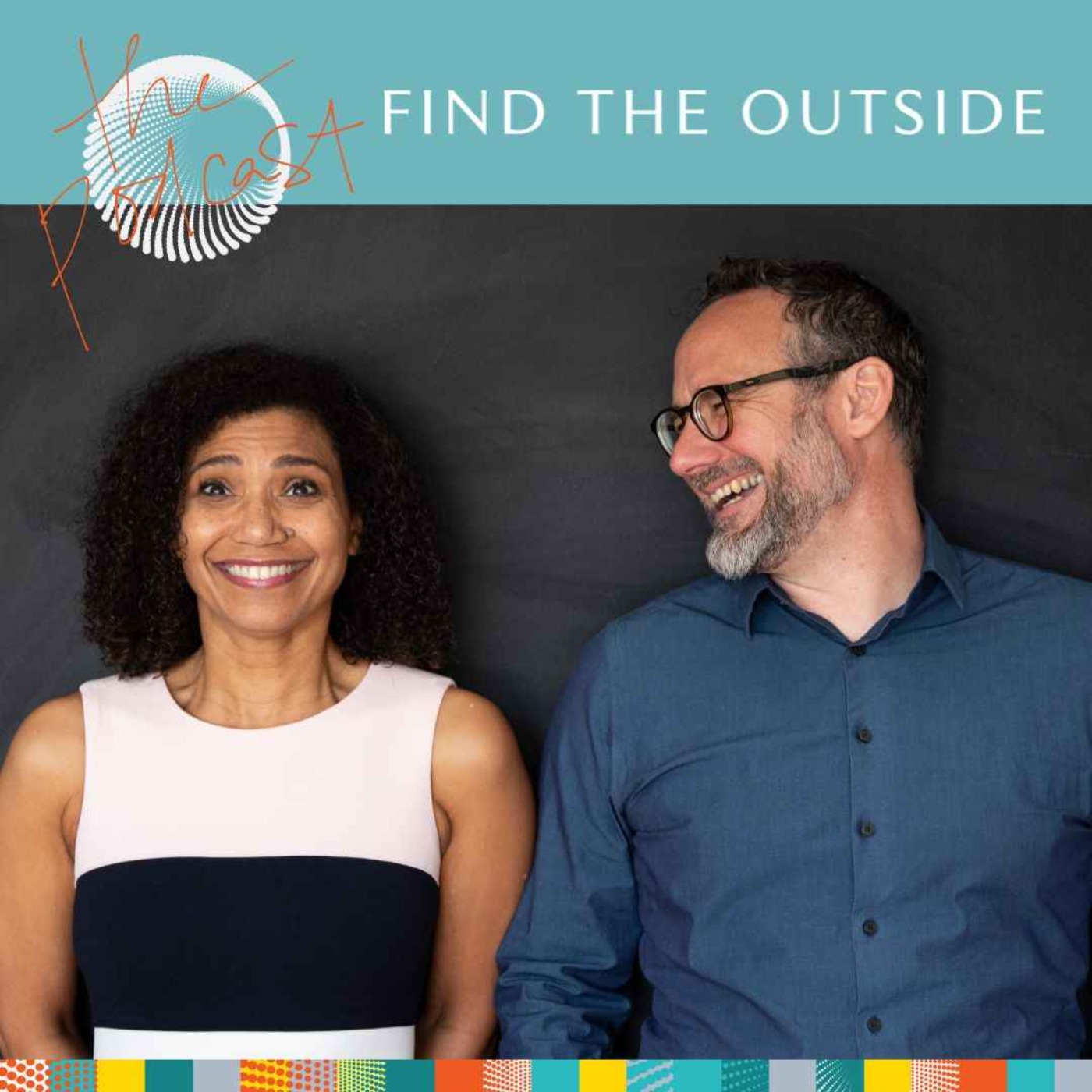
Find The Outside
Tim Merry & Tuesday Rivera
A lively, off-the-cuff conversation hosted by Tuesday Rivera and Tim Merry on large-scale systems change and equity. Together, Tim and Tuesday are THE OUTSIDE - systems change and equity facilitators who bring the fresh air necessary to organize movements, organizations, and collaborators forward for progress, surfacing new mindsets for greater participation and shared impact.In this podcast, we’ll share our greatest light-bulb moments as we advance our own understanding of this work. We’re doing it live, and inviting you in. Welcome! As Tim says in the first episode: reflection is too important to leave to chance. These conversations give us (and you!) a chance to slow down, catch our breath, and see our space and our work more clearly. Hosted on Acast. See acast.com/privacy for more information.
Episodes
Mentioned books

Nov 17, 2020 • 50min
3.04: Winged Words: On finding the soul of the work (Full Episode)
Inspired by Dr. Martin Shaw and author Cyndi Suarez, Tim and Tuesday explore the power of words, story and myth in systems change. How can "Articulation Leadership" add depth and momentum to groups seeking to make progress on big change?For detailed show notes, links and resources, please visit: https://www.findtheoutside.com/podcast Hosted on Acast. See acast.com/privacy for more information.

Nov 3, 2020 • 43min
3.03: Change in St. Croix: Small Reflects All (Full Episode)
Tim and Tuesday talk with fellow Outsiders, Sommer Sibilly-Brown and Kristina Torres, where they introduce us to the Island of St. Croix, Crucians and how this small island can show us that big change can be done differently.For detailed show notes, links and resources, please visit: http://findtheoutside.com/podcast Hosted on Acast. See acast.com/privacy for more information.

Oct 20, 2020 • 51min
3.02: Spirit of Change (Full Episode)
What does the spiritual journey look like for people involved in large scale systems change work? How is the spiritual path different from the mental health and leadership journeys also at play for those engaged in change initiatives? Listen in as Tim and Tuesday share some of their own personal journeys and what they're discovering along the way.New episodes will be available every second Tuesday. If you’d like to get in touch with us about something you heard on the show, reach us at podcast@findtheoutside.com Find the songs we’ve played on the podcast—on our playlist. Or search ‘Find the Outside’ on Spotify.Resources + Links mentioned in today's episode:Awakin CallsDuration: 50:37Produced by: Mark Coffin Theme music: Gary BlakemoreEpisode cover image: source Hosted on Acast. See acast.com/privacy for more information.

Oct 6, 2020 • 44min
3.01: TRANSLATING POWER: FINDING THE LANGUAGE THAT CAN BRIDGE WORLDS
In the first episode of season three, Tim and Tuesday talk with Cyndi Suarez, author of The Power Manual, where they explore the complexities of power and language. Join us for an invigorating, heartfelt and insightful conversation. Together, Tim Merry and Tuesday Ryan-Hart are THE OUTSIDE—systems change and equity facilitators who bring the fresh air necessary to organize movements, organizations, and collaborators forward for progress, surfacing new mindsets for greater participation and shared impact.3.01 — SHOW NOTESTuesday: Today on the podcast, our first of Season III, we are talking with Cyndi Suarez. Cyndi is the Senior Editor at Nonprofit Quarterly, she’s the author of The Power Manual: How To Master Complex Power Dynamics, she’s worked as a strategy and innovation consultant with a focus on networks and platforms for social movements, and she studied feminist theory and organizational development for social change. Cyndi: In the last few years, I’ve realized a different form of leadership that I’ve been exploring and I’ve been calling it “Articulation Leadership.” Seeing the power in putting things that we want into words; how that just opens up different worlds and possibilities. Tim: A lot of what we [The Outside] do happens in the experience that people have with each other but it becomes vastly insufficient when you are talking to someone about some major transformation work, that they will feel has very high stakes to it, and then you’re like, you have to really experience it to know what we are talking about. And so, we’re really in a question of how do you use words to evoke something that in some ways is felt? And then there is something for me about whether we are developing a new language or is it about finding the right words for the moment? Those are the two big questions we are in. Cyndi: The work of translation - of being able to both dive deep for the depth that you need and to find common ground - is one of the biggest challenges of organizing for power. It often does require redefining these identities that have been put on us and at the same time you need to reconnect with a larger table. Tuesday: When you talked about translation or connection; there’s a piece that is strategy. Part of it is grounding and deepening so we know what we’re doing and who we are to do it, but then there is also this piece around strategy that you just have to pay attention to. The reason we formed The Outside is because we felt like as we did systems change work there was very little power analysis and then in some of the movement-based spaces, there wasn’t much strategy to the level that you are talking about - not connecting out to make change. You have to do both to get you where you want to go. Cyndi: In my work, I am constantly challenging people to question the idea of shared strategy. Why? Why don’t we have a portfolio? Why do we have to agree? What do we have to agree on? This idea that we have to agree on everything is really extreme and tiring. It does not allow for the diversity that we have in our spaces. It doesn’t encourage it. I think there is a way that we need to be both humble and sophisticated in these conversations. We have to care enough and be curious enough about people. Being drawn towards difference is less explored especially in leadership and translation work. Tim: That bridging role is about power but also what we are often doing is pitching to people who hold wealth, influence, positional or hierarchical authority something that in many ways will undermine the established power that they have or the way they have got to that position of power. What’s the language that translates into positions of power - why power needs to be let go of and how does that begin to start shifting people’s fundamental beliefs about themselves and what it means to lead in today’s world? What’s the language that’s hard enough to bridge into the leadership worlds that we are currently engaging but soft enough to point to something new?Tuesday: Cyndi, you’ve just said so many interesting little nuggets… I am curious how you got to where you are?Cyndi: Since I was a kid, I always knew that I was going to write about power. I loved reading. Reading has always been a big part of my life. I am attracted to things that are different and that I don’t know. Tim: How do you stay tuned to this? Cyndi: I’m reading this book called Sacred Contract and one of the things that she says about people who tend to create something new or something big is that there is a point at which they have to go against the tribe. They always have to break from what is known to them in order to make their contribution. I think part of it is that. I came knowing and trusting myself and I have a spiritual practice - I am very inward focused. I spend a lot of time imagining what I want. My trajectory has been that I always end up doing exactly what I wanted to do. Tuesday: You feel so clear in your internal compass and there is an outward thing that is happening - you don’t feel afraid of ideas. It’s so unique. Also, please tell us about The Edge Institute. Cyndi: The Edge Institute grew out of the work that I do with Nonprofit Quarterly and The Power Manual. When we engage people of colour, in the sector, no matter what level of leadership they were in, people really wanted a different space, outside of their organization, to come and to think and to be with other leaders and to explore and create the new forms they want or suspect other people want. “Forms” is everything from subjectivity, to organizational form, to interactional frameworks… anything that is a form; that’s what this is a space for. It’s a larger thing than a project in a nonprofit world. Launching our interactive website in October 2020 - edgeleadership.orgFor more of Cyndi’s articles, or to reach out, visit her on Twitter @cyndisuarez or by visiting cyndisuarez.com Song: “Mountains,” by The Vision, feat. Andreya Triana (Danny Krivit Remix)Poem: PEACE, by AkalaPEACE Peace is on the way By the sword they say After this, this last blow Last chop, last drop After this, this last scream Last shout, last trample of boot Just one more, one last Rubble wreck where once were dreams housed Last plane, last flame, last sky Just one, one more naked Vietnamese girl Be she Russian, Israeli, Palestinian, Sudanese Or great, great, great, really great British Just one more placard wielding warrior And this last sword-slinging gunman One more song of machine metal Hurtling death to outrun life Just one more war Then we can have peaceSubscribe to the podcast now—in Apple Podcasts, Spotify, Stitcher or anywhere else you find podcasts. New episodes will be available every second Tuesday. If you’d like to get in touch with us about something you heard on the show, reach us at podcast@findtheoutside.com Find the song we played in today’s show—and every song we’ve played in previous shows—on the playlist. Just search ‘Find the Outside’ on Spotify.Duration: 44:12Produced by: Mark Coffin @ Sound Good StudiosTheme music: Gary BlakemoreEpisode cover image: source Hosted on Acast. See acast.com/privacy for more information.

Jun 30, 2020 • 32min
2.20: Woven: Staying Interconnected
In season two’s final episode, Tim and Tuesday wrap up by offering a piece of advice: stay woven! Stay woven with the people you care about, stay woven with the people you work with and pay attention to how woven and connected you are in your communities. And if you notice someone falling away, weave them back in! Keep weaving the world events into our everyday living. These times demand all of us together meeting these times.Together, Tim Merry and Tuesday Ryan-Hart are THE OUTSIDE—systems change and equity facilitators who bring the fresh air necessary to organize movements, organizations, and collaborators forward for progress, surfacing new mindsets for greater participation and shared impact.2.20 — SHOW NOTESTues: This week on the podcast we are talking about being woven… being woven together as Outsiders, and as a team, being woven together with our clients a little bit in this changing context and then making sure our work is woven and meeting what is happening in the external world.Tues: I am feeling that Tim and I are quite well woven together. I am feeling good about where we are in partnership with this business and my experience of that is simply a re-weaving or re-knitting together, in the past couple weeks, that make us quite strong and smooth. Tim: This is our final podcast of this season… and I like the idea of woven as well as it brings together many of the topics we’ve been talking about over the last two seasons and that feels right - what’s happening between us, what’s happening in the world, what’s happening in our team and in relationship to the people we work with. It feels like a good way to end talking about things being woven, and how they are woven and how well they are woven and how we weave each other together and how important that is when you are working remotely. The quality of attention and alertness we need to have to our relationships so that we can deliver on the work that is at hand is heightened. We’ve always said that relationships equal results. I think that is even more true in terms of being able to deliver results when you are not able to take a walk that morning together or whatever else it might be that you need to do to sustain your relationships. It’s that intention and aspiration to pay attention to each other. Tues: I did this work to be in partnership with you and the work is better when we’re in it together. This idea of distance - we can’t in the same way know what is up for each other. I wonder if there is some inevitable moving apart in this remote way of working that then says what are your practices for coming back together?Tim: When we are working remotely, and in technical web-based spaces, we also need to pay attention to the conditions we put in place for people to connect and contribute. There is a personal reaching out and paying attention to relationship but a lot of what we are doing is tech upgrade. How do you create the ease between people of reaching out to each other to keep everyone connected in? Tues: We were able to get by on good equipment until that was “the way” of being together. We are making it possible for our physical bodies to connect more. Tim: Yeah, can you have a set-up that allows you to relax and be online? Find your techie mate and have them help you to set up an environment to be conducive to being relaxed into online spaces. It’s a big deal when running online meetings and to organize effectively. The other thing I am realizing is one-on-one conversations still need to happen to build the relationship. This also requires effort and planning and it is part of the work. Tim: It’s wild out there, mate and that’s another reason to stay woven. It feels stressful. Meg [Wheatley] also says when the shit hits the fan, “people turn to each other.” That is why this species has managed to evolve. When things get hard, we turn to each other. Tim: If there is one piece of advice in our final podcast episode, as all of us head through the summer and into the Fall and Autumn, it’s stay woven. Stay woven with the people you’re caring about, stay woven with the people you’re working with to deliver the things that matter to you in the world, pay attention not just to the inevitable pivot and thrust of energy we all need to create to get through re-entering our work spaces in new ways but also pay attention to how woven we are and how connected we are as teams and caring members of communities. Tues: This particular moment is calling for a re-weaving or different kinds of weaving that we haven’t had to access before. Most of us haven’t had to do this kind of online life before. There is also the larger movement of breaking down of systems and seeing the brokenness of systems that I think also will require a re-weaving. As you think about staying woven, find new ways to weave and then also look for opportunities to re-weave. Tues: My uncle Chucky was very active in SNCC (Student Nonviolent Coordinating Committee), so I can go to historical news reels and find mention of him and what he did and read his story. This makes me think of what my grandkids will ask of this time and what we did and how we were and will I be proud of how we/I responded? Tim: There is something about looking back and understanding the complexity of our heritage and our lineage that contributes to our ability to be here now. Tues: I feel like we all have to do that. We all have to know where we’re coming from to point where we’re going. Tim: For those of you who dane to tune in to us, we are grateful. Thank you for joining us. We will continue thorough the summer through a vlog series. You will find us on Facebook and Instagram for that. You will get to meet the members of The Outside team. The podcast will start up again this Autumn - let us know if there are things you want to hear in Season 3 or things you want us to go deeper into. Song: “Abebrese” by Ebo Taylor.Poem: “Turning to One Another” by Margaret Wheatley, “Turning to One Another,” 2002There is no power greater than a community discovering what it cares about. Ask “What’s possible?” not “What’s wrong?” Keep asking.Notice what you care about.Assume that many others share your dreams.Be brave enough to start a conversation that matters. Talk to people you know.Talk to people you don’t know.Talk to people you never talk to.Be intrigued by the differences you hear.Expect to be surprised.Treasure curiosity more than certainty.Invite in everybody who cares to work on what’s possible. Acknowledge that everyone is an expert about something. Know that creative solutions come from new connections.Remember, you don’t fear people whose story you know. Real listening always brings people closer together.Trust that meaningful conversations can change your world. Rely on human goodness. Stay together.Subscribe to the podcast now—in Apple Podcasts, Spotify, Stitcher or anywhere else you find podcasts. New episodes will be available every second Tuesday. If you’d like to get in touch with us about something you heard on the show, reach us at podcast@findtheoutside.com. Find the song we played in today’s show—and every song we’ve played in previous shows—on the playlist. Just search ‘Find the Outside’ on Spotify.Duration: 31:31Produced by: Mark Coffin @ Sound Good StudiosTheme music: Gary BlakemoreEpisode cover image: source Hosted on Acast. See acast.com/privacy for more information.

Jun 9, 2020 • 32min
2:19: Uprising: Waking Up And Making Change
For episode nineteen of season two, Tim and Tuesday delve into the hopefulness, the openness, the fear, and the fragility they are seeing in this moment of people rising up together to demand changeTogether, Tim Merry and Tuesday Ryan-Hart are THE OUTSIDE—systems change and equity facilitators who bring the fresh air necessary to organize movements, organizations, and collaborators forward for progress, surfacing new mindsets for greater participation and shared impact.2.19 — SHOW NOTESTim: There is a lot happening in the world and Tuesday started one of our meetings today, by talking about what is happening in the United States as the Uprising. That’s what we are going to talk about today - the Uprising.Tues: I’ve been reading that language and it’s really resonates for me. I feel like it’s an important way to frame what is happening here in the US. It’s that thing around language and narrative really shapes perception. So much of what’s happening here are peaceful protests; our people taking to the streets in great anger and determination and care and commitment and love. Words like ‘riot’ and ‘looting’ are being used to describe - what I think, what I experience, what I know to be - people rising up together to demand change. And so I think different language is needed and that needs to start right up front. I think it’s fine to call these protests because we are protesting what’s happening and what I think is also happening, which cannot be ignored, are hundreds and thousands of people coming together to say no more… and that’s an uprising. That feels quite different from how you might see it portrayed here. Tues: What I am seeing is a lot of characterization of violence and looting and I am not saying that none of that is happening and it’s all happening in a context. There’s this piece around who is actually being violent - is it the police being violent to protestors, because that is a violent protest. Where is the violence coming from? Is the violence instigated? There is so much happening and also, there is righteous anger happening that I am sure is becoming violent because when you are being killed you fight back in any way you can. It just feels like that kind of nuance is not understood generally. Tues: Never before in my life have I seen so many people have their attention towards, and care, about black lives and that’s amazing and it makes me hopeful. And I also don’t believe that ever in my life, have I felt the country so fragile. And so, it could be a moment where we could break through and it could also go really badly. I’m really aware of the fragility of this moment.Tim: I see, in my limited circles of friends and family, an uprising in curiosity and consciousness and desire to learn about issues of race, and social justice and equity. People who, in my circles and community, haven’t engaged in these conversations engaging me in these conversations. Especially in my largely white, middle-class, little world there is a surge of sentiment around I need to be better informed, I need to better understand, I need to be better educated, I am missing something here.Tim: One of the things I am finding, having had the enormous privilege of being your friend and business partner, is that you have always said to me don’t go to the anti-racist training. Go look at your own family, go look at your own history, go look at your own relationships to these issues, from your own story in your own life, and build your own analysis so that you can be in these conversations from a place of your own understanding rather than having been told how to think by somebody else having read the book or done the training. That’s been a massive part of my journey. Tim: We just need the volume turned up right now. We need people in this conversation that have never been in this conversation before. We need to open the gates here because there is a momentum building, an uprising happening that we want to lend as much strength to as we possibly can; especially in the face of misrepresentation in the media and in the news outlets. Tues: For years, I have said: “Not that. We must move beyond this conversation that we are currently having.” And for me, now is not the time to say “not that conversation.” Now is the time for all of it. If it is geared toward moving racial justice forward, even if it’s not the conversation I would have, I want it to be had. I want full press right now. All of the ways that people want, and need and can talk about it. And what I still know is true is the current dialogue will not bring everyone in. We still need alternate ways. That also needs an acceleration right now. I’m not in anyway willing to say, “not that, this.” What are the 18 doorways in? Let’s open them all. Because we need numbers, we need mass. At this moment, I am seeking a way. Tim: This truly has become an international movement where all eyes are on the United States. I have this real sense of we are all watching. This is the thing that is different about what is happening now - it is international. Tues: I’ve never experienced a moment like this where there are so many eyes, openness, and willingness. I am so aware of never being in a place like this before and that is tragic because of so many lives that have been lost to make this happen. At some point, this amount of death (96 unarmed black men and women, killed by the police since 2014) had to cause some attention. Tim: You’ve used the word fragile and full of hope. Can you talk to me about both of those?Tues: Hope - the amount of people who care, who are dancing in the streets, who are singing, making the signs. There is something vibrant and vital, and potent, and electric happening and it’s going in a new direction. And, as we know, when that new system begins to form, the old system does everything it can to crush it. So, of course, it’s fragile because we are a country with a lot of weapons, people out in the streets and a President that will single white nationalists, who are armed and organized, and so of course you begin to see other militaristic, left responses. We have a galvanization of people out and about, the vast majority without weapons, we have a militarized police force and a militarized white, nationalist groups. That feels to me quite fragile. It really could ‘break bad.’Tues: A moment like this can lead to massive transformation and it has. And it can lead to massive rupture. I appreciate people trying. We need all of the things. Song: “Ella’s Song,” by Sweet Honey in the Rock Poem: “Advice for the Living,” by Lemn SissayDead fast this.Everyone’s dying to arrive,Living for deadlines, trying to,Stay straight as a die. They’ll getThere, dead or alive because they’reDead set, and they do arrive in shoresOf dead heats, dead beats at dead endsDead messed up like dead stock. The livingDead flogging dead horses in the dead of Night. Dead right dead lost dead right.Every now and again we stop deadIn our tracks, dead still ‘cause it’sDead hard, like a dead weight’sDropped on the head… wouldn’tYou die for a little piece, die forA breath of hope? Dead right, I would. In the dead centre of All this deadlocking, dreadLocked. Words, dead ahead.They read: Life is not worthliving if there’s no one that youwould die for. Dead right. Subscribe to the podcast now—in Apple Podcasts, Spotify, Stitcher or anywhere else you find podcasts. New episodes will be available every second Tuesday. If you’d like to get in touch with us about something you heard on the show, reach us at podcast@findtheoutside.com. Find the song we played in today’s show—and every song we’ve played in previous shows—on the playlist. Just search ‘Find the Outside’ on Spotify.Duration: 32:24Produced by: Mark Coffin @ Sound Good StudiosTheme music: Gary BlakemoreEpisode cover image: source Hosted on Acast. See acast.com/privacy for more information.

Jun 2, 2020 • 40min
2.18: Scale: Big Change Is Needed - But How?
For episode eighteen of season two, Tim and Tuesday discuss what it means to take the work, and The Outside, to greater scale and longer lasting impact.Together, Tim Merry and Tuesday Ryan-Hart are THE OUTSIDE—systems change and equity facilitators who bring the fresh air necessary to organize movements, organizations, and collaborators forward for progress, surfacing new mindsets for greater participation and shared impact.NOTE TO LISTENERS: We recorded this podcast prior to COVID-19 but the question of how we scale our change work for greatest impact feels even more important. The global crisis has brought into sharp relief the need for systemic and structural change towards great equity. The short-term discomfort of change is better than returning to the long-term dysfunction of life prior to COVID-19. Let's work together for it!2.18 — SHOW NOTESTim: This week on the podcast we are going to talk about “scaling” - what it means to take the work to greater and greater scale. We are going to touch in on two things: (1) How we are going to greater scale with the clients and people we are working with on how we roll out change and graduate it to a level of scale where it really begins to impact the systems and organizational structures as a whole; and (2) The Outside is also going to scale. Tues: One of the things I want to begin to interrupt, because it feels like right on the edge of our own learning, is that when we talk about greater and greater scale; the inference is that we somehow mean we’re “scaling up.” One of the things that we’ve been in really clear learning, and articulation of, is the idea that there are different kinds of scale. When we talk about scaling, we might be talking about “scaling impact,” but that does not mean getter bigger, etc. The first time I heard the difference between scaling up was with Deborah Frieze - scaling up vs scaling across… which is sharing learning out across an ecosystem. The scale of impact is felt because you are scaling across. Tues: We are soon going to have Gabrielle Donnelly on the podcast and she and Bronagh Gallagher are really expanding our thinking on scaling. They talk about scaling up (how do we work with systems and structures), scaling across (across an organization), scaling deep (shifting culture and beliefs and assumptions) and scaling scree (scree are mountain pebbles - often when you begin to do this work, other pebbles begin to fall which you had no intention of falling). Tues: For example, last year we did a project with a Core Team that launched 11 prototypes (small experiments such as layers of decision-making, mental health, purchasing processes) and created 8 recommendations from their learnings. This year, the work is around how do we institutionalize those recommendations. That is the scale we are at now. The work has gone from a small group of people experimenting to having our work impact the system and people’s daily lives.Tim: What I love about our approach is that it is graduated. It’s a far more organic style of change. It begins to build the culture of people being involved in designing their own futures and then implementing them. Ownership is all the way through the process. Tues: As we are doing this particular work; it is important to be explicit that this is an iterative process and sets you up for the next iteration. In times of stress and regression, how do we remind folks that this is a different way of working. Part of our articulation can be that there is going to be a first wave and then we have to make decisions and the tendency may be to pull back. We have to keep facing forward and keep working. Tues: We have another client who, over the past 18-months, has been focused on internal to their organization - what does it mean to work in this way, how do we want the organization to be working as a way to get ready to shift the very large system the organization is located within, which is a very large bureaucracy in the City of New York. After 18 months we are getting to the point where we are thinking of how do we open our eyes to the larger system and begin to think about how we would impact that. These folks have had 18 months to look inward before they begin to look outward. Tim: Simultaneously to all of this happening to two of our biggest clients, The Outside itself is going through its own scaling. We started with you, me and Jen and now we are 16 people. Let’s be clear, we are not 16 people working full-time, that’s not our model. We are up to 50% of somebody’s time, with the assumption that they are doing something else in their lives that they want to be putting time into. The engagement with The Outside supports that - financially, intellectually, practically. Now, we are suddenly managing a large distributed team and trying to figure out how we maintain relationships with people who are spanning continents and how we do that over time. We also have people coming to us looking for work. A previous client has just brought the idea to us to open an office in Sweden. It’s just kinda crazy. Tim: Beyond that, Bronagh has really brought to our attention climate emergency. As we grow, and we burn more and more carbon travelling to our clients, Bronagh is bringing this to our attention. How is this cooked into the model and how we turn up as we grow bigger and bigger? That is one of the reasons we want to create local teams in other parts of the world. But then maybe we need to become the cutting edge, global leader in online, remote-based systems change work because in 10 years we are going to be operating in a world of increasing crisis where travel becomes more limited. Tues: What feels good about this idea of a particular issue, like climate justice, is that it feels like with the people we are bringing into the work - even if they don’t have the expertise around climate justice - they can get behind it because of what we stand for. If you’re an Outsider, and you’re committed to equity and justice, there is no resistance, there is only “okay, how do we pull up our sleeves and do this together.” The people part of the scaling is really important. As we get bigger, how do we stay together? How do we really stay together on this team, and the team continues and we push ourselves and the team reflects the world we want to see. It’s a little bit like Shared Work. Part of what keeps us together is our work with clients, but part of it is we can really rally around the idea of climate justice. There is something about this team having a gravitational pull of the work. Tim: We’re all building this together. It’s kinda amazing!Song: “Final Form,” by Sampa The GreatQuote rather than a poem: From the book “Games for Actors and Non-Actors” by Augusto Boel“When so many certainties have become so many doubts, when so many dreams have withered on exposure to sunlight, and so many hopes have become as many deceptions—now that we are living through times and situations of great perplexity, full of doubts and uncertainties, now more than ever I believe it is time for a theatre which, at its best, will ask the right questions at the right times. Let us be democratic and ask our audiences to tell us their desires, and let us show them alternatives. Let us hope that one day—please, not too far in the future—we’ll be able to convince or force our governments, our leaders, to do the same; to ask their audiences—us—what they should do, so as to make this world a place to live and be happy in—yes, it is possible—rather than just a vast market in which we sell our goods and our souls. Let’s hope. Let’s work for it!”Subscribe to the podcast now—in Apple Podcasts, Spotify, Stitcher or anywhere else you find podcasts. New episodes will be available every second Tuesday. If you’d like to get in touch with us about something you heard on the show, reach us at podcast@findtheoutside.com. Find the song we played in today’s show—and every song we’ve played in previous shows—on the playlist. Just search ‘Find the Outside’ on Spotify.Duration: 40:08Produced by: Mark Coffin @ Sound Good StudiosTheme music: Gary BlakemoreEpisode cover image: source Hosted on Acast. See acast.com/privacy for more information.

May 19, 2020 • 46min
2.17: LeadershipNOW - Leadership in the time of COVID
What leadership is needed now? What are we learning in community, in business and globally about leadership? Join Tim and Tuesday as they dive into these questions, and more, for episode seventeen of season two.Together, Tim Merry and Tuesday Ryan-Hart are THE OUTSIDE—systems change and equity facilitators who bring the fresh air necessary to organize movements, organizations, and collaborators forward for progress, surfacing new mindsets for greater participation and shared impact.2.17 — SHOW NOTESTim: This week on the podcast we dig into leadership - a much talked about topic in the world but very specifically leadership right now. Leadership in the time of COVID. What does it mean? What are the leadership challenges and conversations we’re facing inside ourselves and in our work. As we look out at the political landscape, the leadership landscape in the world, where are we turning for inspiration?Tim: On the personal level, part of what I’ve been experiencing is the tension between the multiple experiences I’m having - this experience of horror, in a lot of ways, at what’s happening in the world and how COVID-19 is making visible the inequities that we all knew were there, let alone the shooting we had in Nova Scotia where 22 people were killed, let alone the struggle I see for parents who I love and care about in terms of caring for their kids right now. There is so much going on that’s hard to witness and sad. There has been a big piece of letting myself be sad. On the other side, there are beautiful things happening: my relationship to my kids and wife and feeling the fittest and healthiest I’ve ever felt. How can I hold both [sadness and happiness] and not let them be in contradiction to each other? That’s a lot of what my personal leadership is right now. Not swinging between but rather holding both.Tues: Last week we talked about our stress behaviours and I think that is what I would bring forward in my own personal leadership and what is being called out. There is such a level of stress in the air that when we think about leadership, many of us - in any given moment - are absolutely at our best and also not at our best. My stress behaviour/response is irritability. I experience it as hard-headed, not hard-hearted. I find that uncomfortable and have a huge amount of self judgement about it. I’m really interrogating that. What brings up irritability versus sadness or defeat. Is there a flavour to when I become irritable or not. That has my attention at the moment. What this brings up for me as we talk about this leadership piece is that many people, at any given moment especially right now, are in their stress behaviours. That feels like a question of leadership - how to understand and navigate their own and how do you meet people where they are? Tues: Part of what I am interested in, or at least has my attention, is sexism / gender depression. The experience of women in this moment. Here in Ohio, there is a viral video about our Department of Health Leader, Dr. Amy Acton, everyone wants to be her. I’m curious about the difference in women responding to this pandemic and their leadership and what we are learning there. I’m also really starting to notice that the backlash is focusing on women. As women step up into their power in this pandemic, then the backlash against them seems to be so intense. This is really up for me right now.Tim: One of the things that has struck me over 20+ years in this field - I would say 70% of the time, it is women who are stepping up to get the ground-breaking work done in all kinds of contexts. There has been a really significant pattern of women leveraging their positions of power to do good work in the world and to seek transformation. It struck me because when you talk about sexism becoming a default response, because it is more comfortable, what is that doing to our ability, within our countries, to have a good response?Tues: If we quiet the voice of the woman who is leading one of the most aggressive, successful responses to COVID in the country all of us are hurt by that - more people get sick, more people die. There is also certainly a race and class dimension to that. If you begin to look at all of these “isms” coming up; we are hobbling ourselves in our response because these structural issues are rearing their ugly heads and we don’t have access to some of the minds, action, thinking, skill, capacity and effort of the majority of people. Tim: We are talking on a national level at this point but we are also seeing this in the teams we are working with as well. As a result, some of the bigger picture of the work is getting lost. Seeing this enables us to be more tactical in our response / more deliberate in how we design our process. This is not about just identifying gender bias but if we can build these types of analysis, then we can organize ourselves more effectively to counterbalance them. This analysis can provide for a deliberate response and ultimately for a more equitable world. Tues: When people are in their stress behaviour, when they pull back, I think these biases are more likely to come out. Less reflective, going faster, more impatience, less able to listen. When those personal pieces begin to have patterns that show bias then it’s worth us bringing them to bear. Have compassion and notice the pattern and work with the pattern. Tim: I’m finding that shaming is being given permission during COVID. Are you finding that? Tues: Yes. I have not heard direct shaming but I have seen rants on Facebook about what other people are doing. To be fair, I can feel it. When I am on the trail and cannot get 6 feet away from people, there is a sense that we have to take care of each other. When people have a sense of threat, then shaming becomes justified. I was listening to a podcast with Esther Perel, a famous relationship expert, and she said that the problem here is that we all think we have the right information. With this lack of clarity around COVID, everyone thinks their position is right. Class-wise, I am wondering if this is happening more in middle class communities?Tim: I wonder if we could chat about what it has been like to lead an organization in the midst of all of this? We’ve had to pivot and redesign and not take massive risks and really change our plans and really distribute leadership to our teams. Tues: What I am holding that I want to share out is that we are trying to think of “who are we” in this crisis and give some real attention to that. We went through the purpose and principles of the company with our team to ask who we want to be, as a company, in this crisis. We are trying to be as thoughtful and transparent as we can be together and share with the team as much as possible. There has been a lot of thoughtfulness, and trying to have a lot of thoughtfulness around equity, in our leadership. I feel proud that we are trying to live by, expand, think through our principles as a company as this happens in this pivot. We are not just surviving, we are trying to figure this out as we go. Tim: What’s been interesting for me is not wanting to compromise on quality even though we are reducing cost. I feel proud that we are taking a stand for quality. We are taking time to think things through. Although we are contracting, we are simultaneously expanding. That makes it exciting to come to work that both those things are happening. Tues: COVID will be a huge period of transformation for The Outside and I will look back and be proud. Song: “Makhloogh” by GoogooshPoem: “Old and Black, A Prayer” by Charlene CarruthersI will watch my relativesgrow old. so oldthat they remember battling twenty five tyrannical presidentsso oldthat they knowpaper food stamps and free landso oldthat they meetmy great grandaughters daughters best friendso oldthat they rememberthat one time so I don't have toso oldthat they watchthis empire fall and never strike backso oldthat they rest and witnessus win.Subscribe to the podcast now—in Apple Podcasts, Spotify, Stitcher or anywhere else you find podcasts. New episodes will be available every second Tuesday. If you’d like to get in touch with us about something you heard on the show, reach us at podcast@findtheoutside.com. Find the song we played in today’s show—and every song we’ve played in previous shows—on the playlist. Just search ‘Find the Outside’ on Spotify.Duration: 46:25Produced by: Mark Coffin @ Sound Good StudiosTheme music: Gary BlakemoreEpisode cover image: source Hosted on Acast. See acast.com/privacy for more information.

May 5, 2020 • 36min
2.16: Unsettled - Facing Ourselves As We Shelter In Place
For episode sixteen of season two, Tim and Tuesday reflect on how sheltering in place, during COVID-19, is presenting an opportunity for the discovery of other parts of ourselves and how unsettling that can be. Together, Tim Merry and Tuesday Ryan-Hart are THE OUTSIDE—systems change and equity facilitators who bring the fresh air necessary to organize movements, organizations, and collaborators forward for progress, surfacing new mindsets for greater participation and shared impact.2.16 — SHOW NOTESTim: This week on the podcast we are going to talk about being “unsettled.”Tues: I think this feels really timely. Last week we hit the month mark and folks had been doing so much to get everything pulled together - how do I get my kids figuring school out, how do I figure out what I am going to do for work? The first month of quarantine was filled with activity, of figuring it out, and then last week it was like, “oh, this is what we are doing” and I feel like things just kind of busted loose. Last week you saw people get more anxious, more depressed, more angry. The first month was all hands on deck and last week it turned to “oh, my gosh, we are doing this thing” and I think it’s deeply unsettling. Tues: Several headlines I’ve read have talked about the second COVID crisis will be around mental health. There is no place to go for our coping besides internal and often that spills out to the people external to us. Tim: What I am beginning to discover, under the boredom piece for me, is a thirst for freedom. The desire to not feel trapped. A lot of that is related to being sent away to school for so long at such a young age and then essentially being confined within an institution for so much of my young life. So I am doing a lot of things that allow me to seek that feeling of not being trapped. Walking has been one of those. Tim: I’ve been roaming through boredom, depression and desperately trying to find tasks to keep me busy. I put on a mixed tape the other day and it was perfect. It was like 25 year old me had made it for me for this moment. I wonder what other parts of us we are discovering to help us in these times? Tim: I’m finding in the midst of what feels trapped, and quite dark and quite uncomfortable, and quite painful for me sometimes in terms of what I am encountering inside myself, I’m also finding there are these moments where something just clicks. A little bit of beauty happens, a little bit of synchronicity takes place that creates that feeling of freedom. It’s a funny world right now because I feel like I am wandering between these multiple different states. Tues: I know what you mean! I feel like at the beginning of this sheltering in place/quarantine it was day-by-day and now it feels like hour-by-hour. I listen to a lot of podcasts and people are talking about a going back to things that gave them comfort earlier in their life - music, old TV show, old clothes, old friends from high school… familiarity. People are seeking some of that in the midst of all this uncertainty. That feels really interesting to me because I think we are both pretty self-reflective people and yet this period is almost making us go to the root, of the root, of the root. Now we can’t get away from it - you have to go into that particular thing and get to know the nuances of it. Right now I try to turn toward it - walk/run, journal, etc. Tim: There is a lot of forgiveness in our house at the moment; not making things bigger than they already are in our house and that seems to be very healthy. There is a lot of letting things go in terms of the emotional tennis that is happening in households right now. Tues: A lot of it is acknowledging that it is a hard time for everyone so you can give grace. Tim: We are all facing our shadows. I know it might sound trite but now we are getting the opportunity to deal with our deepest, darkest shit. So many of the structures that are in place are now falling away and we are now being faced with things that we structured our lives to avoid. Tues: It might be trite… but it is also true and it is a choice. We can or we can’t. We will or we won’t. I don’t think we have too. I think that we could all stumble through this, coping the best we can - in good ways and in bad ways - and come out the other side with not a bit more insight or self-reflection and just having survived. I feel really strongly that if my mind is going to try and take me to these places, I am going to go. I am going to try and use it as an opportunity, and I won’t take every opportunity and I won’t do it perfectly, but the world doesn’t get to stop and slow down that often and you don’t get to really look and have these things come up. The things, the very things, we have tried to avoid are coming up. We do have a choice and we don’t have to make it everyday… some days you can just listen to really loud music. Tim: In addition to all this personal practice that is going on, some of the stuff we have been navigating is in our business. How do you and I distribute wealth between us during this period? How are we tending to, and looking after, our subcontractors? Who needs what during a period of crisis? Tues: We know that conversations on equity can be a challenge at the best of times and then when you have a lot of economic uncertainty, that we’re facing, it’s quite interesting. We just said that this gives us the opportunity to look at things we haven’t had to look at, we’ve structured ourselves in a way that we haven’t had to look at them and so that would also be true in terms of any money issues. We haven’t, either personally or professionally, had to go too deeply into them. We’ve had some really good conversations that had to be quite explicit and frank. What does it mean that you [Tim] have family money and I don’t? What does that mean when we are running a business together that is having some contraction and the partners in the business have a different level of wealth to fall back into / that they can count on? What does that mean going forward? What does that mean as we do things that are building the business but are not billable hours? Because I [Tues] have less family wealth, we should give me more billable hours but you [Tim] are still working? It’s quite complex and emotional and it’s about our good friendship and it’s about this lens we have. How do we build a company together across class?Tues: This is what is happening now with The Outside. This is part of the “unsettled” part of this pandemic. The decisions now are not just short-term, it’s medium and long-term and what does this mean for us across time, and what does that mean for us in our different circumstances and what does this mean for our different perspectives around our company income and revenue. All of it is up now. It’s coming up for us personally, for our company, and for our clients. One of the things we’ve talked about is that there is a tendency to go back to a more traditional, mechanistic, command and control leadership right now. But, some of the people in our client base are thinking this is a time when we could choose do be different here. It’s a choice point in the organization. That’s happening at every level we’re working with right now. It’s all levels, all the time. Tues & Tim: All of our online courses are free right now until the end of June 2020. Check them out!Song: “A message to myself,” by Roo PanesPoem: “Untitled,” from the book “Lele Kawa: The rituals of Pele," by Taupouri TangaroOlelo i ke akaKa hele ho’okahi eMamina ka leoHe leo wale no eSpeaking to the shadowIs what one does when travelling aloneTreasure the voiceFor it gives sound to the thoughts otherwise dormant.Subscribe to the podcast now—in Apple Podcasts, Spotify, Stitcher or anywhere else you find podcasts. New episodes will be available every second Tuesday. If you’d like to get in touch with us about something you heard on the show, reach us at podcast@findtheoutside.com. Find the song we played in today’s show—and every song we’ve played in previous shows—on the playlist. Just search ‘Find the Outside’ on Spotify.Duration: 35:29Produced by: Mark Coffin @ Sound Good StudiosTheme music: Gary BlakemoreEpisode cover image: source Hosted on Acast. See acast.com/privacy for more information.

Apr 21, 2020 • 31min
2.15: Together + Apart: COVID-19 is not the same for all of us
For episode fifteen of season two, Tim and Tuesday are excited to introduce you to two members of the Outside Team, Bronagh Gallagher and Sommer Sibilly-Brown. We hear their perspectives, from two different parts of the world, on COVID-19 and talk about how we are not all experiencing this pandemic in the same way.Together, Tim Merry and Tuesday Ryan-Hart are THE OUTSIDE—systems change and equity facilitators who bring the fresh air necessary to organize movements, organizations, and collaborators forward for progress, surfacing new mindsets for greater participation and shared impact.2.15 — SHOW NOTESTues: Today on the podcast, we have two Outsiders with us! Welcome, Sommer & Bronagh. Our podcast continues to be about this pandemic. We wanted to talk with some other folks on our team as it has become clear that not all of us are affected in the same way. We’re seeing in the news more and more everyday about how people are disproportionally affected. We thought it might be great to hear from the two of you, who are in very different parts of the world than Tim and I, to hear what’s happening there, what you’re noticing and we can ground this conversation of it’s happening to all of us but it’s not the same for all of us in our own lived experience. Tim: I feel this podcast is juxtaposed to a lot of the stuff that turns up on my social media - themes which are like, “now we’re discovering the great equalizer,” “we’re all in this together,” “finally there is a shared human experience”… and we are not all experiencing this the same. And so I think this podcast, is somewhat in response to that. Sommer Sibilly-Brown: I live in the St. Croix US Virgin Islands and in my day job, when I am not an Outsider, I run a food systems organization that focuses on food systems change. I live in a predominantly black and brown community and I have the awesome opportunity to work and learn with The Outside and its multiplicity of Outsiders; learning a lot more about equity, complexity science and really how we attack large-scale systems change so I can bring some of that work and that lens here to the Virgin Islands. Bronagh Gallagher: Based in Glasgow, Scotland. Been working for The Outside for over 1 year now - involved in prototyping, how to work with complex systems and also in this inquiry with you all around how to make systems change, equity systems change, and not just changing a system for the sake of it and building in old patterns. Bronagh: Some of the other work that I am actively involved in is around economic systems change related to climate breakdown and so really finding the parallels with the conversations I’ve been in around that versus where we are now with the pandemic in which a lot of the stuff that we have been arguing for, in order to create a better world for everyone, was completely off the table 3-4 months ago is now suddenly moving from the “politically impossible” to the “politically inevitable.” We’re seeing conversations about universal basic income, we’re seeing massive amounts of money suddenly being available when we were told that they weren’t… so that is really fascinating from a political perspective. The flip side of this is that around us, there is a really horrible virus killing people, it is being massively disruptive to people’s lives. Everyone I know is negotiating huge amounts of personal stress, health stress, family stress, work stress, and it’s such an intensely exhausting moment to be in.Bronagh: Sitting in Glasgow, I’m just noticing where the numbers of people testing positive are considerably higher than in comparable areas and really wondering what that means and what that is? There is not a real analysis coming through yet but one thing that Glasgow is well-known for is being the “sick man” of Europe. This is known as the “Glasgow Effect” where the death rate is significantly higher than similar post-industrial cities… so really curious to see if the existing health inequalities will be a part of why we are recording such considerably higher numbers. Tues: This feels like it is quite analogous with what’s happening in the US where we’re seeing more COVID-19 deaths among black folks and there are just a few cities who are just starting to track by race; who is being infected and who is dying from COVID. It’s disproportionally black and brown people; black people specifically and it’s because of long-term health disparities. Are you saying that is what’s happening in Glasgow… that the long-term disparities are manifesting through COVID? Can you say more, Bronagh?Bronagh: I’m noticing that the numbers in Glasgow are significantly higher than I think for comparable cities… but we don’t have the analysis on that yet but I am wondering if the pre-existing health inequalities in this city are one of the reasons why folks are experiencing it a lot more. I think we are just seeing that ill health is often socially determined and so communities which have a lot of socially determined ill health are going to be the most “vulnerable.”Tim: Bronagh, when you say “heath inequalities’ can you just make that very, very laymen’s terms for me? What exactly are you pointing to? Can you also break down “social determinants?” Bronagh: So one of the ways of thinking about this is how poverty is actually a social determinant - how your lived experience of poverty actually makes you more vulnerable to illness, to heart attacks, to strokes, to cancer. The stress of that kind of existence makes you more vulnerable to those experiences of ill heath. Poverty is a social determinant.Tues: As we go into this conversation and we say that not all of us are experiencing this the same; this is a key part of it. This idea of class, race, different marginalized groups are going be more vulnerable simply because of pre-existing conditions. Sommer: St. Croix, US Virgin Islands, is a territory. We are an unincorporated territory and I think the largest fare for me is how invisible we tend to be to our nation. As you talk about structural inequalities, we talk about communities that have high level of vulnerabilities… we import 98% of our food, my sister territories have predominantly huge instances of obesity so 60% of my population (20-40yrs) are all vulnerable. When you couple that with two devastating back-to-back hurricanes, that we experienced in 2017, and a hospital that is in recovery where we don’t have access to respirators… those structural inequalities also puts another layer/lens of equity, and service and what justice means for people. What health justice means for people for whom the disaster was created way before COVID. While we are dealing with COVID-19, the other issue is how do we manage what is here in a system that was not made to see me and my community. Tues: Sommer, you’ve been so clear here and careful in calling the US Virgin Islands a territory but I’ve also heard you refer to it as a colony and I’m asking you to go a little deeper into what you understand around the relationship with the US as a territory. What does that look like? What does it mean to be a territory?Sommer: What it means to be a territory of the US is that we are owned property. We are run through the Department of Interior. As an unincorporated territory that means we cannot apply for statehood. So Puerto Rico is a Commonwealth and statehood is an option. For unincorporated territories it means our territory has not been officially incorporated into the American status. It’s still a level of ownership… and so we are in that regard a colony because technically the United States owns us and we are probably four major steps away from being able to ever consider statehood. Tim: How much of this is class? And Bronagh, are you seeing a geographical parallel as Sommer described it?Bronagh: For me, it is being experienced/witnessed as having a very direct class relationship. A really basic framing of it is the rich went to their private islands and yachts, the middle classes stayed home and worried about their kids, and the working class folks had to go and stock shelves, drive buses and take people around and they got very, very, very sick. That is really basic but pretty accurate reading of how this is impacting people.Tues: That’s such a clear way of showing the stratification. To keep us all integrated, we can sometimes be that clear when the classes are all white. Just to name that class is a huge factor and here, at least, we cannot separate from race. Class here is so inextricably tied with race and often gender. Here in the US, people want to say it’s about class, not race. It’s a clear way to not talk about race here instead of really talking about the fact that we have structurally stratified our economy so that black and brown folks are in the lower class. Here there is a real overlay with race. Tim: We’re beginning a conversation and we are inviting you in. As always with The Outside, there are no simple answers but by seeing it and hearing these perspectives from the different parts of the world we get to understand this in a completely different level and way then we would if I was just living in sweet, little Mahone Bay. Tues: We’ll be having these conversations together as Outsiders. Bronagh & Sommer, you are both are so brilliant. This is why I leave our team meetings so happy. Thank you for being here! Song: “Take The Power Back” by Rage Against The Machine Poem: “Untitled,” by Sommer Sibilly-BrownDoes a Black Heart Bleed Black Blood?Does a Black man make Black Love?Does Being Black now signify everything that I am ?Or will ever be?Am I Black?Or is Being Black Me?Does Being Black, mean seeing Black?Black Vision The Black Decision Do the Right thing. Not the White thing !And Manifest your Black Destiny Black DaysBlack Ways Black MagicBLACK MAJESTY Brought on BlackshipsBeaten with Black Whips Stole Freedom in the Black NightFought the Black Fight That one day Black might Escape the Black lagoon And Break the Black Cocoon And Fly high Black Butterfly And Celebrate myself and my way of lifeThan more than some Black HolidaySubscribe to the podcast now—in Apple Podcasts, Spotify, Stitcher or anywhere else you find podcasts. New episodes will be available every second Tuesday. If you’d like to get in touch with us about something you heard on the show, reach us at podcast@findtheoutside.com. Find the song we played in today’s show—and every song we’ve played in previous shows—on the playlist. Just search ‘Find the Outside’ on Spotify.Duration: 31:59Produced by: Mark Coffin @ Sound Good StudiosTheme music: Gary BlakemoreEpisode cover image: source Hosted on Acast. See acast.com/privacy for more information.

