

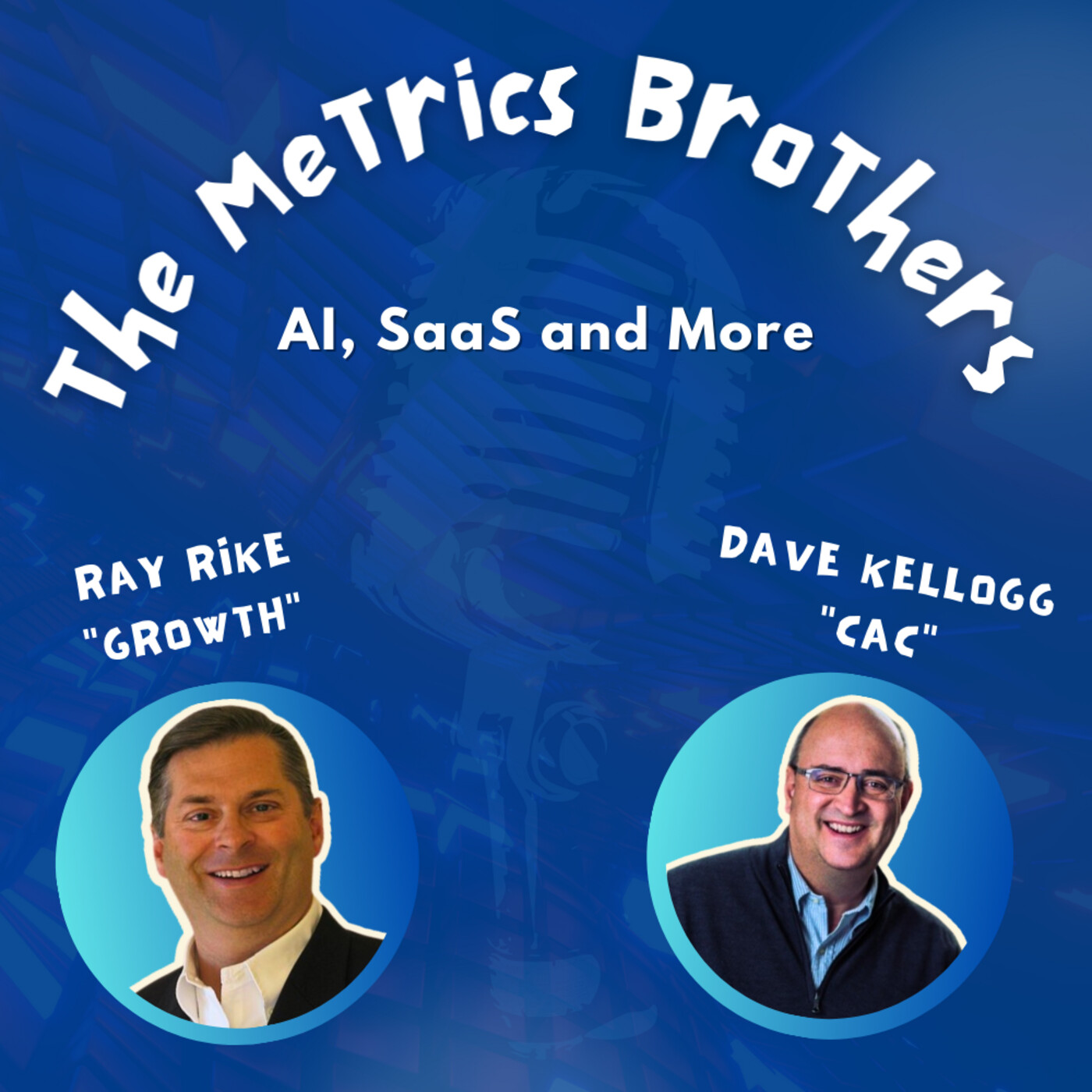
The Metrics Brothers
Ray Rike & Dave Kellogg
The Metrics Brothers (formerly SaaS Talk with the Metrics Brothers) is hosted by Dave "CAC" Kellogg and Ray "Growth" Rike. The Metrics Brothers provides unique insights, strategies, tactics and the metrics that are relevant to Native-AI and B2B software and SaaS companies.Each 20-minute episode will cover a topic critical to leading a B2B software company, and chalked full of practical advice that can be introduced and applied in most Native-AI, Agentic AI and B2B software and SaaS companies.
Episodes
Mentioned books

Mar 25, 2026 • 32min
Norwest B2B Sales & Marketing Benchmark Report
They dig into Norwest’s B2B sales and marketing benchmark study and debate its strengths and flaws. They highlight dramatic marketing budget cuts at smaller firms and shifts in who owns renewals. They discuss the collapse of MQL scoring and which marketing KPIs matter most. They call out widespread blind spots around CAC and cost-per-lead and point listeners to the report’s AI adoption section.
10 snips
Mar 11, 2026 • 26min
The Rule of 40 Becomes the Rule of 60
A deep dive into why SaaS metrics are shifting from the Rule of 40 to a tougher Rule of 60. They trace SaaS history, explain how valuation math and multiple compression drive new expectations. The conversation covers debt pressure, CAC inflation, AI’s mixed effects on margins, and the radical operational moves companies face to meet higher performance thresholds.
10 snips
Mar 5, 2026 • 28min
A Tale of Two AI Futures - Citrini vs Citadel
A point-counterpoint debate over two clashing AI forecasts, one a dark simulation of mass cognitive-job loss and market collapse and the other a data-driven rebuttal arguing normal tech S-curve adoption. They probe SaaS private-credit contagion fears, whether AI uniquely displaces white-collar work, the timing of adoption and likely policy responses, and why this scare feels so personal.
Mar 2, 2026 • 30min
ICONIQ State of AI: Bi-Annual Snapshot Report
A deep look at a bi-annual AI report from ~300 software leaders. They explore the shift from model races to durable, vertical applications and the importance of UX and workflows for differentiation. The conversation covers a projected gross-margin U-curve, rising R&D allocation to AI, and the move toward usage and outcome-based pricing models.
6 snips
Feb 18, 2026 • 49min
The SaaSpocalypse and the Avenir Future of SaaS Report
They unpack the SaaSpocalypse and why market value has plunged for many software companies. They debate AI-driven FOBO, regression to the mean in valuations, and shifting valuation methodologies. The Avenir report’s red pill vs blue pill framing sparks a discussion about embracing AI systems of context versus financializing for profit. They map a three-layer taxonomy for AI-era apps and survey buyer sentiment.
Feb 11, 2026 • 25min
The Impact of AI on Labor Productivity and Growth
In this episode of the Metrics Brothers podcast, Ray Rike and Dave Kellogg tackle one of the most critical yet misunderstood metrics in the U.S. economy: Labor Productivity. Amidst the rapid rise of Artificial Intelligence, the "Metrics Brothers" break down how productivity is officially measured by the Bureau of Labor Statistics and why historical technology booms, from SaaS to Cloud, haven't always moved productivity growth as much as expected.Key Takeaways: A deep dive into the ratio of economic output per hour worked, including what the BLS excludes (farms and government) and the nuances of white-collar labor tracking.Historical Trends: A comparison of the post-war boom versus the "SaaS era," exploring why the last 20 years have seen a 66% relative decrease in productivity growth despite trillions in tech investment.The AI Impact: Three potential scenarios for the future of work, from "exploding output" to "labor displacement," and why AI might fundamentally remake work in ways the Cloud never did.Global Benchmarking: How the U.S. stacks up against leaders like Ireland and Norway in output per hour.Why Listen? Whether you are a SaaS leader, investor, or white-collar professional, this episode provides a roadmap for staying on the "right side of the divide" in the upcoming AI-driven economic shift.See Privacy Policy at https://art19.com/privacy and California Privacy Notice at https://art19.com/privacy#do-not-sell-my-info.
Feb 5, 2026 • 27min
Brand Measurement Metrics and Techniques
Brand is one of the most powerful assets a company can build and one of the hardest to measure. In this episode of The Metrics Brothers, Dave “CAC” Kellogg, and Ray "Growth" Rike take on one of marketing’s most persistent challenges: how to measure brand in a world obsessed with direct attribution and near-term ROI.The conversation starts with what a brand really is, originating from literal marks of ownership and evolving into a promise of quality, trust, and differentiation. From there, Ray and Dave explore why strong brands create pricing power, customer loyalty, category leadership, and long-term defensibility, even if those benefits do not always show up cleanly in dashboards.They then break down practical ways to measure brand that align marketing and finance perspectives, including indirect valuation approaches such as brand value and goodwill frameworks, along with comparative metrics like direct and branded web traffic, share of voice, share of search, and inbound pipeline contribution. The episode also covers market research fundamentals including awareness, consideration, trial, and repurchase, and why dedicating a portion of your marketing budget to measurement is essential to sustaining brand investment.Finally, the Metrics Brothers dig into brand measurement techniques that work in practice, including self-reported attribution, lift experiments, and analyzing sales conversations to see how brand shows up late in the buying process, often at the exact moment a deal is won.If you have ever struggled to align brand investment with measurable outcomes, justify brand spend alongside demand generation, or connect long-term brand building to real business results, this episode provides a grounded, metrics-driven framework for doing exactly that.See Privacy Policy at https://art19.com/privacy and California Privacy Notice at https://art19.com/privacy#do-not-sell-my-info.
Jan 28, 2026 • 25min
The State of Generative AI in the Enterprise 2025
The State of Generative AI in the Enterprise 2025In this episode of The Metrics Brothers, Ray Rike and Dave Kellogg break down the 2025 State of Generative AI in the Enterprise report from Menlo Ventures and explain what the data really says about where enterprise AI adoption is accelerating and where the market is consolidating.The headline takeaway: AI software is scaling faster than any software category in history. Enterprise AI spend has exploded from roughly $1.7B in 2023 to nearly $37B in 2025, reaching scale in just three years. This revenue milestone took SaaS more than 15 years to achieve. Foundational models now represent the single largest area of spend, highlighting how infrastructure and model access remain core to enterprise AI strategies.Ray and Dave also explore a major strategic shift inside the enterprise: buy is decisively beating build. In 2025, 76% of enterprise AI solutions are purchased rather than built internally, up sharply from 53% the year prior. Rapid model evolution, ongoing retraining costs, and model drift are making internal AI development far more expensive to maintain than many teams originally expected.One of the most surprising findings is on go-to-market efficiency. AI software pilots convert to production at nearly twice the rate of traditional software, with roughly 47% of AI pilots reaching production versus about 25% for conventional enterprise software. This runs counter to recent narratives suggesting enterprise AI pilots are stalling and points to clearer ROI and faster time-to-value.The episode also dives into what Menlo calls the first true “AI killer app”: AI-assisted coding. Coding tools now account for more than half of departmental AI spend, with over 50% of developers already using AI coding assistants and adoption exceeding 65% among top-quartile teams. Real-world examples show meaningful productivity gains, including double-digit increases in development velocity and significant time savings during legacy system upgrades.Industry-wise, healthcare emerges as the largest buyer of vertical AI, representing 43% of vertical AI spend. This is notable given healthcare’s historically lower IT spend as a percentage of revenue. Much of the value is coming from administrative automation such as medical scribing, where AI directly reduces non-clinical workload and unlocks meaningful productivity gains for care providers.Finally, Ray and Dave examine the shifting competitive landscape among foundation model providers. Anthropic has surged to roughly 40% share of enterprise AI usage, up dramatically from prior years, while OpenAI’s share has declined as Google continues to gain traction. The discussion centers on focus versus breadth and why enterprise positioning and reliability may matter more than consumer mindshare.Key takeaways from the episode:AI software is the fastest-scaling software category everEnterprises are rapidly moving from build to buyAI pilots convert to production at nearly 2x traditional softwareAI coding is emerging as the first true enterprise AI killer appAnthropic’s enterprise focus is translating into meaningful market share gainsIf you care about how AI adoption actually translates into spend, productivity, and competitive advantage inside large organizations, this episode is a must-listen.See Privacy Policy at https://art19.com/privacy and California Privacy Notice at https://art19.com/privacy#do-not-sell-my-info.
Jan 21, 2026 • 26min
Dissecting the MIT NANDA Report
The podcast takes a deep dive into the viral claim that "95% of AI projects fail". Hosts analyze the MIT NANDA report, revealing inconsistencies and methodological flaws. They discuss how failure is defined and why many early-stage projects are misclassified. The conversation highlights the rise of Shadow AI, challenges with workflow integration, and the impact of fear-driven narratives. The hosts also emphasize measuring AI success by business value rather than project counts, shedding light on productivity's hidden impacts.
Jan 14, 2026 • 27min
2026 Brand vs Demand Benchmark Report
Brand vs Demand: Why B2B Marketing Is Stuck in a Measurement TrapIn this episode of The Metrics Brothers, Dave "CAC" Kellogg and Ray "Growth" Rike tackle one of the most persistent and controversial questions in B2B marketing: Brand vs. Demand.The discussion is grounded in new data from the 2026 B2B Brand vs Demand Benchmark Report. While most marketing teams say they believe brand and demand are complementary, the numbers tell a more complicated story.Today’s reality?Marketing budgets are still heavily skewed toward short-term demand generation, with roughly 70% of spend allocated to demand and only ~25% to brand. Yet when asked how they want to invest, marketing leaders overwhelmingly say they’d prefer a much more balanced future, closer to 50% demand and 40% brand.So why the disconnect?Ray and Dave dig into the root cause: measurement.Demand generation is tied to metrics CFOs understand like pipeline dollars, opportunities, and ARR. Brand, on the other hand, is still largely measured using proxy metrics like website traffic and awareness, leaving many executives unable to confidently link brand investments to revenue outcomes. Only 28% of companies say they can directly tie brand activity to pipeline, and when budgets are cut, brand is sacrificed five times more often than demand.The episode also explores:Why performance marketing struggles are pushing CMOs back toward brandThe growing inefficiency of demand spend aimed at “future buyers”How much of the “demand” budget is effectively unmeasured brand spendThe dangerous gap between belief in brand and proof of impactWhy AEO, AI search, and LLM visibility will make brand ROI even harder and more urgent to measureRay and Dave don’t just highlight the findings, they discuss the reality of Chief Marketing Officers making the Brand vs Demand budget allocation trade-offs.One key takeaway? Until brand investments can be credibly connected to pipeline efficiency, win rates, and ARR, it will remain more a faith-based investment instead of a financial one the CFOs understand.If you’re a CMO trying to defend brand spend, or a CFO trying to understand where marketing dollars truly drive growth, this episode is required listening.See Privacy Policy at https://art19.com/privacy and California Privacy Notice at https://art19.com/privacy#do-not-sell-my-info.

