

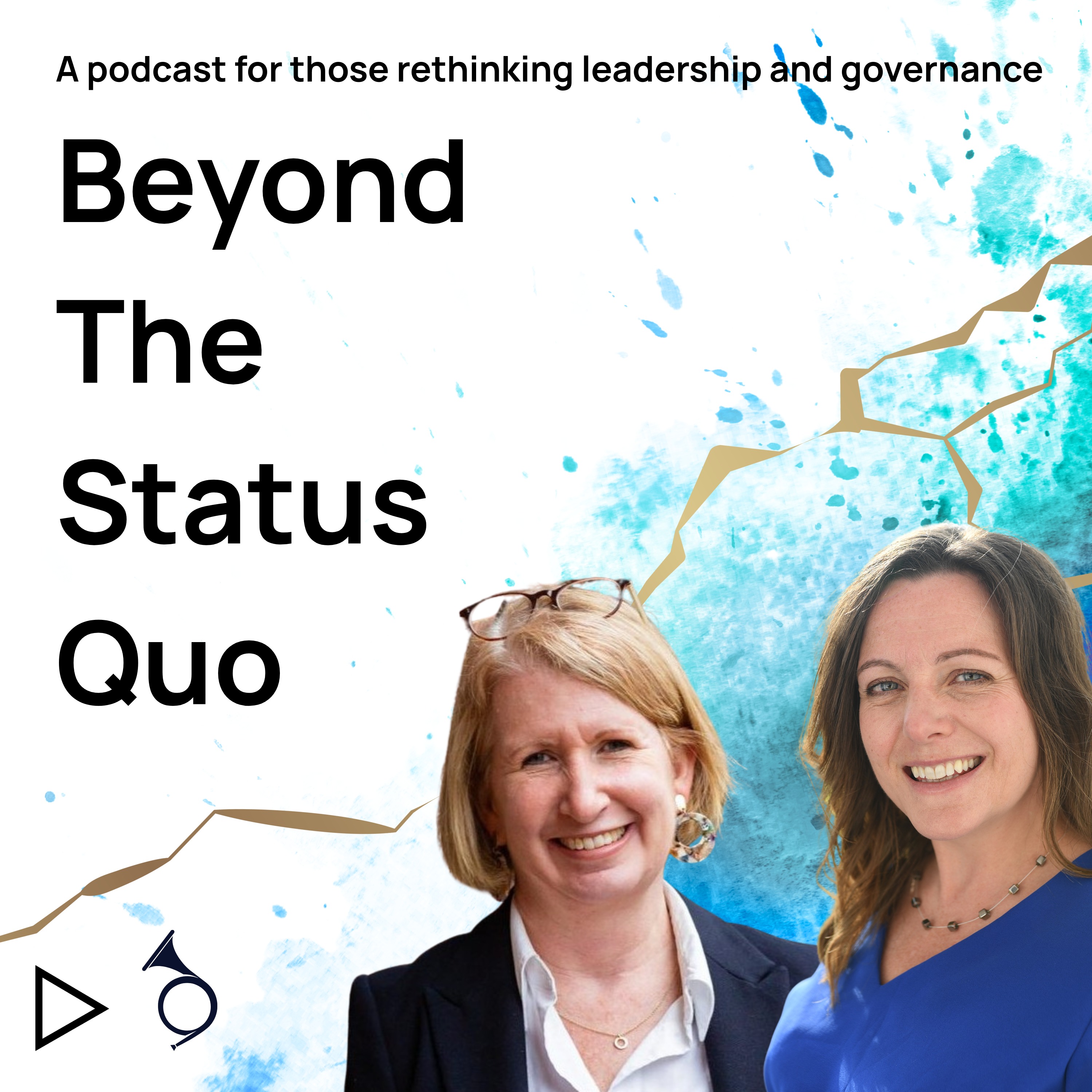
Beyond the Status Quo
Kathryn Gorman & Tamara Zaple Rolfs
Beyond the Status Quo is the podcast for purpose-driven changemakers. They are executive leaders and boards who are ready to question inherited systems. The world is shifting but many leadership models haven't caught up: we're still rewarding control over connection, certainty over nuance and status over substance.Brave, values-lead leadership isn't just possible. it's already happening. And it's exactly what the world needs.On this podcast, we bring together cross-sector voices who go beneath the surface to explore what meaningful change really takes - and what's already underway. Hosted on Acast. See acast.com/privacy for more information.
Episodes
Mentioned books

Mar 12, 2026 • 36min
Nilema Bhakta-Jones - Courageous Leadership: A Daily Practice
Summary: In this episode of Beyond the Status Quo we are joined by Nilema Bhakta-Jones who shares her journey of courageous leadership, discusses the importance of challenging the status quo, the role of psychological safety in leadership, and the need for creativity and play in the workplace. She emphasizes the significance of empathy and storytelling in leadership and highlights her work with Courageous Leaders and Empathy Week, aiming to empower marginalized communities through education. Nilema encourages listeners to embrace courage as a virtue that enables them to be their authentic selves and make a positive impact in their communities. Takeaways: · Courage is a daily practice that leaders must embody. · Challenging the status quo often begins in childhood. · Psychological safety is crucial for open communication in teams. · Creativity and play can enhance leadership effectiveness. · Empathy is a skill that can transform communities. · Leaders must navigate tensions and competing ideas. · Education systems need to foster critical thinking and creativity. · Storytelling is a powerful tool for leaders. · Courage can manifest in quiet, everyday actions. · Supporting marginalized communities through education is vital. Links:Courageous LeadersEmpathy Week 2026 is coming! Hosted on Acast. See acast.com/privacy for more information.

Feb 27, 2026 • 48min
Ewan McIntosh- Cutting Through The Tosh: Learning and Leading in a New Era
Episode SummaryIn this episode of Beyond the Status Quo, Tamara and Kathryn are joined by Ewan McIntosh, founder of NoTosh, an international education consultancy, for a practical conversation about learning and leading in education.Drawing on his work with schools and systems across more than 70 countries and his cross-sector experience, Ewan challenges the status quo from a global vantage point, seeing first-hand that the world is changing rapidly, and that how we learn and how we lead must evolve just as quickly.Together, they explore what happens when schools and organisations focus on performative tasks instead of meaningful learning. Ewan unpacks his idea of “stupid questions”: including the ones that feel risky to ask but reveal hidden assumptions and blind spots.The conversation also tackles AI’s impact on assessment and curriculum design, not from a place of fear, but through the lens of redesign. Rather than rushing to control, they discuss how leaders can create the conditions for better thinking: prioritising judgement, originality, empathy and craft.Finally, they zoom out to what courageous leadership looks like under constraint: holding structure lightly, focusing on purpose that actually guides decisions, and putting people first so schools (and teams) can thrive.Key takeaways• AI increases performance optimisation; task design must protect learning.• Use AI to accelerate low-value work and make space for judgement and originality.• Creativity is learnable and strengthened through complementary teams.• Purpose should guide decisions and clarify what you won’t do.• People-first leadership creates the conditions for better outcomes.• Hold structure lightly, and focus on what you can influence.• Policy (and strategy) works better when designed around real users, not silos.• Sometimes asking the “foolish” question reveals the real problem.Links:Inspired Strategic Planning with Community at its Heart | NoToshLeadership Lessons | YestothemessLament - YouTube Hosted on Acast. See acast.com/privacy for more information.

Feb 12, 2026 • 25min
Jillian Reilly- Permission to Question the Status Quo
In this episode, facilitator and author of The 10 Permissions, Jillian Reilly joins Tamara and Kathryn for a powerful conversation about what it really means to question the status quo, not as rebellion, but as a deeply human act of listening inward, honouring integrity, and navigating uncertainty with courage.Jillian reflects on the early moment she realised the “default path” wasn’t hers, and how that instinct, before she had language for it, shaped a very different trajectory. She shares candidly about her rapid rise in international development, the disillusionment that followed, and the difficult decision to step away from work that no longer aligned with her values.Together, they explore the myth of the secure linear career, the tension between privilege and risk, and why adaptability is becoming essential as institutions no longer guarantee stability. Jillian also reflects on how young people are still trained to seek external validation, even as the world increasingly demands creativity, originality and inner authority.Key takeaways• Intuition is a valid guide. Many people are never taught they’re allowed to trust their inner voice.• Questioning the status quo often starts as a feeling, not a logical plan.• Integrity requires alignment. Staying in roles that contradict our values creates deep internal conflict.• Courage is contextual. There’s an important difference between discomfort and real danger.• The “secure path” is disappearing. The old promises of safety through compliance no longer hold.• Adaptability is now a core life skill. Reinvention and entrepreneurial thinking are becoming essential.• Human skills matter more than ever. Creativity, connection and originality rise as knowledge becomes commodified.• Young people need permission to explore. Pivoting, experimenting and puzzling things out matter more than following a script.• Optimism is a form of agency. It allows people to reclaim their power and shape their own path.• The future requires puzzling, not predicting. Uncertainty brings risk and a wider field of possibility.LinksThe Ten Permissions - Rewrite the Rules. Design Your Life. Hosted on Acast. See acast.com/privacy for more information.

Jan 30, 2026 • 35min
Adam Kahane: Radical Engagement in Fractured Times
Radical Engagement for Fractured Times — Episode SummaryIn this episode, systems change practitioner, author and long‑time collaborator across conflict lines Adam Kahane joins us to explore what it means to engage radically in a world that is fracturing at speed. Drawing on his decades of work in some of the world’s most divided contexts - from South Africa’s transition to democracy to multi‑stakeholder conflicts across business, politics and civil society - Adam reflects on why our old models of leadership no longer work in the volatility we now face.He invites us to rethink how we show up with those we don’t agree with, like or trust, and why transforming systems requires us to step forward with difference rather than retreat from it. In a moment where political polarisation is deepening and institutions are cracking under pressure, Adam offers a grounded, hopeful and deeply practical way of navigating uncertainty: through radical engagement, everyday habits, and the courage to collaborate across boundaries without abandoning our values.TakeawaysRadical engagement is a foundational habit for transforming systems, requiring us to lean in rather than stand back.We don’t need full alignment to move forward. Progress often begins with small, imperfect steps taken together.Collaborating with people we don’t agree with, like or trust is increasingly essential, and increasingly difficult, in today’s polarised world.Disagreement is not a barrier to collaboration; learning to disagree well is a leadership skill we urgently need.Cracks in our systems reveal both danger and possibility, they expose what’s been hidden and invite new ways of working.Understanding others doesn’t mean agreeing with them; it means seeing more of the system so we can act more wisely.Leaning forward, listening deeply and looking for what’s unseen helps us move beyond superficial engagement.Systemic change is always a collective act, never the work of one person or one organisation.Working across difference clarifies our values and boundaries, rather than diluting them.Feeling our way forward, one step at a time, is often the only viable path in volatile, uncertain environments.LinksAdam KahaneConnect with TamaraLinkedIn:Tamara Zaple Rolfs FCCT | LinkedInEmail: tamara@my-delta.co.ukConnect with KathrynLinkedIn: Kathryn Gorman FCCT | LinkedInEmail: kathryn@clarioneducation.co.ukFeedbackThank you for listening to Beyond the Status Quo. Please do connect with us or like and share the Podcast. If you have any feedback, please email us or click on this link to a short feedback form: https://forms.gle/7H2NZDvC92Go56ZE8It helps us to improve the podcast and make sure it is giving you what you need. Thank you! Hosted on Acast. See acast.com/privacy for more information.

Jan 15, 2026 • 45min
Megan Reitz- Spaciousness in a Noisy World
Spaciousness in a Noisy World — Episode SummaryIn this episode, leadership thinker, researcher and author Megan Reitz joins us to explore what it means to create spaciousness in a world that feels increasingly frantic, noisy and attention‑hungry. Drawing on her research into mindfulness, speaking truth to power and the dynamics of attention, Megan reflects on how modern workplaces have become “pathologically busy” and why so many leaders struggle to pause, listen and make wiser choices. She ultimately invites us to rethink how we use our attention, how we define achievement, and how we might reclaim the space needed for more human, thoughtful leadership.TakeawaysSpaciousness enables wiser, more grounded leadership.Modern workplaces often confuse activity with effectiveness.Our attention is constantly pulled, shaped and colonised by noise and urgency.Leaders profoundly influence whether others feel able to speak up.Psychological safety requires leaders to examine their own habits, not “fix” others.Pausing is a radical act in environments addicted to speed and certainty.Mindfulness helps create space between stimulus and response.Intergenerational tensions often reflect broader societal pressures, not simple differences in attitude.Success needs redefining beyond productivity and constant busyness.Creating reflective space is essential for insight, connection and meaningful change.LinksMegan ReitzConnect with TamaraLinkedIn:Tamara Zaple Rolfs FCCT | LinkedInEmail: tamara@my-delta.co.ukConnect with KathrynLinkedIn: Kathryn Gorman FCCT | LinkedInEmail: kathryn@clarioneducation.co.ukFeedbackThank you for listening to Beyond the Status Quo. Please do connect with us or like and share the Podcast. If you have any feedback, please email us or click on this link to a short feedback form: https://forms.gle/7H2NZDvC92Go56ZE8It helps us to improve the podcast and make sure it is giving you what you need. Thank you! Hosted on Acast. See acast.com/privacy for more information.

Dec 19, 2025 • 29min
Episode 5 - Disruptive Leadership with purpose with Nick Osborne
SummaryIn this episode, Nick Osborne, the founding CEO of Maritime Academy Trust, discusses his journey in education, emphasising the importance of questioning the status quo, the role of humour in leadership, and the necessity of vulnerability. He shares insights on positive disruption in education, the significance of board support, and building trust within organisations. Nick encourages leaders to focus on their passions and highlights the need for honesty and openness in addressing challenges. The conversation concludes with a message of hope and the idea that everyone is navigating their paths, often making it up as they go along.TakeawaysQuestioning the status quo is essential for growth.Humour can create bonds and foster honesty in the workplace.Vulnerability is a powerful leadership trait.Positive disruption is necessary for educational improvement.Support from the board is crucial for implementing change.Building trust requires honesty and openness.Finding joy in work enhances resilience and effectiveness.Education systems have more autonomy than often perceived.Sharing failures is as important as celebrating successes.Hope can be found in the freedom to pursue passions in education.LinksMaritime Academy Trust - HomeConnect with TamaraLinkedIn: (1) Tamara Zaple Rolfs FCCT | LinkedInEmail: tamara@my-delta.co.uk Connect with KathrynLinkedIn: (1) Kathryn Gorman FCCT | LinkedInEmail: kathryn@clarioneducation.co.ukFeedbackThank you for listening to Beyond the Status Quo. Please do connect with us or like and share the Podcast. If you have any feedback, please email us: it helps us to improve the podcast and make sure it is giving you what you need. Thank you! Hosted on Acast. See acast.com/privacy for more information.

Nov 28, 2025 • 26min
Episode 4 - Astrid Korin Leading with Purpose: From the Inside Out
In this episode of Beyond the Status Quo, hosts Tamara Zaple Rolfs and Kathryn Gorman discuss the importance of challenging the status quo in leadership, the dynamics of power in organisations, and the role of resilience and self-awareness in effective leadership with organisational coach and mentor, Astrid Korin. They explore how education shapes leadership styles and the necessity of creating psychological safety within organisations to foster growth and innovation. The conversation emphasises the need for leaders to be authentic, aware, and compassionate while navigating complex systems and challenges.Key takeawaysChallenging the status quo can be subtle and collaborative.Resilience in leadership is a continuous practice, not a goal.Self-awareness is crucial for authentic leadership.Education often perpetuates compliance rather than creativity.Creating psychological safety is essential for effective leadership.Power dynamics in organisations can hinder collaboration.Leaders must support others to grow and learn.Compassionate leadership does not equate to lowered expectations.Awareness of human behavior is vital for effective leadership.Unlearning compliance is necessary for thriving in the workplace.You can find more information about Astrid's work and her course 'Inside Out' here Transformational coaching — Astrid Korin CoachingIf you are interested in the theory and practice of Psychological Safety, then the go-to text is here Psychological Safety – Amy C. Edmondson Hosted on Acast. See acast.com/privacy for more information.

Nov 14, 2025 • 9min
David Liddle - Host Reflections
In this reflective conversation, Tamara Zaple Rolfs and Kathryn Gorman discuss their insightful podcast episode with David Liddell, focusing on the importance of translating theory into action within leadership and organisational culture. They explore the evolution of leadership towards integrative approaches that prioritize listening and valuing diverse voices, as well as the role of conflict in fostering positive change. The discussion emphasises the need for intentionality in creating a culture that aligns business needs with human values, highlighting the complexities and challenges leaders face in this endeavour.TakeawaysTheory into action is essential for effective leadership.Leaders must be culture architects, designing intentional workplace cultures.Listening to diverse voices is crucial for conflict resolution.Conflict can be a positive force for change.Leadership today requires integrating various values and perspectives.Creating a values-driven culture is complex and challenging.Psychological safety is increasingly recognised in workplace dynamics.Humanity should be central to organisational policies.Business needs and people’s needs can coexist harmoniously.Courage and bravery are necessary in questioning the status quo.Useful LinksDavid Liddle. | The TCM GroupRecommended Reading | The TCM Group Hosted on Acast. See acast.com/privacy for more information.

Oct 31, 2025 • 53min
Episode 3 - Tipping the Balance: from conflict to connection with David Liddle
David Liddle, a recognized expert in conflict management and founder of The TCM Group, discusses the transformative power of leadership in fostering connection and belonging. He introduces the Align Model, emphasizing constructive conflict within a psychologically safe environment. Liddle highlights the importance of inclusive policies that shape positive organizational culture. He advocates for courageous leaders to embrace diverse perspectives and leverage humility to create meaningful change while challenging status quo norms.

Oct 17, 2025 • 8min
Wayne Norrie - Host reflections
In this conversation, Tamara and Kathryn discuss their insights from a recent interview with Wayne, focusing on challenging educational norms, reframing autonomy, the courage of conviction in leadership, and the importance of community engagement. They explore how effective leadership requires understanding the unique needs of different communities and the balance between authority and flexibility in educational settings.TakeawaysChallenging the norms within education is essential for progress.Reframing autonomy can empower leaders to make effective decisions.Courage of conviction allows leaders to say no to directives that don't fit their context.Understanding the specific needs of communities is crucial for effective leadership.Every school can be outstanding in different moments, depending on context.Listening deeply to communities enhances leadership effectiveness.Agency in education empowers individuals to drive change.Delegating tasks and accountability are often misunderstood in educational settings.Storytelling is a powerful tool for sharing insights and experiences.Cross-sector learning can enhance educational practices. Hosted on Acast. See acast.com/privacy for more information.

