

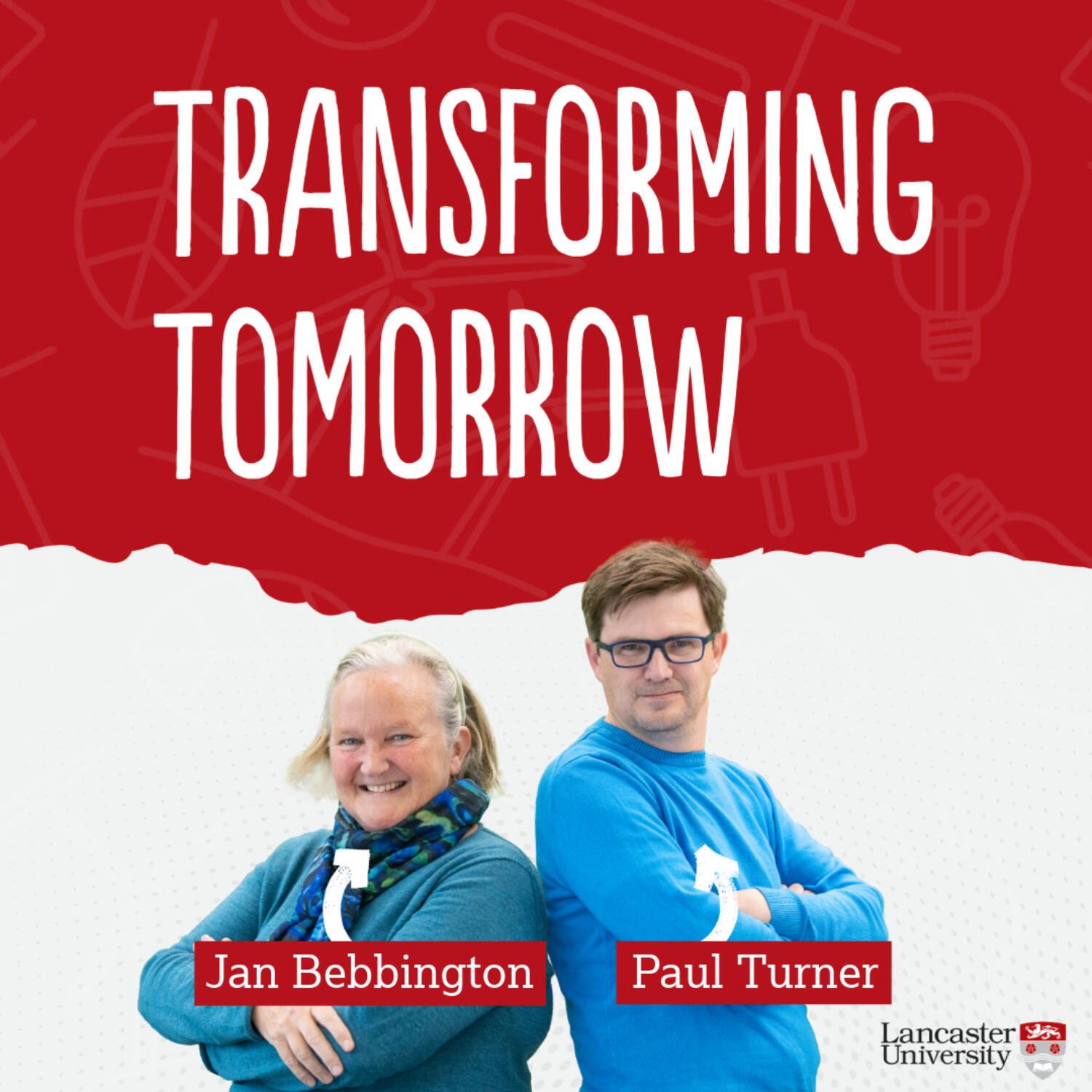
Transforming Tomorrow
The Pentland Centre for Sustainability in Business
Sustainability is a key consideration for any contemporary business, from biodiversity to modern slavery, seabeds to factory floors. Transforming Tomorrow guides you through the complex, ever-changing and often exciting (yes, really!!) world of sustainability in business.
Alongside members of the Pentland Centre, international research experts, and business leaders, we cover the theory and practice of mainstreaming sustainability into purposeful business strategy and performance.
Whether you are leading change in your business, or just want to know more about how space weather, human trafficking or architecture may influence the future of sustainability, Transforming Tomorrow is the show for you.
Taking you through it all, hosts Jan and Paul bring insight, perspective, and more than occasional disagreement to their topics.
Professor Jan Bebbington is the Director of the Pentland Centre for Sustainability in Business at Lancaster University. Jan is an expert on accounting, benchmarking (to her co-host’s annoyance), and how business and sustainability intersect. She loves nature and wants to protect it – and hopes she can change the world (ideally for the better). She is also motivated to address inequality wherever it is found and especially to eliminate forced, bonded or child labour. Transforming Tomorrow is one small step on that quest.
Paul Turner is a former sports journalist who now works promoting the research activities in Lancaster University Management School – a poacher turned gamekeeper as his former colleagues would have it. He has always been interested in nature and the natural environment – it comes from growing up in Cumbria – and has been a vocal proponent of the work of the Pentland Centre since joining Lancaster University. He does not like rankings and benchmarking, and is not afraid to say so.
Join us every Monday to uncover new insights and become a little more inspired that you can make a difference in sustainability.
Alongside members of the Pentland Centre, international research experts, and business leaders, we cover the theory and practice of mainstreaming sustainability into purposeful business strategy and performance.
Whether you are leading change in your business, or just want to know more about how space weather, human trafficking or architecture may influence the future of sustainability, Transforming Tomorrow is the show for you.
Taking you through it all, hosts Jan and Paul bring insight, perspective, and more than occasional disagreement to their topics.
Professor Jan Bebbington is the Director of the Pentland Centre for Sustainability in Business at Lancaster University. Jan is an expert on accounting, benchmarking (to her co-host’s annoyance), and how business and sustainability intersect. She loves nature and wants to protect it – and hopes she can change the world (ideally for the better). She is also motivated to address inequality wherever it is found and especially to eliminate forced, bonded or child labour. Transforming Tomorrow is one small step on that quest.
Paul Turner is a former sports journalist who now works promoting the research activities in Lancaster University Management School – a poacher turned gamekeeper as his former colleagues would have it. He has always been interested in nature and the natural environment – it comes from growing up in Cumbria – and has been a vocal proponent of the work of the Pentland Centre since joining Lancaster University. He does not like rankings and benchmarking, and is not afraid to say so.
Join us every Monday to uncover new insights and become a little more inspired that you can make a difference in sustainability.
Episodes
Mentioned books

Mar 25, 2024 • 32min
Don't Be A Greenwasher
Dr Di Wang dials in from Sydney, Australia, to talk to Jan and Paul about his work on sustainability reporting and materiality.
Di talks about his experience of interviewing more than 200 businesses on their understanding of materiality – a concept that underpins reporting and which will be explained in the podcast. He explains why companies take part in greenhushing – and explains why he thinks the practice is only likely to increase. He also introduces us to the concept of brownwashing.
And Paul's brainwashing is complete, as the word ‘benchmarking’ comes into his head unprompted.
Find out more about Di’s work and research interests here: https://www.lancaster.ac.uk/lums/people/di-wang
And you can see Di’s paper on Sustainability Reporting and Materiality here: https://papers.ssrn.com/sol3/papers.cfm?abstract_id=4687038
Mar 18, 2024 • 26min
Stewardship and Responsible Leadership
What is leadership? And what makes a good leader?
Dr Marian Iszatt-White heads to the studio to talk with Jan and Paul about her perspective on leadership and management – as well as her time working in the oil industry.
Marian discusses what authentic leadership is – and why we should or should not be authentic; how leaders address sustainability issues; where stewardship and accountability fit in; and the importance of teaching on how future leaders can be shaped by programmes such as Lancaster’s MBA.
Find out more about Marian’s work here: https://www.lancaster.ac.uk/lums/people/marian-iszatt-white
Mar 11, 2024 • 31min
Wicked, Clumsy and Post-Normal
What are wicked problems? How about clumsy solutions? And where does post-normal science fit in?
In tackling issues such as climate change, scientists and researchers face complicated scenarios that are not easily explicable, with problems that are not always solvable in a clean fashion. Jan explains the development of post-normal science as a way of addressing huge modern (wicked) problems such as climate change, how there is not always a definitive answer to every question, and why uncertain (clumsy) solutions are better than none at all.
Why is being uncertain a good sign? Why do we all need to be open to changing our minds? If we don’t rely on facts for solutions, does this lead to a post-Truth future? Do we need to involve more people from beyond science in drafting solutions? Can a solution to a wicked problem ever be permanent? We cover all these questions, and more.
Find out more about the Cynefin Framework here: https://thecynefin.co/about-us/about-cynefin-framework/
Mar 7, 2024 • 10min
Going Glocal
Paul’s head is going to explode as another new word to the English language is introduced to the podcast.
Law PhD researcher Camilo Cornejo Martinez returns to talk to Jan and Paul about the importance of both local and global attitudes, actions and policies towards climate change.
Discover more about Camilo’s work here: https://www.lancaster.ac.uk/law/people/camilo-cornejo-martinez
Mar 4, 2024 • 33min
Environmental Law
The law won’t let Jan and Paul get away that easily!
Another member of Lancaster University Law School, PhD researcher Camilo Cornejo Martinez, comes into the studio with the unprompted assurance that he is not an accountant.
Camilo talks about his background as a practising lawyer in his home country of Chile; the different attitudes and approaches – legal and otherwise – to the environment and sustainability between Chile, the UK, and other countries; environmental courts; just transitions; and the rights of nature, and giving nature a voice.
Discover more about Camilo’s work here: https://www.lancaster.ac.uk/law/people/camilo-cornejo-martinez
Feb 26, 2024 • 34min
Corporate Responsibility
The law has caught up with Jan and Paul!
Dr Rafael Savva, from Lancaster University’s Law School, promises he won’t sue us, but will recording the podcast turn him into a supervillain?
Rafael talks to us about corporate governance legislation; the differences between hard and soft law – and how they apply to corporate responsibility; the potential conflicts between environmental regulation and seeking profit; the power of shareholders; socially responsible investing; and the importance of defining sustainable development in order to shape future legislation.
Discover if Paul and Jan would make good Law students – and whether Jan has any memory of her prior education in contract law.
Find out more about Rafael’s work here: https://www.lancaster.ac.uk/law/people/rafael-savva
Feb 19, 2024 • 36min
The Blue Economy
It’s time to talk politics! And discover the Blue Economy – and how it varies around the world.
Dr Celine Germond-Duret steps into the studio to speak with Jan and Paul to discuss how people and business connect to the coast and the sea (including fish and chip shops); why an exact definition of the blue economy is hard to find; the politics and resources of the oceans in different countries; and the balance between economics and the environment in sustainable development.
Find out more about Celine’s work here: https://www.lancaster.ac.uk/ppr/people/celine-germond-duret
Feb 15, 2024 • 15min
Sustainability in Scotland
Dr Lucy Wishart returns to tell Jan and Paul about the varied governance and structures within Scottish policy-making bodies when it comes to waste.
She reveals the changes she has seen over recent years, how policy debate has evolved and moved away from Westminister, Scotland-specific patterns and approaches – and (almost) answers the perennial question of whether you can recycle a paper envelope with a clear plastic window, or if you have to take the window out first.
Discover more about Lucy’s work here: https://www.st-andrews.ac.uk/management/people/la24
Feb 12, 2024 • 26min
Waste and the Circular Economy
What is waste? It goes far beyond what we all might think.
Dr Lucy Wishart joins Jan and Paul from the University of St Andrews Business School to discuss something that is there in every action we make, but which we rarely think about.
We cover everything from discard studies to the circular economy and the difficulties in making it a reality, how we might extend the life of objects and encourage people to reuse, and the hidden labour and (physical and mental) effort needed in reusing and recycling. Plus, can there be sustainable waste?
Discover more about Lucy’s work here: https://www.st-andrews.ac.uk/management/people/la24
Feb 5, 2024 • 27min
Sustainability Fairy Tales
How can fairy tales be used help people more easily understand sustainability challenges and pitfalls? Where do mermaids, vampires and witches fit in?
Dr Carolynne Lord talks to Jan and Paul about her work in making research more accessible to broader audiences; how green energy generation is like a mermaid luring businesses onto the rocks and distracting from other important issues; and why policymakers are waving garlic at vampire cars rather than brandishing stakes.
They also discuss urban sustainability transitions, and how experts need to cross boundaries to share ideas and expertise with other people working in the same area.
See more of Carolynne’s work on sustainability fairy tales, and the imagery that was created to go with the project here: https://doc.your-brochure-online.co.uk/Lancaster-University_FiftyFourDegrees_Issue_19/10/

