

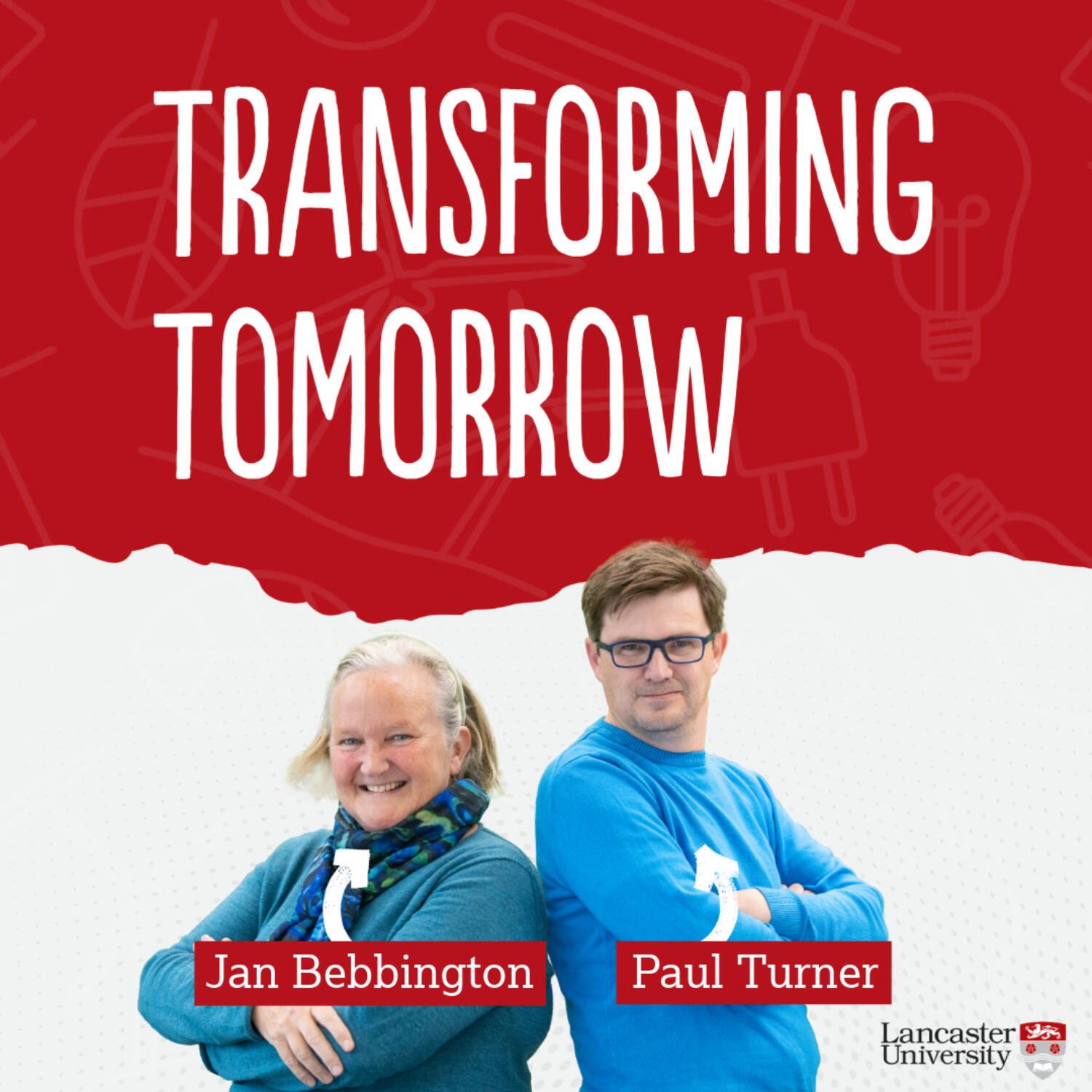
Transforming Tomorrow
The Pentland Centre for Sustainability in Business
Sustainability is a key consideration for any contemporary business, from biodiversity to modern slavery, seabeds to factory floors. Transforming Tomorrow guides you through the complex, ever-changing and often exciting (yes, really!!) world of sustainability in business.
Alongside members of the Pentland Centre, international research experts, and business leaders, we cover the theory and practice of mainstreaming sustainability into purposeful business strategy and performance.
Whether you are leading change in your business, or just want to know more about how space weather, human trafficking or architecture may influence the future of sustainability, Transforming Tomorrow is the show for you.
Taking you through it all, hosts Jan and Paul bring insight, perspective, and more than occasional disagreement to their topics.
Professor Jan Bebbington is the Director of the Pentland Centre for Sustainability in Business at Lancaster University. Jan is an expert on accounting, benchmarking (to her co-host’s annoyance), and how business and sustainability intersect. She loves nature and wants to protect it – and hopes she can change the world (ideally for the better). She is also motivated to address inequality wherever it is found and especially to eliminate forced, bonded or child labour. Transforming Tomorrow is one small step on that quest.
Paul Turner is a former sports journalist who now works promoting the research activities in Lancaster University Management School – a poacher turned gamekeeper as his former colleagues would have it. He has always been interested in nature and the natural environment – it comes from growing up in Cumbria – and has been a vocal proponent of the work of the Pentland Centre since joining Lancaster University. He does not like rankings and benchmarking, and is not afraid to say so.
Join us every Monday to uncover new insights and become a little more inspired that you can make a difference in sustainability.
Alongside members of the Pentland Centre, international research experts, and business leaders, we cover the theory and practice of mainstreaming sustainability into purposeful business strategy and performance.
Whether you are leading change in your business, or just want to know more about how space weather, human trafficking or architecture may influence the future of sustainability, Transforming Tomorrow is the show for you.
Taking you through it all, hosts Jan and Paul bring insight, perspective, and more than occasional disagreement to their topics.
Professor Jan Bebbington is the Director of the Pentland Centre for Sustainability in Business at Lancaster University. Jan is an expert on accounting, benchmarking (to her co-host’s annoyance), and how business and sustainability intersect. She loves nature and wants to protect it – and hopes she can change the world (ideally for the better). She is also motivated to address inequality wherever it is found and especially to eliminate forced, bonded or child labour. Transforming Tomorrow is one small step on that quest.
Paul Turner is a former sports journalist who now works promoting the research activities in Lancaster University Management School – a poacher turned gamekeeper as his former colleagues would have it. He has always been interested in nature and the natural environment – it comes from growing up in Cumbria – and has been a vocal proponent of the work of the Pentland Centre since joining Lancaster University. He does not like rankings and benchmarking, and is not afraid to say so.
Join us every Monday to uncover new insights and become a little more inspired that you can make a difference in sustainability.
Episodes
Mentioned books

Jan 29, 2024 • 33min
Entrepreneurs and Sustainability
How do entrepreneurs approach sustainability?
Brian Gregory and Salma Atcha, from the Lancaster University Entrepreneurs in Residence network, join Paul and Jan in the studio to share their experiences.
They discuss differing attitudes towards sustainability; how the Sustainable Development Goals help shape business behaviours; when entrepreneurs are no longer entrepreneurs;
Find out more about the Entrepreneurs in Residence network here: https://www.lancaster.ac.uk/lums/business/entrepreneurs-in-residence/
Read the article about degrowth and B-Corps by Entrepreneur in Residence Victor Giannandrea, the Pentland Centre’s Duncan Pollard, and B-Corp owner Celia Gaze here: https://doc.your-brochure-online.co.uk/Lancaster-University_FiftyFourDegrees_Issue_17/43/
Jan 22, 2024 • 32min
Universities and Sustainability
What are universities doing to address sustainability challenges?
Dr Georgiana Allison, Head of Sustainability at Lancaster University, joins Jan and Paul to discuss what the home of the Pentland Centre is doing to become more sustainable. They cover everything from Lancaster’s wind and solar farms, carbon impacts, changing attitudes and behaviours, how to make an impact in the classroom and where there is hope for the future.
Plus, why are sustainability strategies like icing and cake? And has Paul found an ally against rankings and benchmarking?
Find out more about sustainability at Lancaster University here: https://www.lancaster.ac.uk/sustainability/
Jan 17, 2024 • 14min
The Wonders of Sand!
Jan and Paul are joined once more by Dr Jean-Baptiste Jouffray to discuss the fascinating world of sand. Without it, there would be no windows, no buildings, no electronics, no Transforming Tomorrow podcast! But what are the social and ecological impacts of sand extraction? And is our use of it sustainable?
Jan 15, 2024 • 31min
An Ocean of Issues
You may have been taught the names of the world’s oceans as a child, but is there really only one?
Dr Jean-Baptiste Jouffray, of the Stanford Center for Ocean Solutions, speaks to Jan and Paul from his home in Northern California. As well as busting myths on how many oceans we have on Earth, he discusses the many challenges it faces; his work across science, academia and business; the concepts of keystone actors and leverage points as a means to instigate change; and what it is really like working with Jan.
See the One ocean map, JB talks about here: https://storymaps.arcgis.com/stories/756bcae18d304a1eac140f19f4d5cb3d
Episode Transcript
Jan 8, 2024 • 34min
Modern Slavery Reporting and Regulation
It has been too long since we had an accountant on the show, so it’s time to rectify that! Jan and Paul welcome Dr Mahmoud Gad to talk with them about his important work with the Financial Reporting Council and the UK’s Independent Anti-Slavery Commissioner on companies’ modern slavery reporting.
What effects do regulations have? How can we encourage companies to treat modern slavery reporting as more than a tick-box exercise? How can AI be used to help tackle the larger problem? How can it be that only 15%of companies work with their suppliers to improve labour rights practices? Can Jan and Paul stop themselves going off on too many tangents? And does Jan really call statistics meaningless?
Find out more about the work taking place on modern slavery in Lancaster University Management School here: https://www.lancaster.ac.uk/news/spotlight/modern-slavery/
Read the report Modern Slavery Reporting Practices in the UK, here: https://media.frc.org.uk/documents/FRC_Modern_Slavery_Reporting_Practices_in_the_UK_2022.pdf
Dec 20, 2023 • 35min
COP28 and Business
In the aftermath of COP28 in the United Arab Emirates, Jan drags Paul back from his Christmas break for a special episode. They discuss the agreements made between nations, and the implications for business.
Dec 18, 2023 • 28min
Sustainable Family Businesses
There are almost five million family businesses in the UK alone. They are all around us, and have been for thousands of years. But what do we mean when we talk about family businesses?
Dr Allan Discua Cruz, Director of the Centre for Family Business at Lancaster University Management School, speaks to Jan and Paul about his personal experiences growing up in a family business, the issue of succession and longevity, how family firms address sustainability and consider the Sustainable Development Goals, and how faith and religion can impact their environmental behaviours.
Find out more about the Centre for Family Business here: https://www.lancaster.ac.uk/lums/research/areas-of-expertise/centre-for-family-business/
Dec 11, 2023 • 30min
Local Sustainability Policy
Global climate change has local impacts. So, how important is it that local government and the general public have an input into sustainability policies and actions?
Dr Jekaterina Rindt joins Jan and Paul to discuss the I-Connect project, which is looking at the future of Lancaster and Morecambe when the Eden Project arrives. How can the journey to Eden be made Eden-like? With a focus on the Net-Zero agenda; sustainable, accessible and inclusive transport; and the need to consider communities, health and sustainability across all areas of policy, its design and impact, there is much for everyone to consider.
Read more about the I-Connect project here: https://doc.your-brochure-online.co.uk/Lancaster-University_FiftyFourDegrees_Issue_20/14/
And here: https://wp.lancs.ac.uk/i-connect/
Nov 20, 2023 • 20min
How do Sustainability and Accounting go together?
Jan and Paul welcome Richard Spencer, Director of Sustainability at the Institute of Chartered Accountants in England and Wales (ICAEW), to discuss how sustainability and accounting are interlinked, and why it is important for all accountants to embrace the connections.
Discover more about Jan’s work with the ICAEW on educating the next generation of accountants on sustainability here: https://doc.your-brochure-online.co.uk/Lancaster-University_FiftyFourDegrees_Issue_18/14/
Episode Transcript
Nov 13, 2023 • 30min
Sustainability Benchmarking
Jan and guest Dr Dasha Smirnow try to convince a sceptical Paul that sustainability benchmarks – rankings based on companies’ performances relating to certain criteria – are actually worthwhile.
Find out whether benchmarks have any effect on companies’ actions, if poor performers care that they are not doing well, and whether the World Benchmarking Alliance really is an organisation set up just to benchmark benchmarks (hint: it’s not). Can Paul’s natural cynicism be overcome?
Episode Transcript

