

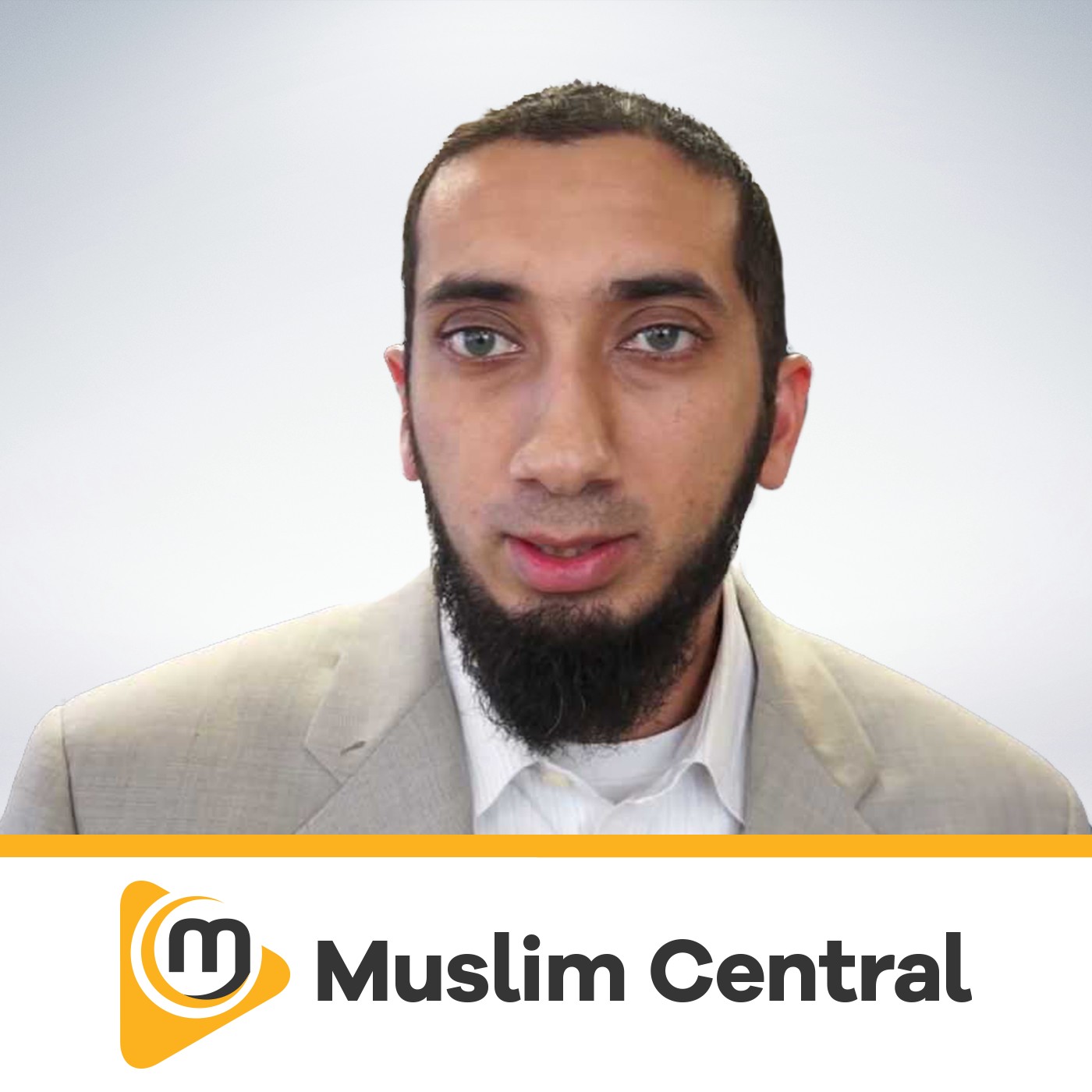
Nouman Ali Khan
Muslim Central
Nouman Ali Khan is the founder and CEO of Bayyinah and serves as a lead instructor for several programs including Dream, traveling seminars and Bayyinah TV. His serious Arabic training began in the U.S. in 1999 under Dr. Abdus-Samie, founder and former principal of Quran College in Faisalabad, Pakistan.
Khan served as a professor of Arabic at Nassau Community College until 2006 when he decided to take Bayyinah on as a full-time project. Since then he has taught more than 10,000 students through traveling seminars and programs. He currently resides in Dallas, Texas and is focusing on teaching his students, developing Arabic curricula and filming material for Bayyinah TV.
Nouman Ali Khan, who was of Pakistani descent and was born in Germany on May 4, 1978, spent his early years in the former East Berlin. Khan attended the Pakistan Embassy school from second through eighth grade while his father was employed by the Pakistani Embassy in Riyadh, Saudi Arabia. Khan was a teenager when his father decided to relocate the family to New York.
Khan served as a professor of Arabic at Nassau Community College until 2006 when he decided to take Bayyinah on as a full-time project. Since then he has taught more than 10,000 students through traveling seminars and programs. He currently resides in Dallas, Texas and is focusing on teaching his students, developing Arabic curricula and filming material for Bayyinah TV.
Nouman Ali Khan, who was of Pakistani descent and was born in Germany on May 4, 1978, spent his early years in the former East Berlin. Khan attended the Pakistan Embassy school from second through eighth grade while his father was employed by the Pakistani Embassy in Riyadh, Saudi Arabia. Khan was a teenager when his father decided to relocate the family to New York.
Episodes
Mentioned books

Feb 11, 2013 • 54min
When Muslims Work Together 1 Introduction What Motivates Us
Ustadh Nouman Ali Khan provides an in-depth discussion of the importance of the need for Muslims to stand on a united front and confront the inner struggles n the quest for the progression of Islam.
From an Islamic point of view, there are numerous struggles at the level of the individual such as to fight his nafs, to fight shaytan, to fight his laziness and anger, to become better in his Ibadah. We need to understand that any of these efforts that we make for others are at the end of the day more than anyone else is benefiting first and foremost ourselves. They benefit us. They don’t necessarily benefit anyone else because we are not capable of that. The Prophet ﷺ benefited humanity more than any other human being but Allah commanded him to say, ‘La amliku ahadun naafun wala darrun,’ ‘I don’t possess the power to benefit you nor the power to harm you.’
The challenges we are facing as individuals and as an ummah are unique and particular to the times we are living in. It can even be said that as Ummah we have never in our history faced the type of challenges we are facing in the current epoch.
We need to understand is that the first generation of Muslims and a majority of the scholars throughout Islamic history never went around claiming to be the only ones with the whole truth and condemning everyone else to hell. They were too humble to make such claims. Even the companions had differences of opinion amongst themselves. But they loved and respected each other.
But today the situation is drastically different where one is always trying to outdo the other thereby, tarnishing the spirit of Islam. What have been the results of difference of opinions? It results in further divisions and in-fighting. They usually end up splitting into sub-sects themselves, leading to further divisions of an already divided entity. We have to instill respect for each other keeping our difference of opinion aside.
Jul 23, 2012 • 28min
I believe I Can Fly (back to Allah)
Jul 22, 2012 • 59min
Blessed Guest: Quran and Ramadan
In this lecture, Ustadh Nouman Ali Khan discusses three things about an Ayah from Surah Al Baqarah. One of them is the placement of this Ayah. The story begins with the beginning of Surah Al Baqarah and reaches a point when Ramadan is given to the Ummah - how Allah SWT builds the argument and finally reveals to us this incredible gift. He also shares certain insights about the Ayah itself and also acquaints us with a clue that Allah gave us on how to make the most advantage of Ramadan.
“The month of Ramadan [is that] in which was revealed the Qur'an, a guidance for the people and clear proofs of guidance and criterion. So whoever sights [the new moon of] the month, let him fast it; and whoever is ill or on a journey - then an equal number of other days. Allah intends for you ease and does not intend for you hardship and [wants] for you to complete the period and to glorify Allah for that [to] which He has guided you; and perhaps you will be grateful.”
Surah Al Baqarah, Verse 185
Surah Baqarah is basically divided into two halves. The first half overwhelmingly deals with Bani Israel and the second half overwhelmingly deals with the Muslim Ummah. Quran is a guidance for people, the conversation no more about Ramadan it's about Quran. The Quran is so important in this Ayah that the subject of the month of Ramadan is stopped and the conversation began about the Quran itself - What Allah says about Quran in this Ayah.
Did the Muslims fast before Ramadan came? Yes, and Allah gave some rules. What were those rules? Listen intently to unravel the details.
Taqwa means consciousness and also ‘protection’. So, when we were given fasting, we were expected to get Taqwa. One can develop Taqwa hopefully by the act of fasting. What is the connection between one not drinking and eating and developing Taqwa? Not drinking and eating is something physical and we feel the effects of it physically. But Taqwa is something spiritual. Allah says to do something physical and then, Allah will help us attain spirituality.
Jul 12, 2012 • 1h 11min
Ramadan: A Gift for Muslims
Ustadh Nouman Ali Khan shares with us some probably already deciphered reminders that will help one prepare for Ramadan.
The first of those things is probably the most ignored in the conversation about Ramadan. The placement of the ayat of Ramadan in the Qur’an where we realize that Ramadan is a part of the larger lesson and larger wisdom that Allah SWT revealed in His book. The second thing is to pay attention to the Ayat themselves and maybe extrapolate some lessons from the Ayah itself in which Allah talks about Ramadan. He highlights exactly how Allah Himself talks about it and maybe help oneself derive some benefits from that. He also shares the six Ayat that is the entire section of the Quran on fasting that deals with the entire wisdom of fasting and the month of fasting. Also, in these Ayats, there is a gift from Allah embedded inside. There is an opportunity. What is this gift or opportunity?
Listen intently and be mesmerized by the beautiful answers.
Allah said fasting was given so that one can get Taqwa. Ramadan is given so that one can be grateful. Dua is given so that one can get straight. Allah has made the month of Ramadan, the month of Taqwa for us, a month of gratitude for us and month of being set guided for all us.
Jul 11, 2012 • 30min
Leniency in Leadership
Ustadh Nouman Ali Khan delves into the topic of leadership and how leniency should be advocated in this matter as is evident from numerous verses of the Qur'an. In Surah Al Imran, the third Surah of the Qur’an, one particular subject has been given a lot of space in the Surah. And that subject matter is the accounts and whatever happened in the battle of Uhud. it was the second major battle in the Madani life of the Prophet ﷺ.
There are a lot of things to learn from these accounts and that’s why Allah dedicates a lot of Ayaat to this subject and we know that every Ayah of the Qur’an offers us guidance so that we can learn from it and make our own lives better forever to come. So the Qur’an is a book of timeless instruction, timeless counsel and timeless guidance.
Allah says, “No matter how good a leader you are, Muhammad ﷺ, there’s not going to be a better leader, there will not be a better leader. But no matter how amazing a leader you are, victory and loss do not come from you.” The very next ayah says, “If Allah was to aid you, no one can overcome you…”
This implies that victory doesn’t come from the leader. Victory comes from Allah. Allah puts the right attitude in place, right when we need it and loss comes from leaders. Hence, we should inculcate the ability to implement the qualities of this leadership in our household with our wives and our children. We should aim to make ourselves good leaders as teachers, good leaders as people that are in-charge for different aspects of the community. We should imbibe the leadership practices of the Prophet ﷺ so that we can lead a better family lives, better community lives and run better Islamic organizations.
Jul 10, 2012 • 36min
The Qur'an : The Word Of God
Jul 10, 2012 • 14min
The Role Model
Ustadh Nouman Ali Khan implores us to be that role model and teach the same to those around you based on how Allah ordained us to be in this life so as to enjoy the fruits of the Hereafter.
The Ustadh tells us that when we go on a search for role models next time, we should have a brief look in the mirror. Why so? This is because Allah has already put us in the position of leadership and responsibility by making us Muslims. We are the blessed Ummah of Muhammad ﷺ.
The majority of the people that walked this earth do not have this gift and since we have that gift, we are an honored Ummah and Allah gave us this honor so we could be role models to the rest of humanity. Hence, it is paramount that we recognize our place in the world and realize our future so that we can show this world the beauty of this religion in a way that it’s never, ever, ever seen before.
Jul 2, 2012 • 51min
Timeless Guidance
Jul 1, 2012 • 23min
Linguistic Miracles of the Quran
Jul 1, 2012 • 54min
Importance of Youth in Our Communities
Ustadh Nouman Ali Khan delves into the topic of the youth and how when we talk about youth, we talk about the problem segment of our society.
Youth has become synonymous with the problem and it seems like they are the weakest link in our community. But Allah highlights the youth and makes us realize that they are not our weakness. young people are our strength. And they will find their strength in the Word of Allah. When a young generation goes back to the book of Allah, the world changes. The map of the world changes.
There are ‘ulama, scholars, that have spent their entire life worshiping Allah, studying Hadith, Fiqh, Usool, Aqeedah, Tafsir, etc., and have lived a life of learning and teaching. these are some of the most noble-dignified-symbols of Iman in the community, the elders. The older scholars of this Ummah are a treasure of this Ummah. Yet, the scholars of this Ummah, for fourteen centuries are learning about a bunch of young men who knew nothing, except there’s one God. These scholars wrote books, and articles, and papers, and reflections, on the lives of these not knowledgeable, not scholarly, no ijazah in any tajweed category of young men. Pause for a moment and understand the profundity of this! Knowledge is not something that is exclusive to the elders. It is the Iman in the heart of a Muslim that counts.
We paint an extreme picture that the Quran itself doesn’t paint. And our youth suffer because of this misconception. They feel that becoming serious about Islam means that we must let go of our existing life devoid of friends, a personality and much more. But the youth needs to realize that Islam is a beautiful religion that brings color and joy to our life.

