

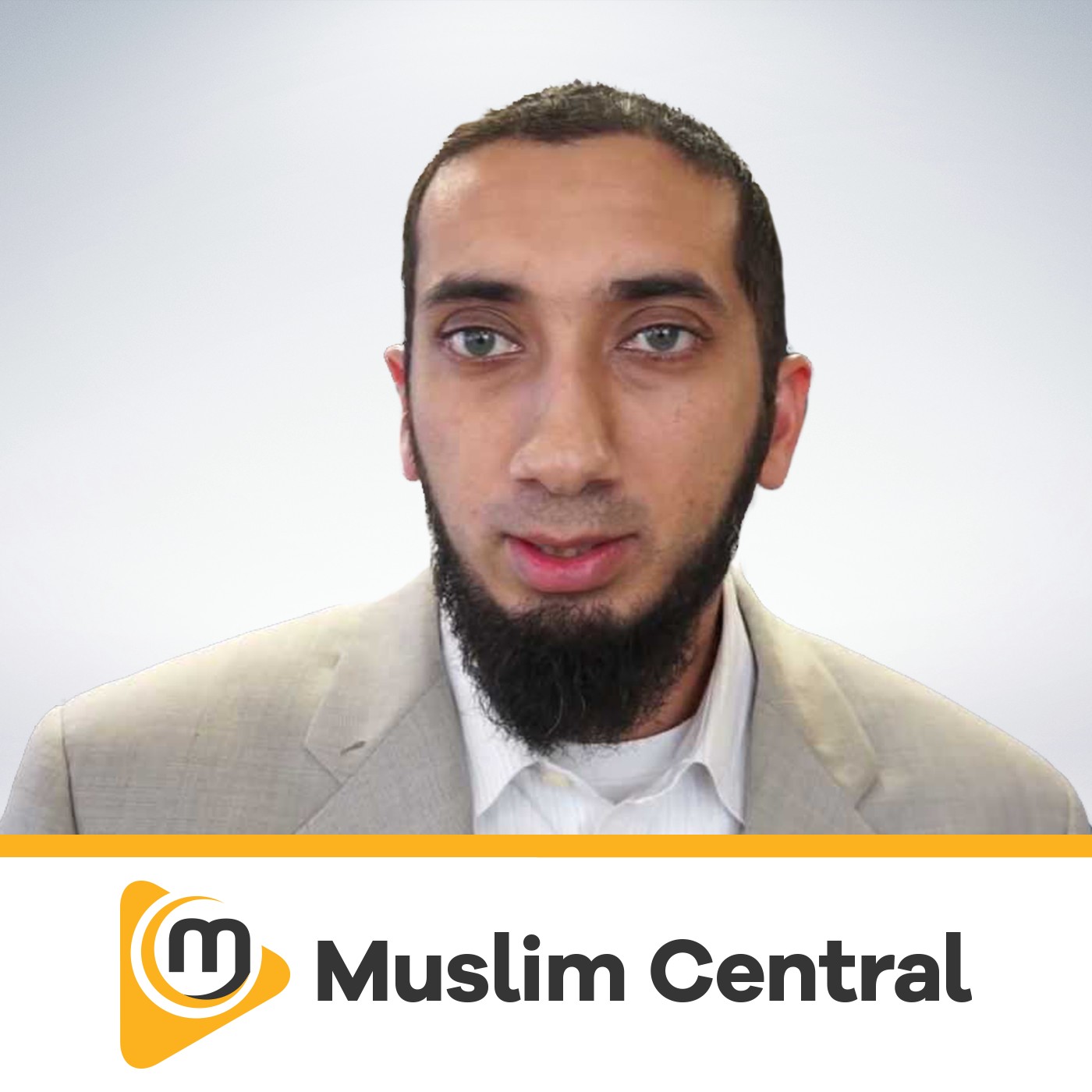
Nouman Ali Khan
Muslim Central
Nouman Ali Khan is the founder and CEO of Bayyinah and serves as a lead instructor for several programs including Dream, traveling seminars and Bayyinah TV. His serious Arabic training began in the U.S. in 1999 under Dr. Abdus-Samie, founder and former principal of Quran College in Faisalabad, Pakistan.
Khan served as a professor of Arabic at Nassau Community College until 2006 when he decided to take Bayyinah on as a full-time project. Since then he has taught more than 10,000 students through traveling seminars and programs. He currently resides in Dallas, Texas and is focusing on teaching his students, developing Arabic curricula and filming material for Bayyinah TV.
Nouman Ali Khan, who was of Pakistani descent and was born in Germany on May 4, 1978, spent his early years in the former East Berlin. Khan attended the Pakistan Embassy school from second through eighth grade while his father was employed by the Pakistani Embassy in Riyadh, Saudi Arabia. Khan was a teenager when his father decided to relocate the family to New York.
Khan served as a professor of Arabic at Nassau Community College until 2006 when he decided to take Bayyinah on as a full-time project. Since then he has taught more than 10,000 students through traveling seminars and programs. He currently resides in Dallas, Texas and is focusing on teaching his students, developing Arabic curricula and filming material for Bayyinah TV.
Nouman Ali Khan, who was of Pakistani descent and was born in Germany on May 4, 1978, spent his early years in the former East Berlin. Khan attended the Pakistan Embassy school from second through eighth grade while his father was employed by the Pakistani Embassy in Riyadh, Saudi Arabia. Khan was a teenager when his father decided to relocate the family to New York.
Episodes
Mentioned books

Feb 11, 2013 • 27min
Dawah And You
Ustadh Nouman Ali Khan revolves his lecture around the idea of presenting the message of Islam and how we must share our responsibility in delivering and sharing that message.
This universal message of submission to Allah and this universal message that Muhammad ﷺ is the last of the Messengers, not that we reject any of them. We accept all of them but we accept him as the final one and the Quran is the final revelation, the final testament, sent to humanity that applies to all human beings.
Some major obstacles lie between us and sharing that message. One of those obstacles that are prominent is how Islam is talked about as something evil and how it is a threat! Islam is being portrayed as something evil, something scary, something alien.
What we learn from the book of Allah and Sunnah of Allah as far as we are dealing with all these accusations that are baseless is that the Muslim Ummah or the Ummah of believers will face trials and they will face troubles. And these trials are there to guarantee us Jannah.
Hence, it is absolutely essential that we become capable of changing our behavior and become better Muslims by keeping ourselves away from evil things and make ourselves truly capable of tawbah to Allah SWT. This will ensure that our Muslim ummah stands up for the message of La ilaha Illaha Muhammadur Rassollullah.
We should also see to it that our children, our families are well versed and knowledgeable with the book of Allah and Rasool Allah ﷺ so that they are capable with the confidence of sharing the beautiful message of Islam with friends and neighbors alike.
Feb 11, 2013 • 34min
Importance Of The Jummah Friday Prayer
Ustadh Nouman Ali Khan delves into the importance of the blessed Jummah prayer.
Surah Al Jumu'ah is the best place to learn the spirit, the wisdom, guidance about the Friday prayer itself. There is one Ayah in the Surah that summarizes the mission of Allah’s Messenger ﷺ and the second Ayah of the Surah is where Allah SWT basically takes the entire mission of the Messenger ﷺ and summarizes it.
What is the purpose of this weekly gathering for the Jummah prayer? What do we wish to do? The big gathering of every week in Jum'ah is the installation of faith in Allah so that we get refreshed with our relationship with the Qur'an. We should cultivate a sense of responsibility that we are supposed to be in appreciation of the Quran. We should strive to get our sins forgiven and to be able to make sincere 'tawbah' to Allah. We should seek to appreciate our time on this earth and not waste it away with things that have no benefit here and no benefit in the next life. We should also indulge in the love of useful activities, useful times spent within the worship of Allah or in learning beneficial things and in sharing beneficial things with one another and making ourselves better people for His sake.
Listen intently to fathom the explanation.
Feb 11, 2013 • 28min
To My Angry Muslim Brother
Ustadh Nouman Ali Khan targets his entire discussion at that young angry Muslim brother of ours who feel that when the Prophet ﷺ is insulted, then he is insulted, and he should do something about that, and his blood boils when the Messenger of Allah ﷺ is spoken of in a way that did not deserve to be spoken of. Even the slightest insult to our Messenger ﷺ is enough to take all the happiness and joy out of his life and makes him forget all of it because his love for him is that intense.
We need to understand that there is something problematic about the way we emotionally respond. Allah says in the Qur'an - “Glory to thy Lord, the Lord of Honour and Power! (He is free) from what they ascribe (to Him)! And Peace on the messengers! (Surah As Saffat :180-181). Allah is the one who said peace upon All of the Messengers.
Thus, the honor of our Messenger ﷺ, the nobility, the respect, the love of our Messenger ﷺ and the status of our Messenger ﷺ is not something we give him. It is not something that comes from human beings. It came from Allah. Nobody on the earth can take it away. The Quran has come from Allah. People can burn copies of it, people can make fun of it, people can make pieces of it; it will not insult the Quran; because the Quran is in Laohe Mahfudh. It can not be insulted. It is above these insults. Our Messenger’s ﷺ honor is above them.
Our job in this world today is to just be ambassadors of this Deen and let people know what Islam is. The real issue isn’t that we love our Messenger ﷺ more. The real issue is we don’t have a fundamental education in our own Deen. We don’t know that our Deen makes us civil, makes us decent, makes us patient, makes us not reactionary, it gives us control over our emotions.
Hence, the need of the hour for that angry Muslim brother of ours is to educate himself, his family and also the entire Ummah in a befitting manner. We should be able to lift the Ummah from the darkness that it suffers from. We should speak the word of truth courageously and be able to engage with each other in civil, respectful disagreement when the time comes.
Feb 11, 2013 • 30min
Yusuf Grief 1
Ustadh Nouman Ali Khan takes us on an emotional rollercoaster ride that revolves around the grief and sadness experienced by Yusuf AS as illustrated beautifully in Surah Yusuf.
When grief presents itself in various forms, it alters the perception of oneself at the same time the perception of our faith in the wake of an intense loss. These feelings have even impacted the Prophets of Allah (AS). We can learn from the life of Prophet Yaqub AS and Prophet Yusuf AS. When Yaqub AS was separated from his son Yusuf AS, he was filled with such deep anguish and grief that his eyes turned white due to excessive crying.
Like most stories from the Quran, there are some important life lessons that stem from Surah Yusuf. This entire Surah is dedicated to a story in a chronological order. Most importantly, it teaches us how to deal with sadness and difficult situations in life. Allah SWT essentially describes two characters who suffer and deal with a lot of grief in their lives: Prophet Yaqub AS and his son, Prophet Yusuf AS. We can apply these examples to our own difficulties. Even the Prophet ﷺ was signaled to seek counsel through Surah Yusuf at the time of his trials and tribulations marked by the Year of Sadness.
Feb 11, 2013 • 42min
Shield Of Honor Ilmnotes
Ustadh Nouman Ali Khan addresses the topic of the hour and a pertinent problem amidst the Muslim youth - a crisis of faith, and a crisis of confidence in the religion. our struggling Muslims friends and family that are Muslim are barely holding on to their faith, and they’re barely holding on to any semblance of Islam in their lives.
How do we solve this predicament? A feasible solution needs to be adopted. There needs to be a kind of mentorship happening at the community level so that our younger boys are spending time with some of the older boys, especially the ones that are mature in their religion and those who have chosen to submit themselves to Islam. Doing this helps us achieve two objectives - it gives young people someone to look up to, and it gives older kids a sense of responsibility. It makes them realize that others have their eyes on them, they have to answer to a higher standard because they set the tone for others.
On a long term basis, we can hope to have forums where our young people can talk about the real questions they have without being afraid of reactions from their parents or their Imam or their scholar, or their speaker. We shouldn’t put them into a position of them feeling intimidated for them to even want to be able to ask a question. We need to create an environment where they feel comfortable enough to be able to ask certain kinds of questions.
Feb 11, 2013 • 1h 2min
Brilliance Of The Book
Ustadh Nouman Ali Khan delves on the amazing features and the brilliance and the inimitable, incomparable beauty of the Qur'an.
There are four categories of the Arabic language - spoken Arabic, proper Arabic, ancient Arabic, and Quranic Arabic. The Quran has this perfected eloquence in ancient Arabic and Quranic Arabic. There’s no poetry like it. There’s no other literature like it.
The Quran doesn’t repeat itself across its coat on coat chapters. Also, the Quran can’t ever be divided. You know why? Because the Quran defies human logic. Are the Madni Surahs or Makkan Surahs first and then the Madni Surahs? Rather, it’s all mixed together. Is the shortest Suran first and then the longest Surah last? Is the longest Surah first and the shortest Surah last? No. It’s doesn't follow the norms of size, subject or chronology. It has its own unique order. It is incomparable, even in its structure. The next discussion is aimed at the word ‘Ayah’. The word ‘Ayah’ is unique. Nothing else has Ayat. only the Quran has Surah and it has Ayat.
The Quran’s message, lessons, wisdom and the Sunnah’s wisdom are timeless. But the Quran’s language and the mode of communication is not timeless. It was revealed at a very particular time with a very particular language.
Feb 11, 2013 • 45min
Darkness To Light Looking At It At A Quranic Perspective
Ustadh Nouman Ali Khan talks beautifully about how the Qur’an talks about the believers being pulled out of the darkness into the light on multiple occasions and the one occasion that he shares with us in this lecture is the Ayat of Ayatul Kursi.
Reciting the Qur’an and listening to the recitation of the Qur’an is not only an act of worship but also benefits our Emaan. Of course, it also fulfills the beautiful Sunnah of the Prophet ﷺ.
‘Ayatul Kursi’ - This grand Aayah of the Qur’an, “Saidatul Ayat Al Qur’an”, the chief Ayah of Qur'an is where Allah describes some of His most fundamental qualities and how Incredible and Awesome He is, how Magnificent He is. That there is no one worthy of worship, only He is, in any shape or form except He is. The Ayah is about darkness and light.
Hence, in our lifetime, we need to confess to Allah what our darknesses are such as laziness, not paying attention in Salah, having filthy habits that nobody knows about, anger, hiding secrets, cheated someone, lied against, etc. we have to admit them to Allah and then ask to pull us out of that darkness. Those who disbelieved and are ungrateful are the same sources of rebellion, then that's the only protection they get from those entities.
Allah brings them out of the light into various shades of darkness. How so? Listen intently to find out.
Feb 11, 2013 • 34min
Islam And Why Muslim Men And Women Can T Be Just Friends
Ustadh Nouman Ali Khan answers the pertinent and the most oft-asked question - Can boys and girls be just friends?
Islam that is based on complete adherence to what God Almighty the Creator wants us to do is the best of defense from many of these evil vices. The interaction between boys and girls must have some guidelines that should be healthy as opposed to unhealthy. There should be guided interactions between brothers and sisters especially young boys and young girls as they are coming up guided by the elders so they would know how to respectfully interact with one another also.
The boys should be trained where to keep their gaze and how to keep the conversation business only and how to ensure that they recognize when they are crossing the line and the elders are supposed to be there to guide those conversations. The interactions between boys and girls gives Shaytan an opportunity who may not convince us the first time but does hammer away until it adds up until it becomes a very big problem.
What young people especially need is to surround themselves with other people that are trying to protect themselves too. They must try to guard their chastity, their dignity, their shame, their religion at the same time. We must pick our friends carefully and picking friends that will safeguard our own Islam.
Feb 11, 2013 • 43min
SurahFatiha Points to Ponder
Ustadh Nouman Ali Khan delves into a brief discussion on the reflections of Surah al Fatihah in the context of the most fundamental aspects of our Deen or a summary of the entire Islam.
He begins by the first three Ayats of the Surah. In them, he first analyses the difference between thanking Allah and praising Allah. The meanings of the word - Hamd are also elaborated upon.
Another wonderful thing about the beginning of Surah Al Fatiha is that the hadith tells us that Allah has 99 names and in Surah al Fatiha we specifically use Allah and there is profound benefit in that the benefit is that if we thank and praise Allah only for being Khaliq then the only thing you are appreciating is that he created, if you thank/praise Him only for being Wise then the only thing you are appreciating is that He is Wise as is the case of the other phrase too. Alhamdulillah covers all. We are also acquainted with the concepts of how we want to be Allah’s slave, and how despite Him being our Master, He is Ar Rahman- the Bestower of Mercy.
The Ustadh also discusses:
The understanding of the verse Sirat Al-Ladhina 'An`amta `Alayhim.
The paths that lead to Allah.
The concept of Hidaya (Guidance).
The reasoning behind a Muslim asking for Hidaya while he has already been guided to the truth.
The different levels of Hidaya
The absolute magnificence of the fact that Allah SWT Himself is responding to us when we recite Surat al-Fatihah in our Salah and the need for us to be in full realization and awareness of it the next time we perform Salah.
Feb 11, 2013 • 45min
Witnesses To Humanity
Ustadh Nouman Ali Khan delves into a deep discussion on what it actually means to be responsible for being witness to Humanity.
In the Qur'an, Surah Al Baqarah, Verses 142 - 143,
“The foolish among the people will say, "What has turned them away from their qiblah, which they used to face?" Say, "To Allah belongs the east and the west. He guides whom He wills to a straight path."And thus we have made you a just community that you will be witnesses over the people and the Messenger will be a witness over you. And We did not make the qiblah which you used to face except that We might make evident who would follow the Messenger from who would turn back on his heels. And indeed, it is difficult except for those whom Allah has guided. And never would Allah have caused you to lose your faith. Indeed Allah is, to the people, Kind and Merciful.”
The Prophet ﷺ had moved to Madinah and now there was a direct interaction with the Christian and Jewish community and in particular the Jewish community. One of the fundamental reason that the Jewish community of Arabia decided to reject Muhammad ﷺ by large is that he did not belong to their family, he was not from the children of Ishaq (AS) but from the children of Ismail (AS) so he was not from the “chosen group”. When Allah Azzawajjal revealed the Quran and he revealed instructions, a lot of instructions were the same which Allah gave to Musa (AS).
Allah SWT exposes in Surah Al Baqarah that there was a knowledgeable group among the Jewish community of Madinah that looked to this Messenger ﷺ and found that every single description that they were given about him in their books, so they came to the conclusion that in fact, this is the Messenger of Allah ﷺ. And at the same time they came to a very strange conclusion also that “no matter what we will not follow him, we will not accept him as a Messenger of Allah”. They actually start blaming Jibreel (AS) saying that he must have gone to the wrong address. so, Allah defends Jibreel (AS) in this Surah.
Now, a new Ummah is being inaugurated by two major things:
The change of the Ka'bah.
The installation of the month of Ramadan.
These two things are identifying us as a distinct new nation completely separate from Bani Israel. How did these two events come into existence? Do listen intently.
What is the meaning that we have become an Ummah and we share this responsibility?
The Messenger delivered the message to us and that message, in summary, is Allah’s book. His life mission was to deliver this book to the best of his ability and he did his job, He finished his job, to represent it’s teaching in our character, not only that but to be closer to Allah.
Two things that will ensure success in this world and the Hereafter:
One thing is the promise of the Messenger ﷺ.
The second thing is the promise of Allah.
First, is the promise of the Messenger ﷺ that occurs in Bukhari -“The expert in the Quran is ranked among the highest angels”.
Allah’s promise to us is said to us three times which is to really be an Ummah is to be united and Allah says “hold on to Allah’s rope tightly”. That rope of Allah is the Quran. The more we are tied to the Quran, the more we are tied to each other and it’s the glue that bonds us.

