

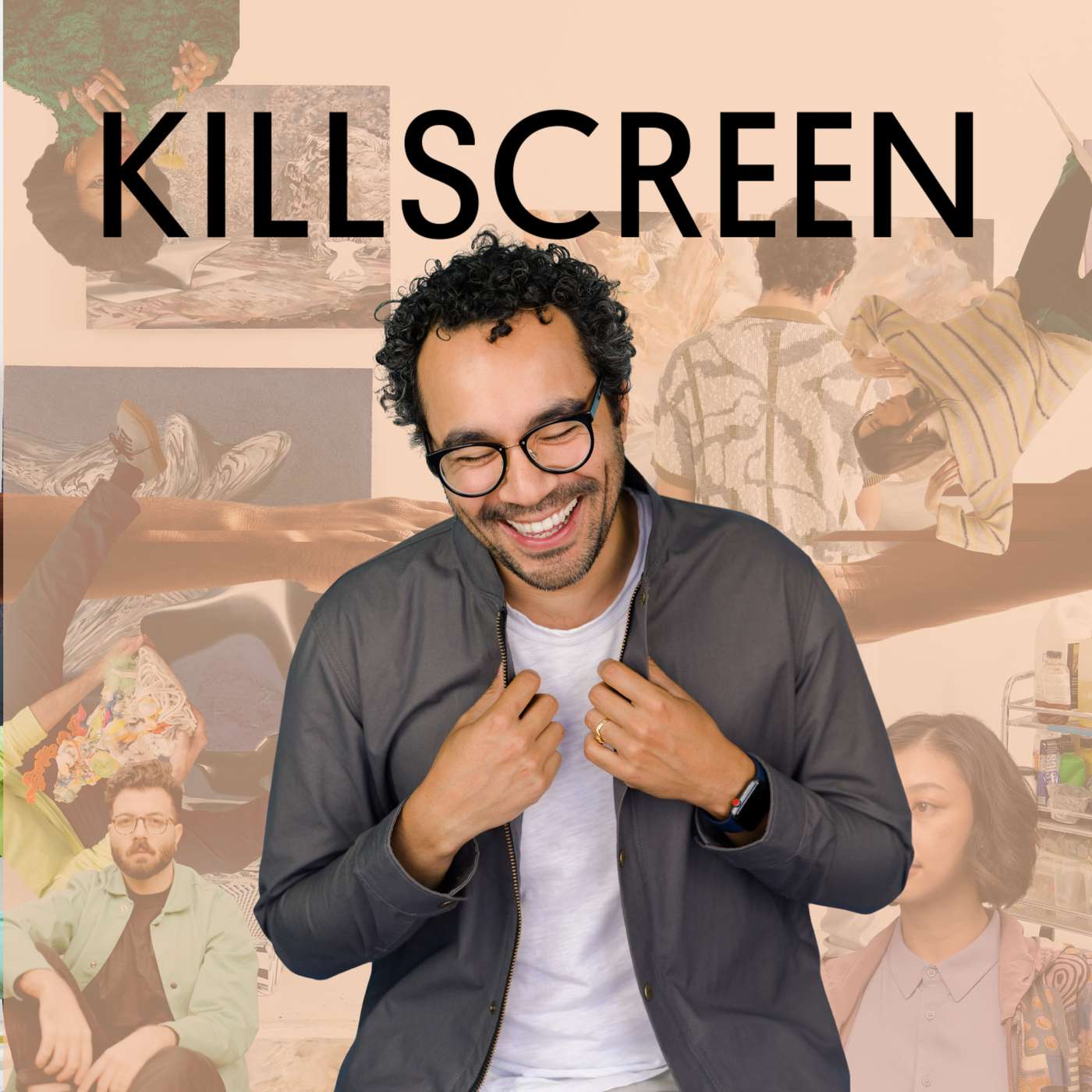
The Killscreen Podcast
Jamin Warren
Jamin Warren founded Killscreen as well as Gameplayarts, an organization dedicated to the education and practice of game-based arts and culture. He has produced events such as the Versions conference for VR arts and creativity, in partnership with NEW INC. Warren also programmed the first Tribeca Games Festival, the groundbreaking Arcade at the Museum of Modern Art, and the Kill Screen Festival, which Mashable called "the TED of videogames." Additionally, he has served as an advisor for the Museum of Modern Art's design department, acted as cluster chair for the Gaming category for the Webbys, and hosted Game/Show for PBS Digital Studios.
Episodes
Mentioned books

Feb 19, 2026 • 42min
What If A Love Eternal's Story Doesn't Explain Itself?
Toby Alden is a game designer and DJ based in Los Angeles. Their platformer Love Eternal — released today — is an eight-year collaboration with their brother Sam that grew from an earlier, near-unbeatable freeware game called Love. In this conversation, Toby talks about making music and games in parallel, the surprising amount of work a single animation frame can do, why they let the story operate on dream logic, and what it feels like to hand a creative problem to someone you trust completely.(00:00) - Does the Story Have to Connect to the Mechanics?
(01:55) - Cave Story, Solo Dev, and the Free-to-Play Asterisk
(05:54) - DJing, Ambient Music, and Scoring Love Eternal with Emily Glass
(15:17) - From Brutal Freeware to Family Drama: Building Love Eternal
(22:58) - Making a Game With Your Brother for Eight Years
(24:16) - Division of Labor and Improvising Scenes Together
(25:21) - Why the Jump Feels Right: Animation, Physics, and Dream Logic
(36:21) - Level Design by Instinct, Portland to LA, and Closing
Hosted by Jamin Warren. Music by Nick Sylvester.Subscribe to Killscreen for unlimited access to Jamin's writing and the archive at killscreen.com, member-exclusive newsletters and events. I love hearing from you! Email your questions and thoughts to info@killscreen.com Please consider supporting independent media!
★ Support this podcast ★
8 snips
Feb 13, 2026 • 58min
He Fed a Classic Anthropology Text To Make An AI Game. Here's What Happened.
Michael Hoffman, a computer scientist-turned-anthropologist at a German supercomputing center, built an "Anthrogame" by feeding Malinowski into LLMs. The conversation explores adapting dense ethnography into interactive fiction. It covers technical choices like retrieval-augmented generation, ethical framing and colonial context, player roles and surprising student playtests, and the limits and promise of AI-made cultural simulations.
Feb 5, 2026 • 53min
Doors That Don't Open: Simon Flesser on Constraint, Preservation, and Northern European Melancholy
Swedish studio Simogo spent their first five years making seven games—Year Walk, Device 6, Sailor's Dream—then two games over the next decade. Their new Legacy Collection preserves that early mobile work by recreating the iPhone itself inside modern platforms, complete with virtual gestures and motion controls. Simon Flesser talks about the decade-long conversation that led to preservation, the difference between remasters and ports, why doors that don't open are more interesting than the rooms behind them, and the specific Northern European melancholy that Americans mistake for horror. We discuss production constraints as creative fuel, the challenge of staying relevant across decades of game-making, and why no one would start a five-year project if they knew it would take five years.(00:00) - Introduction to Digital Preservation
(00:33) - Samo's Legacy Collection and Preservation Challenges
(05:25) - The Philosophy Behind Remasters and Ports
(14:52) - Reflections on Time and Creative Evolution
(28:09) - Production-Driven Game Development
(29:16) - Architectural Influence in Game Design
(35:08) - Intertextuality and Media Inspiration
(44:23) - Creative Community and Future Plans
★ Support this podcast ★

Jan 28, 2026 • 47min
Why This Game About the Haitian Revolution Has No Bullets
Dom Rabrun, a Haitian-American painter and game designer blending Vodou symbolism and Basquiat-influenced art, builds Vèvè-Punk: Mind Singer. He discusses making a Haitian Revolution game with no guns. Conversations cover nonviolent dialogue-driven mechanics, race and status systems, painting as interactive menus, and crafting a new lineage for Black game makers.

Jan 23, 2026 • 15min
Spending the Big Bucks
Big Buck Hunter made a quarter billion dollars by perfecting one thing: the tactile pleasure of pulling a trigger. This arcade shooter stripped hunting down to its essential tension—the moment before you fire, when your heart jumps and your hand trembles—then packaged it for drunk people in Brooklyn bars.We read Jason Fagone's 2010 profile of the game's creator George Petro, who understood that the gun itself had to be an object of desire, calibrated like an iPhone for immediate satisfaction. The piece examines how Buck Hunter became morally complex without trying to be: a game that presents animals as innocent, majestic creatures, then asks you to shoot them anyway while chatting with friends over beer. It's the gap between the act and the environment that creates its under-the-skin power.Fagone traces how an arcade game designed by non-hunters became the most lucrative shooter ever made, not through narrative sophistication but through understanding something older and weirder about human psychology. The sensation of shooting in Buck Hunter feels less like a video game and more like telling someone you love a lie—a tiny thrill followed by mostly subconscious regret, justified and moved past.Originally published in Kill Screen Issue #1, Spring 2010. Get a physical copy if you are so inspired!Music by Shiden Beats Music from PixabaySound Effect by Universfield from PixabaySound Effect by freesound_community from PixabaySound Effect by freesound_community from Pixabay
★ Support this podcast ★

Jan 8, 2026 • 28min
The Dog, The War, & The Souls You Can't Save
War games let you be a hero. Alan Kwan's games make you helpless.In this conversation, we explore Scent—a 20-minute experience where you play a dog witnessing an unnamed war. No shooting. No saving. Just survival, souls, and the anxiety of watching violence you can't stop.Kwan spent seven years developing Scent with no budget, transforming it from a sci-fi project about his father losing vision into a meditation on human brutality from an animal's perspective. The result premiered at Tribeca Festival 2025 and earned an Honorary Mention at Prix Ars Electronica.But Scent is just the latest in a practice that's been questioning gaming's assumptions for over a decade. His previous game The Hallway sits in Hong Kong's M+ Museum permanent collection. Forgetter won multiple awards at international game festivals. His work has been exhibited everywhere from Ars Electronica to the Nam June Paik Art Museum.What we discuss:Growing up in Hong Kong game arcades without actually playing—just watching couples sit in racing games, viewing virtual Tokyo sunsets like they were on datesWhy he moved from filmmaking to experimental games and what cinema taught him about interactive storytellingThe design philosophy of "witness without power"—rejecting superhuman abilities and open worlds for fragile bodies and limited controlHow he creates psychological immersion through grass sounds and spatial audio instead of haptics and high-tech solutionsWorking on rails: why Scent is structured like a long cinematic take where you follow the dog's back through horrorThe philosophy of keeping violence off-screen—learning from Zone of Interest and the power of implied brutalityWhy he calls it an "interactive cinematic experience" more than a game, and what his Steam-native students think about that distinctionTeaching international students at SAIC who come from different gaming cultures—China's lack of console culture versus Western expectationsThe strange ethics of trigger boxes: if you don't start the game, the war won't happenHis interest in cloud streaming to remove Scent from Steam's expectations and make it browser-accessibleWhy short cinematic games should exist as a format—rejecting the assumption that meaningful experiences require 25+ hoursAlan Kwan is an artist working at the intersection of cinema and videogames. Originally from Hong Kong, he holds an MFA from MIT and currently teaches at the School of the Art Institute of Chicago. His experimental games and VR installations have been exhibited internationally and collected by major institutions including M+ Museum. His latest work, Scent, premiered at Tribeca Festival 2025.Mentioned in this episode:Scent (2025) - available at [link]Forgetter (2021) with Allison YangThe Hallway (M+ Museum collection)Bad Trip (2011-12) - his first lifelogging game projectZone of Interest (film)Prix Ars ElectronicaTribeca FestivalSchool of the Art Institute of Chicago (SAIC)Links:Alan's work: https://www.kwanalan.com/Killscreen newsletter: killscreen.com
★ Support this podcast ★
Dec 16, 2025 • 50min
Why should we treat video games as archaeological sites?
What happens when you apply the "steely, assertive mind" of a professional archaeologist to the shifting digital landscapes of video games? In this episode, we sit down with Florence Smith Nicholls to discuss her transition from excavating Bronze Age Greece to conducting the first formal archaeological survey of Elden Ring.We explore the concept of inside-out research —diving deep into the "innards" of a game's server to map player traces—and discuss why the ephemeral nature of digital play requires a new movement called anticipatory archaeology.Key Discussion PointsFrom Fieldwork to Digital Spaces: Florence describes her journey from working on London construction sites as a heritage consultant to discovering the "archaeogaming" community on the Internet.The Elden Ring Survey: A deep dive into Florence’s "laborious" process of mapping the Church of Elleh using the player’s foot as a unit of measurement.Deciphering Player Traces: How bloodstains and messages left by "people who play videogames" serve as digital artifacts of human activity and server algorithms.Generative Archaeology Games: An exploration of procedural generation and games like Blue Prince and Outer Wilds that encourage players to role-play as interpreters of material culture.The Ethics of Recording: Why we must treat the "assemblage of play" (the player, hardware, and software) as a significant cultural form before it disappears into the ether.Mentioned in this EpisodeElden Ring (FromSoftware)Nothing Beside Remains (Florence Smith Nicholls)Blue Prince (Dogubomb)Curse of the Obra Dinn (Lucas Pope)The Assemblage of Play by T.L. TaylorNotable Quotes"I’m fascinated by how players can come up with emergent storytelling... mapping the digital landscape is a way to understand why these experiences were so important to us."Music by Nick Sylvester. Hosted by Jamin Warren.Please consider subscribing for more on the future of games, play, and culture.
★ Support this podcast ★

Aug 8, 2025 • 26min
Silicon Valley in a Sand Trap with Sam Ghantous
The same silica that powers your GPU fills the sand traps at Augusta National. Artist Sam Ghantous joins us to discuss "your golf course made my GPU," his three-channel video installation that traces the geological origins of our digital obsessions.Ghantous admits he's afraid of hardware. Despite this—or because of it—he's spent the past year confronting the physical reality behind our screens. Using Unity and Unreal Engine not to make games but to interrogate them, he reveals how ultra-pure silica mined in North Carolina becomes both microchips and golf course sand. The work forces us to reckon with what he calls the "big sludge of media" that surrounds us—accessible on one hand, black-boxed on the other.We discuss his childhood moving between Oman, the Middle East, and North America, and how this itinerant experience shaped his understanding of sand's perpetual movement. He describes printing UV images onto silicon wafers—the raw material of microchips—creating what he calls "portals" framed by rings of sand scanned in his studio. Behind the cleared dust, ethereal reimaginings of Botticelli paintings emerge.The conversation toggles between pleasure and guilt, much like the two voices in his video work—a synthetic childlike inquisitor and the artist's own voice. We talk about Chinese sand dredgers "editing the map" at planetary scale, golfers trapped in bunkers, and future projects where "Hello World" might take millions of years to print in deep time computing."I'm not standing on some moral high ground," Ghantous tells us. "I'm struggling with the temptations, both for new things and for fascinating things, but also trying not to look at my phone more."Currently teaching at ETH Zürich, Ghantous hints at future works: games affecting one another across distances, sculptures bringing earthliness and computation together, seeking new languages for the consequences of our actions on other parts of the planet.This episode was hosted by Jamin Warren, founder of Killscreen. Music by Nick Sylvester.Thoughts? Guest suggestions? Email us at info@killscreen.com. Killscreen is an arts and culture organization committed to advancing the practice of interdisciplinary play. Founded in 2010, we seek to drive the intersection of design, culture, and impact through cross-disciplinary collaboration to show the world why play matters. We want to break down the barriers that have traditionally segregated play and games from other creative disciplines and foster a diverse community of creators with ambassadorial relationships to the world around us.Sign up for our newsletter.
★ Support this podcast ★

Aug 17, 2023 • 48min
Exploring the material culture of games with metalwork, jewelry, and a little bit of horror
Artist, jeweler, metalsmith, and art conservator Lauren Eckert shows us what it means to look at craftsmanship through a contemporary lens. Drawing from inspiration from the objects in video games, religious iconography, and classic science fiction VFX, Lauren’s work gives metals and jewelry a life on screen—and similarly, digital objects a physical life. Whether through wearable pieces or digital triptychs, Lauren’s projects make a space where past and future, alchemy and technology, collide. We had a great conversation with Lauren back in 2021 and have featured more of her work here.Photography by David Evan McDowell.This episode was hosted by Jamin Warren, founder of Killscreen. Music by Nick Sylvester.Thoughts? Guest suggestions? Email us at info@killscreen.com. Killscreen is an arts and culture organization committed to advancing the practice of interdisciplinary play. Founded in 2010, we seek to drive the intersection of design, culture, and impact through cross-disciplinary collaboration to show the world why play matters. We want to break down the barriers that have traditionally segregated play and games from other creative disciplines and foster a diverse community of creators with ambassadorial relationships to the world around us.Sign up for our newsletter.
★ Support this podcast ★

Apr 21, 2023 • 54min
How to design political games with a broken heart
Can games seep into life's political, social, and cultural realms? Across projects that fuse game development, filmmaking within game engines, LARP (live-action role play), and more, Mario Mu interrogates this question. The Croatian-born artist now lives in Berlin, where he researches games, labor, and memory. After a career illustrating for commercial brands such as Doodle Jump and publishing with Gestalten, Mario continues his independent creative practice, with all projects he thinks of as ‘extended gaming platforms.’In this talk, we spoke with Mario about his design process of games and live-action role-play experiences, how he incorporates research on politics and labor into his creative practice, and how he is shifting from commercial work to personal practice in the fine-art world.This episode was hosted by Jamin Warren, founder of Killscreen. Music by Nick Sylvester.Thoughts? Guest suggestions? Email us at info@killscreen.com. Killscreen is an arts and culture organization committed to advancing the practice of interdisciplinary play. Founded in 2010, we seek to drive the intersection of design, culture, and impact through cross-disciplinary collaboration to show the world why play matters. We want to break down the barriers that have traditionally segregated play and games from other creative disciplines and foster a diverse community of creators with ambassadorial relationships to the world around us.Sign up for our newsletter.
★ Support this podcast ★

