

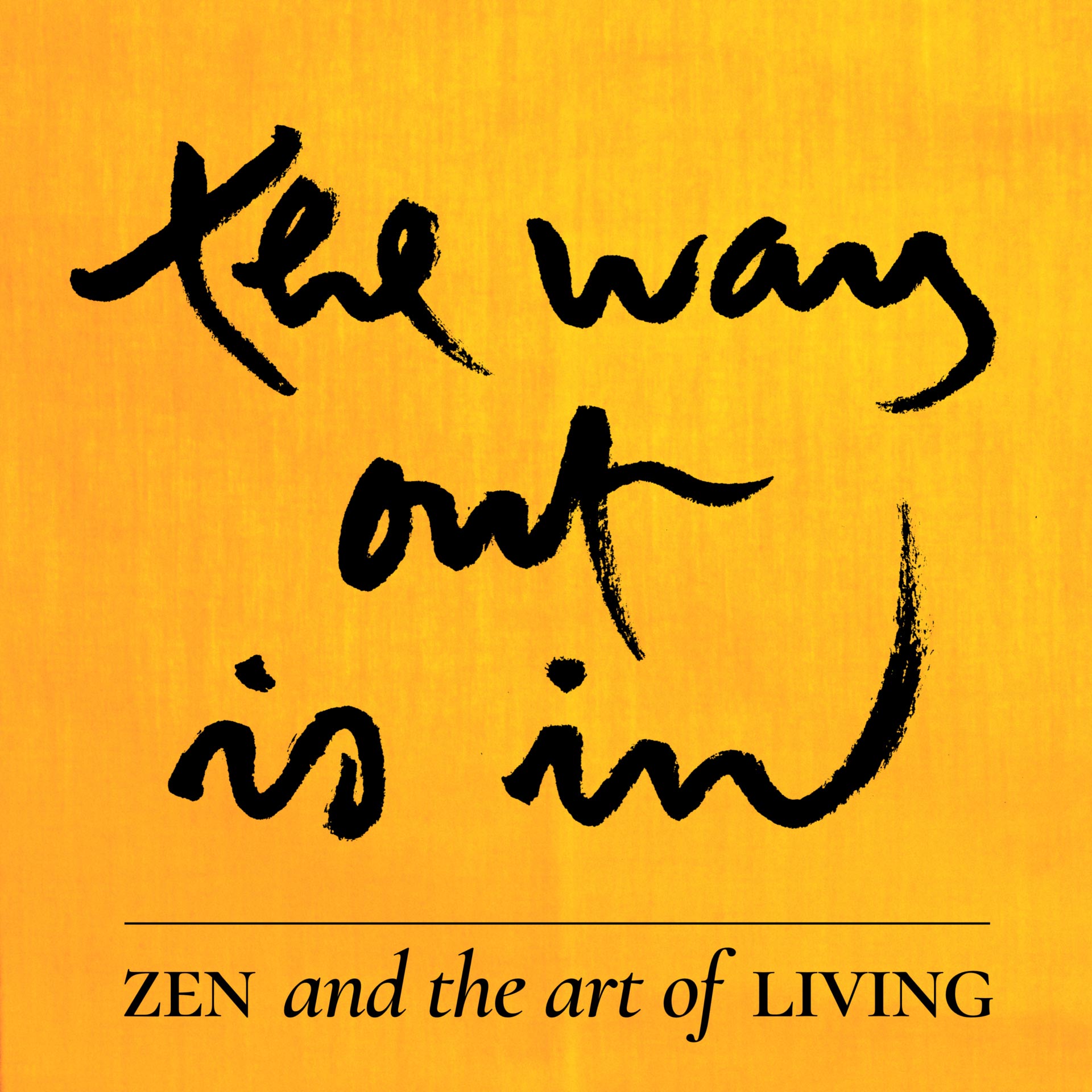
The Way Out Is In
Plum Village
This podcast series is aimed at helping us to transcend our fear and anger so that we can be more engaged in the world in a way that develops love and compassion.
Thich Nhat Hanh’s calligraphy ‘The Way Out Is In” highlights that the way out of any difficulty is to look deeply within, gain insights and then put them into practice.
"The Way Out is In" is co-hosted by Brother Phap Huu, Thich Nhat Hanh's personal attendant for 17 years and the abbot of Plum Village's Upper Hamlet, and Jo Confino, who works at the intersection of personal transformation and systems change.
The podcast is co-produced by the Plum Village App and Global Optimism, with support from the Thich Nhat Hanh Foundation.
Thich Nhat Hanh’s calligraphy ‘The Way Out Is In” highlights that the way out of any difficulty is to look deeply within, gain insights and then put them into practice.
"The Way Out is In" is co-hosted by Brother Phap Huu, Thich Nhat Hanh's personal attendant for 17 years and the abbot of Plum Village's Upper Hamlet, and Jo Confino, who works at the intersection of personal transformation and systems change.
The podcast is co-produced by the Plum Village App and Global Optimism, with support from the Thich Nhat Hanh Foundation.
Episodes
Mentioned books

26 snips
Aug 11, 2022 • 1h 34min
Free from Views in a Polarized World (Episode #36)
Welcome to episode 36 of The Way Out Is In: The Zen Art of Living, a podcast series mirroring Zen Master Thich Nhat Hanh’s deep teachings of Buddhist philosophy: a simple yet profound methodology for dealing with our suffering, and for creating more happiness and joy in our lives.
This time, the presenters, Zen Buddhist monk Brother Phap Huu and journalist Jo Confino, discuss views and perceptions, and how to move beyond them to find deeper meaning and truth in life.
Together, they provide the context for the Buddhist concept of right view, deconstruct ‘view’ and perceptions, including giving examples. They also share zen stories and practices (such as the Five Mindfulness Trainings – with a special focus on the first three) which can help us let go of views that bring suffering, while embracing the ones that can bring happiness.
Brother Phap Huu explains the Buddhist perception of view and the updated Fourteen Mindfulness Trainings for monastic and lay practitioners. He further discusses fanaticism; “seeing the world beyond our world”; the practice of compassionate listening and deep looking; true communication; freedom of thought and openness to learning; and collective awakening. And what is it about aligning with a particular viewpoint that makes people feel safe and secure?Jo delves into the “terror of nothingness”; the sacred nature of things, and the fear of the sacred; the importance of connecting with and understanding our roots; holding more than one truth; and the accumulation of intellectual knowledge.
The episode ends with a short meditation guided by Brother Phap Huu.
Co-produced by the Plum Village App:https://plumvillage.app/
And Global Optimism:https://globaloptimism.com/
With support from the Thich Nhat Hanh Foundation:https://thichnhathanhfoundation.org/
List of resourcesDharma Talks: ‘The Noble Eightfold Path’https://plumvillage.org/library/dharma-talks/the-noble-eightfold-path/Dharma Talks: ‘The Ground of Right View’https://plumvillage.org/library/dharma-talks/the-ground-of-right-view/
Sister Chan Khonghttps://plumvillage.org/about/sister-chan-khong/
The Beginner’s Mindhttps://en.wikipedia.org/wiki/Shoshin
The Fourteen Mindfulness Trainingshttps://plumvillage.org/mindfulness/the-14-mindfulness-trainings/
Mahāyānahttps://en.wikipedia.org/wiki/Mahayana
Buddhahoodhttps://en.wikipedia.org/wiki/Buddhahood
Leaders’ Questhttps://leadersquest.org/
Lindsay Levinhttps://leadersquest.org/who-we-are/people/lindsay-levin/
Dharma Talks: ‘The Three Doors of Liberation or the Three Dharma Seals’https://plumvillage.org/library/dharma-talks/the-three-doors-of-liberation-or-the-three-dharma-seals-sr-chan-duc-italian-retreat-2018-05-04/
Old Path White Cloudshttps://plumvillage.org/books/old-path-white-clouds-2/
Dharma Talks: ‘The Four Immeasurable Minds – The Four Elements of True Love’https://plumvillage.org/library/dharma-talks/the-four-immeasurable-minds-the-four-elements-of-true-love-sr-dieu-nghiem-sr-jina-2018-07-26/
Quotes
“The Buddha once said that 95% of our perceptions are wrong; we are so quick in our judgment that we see things as we want to, but not as they are.”
“Thay said, ‘I would never want to bring my students, my children, to a place where there is no suffering. In such a place, my children would never have an opportunity to grow, because they will not learn from suffering. And we know that life has a lot of teachings, and suffering is one of the teachings.’”
“Thay had told us a mantra should be, ‘You are partially right.’”
“We have to experience everything in life, not in concept.”
“Freedom of thought: aware of the suffering brought about when we impose our views on others, we are determined not to force others – even our children – by any means whatsoever, such as authority, threat, money, propaganda, or indoctrination to adopt our views. We are committed to respecting the rights of others to be different, to choose what to believe and how to decide. We will, however, learn to help others let go and transform fanaticism and narrowness, through loving speech and compassionate dialog.”
“Embrace your view, give it space, allow it to be, but don’t feed it. Don’t feed it and give it extra food, but question it and challenge it.”
“I always remember the Dalai Lama saying, ‘If you have a spiritual epiphany, let it go, because a spiritual epiphany can be an imprisonment that you spend your life going back to. And that’s where you get stuck.’”
“I wish everybody had the conditions to see the world beyond their world. When we are so attached to our views, it is because we haven’t yet allowed ourselves to be open.”
“One time, someone asked Thay, ‘What would you choose, Buddhism or peace?’ And he said, ‘Of course, peace. Because the essence of Buddhism is to have inner peace and outer peace. I’m ready to let go of Buddhism. If peace is there, then Buddhism is not needed, because Buddhism is also just a view.’”
“Thay was very, very clear that if you come to Plum Village and you become interested in Buddhist teachings and practices, do not let go of your own religious or spiritual traditions. Buddhism doesn’t [need to] take over from that; it can add something. But he has constantly talked about the importance of connecting to your own roots, of being aware of your own roots, of not distancing yourself. Because our roots are important and they help us to understand ourselves, they help us to understand what our views are. Even if they are views that we want to let go of, we can only understand them in the context of our past.”
“There is no one truth; there are many truths.”
“Aware of the suffering created by attachment to views and wrong perceptions, we are determined to avoid being narrow-minded and bound to present views. We are committed to learning and practicing non-attachment to views and being open to others’ experiences and insights, in order to benefit from collective wisdom. We are aware that the knowledge we presently possess is not changeless, absolute truth. Insight is revealed through the practice of compassionate listening, deep looking, and letting go of notions, rather than through the accumulation of intellectual knowledge. Truth is found in life, and we will observe life within and around us in every moment, ready to learn throughout our lives.”
“Life is always changing. Are we the same as we were yesterday, or different? The answer is, we are neither the same nor different, because we are always changing. We are the present moment, but we are also of the past, because everything that we have experienced is here. But we are not just that past, because we’re living in this moment, which we are organically changing.”
“The raft is not the shore. When you arrive at the shore, the shore which resembles liberation, we have to let go of the raft.”
“If people are not deeply listening to each other, not incorporating ideas, not seeing a constellation or system of change, then actually people are just defending themselves.”
“When we want to teach something, we have to learn to walk the talk.”
18 snips
Aug 4, 2022 • 1h 46min
No Way to Happiness; Happiness Is the Way (Episode #35)
Welcome to episode 35 of The Way Out Is In: The Zen Art of Living, a podcast series mirroring Zen Master Thich Nhat Hanh’s deep teachings of Buddhist philosophy: a simple yet profound methodology for dealing with our suffering, and for creating more happiness and joy in our lives.This time, the presenters, Zen Buddhist monk Brother Phap Huu and journalist Jo Confino, discuss the art of happiness according to the sutras from the Buddha’s time. Their conversation explores the many layers of the Discourse on Happiness, each of the 11 causes of ‘the greatest happiness’, as shared by the Buddha, and how these ancient texts help us create the conditions in which our own happiness can ripen today. Both Brother Phap Huu and Jo dig deeply into their own private and professional lives to exemplify and support these subjects; from ‘living our values’ and the Four Gratitudes to the power of the sangha, meaning and purpose, generosity, forgiveness, Thay’s memorable calligraphies, and many other topics.
The episode ends with a short meditation guided by Brother Phap Huu.
Co-produced by the Plum Village App:https://plumvillage.app/
And Global Optimism:https://globaloptimism.com/
With support from the Thich Nhat Hanh Foundation:https://thichnhathanhfoundation.org/
List of resources
Sutras: ‘Discourse on Happiness’https://plumvillage.org/library/sutras/discourse-on-happiness/
Tathāgatahttps://en.wikipedia.org/wiki/Tath%C4%81gata
Devahttps://en.wikipedia.org/wiki/Deva_(Buddhism)
Buddhahoodhttps://en.wikipedia.org/wiki/BuddhahoodSutras: ‘Discourse on the 5 Ways of Putting an End to Anger’https://plumvillage.org/library/sutras/discourse-on-the-five-ways-of-putting-an-end-to-anger/
‘The Order of Interbeing’https://plumvillage.org/community/order-of-interbeing/
‘The Five Mindfulness Trainings’https://plumvillage.org/mindfulness/the-5-mindfulness-trainings/
‘Dharma Sharing’https://plumvillage.org/mindfulness/extended-practises/
TWOII: ‘Engaged Buddhism: Applying the Teachings in Our Present Moment (Episode #9)’https://plumvillage.org/podcast/engaged-buddhism-applying-the-teachings-in-our-present-moment/
The Four Noble Truthshttps://www.youtube.com/watch?v=dy-RI3FrdGA
Tếthttps://en.wikipedia.org/wiki/T%E1%BA%BFt
Quotes
“There is no way to happiness; happiness is the way.”
“Thay said that happiness is not outside of you, happiness is in you and around you already. It’s whether we have the mindfulness to recognize the wonderful conditions that are there. And so, if we change our perceptions, we start to see that happiness is the way. Just being is the way. And so we can free ourselves from the habit of running after happiness.”
“Not to be associated with the foolish ones, but to live in the company of wise people, honoring those who are worth honoring – this is the greatest happiness.”
“[Thay suggested sometimes calling] a good friend, a soulmate, someone who understands you, someone who helps you see your shortcomings, and has the courage and the intention to share with you your own ignorance, so that you can grow from it. That is happiness.”
“To live in a good environment, to have planted good seeds, and to realize you are on the right path – this is the greatest happiness.”
“The environment is not outside of you; you are the environment.”
“Every thought is planting a seed. Every idea I conjure up in my mind is planting a seed. Everything I say is planting a seed. Everything I do is planting a seed. And I think people tend not to see the full nature of what it is to plant seeds; that, actually, there’s nothing neutral [about it].”
“To have a chance to learn and grow, to be skillful in your professional craft, practicing the precepts and loving speech – this is the greatest happiness.”
“To live honestly, generous and giving, to offer support to relatives and friends living a life of blameless conduct – this is the greatest happiness.”
“Most of the time, we make ourselves very busy and we think we love and we define love as always giving each other presents. But love is to give each other presence, our true presence, our heart, our ears, our eyes: ‘I see you for who you are. I’m here to listen to you.’”
“Being honest means never having to remember what you said.”
“To avoid unwholesome actions, not to be caught by alcoholism or drugs, and to be diligent in doing good things. This is the greatest happiness.”
“To be humble and polite in manner, to be grateful and content with a simple life, not missing the occasion to learn the dharma – this is the greatest happiness.”
“Be grateful and content with a simple life. That always brings me to one of Thay’s calligraphies: ‘You have enough.’ That line tells us to continue to learn to have moderation. We are a species with a lot of greed; we take more than we need. We see things as just things, so we keep taking and taking and taking. But what we have learned in our times is that everything is interrelated; that’s why we are in the state that we are in. And that’s why we need this collective awakening. Simple life should be the new culture.”
“To be humble is to be free, because as soon as we believe we’re something more than ourselves, it’s a shaky superstructure. To keep it going, we have to keep feeding it, and building it, and protecting it. And, again, it feeds into that egoic mask. Actually, we just lose ourselves. And the more we lose ourselves, the harder it is to come back to ourselves, because the distance becomes so great.”
“Practicing Buddhism is not to escape this world, but to be more alive in it.”
63 snips
Jul 28, 2022 • 1h 21min
Pathways through Busyness, Overwhelm and Burnout (Episode #34)
Welcome to episode 34 of The Way Out Is In: The Zen Art of Living, a podcast series mirroring Zen Master Thich Nhat Hanh’s deep teachings of Buddhist philosophy: a simple yet profound methodology for dealing with our suffering, and for creating more happiness and joy in our lives.This time, the presenters, Zen Buddhist monk Brother Phap Huu and journalist Jo Confino, talk about the modern diseases of busyness, overwhelm, and burnout, and how Zen Buddhist practices and Thich Nhat Hanh’s teachings can help us regain our balance.
Brother Phap Huu shares his thoughts on busyness in a monastic environment; coming home to ourselves and learning to stop in the midst of crises; the four elements (the practice, the study, the service, the joy); the noble silence practice in a retreat, and becoming one with the silence; learning to stop and listen to ourselves; the practice of deep belly breathing; impermanence. And do you know how the Zen Master himself would face up and deal with overwhelm?Jo shares his thoughts on the Climate Leaders retreat and makes a case for an “age of community.” He further reflects on allowing vulnerability in our overwhelm and busyness; compassion for ourselves; selfishness and selflessness; simplicity in the practice; guilt.
The episode ends with a short meditation guided by Brother Phap Huu.
Co-produced by the Plum Village App:https://plumvillage.app/
And Global Optimism:https://globaloptimism.com/
With support from the Thich Nhat Hanh Foundation:https://thichnhathanhfoundation.org/
List of resources
‘Wake Up Humanity 2022’ retreathttps://plumvillage.org/retreats/info/international-wake-up-retreat-2022/
Plum Village Retreats Calendarhttps://plumvillage.org/retreats/retreats-calendar/
Five Skandhashttps://encyclopediaofbuddhism.org/wiki/Five_skandhas
Dharma Talks: ‘The Five Skandhas of Grasping and Non-Self’https://plumvillage.org/library/dharma-talks/the-five-skandhas-of-grasping-and-non-self%e2%80%8b-dharma-talk-by-br-phap-lai-2018-06-08/
Songs: ‘The 16 Exercises of Mindful Breathing’ https://plumvillage.org/library/songs/the-16-exercises-of-mindful-breathing/
‘Connecting to Our Root Teacher, the Buddha’https://plumvillage.org/about/thich-nhat-hanh/letters/connecting-to-our-root-teacher-a-letter-from-thay-27-sept-2014/
Thay’s Poetry: ‘Please Call Me by My True Names’ (song & poem)https://plumvillage.org/articles/please-call-me-by-my-true-names-song-poem/
‘The Toadskin Hut and Paths of Legend’https://plumvillage.org/about/thich-nhat-hanh/letters/the-toadskin-hut-and-paths-of-legend/
Quotes
“Mindfulness means to be aware of what is happening in the here and now. And when we associate to this practice, a lot of the habits that we have as a practitioner, especially practitioners, we want to feel the good sensation more than the negative. But here, in the spirit of Buddhism, the teachings of the Buddha, when we speak about mindfulness, it is to embrace everything that is happening.”
“A lot of monks in this time, and generations before us, have Zen gardens. They have gardens that they would take care of because that is also a way of directing energy, so overwhelming is an energy. So our practice is learning to identify the energy and directing that energy so that it can bring us back to balance.”
“What I think is core to Buddhist practice is that we can only be useful in the world if we’re in balance ourselves. And it’s not selfish to look after yourself, it’s actually selfless because it’s only when our bowl is full and overflowing that we’re able to naturally give to other people. And when our bowl is empty, actually we’ve got nothing to give.”
“When you come to our practice in the retreats, this is the first thing we teach everyone: learning to stop. That’s why these bells in the monastery are so important. We have this aspiration to stop, but our habit, our ancestral habit, our habit from society is so strong in us that we feel like we have to do something.”
“Learn to listen to yourself.”
“Don’t wait for life to be difficult to start practising, but learn to practise in the good times so that when a difficult time comes, we’ve already built that into our system. Because a lot of people think, ‘Oh, well, life is fine. Why do I need to be mindful? Why do I do this? Because everything’s good.’ But it’s when we have space in the good times to focus and to understand how our mind works, how our body works, how we can reflect on ourselves, that in the moments where things get very tough and we lose that space, that we already know how to act. And I think a lot of people feel that they can just do this when times are bad.”
“Coming home to oneself is the beginning of transformation, because when we have the capacity to come home, that’s when we can work on oneself.”
“We want to create sustainability outside, but we have to create sustainability inside also.”
“When you come home to yourself, this is transformation at the base.”
“An important aspect of dealing with overwhelm is to be vulnerable with it, because often we feel that to cope we have to close down, and we have to protect ourselves. Whereas, more than often, the truth is we open up, we share, we are present, we show our weaknesses, we show our scars. And that gives other people permission to do the same.”
“I think so much of dealing with overwhelm, dealing with busyness is to be vulnerable in it. Because if we all feel alone and none of us are sharing about it, then all we’re doing is exacerbating it. We’re not letting anyone offer their support. No one can offer their care because we’ve closed the door.”
“Man is not our enemy. It is ignorance.”
Jun 30, 2022 • 1h 51min
Beyond Words: The Power of Presence (Episode #33)
Welcome to episode 33 of The Way Out Is In: The Zen Art of Living, a podcast series mirroring Zen Master Thich Nhat Hanh’s deep teachings of Buddhist philosophy: a simple yet profound methodology for dealing with our suffering, and for creating more happiness and joy in our lives.
This time, the presenters – Zen Buddhist monk Brother Phap Huu and journalist Jo Confino – are joined by Zen Buddhist nun Sister Dinh Nghiem; together, they discuss Thich Nhat Hanh’s years following his stroke in 2014, its impact on the community of monastics, and the Zen master’s powerful presence beyond words.
In this intimate and moving episode, the two monastics – both former attendants of Thich Nhat Hanh – recollect stories from the period of Thay’s illness: from overcoming his coma to the lessons the Zen master continued to share with the sangha from his hospital bed, and later, from the ‘root temple’ Tu Hieu in Hue, Vietnam, where he continued to be a great teacher even without the ability to speak. They also address the way the sangha became Thay’s continuation, both before and after his passing in 2022; the power of presence in challenging circumstances; transmission without words; clarity; acceptance; death; and support.
Sister Dinh Nghiem (Sister Concentration) was ordained in 1993, when she was 24 years old. In 2000, she became the first abbess of the New Hamlet in Plum Village (and remains the youngest ordained to date). She was also one of the monastics who attended Thich Nhat Hanh during the five and a half years after his stroke and until his passing.
In this episode, she talks about her decision to become a nun, and spending her life with the practice; dealing with her father’s death and the deep teachings of ‘no birth, no death’; the guidance Thich Nhat Hanh gave her during his illness; and the Zen master’s final days.
Co-produced by the Plum Village App:https://plumvillage.app/
And Global Optimism:https://globaloptimism.com/
With support from the Thich Nhat Hanh Foundation:https://thichnhathanhfoundation.org/
List of resources
Old Path, White Clouds: Walking in the Footsteps of the Buddhahttps://www.parallax.org/product/old-path-white-clouds-walking-in-the-footsteps-of-the-buddha/Sister Chan Khonghttps://plumvillage.org/about/sister-chan-khong/‘Thich Nhat Hanh Returns Home’https://plumvillage.org/about/thich-nhat-hanh/thich-nhat-hanhs-health/thich-nhat-hanh-returns-to-vietnam/
Plum Village Thailandhttps://plumvillage.org/practice-centre/plum-village-thailand/
The Way Out Is In: ‘“Arrived, Home”: The First Plum Village Dharma Seal (40 Years Retreat #2)’https://plumvillage.org/library/dharma-talks/arrived-home-the-first-plum-village-dharma-seal-40-years-retreat-2/
‘Parallel Verses – Continuing Thay in the Lunar New Year (Tet)’https://plumvillage.org/articles/harmony-at-home-peace-all-around/
Quotes
“You may have [achieved] some awakening, but you need to maintain this concentration in your daily life so that this insight sinks deep into the body, your deep consciousness.”
“When there is chaos, we have to be centered so that we all have clarity.”
“We recognized that his [Thay’s] breathing was incredible. It’s like the stored consciousness of 80-something years of practicing went into autopilot and Thay’s mindfulness was a continuing stream of practice.”
“I need to continue to invest in this dharma because in the most critical moment, ‘What is your best friend?’ – it’s your breathing.”
“I was told that one of the doctors or nurses came to see about Thay’s oxygen level in his blood and was looking at the machine and kept on tapping it. And eventually one of the monastics said, ‘What’s the problem?’ They replied, ‘Well, this must be wrong because it’s showing 95%’ – or whatever – ‘oxygen level. And someone in this condition, it normally goes down to 70 or 75.’ And you’re just thinking, ‘Well, that’s obvious, because Thay’s one of the best breathers in the world.’”
“Thay made them practice mindfulness and concentration being 100% present. Thay didn’t need to say anything. It was transmission from heart to heart, not through words.”
“When we don’t use the words, we use energy and we are more sensitive with energy – the other person’s as well as our own.”
“Thay has finessed and deepened and focused and taken the time and energy to show what’s possible for us. So what I’m hearing is an invitation to us all – not to be like Thay, but to show that if we are able to be attentive, to be mindful, to be ourselves, to come back to ourselves in the present moment, then we can taste that aspect of Thay.”
“The joy of meditation is daily food.”
Jun 16, 2022 • 56min
Falling Back in Love with Mother Earth: In Conversation with Thich Nhat Hahn (Episode #32)
Welcome to episode 32 of The Way Out Is In: The Zen Art of Living, a podcast series mirroring Zen Master Thich Nhat Hanh’s deep teachings of Buddhist philosophy: a simple yet profound methodology for dealing with our suffering, and for creating more happiness and joy in our lives.
This bonus episode showcases an interview between Zen Master Thich Nhat Hanh and journalist Jo Confino from before Christmas 2011, during the winter retreat in Plum Village. It begins with a short introduction by Jo and Zen Buddhist monk Brother Phap Huu.
This is a conversation about our relationship with Mother Earth, the need to move beyond the idea of ‘environment’, and falling back in love with our life-giving planet.
Thich Nhat Hanh talks about the ‘Buddha nature’; the Earth as a Bodhisattva; meditation as active awakening, and practical ways to bring about a collective awakening; the need for a cosmic religion not based on Dharma or belief; producing our own right view; dogmatism as a cause for separation and war; the most necessary teachings for our times; mindful and compassionate business; transforming suffering; collective awakening; and connecting to the Earth through mindfulness. Thay also further develops on his interest in science, and the benefits of a retreat for mindfulness practitioners and scientists.
The interview also includes important advice to help activists maintain their motivation and peace amid chaos, and how to suffer less in order to help more.
Co-produced by the Plum Village App:https://plumvillage.app/
And Global Optimism:https://globaloptimism.com/
With support from the Thich Nhat Hanh Foundation:https://thichnhathanhfoundation.org/
List of resourcesLove Letter to the Earthhttps://www.parallax.org/product/love-letter-to-the-earth/
Antoine Lavoisierhttps://en.wikipedia.org/wiki/Antoine_Lavoisier
Paul Tillichhttps://en.wikipedia.org/wiki/Paul_Tillich
Bodhisattvahttps://en.wikipedia.org/wiki/Bodhisattva
Shakyamuni Buddhahttps://en.wikipedia.org/wiki/Gautama_Buddha
Journalist Jo Confino Interviews Thich Nhat Hanh: Falling Back in Love with Mother Earthhttps://www.youtube.com/watch?v=X-TZlJW2FEs
‘Beyond Environment: Falling Back in Love with Mother Earth’https://www.theguardian.com/sustainable-business/zen-thich-naht-hanh-buddhidm-business-values
Dharma Talks: ‘The Ground of Right View’https://plumvillage.org/library/dharma-talks/the-ground-of-right-view-2/
Quotes
“If you look into the Milky Way, we see that there are millions of stars and each star can be a Buddha, like the sun above us is the real Buddha, a Buddha that can provide light and warmth, a Buddha that can offer life. So it is possible for us to conceive Buddha [as] not [being] in the form of a person.”
“If you look around deeply, you realize that there isn’t anything as beautiful as our planet Earth. And that is why we should not try to abandon this beautiful planet, searching for something far away – whether that is called Pure Land, the Kingdom of God, or anything. And if we gain that insight, we see that the Earth is not only the environment; everything is us, and by taking care of the Earth we take care of ourselves.”
“In Buddhism, we speak of meditation as an active awakening. To awake is to be awake to something. To be awake to the fact that the Earth is in danger and living species on Earth are also in danger. And that should be a collective awakening, in order to have enough strength for a change.”
“Scientists are motivated by a desire to understand better, and Buddhist practitioners are also motivated by that kind of desire. But, in Buddhism, we keep in mind that understanding could help us suffer less. Any kind of understanding, true understanding, will help us suffer less. And the Buddhist tradition has elaborated ways of practicing in order to help people to suffer less. And in the process, they have found out many things about themselves and the world. They don’t use the scientific method, but they have a lot of insight and a lot of experiences. And I think they can share it with other people, including scientists.”
“There are plenty of us who are activists, who are eager to do something. And we should go this way: we should begin with ourselves. We should begin with removing our wrong views, so that we can suffer less. And when we suffer less, we can be more helpful. We can help people to change.”
“If you transcend the notion of birth and death, you are able to transcend the notion of being and non-being. And you know that to be or not to be, that’s no longer the question.”
“When I drink tea, this is a wonderful moment. You do not need a lot of power or fame or money to be happy. Mindfulness can help you to be happy in the here and now; every moment can be a happy moment. Set an example and help people to do the same. Take a few minutes to experiment to see the truth.”
“The Earth cannot be described either by the notion of matter or mind, which are just ideas, two faces of the same reality. That pine tree is not just matter, as it possesses a sense of knowing. A dust particle is not just matter since each of its atoms has intelligence and is a living reality.”
“When we recognise the virtues, the talent, the beauty of Mother Earth, something is born in us; some kind of connection, of love is born.
“We want to be connected. That is the meaning of love: to be at one. When you love someone, you want to say, ‘I need you, I take refuge in you.’ You do anything for the benefit of the Earth and the Earth will do anything for your wellbeing.”
Jun 2, 2022 • 1h 33min
True Love: Practicing in Relationship (Episode #31)
Welcome to episode 31 of The Way Out Is In: The Zen Art of Living, a podcast series mirroring Zen Master Thich Nhat Hanh’s deep teachings of Buddhist philosophy: a simple yet profound methodology for dealing with our suffering, and for creating more happiness and joy in our lives.
The presenters – Zen Buddhist monk Brother Phap Huu and journalist Jo Confino – are joined by lay Buddhist practitioner and artist Paz Perlman to talk about how mindfulness can support a healthy relationship: a core practice in Engaged Buddhism.
Paz Perlman is a Zen Buddhist practitioner and a visual artist, who regularly exhibits in the United States and Europe. She has studied with Thich Nhat Hanh for the past 15 years and is a member of the Order of Interbeing. In her artistic practice, she integrates Buddhist concepts such as impermanence, healing and transformation. In recent years, she has increasingly incorporated activism into her works and is presenting a large-scale installation at an upcoming retreat of climate leaders in Plum Village. Paz, who moved from New York to live a few minutes walk away from Plum Village, completed her art degree at Central St Martins, University of Arts, London. Read her artist statement here.
Paz and Jo have been married for 15 years; in this episode, they talk about how making the Buddhist practice of Beginning Anew part of their daily life has nourished their relationship. This practice of looking deeply and honestly at ourselves, our actions, speech, and thoughts, creates a fresh beginning within ourselves and in our relationships with others.The couple further share about discovering Thich Nhat Hanh’s teachings and integrating them into their life together; developing a shared spiritual aspiration and practice; their special marriage ceremony in Plum Village, including vows, and tea with Thay; relationship dynamics; maintenance and renewal; deep listening and loving speech; intimacy; and the four essential mantras in the practice. Brother Phap Huu discusses the same Buddhist practice, but in relation to a monastic environment; the four mantras to take care of relationships; the insight of interbeing; perceptions about others; mental formations; hugging meditation; and the energy of gratitude.
The episode ends with a short meditation guided by Brother Phap Huu.
Co-produced by the Plum Village App:https://plumvillage.app/
And Global Optimism:https://globaloptimism.com/
With support from the Thich Nhat Hanh Foundation:https://thichnhathanhfoundation.org/
List of resourcesPlum Village Communityhttps://plumvillage.org/
Paz Perlmanhttps://www.pazperlman.com/
Beginning Anew: Four Steps to Restoring Communicationhttps://www.parallax.org/product/beginning-anew-four-steps-to-restoring-communication/
‘Extended Practices’https://plumvillage.org/mindfulness/extended-practises/
Sister Chan Khonghttps://plumvillage.org/about/sister-chan-khong/
Sister Jinahttps://plumvillage.org/people/dharma-teachers/sr-dieu-nghiem/
The Four Noble Truthshttps://www.youtube.com/watch?v=dy-RI3FrdGA
Deepak Choprahttps://en.wikipedia.org/wiki/Deepak_Chopra
Thich Nhat Hanh On…: ‘Learning to Hug’https://plumvillage.org/articles/learning-to-hug/
Dharma Talks: ‘The Practice of True Presence’https://plumvillage.org/library/dharma-talks/the-practice-of-true-presence/
How To: ‘Begin Anew’https://plumvillage.org/articles/begin-anew/
Quotes
“Taste of tea, taste of time.”
“Thay talks about what happens in relationships. A lot of little things can happen that annoy or cause offense, or which on their own aren’t very big – and often, as a result, don’t get dealt with. And so he talks about a stalagmite in a cave where there’s a small, small drip of little things – but those small drips eventually create a huge calcified monolith. And that if you don’t address things when they arise, then they get buried and can turn into resentment and into anger.”
“Love is a wonderful thing, but at the same time it doesn’t survive on its own unless you look after it.”
“Thay’s practice is actually a masterstroke. When people talk about problems, their relationship, and we talk about the Beginning Anew practice that Thay developed, a lot of them who have tried it say it has really, really helped them. And this is a core part of Thay’s teachings: that he has the deep insights that lead to practical application. And that one practice has been instrumental in us maintaining a healthy, vibrant, and happy relationship.”
“Practices create spaciousness and trust.”
“I had been involved in personal development for many, many years, and when I came across Thay’s teachings, what came to me so quickly was just how gentle and deep they are. Because, in my early life, I’d been doing much more wrestling, mental and emotional wrestling, with issues in my life – which had its place at that age. But then I got to the stage where I realized that I needed something much more gentle, something that I could rest in rather than fight with.”
“The practice brings a wonderful space of communication; when we are in any relationship, we want to have understanding because understanding is a bridge that connects all of us.”
“There is a logic – I call it compassionate logic – to the order of the stages. You first water the positive seeds, which is like, ‘First: happiness’; first something which can give us a base [from which] to talk later on about our suffering.”
“It’s not about being perfect, it’s about being a better person. And I want to add that it’s not about being a perfect relationship, but to know that we have a path. And when we have a path, we know that we can always fall onto it. And we have a place that can hold us. It’s like a compass; it brings us straight to the line with our aspiration to have a good relationship.”
“Love is a living thing, it is not something that you receive once and will last forever.”
“When we listen like that, we are also practicing interbeing. We’re practicing ‘Your suffering is my suffering, and my joy will also be your joy.’ So my healing will also be your healing. My transformation will also be your transformation. And this is where love has no boundary. And this is a very deep teaching of Buddhist love.”
“Thay said, ‘You can share the same bed, but if you don’t share the same aspiration, then that relationship will not blossom.’”
“Love is energy. It’s a kind of nutriment that helps our well-being, and it belongs also in the dimension of spirituality, because when we get in touch with love, that gives us the energy to take care and transform suffering.”
May 26, 2022 • 1h 6min
Guest Episode: ‘Reconnecting with Gaia: A Deep Time Walk’
Welcome to a special bonus episode, a collaboration with our good friends at Global Optimism, and their podcast series Outrage + Optimism.
This episode is a powerful immersive sound journey through the 4.6 billion year history of Gaia, as told by Dr. Stephan Harding. You’ll learn to “walk well into the life of Gaia”, as Stephan puts it.Stephan Harding, Ph.D., obtained his doctorate in behavioral ecology from Oxford University and is one of the founders of Schumacher College, where he is Deep Ecology Research Fellow and Senior Lecturer in holistic science. A student of James Lovelock, he has taught Gaia theory, deep ecology, and holistic science all over the world. He is the author of several books, including Animate Earth and Gaia Alchemy.
Before going on this Deep Time Walk, the Way Out Is In presenters, Brother Phap Huu and Jo Confino, introduce the episode and explain why it is a good fit for the series, and share their special friendship with the team producing and presenting Outrage + Optimism. Jo also has some insights from a transformational moment that occurred while studying with Dr. Stephan Harding.
The O+O presenters – Christiana Figueres, Paul Dickinson, and Tom Rivett-Carnac – take a mindful breath as they acknowledge the passing of Zen Master Thich Nhat Hanh (this episode originally recorded as part of Outrage + Optimism five days after Thay’s passing). Speaking from Plum Village, Christiana shares a few heartfelt words about Thay and how grateful we are to have such influential teachers in our lives.By inspiring global leaders to shift their worldview to a Gaian view of life, Stephan Harding has had a massive influence on the climate movement. What you are about to listen to is an exercise of that shift.
It is in this spirit of deep gratitude and stubborn optimism for the continuation of our teachers that the O+O team offers this The Deep Time Walk audio journey.
The episode ends with a Gaian meditation guided by Dr. Stephan Harding – one often given on Deep Time Walks at Schumacher College.
Co-produced by the Plum Village App:https://plumvillage.app/
And Global Optimism:https://globaloptimism.com/
With support from the Thich Nhat Hanh Foundation:https://thichnhathanhfoundation.org/
List of resources Outrage + Optimismhttps://www.outrageandoptimism.org/episodes/the-deep-time-walk-stephan-harding The Deep Time Walk Projecthttps://www.deeptimewalk.org/about/The Deep Time Walk Field Kithttps://www.deeptimewalk.org/kit/
The Deep Time Walk Apphttps://www.deeptimewalk.org/
Schumacher Collegehttps://campus.dartington.org/schumacher-college/
Zen and the Art of Saving the Planethttps://plumvillage.org/books/zen-and-the-art-of-saving-the-planet/
James Lovelockhttp://www.jameslovelock.org/
David Abramhttps://en.wikipedia.org/wiki/David_Abram
Lynn Margulishttps://en.wikipedia.org/wiki/Lynn_Margulis
Quotes
“Stephan has the most remarkable ability for drawing you into a broader consciousness of what the living Earth is. And, without a hint of irony or exaggeration, Stephan completely changed my life. I discovered later that he also changed the lives of many other people who are quite central in the climate movement. Nigel Topping, Paul Dickinson, Lindsay Levin; all previous guests on this podcast who also began their journey by hearing from Stephan about the Gaian world that we inhabit.”
“It’s a 4.6 kilometer walk representing the 4.6 billion year lifespan of this Earth. And it’s an opportunity for us all to deeply connect and engage with the fact that, actually, this moment we’re in now, where the Earth is threatened with so much destruction, this moment is the creation, is the culmination of this extraordinary journey of development of the Earth and all living beings. And it gives us the opportunity to really appreciate the extraordinary beauty and complexity of this living planet, Gaia.”
“Can we develop a Gaian consciousness in which we feel ourselves to be symbiotic with our planet, in which we feel ourselves to be living inside this great living, planetary motherly body of ours, Gaia, our own Earth, whom we have to protect for our own self-interest and for our own well-being and for her well-being? That’s up to you. The best thing you can do now, as a human being, is to become a Gaian human being, a human being part of this great living planetary community of life, rocks, atmosphere, and water. Part of this great move towards living well with the Earth.”
May 19, 2022 • 1h 3min
Meditating on Grief (Episode #30)
Delve into the profound exploration of grief and transformation. The hosts share insights from a retreat in South America, discussing the beauty of community and mindfulness. They emphasize the importance of grief ceremonies and facing personal traumas while highlighting the duality of experiencing pain. The conversation touches on the power of collective mourning, and how embracing sadness can lead to healing. A meditative reading encourages listeners to reflect on life's cycles and the enduring bonds that define our journeys.
May 12, 2022 • 1h 18min
Mindful Consumption (Episode #29)
Welcome to episode 29 of The Way Out Is In: The Zen Art of Living, a podcast series mirroring Zen Master Thich Nhat Hanh’s deep teachings of Buddhist philosophy: a simple yet profound methodology for dealing with our suffering, and for creating more happiness and joy in our lives.
In this episode, the presenters, Zen Buddhist monk Brother Phap Huu and journalist Jo Confino, discuss the Four Nutriments – edible foods, sense impressions, volition, and consciousness – and share their own experiences and understanding of this core Buddhist teaching.
By further delving into each Nutriment, the two find Buddhist insights and practical ways to explore and shift how we can consume mindfully.
Brother Phap Huu shares his thoughts about practicing moderation and gratitude for our meals (plus, the benefits of chewing each bite a full 30 times); nourishing our consumption when we eat; being mindful in an addictive society and recognising the energies in us; volition as a source of energy; wholesome individual and collective consciousness (and habits); mental formations; lazy days; and: what is enough?
Jo considers food politics and ethics; addiction and suffering; shifts in the mindfulness of eating; the impact of big cities on our consumption; the possible dangers of volition (with a story from the 70s television drama Colditz); collective ‘rivers’ of consciousness; and forgiveness.
The episode ends with a short meditation guided by Brother Phap Huu.
Co-produced by the Plum Village App:https://plumvillage.app/
And Global Optimism:https://globaloptimism.com/
With support from the Thich Nhat Hanh Foundation:https://thichnhathanhfoundation.org/
List of resourcesPlum Village Communityhttps://plumvillage.org/#filter=.region-eu
Sutras: ‘Discourse on the Four Kinds of Nutriments’https://plumvillage.org/library/sutras/discourse-on-the-four-kinds-of-nutriments/
Dharma Talks: ‘The Four Kinds of Nutriments Mindful Cooking Retreat’https://plumvillage.org/library/dharma-talks/the-four-kinds-of-nutriments-sister-tue-nghiem-2019-06-06-mindful-cooking-retreat/
Dharma Talks: ‘Nutriments for Healing’https://plumvillage.org/library/dharma-talks/nutriments-for-healing/
Hungry Children Programhttps://donation.plumvillage.org/hungry-children-program/
‘51 Mental Formations’ https://plumvillage.org/transcriptions/51-mental-formation/
Colditzhttps://en.wikipedia.org/wiki/Colditz_(1972_TV_series)
Sister Chan Duchttps://plumvillage.org/people/dharma-teachers/sr-chan-duc/
Quotes
“The bread in your hand is the body of the cosmos.”
“Don’t eat your thoughts. Don’t eat your project. Eat your food.”
“Whatever we consume, it becomes our energy.”
“When we are lining up for the food, we are practicing moderation. We eat just what is enough. And this is really crucial, because it helps us not take more than what we need from the Earth.”“I think people have a sort of a reverence for the taste of food, but not for the food itself.”“’If you take a single piece of carrot, and before you put it in your mouth, just look deeply at that piece of carrot and you can see that the entire universe is in that piece of carrot.’ He [Thay] was saying that for the carrot to grow, it needs the air, it needs the water, it needs the soil, and it needs the sun. And for the sun to exist, the whole universe has to exist. And then, from a human perspective, it needs the farmer and the person picking the crop, and then delivering it to the shop, and then the shopkeeper to sell it to you. So in just one carrot, if you really stop and look, you would develop a reverence for that carrot because you see that all of life was needed for it to exist.”
“We have to speak about very practical things so that we can have a journey, a practice, so that we can become aware of our habits. We have personal habits, and we even have collective habits, as a community, as a society. And then we have habits that are passed down through our ancestors to us, in relation to how we consume life.”
“We have needs and we think they’re essential for us, but if we reflect and review the way we are consuming, I think we are happy with having less.”
“Are we consuming mindfully? It’s not about not consuming, it’s about how we are consuming.”
“There is no way to happiness. Happiness is the way.”
“We are in a dynamic relationship with life, and often we’re not really conscious of that.”
“All of our thoughts create this river of consciousness.”
“Nature is a very good television. But it’s not about just watching it, but being in it.”
“There’s so much coming at us, from a thousand directions. And if we are not aware of how we are responding to life, then we lose our agency and become a victim.”
“I have this image of a racehorse going around the track with blinkers on its eyes. They put blinkers on it so it can only look forward and isn’t distracted by life. And, in a sense, that’s always the risk, isn’t it? We think our job is to race around the track as fast as possible – but then we miss everything that’s going on in life, and any opportunity to try to transform.”
“If someone is really purifying their mind, that is going to have a positive impact on the collective consciousness. And it made me realize that, actually, all our actions – whatever we do or choose to think or act on – feed into what the future will look like.”
Apr 22, 2022 • 1h 31min
Understanding How Our Mind Works (Episode #28)
Welcome to episode 28 of The Way Out Is In: The Zen Art of Living, a podcast series mirroring Zen Master Thich Nhat Hanh’s deep teachings of Buddhist philosophy: a simple yet profound methodology for dealing with our suffering, and for creating more happiness and joy in our lives.
In this episode, lay Buddhist practitioner and journalist Jo Confino is joined by Zen Buddhist nun Sister Lang Nghiem, of the Plum Village community, to talk about the role of Buddhist psychology in understanding how our mind works. What is the impact of our survival instincts in today’s world? What are the risks of focusing only on ourselves? And are we really responsible for everything?
Sister Chan Lang Nghiem (Adornment with Heroic March) was ordained as a novice nun in 2003, received full ordination as a bhikshuni in 2006, and became a dharma teacher in 2010. Originally from Vietnam, she and her family immigrated to America in 1979. She has lived in Lower Hamlet, France; Deer Park Monastery, California; and Blue Cliff Monastery, New York. With her love of books and of Thay’s teachings, she serves on the advisory board of Parallax Press and is happy to see Thay’s books appear in schools, hospitals, and prisons, on bedside tables, and even in local coffee shops around the world. Though an amateur at sewing, she can replicate practically anything just by looking at the original product. Many of the robes, jackets, hats, cushions, and mats in Plum Village are lovingly sewn with her mindful energy.In this episode, Sister Lang Nghiem digs deeply into Buddhist psychology and how it can help people lead a better life. She further discusses manas, interbeing, and false boundaries and identities; protective and survival instincts; pleasure seeking and moderation; levels of happiness; avoidance of suffering; individual and collective consciousness; sharing; store and mind consciousness; cultivating peace through consciousness; and new ways to lead peace talks during a war. And: why do we need a self? How that works for us and where it stops helping.
Jo shares about the art of letting go; separation; work environments and happiness; gratitude practices; and the story of an unlikely friendship.
The episode ends with a short meditation guided by Sister Lang Nghiem.
Co-produced by the Plum Village App:https://plumvillage.app/
And Global Optimism:https://globaloptimism.com/
With support from the Thich Nhat Hanh Foundation:https://thichnhathanhfoundation.org/
List of resources Sister Chân Lăng Nghiêm (Adornment with Heroic March)https://plumvillage.org/people/dharma-teachers/sr-lang-nghiem/Plum Village Communityhttps://plumvillage.org/#filter=.region-eu
Deer Park Monasteryhttps://deerparkmonastery.org/
Blue Cliff Monasteryhttps://www.bluecliffmonastery.org/
‘Thich Nhat Hanh on Mind and Consciousness’https://plumvillage.app/thich-nhat-hanh-on-mind-and-consciousness/
Thich Nhat Hanh On…: ‘The Mind as a Gardener’https://plumvillage.org/articles/the-mind-as-a-gardener/
Dharma Talks: ‘Manas Consciousness, Teachings on Buddhist Psychology Retreat, 1997’https://plumvillage.org/library/dharma-talks/manas-consciousness-thich-nhat-hanh-teachings-on-buddhist-psychology-retreat-1997/
Dharma Talks: ‘Interbeing and Store Consciousness’https://plumvillage.org/library/dharma-talks/interbeing-and-store-consciousness/
Dharma Talks: ‘The Power of Understanding – Transformation of Manas’https://plumvillage.org/library/dharma-talks/the-power-of-understanding-transformation-of-manas-dharma-talk-by-sr-tue-nghiem-2018-08-02/
‘Cultivating Our Blue Sky Nature: Skilful Means for Emotional Healing’https://www.parallax.org/mindfulnessbell//archive/tag/change+the+peg
Kristallnachthttps://en.wikipedia.org/wiki/Kristallnacht
Quotes
“There’s so many different models of how the mind works. Western psychology has one model, and Buddha psychology has one model, but I think we have to remember that they’re all just models. Nothing is absolute.”
“Your thoughts continue in the world.”
“It’s important to recognize what we identify with and, when it is being challenged, the lengths to which we go to protect it, and the expense, the cost of protecting it, to our own happiness or to the happiness of the organisation, our loved ones, the people around us, other nations around us.”
“We always had to protect ourselves from the elements, the dangers. But now, increasingly, we are able to create more and more safe environments in terms of homes, or relationships, alliances and things like that – but that survival instinct, that need to protect and feel that we are being threatened and endangered is still very much alive. So we have to be quite aware of how manas operates, how the survival instinct is operating in us, so that we’re not spending all of our energy just trying to survive and trying to protect ourselves, but to spend more energy trying to recognize what our potential is and what the other person’s potential is as well. Spend more time cultivating the things that we would like to cultivate in ourselves and in the other person. More peace, more happiness, more joy and more compassion, rather than spending so much time trying to protect the boundaries that we feel are ‘ourselves’ and that need protecting.”
“The teaching of interbeing is crucial in helping us to recognize the false boundaries or false identities that we are often stuck with every day. I think we have to train ourselves to see that we’re not separate. My happiness is not separate from your happiness. We can share this cup and I’ll still be happy, for instance. Or there’s so many things that I feel are crucial to my happiness, but I can challenge that a little bit. And what I think is my happiness is not just my own individual happiness; it’s intimately related to your happiness, your safety, your well-being as well.”
“It’s very important for us to also recognize our deepest desire. And it’s not just to survive, it’s to be happy, and to ‘download’ this message to our stored consciousness. And the stronger awareness we have of our desire, of our deepest desire – our deepest desire is to be happy. Our choices align accordingly.”
“We can have more than one truth. We can suffer and we can be happy. And if someone’s suffering, we don’t have to just have to offer them more suffering. We can offer them lightness of being. We can offer them joy, but while also being deeply respectful of the suffering.”
“You don’t need to go on a training course, you don’t have to spend money, it doesn’t have to take 10 years of hard work, it’s just a change of perceptions, like putting a different lens in our camera.”
“Trying to avoid suffering actually leads to suffering.”

