


Eurodollar University
Jeff Snider
Jeff Snider will guide you through the realm of monetary science. Multiple episodes uploaded each week, discussing big news and key current events, the state of markets and what they are telling you, as well as historical summaries and deep background material so that you can understand what’s really going on in this eurodollar’s world.
Episodes
Mentioned books
Jul 20, 2020 • 50min
The Fractured Flask
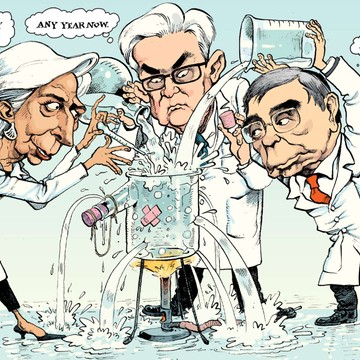
2008. Albuquerque, New Mexico. The first business meeting of what would become the best-known chemist team since Nobel-prize winners Molina, Crutzen and Rowland was not auspicious. Pinkman wanted to cook as an artist, with chili powder. White, called Pinkman's chili-p recipe -- garbage. In-turn, Pinkman dismissed White's science; all he needed was a big jar. He was actually referring to a volumetric flask, which as - the appalled chemistry teacher Mr. White responded - is for general mixing and titration you wouldn't apply heat to it. That's what a round bottom 5000 millilitre boiling flask was for. Pinkman's flasks almost certainly fractured often and leaked out.It is the metaphor of the fractured flask, the punctured pail - the leaking bucket - that Jeff Snider uses, in this the 18th episode of Making Sense, to explain why the inflationary concoction created by monetary technocrats isn't boiling over. First, we discuss why the Federal Reserve's monetization of debt isn't inflationary. Second, we review the latest inflation readings from the United States. Finally, Snider explains why the accelerating size of the US Treasury's checking account isn't inflationary either. It is all about the metaphor - technocrats and politicians pour inflationary water in yes, but not only is the bucket not a full one, ready to spill over, but it's perforated.Well, to head off a letter writing campaign, this podcaster acknowledges that a fair number of you dear listeners feel your podcasting team missed the opportunity to employ the metaphor of the leaky cauldron. To cast central bankers as a coven of warlocks preparing a witches brew of inflation. However, your podcaster prefers the analogy of the fractured flask. The technocrats style themselves as scientists, not magicians. They surround themselves with very rare 800 millilitre Kjeldahl-style recovery flasks and dynamic stochastic general equilibrium models, Griffin beakers and Erlenmeyer flasks. The tragi-comedy is that despite the scientific accouterments, they go about it in a Pinkman-like manner. Heating volumetrics, adding adulterants like yield curve control, bank reserves and chili-p.----------WHERE----------AlhambraTube: https://bit.ly/2Xp3royApple: https://apple.co/3czMcWNiHeart: https://ihr.fm/31jq7cICastro: https://bit.ly/30DMYzaTuneIn: http://tun.in/pjT2ZGoogle: https://bit.ly/3e2Z48MSpotify: https://spoti.fi/3arP8mYCastbox: https://bit.ly/3fJR5xQBreaker: https://bit.ly/2CpHAFOPodbean: https://bit.ly/3enSAkrStitcher: https://bit.ly/2C1M1GBOvercast: https://bit.ly/2YyDsLaSoundCloud: https://bit.ly/3l0yFfKPocketCast: https://pca.st/encarkdtPodcastAddict: https://bit.ly/2V39Xjr----------WHAT----------So Long As The Bucket Is Full of Holes, Treasury Demand Comes FirstTransitory, The Other WayWait A Minute, The Dollar And The Fed’s Bank Reserves Are Directly Not Inversely RelatedA General Sense of Treasury’s General Account----------WHO----------Jeff Snider, Head of Global Investment Research for Alhambra Investments with Emil Kalinowski, Pinkman. Artwork by David Parkins. Podcast intro and outro is "Full House Dusk" by River Foxcroft, at Epidemic Sound.
Jul 11, 2020 • 49min
Communism - Don't Call it a Comeback
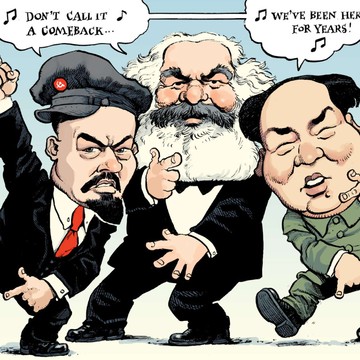
Plato, Kant, Nietzsche, Buddha, Confucius, Rousseau, Aristotle, Bastiat, Molinari, Cicero, Hegel, Hobbes, Kant... LL Cool J. The contemporary philosopher sits on the social and political branch of the Western tradition. He began releasing treatises in 1985 after collaborating with Def Jam. Radio was his first. Two years later, Bigger and Deffer. But 1989's Walking with a Panther was 'too pop-y', said the Philosophical Review. 'So much empty fluff,' pondered the British Society for Phenomenology. Dialectica wouldn't even look at it. His fourth commentary however, returned him to the top. Both the album and its most famous song were titled Mama Said Knock You Out. The single famously begins with, "Don't call it a comeback, I been here for years".Singing that tune these days are Communism, Marxism and Socialism. In this, the 17th episode of Making Sense, Jeff Snider explains how to understand their philosophy and why their recent popularity is not a comeback despite the doctrine's body of work. Marxism was never gone, it was waiting for the club of mostly wealthy nations to reach the end of their capitalist potential. Well, a thirteen year depression on par with the 19th century's Long and the 20th century's Great depressions is making a good case. So then, how to counter the argument? But that's for the back-half of the show. First, a Catch-22 like paradox in bond markets. Safe sovereign and risky corporate bonds both display falling yields. Why? We look back to the last worldwide depression for answers. Then, yield curve control. This podcaster has a feeling it'll be the must-have toy for central bankers by Christmas. We look back at the US experience with the policy during the 1940s. Then Marx, Lenin and Mao take the stage, grab the mic and start spitt'n.----------WHAT----------Don’t Low Rates On Junk Bonds Mean Fed-fueled Credit Bubble? No. Precisely The OppositeYield Cap History Is Rock Solid, Just Not At All In The Way They Are Telling YouYield Caps = ToddlersFrom QE to Eternity: The Backdoor Yield CapsSocialism Would Have Been Easy to Discredit, Had There Been GrowthBrent Johnson & Jeff Snider "Breaking Down Eurodollars" Webinar by BlockWorks GroupReddit Late Stage Capitalism Thread 549,000 Strong----------WHO----------Jeff Snider, Head of Global Investment Research for Alhambra Investments with Emilulous. Artwork by David 'Straight Outta London' Parkins. Podcast intro and outro is "Callin Shots" by Damma Beatz at Epidemic Sound.
Jul 4, 2020 • 38min
What is... Eurodollar Mailbag?
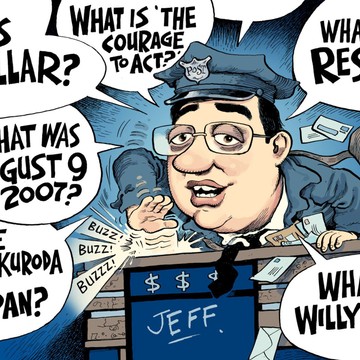
After half-a-century, some 8,000 episodes and numerous tournament of champions the American television game show Jeopardy! decided to hold its definitive contest to determine its ultimate victor. The trial featured three accomplished champions: Ken Jennings, Brad Rutter and James Holzhauer. The selection of these three remains one of sports' great scandals -- right up there with the Czechoslovakian judge in Lillehammer. The three contenders were fine, having won more than a 100 contests and $10.7 million dollars between them. That's not bad... as far as humans go. Who should have been in the tournament?The first contestant most clearly deserved to be Phil Connors. Connors, initially a Pittsburgh weatherman stuck in a time loop, eventually attained the status of god. Not the God - at least he didn't think so - but a god. And as a deity not only did Connors know every answer in "Lakes & Rivers" - What is Mexico? What are the Finger Lakes? What is Titicaca? - he knew the question before the answer was even given: What is the Rhône?The second contestant was god-like in its knowledge: Watson. The likely forerunner of HAL-9000, this question-answering computer system already beat both Jennings and Rutter in an exhibition match for a million dollars. A eurodollar realist and having no use for a pyramid of physical bills, Watson promptly set the money alight and was heard walking off stage saying, "It's not about the money - it's about sending a message."The third contestant inhabits that shimmering space between reality and myth called "legend": Clifford C. Clavin, Jr. The part-time Boston-area mailman and full-time bar patron appeared on Jeopardy! in 1990, where he feasted on the categories like a walrus in a bed of bivalve mollusks, which is the mammal's preferred food you know. "Civil Servants", "Stamps from Around The World", "Mothers and Sons", "Beer", "Bar Trivia", "Celibacy".It is in the spirit of these latter three - as legend, as eurodollar realist, as living through a monetary time-loop - that Jeff Snider confronts listener questions in a Jeopardy!-style show in this, the 16th episode of Making Sense.----------WHAT----------Alhambra Investments BlogRealClear Markets EssaysYield Cap History Is Rock Solid, Just Not At All In The Way They Are Telling You----------WHO----------Jeff Snider, Head of Global Investment Research for Alhambra Investments with Emil Kalinowski, the Vanna White of Eurodollar Jeopardy! Artwork by the Phil Connors-like, preternatural David Parkins. Podcast intro and outro is "Come 2gether" by Ooyy at Epidemic Sound.
Jun 27, 2020 • 47min
Hey Kid, Want Some Communism?
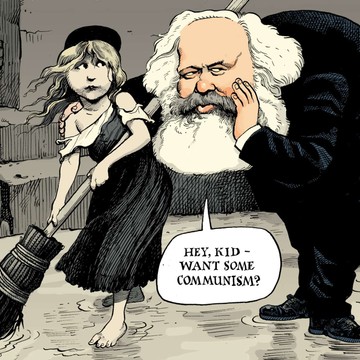
Published in 1862, Les Misérables by Victor Hugo is "the novel of the century" according to David Bellos, professor of French and comparative literature at Princeton University. When asked on The Great Books podcast what qualifies this novel to be on the show Bellos responded, "It tackles a huge range of human experience, with an enormous amount of passion. If there ever was a great book, it must be Les Misérables." The story focuses on 'the suffering ones', 'the humiliated'. It's set in the social, political and economic upheaval of early-nineteenth century France. 'The poor people who are worthy of our pity' were caught up in the consequences of what Jeff Snider calls the first modern business cycle. Michael Pettis, in his 2001 book The Volatility Machine, identifies it as the first modern deglobalization. And Friedrich Engels called it "the first general crisis". Engels is, of course, the co-author of the Communist Manifesto, published in 1848 in response to the shocking, worldwide disorder. Karl Marx and Engels are said to suggest that capitalism has an expiration date; that capitalism was an ahistorical phenomenon which would burn up the limited fuel of labor and then sputter. And at that point communism would take over and redistribute the existing wealth equitably because there was a limit to human wealth creation.This, over the long sweep of history, is a pessimistic view of human character and potential. But humans don't live across history, they have a handful of decades. And when capitalism does find itself in a cul-de-sac as it did during the first general crisis, and the Long Depression, and the Great Depression and now this -- Year 13 of the Silent Depression, well then terminal capitalism sounds perfectly reasonable. In this the 15th episode of Making Sense, Jeff Snider discusses the barricades and autonomous zones of Les Misérables, Marx and Engles' thesis, late-stage capitalism, the Soviet Union, and present-day China; but all in defense of capitalism without denying that it's going down the wrong road -- toward the barricades.----------WHERE----------Apple: https://apple.co/3czMcWNiHeart: https://ihr.fm/31jq7cICastro: https://bit.ly/30DMYzaTuneIn: http://tun.in/pjT2ZGoogle: https://bit.ly/3e2Z48MSpotify: https://spoti.fi/3arP8mYCastbox: https://bit.ly/3fJR5xQStitcher: https://bit.ly/2C1M1GBOvercast: https://bit.ly/2YyDsLaPocketCast: https://pca.st/encarkdtPodcastAddict: https://bit.ly/2V39Xjr----------WHAT----------The Economic Boom You Heard About Never Really Was A Massive Problem That Has Them Searching For One----------WHO----------Jeff Snider, Head of Global Investment Research for Alhambra Investments with Emil Kalinowski, manning the barricades in the CHAZ (Cayman Highball Armorik Zone). Artwork by David Parkins, a modern-day Émile-Antoine Bayard. Music track "The Ministry" by Howard Harper-Barnes at Epidemic Sound.
Jun 20, 2020 • 50min
Reading Tea Leaves
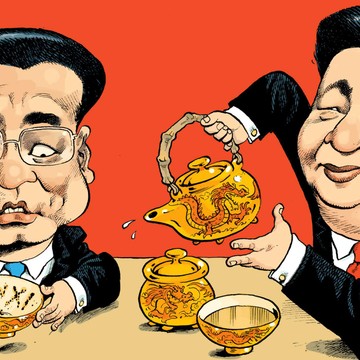
Your podcaster shunned traditional university education and instead sought a guild apprenticeship. Drawn to parapsychology and the occult even as a sma' one, it was natural this podcaster's inclinations were in alchemy, phrenology, gryphography, cryptozoology and economics. However, The Inquisition and Salem Trials had somewhat narrowed opportunities in these first options; opportunities which are now reserved for only the most gifted. With an aptitude optimistically scored by one high-school counselor as "average", your podcaster nevertheless found a welcome home in economics. That field was supplemented with a minor in tasseomancy.Sometimes called tassology or tasseography, it's the study of tea leaves for the purposes of divination, fortune telling and interpreting the political economy of China. Yes, any economist can tell you about last month's results for industrial production, retail sales and fixed asset investment. And Jeff Snider does, in this the fourteenth episode of Making Sense. We first steep and then drink West Lake's famous Dragon Well tea while discussing April's Treasury International Capital report, the echoes of 2013 and the Oktoberfest-in-June-like optimism of German Financiers. But then conversation turns to the political intrigue surrounding President Xi and Premier Li. Peering inside our porcelain cups the upward strokes of the leaves indicate a stabilized GDP level. The flourishes on the lower zone denote meticulous, yet highly creative accounting. But if one observes the overall slant and the pressure of the leaves there's a suggestion of acute overcapacity, a complete lack of recovery, and a pronounced inclination toward stagnation.If the monetary shadows are your fancy then the next time someone asks, 'Would you care for some tea or coffee? Something stronger perhaps?' - you know what to say.----------WHAT----------Still TIC’ed Off In The Shadows In AprilWhen Sentiment FliesA Chinese Outbreak (of Li v. Xi, Round 2)----------WHO----------Jeff Snider, Head of Global Research at Alhambra Investments with Emil Kalinowski, who prefers his tea by leaf not by the bag. Artwork by the Yellow Mountain Fur Peak of the paintbrush, David Parkins. Song "Asian Fork Fight" by Lenzer at Epidemic Sound. Apologies to Michele Mulroney and Kieran Mulroney, screenwriters for Warner Bros' Sherlock Holmes: A Game of Shadows.
Jun 12, 2020 • 38min
The Great Portnoy
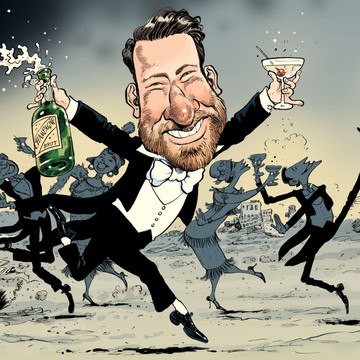
Upon its release the book was met with popular indifference. And no wonder. A cautionary tale about indulgence, extravagance and social upheaval? Right into the racing heart of the Roaring Twenties and its cloche hat wearing flappers, smoking Lucky Strikes and listening to jazz? No thanks. When Fitzgerald asked his editor about the book's reception he was told, "Sales situation doubtful, but excellent reviews." The author, in response, closed with, "Yours in great depression." It wasn't until the consequences of the Great Depression that the book achieved the acclaim it holds today. Only in retrospect did perception resonate with plot. Only in retrospect did the era seem an empty phantasm.Our own 'Roaring Twenty' has no such excuse. Unlike 1925 when economic depression was five years in front of those enormous yellow spectacles, our economy is 13 years in Daisy's rear-view mirror -- run over, killed. But you wouldn't know it if your radio was tuned to the business network. When it was reported in early June that the US economy unexpectedly added 2.5 million jobs for the month of May it set off an orgy of dip buying, lest there be no dip left to buy. David Portnoy, the Gatsby of our day and host of this stock market party leaves the invitation open to all via livestream and will tell you stocks only go, "Up! Up! Up! Up! Up!"In this episode we discuss how even establishment-economist forecasts -- forecasts in which the economy runs pure -- implicitly anticipate a worse experience than 2008. An experience from which the world never recovered; not really. In this episode we emerge from sheltering in place and survey the landscape. We see the Great Portnoy, hosting an elaborate party, in the Valley of Ashes.----------WHEN----------00:32 US Employment | Establishment / Household Survey02:52 US Employment | Initial & Continuing Jobless Benefit Claims04:59 US Employment | Economically Unemployed vs. Exogenous Shock Unemployment12:51 World Economy | Consensus Two-Year Outlook for GDP 16:38 World Economy | The OECD W-Shaped Recovery Doesn't Factor in a Second Economic Wave19:04 World Economy | World Bank Forecast as Warning that V is very L22:09 US Consumers | Revolving Consumer Credit Being Extinguished by Consumers27:22 US Yield Caps | Talk of Yield Curve Caps and What About Yield Curve Control in Japan32:01 US Yield Caps | World War II Experience with Yield Curve Ceilings35:31 World Economy | The Worst is Behind Us Now We Survey the Damage----------WHAT----------What Did Everyone Think Was Going To Happen?This Thing Is Only Getting Started; Or, *All* The V’s Are Light On The RightAttention All “V” PeopleA Second Against Consumer Credit And Interest ‘Stimulus’OMG The 30s!!!From QE to Eternity: The Backdoor Yield Caps----------WHO----------Jeff Snider, Head of Global Research at Alhambra Investments with Emil Kalinowski, someone that's not invited to the party. Artwork by David Parkins, the Francis Cugat of our Roaring Twenties.
Jun 5, 2020 • 43min
Mailbag
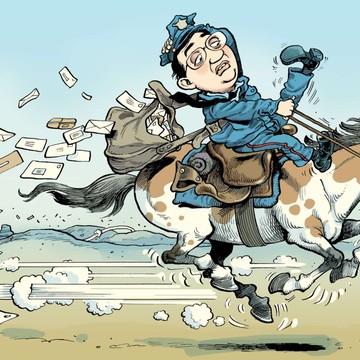
Legendary figures took on the mantle of "Mail Carrier!" including: founding father Benjamin Franklin, Wells Fargo cowboys of the Pony Express, and nice guy Mr. McFeely from Mr. Rogers' Neighborhood. In more recent decades the profession saw its reputation sullied. Represented at one end of the spectrum by the austere, virginal, trivia-oracle Clifford C. Clavin, Jr. and at the other end the covetous and lurid Newman.But in this episode of Making Sense, Jeff Snider endeavors to bring back the profession's good name, just like Kevin Costner did in The Postman, a 1997 escapist fable about a post-Apocalyptic America that begins to find its soul thanks to a mailman. The film takes on a more documentary-like tone these days. Snider as itinerant nomad, wandering the dystopian monetary order delivering long lost answers to bewildered people asking why -- in a world where a smokey haze obscures the horizon -- oil is more valuable underground and stock prices are lighter than air. "Why? Why?! Why!"Sure, Rotten Tomatoes gave The Postman an 8 percent rating with one reviewer thinking, 'Relative to this, Waterworld is Citizen Kane.' Well, this podcaster disagrees and gives the movie 100 percent for British actress Olivia Williams alone.Is the US Treasury deluge good? Are banks opting out of the game? What's the deal with foreign central banks and their dollar reserves? Can the banking system function without central bank reserves? Why buy lower-yielding sovereign debt from Europe or Japan instead of the US Treasury? How to animate reserves? Should we add asset managers to the Primary Dealer pool? Is inflation low due to Chinese goods? Why is the Federal Reserve buying mortgage backed securities? Is it a violation of the Federal Reserve Act to buy risky assets? Why is the S&P500 exploding higher? Why was there inflation in the 1970s?WHATAlhambra InvestmentsRealClear MarketsMetals & Markets BlogWHOJeff Snider, Head of Global Research at Alhambra Investments with Emil Kalinowski, not mailman material. Artwork by David Parkins, il primo ballerino of the colored pencil.
May 29, 2020 • 37min
The Worst V Since "V"
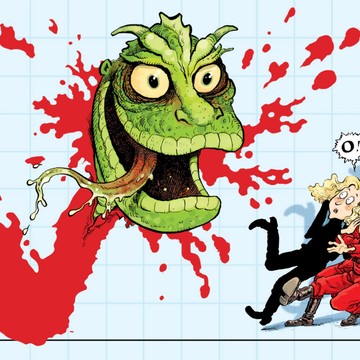
In the mid-80s parents allowed their children to watch an innocent-looking television program titled V thinking it was some kind of Sesame Street offshoot. Imagine little Johnny and Suzy Q's horror when, instead of Reading Rainbow, they were watching a sci-fi melodrama about disguised reptilians. The Visitors, presenting themselves as competent, benevolent beings here to teach the backwards ape a few things, were hiding behind masks -- including their beautiful smokeshow of a leader Diana -- and had actually come to harvest Earth's water and snack on humans. A sophisticated allegory about economists? Perhaps...The mini-series had been the reigning champion of "Worst V of All Time" until the 2007-09 financial crisis, which sent the global economy off its post-World War Two trend. Unlike all downturns since 1945, this one was different in that a plurality of economies representing a majority of global gross domestic product never regained their pre-crisis trend growth. The V-shaped recovery that three generations had come to take for granted turned out to be a grossly misshapen, lizard-like L that was visible beneath the mask of positive numbers in all manner of broad economic accounts, including: global foreign direct investment, world merchandise trade, the 35-country Organisation for Economic Co-operation and Development industrial production index, etc.In this eleventh episode of Making Sense, Jeff Snider, Chief Investment Officer of Alhambra Investments (and Resistance Leader) explains why 2020 may surpass the intergalactic reptiles AND dethrone 2007-09. We review the US Congressional Budget Office's very un-V forecast through 2021, estimate in trillions the depth of the contraction in the US, put into context Washington D.C.'s inadequate-sized stimulus and review the Euro Area's broad survey of economic confidence.No iguanas were hurt in this episode.WHATGetting A Sense of the Economy’s Current Hole and How the Government’s Measures To Fill It (Don’t) Add UpThe *Optimists* Have Some Terrible News For the ‘V’What Would The Hole Be Without The ‘L’?What Flood?WHOJeff Snider, Head of Global Research at Alhambra Investments with Emil Kalinowski, still working on his ABCs. Artwork by David Parkins, mammal.
May 22, 2020 • 39min
Stock Magiq
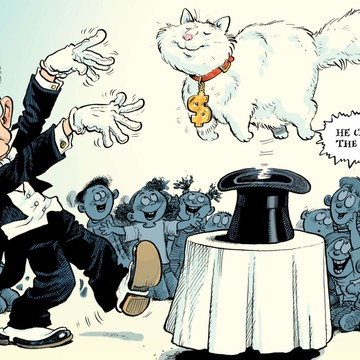
We are informed by the financial press the agitated creation of reserves are, to capital market participants, a mix of whiskey and Felix Felicis; liquid courage and luck. The first manifestation of the wealth effect, which will encourage households to consume and corporations to invest. The financial market animal spirit. The economist's Patronus Charm. But what did the Federal Reserve do - and more importantly not do - in 1929, 1987 and throughout 2008-20 to support US stock markets? When was there a direct link between bank-created money and the stock market? And when was there nothing more tangible than "expectations policy" - the modern equivalent of the warlock's frantic charms, hexes, jinxing and spell-casting? Also, Federal Reserve Chairman Jerome Powell was interviewed on the American news program 60 Minutes this week. He said, the Fed saw the market meltdown coming, that the central bank increased money supply - he says they can print 'real' money too, you know - that there's no limit to what they can do to support the economy (and also that the said economy may not 'get back to zero' until the end of 2021). We review the interview by pointing out what the smoke is obscuring, where the mirrors have been placed, and discuss how "theatricality and deception are powerful agents to the uninitiated." WHATStocks Haven’t Been MoneyedThe Reason For So Many Lies: He Finally Realizes He’s In Way Over His HeadWHOJeff Snider, Chief Investment Officer of Alhambra Investments with Emil Kalinowski, a physical (precious metals) man; artwork by David Parkins, sculptor of the color wheel.
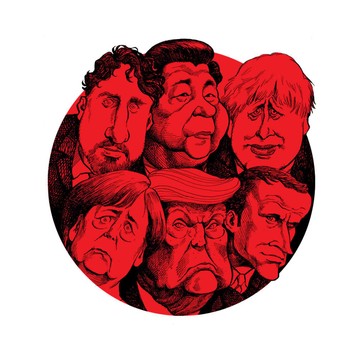
May 15, 2020 • 33min
Japanification
It is often said that there is, "nothing new under the sun", and with a few exceptions (e.g. negative nominal interest rates, negatively priced oil, TikTok) that is true, even with a monetary gewgaw like quantitative easing. Japan, so as to revive its economy, has been implementing different flavors of QE for just under two decades now (that's all one really needs to know about its effectiveness). In this episode we explore what lead up to the first QE program with a tour guide: Milton Friedman.What was Friedman's analysis of 1970-90 from the perspective of money supply and economic activity? How did the Bank of Japan seemingly lose its way during the 1990s when it had 'got it all right' during the 70s and 80s? Why did Friedman believe that QE would be the solution? Why did the Japanese bond market disagree from the get-go? Why is a sovereign bond market important anyway? Why do low rates - not high - signal monetary tightness and vice versa? On the other side of the Pacific, in late 2001, with the Good Ship Q.E. having already been launched, researcher Mark Spiegel from the Federal Reserve Bank of San Francisco raised a critical question: what if private banks don't want to put this newly 'printed money' to work? In Japan that question has remained unanswered for two decades. In the United States and Europe? Over a decade. Is it a matter of difficulty or ideology that impedes the answer? We believe it is the latter.WHATThere Was Never A Need To Translate ‘Weimar’ Into Japanese by Jeff SniderReviving Japan by Milton FriedmanQuantitative Easing by the Bank of Japan by Mark SpiegelA Tally of 23 Japanese QEs by Jeff SniderWHOJeff Snider, Chief Investment Officer of Alhambra Investments and Emil Kalinowski, not bad at fantasy football. Artwork by David Parkins, curator of the illustrated aesthetic.

