

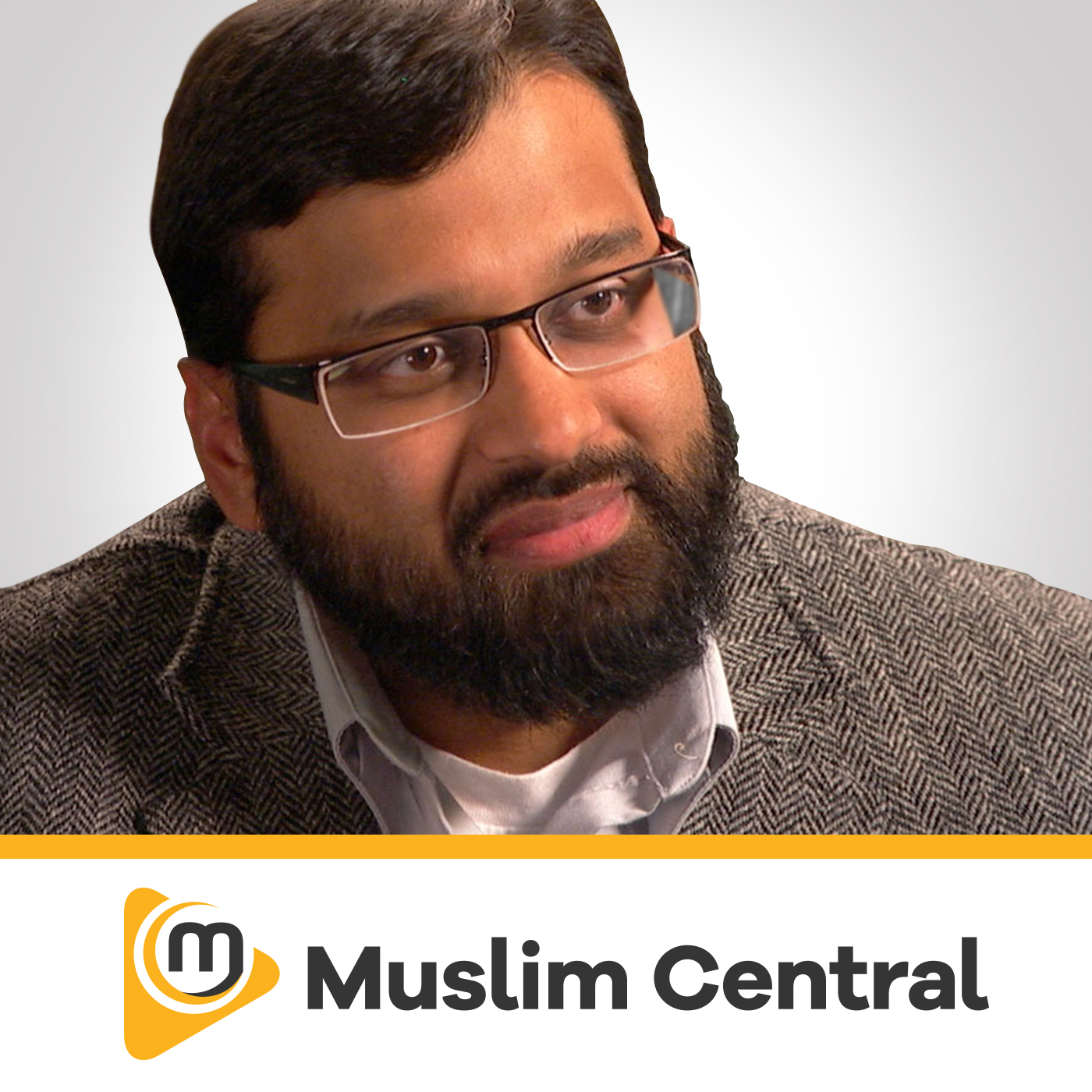
Yasir Qadhi
Muslim Central
Yasir Qadhi was born in Houston, Texas and completed his primary and secondary education in Jeddah, Saudi Arabia. He graduated with a B.Sc. in Chemical Engineering from the University of Houston, after which he was accepted as a student at the Islamic University of Madinah.
After completing a diploma in Arabic, he graduated with a B.A. from the College of Hadith and Islamic Sciences.
Thereafter, he completed a M.A. in Islamic Theology from the College of Dawah, after which he returned to America and completed his doctorate, in Religious Studies, from Yale University. Currently he is teaching at Rhodes College, in Memphis, TN.
After completing a diploma in Arabic, he graduated with a B.A. from the College of Hadith and Islamic Sciences.
Thereafter, he completed a M.A. in Islamic Theology from the College of Dawah, after which he returned to America and completed his doctorate, in Religious Studies, from Yale University. Currently he is teaching at Rhodes College, in Memphis, TN.
Episodes
Mentioned books

Aug 11, 2013 • 1h 17min
Seerah 05 Genealogy & Year of The Elephant
In this video, Shaykh Dr. Yasir Qadhi elucidates in immense detail the genealogy of the Prophet ﷺ, the incident of the discovery of Zamzam and the Year of the Elephant.
As many as 20 generations can be traced back in the name of our Prophet Muhammad bin Abdullah bin Abdul-Muttalib bin Hashim bin Abd Manaf bin Qusai bin Kilab bin Murah bin Ka'ab bin Lu'ay bin Ghalib bin Fihr bin Malik bin An-Nadr bin Kinanah bin Khuzaimah bin Mudrikah bin Ilyas bin Mudar bin Nizar bin Ma'ad bin Adnan. Nobody had a more noble and prestigious lineage than our Prophet ﷺ.
Details are divulged of the various generations and special names are highlighted to understand the essence of these names.
The three important events that transpired in the lifetime of Abdul Muttalib are next in the line of discussion. Also, his family is mentioned by way of the names of his children.
The story of the lineage of the Prophet ﷺ proves without an iota of doubt that something momentous was to follow and every person in the lineage of the Prophet ﷺ provides momentous value whether it is economic or political or monumental discoveries.
A hidden symbolism is also made to ponder on with the protection of the Ka'bah in the context of the story of the year of the elephant and how in all retrospection it was the Prophet ﷺ that Allah was protecting who was inside the Ka'bah in the womb of his mother Amina RA.
Aug 11, 2013 • 1h 18min
Seerah 04 Religious Status of the World before Islam
In this video by Shaykh Yasir Qadhi, we gather insight on the religious status of the world pre-Islam and before the advent of Prophet Muhammad ﷺ. The reason behind this need is that we will appreciate the Prophet ﷺ more if we see the pre-Islamic Jahiliyyah.
When and where did paganism begin? How did idolatry come into being? Who were the exceptions to the norms of idolatry? Shaykh Yasir Qadhi answers these questions impeccably and with utmost clarification.
The story of Naailah and Assaf on Mount Safa and Marwa is another interesting addition to show the extent of Jahiliyyah. Shaykh Yasir also delves into the three major strands of Christianity. The story of Salman Al Farsi makes for a very morally enriching experience - whoever is sincere will be rightly guided if their heart is pure.
We are also astonished and wonder how Waraqah bin Naufal, Uthman bin Al-Huwairith, Zayd bin ‘Amr and Ubaidullah bin Jahsh managed to keep away from paganism even in the wake of mass herd mentality of the people then. An interesting listen , so please do not miss it.
We also get answer to the question - who was the one man ummah without any Prophet ?
Get answers to all of our most pertinent questions concerning idolatry and paganism.
Aug 11, 2013 • 1h 9min
Seerah 03 Why Study The Seerah and Pre Islamic Arabia
In this lecture in the Seerah of the Prophet ﷺ, Shaykh Yasir Qadhi attempts to unravel the actual meaning of Seerah and what is its significance. We are also acquainted with the innumerable benefits of the Seerah or why we should study the Seerah.
Firstly, Allah has commanded us to know the Prophet ﷺ and hence, primarily the one way to increase the love for the Prophet ﷺ and to demonstrate our love for him can only be made possible with the detailed understanding of the Seerah. Without it, we cannot also attempt to appreciate the Qur'an and follow the Noble Book in all earnestness ever. We can always defend the Prophet ﷺ by studying the Seerah.
Where does one study the Seerah from? What are the sources of Seerah? The number one source of the Seerah is inevitably the Noble Qur'an, the second is hadith and third has got be from the chain of narrators (isnad) - Ibn Ishaq and Ibn Hisham.
Pre-Islamic Arabia is the next subtopic in this amazing lecture on which light is shed upon and explicit details have been provided to have a clear indication of the genealogy (for instance, the types of Arabs) and it is advised to listen intently and be educated immensely.
Aug 11, 2013 • 1h 8min
Seerah 02 Specialities of Prophet Muhammed Part 2
As the series continues, we join Shaykh Yasir Qadhi in his quest to divulge ample details on the physical appearance of the Prophet ﷺ which was an amalgamation of perfect mannerisms and images.
We are acquainted with various statements made by the Sahabas attempting to describe his physical attributes. Ka’b ibn Malik compares the Prophet ﷺ to a full moon while Ar-Rubayya compares him to the rising sun. Amr ibn Al-A’as RA says that there was nothing that was more sweeter and beloved to him than to stare at the face of the Prophet ﷺ. He also mentions that along with this desire to stare at him there was also this awe and reverence that he had to lower his face.
The spiritual characteristics emanating from the Prophet ﷺ were no less in magnitude and stature. Exudance of humility, modesty, bravery, generosity, impeccable manners, a great sense of humour showing humanity was what came naturally to the Prophet ﷺ and was mesmerising to the people around him which has been indicated in various accounts. He was an embodiment of dignity and composure in the face of hardships, conflicts and calamities.
We also realise the extent of the love of the Prophet ﷺ for his Ummah and how he sacrificed his dua for his Ummah and how he would utilise it at the right time.
May Allah SWT bless us with possessing genuine love for the Prophet ﷺ.
Aug 11, 2013 • 46min
Seerah 01 Specialities of Prophet Muhammed Part 1
As the Seerah of the Prophet Muhammad ﷺ commences, we embark alongside Shaykh Yasir Qadhi to concentrate on the life and times of the greatest human being to have ever walked on the face of earth.
Some of the broad characteristics of the Prophet ﷺ, the Shama'il (the appearance) and the Khasa’is unique and specific characteristics only attributed to him) will also be discussed at length and one is surely left mesmerised and wanting to know more. The stature of this great man is gathered and understood with evidences of how Allah SWT name and the Prophet ﷺ name is always mentioned together.
As many as 250 names have been given to him such as Muhammed, Ahmad, Mahi, Aqib and many more. No one is more praised more than him. When will the ultimate form of praise be given to him? What is Maqam al Mahmud? Shaykh Yasir answers these questions explicitly.
Details are also divulged on how the names of the Prophet ﷺ - Muhammad and Ahmad - are used to signify different meanings and what is the context in which they are used.
Of the innumerable Khasais of our Prophet ﷺ are that- he is the final Prophet of Allah, he has been given the largest Ummah among all the Prophets, the powerful miracle of the Quran has been given to him, the miracle of Isra wal Miraj, blessed with the highest level of Jannah and many more.
Do listen intently to get acquainted with the Prophet ﷺ.
Aug 1, 2012 • 1h 4min
A Critical Analysis of Shirk Part 1 of 2
Shaykh Yasir Qadhi divulges information on the topic of Shirk and provides a critical analysis of Shirk in immense detail.
The topics that are brought to the fore are basically related to the theoretical implications of Shirk and a vast canvass of thoughts are discussed.
The Qur'an is quoted in various parts of the lecture to help us achieve a clear understanding on the topic of Shirk and what it means to indulge in the same in the light of Islam.
Aug 1, 2012 • 2h 3min
A Critical Analysis of Shirk Part 2 of 2
Shaykh Yasir Qadhi discusses the categorization of Shirk in a practical manner which is most apt to benefit us.
The topics discussed here are -
The Definition Of Shirk.
The Dangers Of Shirk.
Categories Of Shirk- Major and Minor
Tawheed Preceded Shirk.
The Futility Of Shirk - how the Qur'an, Sunnah, Aql and Fitrah demonstrate the same.
The Most Important Reasons For Shirk.
What Is The Ruling On The Person Who Commits Shirk.
The Most Important Evidences Used To Justify Shirk.
Aug 1, 2012 • 47min
Dua [The Weapon of The Believer] Part 01 of 04
Shaykh Yasir Qadhi sheds light on the topic of Dua being the weapon of the believer. He has also compiled a book on the same topic which can be read for interesting insights.
In this lecture, we are acquainted with the meaning of Dua, the types of Dua, the categories of people making Dua and the status and blessings of Dua.
What is Dua? Linguistically, Dua means to call out. In the Shari’ context, Dua means to request and implore Allah for something that is of benefit or that some calamity be removed or prevented. Dua is a form of worship. It is the essence or crux of worship depicting a clear sign of one’s Iman.
The types of Dua are - Dua Ul Mas’alah (Dua of asking) and Dua ul Ibadah (Dua of worship). These types are familiarized to us in explicit fashion and is truly enlightening.
The categories of people who do Dua:
Reject both types of dua
Do dua ul ibadah but reject dua ul Mas’alah.
Do dua al Mas’alah but don't do dua ul ibadah.
Do both Dua al mas’alah and Dua Ul Ibadah.
Status and blessings of Dua:
Dua is the most noble and best act of worship in the eyes of Allah.
When we make Dua, we obey Allah’s command.
The one who makes Dua makes Allah close to him.
Allah cares and loves us because of our Dua made to him.
It is a sign of Allah’s generosity.
Every single Dua will be responded to by Allah.
Dua is the weapon of the weak and the oppressed.
Aug 1, 2012 • 1h 42min
Dua [The Weapon of The Believer] Part 02 of 04
Shaykh Yasir Qadhi now moves on to discuss at length about the preconditions of Dua, the etiquettes of Dua and the acts that are disliked during Dua.
Some of the preconditions of Dua are as follows:
The realisation that only Allah responds to the Dua we make.
Sincerity in Dua to Allah alone.
To perform Tawassul properly.
Dua for things that are good and to have good intentions.
Prayer upon the Prophet ﷺ.
That the Dua doesn't interfere with something important.
Some of the etiquettes of Dua :
Praising Allah SWT before the Dua and praying upon the Prophet SAW.
Raising one’s hands while making Dua.
Facing the Qiblah
Performing Wudu.
To expect the best from Allah.
To pray with humility and fear and to complain only to Allah.
To say Aameen.
Some of the acts that are discouraged during Dua:
Poetry in Dua.
Transgressions in Dua.
To pray for matters of this world only.
Dua to expedite punishment.
Dua for evil and hastiness in Dua.
To imply that one will not ask anything else.
To look upwards while making Dua.
To rely on others to make Dua.
Aug 1, 2012 • 1h 3min
Dua [The Weapon of The Believer] Part 03 of 04
Shaykh Yasir Qadhi extrapolates for us the recommended timings of Dua, the factors that increase and decrease the chance of getting a Dua accepted.
The recommended timings of Dua:
Dua in the last third of the night.
Dua when the Adhan is called.
Dua between the Adhan And the Iqamah.
Dua while prostrating.
After Al Fatihah.
Dua during the Night of Decree.
Dua at Safa and Marwa.
Dua on the Day of Arafah.
Conditions during which Dua is answered:
The person who has been wronged.
The one in severe circumstances.
After a calamity.
The traveller.
The father against or for his son.
The one who is fasting or performing Hajj, Umrah or Jihad.
The factors that increase the chances of a Dua being answered:
Utmost sincerity and expecting the best from Allah.
Doing good deeds and fulfilling the rights of the parents.
Repenting from previous sins.
Dua at holy places.
Humility
The factors that decrease the chances or prevent the Dua from being answered:
Haram Sustenance
Sins
Being hasty and becoming tired.
Asking for something prohibited.
Abandoning the etiquette of Dua.

